Awakening Dragons

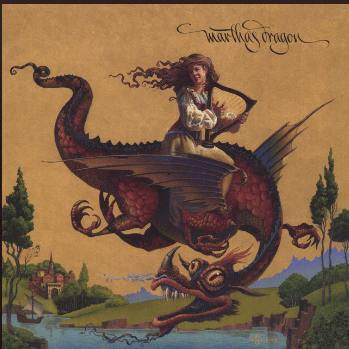
Album cover of “Martha’s Dragon” by Cantiga on Spotify. If you know the artist, please let me know! I have been unable to track them down.

In the fairy tale, the myth, the religious text, the story: there are two sisters, one dark and one light, one radiant and one beastly, one beautiful and one ugly, one pure and one profane. Sometimes, perhaps often, they are the same woman, two halves. As the patriarchy tells it, the pure one is malleable and tractable, dutiful and kind and good. She is holy, as long as she is holy, and then she is the Other One. The Other sister is wayward, deranged, defiled, dirty, and dangerous. She is likely a prostitute. She may be possessed of demons.

Think Eve and Lilith. Eve was the pure one. Until she wasn’t.

Think Isis and Nephthys.

Think Inanna and Ereshkigal.

Think beautiful Helen and avenging Clytemnestra.

Think Mary and Martha of Bethany. And these two are interesting, in their dance between the poles of acceptability and disgrace. Mary of Bethany (my friend says we need a book of Mary for Dummies, there are so many Marys) is the sister of Martha and Lazarus. But even that is in dispute. Some scholars look at references to Martha and some modifications on the initial scroll that indicate even this dyad was perhaps one person. As the story is most often told, however, they’re two women, who with their brother Lazarus are best friends of Jesus. Mary sits at the feet of Jesus and receives his blessing for it. Martha asks Jesus to get Mary to help him, and is lightly scolded for it. Mary the contemplative, Martha the scold. Martha the dutiful, Mary the shirker. Things get interesting when you read the scholarship that suggests that Mary was the same person as Mary Magdalene, the best best friend of Jesus. Although there is almost no evidence that the following is true, this Mary carries the legend of being a prostitute, who hosted seven devils that Jesus cast out of her. Even to tell this story, I am conflating Marys, allowing the confusion about Mary the sister of Lazarus, Mary the sister of Martha, and Mary Magdalene to stand.

More lore: In the Catholic folklore of the French countryside, when the Marys (who knows which ones?), Lazarus, St. Sara (daughter of one of the Marys and probably Jesus) and maybe Joseph of Arimathea, set sail on the Mediterranean to escape persecution, they end up on French beaches. It could happen. It is also a convenient way for European folks to transport the sacred stories of their Middle Eastern-centered faith to their own lands. In the legend, Mary Magdalene (Bethany) lived out her life in a grotto-cave that you can still visit today. Martha lived in a seaside town that was beset by a dragon named Tarasque, who was in the habit of eating people. The villagers appealed to Holy Martha, who sprinkled Tarasque with holy water and tamed the ferocious beast. She walked the tamed creature into the town, where the villagers attacked it with sharp spears and killed it, poor thing.

St. Mary the radiant lives a holy hermit life in the mountains. Her sister St. Martha takes the more practical and worldly life and tames a dragon.

So here is where I pick up the story. Mary and Martha, radiant and beastly sisters, both with Mar- as their name-root. Mar, meaning “of the sea,” meaning “bitter,” meaning “beloved.” Maybe the pairing is too convenient. Perhaps I am creating something that isn’t there. But that’s the thing about stories. They become ours as we pick them up and work with them. The Keepers of the Patriarchy have been using these stories for their own purposes for centuries: Women, be dutiful, be pure, be careful, be attentive, be hard workers, be pure. For if you aren’t, you are that Other One. And even if we look at this story with a metaphorical psychological lens, we see Martha taming the dragon. Does the dragon represent women’s sexuality, power, passion, drive? Good old Martha tamed that stuff right out of Tarasque, enough that the righteous spears of the village could destroy the fearsome thing.

But if we look at this story as we do fairy tales, uncovering the layers of religious and psychological patriarchy, we see a sister who devoted her life to contemplation, and a sister who engaged with dragons. We can look at Martha outside of the realm of a woman who works with the patriarchal village structure to tame dragon-nature, but as a woman who engaged with dragons, who awakens dragons. I know it feels like the opposite of the Tarasque story, but it feels like something is more deeply embedded here, that practical Martha is one who tends to the dragons, like the Tarasque story both hides and encodes something essential about this shadowy sister of the radiant contemplative. Think Martha the Dragon Whisperer, Martha the Tender of Dragons.

I’m seeking to reawaken my own dragon, the passion and fire and fierceness that I know was a part of a younger me, a past self (either in this life or lives previous), that I know is part of the birthright of women, and of my own family line (although it is sometimes hidden in those genetic spirals). I’m grateful to my friend Chris and her references to Sharon Blackie’s talk about dragons in Hagitude for leading me to the lair of the dragons.

I love the image from the cover art of Cantiga’s album “Martha’s Dragon,” where the saint rides the dragon in a joyful spiral rather than taming it for slaughter. Perhaps I will ask St Martha to help me awaken and tend to my own wild and fierce inner dragon, so I may find both my fire and my flight.


Gratitude List:
1. Following the fire in a story
2. The thoughtfulness, professionalism and good-heartedness of my colleagues
3. Grey as it is, I know that the light is returning
4. Making new habits
5. So many good books!
May we walk in Wisdom!


“If you want to change the world, you have to change the metaphor.” —Joseph Campbell


“Find ecstasy in life; the mere sense of living is joy enough.” —Emily Dickinson


“Adults keep saying: ‘We owe it to the young people to give them hope.’ But I don’t want your hope. I don’t want you to be hopeful. I want you to panic. I want you to feel the fear I feel every day. And then I want you to act.

“I want you to act as you would in a crisis. I want you to act as if our house is on fire. Because it is.” —Greta Thunberg, 16-year-old Swedish climate activist


“Create your community. Be good to each other. And do not look outside yourself for the leader.” —Dr.Clarissa Pinkola Estes


“The opposite of death is not life. The opposite of death is birth. Life has no opposite.” —Eckhart Tolle


“Compassion is a lifetime business. You can’t say something like, ‘I will have compassion on Monday, Thursdays and Fridays only. But for the rest, I will be cruel.’ That is hypocrisy.” ―Israelmore Ayivor


“Stop being horrible in the name of God.” —John Pavlovitz

Good Words to Begin the Year

One of my beloveds nearly died this past summer. I’m not being over-dramatic about that. It was touch and go with his first treatment for his lymphoma, whether his failing liver and kidney function could support the clean-up work of the immunotherapy and chemo. I felt Death hovering in the corners of the room, thought I could see the shadowy and bright forms of his escorts from realm to realm.

Today, the oncologist gave us some glorious words: “complete remission” and “probably a cure.” I still don’t know how to articulate the joy of this. It’s a moment to pause in the glorious rays of morning sun and whisper hallelujah.


Gratitude List:
1. Those miracle words of such great relief: “complete remission,” “probably a cure”
2. Trusting that excellent substitutes can take my classes for two days while I finish my Covid isolation
3. A warm house
4. Patty Griffin’s song, “Mary”
5. Words! So many words!
May we walk in Beauty!


“Brew me a cup for a winter’s night.
For the wind howls loud and the furies fight;
Spice it with love and stir it with care,
And I’ll toast our bright eyes,
my sweetheart fair.” —Minna Thomas Antrim


“How do we go on living, when every day our hearts break anew? Whether your beloved are red-legged frogs, coho salmon, black terns, Sumatran tigers, or fat Guam partulas, or entire forests, mountains, rivers, lakes, or oceans, or the entire planet, the story is the same, the story of the murder of one’s beloved, the murder of one’s beloved, the murder of one’s beloved.” —Derrick Jensen


“The Work. I am learning, slowly and in tiny little ways, to stop asking myself what I can get from each moment, but instead what my Work is here in the moment. And realizing, ever so dimly, that when I am really doing my Work (really doing my Work), I am also receiving what I need.” —Beth Weaver-Kreider


“And now we welcome the new year, full of things that have never been.” ―Rainer Maria Rilke


“The best way to predict the future is to create it.” —Peter Drucker


“There is nothing in a caterpillar that tells you it will be a butterfly.” —Margaret Fuller


“For last year’s words belong to last year’s language. And next year’s words await another voice. And to make an end is to make a beginning.” —T.S. Eliot


“So my mind keeps coming back to the question: what is wrong with us? What is really preventing us from putting out the fire that is threatening to burn down our collective house? I think the answer is far more simple than many have led us to believe: we have not done the things that are necessary to lower emissions because those things fundamentally conflict with deregulated capitalism, the reigning ideology for the entire period we have been struggling to find a way out of this crisis. We are stuck because the actions that would give us the best chance of averting catastrophe—and would benefit the vast majority—are extremely threatening to an elite minority that has a stranglehold over our economy, our political process, and most of our major media outlets.”
― Naomi Klein

WORDHOARD

I said I wasn’t going to choose a specific word or theme for this year because I had so many words I wanted to work with, and that in itself became a word and a process. Of course. So my word for 2023 will be WORDHOARD. In the past week, I’ve been foraging for words (and hoarding them) to make into little cards to represent lots of ideas and themes that have lingered in my inner rooms.

I’ve been painting the insides of cereal and food boxes with gesso, then cutting them into 4×5 cards, then painting and collaging and drawing on them, and pasting a word from my wordhoard–these are the words that I have already foraged and printed from a document. I really like the Courier New font for a project like this. I already have several dozen words in my hoard. I have lots of little cards to make!

After all the recent years of metaphors and symbols and inspirations that I have chosen for my Word of The Year, it feels a little strange to move to something so nearly concrete. It’s my hoard of words. But it has also been–already–a really energizing creative process, both linguistically and visually. I’m including the animal symbols that have been meaningful to me, and words that have been previous Word of The Year words. I’m studying Swahili, so instead of Bridge, I will make a Daraja Card. And Spider will be Buibui.

It’s going to be a chance for me to do some experimental work with artistic processes. I find myself thinking about different ideas I want to try for laying on paint or embellishing.

We usually tend to celebrate New Years Eve at home, and with three of the four of us down with Covid this year, we aren’t going anywhere. Some of us will probably be going to bed in a couple of hours.


Gratitude List:
1. The challenges. I don’t want to do this year again. But I am grateful for the things I have learned through the challenging times.
2. The sighs of relief. I know that good news does not always follow bad, but this year’s run of bad news was frequently followed by sighs of relief.
3. Making things, coming up with ideas and then making them happen.
4. Moments in time when we look backward and forward, like the god Janus, who sees both past and future, and integrates them into the work of the now. New years, new months, new eras in our lives. How the future reflects the past.
5. You. All my Beloveds. I can’t imagine how I would have moved forward this year without the amazing community of people who surround me. I am grateful. Sometimes it’s just a nod or a little word of encouragement or commiseration that makes the difference.
May we walk ever in Beauty!


Honoring Kwanzaa with those who celebrate it: Today’s Principle in the Kwanzaa celebration is Kuumba: Creativity.


“I think it’s one of the most useless questions an adult can ask a child—What do you want to be when you grow up? As if growing up is finite. As if at some point you become something and that’s the end.” —Michelle Obama, Becoming


“The great affair, the love affair with life, is to live as variously as possible, to groom one’s curiosity like a high-spirited thoroughbred, climb aboard, and gallop over the thick, sun-struck hills every day. Where there is no risk, the emotional terrain is flat and unyielding, and, despite all its dimensions, valleys, pinnacles, and detours, life will seem to have none of its magnificent geography, only a length. It began in mystery, and it will end in mystery, but what a savage and beautiful country lies in between.” —Diane Ackerman


A string of beads has a thread running through all the beads, keeping them together. What we need is a thread too—of sanity and stability. Because when you have a thread, even though each bead is separate, they hang together.” —Sogyal Rinpoche


“Do not be daunted by the enormity of the world’s grief. Do justly, now. Love mercy, now. Walk humbly, now. You are not obligated to complete the work, but neither are you free to abandon it.” (From the Talmud)


“The earth has music for those who listen.” —George Santayana


“By our love and our need for love we become for one another midwives of the true self.” —James Finley


“Civility will not overturn the patriarchy.” —Mona Eltahawy


“The opposite of poverty is not wealth. The opposite of poverty is justice.” —Bryan Stevenson


“Aging is an extraordinary process whereby you become the person you always should have been.” ―David Bowie


“In a political culture of managed spectacles and passive spectators, poetry appears as a rift, a peculiar lapse, in the prevailing mode. The reading of a poem, a poetry reading, is not a spectacle, nor can it be passively received. It’s an exchange of electrical currents through language.” ―Adrienne Rich, 1993


“A revolutionary poem will not tell you who or when to kill, what and when to burn, or even how to theorize. It reminds you… where and when and how you are living and might live, it is a wick of desire.” ―Adrienne Rich


“More firebrand women. More dragon spirited women. More loud women. More angry women. More hard women. More intimidating women. More history-making women. More rebel women. More rebel women. More rebel women.” ―Nikita Gill


“In the teaching of history, there should be no undue emphasis upon one’s own country. The history of wars should be a small part of what is taught. Much the more important part should be concerned with progress in the arts of civilisation. War should be treated as murder is treated. It should be regarded with equal horror and with equal aversion. It will be said that boys under such a regimen will be soft and effeminate. It will be said that they will lose the manly virtues and will be destitute of courage. And all this will be said by Christians in spite of Christ’s teaching.

But, dreadful as it may appear, boys brought up in the old way will grow into quarrelsome men who will find a world without war unbearably tame. Only a new kind of education, inculcating a new set of moral values, will make it possible to keep a peaceful world in existence. In the future there will, after all, be plenty of opportunity for adventure, even dangerous adventure. Boys can go to the Antarctic for their holidays, and young men can go to the moon. There are many ways of showing courage without having to kill other people, and it is such ways that should be encouraged.” ―Bertrand Russell,


“Democracy is not a state. It is an act, and each generation must do its part.” ―John Lewis


“The web of life both cradles us and calls us to weave it further.” —Joanna Macy


New Year Poem
by May Sarton

Let us step outside for a moment
As the sun breaks through clouds
And shines on wet new fallen snow,
And breathe the new air.
So much has died that had to die this year.
We are dying away from things.
It is a necessity—we have to do it
Or we shall be buried under the magazines,
The too many clothes, the too much food.
We have dragged it all around
Like dung beetles
Who drag piles of dung
Behind them on which to feed,
In which to lay their eggs.
Let us step outside for a moment
Among ocean, clouds, a white field,
Islands floating in the distance.
They have always been there.
But we have not been there.
We are going to drive slowly
And see the small poor farms,
The lovely shapes of leafless trees
Their shadows blue on the snow.
We are going to learn the sharp edge
Of perception after a day’s fast.
There is nothing to fear.
About this revolution…
Though it will change our minds.
Aggression, violence, machismo
Are fading from us
Like old photographs
Faintly ridiculous
(Did a man actually step like a goose
To instill fear?
Does a boy have to kill
To become a man?)
Already there are signs.
Young people plant gardens.
Fathers change their babies’ diapers
And are learning to cook.
Let us step outside for a moment.
It is all there
Only we have been slow to arrive
At a way of seeing it.
Unless the gentle inherit the earth
There will be no earth.


Someone Should Start Laughing
A Poem by Hafiz (Ladinsky)

I have a thousand brilliant lies
For the question:
How are you?
I have a thousand brilliant lies
For the question:
What is God?
If you think that the Truth can be known
From words,
If you think that the Sun and the Ocean
Can pass through that tiny opening
Called the mouth,
O someone should start laughing!
Someone should start wildly Laughing—Now!


Mary Oliver:

The poem is not the world.
It isn’t even the first page of the world.
But the poem wants to flower, like a flower.
It knows that much.
It wants to open itself,
like the door of a little temple,
so that you might step inside and be cooled and refreshed,
and less yourself than part of everything.