I’ve had quite a few ideas about how I wanted to organize this year’s November Poem-a-Day. Try on a different persona every day? Do a month’s worth of epigraph poems? Do two days on each of the fifteen Mysteries of the Rosary? Write a daily ekphrastic poem based on drawing a tarot card? Do a month’s worth of found poems? Make each a magic spell?
Today I hadn’t yet settled on an organizing motif, and I’d sketched out the beginnings of several ideas for today’s poem, when I picked up The Best American Poetry 2000 (edited by Rita Dove) to read during Library Period while my students were independently reading.
One of the poets described how his poem in the anthology had taken him three years to write. Three years!?! How does a poet sustain the energy and attention for a single poem over three years? My own process has become very tied to my poem-a-day cycles in April and November, a discipline that tends to place practice over craft, a way to ensure that even when I go through dry times, I’ll always come back to a writing practice twice a year.
Even as I wrote that last sentence, I began to quibble with myself, because the practice, messy as it is, has definitely honed and sharpened my craft, and I always come back, select the best of the month’s harvest, and subject them to more careful crafting. I’m not just a word-vomit poet. I take crafting seriously.
But this poet who took three years to craft a poem! Perhaps it’s my own squirrelly attention span, or the mediocrity of my poetic sensibility, but I have never been able to imagine the process when poets talk about lengthy poem-crafting, the aching strain of shaping an idea over such a span of time. What was the poem doing in those years? Was it like a painting waiting for the artist to dab a few dabs of paint a day? Or half-abandoned like one of my knitting projects that gets stuck in the bottom of a basket for months before I remember to work on it again? Was it working on the poet’s psyche every day?
Perhaps the poem that rushed from me as I considered this poet and his process, and my own slap dash throw-it-on-the-page method of writing, made me a little defensive. I don’t really intend the tone to be snarky–toward him or myself. I was invigorated by the rush of ideas, the whoosh and whisper as the words winged in.
Perhaps this is one I will return to more deliberately, to craft into a gem. It will not take me three years, and yet, despite that essential lie, I feel like I’ve found some gold inside today’s idea.
Three Years
by Beth Weaver-Kreider
This poem has taken me three years to write.
First, it was a simple spot of blood, blooming
crimson on the white petal of the page,
glowing slightly, touched with were-light.
It hovered in that state for months, in stasis
while I hammered out the form,
the quiet exhalations of its line breaks,
the humming tension of occasional enjambment
heightening the tautness of the structure,
driving the metrical processional
to the first stanza’s end. That was the first year.
In the second year, I crawled about, blindly,
in the dusty rooms of the poem, gathering shadows
like cobwebs stuck to my knees, my hair, my teeth.
Here and there I tugged transitions into place,
opened blinds to let light in, took myself in hand
and faced the demon labyrinth of the second stanza
with every scrap of strength my soul could muster.
Perhaps you can sense, Sensitive Reader,
the longing that fed me forward
to the exhausting conclusion of the second year?
The third year was filled with howling and wrangling,
attempting to tame the wild creature of the poem
without breaking its will, feeding it symbols and reasons,
assonance, consonance, rhythms and patterns to live for,
then recanting the dominion within me that sought
to subject it, to coax and corral it under my will.
I gave it some rein for its wildness,
then set it free. And just today I heard it nickering
on the hill behind the orchard, its gentle form
slipping through the mists to return to me complete.
Gratitude List:
1. Writing Practice
2. Writing Craft
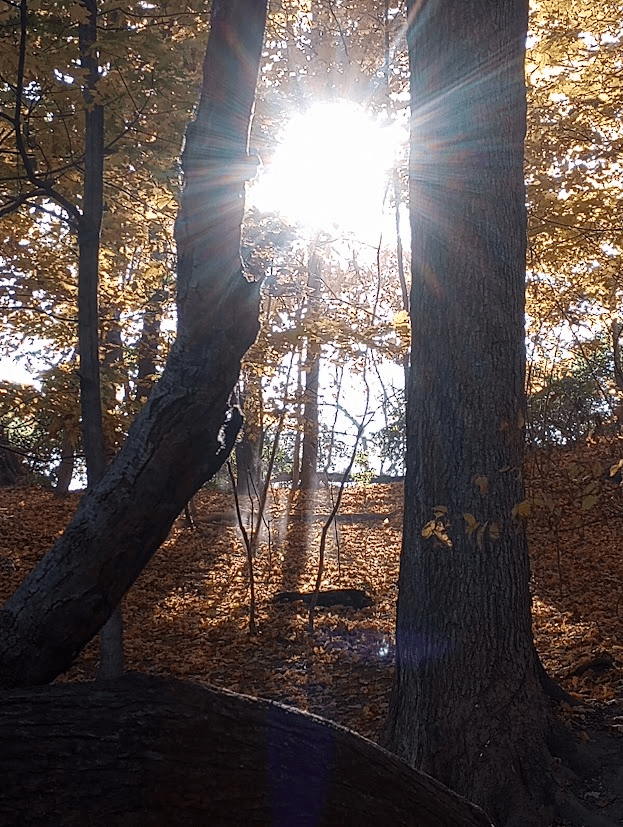
3. How golden sunlight fills the bowl of woods, of hollow.
4. Weekend
5. No matter what happens, people will continue to work for good.
May we walk in Beauty!
“I am passionate about everything in my life, first and foremost, passionate about ideas. And that’s a dangerous person to be in this society, not just because I’m a woman, but because it’s such a fundamentally anti-intellectual, anti-critical thinking society.” —bell hooks
“Bless the light and the darkness, the love and the fear.” —Rabbi Olivier BenHaim
“It doesn’t matter who you are or what you look like, so long as somebody loves you.” —Roald Dahl, The Witches
“For women who are tied to the moon, love alone is not enough. We insist each day wrap its knuckles through our heart strings and pull. The lows, the joy, the poetry. We dance at the edge of a cliff. You have fallen off. So it goes. You will climb up again.” —Anais Nin
“The creation of a thousand forests is in one acorn.” —Ralph Waldo Emerson
“In the morning I went out to pick dandelions and was drawn to the Echinacea patch where I found a honeybee clinging to one of the pink flowers. She seemed in distress, confused and weak. She kept falling off the flower and then catching herself in midair and flying dizzily back. She kept trying to get back to work, to collect her pollen and nectar to take home to the hive to make honey but she was getting weaker and weaker and then she fell into my hand. I knew she would never make it back to her hive. For the next half hour she rested in my palm, her life slowly ebbing away as a thunderstorm started to brew. I sat on the earth waiting for death with her. The lightning flashed over the mountains, a family of turkeys slowly walked the ridge, a wild dog keyed into what was happening circled past us. The trees appeared startlingly vivid and conscious as the wind blew up and the thunder cracked and then her death was finished. She was gone forever. But in her going she taught me to take every moment as my last flower, do what I could and make something sweet of it.” —Layne Redmond
“Let me seek, then, the gift of silence, and poverty, and solitude, where everything I touch is turned into prayer: where the sky is my prayer, the birds are my prayer, the wind in the trees is my prayer, for God is all in all.” —Thomas Merton
“Beware; for I am fearless, and therefore powerful.” —Mary Wollstonecraft Shelley, author of Frankenstein
Audre Lorde:
“For women, then, poetry is not a luxury. It is a vital necessity of our existence. It forms the quality of the light within which we predicate our hopes and dreams toward survival and change, first made into language, then into idea, then into more tangible action.
.
Poetry is the way we help give name to the nameless so it can be thought. The farthest external horizons of our hopes and fears are cobbled by our poems, carved from the rock experiences of our daily lives.
.
As they become known and accepted to ourselves, our feelings, and the honest exploration of them, become sanctuaries and fortresses and spawning grounds for the most radical and daring of ideas, the house of difference so necessary to change and the conceptualization of any meaningful action. Right now, I could name at least ten ideas I would have once found intolerable or incomprehensible and frightening, except as they came after dreams and poems. This is not idle fantasy, but the true meaning of “it feels right to me.” We can train ourselves to respect our feelings, and to discipline (transpose) them into a language that matches those feelings so they can be shared. And where that language does not yet exist, it is our poetry which helps to fashion it. Poetry is not only dream or vision, it is the skeleton architecture of our lives.”
“Wake at dawn with a winged heart and give thanks for another day of loving.” —Khalil Gibran
Marge Piercy:
Forgive the dead year. Forgive
yourself. What will be wants
to push through your fingers.
The light you seek hides
in your belly. The light you
crave longs to stream from
your eyes. You are the moon
that will wax in new goodness.
“Surrender is not passively resigning yourself to something. . .it is a conscious embracing of what is.” —Cynthia Bourgeault
 Mockingbird Chronicles
Oh, November just got better. ❤️
LikeLiked by 1 person