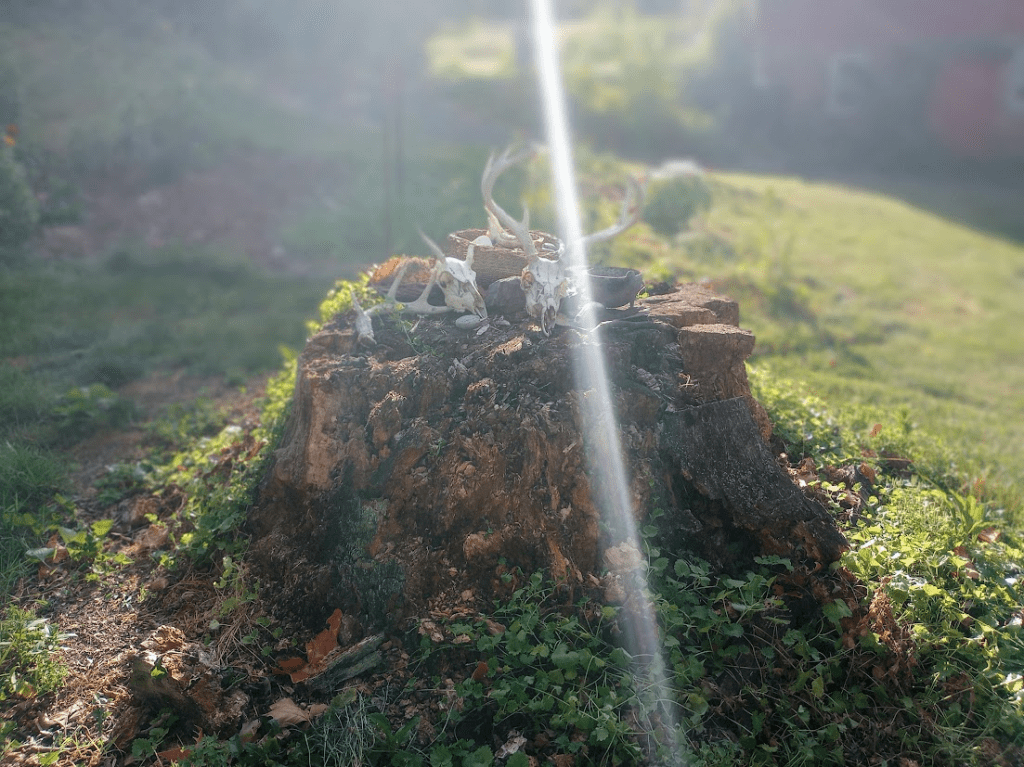
Today’s poem began as an intellectual exercise. Perhaps I will come back to it another day and tend it with a little more care and reflection, but for now, I’m going to call it done. Here is the exercise I set for myself: to write a pantoum-like poem, but to let the first stanza be what it wanted to be, and then to modify a pantoum-form from there. So instead of four lines, the stanzas are five lines each, and the second and fourth lines are repeated as in a traditional pantoum, but the fifth line in each stanza is a repetition of the poem’s first line.
I’m intrigued by the possibilities of modifying traditional poetic forms to suit my own ends. For this experiment, I’ll declare here that I have invented the pantoumly, a variation of the pantoum. I’ll try it again sometime when my head is not so full of the grey cobwebs of encroaching winter darkness.
The Lost Song
a pantoumly poem
by Beth Weaver-Kreider
I no longer understand
the words of my mother tongue,
no longer remember the voice
that sang through my veins
in the hour of my birth.
The words of my mother tongue
in the mouth of the tyrant
(singing in my veins)
turned to poison.
I no longer understand.
In the mouth of the tyrant,
the people are reduced to dust,
poisoned
by waves of meaningless words
I cannot understand.
The people are reduced to dust,
driven to mad worship
by meaningless words,
and threats, and lust for power
I refuse to understand.
Driven to worship their madness,
they cannot escape the maelstrom
of threats, their lust for power
eating away empathy
which they no longer understand.
I cannot escape this maelstrom
but seek the still point
which feeds empathy,
and the dust rises.
They will once again understand.
Seek the still point,
hear the ancient voices
rising like dust
in the words of your mother tongue:
This you shall understand.
“Disobedience was [humanity’s] original virtue.” —Oscar Wilde
“Love the earth and sun and animals,
Despise riches, give alms to everyone that asks,
Stand up for the stupid and crazy,
Devote your income and labor to others…
And your very flesh shall be a great poem.”
—Walt Whitman
“I believe the world is incomprehensibly beautiful—an endless prospect of magic and wonder.” —Ansel Adams
“A tree is a nobler object than a prince in his coronation-robes.” —Alexander Pope
“We must finally stop appealing to theology to justify our reserved silence about what the state is doing—for that is nothing but fear. ‘Open your mouth for the one who is voiceless’—for who in the church today still remembers that that is the least of the Bible’s demands in times such as these?” —Dietrich Bonhoeffer
“Christianity stands or falls with its revolutionary protest against violence, arbitrariness, and pride of power, and with its plea for the weak. Christians are doing too little to make these points clear. . . . Christendom adjusts itself far too easily to the worship of power. Christians should give more offense, shock the world far more, than they are doing now.” —Dietrich Bonhoeffer
“Those who love their dream of a Christian community more than they love the Christian community itself become destroyers of that Christian community even though their personal intentions may be ever so honest, earnest, and sacrificial.” —Dietrich Bonhoeffer
“We are not to simply bandage the wounds of victims beneath the wheels of injustice, we are to drive a spoke into the wheel itself.” —Dietrich Bonhoeffer
“Silence in the face of evil is itself evil: God will not hold us guiltless. Not to speak is to speak. Not to act is to act.” —Dietrich Bonhoeffer
“It is so easy to break down and destroy. The heroes are those who make peace and build.” —Nelson Mandela
“We are not lacking in the dynamic forces needed to create the future. We live immersed in a sea of energy beyond all comprehension. But this energy, in an ultimate sense, is ours not by domination but by invocation.” —Thomas Berry
 Mockingbird Chronicles