Learning Chess

sunrise

Gratitude List:
1. Playing Chess. I am so bad at it. I think of myself as being fairly intelligent, but I am miserable at chess. I do dumb things. But I am loving playing, and loving being schooled by my ten-year-old.
2. Crawling out from under the rock.
3. Long sleeps.
4. The light will return. The light will return. The light will return. Wednesday at 5:44, to be precise.
5. The Great Horned Owl calling in the bosque.

May we walk in Beauty!

****

I’m not sure where I am going with this story. I may take more time off. I seem to have shifted out of the voice in which I began it, and it’s becoming tedious to write it without that initial fire. Perhaps its next steps will have to happen during summer vacation.

****
Deep in the lower ring of the city, where the bustle of the market lasted from early in the morning to late in the evenings, where the fruit and vegetable vendors set up their brightly-colored stalls along the main street out to the gates, where the shops of the bakers and the butchers lined the ancient walls in a rumble-tumble fashion–there where the press of humanity was greatest, in the back of the shop of Bilhah the Baker, there grew up a secret school for women and girls.

While educating females was expressly forbidden by law, many families saw fit to “teach” their daughters to read and write and do simple sums in order that they might help with the family businesses.  As long as no one pushed against the law and tried to send their daughters to school, the spirit of the law could be bent for the good of the family economy.

In recent years, however, the generals had begun to take a firmer hand. King Astra Djin, they whispered secretly amongst themselves, was soft. He wanted easy living, fine wine, gentle and docile women, and lots of gold. His hardest edges were reserved for the collection of taxes, which he raised in greater amounts with each succeeding year.  The generals believed, to a man, that the city-state of Zammarqand needed a heavy-fisted rule. The king could have his cushy life, and the generals would keep him content, fat and happy, while they set about the careful enforcement of law and order in the city.

Simply Gratitude

door1

Gratitude List:
1. It’s not Lyme Disease. I asked for the blood test because I did pull a little tick off my neck last week. But the test was negative.
2. Sore throat is going away
3. Friday nights mean long sleeps
4. Reminders that I am in charge of my own story
5. Amazing student musicians. The choral concert this weekend is going to be incredible.

May we walk in Beauty!

Depleted

in-prints

I did not write yesterday. This flu/cold/encroaching darkness has been a little soul-sapping. I’m not suffering, not falling apart. Just extremely weary. The last days before Winter Solstice are always harder. It’s like the cave in the dream–you know that for every step you take inward, you’ll have that many more steps to take to get you out again. And in this one, you don’t get to choose–you just have to keep going into the darkness, one more step each day until you get there. I managed it last year, and the year before that. I will manage the final week this year, too. Somehow this year seems grayer, darker, more menacing. My physical malaise of the past week is just a perfect metaphor for the psychological/spiritual/political malaise of the moment.

Goodness. I should re-iterate that I am not falling apart here–just living the season. I love the lights and the songs and the way the children anticipate the holiday. I love peppermint things and the extra chocolate and lots of citrus. The sky is still beautiful many mornings and lots of evenings. My colors are still rich. People are still working for justice, still letting their hearts break for the pain of others, still trying to make the world a better place. All of that is intact and hopeful. It’s just that I’ve seen the nastiness more closely and clearly this year, too, so the need to find the balance is ever dearer.

I want to get back to writing my story, but it will probably be a few days before my head settles out of the fog of flu and winter. I need to be extra careful with where I place my energies in the coming week or two.

Gratitude List:
1. Full moon in the morning, setting over the ridge.
2. Warm cat on my lap
3. Peppermint things
4. New snuggly dresses
5. Hot lemon tea with honey

May we walk in Beauty!

Simply Gratitude

hosta

Gratitude List:
1. The musical directors at my school. This evening’s Middle School Band, Orchestra, and Choir concert was really delightful.
2. Diverse music
3. I know the moon is there, even though it’s cloudy
4. I know you’re there, even when you’re quiet
5. I slept until the alarm this morning. It’s always sort of notable, and it feels so good to wake up, knowing I have been really sleeping.

May we walk in Beauty!

More story another night. Tonight I will do my work and then sleep.

That Moon!

Gratitude List:
1. That Moon!
2. Starting to get the energy back
3. Those Thai ads about kindness. Ellis has to find a video about random kindness for class, so we were looking at the Thai ads. I had to make myself stop, I was getting too weepy.
4. Music. Today’s soundtrack is Mindy Nolt and Siobhan Miller.
5. This marvelous recliner.

May we walk in Beauty!

scrolls

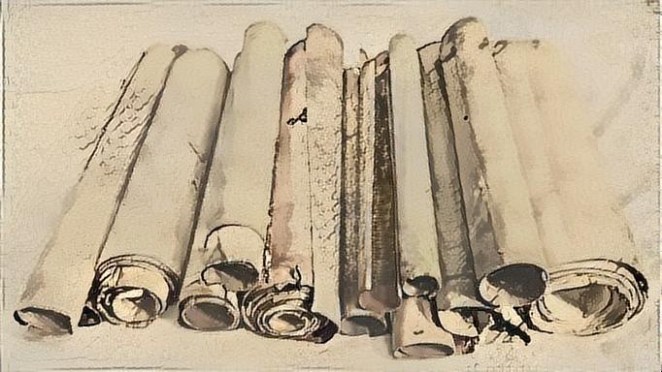
They knew instinctively that the scrolls must be kept secret and safe. Gormlek cleared away the rubble of the fallen wall, patched and repaired it, leaving a little doorway that even his granddaughter had to stoop to get through, and covered the door with a wooden cabinet that could be rolled aside for entry, but looked solid and immovable enough to a scanning eye.

In the evenings, when the day’s baking and sales were finished and Gormlek had returned from his day’s work in the Houses of the Dead, the little family would take a scroll from the hidden annex, and read the ancient hi’Stories of the Queens of Zammarqand.

“These sound like the fairy tales that Granny tells me when I visit her in the village!” Leeta told her mother. “There’s the one about the Prince of Karadzu, who came to Zammarqand to seek for the hand of Princess Jinna in marriage, but Jinna did not want to marry him, so she challenged him to a game of chess. If he won, she would marry him, but if she did, he would give her his proud stallion and walk home. That stallion made Princess Jinna the winner of every horse race in the city for years afterward.”

Bilhah’s eyes were bright. “I’ve been thinking that, too, how Granny seems to know these hi’Stories, how her tales are little mirrors of the stories in these parchments. Do you think they’re true, Abba? Or are they just someone’s written-down version of the fairy tales?”

Gormlek carefully studied the parchment at hand, the candle-light flickering over his face. Finally, he said, “Our hi’Story does not begin with the Wolf Kings–I am certain of it–although that is what we boys were taught in school, that the city began when Chinngis Djin settled the river valley. But those hi’Stories always say he conquered the people of the city, so there must have been a city before the Wolf King’s reign. All my life, I have heard the stories of Granny and the others, of a different life, a different city, a different hi’Story. Even the grannies say that their stories are nonsense, little ditties to be told to the children and ignored by everyone else. But now I think that they have been keeping the oldest hi’Stories alive in their tellings.

<More on this part of the story tomorrow>

Nannies and Grannies

light

Gratitude List:
1. Crows in fields, in trees, in sky, and snow
2. The Children’s Program at church this morning–baby angels tossing their halos into the air, kings wearing their crowns at jaunty angles over their ears, little drummers and shepherds and all
3. Taking a nap at my parents’ house this afternoon–having someone just take care of me
4. Hot chocolate
5. That family of four deer that came down the hill in the bosque, crossed the stream and the road, and went up the bluff and over the ridge.

May we walk in Beauty!

*****
Even kings have grandmothers, and nannies. It might be the grannies and nannies who hold the world together, or who bring it back around to rights when it’s gone off the deep end. Slow and steady, one story at a time.

The Eighth Wolf King, Astra Djin, had three children, the youngest born the same month of the same year as Bilhah the Baker. The two boys, Mussa and Ahmbra, were educated in the traditional military academy where there father and grandfathers had also learned to read and write, to rule, to fight, and to venerate the Djin-Wolf, fiercest of all gods. The middle child, Behna, was a girl, and she was instructed in palace graces and etiquette by her mother and her many governesses. In the late afternoons, when the boys’ schooling was finished, and Behna had completed her palace duties, their nanny would take up her spinning and the children would settle around her like kittens and wait for her to begin spinning a tale.

“Once upon a time,” she would begin, for all good stories begin thus, “the city was ruled by a Wolf-Queen.”

The children would laugh and protest: “Nanny! There’s no such thing as a ruler queen!”

“This is a fairy tale, my darlings. Only a fairy tale,” she would tell them, her eyes glowing in her crinkly smiling face.  “Once upon a time, there was a Wolf-Queen named Rama-Shala-Mehbaz. But the people just called her Queen Rama, or Your Majesty. She was a great ruler and loved by her people. When she was Queen, all the girls in the city went to school, too, just like the boys. And no one in the city ever starved for lack of food, and there were no soldiers in the streets, and there was a great temple in the center of the city to honor the Wolf Mother.”

“Nanny, that’s just wrong,” protested Mussa. “There is only the Djin-Wolf. You must not say Wolf Mother, as though it were another god as great as Djin-Wolf. Even for a story. And even you know that we must have soldiers in the streets to keep the peace. Otherwise the people might fight and kill each other. The people are like children, and they must be treated with harshness and a firm hand.”

“Perhaps,” said Nanny to the boy, whose face was a mass of grey confusion. “Don’t worry, my princeling. This is only a story, and I am a silly old woman. Would you like to hear more? Well, it was said that the Queen would often disappear on nights when the moon was dark. She would walk out of the city, not returning until the first rays of dawn rose over the river, leaving a trail of bare footprints in the dew.

“The legends say that when she reached the riverbank, she would transform into a great wolf, and stand in the darkness, singing the wolf songs until all the wolves in all the hills around the city would meet her there on the riverbank.  One morning, she returned from the river carrying a tiny squirming wolf cub in her arms. She carried it to the palace, and before the day was out, the cub had transformed into a human child, and Queen Rama raised her as a daughter, and she became queen in her turn.  It is said that all the ancient queens were shape-shifters, gift-cubs from the wolves, and that is why the city was so peaceful–they lived as wolves do, caring for the sick and the young and the elderly, looking out for the good of all.”

Mussa’s face was still cloudy. “But it’s only a story, isn’t it, Nanny?”

“Hmmm? A story? Yes, it’s a story, certainly. Now off to bed with you.”

The Secret Ways of Hi’Story

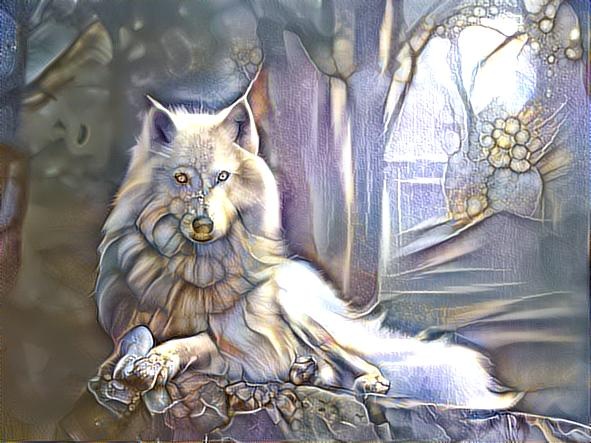
wolf

Gratitude List:
1. Help with the tale
2. Feeling better every day
3. Getting work done
4. Crusty bread, toasted and buttered
5. Hot chocolate

May we walk in Beauty!

*****
These stories are becoming something of a family project. I read a few at a time to the children, and then they ask what will happen next, and what bits of the story I will reveal next. Or they make suggestions about how to unpack something in the next bit of story. I don’t quite know where all this is going. Perhaps if they come together into some sort of form, I will edit and revise them and try to publish them some day, but for now, it’s a pleasant thread to follow.

I think I will continue to spell it “hi’story,” to emphasize the story piece of it. Because Chinngis Djin tried to erase the Wolf Queens, the era of the Wolf Queens has become legend, and Story is a crucial part of keeping them alive.

While I have chosen to separate my story from the real Samarkand by changing its name a little, and placing it in something of a fantasy realm, I found the story of the sack of the city by Genghis Khan in 1220 to be rather compelling, and so I have kept him in the parallel. Several sources call him the Blue Wolf, and in one source, he is spelled Chinngis Khan.  At this point in the process, I do not intend to do the careful research necessary to make this an academically accurate historical/cultural novel. I just want to follow the thread of this hi’story, and see where it takes me.

The Secret Ways of Hi’Story

The hi’story of Zammarqand seemed to begin with the coming of Chinngis Djin, the Blue Wolf of the North. In the year 1220, the Blue Wolf and his hordes had ridden down the steppes like a mighty wind, conquering the villages and cities in their path, setting up fierce and brutal warriors to control the lands they overthrew. In the city of Zammarqand and it surrounding villages, the subjugation included an overthrow of hi’story. The great library was burned, the temples torn down, and the sacred groves were uprooted and laid waste. The Wolf Mother shrines that lined the inner walls of the city were simply plastered over, along with the dozens of small shops that were built right into the city walls.

The Wolf-Queen, daughter in a line of a thousand queens before her, was deposed and slain publicly in the market square, her children dragged off as slaves with Chinngis Djin’s southward-surging army, never to be seen in Zammarqand again. The peaceful rule of the mothers was ended, and a new day of military might and harsh rule began.

In the days of Leeta the Storymaker, three hundred years after the coming of the Blue Wolf, the governance of the city had settled into a patriarchal rhythm that had a great deal less surface brutality than it had in the first century following the coming of the Blue Wolf, though its deep reality was one of repression of the city’s daughters, and a near-complete erasure of the city’s hi’story prior to the coming of Chinngis Djin.

But hi’story has a way of making itself found. Images of the tender-eyed Wolf Mother proliferated in secret places in the city, for those who had the eyes to see. Grandmothers faithfully remembered the fairy tales and stories, passing them on to daughters and granddaughters. Young women would dream dreams of a great and watchful She-wolf sitting in the gateway to the city. Travelers would come upon wild groves of trees growing in near-perfect circles. And in the city, in houses that were built right up against the city walls, occasionally a plaster wall would give way, and a little room would open up, a small chamber holding a statue of a nursing wolf or a bust of the Wolf Mother.

When she was eight, in her sleeping room at the back of the little shop of Bilhah the Baker, Bilhah’s daughter Leeta one day discovered a crack in the wall. She had been ill for three days, and boredom was beginning to grow greater than the illness that kept her to her room. The child began to pick at the crack. Her mother, pulling a large tray of mooncakes from the ovens, heard a rumble and a crash. Racing back to her daughter’s room, she discovered Leeta unhurt, but covered in plaster dust, standing awed in the entrance to a newly opened chamber into the city wall behind the house.

The walls of the chamber were lined with shelves and each shelf was filled with scrolls, perfectly preserved through the centuries. The plastered walls that had been intended to erase the city’s hi’Story had instead preserved it perfectly for distant generations.  A plaque on one wall read “ElSheba Hi’Storian.”

Gormlek the Mourner had taught his daughter and then his granddaughter to read, a minimally revolutionary act in a city where only boys attended school, and the education of girls was frowned on or scoffed at.  Leeta and her mother wasted no time in reading and cataloging their new treasures.

Moon Cakes

Gratitude List:
1. Those UNICEF kids. I didn’t think I would have the energy to help them pull off a party tonight, but they came together and set up with a real will. What a terrific bunch of teenagers.
2. Flan. LaRice makes the best flan I have ever tasted.
3. A weekend to rest up.
4. Crows
5. Walt Whitman

May we walk in Beauty!

moon-cakes
Moon Cakes

Rana the Baker needed an apprentice, and her niece Bilhah needed work that would keep her closer to her foster daughter instead of out in the fields and orchards. Bilhah took to her work like a wagon wheel to the rutted lanes of Low Street, steady and sure.  She often worked with baby Leeta tied onto her back with a long strip of cloth.

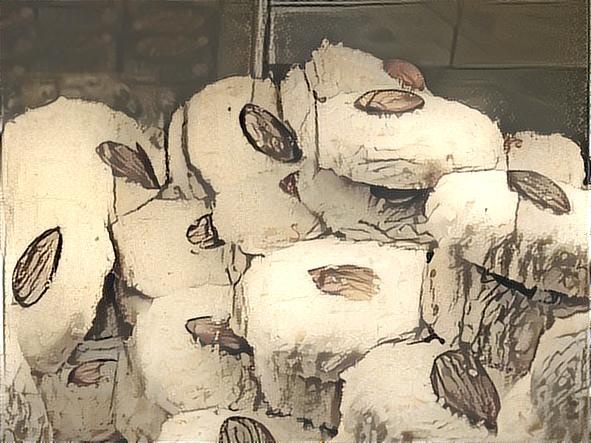
On days before the full moon, Rana’s shop was always full of customers, women requesting the round almond moon cakes that were one of the baker’s specialties. And on the days of Equinox and Solstice, and the corner days between them, Bilhah and her aunt could barely keep up with the demand for the tasty treats.

In this way, Bilhah was ushered into women’s society. She didn’t ask many questions, but she kept her eyes and ears open, and soon she had learned quite a bit about the rites and rituals of women, the keeping of time by the moon, the celebrations of the sun cycle, the moon cakes offered to the Queen of Heaven.

One early morning, carrying a squirming two-year-old Leeta on her back, Bilhah opened the bakery door to a wall of billowing smoke. Neighbors came running, and waded through the smoke to the kitchen where they found a batch of moon cakes burning in the oven. Rana had died of a sudden stroke mid-batch, and the cakes had burned.

Gormlek the Mourner himself took his sister to the houses of the dead, where he prepared her body for the cremation. Lawyers who opened her sealed testaments discovered that all her worldly possessions she had left to her niece Bilhah.  And so it was that Bilhah became Bilhah the Baker, and Leeta the Wolf-Child came to be raised in the company of women, with the exception of her doting and adored Babu Gormlek.

How Bilhah Found the Baby

wolf

Gratitude List:
1. Giving in–just taking the day off work. Sometimes you just can’t muscle through, and you have to ask for help.
2. Sleep
3. Ibuprofen–this version of the bug has every nerve and muscle aching
4. Featherbed
5. The way stories reach out and grab you

May we walk in Beauty!

This is what happens after a night and a day of flu-fueled half-sleeping/dreaming:

How Bilhah Found the Baby

Bilhah, the daughter of Gormlek the Mourner, found the baby one evening after she’d been working in the almond orchards outside of the city walls. She only told the story to her father, and then to the child herself, as she grew.

In preparation for the celebration of the Wolf-King’s birthday the following week, many of the regular harvesters had been conscripted to work in the palace kitchens and sculleries, so there were only about eight young women in Bilhah’s group that day, and none of them would work the far ends of the rows because of the rumors that a great and vicious she-wolf had been seen prowling along the river, down beyond the orchards. Bilhah, seeking solitude, found herself working alone in the fringe of trees where the others refused to go.

Keeping her ears peeled for the sound of the bells that signaled the end of the work day, Bilhah had a found a rhythm to the picking that kept her moving at a quick pace. She loved the skittering sound of the almonds clattering into her basket, and reveled in the scent of the nuts warming in the afternoon sun. At the very end of the row of trees, she paused, sighed, and lifted her eyes to the river. A thrill of terror mingled with excitement filled her: there in the shadows of the big rocks by the river, she could clearly discern the form of a large wolf. It was sitting quietly, as though it were simply one of the city dogs, patiently waiting for its human to finish working and come home. Had she imagined its tail thumping twice against the ground?

She slipped back into the orchard to the next row, three trees back, and began picking her way once more toward the end of the row. She could see Zoha and the others working the other way down the row, close to the safety of the city walls. As she reached the river end of the next row, she looked again for the wolf. This time, she clearly saw the tail thump, and the creature stood, took two steps toward her, remaining in the deep shadows by the rocks.

Bilhah had lived with dogs all her life, and something in the demeanor of this fearsome wild creature kept reminding her of her own beloved Tigo and Amona. Underneath her fear, she felt an undeniable sense that this wild thing was trying to communicate something. She took a few steps out from under the trees toward the large rocks. The wolf shrank back into shadow. Another step. The wolf bolted to the left, down the rocky trail toward the river, but stopped suddenly in the shadow of a large fig tree and looked back toward Bilhah. She wants me to follow her!

At that moment, the bells began to ring in the city, letting the harvesters know that the work-day had ended. She heard Zoha and the others calling her name down the row. She had made the decision before she realized it had been made. Making momentary eye contact with the wolf, she turned and headed back into the trees. “Coming!” she called to the others, slipping down the row toward them.

Breathless, she caught up with Zoha. “Can you take my basket back for me? I want to see if I can find some figs for Abba on those trees by the river.”

“Oh, please don’t, Bilhah,” Zoha pled. “You know they’ve been seeing that wolf down by the river.”

“I’ll be fine, Silly. I worked down there by the river all day, and no wolf has eaten me yet.” She managed not to lie, exactly.

Zoha took her basket begrudgingly: “If you aren’t back by nightfall, I’ll send Uncle Drago out to find you.”

“Thank you, Zoha. You don’t need to worry about me. You know Granny goes out to the river all the time, and she’s never been attacked by the wolves.”

She watched the colorful flock of her friends melt into the shadows by the city gates, and turned to walk down the row of trees. There at the end of the row, almost hidden in shadow underneath the last tree, was the she-wolf! She followed me! Another thrill of fearful horror overcame her, and she almost turned and ran back to join her friends, but again something in the expectancy of the wolf’s posture made her pause, take a breath, and walk toward the waiting creature.

As she approached, the animal whirled and dashed into the shadow of the rocks by the river trail. She followed steadily, the wolf retreating in short bursts, waiting in shadows for her to approach. Down the long path along the river they went, and Bilhah even managed to pick several figs from the low branches of trees to tuck in her skirts in order to give truth to her words to Zoha.

The sun settled lower and lower in the sky, and Bilhah began to worry that she would not make it back to the city before nightfall and the closing of the gates. This wolf might be friendly, but what about the packs that roamed the steppes at night? She had seen the green glow of their eyes in the dark when she had stood on the city walls with her father to look at the stars.

And suddenly the wolf disappeared. She had dashed into shadow by an outcropping of rock up a little hill away from the path, and Bilhah lost sight of her. She waited, uncertain, considering whether she ought to just start back down the path to the city and safety.

A wolfy whine startled her, and she could hear distinctly the sounds of tiny cub whimpers. She has led me to her den. The realization filled her with a new mixture of fear and awe. She stood frozen, wondering what her guide intended. Am I supposed to climb up and see her babies?

That was when she heard the human baby, a whimpering sound, not of distress but of demand.

Without thinking further, she began to scramble up the hillside toward the rocky outcrop. Shadows impeded her view as she peered into the space between the rocks, and her eyes took moments to adjust before she could make out the distinct shapes of mother wolf and cubs deep in the den. A lighter shadow moved among them. A human child, nursing with the wolf cubs. The baby looked to be only weeks old, but well-fed and carefully tended. The mother wolf’s eyes were glowing green in the shadows. Bilhah watched her tenderly licking her cubs, wolf and human alike. As the squirmy bunch settled down to milk-dazed satisfaction, the she-wolf raised her head to Bilhah, gave a little whine, and again licked the head of the child. She is offering me the child. That’s why she led me here!

Slowly, hardly daring to breathe or even to think, Bilhah eased forward into the tight doorway of the den until her body blocked the light, until she could touch the smooth skin of the child. Her nose was assaulted by the musky odor of wolf, and the she-wolf gave another doggy whine. As Bilhah reached to take the child, she felt the tender tongue of the mother wolf slide over her fingers as it gave its tiny charge one last kiss.

Bilhah backed slowly from the den. “Thank you,” she breathed, catching the green glow of the mother wolf’s eyes one last time as she turned to slide as carefully as she could down the rocky hillside to the path, holding her sleeping charge carefully in her arms.

She hurried as quickly as she could up the rocky river path in the growing dusk, filled with the wonder of her encounter and of the child she carried in her arms. How had she come to be there in the wolf’s den? Had the mother wolf stolen the child? Had a desperate mother, unable to care for one more child, left her baby girl there at the wolf’s den? Bilhah stumbled in the near dark and almost lost her footing, but managed not to fall. Panting, she stopped and held the baby tightly, fearing to fall and harm the child, but fearing to be left outside the city gates when the wolves began to prowl.

As she began to step more carefully along the path toward the orchards, she became aware of a light ahead, bobbing up and down on the pathway, and then she heard her father’s voice calling her name.

“I’m here, Abba!” she called, waking the babe, who gave a tiny squawk.

***
Gormlek the Mourner told his neighbors the story of his cousin’s daughter, out in the Seven Villages, who had become involved in an unfortunate relationship with a passing merchant. The child of their union would have been taken to the orphanage in the Market District of the city. Wanting to save the child from such a fate, he and his daughter had decided to take her into their home and raise her as their own. They named her after his late wife and Bilhah’s mother: Leeta.

The Wolves of Zammarqand

Gratitude List:
1. Rays of crows flying out from the trees in front of a magenta sunset cloud
2. The way stories come when you call them
3. Finding center, finding balance
4. Light. There’s always light somewhere.
5. The dark. There’s comfort in the dark when I move past the panic of losing light.

May we walk in Beauty!

zammarqand

I woke in the wee hours this morning with this phrase in my head:
The wolves of Samarkand have greenish eyes.

I looked up Samarkand, thinking I was going to be telling a story of the far north, where snow blows around the city walls, only to discover that Samarkand is a city in Uzbekistan, a much warmer place than my mind had conjured. But there are wolves. In fact, Genghis Khan, who conquered Samarkand in 1220, was known as the Blue Wolf. I don’t think I have it in me to write anything so epic as a Genghis Khan story at this point in time. In fact, not being familiar with the words and ways of Uzbekistan, I will change the spelling of my city to make it more mine, though I think I will keep it in the steppes of a place similar to central Asia.

The Wolves of Zammarqand

The wolves of Zammarqand have greenish eyes. At night, when the sheep and the children of the city have been safely enclosed within the walls, Leeta the Storymaker stands on the high wall overlooking the valley and watches for the green glow of their eyes in the starlight, the shadowy forms moving restlessly in moonlight. She hears their singing from the high ridge across the river.

Legends live long in these hills. Leeta is the Storymaker charged with remembering, with telling the ancient tales. Leeta remembers the hi’Story of the ancient Wolf-Queens, when the strong looked after the weak, the powerful encircled the vulnerable, when the city’s power was determined by the strength of its ability to care for all of its members.

Centuries have passed since the times of the Wolf-Queens, since the good of the pack gave way to might and ferocity, since power over others became the rule. The Wolf is still the city’s symbol, a snarling face with bared teeth and angry eyes. But when Leeta wanders the streets, she can find the ancient face of the mother wolf–eyes watchful, patient–carved into the stones of pillars and temples, painted above doorways. As the city was repeatedly re-built upon itself over centuries, it covertly remembered its mothers in quietly lupine statuary and artwork. Anyone with eyes to see–and half a desire to do so–could find them.

On moonlit nights, Leeta goes by secret ways, out of the city, returning in the hushed moments before dawn, leaving a trail of footprints in the dew.

The daughters of Leeta the hi’Storian all have green eyes.