Love Wins

Gratitude List:
1. Love wins.
2. Fried tomatoes for breakfast
3. Such a birdy day: titmouse fledglings, nuthatch, crows, cardinals, goldfinch, swallows. . .
4. Dream visitors: turkey, this time
5. Tomato sandwiches for supper

May we walk in Love!

Marvel and Wonder

How would things change if, every time we approached the word God in our speech, we would instead use the word Love?  Parker Palmer does this sometimes, and it is powerful: We are made, each one of us in the image of Love.

Would we be less judgmental, more likely to be little versions of Love ourselves?

***

Last night in the Dreamings, I was in a green field of clover and vetch at the edge of a wood.  I was out in the field and standing just outside the trees and looking at me very intently, watching and observing me, was Turkey.  I was gathering blue feathers in the field, and a teen-aged boy was walking up the path toward me.  Turkey watched.  I wanted to be friendly to the boy, but I didn’t want to encourage conversation because gathering the feathers was a private and personal thing for me and I wanted to be alone to contemplate.

I have been reading Jamie Sams’ words about Turkey, a symbol of the Give-Away, the “deep and abiding recognition of the sacrifices of both self and others.”  She seems to be a symbol of reaching a new and deeper place.  Feathers are gifts to me, symbols of my communication with Spirit, and blue feathers are about finding my voice.  I feel like Turkey was watching me, like the “woman of that place” in the Denise Levertov poem, to be sure that I was noticing and appreciating the gifts, both the social and the contemplative moments (especially the contemplative rhythm of summer), the voice, being in the presence of Spirit.

The Fountain
by Denise Levertov

Don’t say, don’t say there is no water
to solace the dryness at our hearts.
I have seen

the fountain springing out of the rock wall
and you drinking there. And I too
before your eyes

found footholds and climbed
to drink the cool water.

The woman of that place, shading her eyes,
frowned as she watched — but not because
she grudged the water,

only because she was waiting
to see we drank our fill and were
refreshed.

Don’t say, don’t say there is no water.
That fountain is there among its scalloped
green and gray stones,

it is still there and always there
with its quiet song and strange power
to spring in us,

up and out through the rock.

– See more at: http://www.poetry-chaikhana.com/blog/2013/03/15/denise-levertov-the-fountain-2/#sthash.1onaRPdD.dpuf

Moth Mummy

Gratitude List:
1. Gentle rain
2. Studying
3. Tomatoes!
4. Cecropia Moth Cocoon
5. Mockingbird: he is effusive, irrepressible, ebullient, buoyant, rhapsodic

May we walk in Beauty!

***
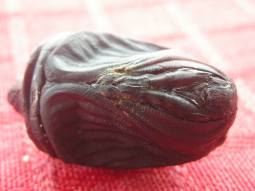
cecropia  Cecropia 2

The cecropia moth cocoon has been attached to the bar of the cast iron plant holder for almost a year now.  I knew it was dead, but I didn’t want to think about it.  Today, Jon and Holly opened it up.  Jon could hardly get his knife through the shell of the cocoon.  Cecropias are silk moths, and this cocoon had hard strands of silk surrounding a paper-like material that was tougher than cardboard (silk and “cardboard” visible in second picture).  Inside was this magical faerie mummy being.  You can see her head to the right side of the first photo, and her legs folded down the center.  Wrapping the head and legs are her two long, feathery antennae, and her wings drape gracefully around the rest of it.  I am so sad that she did not have the chance to emerge.  Still I am fascinated by this incredible moment of transformation frozen in the moments before emergence.

***

I am taking a class right now for professional development, called Shaping a Community of Learners, through the Anabaptist Learning Institute.  One of the recent assignments was to respond to one of William Stafford’s poems, or to choose another poet’s poem which speaks to the spiritual life of the teacher.  I chose Mary Oliver’s “Landscape.” The assignment briefly discussed Howard Gardner’s Five Minds for the Future, which I reference in the paper.  I discovered the Oliver poem when I was reading this OnBeing blog entry by Parker Palmer.

Here is the paper I wrote:

I love the poetry of William Stafford–his ethic of care for humans, animals, and the earth; his hope that acknowledges the journey of anxiety and despair that it takes to get there; his ability to find a moment of worship in a clod of earth.  I excitedly read through all the options listed.  I was focusing on a couple possibilities when, just last night, I came upon a post Parker Palmer wrote for the OnBeing blog, in which he responded to Mary Oliver’s “Landscape.”  I am not sure that Mary Oliver fits the category of Christian Poet exactly, but my own spiritual journey has been so constantly fed and nourished by her words that I think her work will fit the parameters of the assignment.

Landscape
Mary Oliver

Isn’t it plain the sheets of moss, except that
they have no tongues, could lecture
all day if they wanted about

spiritual patience? Isn’t it clear
the black oaks along the path are standing
as though they were the most fragile of flowers?

Every morning I walk like this around
the pond, thinking: if the doors of my heart
ever close, I am as good as dead.

Every morning, so far, I’m alive. And now
the crows break off from the rest of the darkness
and burst up into the sky—as though

all night they had thought of what they would like
their lives to be, and imagined
their strong, thick wings.

I want to read Howard Gardner’s work on the five aspects of mind sometime.  Meanwhile, I want to add “Open-heartedness” to the list, or perhaps to begin a list of various aspects of the heart, and begin with this one.  Mary Oliver’s poem “Landscape” holds this idea of open-heartedness for me.

Oliver writes “. . .if the doors of my heart / ever close, I am as good as dead.”  If I close the doors of my heart to the darknesses that surround me–to the poverty and racism and destruction of the earth, to last week’s massacre in Charleston, to the desperate plight of refugees fleeing places of conflict–then I also close my heart to the lecture of the moss, the posture of the oaks, the imaginings of the crows.  As I hone my sensitivity to the story that comes from the world around me–to the “lecture[s]” from the natural world, my sensitivity to the plight of other humans and other parts of the earth is also heightened.  But I do not want to shut off that part of myself, because I believe with Oliver that to close those doors is like dying.

My students bring me these darknesses.  They come to class and they ask what I think of the latest Painful Thing in the News.  I think I do a disservice to them if I minimize or ignore their questions and their need to come to terms with the harsh realities.  If I want my teaching to be transformative, I think I need to incorporate these things into the discussions, connect what is happening now to the readings that we are doing.  I need to listen to them process and discuss and think critically about the issues that beset us,  and encourage them to think about and write about these things.  If my students and I are in training to be people of service to the world, to teach and model peace and reverence in our lives, then part of our work is to know of the difficult things and to find ways to respond.  Part of my job as their teacher is to model ways to keep those heart doors open while finding ways to “disentangle [ourselves] from the darkness,” as Palmer writes in his response to this poem.

One way to keep imagining our “strong, thick wings” so that we may “burst up into the sky” is to maintain an inner life that contemplates the world of nature, and the depth of spirit of the people all around us.  I hope that I can model for my students the reflective work of listening to our inner voices, to finding the deep wisdom in the people around us, and to reading the text of the natural world around us: reverence, wonder, awe, spiritual observation and noticing.  That work, which Oliver describes in her poem, helps to balance the work of staying aware of the pain of the world.

In the past year, as I have been teaching at LMH, I have become more aware, too, of the fact that it is not just a one-way street, that it isn’t just about how I model this idea of holding our heart doors open for both the reverence and the shadows, but that they already have these capabilities within them.  They are already doing this work.  If I can find the right questions and poems and the right listening attitude, they bring their own transformative wisdom to the table.

(Parker Palmer’s OnBeing blog post: “Poetry as Sacrament: Disentangling from the Darkness”

http://www.onbeing.org/blog/poetry-as-sacrament-disentangling-from-the-darkness/7692)

Conversation in Tanka

Gratitude List:
1. Learning to swim.  How and when did that boy learn to swim?  Last September, he was nervous and just barely able to keep himself afloat.  Throughout the winter, after several sessions with his grandparents in the pool at Landis Homes, he has become a fish.  Today he was jumping off the diving board and swimming most of the way across the pool.
2. They keep eating vegetables without complaining.  No one has complained or fussed about supper for two nights now, and they both keep asking for seconds.  No one even mentioned the zucchini I grated into the roux I made for the macaroni.  They just ate it.
3. Poets.  Poetic conversation.
4. Reading with the boys.  We have gotten back into the rhythm of reading together again.  We finished The Mixed-Up Files of Mrs. Basil E. Frankweiler tonight and started a book of Patricia Wrede’s short stories.
5. A clean house.

May we walk in Beauty!

Featured image

My friend Mara Eve Robbins, a poet with gift for exploring the landscape of the heart (and I keep wanting to insert more and more notes about her here, such as the fact that she is the one who got me started on the spiritual practice of gratitude and that she is the person who helped me finally name myself Poet), hosts a Tanka Tuesday thread on her Facebook page every Tuesday.  She posts a tanka (5/7/5/7/7 syllable count) and invites friends to respond.  In the true conversational spirit of tanka, these little poems sometimes develop into rich and heart-opening conversations.

This week, I joined in one of these poetic conversations with Mara and my friend Daryl Snider (another heartful poet who weaves his words into powerful music).  They both gave me permission to re-post the conversation here.  I wanted to share it, to offer a way in which healing and hopeful conversations can occur outside the realm of intellectual discussion.  Sometimes we would write one stanza at a time, and sometimes several.  Each bold name is the author of the stanza or stanzas which follow.  I love the way this one carried our ideas like little leaf boats in a stream, how it felt finished when it was finished.  Still, I ached for it not to be ended–even putting it here, I felt like I wanted to keep it going, on and on and on. . .

It began with this tanka by Mara:
This can hold many
missing elements, or can
still miss the many
elements that are held. When
will a new path be forged now?

Daryl:
Hold on elements,
for you are elemental:
simple, being, true.
To be is the way; the path
is the traces of footsteps.

Beth:
As the poet said,
“We make the road by walking.”
Sometimes I follow
the roads others made before,
those footsteps in shifting sands.

Daryl:
Steps of one walker
leave tracks that only steadfast
trackers might follow.
Roads trampled by hungry herds
Leave nothing living behind.

Mara:
Elemental, my
dear Daryl. Flesh on earth, bare
to consequences.
What fire in the center holds
true when accuracy rains?

Beth, I follow your
steps into the shifting sands,
strengthened by fragile
threads. We make a road again
and again that’s more traveled.

Daryl:
Heating elements
give off the fury of fire.
Lighting filaments,
yes, the finer the better,
give the luminance of light.

Yet the energy
at the source of heat and light
is always the same.
That which burns me at the core,
transforms and Illuminates.

Dear Mara and Beth,
Your lights shine bright on my path,
pushing me to play
with words that say more and less
than I ever intended.

A poem’s value
is not in accomplishment
but in the doing:
Time spent doing nothing else
but being … still.

Yet now I must go
and succeed in something else,
something that will make
unpoetic evidence
of bodily existence.

Mara:
Leaving the small cloud
under the larger cloud, rain
waits for the sunrise,
packs suitcases of water
to carry into drier places.

Beth:
I have returned here
to this place of words, pathways:
a-quiver now with
the way these words leave a trail,
clear, for my heart to follow.

Mara:
The flow of trust finds
replenishment or dries up,
waiting for rain. Strong
sun today must find a way
to infuse with light what waits.

Two catbirds; holly
tree. One scolds and one defends.
Flash of underwing.
Open window. Everything
to be done waiting for this.

More from the Monastery

Featured image

Gratitude List:
1. Those clouds after the storm.  Everything glowed golden.
2. Veggie quiche.  I can’t believe how those boys ate!
3. Playing Pokemon with Ellis.  Yes, I bought myownself a deck. He wins more than I do.
4. Getting more sleep.  My body lets me sleep until 6:30 now.
5. This circle.  You and you and you and me and you and you.

May we walk in Beauty!

Here are some more things that I wrote at the Monastery:
6-15-15, Wernersville Jesuit Center

When I left the beech tree, I thought I would go sit on a bench beside a cobbled patio to put on my sandals, then find the labyrinth on my map.  The patio turned out to be the labyrinth.

Thinking about the animals that have come to my visions this year.  Lynx came to me at the year’s turning.  Macaw dropped me a feather.  Lioness and jaguar have both been reaching me in dreams and waking dreams–their messages are about leadership and impeccability.  This morning as I left the boys, a swallow flew low overhead.  And here in this place, catbird seems to be following me around.

6-16-15
In the main stairway, every time I go up and down the steps, I feel a need to greet the statue of Jesus with the open heart every time I pass him on the first floor landing.  “Hi, Jesus!”

This morning as I walked away from some contemplative time in the Cathedral of the Weeping Beech, I thought I saw a bird dying, thrashing in the grass a small distance from the gazebo.  A soft light caught the twitching, and as I walked closer, the energy did not seem to be about distress.  Suddenly it resolved in my vision into a fawn–the twitching wings were ears.  It was a small one settling in to wait for the mother, shaking the little bugs out of its eyes.

Walking this afternoon: “What makes you sad?” ask the trees.  I ask this question of myself, but somehow, it takes on new shades of meaning in their language.  I tell them all of it, how it hurts me when natural disasters happen, but that the things that make me saddest are the things the people do to hurt each other and the Earth.  Not just the intentional hurts, but the hurts born of people’s greed and lack of desire to know and to notice.

“What makes you angry?” the trees asked me then.  And many of the things were the same.  Perhaps I need to learn to differentiate better between my emotions.

Something in these questions from the trees unlocks doors within myself that I couldn’t seem to open before.

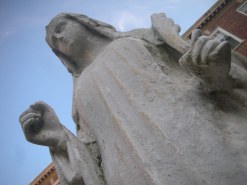
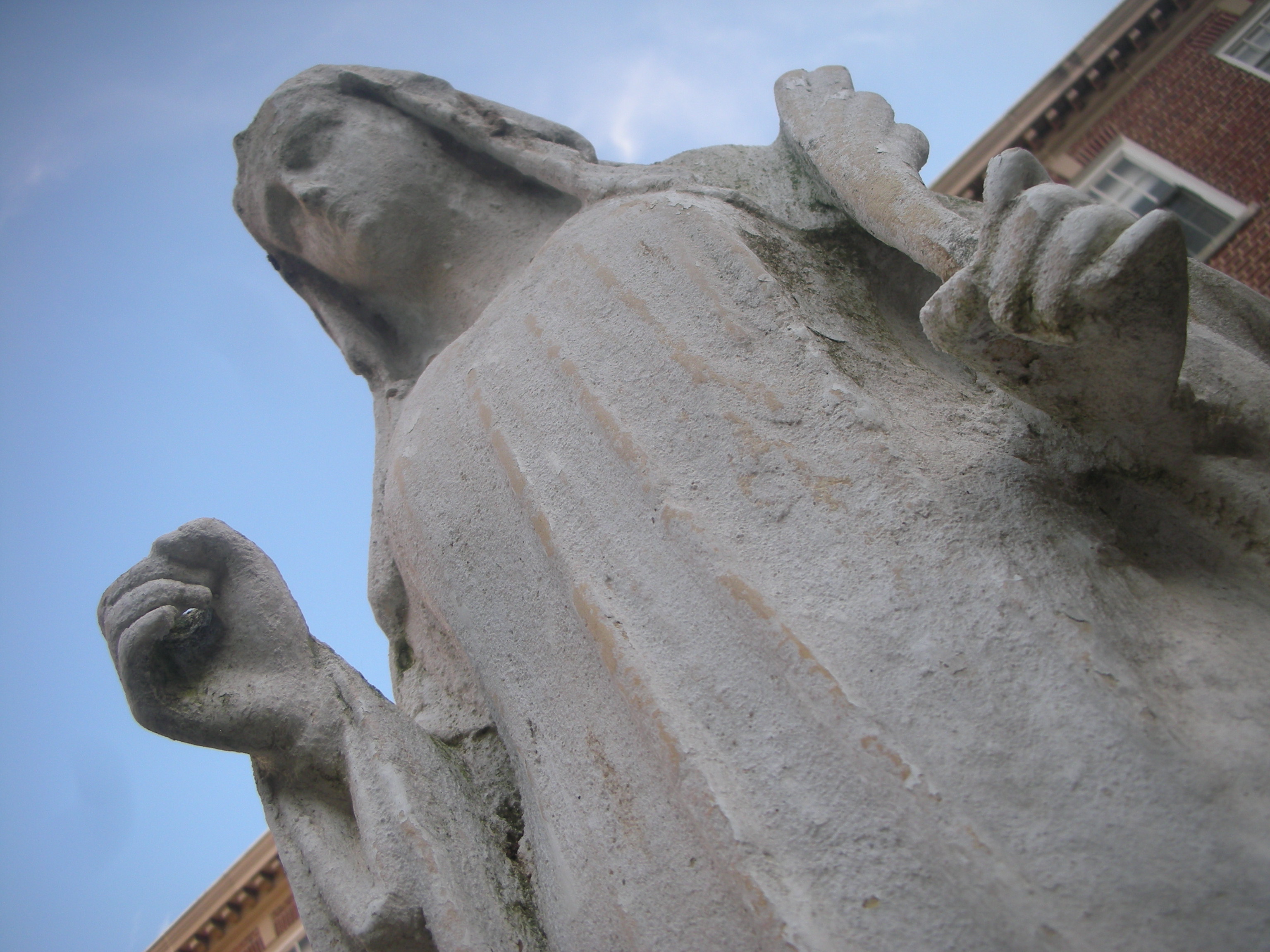
I was carrying the weight of these things with me when I reached the Mary statue, and something profound happened to me there.  I suddenly felt as though I knew about how her heart is broken again and again and again.  How she holds it all.  There she is, holding the Babe of wonder, her face filled with love for this Child of Promise.  There she is, holding the body of the young man, her son, her face filled with love and grief.  The serenity of her face holds within it the extremes of wonder and grief, love and anguish, that she knew.  She pondered these things in her heart: was she pondering how the act of opening herself to great love also opened herself to great grief?  But choosing to do it anyway, joyfully, because love is always worth it, and our hearts were made large enough and strong enough to hold it ALL.  I wept and wept and wept, holding on to her feet and looking out with her over the valley.

****

I need to keep making the story my own.

Gratitude and Blessing (three)

Gratitude List:
1. Feeding my sweet tooth
2. That fingernail moon
3. Stones
4. Feathers
5. That waiting moment between breaths

May we walk in Beauty!

Following is the final installment of collaborative Blessing Poems written by one of my classes.

Blessing (three)

May God’s grace carry us
as we go forth into our summers.
I hope we all have time to breathe and laugh.
May you always have food on your table
and family in your home.

Wishing you a great summer.
The world is your Oyster.
You’ve got it!
You can, if you think you can.
Everything is going to be okay.
May everyone be free
of the anxiety of test-taking.

May your days be sunny
and your refrigerator full of food.
May your summer be the best one yet.
May the sun shine brighter
and the lemonade taste tastier
and you sit back and enjoy
the summer nights’ fresh air.

May you remember to smile.
May you laugh deeply and from the belly
with so much joy that it hurts.

I hope you don’t fall into darkness.
May you find happiness and success
in all your endeavors.
May the rain wash away all your fears
and may the sun replace them with adventure.

May life bring you morning flowers
that make you smile away, but
don’t forget about the rainy days
that make those flowers.

May you make a huge difference
in somebody’s life.
Make that difference a positive one.

May you live in good spirits
and have peace in your heart.
May you find joy deep in your heart.

“May the Lord show his mercy upon you.
May the light of his presence be your guide.
May he love you and uphold you.
May his spirit be ever at your side.”  –John Rutter

May the Lord bless you and keep you.
May he make his face shine upon you,
now and forevermore.  Amen.

Milkweed and Clouds

Gratitude List:
1. Milkweed and Monarchs.  Milkweed is blooming everywhere this year. Dare I have  hope?
2. Clouds flowing through the sky behind Marie’s sea glass blossom.
3. Public Lament.  Public tears.  Challenge: Don’t go back to sleep.  Don’t get over it.  Don’t forget.
4. Hearing my own words spoken as a blessing, in someone else’s voice.  What a gift.
5. Little boats.  Two boys learned/re-learned how to make paper boats in church today.  One boy is going to make “thousands!”  He is going to set up classes to teach other people how to make boats.  He is talking about how professional paper boat makers might make their creases.  He says things like, “This is how you turn a failure into a success.  You take it back to a hat, and start over from there.”  Yes, Boy.  Always take it back to the hat.  Turn those failures into successes.
6. Family reunion.

May we walk in Beauty!

Solstice Rain

Triumvirate

Photo by Lauren Liess

I know I have posted already once today, and I do not want to exhaust anyone who may be following these words, but I want to begin daily gratitude lists again for a time.  I need specific spiritual disciplines to follow throughout the shifty days of summer.  I need gratitude to help me wade through the current darkness.  I need the juxtaposition of words and ideas to prompt deeper poetry.

Gratitude List:
1. Solstice Rain
2. and Thunder
3. Mimosa abloom
4. and Magnolia
5. Wayside wildflowers*

May we walk in Beauty!

*chicory, day lily, Queen Anne’s lace, hag’s taper, buttercup, bladderwort

(It’s all nature today, but you are in there, too if you look closely, you and your eye clear as chicory, your heart a-flame like the day lily, your blooming, blooming self.  You know that love has the last word, right?  Always has.  Always will.  We’re all going to make it through this one, too.)

Meadow of Grace

Dear Shining Souls,
I am ready to give up on us right about now.
Not you.  Not me.  Us: humanity.
Some days, I just can’t find my way
through the forest of horrors.

But how can I stay here in these dark woods
when those who lost the most
are already walking into the green fields of grace,
hands extended in forgiveness?

Oh Dear and Shining Souls.
People.  I keep forgetting
that we’re such a mixed bag.
Sometimes our worst
shows us our best.

I will follow those families
out into the sunlight
and hope to learn grace.

At least for now,
I will join this circle.
Take my hand,
and we will watch
those nine bright birds
wheeling in the sky above us.

640px-Candle (1)

Finder of Lost Things

Today I couldn’t find my classroom keys.  I never lose my keys.  The reason is simply because I used to always lose my keys, so I found particular ways to cope.  My system failed today.  Sandra was here, and she said a prayer to Saint Anthony, Finder of Lost Things.  I didn’t find my classroom keys right away, but I did find that macaw feather.  Maybe the good saint gives you what you most need.

That feather means more than it means.

Earlier this week, I spent three days at a local Jesuit Monastery.  Here are some excerpts from my Monastery writings:


DSCN8086   DSCN8116

DSCN8115

6-15-15: Wernersville, Jesuit Center

I am here.  Slipping deliberately sideways into a pocket of moment–three days of time sustained.  I have not come for silence, exactly, but for solitude.  My chamber or cell is room 266, on the corner, so I have two windows for a slightly angled cross breeze.  One window looks toward the Mary grotto, and the other faces a courtyard where a female saint stands.  I need to look up the symbols so I can learn her name.  When I first arrived, I sat in the chair and listened to a lengthy catbird concert from the pine outside my window.  Later, I looked down into the front garden from a second floor alcove, as the singer bathed himself energetically in the courtyard fountain.  I felt like a voyeur.

The experience of eating alone is a different kind of communion, communing with myself and with those who produced and prepared the food.  Eating slowly and deliberately.

In the short hours I have been here, I have found myself returning repeatedly to that word: deliberately.  I have had to deliberately restrain myself from dashing excitedly from alcove to alcove and from courtyard to courtyard like a child exploring.  So today will be for exploring–at a much less frantic pace–settling my spirit into this place.

Excitement is a jarring word–a somewhat jarring emotion, too–in the context of this serenity.  Still, this has been such a long time coming, and I am so filled with delight to be finally here that I am excited.  So excited that my hands shook as I set out my little altar space on the desk in my chamber.  I am learning to balance the thrill of having made it to this time and this space with the peace that I am building within.

Silence.  Filled with birdsong.

There will be at least one nap in these days, a “task” recommended to me by my father, and he is a spiritual director, so I shall not argue with that one.

This place is grand and wing-y enough to get satisfyingly lost in.  When I lose direction, I find my way to stairs, which are anchors that always seem to bring me back to familiar places.

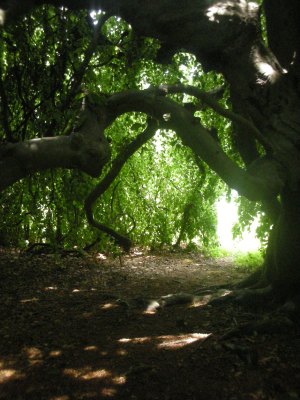
On the lawn across the drive from the statue of Saint Ignatius the Pilgrim is a massive Weeping Beech tree.  Is she forty feet high?  Perhaps.  And her branches sweep the ground, some of them curving back upward again into light.  The space beneath her is a secret cathedral.  A photograph could hardly hope to hint at her sun-dappled mystery, her holy sense of sanctuary.  I removed my shoes.  I found feather there, from a hawk-kill.  The fierce ones must eat, too.  In her tangled roots are small pools of water.  Her pools contain visions for those who will see.  I thought I heard a voice which said, “Do not be afraid to live into your power.  Do not be afraid.  Do not be afraid.  Do not be afraid.”  Afterward, I climbed up into her branches and rested there.

DSCN8041

DSCN8044   DSCN8072

Later in the day, as I was reading, I came upon this quotation of Audre Lorde’s: “When I dare to be powerful, to use my strength in the service of my vision, then it becomes less and less important whether I am afraid.”

And then this one, from Toko-pa: “In the Quechua tradition, when you feel grateful, you say, ‘There is a small bird in my heart.'”

So many, many little birds in my heart.

May we walk in Beauty!

Dear Bright Soul and Blessings (Two)

Dear Bright Soul:

Those demons and addictions do not define who you are.
They do not define you.
They only serve to sharpen your focus,
to teach you what is your heart’s desire.

In this place where you are recovering your spirit:
Don’t forget to breathe.  All the way to your toes.
Put your roots deep and deeper still, into the earth.
Listen for the birds.  Watch for wings.
Seek your waters.  Drink lots and lots of water.
Cleansing water.  Clear water.
Find your fire.  Fan those coals.

Forgive yourself.
Over and over and over again.

Keep making art of your life.
Be safe. Be strong. Be well.
I love you.  Oh so much.

Walk in Beauty!

Green Tara

Blessing from My Students (two)

The best summer is right around the corner.
We are not sure about tomorrow,
so take on the challenges of today.
You never know what might come the next day.
We all deserve the best the world has to offer us.
May the Lord bless us to graduate.

May the force be with you!
May you never have a bad hair day.
May you always have a strong hair game.
May things work out for you.

May you not procrastinate.
May you follow the plan God has for you.
May you be happy in whatever you do.
May you live with love in your life for others to see.

May you wake up every day with a smile.
I hope you’ll step out into the world
with your shoulders back and your head up,
not giving in to the world’s stressors.
May you enjoy life.
Don’t worry about time.
May you never step on a Lego.
May all your stress fade away
and may your dreams become life.

Happiness shall start your day,
and peace shall start your night.
Never say things are impossible,
because God only puts you through things
that are possible to get through.

May trouble neglect you.
May angels protect you,
and heaven accept you.

God says: “We are in love always
if we never give up.
We are tough always
if life is tough.
We are different always
if life is always wonderful.”

May life offer you not so much challenge
that it knocks you down, but just enough
to make you know you are strong.
May you laugh a lot with friends.
May you find happiness in the little things.
May you live without regret.

May you remember to be unafraid of questions.
May you learn to dance in the rain.
And may you remember the stories they told you,
and be brave enough to write your own.
Like a tulip take root
and unfold in the light,
baring your colors to the world
like a tiny little sunrise.