Looking through some old journals today as I work on a project, I came across this, from my 2016 Silent Retreat at the Jesuit Center:
“A brilliant moment. A brilliant and shining moment. Yesterday evening as I was intently collaging in the Ignatian Room in the basement, two women (Catholic sisters) ‘pssss-d’ at me from the doorway. They needed help to figure out their room and how to get settled, and so I broke my silence and directed them where to go. Pleasant connection.
Just now, I saw them coming in from packing their car, so I went to talk to them. (I feel a little shaky-giddy yet with the dearness and synchronicity of it.) They, too, are/have been educators. Sisters Mary Clare and Bridget, Sisters of Mercy from Dallas, PA.
They embraced me, embraced my story. They said that they will add me and my students into their evening Centering Prayers. They said they will send me the Energy of the Universe. They said that there are no chance encounters, no coincidences.
They kissed me and embraced me and blessed me. Oh marvelous world, that has such people in it.”
I remember them and their love so clearly. Indeed, there are no coincidences, no chance encounters. How will I, how will you, bless and embrace those we meet–with such purposeful blessing from the Universe?
Following her fascinating performance at the G20 this past week, I have been thinking about how Ivanka Trump typifies white American femaleness.
This is toxic white femininity at its most caricatured, I think. I remember being caught by her apparent (key word: apparent) candor and thoughtfulness in her speech at the RNC when her daddy was running for prez. She could parrot feminist-sounding ideas, and perhaps she even has some sense of (white) feminist conviction. (What was the phrase she used in the infamous video from the G20? Something about a male-dominated ecosystem?) She can look deeply concerned in interviews about children and poor people. Along with the Barbie-fresh have-it-all physical image she has cultivated, she builds up an image of ideological understanding that has no basis in real, significant thought and education. She’s young and beautiful and well-dressed, and knows how to play for power based on her sexual appeal. She has the family and the power-husband and the power-job and the handbags. From Image Menu C, she’ll help herself to a little pseudo-feminism (as long as it has no hint of intersectionality), a little furrowed brow and sad eyes when presented with the pain of non-white non-rich people. Ideology as image-boost. Like someone who has no idea who Che Guevara is wearing a Che t-shirt because it looks cool.
Please understand that this isn’t simply a hate-Ivanka fest. I want to come back to the main point. I think she absolutely typifies toxic white femininity. Isn’t this toxic white femininity in a nutshell? The image from the G20 that seems to hold it all is the doll-like and flirty Ivanka sitting with her daddy among all those serious world leaders, because vulnerability, because sexuality, because Disney-princess.
And I don’t exempt myself here. I swim in this cultural soup myself. I try to wake up and wake up and wake up again. White sisters, we can choose to use our privilege to pretend our way into powerful situations, we can parrot intellectual-sounding babble about the male-dominated ecosystem, we can weaponize our sexuality with flirty child-like princess-innocence, we can carry all the power-handbags we want, but we’ll be helping only ourselves. Consolidating our own power. Continuing the sinister and insidious mock-innocence of the white woman who could pretend concern for the enslaved people on her husband’s estate while brutally and capriciously abusing the house-slaves. Continuing the hypocrisy of northern white women who could give lip service to civil rights, but do everything in their power to keep black and brown children out of their own children’s schools.
I’m not sure how to wrap this up. I guess the point is more about unwrapping at this stage. How do we white women unthread ourselves from this toxic tapestry? How do we grow beyond the very modern fairy tale that so many of us find ourselves embracing? Let’s begin by walking into a different fairy tale, leaving the princesses behind. We’ve got new woods to walk in, new characters to notice and pay attention to. Here is the stark and liberating reality: we’re not actually the main character. Can we step out of the spotlight, share power, and choose to live authentically? Can we be true to our human selves rather than purchasing images of selves like America’s princess?
(Gratitude: My friend Christine Lincoln–a Poet and Activist and Grandmother and Wise Woman and so much more–is the one who gave me the analytical doorway into an exploration of toxic white femininity. I hope she writes a book. All Americans should read it.)
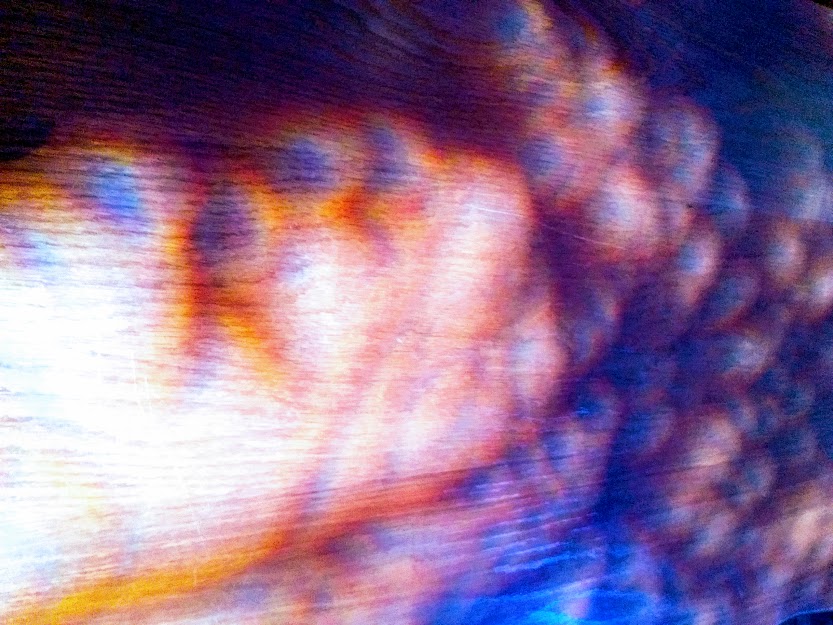
Rainbow Reflections on a bench at the Harriet Tubman Underground Railroad Historic Park.
I need to sit quietly and spend some time understanding all that I have learned and experienced in the last three days as we’ve explored the Harriet Tubman Byway near Cambridge, Maryland. Words like inspiring and life-changing don’t quite do it justice.
Meanwhile, here is a poem I wrote in 2015 after a church meal at the house of friends. I had plans then to revise it, and never did. Perhaps that might be the task of the week ahead.
The Cherry Tree
After we had eaten, the adults shared stories in a circle underneath the trees.
The children rode the tractor wagon down the hill to splash and wander up the creek almost out of hearing or gather sweet black raspberries to pass around in paper cups, each set of fingers smashing down the fruit below until all was sludge scooped out and licked from purple hands: a sacrament.
Back from the creek and the fields and the barn they came, dripping water, straw in their hair, trailing jewelweed, clothes and fingers and smiles stained purple from berries.
We gathered beneath the cherry tree with buckets and bags. We all were children then, in the kingdom of the cherry tree, laughing, leaping high to catch her boughs to draw the clusters down within our reach. We could not hope to get them all, even when the children scampered up into her branches.
We laughed and were amazed at the wild abundance of the tree. And this was church as ever church can be, all of us filled, dazzled, alit.
May your mouth be filled with sweetness. May your ears be filled with the laughter of children. May your heart be as wide and open as the blue sky. And may your stories blend with the stories of others, reaching out and upward like the branches of a tree.
Friends I met on my walk yesterday: 1. Crow. Crow reminds me to get the wide perspective, to take on the adventure that any wind offers, to speak my mind. Crows don’t take heed for nothing. 2. Dogbane. Dogbane reminds me to be resourceful, to take note of the helpers who are always present, and to spin: cord, stories, prayers. . . 3. Deer. She ran across Schmuck Road, causing an SUV to brake. She reminds me to pause. She reminds me to love myself unconditionally, to live from the heart, to listen. 4. Monarch. He reminds me of resilience, how fragility and strength are not mutually exclusive. He reminds me to always look for beauty in everything. 5. Scarlet Pimpernel. A tiny five-petaled scarlet flower found in the grasses. When I was in college, I watched the old black and white movie The Scarlet Pimpernel, about a French dandy who uses disguises to rescue aristocrats condemned to the guillotine. What I took away from the movie is the importance of resisting the machines vengeance and death-dealing. Be surprising. Pop up wherever you’re needed.
I could have sworn there were teeth on that bird, how She came roaring into the room, wings wide, neck cast toward us like an arrow, hissing, engulfing us with feathers and fire.
No gentle dove, She.
No quiet candle flame
setting the saintly halos aglow.
We were herded by holiness,
dented by Her divinity,
shaken, awakened–that beak
breaking us open.
We shattered, pieces
scattering the floor,
the fire pouring through us
as the wind spilled in the door.
Things That Made Me Happy Today (Another way to say Gratitude): 1. The chenille bedspread. It’s so comforting to snuggle up under it. 2. My Best Bird, the Oriole, flitting in and out of the honeysuckle vines all morning. 3. The holler is filled with the scent of honeysuckle. 4. Reading Bud, Not Buddy with the kid before he headed off to school this morning. 5. Completing the grading for four of my six classes. Only two more to go! 6. Talking on the phone with Sarah this morning. 7. The way the sun dapples the pathway the deer have made in the bosque across the stream. 8. How Ellis hums to himself wherever he is, like his dad.
I know. No posts for a week or more, and then two in one day. I’m out of school, and all the things I have not had time to think are now finding their way into my brain.
Here’s a plea: Can we please cut out the personal insults to the president’s appearance, please? It’s too easy, too below the bar, too off-point. We have too much at stake to muddy our message with meanness.
The tuxedo pictures with the Queen? Isn’t that just fat-shaming? Yes, Obama looked terrific in a tux, but I didn’t vote for Mr. Obama because of his body. I liked him because he did his best to try to level the playing field a little. I liked him because he read and understood liberation theology. I liked him because he was well-read and well-spoken, and a man of grace and character. I liked him because he had a plan to make health care accessible to all, and he tried his best to make it happen.
By the same lights, I don’t care what Mr. Trump looks like in a tuxedo. He could look classy and stylish and debonair, and he would still be someone who enacts fascist-style policies that tear children away from asylum-seekers without any intention of getting them back together again. He could be svelte and handsome and charming and still gut environmental protections while denying the climate crisis.
PThe fake tan? Can we just stop with the Cheeto references? Let’s not make fun of people’s skin color, okay? Even when it’s self-inflicted. Didn’t we learn that one a long time ago, from some wise man, that we should judge people on the basis of their character rather than the color of their skin? And there are more than a few aspects of Mr. Trump’s character that make me question his suitability to run a country: blatant misogyny, racism, religious bigotry, classism, narcissism. . . We really need to focus on those: they’re what make him a dangerous leader.
Basic Logic 101 teaches us about the ad hominem fallacy, attacking the person rather than the issue. We have plenty of strong arguments as to why this man is at best a poor leader and at worst a dangerous one, but we weaken our arguments with ad hominem attacks on his personal appearance. We lose our focus on the real dangers he poses to vulnerable people, and we trivialize the actual pain he and his policies cause, when we make fun of his appearance. Plus, it gives people an excuse not to take our very real concerns seriously. Also, would you make fun of your rotund cousin in his tuxedo? Would you make fun of your friend who has rosacea?
I am all for the work of the sacred clown in society, making fun of people who refuse to self-reflect. When a president has his press flunkies lie about the size of his inauguration crowd, then it seems fitting to point out the size of the crowd that turns out to protest his presence in the UK. When he uses Twitter as a platform to spew wild and conspiracy-laden ideas, as well as a forum for personal aggrandizement, then it seems right to point out the ridiculousness in his tweets. But the size of his belly and the color of his face have nothing to do with the size of his crowd or his Twitter status.
Meanwhile, children who have been torn from their parents (nursing babes, toddlers, all the way up to teens) are in camps and detention centers, receiving minimal care and no education, from what I am able to gather. They’re subject to sexual and physical abuse. Reporters are not allowed to film or photograph conditions, if they’re allowed in at all.
Meanwhile, transgender people are in danger of losing human rights protections for medical care. Meanwhile, women are losing reproductive rights. Meanwhile, the environment is being destroyed, and the warnings about impending ecological devastation are ignored or denied.
We need to actively work to remove this man AND his enablers from power, not sit around taking potshots at his appearance.
I hate to be a scold. I know it feels good in the moment to stoop to his level. I know that because I have done it. But it doesn’t feel good in retrospect, to get down in that mud. We don’t save this country by name-calling. We save it by truth-telling. By action on behalf of the vulnerable. By holding the greedy and power-hungry accountable for their speech and their actions. Let’s get to work.
The shooter was disgruntled. An employee. The shooter died after a gunfight with police. The gunman was a worker.
The day was most devastating. The most devastating in history.
The people involved were our neighbors. The shooter was confronted shortly after opening fire. There was an exchange of gunfire. The police officer’s vest stopped a bullet. The police officer was injured.
People heard someone falling. People went to investigate. There was a woman. There was blood all over. Get out of the building! The guy’s got a gun!
Unsure how to react. In a way you want to stay. In a way you don’t want to stay.
The shooting occurred when people were conducting business. People were hiding under their desks.
Police found a pistol and a rifle. The suspect is thought to have purchased the firearms legally. People can take guns into public buildings. The mass shooting took place. The FBI is responding. The president has been briefed.
Six people were hospitalized. Deadliest mass shooting. Since November. Twelve people were killed. Senator devastated by the news. My heart is with everyone. Praying for a swift recovery. Praying for all involved as we learn more. Praying for our city. We are resilient. We will get through this. Stronger than before. We always do.
Gratitude List: 1. Dreaming of crows. The way poet/priestesses unpack the images. Snuggling my shadows. 2. Today I had so many opportunities to do my WORK. Teaching is my vocation, and I love so much about it, but the best thing about it is that it lets me do my Work. It includes tears and hugs and hard conversations and so much self-reflection. 3. Curiosity. When people get curious about each other. Curiosity is a fine engineer, building bridges of gossamer web and light across chasms. But stronger bridges than you can imagine. 4. This fine boy of mine, who keeps being ahead of himself in so many ways. Perhaps what I mean to say is that he is ahead of my perceptions. Or that he grows into whatever space he enters. With grace and thoughtfulness. . .and curiosity (there it is again). He leaves a stage of childhood behind tonight at his eighth grade graduation. 5. Cool breezes. This means exactly what it says, because my room is hot as a sauna. But then it means more than that because your poems and your wisdom and your presence in the world are cool breezes to me, my friends.
If you could trust your voice completely, if you didn’t have to consider how how others would respond, if you didn’t have to be safe, to be tame, to be docile and humble, acceptable and charming and quiet, if you had not been trained to make your words into an easy chair, to turn your voice to honey: What would you say?