Take a Breath

On November Tuesdays on the Poetry page of Writers Digest, Editor Robert Lee Brewer offers dual prompts. He always suggests that you can choose to one or the other or both. I am an Enneagram Seven, and so I am always tempted to do both. Today’s prompt is to write a form poem and/or an anti-form poem.

I have spent entirely too much fluttery energy today trying to create a form poem. I wanted to do a prosey run-on stanza without line breaks, and then suddenly shift into a Rondolet, and back to a prose stanza, but my Rondolets all come out sounding hackneyed and stilted, and my brain is beginning to turn fuzzy, and I still haven’t gotten my lesson plans finished for tomorrow. (You can see how that whole free-association, running sentence thing began to influence my writing.) Plus, I have been feeling tremendous pressure today to create a poem that somehow speaks truth to power on Election Day. In desperation, I just began to type, and tried to settle on something that had a little more form than simply free verse, but that gave me room to breathe a bit.

I am not prepared to sing
at the funeral of democracy,
not ready to recite the ode
that hails her tragic death.

I will not open the door
to the reign of hate and cruelty,
will not welcome the travelers
who enter with bared teeth.

Circle ’round, and let’s tell stories
of the world we hope to see.
Let’s sing songs, and weave spells
of a hopeful future.

Take a breath.
Take a breath.
Take a breath.


Gratitude List:
1. The morning’s cocoon of a moon
2. Golden time in the woods with joyful children
3. Shifting. Perhaps tomorrow morning I’ll feel differently, but right now, I feel a shifting that feels hopeful
4. Carpet otters
5. Stones that speak
May we walk in Beauty!


“Tyrants fear the poet.” —Amanda Gorman


“Don’t be ashamed to weep; ’tis right to grieve. Tears are only water, and flowers, trees, and fruit cannot grow without water. But there must be sunlight also. A wounded heart will heal in time, and when it does, the memory and love of our lost ones is sealed inside to comfort us.” ―Brian Jacques


“Those who contemplate the beauty of the Earth find reserves of strength that will endure as long as life lasts.” ―Rachel Carson, The Sense of Wonder


“Love is the bridge between you and everything.” ―Rumi


“Come senators, congressmen
Please heed the call
Don’t stand in the doorway
Don’t block up the hall
For he that gets hurt
Will be he who has stalled
There’s a battle outside
And it is ragin’
It’ll soon shake your windows
And rattle your walls
For the times they are a-changin’.”
―Bob Dylan

Don’t Adapt

“Resist,” by Beth WK and the Wombo Dream AI. Poetry prompt: Adaptation–from Robert Lee Brewer at Writers Digest.

They will tell you you’re stronger
if you just adapt, just accept their maps
and guidebooks to the town called Normal.

How long will it take,
oh, how long will it take
till you’ve shaped your soul to the prevailing patterns,
till you’ve taken on cruelty as the modus of operation?

And when you’ve accepted your own degradation,
how long yet till you’re doing it, too,
till you’re telling the world
it’s just a song called Survival?

Oh, don’t give up your heart,
don’t learn their brutal tune,
don’t follow the marching orders
when your number is called.

Let them call you heretic, rebel, and witch.
Don’t let them make you afraid.
Keep your golden soul shiny,
keep your spirit intact.
Don’t adapt. Don’t adapt.


Gratitude List:
1. Contemplative donkey munching thistles in a field
2. The Moon!
3. The web that connects us all
4. A deer in the dawn watching me watch him
5. Breaking out of boxes of expectation
May we walk in Beauty!


“The stories I’m trying to write, and which I want to promote, are stories that contribute to the stability of my own culture, stories that elevate, that keep things from flying apart.” —Barry Lopez


“What the world wants, and people need, are people who believe in Something—Something that will lead them to the good, the beautiful, the true, and the universal.” —Richard Rohr


“Love takes off the masks that we fear we cannot live without and know we cannot live within. I use the word “love” here not merely in the personal sense but as a state of being, or a state of grace – not in the infantile American sense of being made happy but in the tough and universal sense of quest and daring and growth.” —James Baldwin


“I am not talking about giving our hearts over to despair. I wonder if we can train our hearts, intentionally, like athletes who train for a marathon, to bear the load without crumpling under the weight. I think that’s what the children need from us, for us to bear them, bear the stories, hold them as though they were our own, to be prepared to act at any moment for any one of them within our reach. I think the times call for hearts strong enough to be tender, to bleed without weakening, to rage and protect and pray and hope without numbing out.

“I don’t think it has to be a choice. We don’t have to choose between the closed heart and the broken heart. We can be awake and yet not despair. It’s worth a try.” —Beth Weaver-Kreider


“If we are going to see real development in the world, then our best investment is in women.” —Desmond Tutu


“Activism is the rent I pay for living on this planet.” —Alice Walker


“When you arise in the morning, think of what a precious privilege it is to be alive—to breathe, to think, to enjoy, to love.” —Marcus Aurelius


Found on a T-shirt: “I am totally happy and not dangerous mostly.”


“Part of the tragedy of our present culture is that all our attention is on the outer, the physical world. And yes, outer nature needs our attention; we need to act before it is too late, before we ravage and pollute the whole ecosystem. We need to save the seeds of life’s diversity. But there is an inner mystery to a human being, and this too needs to be rescued from our present wasteland; we need to keep alive the stories that nourish our souls. If we lose these seeds we will have lost a connection to life’s deeper meaning—then we will be left with an inner desolation as real as the outer.” —Llewellyn Vaughan-Lee


Adrienne Rich: “When a woman tells the truth she is creating the possibility of more truth around her.”

Making Tuesday’s News

It’s not my most poetic of poems, but RLB’s prompt at Writers Digest was to write a news poem, and right now, I’m preparing my inner self to deal with the this coming Tuesday’s news. I kind of copped out at the end. . .

What will you do with Tuesday’s news?
Will you lose your head in a whirling tizzy
or sink into a slough of desperate sadness?
Will you dance on political graves
of the ones you wanted to vanquish?
Will you wear a crown of gloating laurels?

Will you follow the call of your guru and your gut
to make the world a kinder place?
Will you follow the call of your humanity
to make the space more humane?
Will you call out the gleeful cruelty,
and stand up for those who were left behind?

What will you do for democracy?
What will you do for your neighbor?


Really, please vote. Please help to stand up to the forces of fascism. Stand up for kindness and goodness and love and democracy.


Gratitude List:
1. Democracy–it’s really a good idea
2. Kindness
3. Zooming with my beloveds
4. The color! Oh, the color!
5. How prayer changes me
May we walk in Beauty!


“Walked for half an hour in the garden. A fine rain was falling, and the landscape was that of autumn. The sky was hung with various shades of gray, and mists hovered about the distant mountains – a melancholy nature. The leaves were falling on all sides like the last illusions of youth under the tears of irremediable grief. A brood of chattering birds were chasing each other through the shrubberies, and playing games among the branches, like a knot of hiding schoolboys. Every landscape is, as it were, a state of the soul, and whoever penetrates into both is astonished to find how much likeness there is in each detail.” —Henri Frederic Amiel


Chasing Chickens
by Elizabeth Weaver-Kreider
.
I’ve counted my chickens.
A dozen times or more they’ve dashed–
dashed, I tell you–
into blackberry canes,
wings whirring.
.
White clouds of dust engulf me.
Their voices chuckle
from the cliff’s edge.
Don’t tell me about chickens.
I’m green, baby. Green.
And I don’t know how
I’m getting home from here.
—Beth Weaver-Kreider


There is a legend that has its roots buried deep inside the prehistoric culture of these lands. It is a myth that was seeded before the stories were anchored onto the page, before rigid systems of belief tied gods and spirits into names and form, even before the people were persuaded from paths of individual responsibility into hierarchies of power. This story has been fluid and flowing, changing shape and growing over many thousands of years. It is a story of ancestors and a deep relationship with the ancient land. It is a story of memories that permeate stone and wood to rest within the body of the earth. This legend is too old to be defined by history and therefore we are not limited in our own remembering of it; creative recollection lies at the heart of our very best tales.

Memory may arrive at odd moments and in unexpected forms. Recognition may unravel along strange paths. Wherever the wild reaches through the land, we may touch the edges of this story. We start to tease out a thread, then pick and pull until first a fragment of colour, then a whole strand of story, is revealed. Now we peel away the layers, glimpse the traces of a design, watch a pattern grow until an entire story emerges, then a cycle of stories, and now we are unwinding the fabric of our ancestors’ lives.” —Carolyn Hillyer


We stumble on the journey, O God.
We lose heart along the way.
We forget your promises and blame one another.
Refresh us with the springs of your spirit in our souls
and open our senses to your guiding presence
that we may be part of the world’s healing this day,
that we may be part of the world’s healing.
—John Philip Newell

Perilous

Art by Beth and AI.

Today’s Poetry Prompt, suggested by Robert Lee Brewer of Writers Digest, is Peril. This one feels incomplete. . .

Oh Lady of the Labyrinth,
Mother of Midnight,
Queen of the star-strewn Heavens,
only now do I know that I need not pray
that the way will be windswept and winsome,
that the dreams will be joyful and golden.

For it was on the perilous path that you found me,
and the moment I stumbled you came to my aid.
When the road was encumbered by shadows,
you grasped my hand and said, “Follow.”


Gratitude List:
1. An absolutely pleasant day
2. All the colors of autumn
3. Riding Rail Bikes at Seven Valleys
4. Cats in the family
5. An extra hour
May we walk in Beauty.


“Safety is not the absence of threat.
It is the presence of connection.” —Gabor Maté


“Mercy is the willingness to enter into the chaos of another.” —James Keenan


Expose yourself to your deepest fear. After that, you are free.” —Jim Morrison


“You need not wade through the mists and bogs to reach the moon.
You need not climb a ladder of cobweb.
You need not ride the stallions that wicker in the sea’s pounding surf.

Draw back the curtain and open the window.
Breathe the bracing air and listen:
The whinny of an owl, the click of the bat,
The grunt of a buck and the distant roar of the train.

The full moon will spill a milky road before you.
That is all the pathway you will need.”
—Beth Weaver-Kreider


“The word is the making of the world.” —Wallace Stevens


“Through the empty branches the sky remains.
It is what you have.” —Rainer Maria Rilke


“The leaves of the tree become as pages of the Sacred Book to one who is awake.”
—Hazrat Inayat Khan


“Our task must be to free ourselves by widening our circle of compassion to embrace all living creatures and the whole of nature and its beauty.” —Albert Einstein


“I must remind you that starving a child is violence. Suppressing a culture is violence. Neglecting school children is violence. Punishing a mother and her family is violence. Discrimination against a working man is violence. Ghetto housing is violence. Ignoring medical need is violence. Contempt for poverty is violence.” —Coretta Scott King


“When you feel the suffering of every living thing in your own heart, that is consciousness.” —Bhagavad Gita


“And now here is my secret, a very simple secret: It is only with the heart that one can see rightly; what is essential is invisible to the eye.”
―Antoine de Saint-Exupéry, The Little Prince


“The most beautiful things in the world cannot be seen or touched, they are felt with the heart.”
―Antoine de Saint-Exupéry, The Little Prince


“Just that,” said the fox. “To me, you are still nothing more than a little boy who is just like a hundred thousand other little boys. And I have no need of you. And you, on your part, have no need of me. To you I am nothing more than a fox like a hundred thousand other foxes. But if you tame me, then we shall need each other. To me, you will be unique in all the world. To you, I shall be unique in all the world….”
―Antoine de Saint-Exupéry, The Little Prince


“It is such a mysterious place, the land of tears.”
―Antoine de Saint-Exupéry, The Little Prince


“And when your sorrow is comforted (time soothes all sorrows) you will be content that you have known me. You will always be my friend. You will want to laugh with me. And you will sometimes open your window, so, for that pleasure . . . And your friends will be properly astonished to see you laughing as you look up at the sky! Then you will say to them, ‘Yes, the stars always make me laugh!’ And they will think you are crazy. It will be a very shabby trick that I shall have played on you…”
―Antoine de Saint-Exupéry, The Little Prince


“Before you know kindness as the deepest thing inside,
you must know sorrow as the other deepest thing.
You must wake up with sorrow.
You must speak to it till your voice
catches the thread of all sorrows
and you see the size of the cloth.”
―Naomi Shihab Nye

The Song

Art by me and the AI. Robert Lee Brewer’s prompt today was to write a poem that begins, In the. . .

In the hard times, you could still hear the song.
In the skeleton days when all you could do
was to drop out of bed in the quiet dawn to pray,
even then, you could hear it, the gentle melody
underneath the jangling and dissonant voices
that clamored for attention in your head.
Even when your insides were displayed on street corners
for all to see, the hopeful notes floated around you,
small birds that only you could sense, like angels,
leading you through the chanting crowds.

In the house made of sunlight and bone,
where your spirit found shelter
after the ravening creatures of malice and spite
had picked your very soul clean of flesh and sinew,
there, in the liquid autumn air, the music expanded,
mending the breakage, tending the spaces
like cobwebs, repairing the breaches, weaving
the song through the aching gaps, declaring you whole.


Gratitude List:

  • The calm and peace of Friday evenings
  • That autumn slant of light
  • Leaves drifting gently down
  • I get by with a little help from my friends
  • Music

May we walk in Beauty!


(Today’s quotations come in pairs that interact with each other)
“Both when we fall and when we get up again, we are kept in the same precious love.” ―Julian of Norwich
*
“What if I should discover that the poorest of the beggars and the most impudent of offenders are all within me; and that I stand in need of the alms of my own kindness, that I, myself, am the enemy who must be loved–what then?” ―Carl Jung
*****
“I think, at a child’s birth, if a mother could ask a fairy godmother to endow it with the most useful gift, that gift should be curiosity.”
―Eleanor Roosevelt
*
“If I had influence with the good fairy, I would ask that her gift to each child be a sense of wonder so indestructible that it would last throughout life.”
―Rachel Carson
****
“Your problem is you’re too busy holding onto your unworthiness.” ―Ram Dass
*
“In giving of yourself, you will discover a whole new life full of meaning and love.” ―Cesar Chavez
****
“While there is a lower class, I am in it, while there is a criminal element, I am of it, and while there is a soul in prison, I am not free.”
―Eugene V. Debs
*
“I’ll be in the way kids laugh when they’re hungry and they know supper’s ready, and when the people are eatin’ the stuff they raise and livin’ in the houses they build – I’ll be there, too. Ma Joad: I don’t understand it, Tom. Tom Joad: Me, neither, Ma, but – just somethin’ I been thinkin’ about.”
―Tom Joad, from the movie Grapes of Wrath

Misguided

Art: “A New Beginning” by Beth and the AI. Prompt: “Write a Misguided poem,” by Robert Lee Brewer of The Writers Digest.

Take the misbegotten moment,
the misinterpreted glance,
the misguided misapprehension,
and the miserable chance.
Take the mistakes you’ve made,
the misjudgments.
Take the mischief and the misaim.
Then take out your finest eraser,
and start all over again.


Gratitude List:
1. Chances to start over
2. The second half
3. Revision
4. StoryCorps
5. Lemon Drops
May we walk in Beauty!


“Awake, my dear. Be kind to your sleeping heart. Take it out into the vast fields of light and let it breathe.” —Hafiz


“Mercy is the willingness to enter into the chaos of another.” —James Keenan


“The heavens are sweeping us along in a cyclone of stars.” —Teilhard de Chardin


“Sometimes I hear it talking. The light of the sunflower was one language, but there are others more audible. Once, in the redwood forest, I heard a beat, something like a drum or heart coming from. the ground and trees and wind. That underground current stirred a kind of knowing inside me, a kinship and longing, a dream barely remembered that disappeared back to the body. Another time, there was the booming voice of an ocean storm thundering from far out at sea, telling about what lived in the distance, about the rough water that would arrive, wave after wave revealing the disturbance at center.

Tonight I walk. I am watching the sky. I think of the people who came before me and how they knew the placement of stars in the sky, watched the moving sun long and hard enough to witness how a certain angle of light touched a stone only once a year. Without written records, they knew the gods of every night, the small, fine details of the world around them and of immensity above them.

Walking, I can almost hear the redwoods beating. And the oceans are above me here, rolling clouds, heavy and dark, considering snow. On the dry, red road, I pass the place of the sunflower, that dark and secret location where creation took place. I wonder if it will return this summer, if it will multiply and move up to the other stand of flowers in a territorial struggle.

It’s winter and there is smoke from the fires. The square, lighted windows of houses are fogging over. It is a world of elemental attention, of all things working together, listening to what speaks in the blood. Whichever road I follow, I walk in the land of many gods, and they love and eat one another. Walking, I am listening to a deeper way. Suddenly all my ancestors are behind me. Be still, they say. Watch and listen. You are the result of the love of thousands.” —Linda Hogan


Expose yourself to your deepest fear. After that, you are free.” —Jim Morrison


Joseph Campbell: “The cave you fear to enter holds the treasure that you seek.”

Sweetness

Day two of Poem a Day! Prompt (Sweetness) from Robert Lee Brewer at Writers Digest, and art from my own collaboration with Wombo Dream AI.

Birth of a Poem

A poem is not born
until it hits the air,
until you’ve tasted
its sugar on your tongue,
shaped it with your lips,
felt the hiss and slither
as the words meet the soft,
sweet curl of your ears,
those precious shells,
which yearn for music,
which long for golden truth.


Gratitude List for All Souls:
1. Lizzie and Lura and Marian and Mammy
2. Wangari and Rachel
3. Harriet and Sojourner and Dorothy
4. The Witches and Rebels and Heretics
5. Annwyn and Nathan and Merle and Carl
. . .and all those bright spirits gathered around
our remembering hearts.
May we walk in Bright Memory.


“No warmth, no cheerfulness, no healthful ease,
No comfortable feel in any member—
No shade, no shine, no butterflies, no bees,
No fruits, no flowers, no leaves, no birds—
November!”
—Thomas Hood, No!


“I could not be a poet without the natural world. Someone else could. But not me. For me the door to the woods is the door to the temple.” —Mary Oliver


“Nourish beginnings, let us nourish beginnings. Not all things are blest, but the seeds of all things are blest. The blessing is in the seed.” —Muriel Rukeyser


“We discover the Earth in the depths of our being through participation, not through isolation or exploitation. We are most ourselves when we are most intimate with the rivers and mountains and woodlands, with the sun and the moon and the stars in the heavens… We belong here. Our home is here. The excitement and fulfillment of our lives is here… Just as we are fulfilled in our communion with the larger community to which we belong, so too the universe itself and every being in the universe is fulfilled in us.” —Thomas Berry, The Sacred Universe


Words of Howard Zinn:
“We don’t have to engage in grand, heroic actions to participate in the process of change. Small acts, when multiplied by millions of people, can transform the world. Even when we don’t ‘win,’ there is fun and fulfillment in the fact that we have been involved, with other good people, in something worthwhile. We need hope.

“An optimist isn’t necessarily a blithe, slightly sappy whistler in the dark of our time. To be hopeful in bad times is not just foolishly romantic. It is based on the fact that human history is a history not only of cruelty, but also of compassion, sacrifice, courage, kindness. What we choose to emphasize in this complex history will determine our lives. If we see only the worst, it destroys our capacity to do something.

“If we remember those times and places—and there are so many—where people have behaved magnificently, this gives us the energy to act, and at least the possibility of sending this spinning top of a world in a different direction. And if we do act, in however small a way, we don’t have to wait for some grand utopian future. The future is an infinite succession of presents, and to live now as we think human beings should live, in defiance of all that is bad around us, is itself a marvelous victory.”


Bill Maher:
“Christians, I know, I’m sorry; I know you hate this and you want to square this circle, but you can’t. I’m not even judging you. I’m just saying, logically, if you ignore every single thing Jesus commanded you to do, you’re not a Christian. You’re just auditing. You’re not Christ’s followers. You’re just fans.”


“Come, come, whoever you are. Wanderer, worshiper, lover of leaving. It doesn’t matter. Ours is not a caravan of despair. Come, even if you have broken your vows a thousand times. Come, yet again, come, come.” ―Jelaluddin Rumi

Beginnings and Endings

It’s November! Time for a Poem a Day! I am following Robert Lee Brewer’s Prompts over at The Writer’s Digest. Today, he suggests a Beginnings/Endings poem (or one or the other). The art is a collaboration between me and the Wombo Dream AI.

Another Month to Feed
by Beth Weaver-Kreider

Perhaps it’s always rabbits
at the mouth of the month
because beginnings come
so often timidly, twitching noses
in the shadows, marking a small
moment in the never-ending
spiral of time, one birth in
an incandescent infinity
of new beginnings, yet
another meal for the wolf
of the month to come.


Gratitude List:
1. Poetry prompts
2. The two children who held my hands in the woods yesterday.
3. Social/emotional learning and teaching
4. Finding fresh purpose
5. Miracles
May we walk, oh so tenderly, in Beauty!


“I am passionate about everything in my life, first and foremost, passionate about ideas. And that’s a dangerous person to be in this society, not just because I’m a woman, but because it’s such a fundamentally anti-intellectual, anti-critical thinking society.” —bell hooks


“Bless the light and the darkness, the love and the fear.” —Rabbi Olivier BenHaim


“It doesn’t matter who you are or what you look like, so long as somebody loves you.” —Roald Dahl, The Witches


“For women who are tied to the moon, love alone is not enough. We insist each day wrap its knuckles through our heart strings and pull. The lows, the joy, the poetry. We dance at the edge of a cliff. You have fallen off. So it goes. You will climb up again.” —Anais Nin


“The creation of a thousand forests is in one acorn.” —Ralph Waldo Emerson


“In the morning I went out to pick dandelions and was drawn to the Echinacea patch where I found a honeybee clinging to one of the pink flowers. She seemed in distress, confused and weak. She kept falling off the flower and then catching herself in midair and flying dizzily back. She kept trying to get back to work, to collect her pollen and nectar to take home to the hive to make honey but she was getting weaker and weaker and then she fell into my hand. I knew she would never make it back to her hive. For the next half hour she rested in my palm, her life slowly ebbing away as a thunderstorm started to brew. I sat on the earth waiting for death with her. The lightning flashed over the mountains, a family of turkeys slowly walked the ridge, a wild dog keyed into what was happening circled past us. The trees appeared startlingly vivid and conscious as the wind blew up and the thunder cracked and then her death was finished. She was gone forever. But in her going she taught me to take every moment as my last flower, do what I could and make something sweet of it.” —Layne Redmond


“Let me seek, then, the gift of silence, and poverty, and solitude, where everything I touch is turned into prayer: where the sky is my prayer, the birds are my prayer, the wind in the trees is my prayer, for God is all in all.” —Thomas Merton


“Beware; for I am fearless, and therefore powerful.” —Mary Wollstonecraft Shelley, author of Frankenstein


Audre Lorde:
“For women, then, poetry is not a luxury. It is a vital necessity of our existence. It forms the quality of the light within which we predicate our hopes and dreams toward survival and change, first made into language, then into idea, then into more tangible action.
.
Poetry is the way we help give name to the nameless so it can be thought. The farthest external horizons of our hopes and fears are cobbled by our poems, carved from the rock experiences of our daily lives.
.
As they become known and accepted to ourselves, our feelings, and the honest exploration of them, become sanctuaries and fortresses and spawning grounds for the most radical and daring of ideas, the house of difference so necessary to change and the conceptualization of any meaningful action. Right now, I could name at least ten ideas I would have once found intolerable or incomprehensible and frightening, except as they came after dreams and poems. This is not idle fantasy, but the true meaning of “it feels right to me.” We can train ourselves to respect our feelings, and to discipline (transpose) them into a language that matches those feelings so they can be shared. And where that language does not yet exist, it is our poetry which helps to fashion it. Poetry is not only dream or vision, it is the skeleton architecture of our lives.”


“Wake at dawn with a winged heart and give thanks for another day of loving.” —Khalil Gibran

Justice

Since I began this project of creating a tarot deck cooperatively with an online AI generator, the AI itself has evolved so rapidly, and the creators of the generator itself have added so many new features that within the six months since I began, the initial artwork is beginning to feel clunky and old-fashioned. I realize that the work I did to create it was a helpful process, not only in terms of my ideas about the the inner journey and about the tarot, but also in terms of my sense of the artistic and poetic process of cooperating with an AI. I find myself wanting to begin again. Maybe this process will never have an end product, but will simply be a part of my own inner growth. Perhaps I will end up instead creating an oracle deck with the characters that inhabit my own inner meditations: The Psychopomp, the Witch, The Dreamer-Mother, the Two Elves, The Gnomes of Beautiful Vision and Music, The Companion, The Golden One, Death, The Bees, Eagle, Six Crows, The Dancing Fox, Running Deer, The Golden-Crowned Tree, The Lady of the Labyrinth, The Darkness. . . Or perhaps, even, they will merge in some inexplicable way.

So here, halfway through the Major Arcana of the Tarot, I will finish this series for now, with Justice.

What does Justice mean to you? Is it the blind goddess holding her scales and a sword? I find it really interesting that Cupid and Justice are both portrayed in blindfolds: Love and Justice–an odd cosmic balance there.

Is Justice a balance of vengeance? Eye for eye? You hurt me, so I get to extract my pound of flesh from your stony heart.

Is it about karma? The bad stuff we do will come back to haunt us, so we can all relax, knowing that our enemies will eventually get their cosmic comeuppance? I know karma is a lot more complicated and nuanced than that, but I think we sometimes reduce it to this little dance of joy over cosmic rebalancing, celebrating the downfall of the evil-doer.

I want the people who hurt people to be held accountable. I want the ones who are injured and harmed to be seen and heard and listened to, to receive apology or remuneration or recompense for their injury. I don’t need an eye for an eye, but I need the harm to stop. I need the tools of the narrative to be wrested from the hands of the ones who do the injury and handed to the ones who were injured.

Restorative Justice has become a bit of a catchword in institutions these days, especially church-based institutions. When understood and practiced with depth and skill, it’s a wonderful tool for healing and returning to balance, offering a circle of story-telling, where the injured party can speak of their pain and suffering, and the ones who caused harm listen, and take account of what they have done to cause harm. In the process, they, too, get to speak, to tell their own pieces of the experience. We enter restorative justice circles with a recognition that harm has been done, and that healing is possible, but only if we meet ourselves and each other at deep, deep levels of accountability can we hope to repair the breaches in relationships.

Saying that you practice restorative justice, but doing the work half-heartedly or simply to score social points only causes more harm in the long run. Institutions, clubs, churches, and organizations that claim to do restorative justice work but only implement the process when the most powerful members of the group want to exercise controls over less powerful members of the group is an abuse of power and is the antithesis of restorative justice.

The Justice card holds us to keep high moral and ethical codes that include ourselves as well as others. We hold ourselves to the standards we demand of others. We offer others the grace and mercy we would show ourselves. Sounds a little like the Golden Rule.


Tomorrow is November. I am hoping to do a poem a day for the month.


Gratitude List:
1. My compassionate and tender-hearted and fun-loving colleagues. They made Halloween so special and magical and fun for the kids (while also managing to keep things educational).
2. The turning of the wheel. We step into a new season. We can change, metamorphose, transform.
3. Presence. Accompaniment. Companionship.
4. Cats
5. Golden, golden, golden: light and leaves and hearts.
May we walk ever in Beauty!


The wheel turns.
The harvest is in.
The veil parts.
We walk into the dark time.
Dream well.
Bright Blessings.
—Beth WK


“The moon has awoken with the sleep of the sun, the light has been broken; the spell has begun.” —Midgard Morningstar


“A labyrinth is a symbolic journey . . . but it is a map we can really walk on, blurring the difference between map and world.” —Rebecca Solnit


“Turn inward: If you’re asking ‘why’, also ask why ‘why’? If your power is to question, also question the questioner in you.” —Shunya


“Everybody is trying to make their journey till death comfortable. In the process they are missing the moments that can open the door to immortality.” —Shunya


“Walk through the veil of the season.
Carry your own little light into the dark time.
Celebrate the inward spiral.” —Beth WK

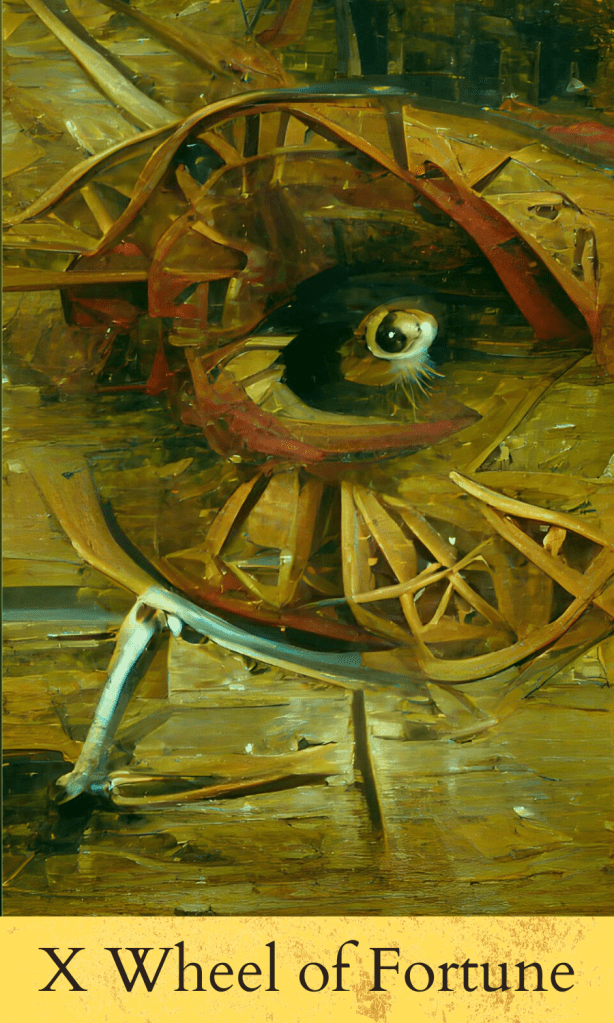
The Wheel Turns

“Fortune, good night; smile once more, turn thy wheel.” –King Lear (2.2.169).

How is your fate determined? Are you destined to live a life decided by the vagaries of fate? Or are you, as William Ernest Henley declares in “Invictus,” the master of your fate? The Greeks wrestled mightily with the question in their ancient plays and poems. Do I bring my fate upon me by trying to avoid the fate the gods have ordained and the oracles have declared? Over and over again, humans in the ancient Greek tales, are playthings of the gods, unable to escape their fate, caught more inextricably within Fortune’s Wheel the more they try to escape.

The ancient Greek goddess Tyche (Fortuna to the Romans) was said to spin her Wheel capriciously, setting peasants and paupers in powerful positions, and kings and saints in the mud and the dust. The Wheel is the symbol of that which we cannot control: the accidents and diseases, the privilege we are born with or without, the world events that set the stage for the eras into which we are born.

And yet, this card reminds us, we are never without choices. We may not be able to control the Wheel’s turning, but we control our own responses. We make choices that affect the patterns of our lives within the larger framework of the fate that happens to us. Some people come to the tarot as they come to an oracle: Tell me what is going to happen to me so I can prepare myself for my fate. A healthier approach, and the one suggested by this card, is to use the cards to better understand ourselves so that we can respond in a wise and grounded manner when we seem to be wrenched out of our even keel by changes beyond our control.

In Shakespeare’s Julius Caesar, Cassius, trying to convince Brutus to help him assassinate Caesar, tells him, “The fault, dear Brutus, is not in our stars, but in ourselves that we are underlings.” And later, when the brutal deed is done, and Cassius begins to doubt that they can win the coming battle, Brutus acknowledges the role of fate in their destiny–“There is a tide in the affairs of men”–but urges Cassius again to action, to take that tide at the flood, which will lead them to their fortune, cautioning him that to refuse to take such a tide will lead them to ruin.

Sometimes, the Fool learns in the tarot journey, the wisest path is to be ready for the tide, like a surfer awaiting the perfect wave, to grab fortune as it approaches, and let it carry you to greater heights. And sometimes, it is helpful to sort out your story by remembering that not everything that happens to you is by choice, that you did the best you could with what you had. And mostly, it helps to know yourself well, so you can be equipped to make choices and to respond in healthy ways.

The Wheel of Fortune is one of the central motifs of Shakespeare’s great (greatest, in my opinion) play, The Tragedy of King Lear. As a teenager reading the play, I fell in love with the Fool, perhaps the play’s wisest character. Lear’s Fool seems to disappear out of the play, perhaps to surface in the tarot cards to gently advise us, as he did King Lear: “Let go thy hold when a great wheel runs down a hill,/lest it break thy neck with following it; but the great/one that goes upward, let him draw thee after” (2.4.71-73).


Gratitude List:
1. Cautiously good news on the cancer front for two of my best beloveds
2. The angels
3. The little screech owl who is calling in the dusk
4. These golden, perfect days
5. The ability to choose how to respond
May we walk in Grace and Beauty!


“Love the earth and sun and animals,
Despise riches, give alms to everyone that asks,
Stand up for the stupid and crazy,
Devote your income and labor to others…
Re-examine all you have been told at school or church or in any book;
Dismiss whatever insults your own soul;
And your very flesh shall be a great poem.”
—Walt Whitman


“To love. To be loved. To never forget your own insignificance. To never get used to the unspeakable violence and the vulgar disparity of life around you. To seek joy in the saddest places. To pursue beauty to its lair. To never simplify what is complicated or complicate what is simple. To respect strength, never power. Above all, to watch. To try and understand. To never look away. And never, never, to forget.” ―Arundhati Roy


“Be like a headland: the waves beat against it continuously, but it stands fast and around it the boiling water dies down. “It’s my rotten luck that this has happened to me.” On the contrary, “It’s my good luck that, although this has happened to me, I still feel no distress, since I’m unbruised by the present and unconcerned about the future.” What happened could have happened to anyone, but not everyone could have carried on without letting it distress him. So why regard the incident as a piece of bad luck rather than seeing your avoidance of distress as a piece of good luck?” —Marcus Aurelius