Today I am home from school with a sick child. It’s a nice chance for some slow, quiet time in between checking his temperature and beating him mercilessly at a game of Monopoly.
It’s Ash Wednesday, the beginning of that 40-day journey before Easter, a moon-bound season between the season of Brigid and the season of Ostara. As spokes on the eight-pointed solar wheel, Brigid and Ostara occur on the same days every solar year: Groundhog’s Day and Spring Equinox, ancient celebrations of the quickening of life in the earth, and the time of hatching and birth that is spring. But Lent is fluid, floating along the surface of the solar year, woven into the cycles of the moon and its dance with that Equinox sun. On Brigid’s February morning, we look to our shadows and consider whether the light we have within us will serve us until the spring. We take stock of our inner reserves and resources. In Lent, we take that question further, considering the question of enough.
During Lent, we look inward and wonder at the holes and spaces within. We see our lack, and instead of shrinking away in fear and despair, we say, “Yes,” and “Yes” again. Here is who I am. I know that I can be one who betrays the Holy One, one with the potential to deny my beloved. I know how I can cringe in fear, hide in shadow, whimper and whine in dread and shame. And I know, too, that I can walk toward those shadows within myself, because only in walking through those shadows will I encounter the shining lights that sparkle on the other side–also within me.
Last night, I gathered with a group of colleagues and students from my school to participate in the first of five Racial Justice Trainings (workshops? seminars? mentoring sessions?) that will happen throughout the spring. During the evening, our facilitator, Dr. Amanda Kemp, challenged us to keep a journal during these weeks of trainings, to ground and center ourselves so that we can hold space for transformation, to walk toward our fear, to challenge our assumptions and implicit biases. It feels to me like just the discipline to take up on this moon-clad journey toward Easter, to consider this time of training as my Lenten Work.
So often we get Lent wrong. We think we have to do penance for our evil ways, to enshroud ourselves in shame, to bewail our miserable selves. But when we simply throw it all off as just an exercise in self-flagellation, I think we get it wrong, too. This is a time to look realistically at who we are inside, what our strengths and our failings are. Lent is a time of discipline–not beatings and beratings, but careful training and thoughtful self-education. Amanda inspires me to take hold of this coming season as a time to consider my accountability, to look at the ways in which I participate in the unjust systems of today, just as the religious elite at the turn of the millennium participated in the destructive systems of their day. In this season, I commit myself to assess my inner world, to take stock of my role in the breaches and breaks, to walk toward my fears, to become a mender and repairer of the web.
This morning on the way to school, a long, rangy V of geese flew over the highway. It took me a moment to realize that they were snow geese rather than the Canada geese we see almost every day. A few miles later another V slid through the low clouds, this one in perfect formation, only a dozen or so birds, and again, I needed to re-arrange my sense of what I was seeing. This was no flock of geese, but a small flock of swans, their long necks a clear sign of who they were.
A week or so ago, my friend Suzy and I were talking about what swans mean: grace, flow, surrender to what is, trust in the process. I needed that conversation. I have been feeling like I haven’t been trying hard enough to figure out how to make more time in my life to write. I feel guilty because I can’t keep up with the work of teaching, and then guiltier still because I am pushing the writer’s life aside while I try to make peace with the grading. Surrender to the flow, said Suzy. Abide. Trust. Stop trying to push the river. Flow with it instead. I don’t know quite where that leads me toward making peace with my teacher/writer divide, but it eases the pressure.
And today the swans, following the geese, trailing behind them those words: “You do not have to be good.” Because that’s always what the geese say, since Mary. And today in class, a student did a presentation on a poet. His poet was Mary Oliver. And his featured poem? “The Wild Geese.” So it’s message upon message upon message.
There are words racing across the sky, in birds, in snowflakes, in cloud formations. And flowing in the rivers and streams, across lakes and oceans. And scattered in pebbles and plant-life all around us on the earth. So much to learn from. So much to listen to. So many texts to be read and understood.
Gratitude List: 1. Swans and snow geese, and the Canadas too. 2. The talented teamwork of the cast of our school’s musical. They were amazing! 3. Leaning in to the hard questions 4. Reconciliations 5. Tea
May we walk in Beauty!
Monday’s Messages:
“Dominator culture has tried to keep us all afraid, to make us choose safety instead of risk, sameness instead of diversity. Moving through that fear, finding out what connects us, revelling in our differences; this is the process that brings us closer, that gives us a world of shared values, of meaningful community.”
―bell hooks, Teaching Community: A Pedagogy of Hope
“Especially now, when views are becoming more polarized, we must work to understand each other across political, religious and national boundaries.” ―Jane Goodall
“When the people were great stones
we silently watched the dawn
we listened to the wind rushing over the mountains
we spoke the language of mist and dreams
and we could feel the pulsing rhythm
of the living heartbeat of the Earth.”
―Beth Weaver-Kreider
“A woman cannot make the culture more aware by saying ‘Change.’ But she can change her own attitude toward herself, thereby causing devaluing projections to glance off. She does this by taking back her body. By not forsaking the joy of her natural body, by not purchasing the popular illusion that happiness is only bestowed on those of a certain configuration or age, by not waiting or holding back to do anything, and by taking back her real life, and living it full bore, all stops out. This dynamic self-acceptance and self-esteem are what begins to change attitudes in the culture.”
―Dr. Clarissa Pinkola Estes
“Compassion is not a relationship between the healer and the wounded. It’s a relationship between equals. Only when we know our own darkness well can we be present with the darkness of others. Compassion becomes real when we recognize our shared humanity.”
―Pema Chödrön
“Ours is not the task of fixing the entire world at once,
but of stretching out to mend the part of the world
that is within our reach.”
—Clarissa Pinkola Estes
Has it been worse this year? I think it’s been worse. The dullness, the bone-weariness, the loss of zip and vim. The sleepiness compounded by insomnia, anxiety-ridden, with sudden nighttime joltings-awake. The Wintertime nightbird sitting on the chest, crying, “Shame! Loss! Devastation! Rage! Woe!” The burden. The Burden.
Winter is an enormous, lumpy, grey gunny sack full of dirty laundry that I must carry around on my back. It gets heavier and heavier by the day. Some years, it’s an act of sheer, daily endurance to make it through. There’s no extra energy to look around and see just how grey it’s all become. I just have to plod forward into the mist.
There are momentary compensations—shining blue days when sun sparkles on ice and snow, sky-heavy days when snowflakes whirl and dance through the air. Yes, momentary compensations. Breaks in the clouded heaviness. Few and far between. Just enough to keep me trudging in the direction of that pinprick of light in the far distance ahead.
And then the light begins to creep back in. The momentary compensations begin to string themselves together like shining beads. People like me, the ones who’ve been caught in Winter’s steely grey net—we lift our heads like small creatures catching a new scent on the breeze. We feel the wind in our whiskers, smell the freshness of the air, and catch a flashing glimpse of yellow aconite or blue-violet crocus.
We’ve still got a bit of a trudge until we can lay down the burden of Winter and roll in the warm grass of Spring, but knowing that the end is in sight makes the Burden lighter. It’s one of those things, for me, where I don’t know quite how bad it is until I’m coming through the other side. When you’re focused on the endurance, you don’t stop to wonder if this time around is worse than the last one. You just put the next foot forward.
And now, I have those shiny beads: earlier sun in the mornings, the aconite slipping out of the mud of the garden, the birds of morning singing their Springtime songs, the geese, the swans, the caress of warmth in the afternoon air.
Gratitude List: 1. Morning birdsong and the Hope of Spring 2. The fun of the Youth Group Auction, a night when we all come together to support the young people. 3. This kid here at the table next to me, carefully and deliberately putting together his new Ertl tractor model, which he got at the auction. He gets frustrated and stops, saying he can’t do it. Then his curiosity and will overcome his frustration, and he gets back to it, solving the problems that seemed insurmountable. (Hmm. I think I am telling myself a story to live by.) 4. Magical conversations. Not simply deep and thoughtful, but full of synchronicities that fill the air of the room like a humming web. Like it’s the two of you talking, and then maybe fairies or angels joining in, the Great Mystery guiding the stories and images. 5. Watching these children grow. Sometimes, I am sad that the babies are gone, gone, gone. But they are Becoming so delightfully themselves. Yesterday, the dentist removed a baby molar from Child 1, to make room for the big tooth coming in. It was his last baby tooth. Another step toward adulthood.
May we walk in Beauty!
Words for Sunday Meditation:
“Humanity, take a good look at yourself. Inside, you’ve got heaven and earth, and all of creation. You’re a world—everything is hidden in you.” —Hildegard of Bingen
“Because that’s what Hermione does,’ said Ron, shrugging. ‘When in doubt, go to the library.” ―J.K. Rowling
“Crystals are living beings at the beginning of creation.” —Nikola Tesla
“Don’t limit a child to your own learning, for she was born in another time.”
― Rabindranath Tagore
“I wanted you to see what real courage is, instead of getting the idea that courage is a man with a gun in his hand. It’s when you know you’re licked before you begin, but you begin anyway and see it through no matter what.” —Atticus Finch in To Kill a Mockingbird, by Harper Lee
“The real damage is done by those millions who want to ‘survive.’ The honest men who just want to be left in peace. Those who don’t want their little lives disturbed by anything bigger than themselves. Those with no sides and no causes. Those who won’t take measure of their own strength, for fear of antagonizing their own weakness. Those who don’t like to make waves—or enemies. Those for whom freedom, honour, truth, and principles are only literature. Those who live small, mate small, die small. It’s the reductionist approach to life: if you keep it small, you’ll keep it under control. If you don’t make any noise, the bogeyman won’t find you. But it’s all an illusion, because they die too, those people who roll up their spirits into tiny little balls so as to be safe. Safe?! From what? Life is always on the edge of death; narrow streets lead to the same place as wide avenues, and a little candle burns itself out just like a flaming torch does. I choose my own way to burn.” ―Sophie Scholl
“I wanted a perfect ending. Now I’ve learned, the hard way, that some poems don’t rhyme, and some stories don’t have a clear beginning, middle, and end. Life is about not knowing, having to change, taking the moment and making the best of it, without knowing what’s going to happen next. Delicious Ambiguity.” ―Gilda Radner
“You can safely assume you’ve created God in your own image when it turns out that God hates all the same people you do.” —Anne Lamott
“And these children that you spit on
as they try to change their worlds
are immune to your consultations.
They’re quite aware of what they’re going through.” ―David Bowie
“A revolutionary poem will not tell you who or when to kill, what and when to burn, or even how to theorize. It reminds you. . .where and when and how you are living and might live, it is a wick of desire.” —Adrienne Rich
“Justice is what love looks like in public.” —Dr. Cornel West
“Deserves it! I daresay he does. Many that live deserve death. And some that die deserve life. Can you give it to them? Then do not be too eager to deal out death in judgement. For even the very wise cannot see all ends.” ―Gandalf, J.R.R. Tolkien, The Fellowship of the Ring
“There may be times when we are powerless to prevent injustice, but there must never be a time when we fail to protest.”
―Elie Wiesel
“As my sufferings mounted I soon realized that there were two ways in which I could respond to my situation―either to react with bitterness or seek to transform the suffering into a creative force. I decided to follow the latter course.” ―Martin Luther King Jr.
“It helps to think of our swamps of despair as the necessary muddle before clarity. Actually, swamps are incredibly fertile places full of life. In mythology the heroine must cross such a place in her darkest hour, where she comes to face her unlived life―meeting each of the divine allies disguised as regret, doubt, and insufficiency which swell up from the mud of her despondency. If she is willing to consummate the full encounter, they will reveal themselves in service to the vitality of her true being.” ―Dreamwork with Toko-pa
Last Sunday morning, two rabbits hopped companionably from northeast to southwest, and someone else trotted sort of purposefully from north to south. Probably this happened at significantly different times. Cat or fox seems to have been unaware of its potential prey-folk going the other direction.
This morning, a week later, most of the snow is gone. The sun is bright in the blue sky, and a murder has just passed through the hollow, a massive flock of crows, barking and yapping, making the very air tingle with their passing. I stood in the yard and watched them. I could swear one of them vocalized “Hello” from the lower limbs of the dying chestnut. In four or five of the trees in the lower part of the hollow, sentries had placed themselves, repeating five or six short quick yaps in a row, in succession: walnut tree sentry, then maple tree sentry, then locust tree, and so on. Changes are on the wing. Fly brightly, Wildfolk.
Gratitude List: 1. Thoughtful conversations with young people on topics of social media and race and personal accountability. 2. My school’s Lunar New Year celebrations. 3. Hundreds of crows flying through the hollow. 4. This sore throat doesn’t seem to be more than a little part of a cold (knock on wood). When I take a cough drop or drink tea, it feels so much better. 5. All the people working for a better world.
May we walk in Beauty!
“Whether through prayer, ritual, poetry, or song, gratitude solidifies our relationship with the living mystery. It rejoins us to the intangible wholeness from which we feel disconnected. As we remember ourselves to the holy in nature, we are forging our own belonging.” —Toko-pa Turner
“If you want to do the work of God, pay attention to people. Notice them. . .especially the people nobody else notices.” —John Ortberg
“There is no reality but Oneness. Open into that.” —Bahauddin
“Take a deep breath. Find the place inside you that remembers how truth feels; remember that there are kinds of anger that are more effective than blind outrage.” —Beth Weaver-Kreider (to remind myself)
Martin Luther King Jr. said, “The arc of the moral universe is long, but it bends towards justice.” Remember: truth and justice ultimately always win.
“The goal of any true resistance is to affect outcomes, not just to vent. And the only way to affect outcomes and thrive in our lives, is to find the eye in the hurricane, and act from that place of inner strength.” —Arianna Huffington
“She was warned. She was given an explanation. Nevertheless, she persisted.” —All of us, now, continuing to take the words away from that senator
Some of the things I have learned, or internalized more deeply, this week, in the wake of the clashing of worlds at the Lincoln Memorial last week:
* I am quick to jump into the dogpile, to join the mob. We think of mobs as being misguided bigots destroying the objects of their hatred, but there are also vigilante mobs that take justice into their own hands, destroying those who are rightly deserving of justice before reasoning justice itself can take place. And this makes the original crime scene so very messy. I think the internet this week has been a little like a vigilante mob, tearing into those boys before reasoning justice had a chance to take place. I might never be the one in the mob who yells death threats or speaks of punching and hitting rude children, but my own energy was certainly part of that mob, and I feel a little sullied by my egging on of the ones at the center.
* I am not ashamed of my rage at the obvious racism, only at my part in the dogpile.
* I think one of the reasons vigilante mobs form IRL and in the virtual world is because we don’t trust reasoning justice to intervene. In the current political climate, with our awareness of the terrible injustices committed by our government toward families trying to enter our country, with our own knowledge of the moral rot at the center of our administration, it is only natural that the mob feel like we are the only justice available when boys seem to be taking cues from our bigoted president to disrespect an elder with a drum.
* I think perceptions are at the center of this story. Those who watched the first video and saw (like myself) aggressive, chanting, jeering boys were not wrong, exactly, but we were not privy to the whole story. Those who watched the longer video and saw a slight difference in how the scene played out were not wrong, exactly, but we were not privy to the whole story. And mostly, I think it’s really important to look at Mr. Phillips’ perceptions. Viewing the second video caused people to question his veracity, but if you were to come upon a large group of mostly white boys wearing MAGA gear chanting and dancing to their sports chants in the direction of a small group of black men, what assumptions would you make? Who would you see as the aggressor?
* The Red Hat and Hatred: We’re that divided. If you support this president, please understand that it’s no longer as simple as us having a disagreement about how this country should be run. We who question his competency as president don’t just think he makes bad policy. We see a dangerous bigot who is not only racist and misogynist himself, but who brings out those things in his supporters. To us, MAGA hats are declarations of one’s own racism and misogyny. Red hat has come to signify hatred. Yes, we’re triggered, but we have reasons to be, and we need you to try to understand why, or we begin to question your intentions as well.
* Sports chants. I am not a sports fan, so perhaps I am not the person to discuss this. Or maybe that makes me the perfect outsider to explain what I see. Sports chanting is aggressive. Sports are rivalries and competitions, and while good sporting behavior is often taught and learned in the context of sporting competitions, the chanting and dancing often moves past simple support for one’s team into primal aggression. Whatever adult said yes to those boys responding to taunting by doing their sports chants was irresponsible and thoughtless. And watching the videos of past sports events at Covington Catholic, it becomes pretty clear that these boys took their chants to a fever pitch of aggression, and aggression which included clear racist markers. I struggle to believe their claims of innocence of the knowledge of the implications of wearing blackface.
* More on perceptions: Did the boys perceive themselves to be acting out of racism there by the Lincoln Memorial? I’m not sure we can say. But I do think, either way, that we can say it was a racist incident. Yes, they were provoked. Yes, they were unprepared. Yes, they were woefully and unconscionably un-chaperoned. But they were acting with all the signs and markers of completely unquestioned white privilege. I might be working to eradicate the racist biases in my own soul, but when I act unconsciously out of my racial biases, then I am being racist.
* Even when (especially when) stories are more complex than they appear on the surface, there are no two sides to racism, no two sides to disrespect for elders.
* Where were the chaperones? I think if we bring a reasoning sense of justice to this situation, the boys certainly need to be held accountable for their actions, but if they’re the only ones who receive opprobrium in this situation, then injustice has been done to them as well, and the real culprits are left to continue ignoring their culpability: the teachers and parents, the school administration, and the chaperones on this adventure. These children have not been taught to question their privilege. They’ve been taught to lean into it, to revel in it, even. They’ve been encouraged to take on the mantle of wealthy white patriarchy. They’re being groomed to carry on the traditions of powerful white men controlling the religious and financial and political institutions of the world. The real culprits, in my opinion, are the ones who are grooming them. Real justice will only be done when the invisible adults are held accountable.
* And the moment I point my finger at those people, I feel a ripple of a shock wave in my own direction. While my own teaching and parenting are geared, to the best of my ability, at tearing down those structures, at getting the young people of my life to examine their privileges and their biases, I know that I, too, work out of my own biases and my own privilege. We who parent and teach and mold the next generation have a great weight of responsibility. And the boys of Covington Catholic, and especially their invisible chaperones, draw that into high relief.
* Addendum: I am so tired of that picture. I feel so manipulated. I feel confused. I feel sullied. I feel the continuing outrage that flows from me, through those boys, to the president. I am so tired of that picture. But: It is a mirror. No matter who put it up, no matter their intentions, no matter the unclarity of the boy’s own intentions and perceptions, it is a mirror. It is a mirror. Can I dare to keep looking into it?
Gratitude List: 1. Mirrors. The mirror of Nathan Phillips and his drum. The mirror, ugly as it is, of the Covington Catholic boys–I will never learn to question my own privilege if I don’t have to confront it in the ugly mirror of my own assumptions. 2. The holy blue of winter 3. Being able to lay down the weight of first semester and focus on the work of second semester 4. How the cats come up and gently greet me throughout the day when I am at home. 5. Silence and solitude.
May we walk in Awareness.
“Like water, be gentle and strong. Be gentle enough to follow the natural paths of the earth and strong enough to rise up and reshape the world.” ―Brenda Peterson
“Tyrants fear the poet.” —Amanda Gorman, U.S. Youth Poet Laureate
In the very end, civilizations perish because they listen to their politicians and not to their poets.” —Jonas Mekas
“Are you enhancing your power to discern the difference between rash risks motivated by fear and smart gambles driven by authentic intuition?” —Rob Brezsny
“I think hard times are coming, when we will be wanting the voices of writers who can see alternatives to how we live now, and can see through our fear-stricken society and its obsessive technologies, to other ways of being. And even imagine some real grounds for hope. We will need writers who can remember freedom: poets, visionaries—the realists of a larger reality. Right now, I think we need writers who know the difference between production of a market commodity and the practice of an art. The profit motive is often in conflict with the aims of art. We live in capitalism. Its power seems inescapable; so did the divine right of kings. . . . Power can be resisted and changed by human beings; resistance and change often begin in art, and very often in our art—the art of words. I’ve had a long career and a good one, in good company, and here, at the end of it, I really don’t want to watch American literature get sold down the river. . . . The name of our beautiful reward is not profit. Its name is freedom.” ―Ursula Le Guin
“I wonder how the world would be different if we grew down?” —Someone in my House, a few years ago
A few somewhat random thoughts, some drawn from yesterday’s discussions: * Just as I want to loosen my attachment to the physical stuff that bogs me down and overwhelms me, I want to loosen my attachment to my sense of the infallibility of my perceptions. Admitting that my own perceptions may be fallible does not mean that I am relinquishing my core beliefs. * About that loosening of attachment to stuff: Tidying, de-cluttering, un-hoarding, relinquishing–all this allows me to actually deepen my delight in the Beauty that surrounds me. * In much the same way that loosening my attachment to stuff allows me to see Beauty more clearly, perhaps loosening my attachment to my righteous rage might allow me to see the complexities inherent in moments of injustice. * I learned about Anonymous Collective Rage from a friend yesterday. I think I knew what it was, but I didn’t know it had a name. While I would never join those who write threatening letters and who call for violence against the young men from that school, my own immediate rage was part of the collective pile-on. I feel some shame at my quick leap into the fray. Still, that rage is born of a sense of justice and a desire to bring change. * There are not two sides to racism or misogyny, or to mistreatment of elders. While events like the one that occurred in DC on Saturday might be more complex than they first appeared, disrespectful treatment of others based on their age or their race is unacceptable. Always. * Could people who are experts in restorative conversations, in rebuilding peace in tense situations, offer to help moderate conversations between those boys and Mr. Phillips and his group? This could be a time for real healing and learning. * I think that the time of Catholic boys’ schools is pretty much over. Time for a new model. They seem to simply be training schools for the patriarchy.
Gratitude List: 1. Yesterday’s time off. I needed the rest. I always need the rest. 2. Tidy drawers with clothes folded so I can see everything at once. Now I look forward to getting dressed instead of hating putting clothes on. I hope I can sustain it. 3. The lines of tree-shadow cast by the morning’s moon 4. That red eclipse 5. This is going to be a really busy semester for me–I have more preps than is ideal, but I love the classes I am teaching, and I love the kids in them. Last year was my first year teaching Speech, and although it wasn’t bad, I just didn’t quite have a handle on it. This year, I feel like I am much more able to pin down the perfect resources. Of course, I am only one week in, but already the course is taking shape with greater liveliness and interest.
May we walk in Beauty!
fire and flight
“In writing, and perhaps all endeavours, there must be a way which doesn’t simply do as men before us have done, but turns to its own erotic authority. The feminine voice comes from the body’s knowing. It is the writing of aches and ragged breath and dirty fingernails from climbing out of the underworld. It is the sonority of our words which is primary, not their definition. This voice is the howling of a child for its mother before language is even learned. It strives not for the objectivity which is removed from feeling, but rather sinks us deeper into the muck of it. It takes things personally. And it gives personally in return. There is no such thing as impartiality when you live in a body. And it speaks from the flesh and bone rhythms of that first belonging.” —Toko-pa Turner
“A noise annoys an oyster, but a noisier noise annoys an oyster more.” —Anonymous
“…The green earth
is your cloth;
tailor your robe
with dignity and grace.”
—Rumi
“When injustice becomes law, resistance becomes duty.” —Thomas Jefferson
fire and flight
after the fire
has kindled
within you
patient gestation
of coals beneath
your heart
between
your ribs
fire within you
fire in the earth
fire in the fruit
the egg
the seed
flames will burst forth
and you will rise
you will know
your wings
you will
open your feathers
catch the breezes
the old world
of magic and monsters
will fall away
below you
you will dance
on pillows of cloud
you will swim
in rivers of air
you will hear your
true name
in the voice
of the wind
—Beth Weaver-Kreider
In the dream, as I was waking: I am translating a four stanza Spanish poem into English. I race to get the translation down. Something of my dreamself knows that I am waking, and I must hear the whole thing.
In real life, my Spanish is shaky at best, not sufficient to translate anything like this. I lay in bed for a while before I got up, reciting the last lines (all I could remember) over and over again, so I wouldn’t forget them the minute I got out of bed:
“. . .and so you left us, holding this bagful of winter.
And you, freshest flower of the morning, will bloom forever in my heart.”
Mary Oliver’s “box full of darkness” may have been in my subconscious, though that hasn’t been one of the poems I have been meditating on in these past few days. It feels too personal to be my own elegy for her, not having known her. But hers is the death I have been living with for these last few days. Were I to write such a poem consciously, I would cringe a little at the rather overblown feel of “freshest flower of the morning,” but I somehow feel as though I am messing with words and ideas that aren’t quite mine, even though they escaped the dreamhole in my brain.
Gratitude List: 1. All the poetry she left us. 2. The way she taught me to look, and then to SEE, 3. to examine the inner as well as the outer landscapes, 4. how she encouraged me to feel at home roaming both inner and outer worlds. 5. How her words always find me when I need them.
May we walk in Beauty!
I keep pondering the arrogant smirk of that boy in the pictures of the protests yesterday, mocking an elder, defiant, twisted, domineering, entitled. I am so sad for him and his friends, so troubled for the shallow and scrappy world they are setting themselves up to live in. I’m angry, too, of course, and I hope they face consequences, but I pray (yes, that’s the word) that they will have to face themselves, somehow, that the mirror of Nathan Phillips’ face will help them to look at themselves, that they will take warning, that they will take up their humanity.
In my own life are quite a number of young men, and some of them tend toward arrogance. Some of them, caught in such a moment, would perhaps join in the energy of such a mob. I hope to heaven that they wouldn’t, but I see some of that self-satisfied arrogance in some of my own circle.
I must look again into the faces of the young men in that crowd and know that they, too, are loved and loveable. They are redeemable. But not if we keep giving them the wall of our rage to butt up against. They are begging for a wall. Let’s follow the example of the wise elder Nathan Phillips and give them mirrors instead.
Young MAGA men, I hope you look back on yesterday and feel shame, great shame, for your actions and words. I hope those of you who stood by and laughed will understand that you, too, were participants in an act of great arrogance and entitlement and shame. I hope you know that by not stepping in and standing up to your friends, you, too, wear that shame. And Smirking Boy, I pray that you will be able to see yourself through the thick haze of patriarchal dominance and posturing that seems to have caught you in its grip.
But I hope you do not stop at shame. May the shame itself be only the outer shell of a seed that will burst forth within you, a seed of desire to do right, to respect your elders, to offer recompense for your terrible disrespect of a man, of a people, of a history, of humanity. May you be humbled, may you choose a new way, may you seek beauty and goodness and respect and gentleness.
And may the rest of us be mirrors instead of walls. I would walk in the footsteps of the drummer.
Daughter, the songs of women
are the first words of children
—Abby E. Murray, in Rattle Magazine
“Our vitality is inextricably bound up with creativity. Like a tree whose expression is fruit, giving our gifts is what keeps life pushing through our veins. It’s what keeps us feeling alive. As anyone who has strayed too far from their creativity knows, without it every corner of one’s life can fall prey to a terrible greying spread. As Kahlil Gibran writes about trees in an orchard, ‘They give that they may live, for to withhold is to perish.” —Dreamwork with Toko-pa
“If we want children to flourish, to become truly empowered, then let us allow them to love the earth before we ask them to save it. Perhaps this is what Thoreau had in mind when he said, “the more slowly trees grow at first, the sounder they are at the core, and I think the same is true of human beings.”
—David Sobel
“We must rapidly begin the shift from a “thing-oriented” society to a “person-oriented” society. When machines and computers, profit motives and property rights are considered more important than people, the giant triplets of racism, materialism, and militarism are incapable of being conquered.” ―Martin Luther King Jr.
I’m not quite sure what that white rectangle is down on the lower right, but it seems to be the blank page.
One thing I love about being part of The Academy (I like the pompous sound of that, more than “school system”) is that twice a year I get a fresh start. No matter how badly I feel about myself at the end of a semester, there’s always a fresh, uncharted page coming up, and I can write myself onto that page as solidly and competently as I possible. There’s a hopefulness, a sense of lightness and release. Maybe I can do this, after all. After the slog at the end of the semester, suddenly, there’s a burning fire of creative juices, and a little chorus of inner voices, saying, “You can do this thing!”
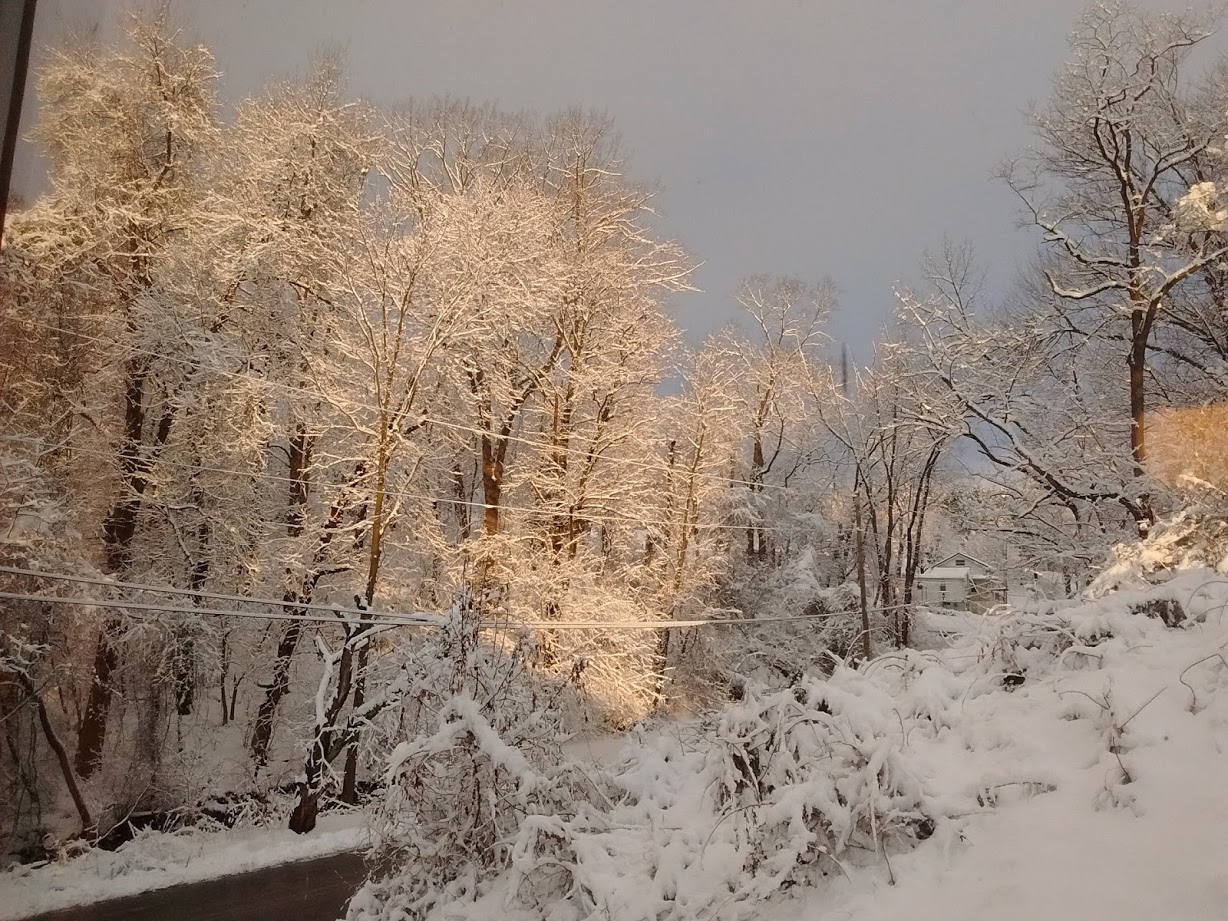
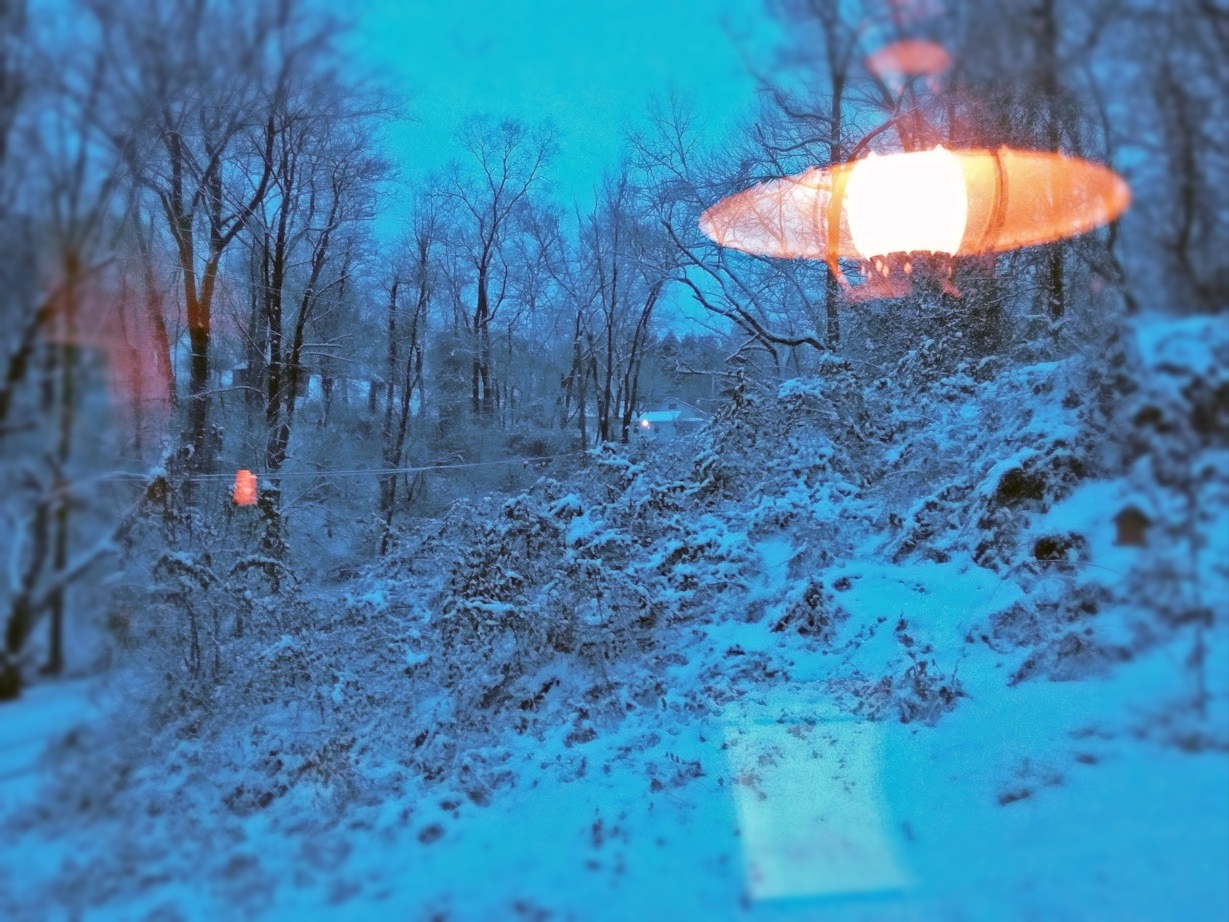
Some semesters are harder than others, and this past semester got caught up in the grind of my slip into the year’s shadow. It was harder this year than it has been for a long time. So there’s a soberness to the creative fires that are sparking for the new page before me. And I still have all that work to finish up from last semester. Still, I love the bright shine of that empty page ahead, stretching out before me like the fields of snow I woke up to this morning.
Gratitude List: 1. The beautiful singers at my school. They’re so brave, these young people who get up on stage to perform for their whole school. I am grateful for my colleagues in the music department who offer our kids such a powerful music education. I have tried not to push my own child into the music classes–I want him to be free to take whatever he wants, to explore all his interests–so I am really delighted that he is taking chorus and two different bands this semester. 2. This week’s birds: kestrel hovering, vultures everywhere (as usual), two bald eagles, blue heron, owls calling in the bosque, and crows and geese winging across the sunrise skies. My soul is stirring, too. 3. Tabula Rasa. The fresh page. 4. Snow. 5. The magic of air filling lungs. I listened to a Shakespeare scholar talk this week about how a line of iambic pentameter is just the right number of beats to fill the human lungs. I might have to start reading Shakespeare sonnets to wake up in the mornings.
May we walk in Beauty on the Fresh Page of Today.
“This is the season of owl, of winds that howl through the hollow, the season of the sharp bark of the fox, voicing longing in the bosque.
This is the season of bitter, of fierce flakes feathering cheeks and hands, the season of crystal, crisp and cutting, of beauty that will slice you open.
This is the season of rising, thin and pale, into the dawn air, but also of burrowing, huddling deep into the layers that hold you.
Walk the thin line of today with care, one foot precisely placed, the other. . .
Perhaps you will notice, when you raise your eyes for a moment, how the line curves out ahead of you, bringing you always back home.” —Beth Weaver-Kreider (1/13/16)
“Something there is that doesn’t love a wall.” —Robert Frost
“I am always doing what I cannot do yet
in order to learn how to do it.” —Vincent van Gogh
“Have you been to jail for justice? Then you’re a friend of mine.” —Anne Feeney
“Nice people made the best Nazis. My mom grew up next to them. They got along, refused to make waves, looked the other way when things got ugly and focused on happier things than “politics.” They were lovely people who turned their heads as their neighbors were dragged away. You know who weren’t nice people? Resisters.” —Naomi Shulman
“The desire to reach the stars is ambitious. The desire to reach hearts is wise and most possible.” —Maya Angelou
“Begin with something in your range. Then write it as a secret. I’d be paralyzed if I thought I had to write a great novel, and no matter how good I think a book is on one day, I know now that a time will come when I will look upon it as a failure. The gratification has to come from the effort itself. I try not to look back. I approach the work as though, in truth, I’m nothing and the words are everything. Then I write to save my life. If you are a writer, that will be true. Writing has saved my life.” —Louise Erdrich (via Terri Windling’s Myth and Moor blog)
“Love the earth and sun and animals,
Despise riches, give alms to everyone that asks,
Stand up for the stupid and crazy,
Devote your income and labor to others…
Re-examine all you have been told
at school or church or in any book;
Dismiss whatever insults your own soul;
And your very flesh shall be a great poem.”
—Walt Whitman
“In lying to others we end up lying to ourselves. We deny the importance of an event, or a person, and thus deprive ourselves of a part of our lives. Or we use one piece of the past or present to screen out another. Thus we lose faith even within our own lives.
“The unconscious wants truth, as the body does. The complexity and fecundity of dreams come from the complexity and fecundity of the unconscious struggling to fulfill that desire.” —Adrienne Rich
Today is Epiphany, the day the light dawns, the coming of the wise ones, the baptism of light, the moment of the Holy Aha! Cultures throughout the world celebrate today as the coming of the Three Kings. Orthodox Christians celebrate this as the day of the baptism of Jesus.
There is a moment, in the baptism story, when the Spirit of the Holy One appears in the form of a dove and speaks to those gathered, saying, “This is my beloved child, in whom I am well pleased.” My prayer for you, for me, for all of us in this coming year, is our significant dawnings and discoveries may be accompanied by the absolute shining certainty that we are the Beloved Children of the Universe. That the One who watches us, who wings above us, who blows through us, who shines light into our confusion and grief and fear, is well pleased with us. It is one of my most deeply held beliefs that this is true, but it is sometimes hard to hold onto. You are Beloved.
Here’s my Dream and Meditation Soup from the Dreamtime. I’m organizing them by character, symbol, theme, and word: 1. Rhiannon, Epona, Kingfishers, the Madwoman in the Attic, the Ferryman, crossing-Maker, two-faced people 2. Bridge, Boundary, Shadow 3. Crossing, grief, solitude (privacy), sufficiency (insufficiency), resistance 4. Maferefun (Praise be!), Sawabona (I see you)
For the coming year, the three words that I will carry with me: Bridge, Boundary, Wing
I’ll be keeping my eyes peeled for kingfishers this year.
Yesterday, my Beloved friend Mara asked her friends to write Epiphany poems. Because of its association with the Three Magi, I wrote my poem about the legend of La Befana, sometimes called the Witch of Christmas, because she flies around the world on her broom searching for the Child of Promise. When the wise ones stopped at her door on their journey to find Holy Child, they invited her to join their caravan, but she was too busy with her own concerns. The moment their dust disappeared in the distance, she regretted her choice, and ever since then, she searches. Sometimes she gives children sweets.
La Befana: The Epiphany Witch
She’d got her eyes fixed on what was right in front of her, the dust and the dirt and the everyday mess. Wanted to be ready for the coming of the child but couldn’t see beyond the day she was in.
Believe me, I know what the old one was up to. I too get caught by the fishhook of the present, stuck in the nextness of each task ahead, forget to lift my eyes to see the shine and sparkle of my arriving guests, can’t put down my broom, my pen, my daily rhythm, to look up and outward.
Like Old Befana, I catch, too late, the jingle of the caravan bells as they turn the corner in the distance, see the disappearing cloud of dust.
Hastening to grab my cloak and bag, I’ve lost their trail before I reach the distant corner, left behind, bereft, alone, dust-covered, traveling bag in one hand and besom in the other, destined to spend my life sweeping the skies on my broom, chasing down the Holy Aha.
Gratitude: 1. The search for the Dawning 2. Bridges, even when they’re rickety and dangerous 3. Boundaries. I don’t believe in political walls. I do know that to preserve my own sanity in the coming year, I have to develop stronger boundaries within me between the working self and the creative self. I need to know myself separate from my work and not defined by my specific work identity. 4. Wings. Flight. Seeing things from new perspectives. 5. Knowing myself a Beloved child of the Universe.
May we walk in Beauty, Beloved Children of the Great Mystery.
Words for the Holy Aha! “A Woman in harmony with her spirit is like a river flowing. She goes where she will without pretense and arrives at her destination prepared to be herself and only herself.” —Maya Angelou
“In such ugly times, the only true protest is beauty.” —Phil Ochs
“The sense-making in poetry is about getting behind the brain. A poem is a door. Sometimes poets make sturdy, locked, exclusive club doors that you can only enter if you are one of ‘us,’ or if you can speak (or pretend to know) the password. A really good and satisfying poem is an open and inviting doorway that frames the view in a particularly compelling way. ‘Look!’ it says. ‘Stand and stare. Take a deep breath. Then tell me what you see.’
“Good poetry, I think, holds a paradoxical perspective on language itself: it acknowledges the inadequacy of words to completely map an inner geography, and it also steps with reverence and awe into the sacred space that language creates between writer and reader. Words are both inadequate and holy.” —Beth Weaver-Kreider, 2014
“Where does despair fit in? Why is our pain for the world so important? Because these responses manifest our interconnectedness. Our feelings of social and planetary distress serve as a doorway to systemic social consciousness. To use another metaphor, they are like a ‘shadow limb.’ Just as an amputee continues to feel twinges in the severed limb, so in a sense do we experience, in anguish for homeless people or hunted whales, pain that belongs to a separated part of our body—a larger body than we thought we had, unbounded by our skin. Through the systemic currents of knowing that interweave our world, each of us can be the catalyst or ‘tipping point’ by which new forms of behavior can spread. There are as many different ways of being responsive as there are different gifts we possess. For some of us it can be through study or conversation, for others theater or public office, for still others civil disobedience and imprisonment. But the diversities of our gifts interweave richly when we recognize the larger web within which we act. We begin in this web and, at the same time, journey toward it. We are making it conscious.” —Joanna Macy
Why Are Your Poems So Dark?
by Linda Pastan
Isn’t the moon dark too,
most of the time?
And doesn’t the white page
seem unfinished
without the dark stain
of alphabets?
When God demanded light,
he didn’t banish darkness.
Instead he invented
ebony and crows
and that small mole
on your left cheekbone.
Or did you mean to ask
“Why are you sad so often?”
Ask the moon.
Ask what it has witnessed.
“In a time that would have us believe there is always more to strive for, more to accumulate, more enlightenment to reach – the most radical stance we can take is enoughness.
What if we quit trying to be spiritual and aspired to be human instead?
What if there is nothing to fix because we are already whole?
What if there was no time to prove ourselves, because we’re consumed with marveling at life?
What if there is no reason to hold back our gifts, because they are meant to be given?
What if every morsel, every glance, every moment and every breath is a miracle of enough?” —Dreamwork with Toko-pa
Today is the last day of Dreamtime. Tomorrow the light dawns. Tomorrow, I will look through the soup of dream-images from the past two weeks and choose the word for the year.
In last night’s dream, I am at a book sale, focusing on the books on the table in front of me. At one point, I become aware that a man facing me at the next table down has a face divided into two: his hair and beard on the left side of his face are white against his brown skin, and both hair and beard are closely trimmed. On the other side, his hair and beard are black and fuller, scruffier. When he faces toward the right side of the hall, he’s an older, white-haired man. When he faces the other direction, he’s younger. It’s like there’s a line down the middle of his face.
Looking around, I notice that everyone is standing in profile in relationship to me. I look down and then up again, and they’re all looking the opposite way, and they appear to be completely different people. Everyone has opposite faces! As I move faster around the room, they find it more difficult to keep only in profile to me, and the game is up. Everyone is two people. They all look toward me, and I can see the lines down the center of their faces where hair and beards and make-up are divided into two different sides. I find out someone’s been doing a social experiment. I figured it out pretty quickly.
Two-sided people, showing you two different sides to themselves.
I woke with a phrase from a song in my head, from a song they sang in chapel yesterday, something about “bringing all his sons to glory.” It really made me feel uncomfortable that young people are still singing and speaking in such patriarchal language. The music was beautiful, though, and the young woman leading the music was a former student with an absolutely angelic voice.
Gratitude List: 1. Books 2. Comfy jammies 3. Playing games with the family 4. The weekend 5. Warm showers
May we walk in Beauty!
Saturday’s Messages: “It takes courage to grow up and become who you really are.” —e. e. cummings
“Again and again, our dreams demand leadership of us, calling our life’s vision forward into the world, step by tenderbrave step.
“The practice above all practices is to relinquish the immature desire to be taken care of (by our parents, spouse, government, guru, church, etc), and to parent our own originality. To give ourselves the support that we may never have received.
“To get behind the creation of one’s life is to recognize your influence in ‘the way things are,’ and nurture your vision with protective discipline until it is strong enough to serve in the world on its own.” ―Toko-pa Turner
“You learn to write by reading and writing, writing and reading. As a craft it’s acquired through the apprentice system, but you choose your own teachers. Sometimes they’re alive, sometimes dead.
“As a vocation, it involves the laying on of hands. You receive your vocation and in your turn you must pass it on. Perhaps you will do this only through your work, perhaps in other ways. Either way, you’re part of a community, the community of writers, the community of storytellers that stretches back through time to the beginning of human society.” ―Margaret Atwood
“We live in a world in which we need to share responsibility. It’s easy to say “It’s not my child, not my community, not my world, not my problem.” Then there are those who see the need and respond. I consider those people my heroes.” ―Fred Rogers
“Good poetry, I think, is more about finding your way by signposts than about following a map. It gives readers a few cues and clues, sets us loose, and then waits for us to say, “Oh! I recognize this territory! I know this landscape.” A series of seemingly unrelated but compelling images can spring to life when sprinkled with the fairy dust of beautiful language or the hint of a story. While I want to be able to understand enough of the controlling idea of a poem for it help me create some sort of sense, the most satisfying meaning that I derive from reading a good poem comes not through the intellectual front door, but through the back door of the emotions. Meaning made through emotional connection rather than mental processing often appears in the form of wonder and holy surprise, even when it comes in a painful or angry guise. Poetic understanding is gut-level understanding. I have long been a fan of singer-songwriter Paul Simon. I don’t think I know what he means about anything, but he always makes me feel something.” ―Beth Weaver-Kreider, 2014






 Mockingbird Chronicles