Day 10: Here’s the thing: I made some adjustments to the pattern thinking it wouldn’t affect the outcome much. It’s been two years, so Bagger no longer has the free pattern on her IG page, so I couldn’t use it even if I tried. My idea to create two panels with slight decreases at the top simply didn’t work. I put it all together this morning, and I hated the shape of it. I’ve never made a sweater before, and I have been hoping that I could just make a lovely messy thing that I would love to wear.
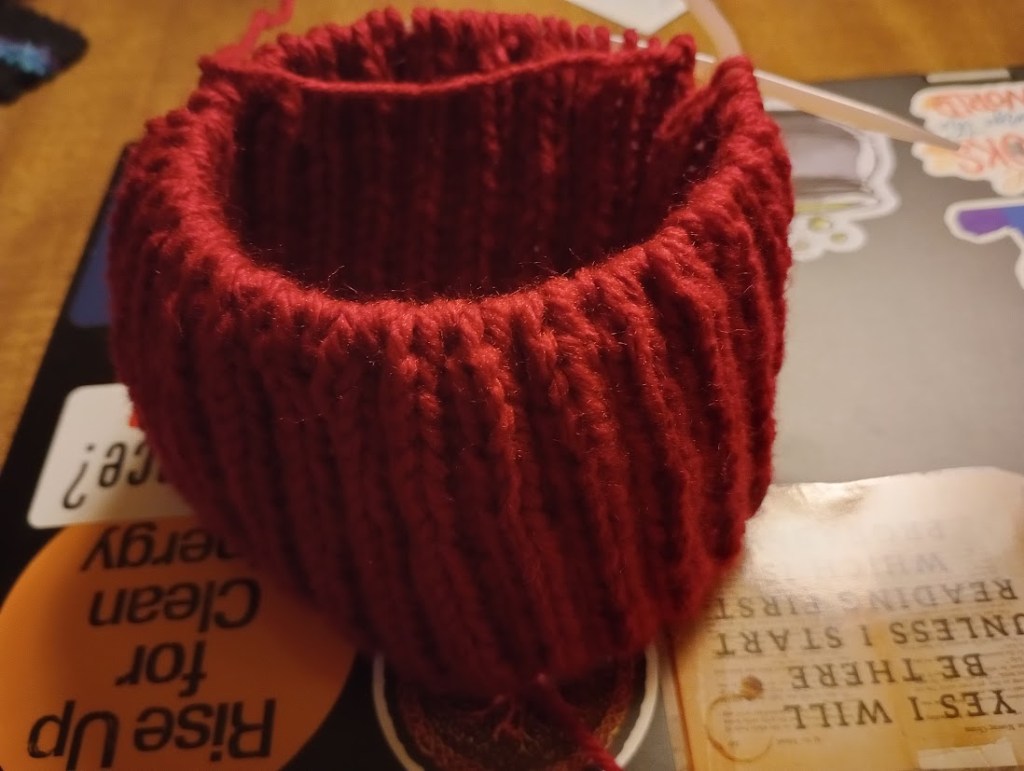
So I unraveled again today. I’m a little frustrated, but also determined to make the final sweater something I WANT to wear. Maybe I’ll make a poncho? I’m going to set it aside for a while and work on this hat, and some of my other projects.
So it has been a bit of a Samuel Beckett project so far. “Ever tried. Ever failed. No matter. Try again. Fail again. Fail better.”
Day 6: My heart is heavy today with the reports of US and Israeli attacks on Iran.
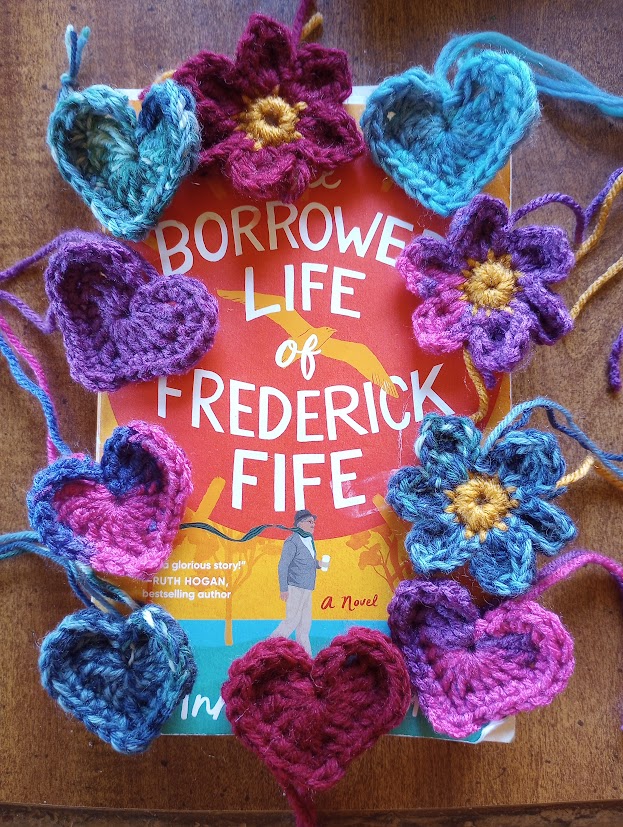
This morning my Book Group talked about this book, The Borrowed Life of Frederick Fife, about a case of mistaken identity that brings redemption and healing to a series of tragic and painful stories. The primary issue of mistaken identity revolves around the idea that so often people don’t really see elders. And the main character, through his own terrible grief, is able to truly and deeply see the people he encounters.
How can I be a better Seer of others? How can I not let anyone go unnoticed or ignored?
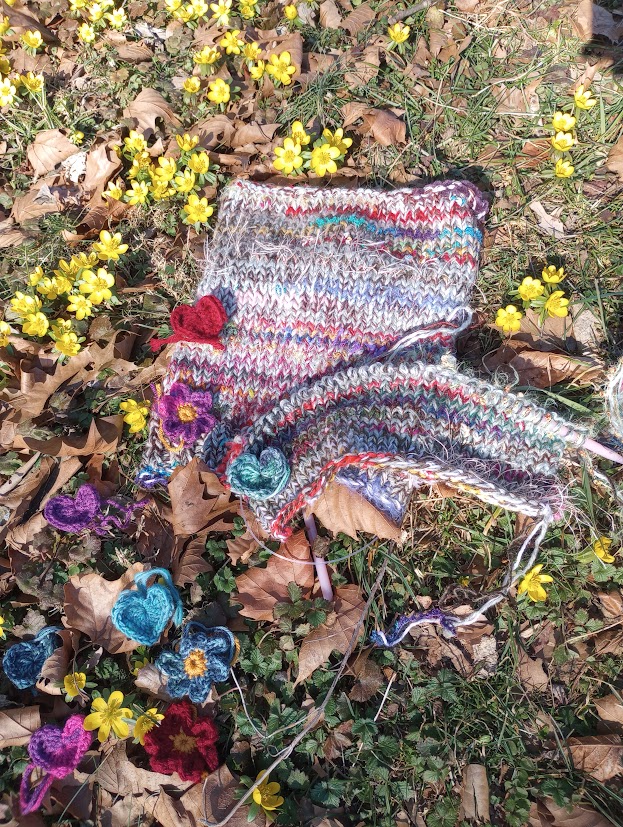
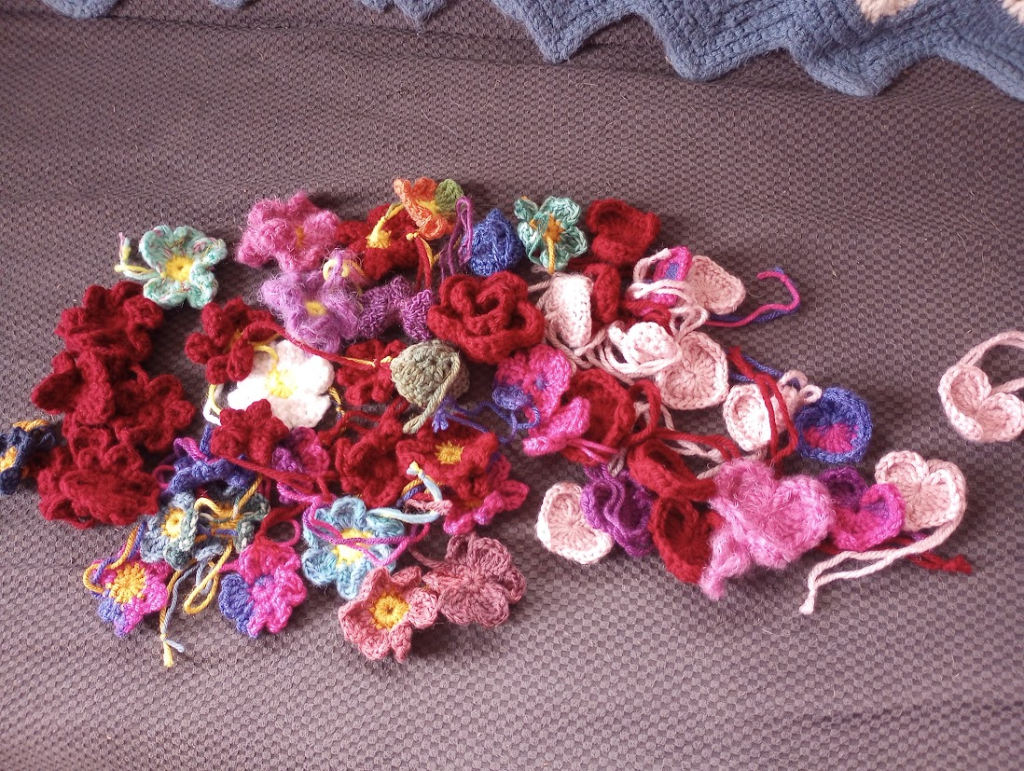
I crocheted hearts and flowers as we talked. Each little heart, each little flower, is a prayer for peace. Later, I finished the first sleeve of The Alone Together Sweater and began the second. I’m feeling anxious about whether it will be a cohesive garment when I finish.
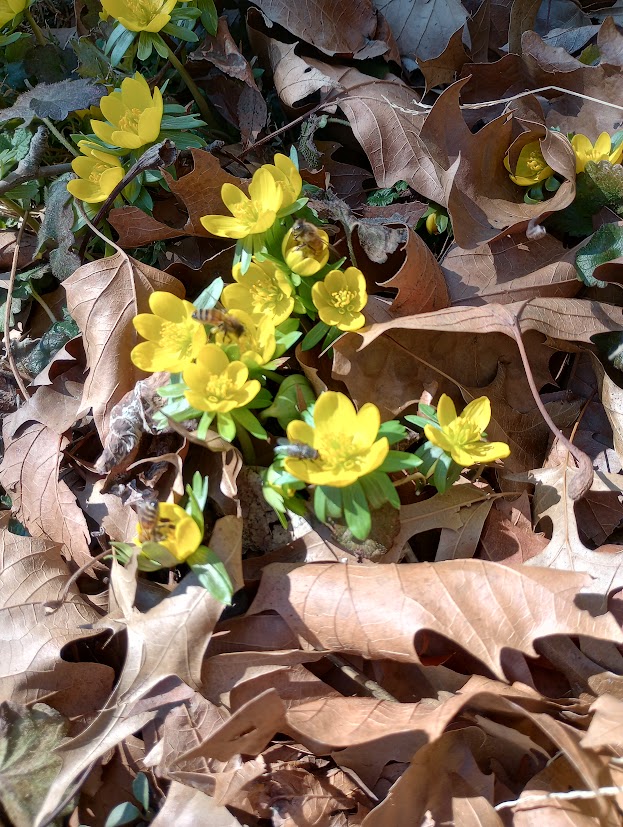
The golden winter aconite were alive with the electric hum of the Little Sisters, and the barn overhang was swarming with the coming and goings from the wild hive.
I came in to school today, and this was in my box! A colleague bought it for me. I feel Seen! The synchronicity is abundant these days.
This knitting element of my Tying Up Loose Ends project has me thinking a lot about textile arts, how they’ve been so often the province of women, how “women’s work” has so often been derided as less than the work and the art of men, how the spinning and the knotting and the weaving of threads are ancient work, necessary to our ancestors for keeping families clothed and warmed, how these acts became magickal acts.
We spin the stories that connect us to each other, weave and knit together the strands of our separateness into whole community cloth. We untangle threads to see more clearly the path we must follow.
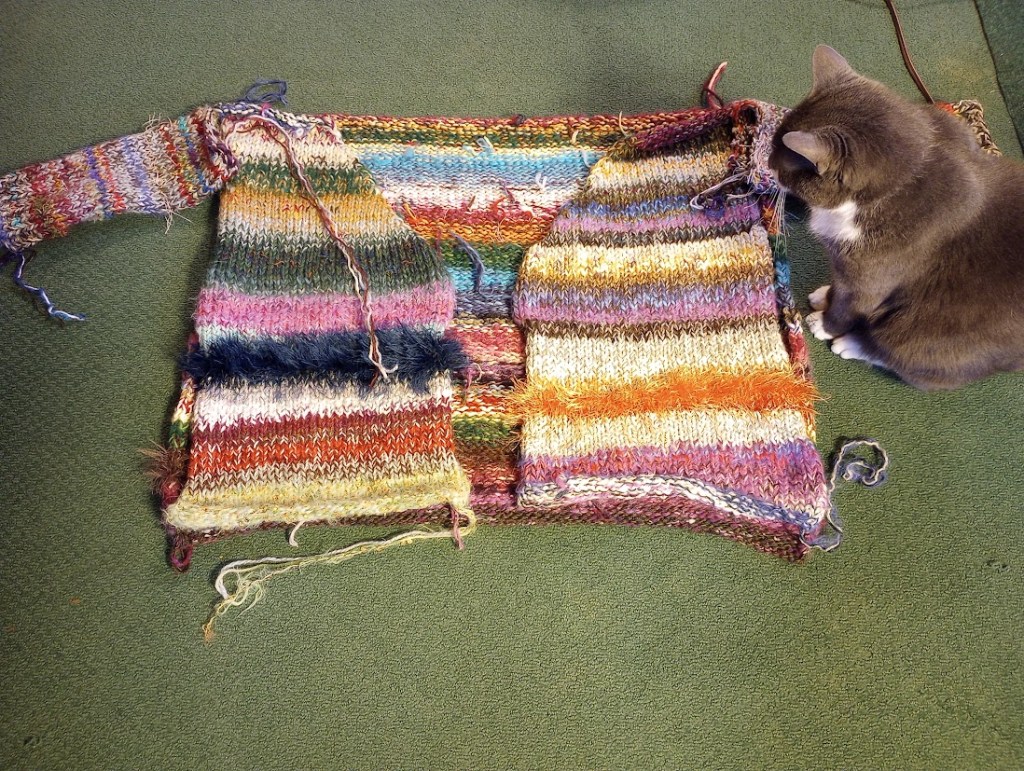
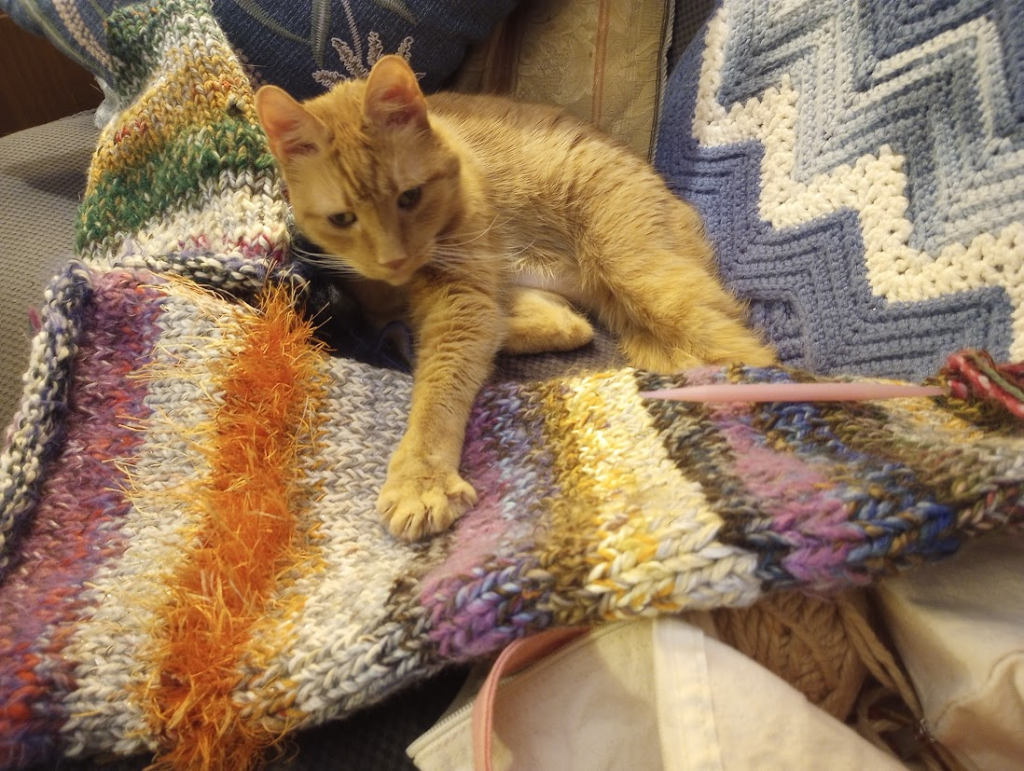
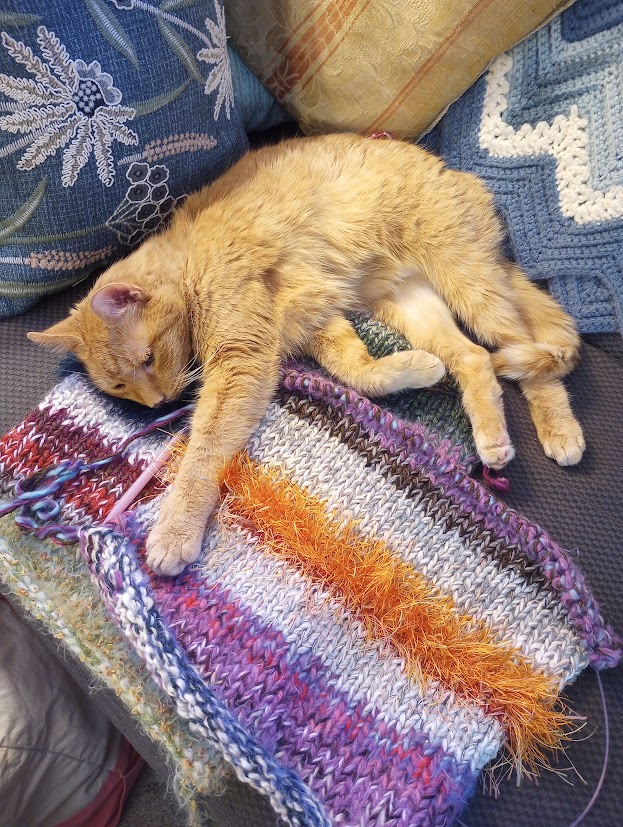
I cast off the second front piece today, and began a sleeve. Thor really does love this project.
I’m home today because all my Parent Teacher Conferences are on Zoom, so I have moments between conferences when I can knit a couple rows—a palate cleanser for the brain, if you will. I’m almost finished with this front panel.
Next week is Spring Break, and I have a feeling I might finish this sweater then! Unless I find myself unraveling to remake bits. I am in this project to learn.
“Letting go is the lesson. Letting go is always the lesson. Have you ever noticed how much of our agony is all tied up with craving and loss?” ― Susan Gordon Lydon, The Knitting Sutra: Craft as a Spiritual Practice
I found that quote online, and just went and ordered the book on Thriftbooks.
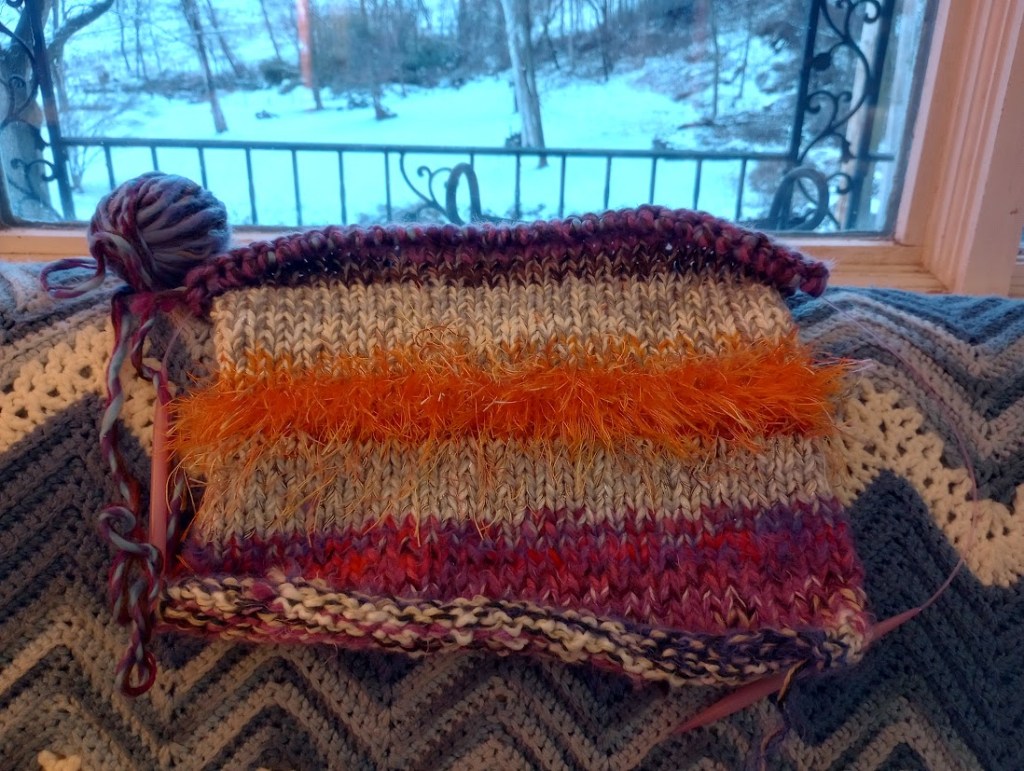
Yesterday after I posted, I continued to knit my ATS 2.0, so the first photo is where I began today.
The Alone Together Sweater was designed during the pandemic by Lærke Bagger, a wildly creative out-of-the-box textile artist from Denmark (look her up on IG). In her directions, she gave permission just to knot yarns together. The idea was that since we couldn’t go out shopping, we needed a way to creatively use up our stashes, using two or three strands at a time, giving the feeling of impressionistic painting with yarn.. Her original construction was a back, a front, and two arms. After my initial sweater was too wonky, I decided to divide the front into two pieces to make a v-shaped neck. I might make it a cardigan or I might stitch up the front.
What I love about this project is that it gives me the permission I crave to be free-spirited and messy. There is a punk quality to her designs, a refusal to force herself and her art to fit into the pretty and fine art box. And yet her designs are incredibly artful and exuberant.
This is the first time I have made a complete knitted or crocheted garment (other than a scarf or shawl), and ATS 1.0 was the first time that I have unraveled a project of any significant size. So I’m growing.
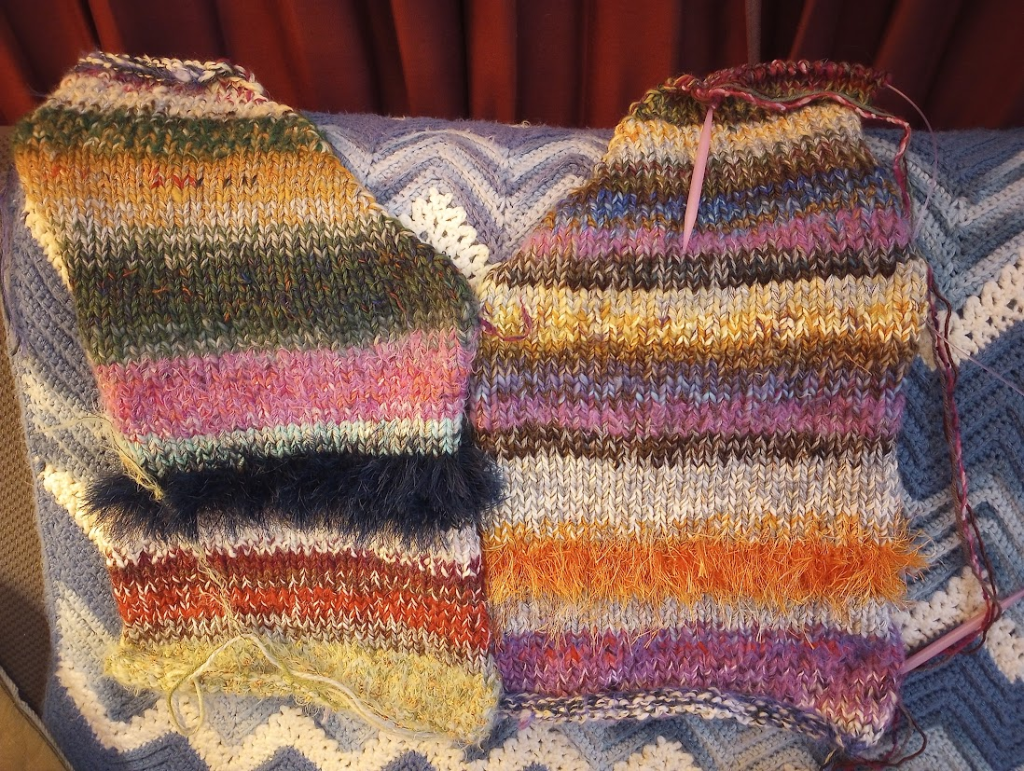
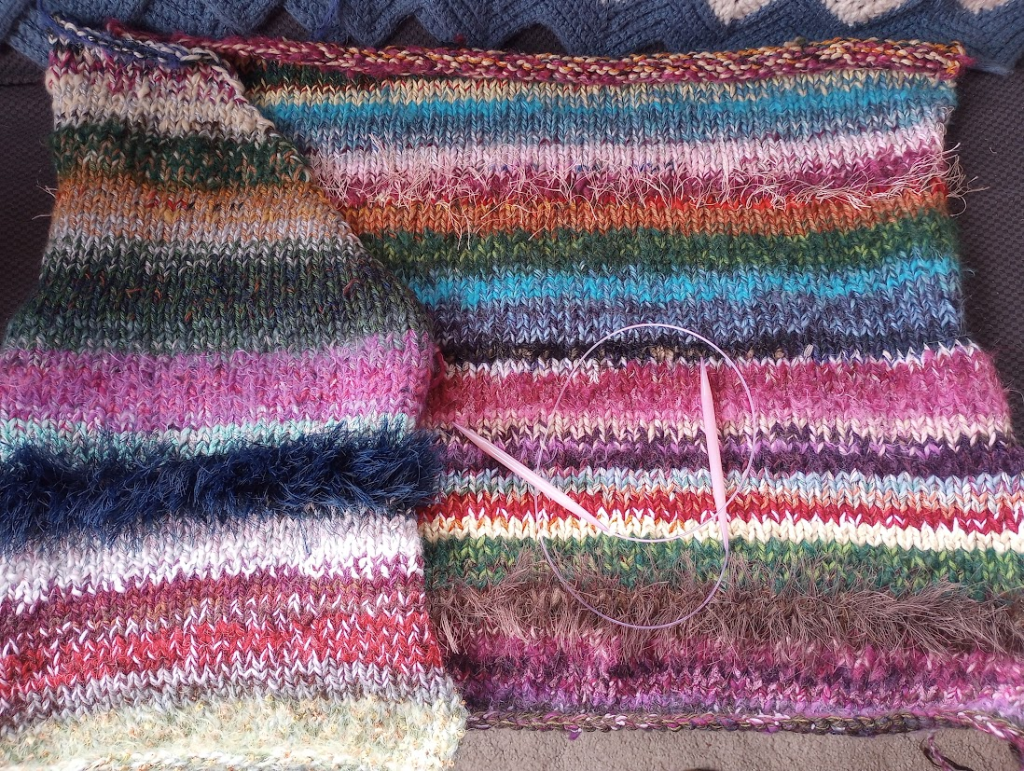
The first photo shows the two completed pieces (of five) of the Alone Together Sweater I began in 2021 when I was in Covid Quarantine. I completed it about a month ago, and unraveled it because the sizing was way off. The second attempt (ATS 2.0) is less wildly wonky, but still wacky, but in a satisfying way.
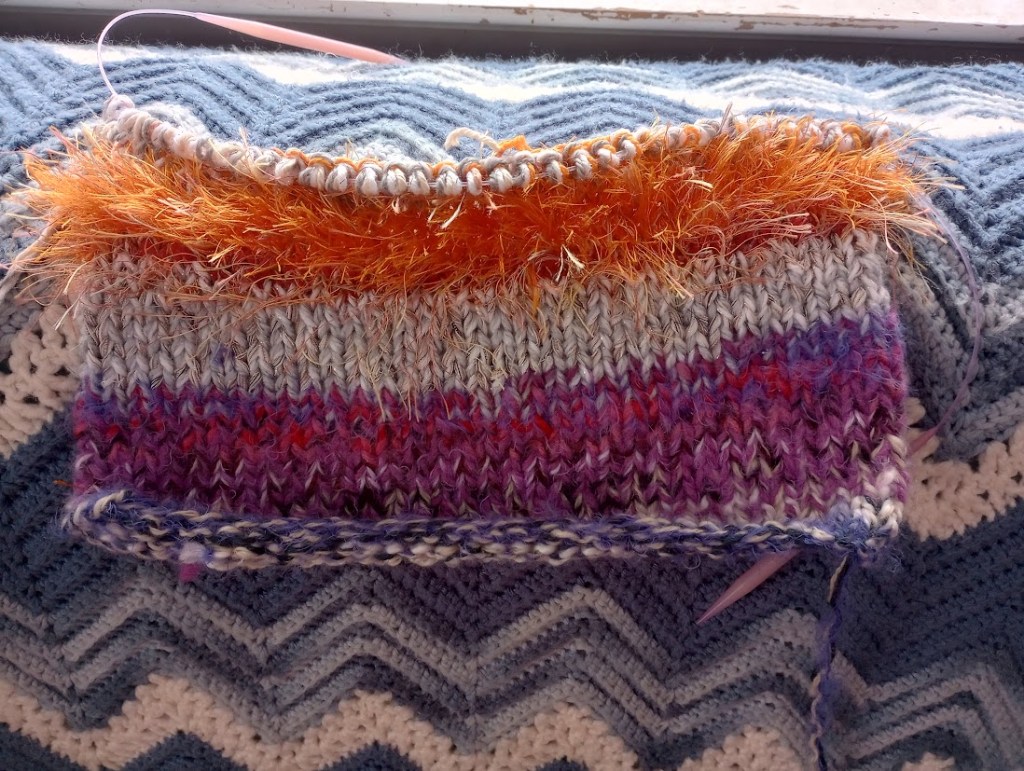
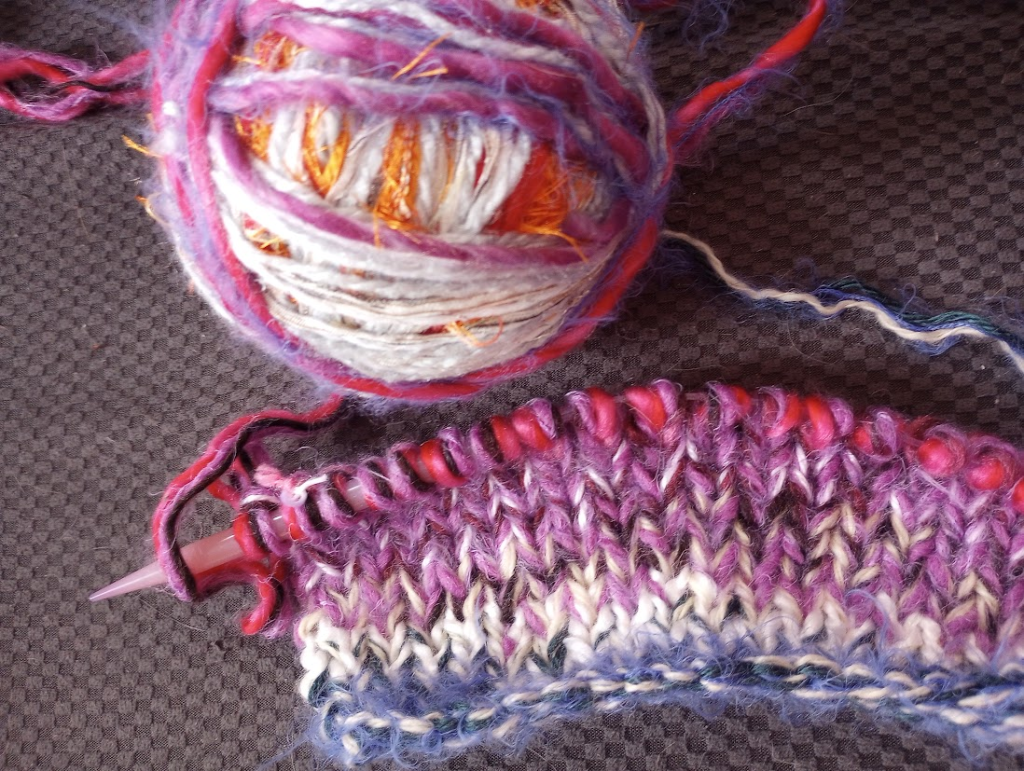
Today I cast on the 35 stitches for the third piece, and knitted 11 rows.
Then I sewed in the loose threads on several flowers for Pride. I have 53 ready to go. I think I’ll want to increase my goal number from 200 to 400.
This afternoon on a Zoom call, I am going to do some mending. I won’t keep up this pace for 100 Days, but today is a Sunday and rainy.
I have finally managed to get my brain-squirrels at least running in the same direction. I think.
I had a wild and unmanageable list of exciting and interesting possibilities for #The100DayProject, lots of potential for daily dopamine sparkles, but a couple days ago as I was vacuuming the rugs (I do that occasionally), I had a brainstorm: What if this year’s 100 Day Project would be about tying up loose ends? What if I made a list of all my Unfinished Projects, and pledged to work on one of them every day for 100 days? The daily dopamine hit would be less sparkly, perhaps, but the satisfaction in the end could be immeasurable.
So here’s the plan: 1. Spend 10-15 minutes every day on an Unfinished Project. If I have an occasional crazy busy day in which I am simply running all day from thing to thing, I can give myself a short break and do five minutes. 2. I must work on a project from my project list, and not create a new project mid-stream. I can still work on things off the list, just not as a fulfillment of this project. 3. I will take a picture of my progress on whichever project every day to log on my social media for accountability’s sake. 4. I do not have to finish one project on the list before picking up another–it’s about making progress on the things I begin but haven’t finished.
Here’s the List (for now–I may tweak it in the next two couple days before the project begins on Sunday, February 22): 1. The crochet shrug 2. The Alone Together Sweater (second attempt) 3. The Granny Square Yard Sale Cardigan 4. My Tanzania 2024 Book 5. The Rosary Zines 6. The Words Collection 7. The black Granny Squares–whatever was I doing with them? 8. 100 Hearts and Flowers for Pride 9. 20 more Little Protector Dolls for Radiance 10. Nisselue–the knitted and/or crocheted Norwegian Resistance Hat 11. Mending 12. The Red Thread Embroidery 13+ I feel like there are some more that I listed in my journal the other day, so I might add a couple from there.
I have a little cheaty thing going on in my brain right now. I have been inspired by a crocheter who makes elaborate neckpieces of different yarns and stitches, mixing knitting and crochet and different sizes of hooks and needles. If I were to begin one before Sunday, then it would be an Unfinished Project. . . Hmmmm.
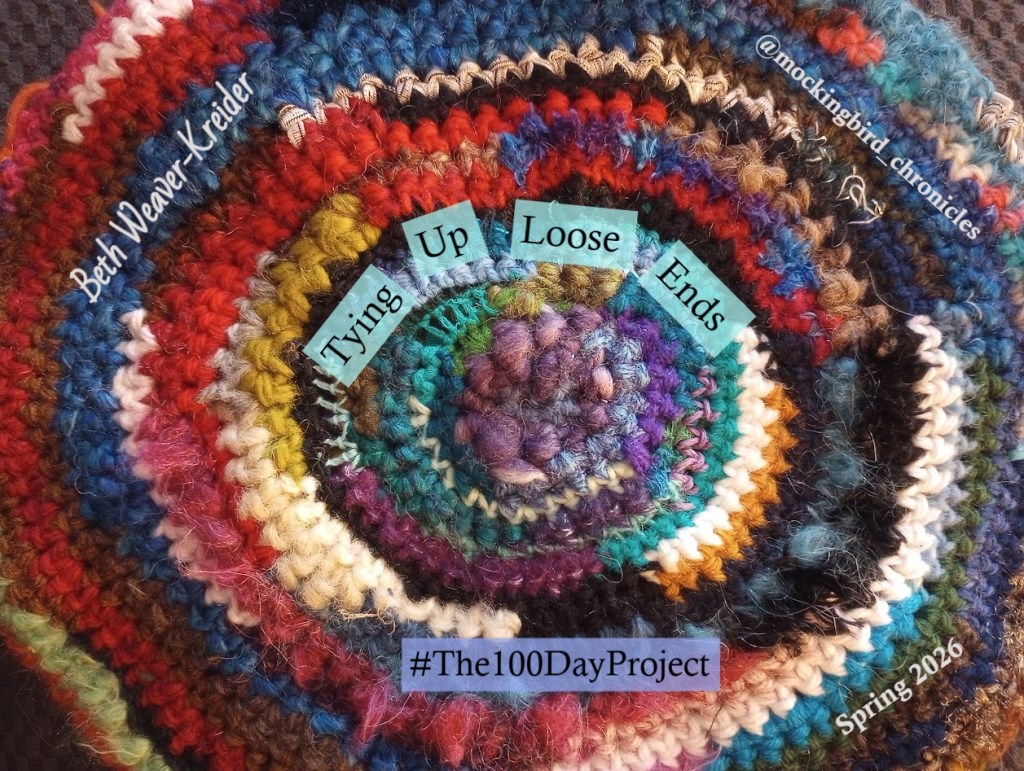
I chose the name Tying Up Loose Ends for the project because I am trying to free up my mind for other projects. The image I am using is a crochet circle I am making. As I cut off ends of yarn from projects, I knot those that are longer than five or six inches to a ball of loose ends, and then I crochet them onto my circle. When it’s large enough, I will use it as the top for a beret. I’ll keep adding to the Ball of Loose Ends throughout the project.
The project begins on Sunday, and lasts until June 1. Go to #The100DayProject web page, if you are intrigued and want to join. My process is to: 1. Do the Project every day 2. Photograph or video it 3. Post on Social Media
At school, we are encouraging our middle and high schoolers to join us if they want, for the sake of creativity, mindfulness, or focus.
You can be very creative about your project choice: Try a new dance every day, give a compliment every day, do a watercolor a day, a Zentangle a day, doodle a face every day, do a breathing exercise every day, write a haiku a day, research a different animal every day, sing a song a day. . .
This is the post (3/3) that I wrote for my rosary group this morning:
Crown of Thorns Novena Day 37 , Friday, 30 January 2026 Joyful Mysteries: You Are Shameless!
Today, we walk through the Garden of Yes, to the House of my Beloved, to the Village of Birth, to the Blessing of the Elders, to the Finding of Myself in the Temple.
It is possible I have written of this here before. Several years ago, I wrote a poem about my grandfathers, the ways in which the patriarchy of my Mennonite ancestors affected the women. I can no longer find the poem, but I remember part of the end of it:
Oh, Shameless! To be without shame. Could you know, Sister-Ancestors, that they blessed in their cursing. We’ll find our own valley, called Shameless. Called Brazen. Oh, carry that name. I’ll wear it, too.
In many religious traditions, and particularly in some streams of the Mennonite tradition of my own ancestors, it was considered shameful just to be a woman, especially if you did not redeem your femaleness by being feminine, by keeping immaculate house, by serving, by listening instead of talking, but submitting to the will of God (which meant the will of the men in your family and church). Women have borne the burden of keeping the family’s honor, of doing the emotional labor, of passing on the culture. If she stepped out of line, she was labeled shameless.
My own parents did everything they could, fiercely and with great intention, to break those assumptions about gender and to give their children a different pathway to follow. And in many ways we did, and in other ways, we—like our peers—absorbed many of the messages that church and culture told us about women and men and about staying within the lines, about behaving ourselves, about not being shameful. And I, who am so many things that are not that womanly ideal, could never measure up.
No matter your gender, can you hear those elders and gatekeepers of the past scolding you for not being all you were told you should be? “Shameless! Have you no shame?”
Why, no. Thank you very much. No, actually, here on this pathway of the Joyful Mysteries today, no, I have no shame. I am shameless.
Practice: Settle. Breathe. Rest in the Mother’s Arms. It helps if you can look in a mirror while you do this. Take the curse and twist it into a blessing, for blessing it is. Say it: “I am shameless.” “I have no shame.” Say it again. Again. Grin at yourself. You ARE shameless, you know. So worthy. So Beloved.
This is the post I wrote for my rosary group today, part 2 of 3:
Crown of Thorns Novena Day 36 , Thursday, 29 January 2026 Glorious Mysteries: Walking the Pathway of the Resurrection
On this pathway, we walk through the Garden of Resurrection, the Ascension (Enlightenment), the Coming of the Spirit, the Mother’s Assumption (Dormition), and the Coronation of the Queen of Heaven.
I love the word Somatic. It basically just means “of or relating to the body.” I extend it to mean embodiment. My heart’s desire prayers in recent novenas has been focused on embodiment issues, exploring how I live my feelings in my body, how I move and inhabit my body as I age into this next stage of menopause, how I build my strength, how I experience the world through my senses, how I learn to love and really treasure this body I am in. I am almost 60, about to start my Third Act, and I want to cooperate with and listen to my body as I step onto this stage. I want to keep her healthy as long as I can, and to (as Mary Oliver puts it), “Let the soft animal of my body love what it loves.”
Speaking of stages, I haven’t actually been on dramatic stages much at all since I was the rose seller in Oliver, and sister Berthe in The Sound of Music at Lancaster, PA’s Fulton Theater in my early twenties. But I remember some of the things that bloomed in me when we did warm-up exercises in theater classes. Walk like a giant. Walk like a cow. Walk like a toddler discovering the world. And suddenly, as I walked like a giant, in my five-foot human body, I was a giant, then a cow, then a toddler. For today’s “lesson,” we walk like someone completely unashamed.
After yesterday’s discussion of Shame in the Sorrowful Mysteries, I wonder if we could resurrect some of the certainty and belonging and confidence and courage that inhabits a body unencumbered by shame, simply by walking or standing (or sitting or lying) as someone without shame. What does it feel like in your body to stand without shame? To walk with confidence? To hold your head and shoulders as if what you are saying deserves to be heard?
Sometimes it helps to have an image to work with. I picture Eleanor Roosevelt’s calmly confident face, Harriet Tubman’s fierce belonging, Greta Thunberg’s truth-telling. I picture the Sun card from one of my tarot decks: a person standing, feet shoulder width apart, face and heart lifted to the sun, arms out to the sides in a receiving gesture.
Practice: Try this Somatic/Embodiment Exercise.
Stand with your feet shoulder width apart. (Or, if standing is not an option, you can do this to the best of your ability from a sitting or lying position. It’s about what you feel in your body, after all.) Settle. Breathe. Rest in the Mother’s Arms. Breathing, straighten your spine. Roll or shake your shoulders and let them drop slightly. Breathing, feel your feet on the earth (or the floor or the bed). Send roots down into the earth. Breathing, tilt your face toward the sun (even if it is a cloudy day and you have no windows). Breathing, lift your heart toward the sun. Breathing, open your arms wide, receiving the sun into your body. Feel comfort and courage and confidence fill you. Let belongingness fill you.
Breathe it in.
If you feel any of those shame-messages whispering in your head, turn each one into a raindrop, and let it drip from your fingers into the earth. How does confidence and courage and shamelessness feel within your body? What color is it? Does it have a shape or temperature? A voice? A name? Where in your body do you feel it most strongly? Now move—walk or shrug or dance or just feel it in your face—with shameless ease. You are worthy. You deserve to be here, to take up space, to speak your mind.
Here is my post for The Way of the Rose Novena today:
Crown of Thorns Novena Day 35 , Wednesday, 28 January 2026 Sorrowful Mysteries: You Do Not Have to Take the Shame They Hand You
Today we walk the rooms of the Sorrowful Mysteries: Agony of Anticipated Trauma, Pain of Scourging, Shameful Crown of Thorns, Carrying the Burden, and Death.
After the agony, after the pain, comes the public shaming, mocking, and humiliation of the Crown of Thorns, the shadowy reversals, the gaslighting. The propaganda. The victim-blaming. The outright lies.
Stripped naked, beaten, and put on trial, forced to listen to the Authorities build their narrative against you: This is who you said you were, but we know better. You thought you were so great. He said he was the King. They’re not protestors and protectors; they’re domestic terrorists and violent extremists. She tried to run him over. He brandished a gun. They deserved to be shot. She’s a witch: Burn her! He’s a heretic: Execute him! What was she wearing? He had it coming. You deserved it. You’re too fat, too thin. Too driven, too lazy. Not worthy.
It’s nothing new, this tendency of Empire and authority and patriarchy to twist its evils into shame poured on the victims. You can’t believe the evidence of your senses. Order is more important than empathy. How dare you question the established order of things?
Shaming is meant to make you feel small. Powerless. Helpless. Unable and unworthy to stand up to power. Shaming makes you question your truth at the deepest levels. Makes you doubt yourself.
The truth is, if I accept the shame they offer me, then I have handed the narrative to others to take power over me. I’ve given away my agency, abdicated my responsibility for my own life. I’ll spend my days cringing, worrying that someone will see my true shameful self, instead of living into my own blossoming, into my power to create goodness in the world around me.
Practice:
Settle. Breathe. Rest in the Mother’s arms.
Can you bear to list (in your head or on paper) the messages you have been told (by the culture, by others, by yourself) about why you should feel shame? If you can, write them or remember them in your quiet space in the presence of the Mother.
[Here are some of mine, for full disclosure, and probably over-sharing. Note that not all of them are true, or shameful. They’re just what I’ve been handed. I’m messy, chaotic, lazy, a hoarder. I’m too fat, too distractable, too loud, too emotional. I make decisions too fast, and I work too slow. I have hurt people’s feelings, ignored people who needed my attention, and made a fool of myself trying to be the center of attention. More and more and more. . .]
Stop.
Feel her tender gaze upon you. At some of these items on your list, can you see her shake her head, hear her tell you how very worthy you are? At others, you can hear her chuckle: “Darling One, you try so very hard. Rest now.” Or, “This is not you at all, only what others try to make you believe about yourself.” And maybe after one or two: “Let’s work on that one together, you and I.” Remind yourself that she loves you no matter what, that she will always love you, that you do not have to DO anything or perform anything to be worthy of her love. If you wrote a list of things you have been told to be ashamed of: burn it, or flush it, or put it under a rock.
(Note: I would like to say also that I don’t think shaming is always inappropriate. For instance, right now I want to say, “Shame on the leaders who are authorizing and encouraging kidnapping, terror, and death. Shame on the ones who hurt our children! Shame on the ones who execute people in the street, on the ones who break into people’s houses, on the ones who kidnap children and use them as bait, on the ones who refuse to see all people as our neighbors.”)





 Mockingbird Chronicles