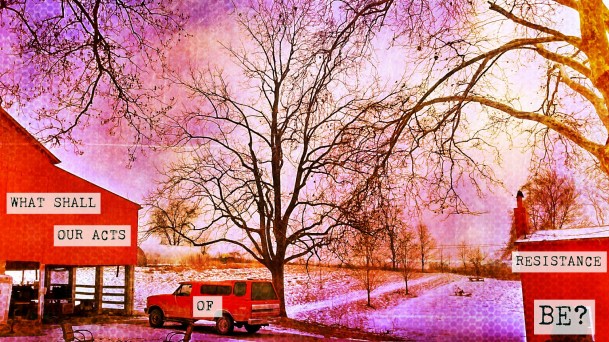
Ranting

I have been ranting for the last couple of days. Here’s the gist:
Quote by Nancy Shulman:
“Nice people made the best Nazis. My mom grew up next to them. They got along, refused to make waves, looked the other way when things got ugly and focused on happier things than “politics.” They were lovely people who turned their heads as their neighbors were dragged away. You know who weren’t nice people? Resisters.”
***
Dallas Megachurch pastor Robert Jeffress said: “Apart from the vocabulary attributed to him, President Trump is right on target in his sentiment.”

To the contrary: The word “shithole” is nothing compared to the vulgarity of the sentiment he expressed.

I have been quietly not openly calling myself a Christian for years now, because I do not like the look of Christianity in this country. I now openly walk away from the name. I continue to be a Follower of Jesus, in an Anabaptist and Universalist sort of way, with an emphasis on the feminine nature of the Great Mystery, and a belief that the Great Mystery is within everything and everyone. But I can no longer categorize myself as a Christian. I do not belong in any way, shape, or form to the same group as this man. No, we clearly are not following the same Jesus. Yes, this is judgemental. Yes, it is not being accepting of differences. There are differences I will not accept. Racism and xenophobia have absolutely no role in the realm of Jesus. If that is Christian, I am not that. I will have no part of that. Rather than trying to claim the term as something that embraces me as well, I walk away from it.

I will not check myself in as a Christian on polls and forms. If you ask my religion, I will no longer tell you that I am “a Christian, just not one of those.” Public Christianity in the United States is nothing I recognize as having anything to do with Jesus.

There are many people I know who continue to claim and reclaim the word, and I do not judge them. I, however, feel that at this point in time, I need to make a clear distinction between what I believe and what seems to be the path of U.S. Christianity.
***
This is no shock. We knew he was racist. Still, putting it into the public discourse so baldly demands that public figures, especially ones who follow Jesus, repudiate the language. One can say that this is not surprising, that he’s been doing this all along. That is true. But this is a level of unstatesmanlike public discourse that needs to be addressed right now. Robert Jeffries certainly did. His counterparts need to speak up. Now.
***
I believe in the path of Love, but this is one of the biggest challenges to that, even more than Dick Cheney. It was easier when it was abstract, but having an actual person to work it out with is really hard. I should probably take a FB break and read more Thich Nhat Hanh and Pema Chodron and Richard Rohr. Still, I feel a need to be part of the conversation. Somehow, I think these things need to happen in tandem: the inner work and the outer work.

Let’s keep talking about how to manage this. If not to Love, if not even to stop hating, at least to manage it all, to not be drowned, ourselves, in the hatred.

This I can say: I love You. I love my family, my students, my colleagues, my Beloved Friends, the sun and the earth and the animals. The moon. Those who are downtrodden and beaten and excluded. And because of that Love, I must fight the Wrong that these men are unleashing.

I have a sense that my hatred will not be an effective tool in that, though I have not managed to quell it. My anger can go either way, to push me to toward effective Work, or to enmire me in the bogs.

I cast a line from me to you, a line of Love for all that we love in common.
***
“No human race is superior; no religious faith is inferior. All collective judgments are wrong. Only racists make them.” –Elie Wiesel
***
I have been neglecting the grounding work of my gratitude lists during a couple of days when I desperately needed the grounding.


Gratitude List:
1. The fine musicians and singers at my school. They are really given the opportunity to learn and to shine.
2. A long weekend
3. Bright souls, all around
4. A warm hat and slippers
5. Being surrounded by stories

May we walk in Beauty!

Holding Presence

Gratitude List:
1. Did you see that sunrise this morning? The magenta clouds shot through with a golden ray?
2. An extra nap for the bad cold. Complete with cats.
3. The humidifier–may it last the whole winter.
4. Warm blankets
5. All the colors that we painted these rooms. Colors feed me through winter.

May we walk in Beauty!


Quotations for Today:
“You loose your grip
and then you slip
into the Masterpiece…”
—Leonard Cohen
***
“Your life and my life flow into each other as wave flows into wave, and unless there is peace and joy and freedom for you, there can be no real peace or joy or freedom for me. To see reality-not as we expect it to be but as it is-is to see that unless we live for each other and in and through each other, we do not really live very satisfactorily; that there can really be life only where there really is, in just this sense, love.” ―Frederick Buechner
***
Toko-pa, quoting and reflecting on Marion Woodman:
“Marion Woodman—Jungian, author, teacher, crone—taught me that what is most missing from our culture is the Mature Feminine. Mature Feminine, she says, is the ability to ‘hold presence.’ It is not divided attention, like the sort you feel when someone is psychically composing their grocery instead of listening to you. “I don’t have time for that,” she says. Holding Presence “is to love the other exactly as they are, not as you want them to be.” It is love without judging, without getting the other tangled up in your own unconscious, unlived life. “Holding presence is to create room so the other can grow into their destiny. They can feel that.””
***
This one is not just for mothers. I know people, men and women, single and married, parent and nonparent, who see all children as their own. I know that parenting has heightened this for me personally:

“Becoming a mother makes you the mother of all children. From now on each wounded, abandoned, frightened child is yours. You live in the suffering mothers of every race and creed and weep with them. You long to comfort all who are desolate.” —Charlotte Gray

Making It Matter

My word for this year will be Matter. Matter, the primal stuff, the essence, the source. Matter, from mater, which is mother, which is source. What matters? What manifests? What incarnates and comes into being? Matter is that which is of consequence, of significance, of importance. Material, substance, that which has form.

My work for the year is to take the idea and make it real, to materialize it, to manifest it, to enmatter it. The work of the year will matter: it will be important, it will manifest, it will go from idea to reality.

The dreams that have accompanied me this month have been about approaching with curiosity ideas and tasks which make me uncomfortable, about stepping with courage into the work that approaches.

There was the dream about the young Ellegua who beckoned me to wide green field where we greeted a flock of vultures. Their feathers were surprisingly soft.

There was the dream about the three girls (Graces? Goddesses? Muses?) who led me forward, and laughed kindly at my timidity.

There was the dream where I was told two times (and very distinctly): “This is how you will begin to do battle with the big lie.” And then there was no further direction. How? How am I to battle the lie?

There was a dream about bears which turned themselves into trees. And then the trees turned into birds and flew away.

There was the dream of a blue sky and some sort of hazy philosophical discussion, and someone gesturing around the vast bowl of blue, “It all makes sense, unless you factor in the Goddess. If you add the Goddess to the mix, it all becomes a mystery.”

What a hodgepodge of ideas and images! They’ll be in my toolbox as I contemplate what it means to make the ideas matter in the coming season.

Do you choose a word or a phrase or an idea or image to accompany into the New Year? How do you find it?


Gratitude List:
1. Good movies. We watched Amal last night on Netflix. We hadn’t heard of it, but Jon was looking through the Rotten Tomatoes movies with 100% ratings and found it. I concur with the rating. It was simply sweet, and deeply profound, like an excellent short story. You should watch it, too.
2. A lovely quiet day with Joss yesterday. It was just the two of us, playing games and reading. My voice is hoarse from reading.
3. The house is still clean. I can still think.
4. Dreams that light the way.
5. Blue skies and mystery.

May we walk in Beauty!


“There are years that ask questions, and years that answer.”
—Zora Neale Hurston
***
I see her walking
on a path through a pathless forest
or a maze, a labyrinth.
As she walks, she spins
and the fine threads fall behind her
following her way,
telling
where she is going,
telling
where she has gone.
Telling the story.
The line, the thread of voice,
the sentences saying the way.
—Ursula K. Le Guin (from “The Writer On, and At, Her Work)

Stories Will Save Us

These days, I am immersed in several pieces of literature, three of which have uncanny connections to the current socio-political atmosphere.

Having just finished analyzing To Kill a Mockingbird with my English 101s, I am struck again by Lee’s portrayal of a culture on the cusp of change, of the willful ignorance of a people deeply entrenched in their own social privilege and power. I want to keep aware of the book’s faults when it comes to teaching a diverse body of students in the 2000s: Atticus as the white savior, the fact that it’s yet another white child’s coming of age story, the use of the n-word (even in the context of the story). Still, I think it’s a powerful tool for helping 14- and 15-year-olds understand not only the history of systemic racism in our country, but also the social context, of how people deliberately ignore the imbalances of privilege and power. I want them to make the connection to ourselves, to explore how systems of privilege and power still affect the ways in which we see ourselves and others today. Sometimes I feel as though I am teaching three books at once: it’s literature, it’s history, it’s social commentary.

In another class, we’re finishing up an exploration of Julius Caesar. Again, I keep feeling an uncanny connection to the politics of today–not the assassination bit, of course, but the ways in which the powerful act for their own ambition while saying they work for the good of the country, the ways in which the mob can be manipulated to do the will of those who have power.

At home, we are reading Harry Potter and the Goblet of Fire. We just read the bit about the Death Eaters who attacked and terrified and mortified a family of Muggles after the Quidditch World Cup. All I could see, as the boys and I were talking about it, was young men marching through Charlottesville with torches. It’s the same story, really, about people dehumanizing those who are not like them, drunk on their own social power, using fear and threats to intimidate. Each time I re-read her books, I am more deeply aware of how Rowling understands social systems, how she portrays systemic injustices even as she’s creating a magical world. I’ve often thought that young people ought to be required to read Harry Potter and the Order of the Phoenix. The student resistance at Hogwarts resembles the European resistance movements in World War II. What do you do when your own governing structures have been infiltrated by Death Eaters? I am more aware than ever now how Rowling began setting up the complex social and political systems even in the early books.

Stories will save us, if we let them. We choose the stories we follow, like we choose the voices we listen to. Of course, stories can be misused, if we abdicate our responsibility to think and question and process because we rely on the tired plots we know, if we simply let the old stories keep telling us, if we refuse to participate in the creation of the new story. Still, stories can be dangerous to the status quo, making us question our roles, helping us to identify more clearly who we want to be in the current plot, offering us maps and possibilities so that we can take the current where it serves us.


Satuday’s Musings:

“In such ugly times, the only true protest is beauty.” —Phil Ochs
***
“The sense-making in poetry is about getting behind the brain. A poem is a door. Sometimes poets make sturdy, locked, exclusive club doors that you can only enter if you are one of ‘us,’ or if your can speak (or pretend to know) the password. A really good and satisfying poem is an open and inviting doorway that frames the view in a particularly compelling way. ‘Look!’ it says. ‘Stand and stare. Take a deep breath. Then tell me what you see.’

“Good poetry, I think, holds a paradoxical perspective on language itself: it acknowledges the inadequacy of words to completely map an inner geography, and it also steps with reverence and awe into the sacred space that language creates between writer and reader. Words are both inadequate and holy.” —Beth Weaver-Kreider, 2014
***
“Where does despair fit in? Why is our pain for the world so important? Because these responses manifest our interconnectedness. Our feelings of social and planetary distress serve as a doorway to systemic social consciousness. To use another metaphor, they are like a “shadow limb.” Just as an amputee continues to feel twinges in the severed limb, so in a sense do we experience, in anguish for homeless people or hunted whales, pain that belongs to a separated part of our body—a larger body than we thought we had, unbounded by our skin. Through the systemic currents of knowing that interweave our world, each of us can be the catalyst or “tipping point” by which new forms of behavior can spread. There are as many different ways of being responsive as there are different gifts we possess. For some of us it can be through study or conversation, for others theater or public office, for still others civil disobedience and imprisonment. But the diversities of our gifts interweave richly when we recognize the larger web within which we act. We begin in this web and, at the same time, journey toward it. We are making it conscious.” —Joanna Macy
***
Why Are Your Poems So Dark?
by Linda Pastan

Isn’t the moon dark too,
most of the time?
And doesn’t the white page
seem unfinished
without the dark stain
of alphabets?
When God demanded light,
he didn’t banish darkness.
Instead he invented
ebony and crows
and that small mole
on your left cheekbone.
Or did you mean to ask
“Why are you sad so often?”
Ask the moon.
Ask what it has witnessed.


Gratitude List:
1. Sunshine
2. Story
3. Sleep
4. A clean house
5. A blue true dream of sky

May we walk in Radiant Beauty!

Finding the Map Home

Repeating some questions I asked myself a year ago:

When have you felt yourself to be your best self?
When have you been most comfortable being who you are?
What would it take to find your way back into that house of yourself?
Did you leave yourself a map?
Is there an old photograph in a dusty album somewhere in your heart
that you can use to guide yourself back to that place?
It might be as simple as taking three deep breaths,
clicking your sneaker-clad heels together three times,
and chanting, “I want to go home, I want to go home,
I want to go home.”
Shall we try it?


A series of Random Musings for a Snowy Day:

“We use language to build the structures upon which we hang our ideas. Language is the scaffold upon which we develop whole structures of thought. Language anchors and shapes and breathes life into thought and idea. Conventional thinking, and conventional language, can end up being a pretty tight little box of a windowless building that doesn’t let in the light. The air in there gets pretty stale. When language—and its attendant ideas—become calcified and crippled into arthritic patterns, poetic image and word-use can find new ways to say things, can break windows into the walls of those airless rooms and build ornate new additions onto the old structures. Poetry jars the cart of language out of its constricting wheel ruts. This is why poets and writers can make good revolutionaries—if they know their work and do their jobs well.” —Beth Weaver-Kreider, 2014
***
“The nuclear arms race is like two sworn enemies standing waist-deep in gasoline, one with three matches, the other with five.” —Carl Sagan
***
Mary Oliver, on the Great Horned Owl: “I know this bird. If it could, it would eat the whole world.” And then: “The world where the owl is endlessly hungry and endlessly on the hunt is the world in which I too live. There is only one world.”
***
Fierce Wild Joy
by Beth Weaver-Kreider, 2016

May this year bring you joy
like crows rising from the fields

fierce
wild joy

yelling full-voice
into the wind

rowing through the tempest
with nothing but feathers.
***
“Have patience with everything
that remains unsolved in your heart.
Try to love the questions themselves,
like locked rooms and like books
written in a foreign language.
Do not now look for the answers.
They cannot now be given to you
because you could not live them.
It is a question of experiencing everything.
At present you need to live the question.
Perhaps you will gradually,
without even noticing it,
find yourself experiencing the answer,
some distant day.”
―Rainer Maria Rilke
***
“With life as short as a half-taken breath, don’t plant anything but love.”
―Jalaluddin Rumi


Gratitude List:
1. Two-hour delays. They wreak havoc on the teachers’ end-of-semester schedules, but 10 o’clock is such a humane hour to begin the work day. Breathe. Sleep in.
2. Bhangra Dance. It’s so joyful, so full of life. I’ve been looking up How-to videos on bhangra dancing. It’s all very funny-looking on my part at this point, because I have both the Mennoniteness and the hobbity-ness to contend with, but at least I get a little exercise, and I entertain the family while I practice.
3. Home remedies. I still have an uncomfortable cold, but I have a hunch all the home remedies helped get me past the trampled-by-rhinos phase.
4. Cold weather. Odd thing for me to say, because I really hate being cold, but it feels right that January be cold. After the mildness of November and early December, this feels right. Still, I will be glad for Spring to begin showing her feathers.
5. Good literature.

May we walk in Beauty!

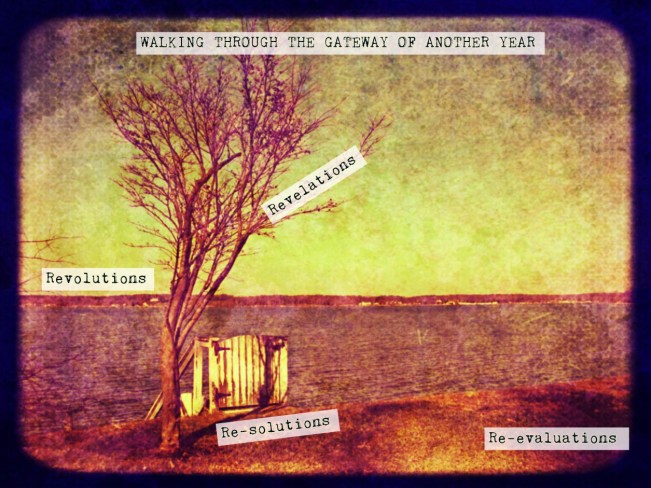
Walking Through the Gateway of Another Year


Let’s call them New Year’s Revolutions
or Re-Solutions
or Revelations
or Re-evaluations.

Change. Progress.
Uncovering. Assessing.

In the coming year, I resolve to re-solve
my problems and issues every day
not just on this morning.

For every morning is the morning
of a whole new year,
a bright blank page
in which any thing
can be a new thing.

Let every moment be a moment like now,
when the newborn sun shines
over the ridge
onto the scarlet breast
of a cardinal,
and the eye
for a moment sees nothing,
nothing but sparkling red.


Gratitude List:
1. The red breast of the cardinal on the hill
2. The scent of orange and cloves
3. The sound of a woodpecker drumming high in a tree on the bluff
4. A warm house and warm clothes in bitter weather
5. All my Beloveds.

May we walk together in Beauty into a radiant new season.

Contemplating Dreams and Seeds


Photo from April 2007. May the seeds we plant today grow and flourish.

Random morning musings on the last morning of 2017:
The sun is rising on the last morning of 2017. I can’t say I am very sad to see it go, but it’s had its share of beautiful and shining moments. While 2018 stands golden on the horizon, just like that ball of the sun, we can know with absolute certainty that it will hold its own share of difficulties.

Here are some Re-Solutions I am carrying for the coming year:
–Less giving in to fits of unbridled fury. More using of rage to fuel transformative action.
–Less worrying what others think. More focus on what I think.
–Less frittering. More focusing.
–More and more and more noticing, and being in the moment, being present.
–Follow the images and stories that my dreams show me.

This is last night’s dream. It’s not deeply profound, perhaps, but it suggests a magical realism that I want to begin to incorporate more into my writing.

In the dream, I am reading something by Barry Lopez or Gary Snyder. It sounds something like this:
“Once there were bears, massive creatures of sinew and blood and bone, great beasts of tooth and fur and claw. A day came when they turned themselves into trees, and the trees turned into birds and flew away.”

Just a little fragment, a seed of possibility.

Speaking of seeds, have you seen the little cartoon of two little critters? One is looking anxious and belabored. The other is looking happy, and digging in the dirt. The anxious one says something like, “Why are you so optimistic about the coming year? Everything seems to messed up. What could the new year possibly bring?”

“I think,” says the other, “that it will bring flowers.”

“Why?” asks Anxious Critter.

“Because,” says Happy Critter, “I am planting flowers.”

Ah. There it is.

Dystopia


Imagine a world in which every child, at the moment of its birth–and often months before–is placed into a category, labeled and processed. “You are this,” it is told, before it even opens its eyes for the first time. It is dressed according to its category, handed a list of assumptions about itself based solely on singular physical characteristics. It will be given a particular subset of toys to play with and expected to behave in certain ways based entirely on the category it was assigned.

One category of children will be encouraged to cry, to be tender, to look on the world with wonder and delight. Children in this category are raised to nurture and care for others. They are trained from the moment they are born to look to the needs of others. They are told that their lot in life will be to care for the young, to see to the needs of the elders, and to serve the desires and needs of the members of the opposite category.

Members of the other category are told that it is never acceptable to cry, and they are punished for showing emotions, which are–for them–a sign of weakness. They are trained to be aggressive and strong, powerful and dominating. They are pushed to excel in competitive games of strength. They are trained to be the leaders of the society, told that members of the other category will see to their needs. They are meant to protect, and must be served by others in order to fulfill their obligations as defenders and providers.
***
I had the disturbing experience the other day of hearing some people discussing something that someone in one of my circles said about women’s roles in society, the “inborn” leadership qualities of men. This is an acquaintance, and not a close friend, but I feel like it might be important for me to address it, to ask if what I heard is true, and if so, express my concern.  I am really bad at this sort of thing, but I feel like this is one that needs to be addressed, especially in the particular circle where it occurred. In the night last night, when I would wake up, I found myself thinking about it, and trying to see it from outside the culture. What would it look like to someone from another planet, to see how we categorize ourselves into two genders with incredibly powerful ideas about what is acceptable or unacceptable behavior for people, simply because of the accident of the gender they were born with?

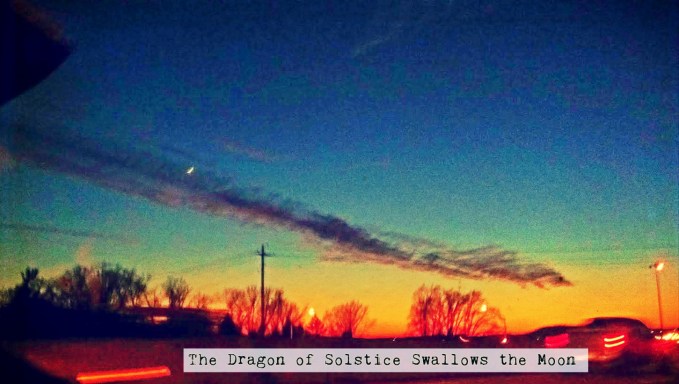
The Dragon of Solstice


Not the clearest picture, perhaps. One of the riders in my car took it, and my camera doesn’t handle near-darkness very well. This was in the early stages of her metamorphosis. About five minutes later, she was looking more dragonish than ever.

Now we are several hours into Longest Night. Tomorrow, we begin the inward turn again. Now is the time to settle into the darkness. To breathe. To dream. To melt.

In my own sacred calendar, the night of Solstice begins the deepest dreamtime of the year, almost time out of time. From now until the first of the year, or until Epiphany, I will monitor and mine my dreams for the images that will guide me in the coming year. Already, my dreams have been tossing up some powerful images to begin the percolation.

May your dreams in this, the Longest Night, bring you peace and hope. May they invigorate and inspire and challenge you for the work ahead. For there is much work ahead. There will be need of wakefulness and wisdom.

Much Love and Beauty to you.

Gratitude List:
1. This evening on the way home from school, just as the sun was setting, and the day was opening the curtains into the Longest Night, a great dragon swept across the sky, casting its body from east, and around the bowl of sky, into the west. Its head lay directly in front of us, toward the setting sun. It had swallowed the sliver of a horned moon. If you weren’t looking closely, as we were, you might have taken it for a cloud. We decided that The Dragon of the Solstice was offering us a portent or a message for the dying year: Be fierce. Take up all the space you are given. Believe in miracles. Hold the Moon inside you.

2. The geese and little birds are crossing the sky these early mornings and late evening, like mysterious scripts that someone, certainly, will be able to read, but my eyes are not trained to interpret this alphabet. Still, like Korean or Chinese or Hindi or Arabic, it catches my eye and draws me in with the sense of the meaning that is there behind the lines, but to me is only Beauty.

3. I have many friends and beloveds who are perfectly yourselves. Divinely, wondrously, solidly, and delightfully yourselves. Where would I be without you, without your inspiration, without your challenges? You keep me honest. You help me to be my better self. So much of my own shine is reflection from you. You’re the moon I carry inside me.

4. Rage has lessons to teach me. I’ll try to be grateful now simply to know that, although it burns to carry those coals inside. Sometimes, I think I have learned the lessons–the vocabulary, the angles and calculations, the social history, the science–of rage, but then I find myself back in the primary class. It takes some of us a little longer to learn. I will be patient with myself.

5. I have a class of quite energetic, distractible students who have experienced a high degree of frustration with the subject at hand. Often, the most carefully-planned lessons fall flat, but they can’t handle too much spontaneity, either. I really need to work hard with them on writing, and I have been nervous about that for several reasons. One boy often freezes when I ask them to write. Another can’t handle silent, quiet work and creates so many distractions the others can’t work.

Still, I decided that yesterday I would give them five prompts and have them write about one or more for the whole period. With only one exception, they got to work with a will, several of them asking if they could write whatever they wanted instead of the prompts. I had them share their documents with me, and I would check in on them, offering comments and responses on their documents. At the end of the period, they begged for another day of writing.

Today, we wrote again, for the whole period. Some incredible stories are emerging. We’re doing absolutely no editing at this point, and things are pretty raw, but it will give us something to work on in the next step. The only student who couldn’t handle it yesterday came in today with a page and a half that he’d written between yesterday’s class and today. Everyone buckled down and wrote today. They begged for a third day of writing.

I am going to tempt the magic for one more day. Then we may have to move to other things: some more direct work on the basic grammar and sentence structure points, and other sorts of literacy and fluency work.

I am grateful for moments of magic in the classroom.

May we walk in Beauty!

Walking Into the Dark

This week, weaning myself from the keyboard, I jumped back into my handwritten journal-book, with pens and colored pencils, and the slower, reflective pacing of handwriting.

I have been dreaming and writing dreams, feeling the shadows of dreams flitting around my head even when the images and plotlines escape me. Vultures and daughters, bees and small children–the dream-symbols have been feeding me as I walk into the darkness of winter.

During the years when we were both farming full-time, when winter was truly a resting time, I think I had my most satisfying winters. I was able then to hibernate, to draw myself inward, to slow way down. Now in these years, when the days are so busy, and the evenings hold lists of necessary tasks, I lose myself a bit in winter. I struggle to focus in the outer world, but I don’t have the inner space to really slow down. Not really.

And so I am taking a bit of an Advent Break, shifting up my morning and evening routines, letting myself drift out of the social media spheres. It has been a good thing to take this break, to shift my habits. In the coming weeks between now and Epiphany, I will continue to make occasional forays onto this page, occasional steps into the world of Facebook, but I am going to breathe and rest and meditate and dream as I need to in these days, and hold myself to as few schedules as possible..

Blessings on your own Advent, your Dark Time, your Inward Journey. May your dreams be fruitful, and your visions be keen.

Much love.


Gratitude List:
1. Shadows and darkness
2. Dreams and visions
3. Rest and Quiet
4. Joy and Peace
5. Waiting and Anticipation

May we walk in Beauty!