NPM Day 21: Justice

Today, write a poem about accountability and consequences. Or make an acrostic poem about JUSTICE. Or try your hand at a credo poem, expressing what kind of society you want to be part of. Perhaps write a letter to the future, explaining what future you have been trying to manifest here and now. You could take a verse—like “Let justice roll down like waters”—and use it as your epigraph, or as a repeated phrase in a chant poem. Find a picture of the blind goddess Justice with her scales, or the tarot card Justice with scales and two-edged sword, and write a poem about justice personified.


Gratitude List:
1. Finally, justice. It’s a hard gratitude, not a soft one, like blossoms and birdsong, because a man is dead, and now yet another black child is dead, and we still have so much work to do, but one step toward a change has been made. Now we work.
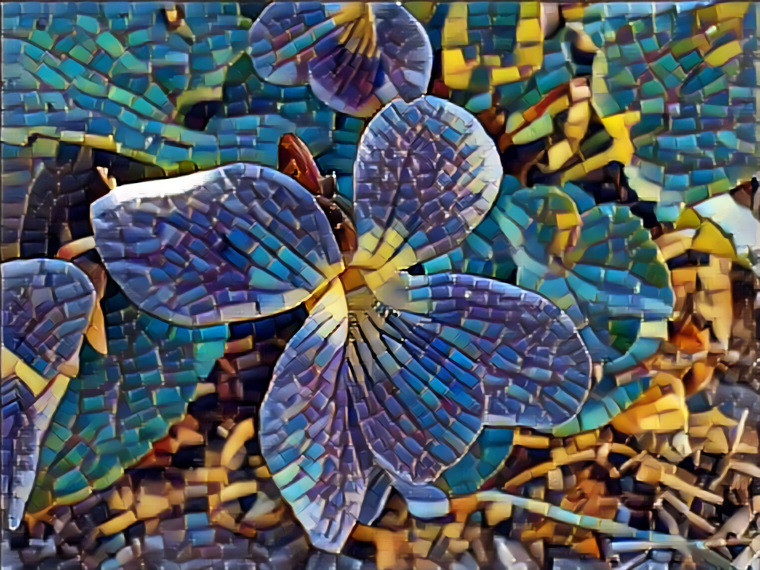
2. Collage, quilting, mosaics, found poetry, creating a life: taking pieces and fragments and putting them together to create beauty.
3. Okay, blossoms and birdsong. They’re soft, but they’re also–some days–the crumbs on the pathway that help me find my way.
4. Reflections. Light on the windows. The suggestions of worlds within worlds. Worlds beyond worlds. They way you reflect me, and I reflect you.
5. Smoothies. For some reason, I never really want them in the winter, but spring and summer bring smoothie weather. I look forward to berry season.

May we walk in Beauty!


“Buying a book is not about obtaining a possession. . .but about securing a portal.” —Laura Miller


“I’m writing a first draft and reminding myself that I’m simply shoveling sand into a box so that later I can build castles.” ―Shannon Hale


“I can promise you that women working together―linked, informed, and educated―can bring peace and prosperity to this forsaken planet.” ―Isabel Allende


“Everybody needs beauty as well as bread, places to play in and pray in, where nature may heal and give strength to body and soul alike.” ―John Muir


“When we went to jail, we were setting our faces against the world, against things as they are, the terrible injustice of our capitalist industrial system which lives by war and by preparing for war.” ―Dorothy Day


“What is not acceptable is silence in face of oppression. Boycott if you want, or participate if you want. But do not remain silent in face of injustice.” ―Omid Safi


“When we walk on the earth with reverence, beauty will decide to trust us. The rushed heart and arrogant mind lack the gentleness and patience to enter that embrace.” ―John O’Donohue


“Beauty is an experience, nothing else. It is not a fixed pattern or an arrangement of features. It is something felt, a glow or a communicated sense of fineness. What ails us is our sense of beauty is so bruised and blunted, we miss all the best.” ―D. H. Lawrence


“Poems are maps to the place where you already are.” —Jane Hirshfield


“Be still, and the world is bound to turn herself inside out to entertain you. Everywhere you look, joyful noise is clanging to drown out quiet desperation. The choice is to draw the blinds and shut it all out, or believe.” ―Barbara Kingsolver


“Trees are sanctuaries. Whoever knows how to speak to them, whoever knows how to listen to them, can learn the truth. They do not preach learning and precepts, they preach, undeterred by particulars, the ancient law of life.” ―Hermann Hesse

NPM Day Twenty: Lost & Gained in Translation

Lost and Gained in Translation:
Take a short poem you’ve written. Open Google Translate. Copy and paste your poem into the translator. Turn it into French, or Urdu, or Javanese, and back again. What happened to it? What startles you? Copy out the phrases and combinations you like. Try it again. The final poem could be anything.

I sent my Science poem from yesterday through quite a number of translation transformations. At one point, science became elm, then alarm, then bell, and finally, depression. The mouse became a moth and a beetle and a butterfly and a bill. It began to sound so much like someone was telling my fortune that I kept the five phrases pretty much intact as I went.

Depression: The Bell
(Telling Your Fortune)

Be quiet like a moth walking on a fence.
The model is simple, but the money is hard,
Because of the large number of central bodies.
Look closely at all the evidence.
Purify your heart with reverence.

The original, for Reference:

Science

Silent as a mouse creeping along a fence,
Simple the patterns, but intricate the sense,
Since what’s in the center is often intense,
Sift carefully through all the evidence,
Silt washes away, leaving behind reverence.


Gratitude List:
1. Trusting my instincts
2. Clear, fresh, sweet water
3. That titmouse calling out in the dawn, insisting on his place in the world
4. I’m mostly sleeping through the night again
5. Memory

May we walk in Beauty!


“Life will break you. Nobody can protect you from that, and living alone won’t either, for solitude will also break you with its yearning. You have to love. You have to feel. It is the reason you are here on earth. You are here to risk your heart. You are here to be swallowed up. And when it happens that you are broken, or betrayed, or left, or hurt, or death brushes near, let yourself sit by an apple tree and listen to the apples falling all around you in heaps, wasting their sweetness. Tell yourself you tasted as many as you could.” —Louise Erdrich


“To light a candle is to cast a shadow…”
―Ursula K. Le Guin


“Everyone discusses my art and pretends to understand, as if it were necessary to understand, when it is simply necessary to love.” ―Claude Monet


“We realize the importance of our voices only when we are silenced.” ―Malala Yousafzai


I called through your door,
“The mystics are gathering in the street. Come out!”
“Leave me alone. I’m sick.”
“I don’t care if you’re dead! Jesus is here,
and he wants to resurrect somebody!”
―Jalaludin Rumi (trans. by Barks)


“Your hand opens and closes, opens and closes. If it were always a fist or always stretched open, you would be paralysed. Your deepest presence is in every small contracting and expanding, the two as beautifully balanced and coordinated as birds’ wings.”
―Jalaluddin Rumi (trans. by Barks)


“Something is always born of excess: great art was born of great terror, great loneliness, great inhibitions, instabilities, and it always balances them.”
―Anaïs Nin


“Everything has boundaries. The same holds true with thought. You shouldn’t fear boundaries, but you should not be afraid of destroying them. That’s what is most important if you want to be free: respect for and exasperation with boundaries.”
―Haruki Murakami


“All great spirituality is about what we do with our pain. If we do not transform our pain, we will transmit it to those around us.” —Richard Rohr

NPM Day Eighteen: National Haiku Day

April first had a sort-of-haiku poem in it, but today is actually National Haiku Day, so we have to write haiku today. The American form of the ancient Japanese tradition is a three-stanza syllable-count poem with lines of 5, 7, and 5 syllables. At its most basic, that’s it, but there are further rules to follow, if you want to take on that challenge:
Make the theme about nature
Focus on a very specific, clear image, and then add a second very crisp image
Use sensory words
One of the words in the poem gives a sense of the season of the year
The third line offers a surprise or twist or shift (often that second image)

Here’s my attempt for the morning:
Spring sun warms feathers.
Tiny sparrow hops, sees me.
The cat is also watching.


Gratitude List:
1. How sun shines on the green
2. How squirrels suddenly stop, and stand with their hands over their hearts, wide-eyed
3. How invigorating a morning shower feels
4. How everything is in bud, is in flower. Me, too. You, too.
5. How wise words enter the labyrinth of the heart.

May we walk in Beauty!


Sunday’s Messages:
“The beginning of love is the will to let those we love be perfectly themselves, the resolution not to twist them to fit our own image. If in loving them we do not love what they are, but only their potential likeness to ourselves, then we do not love them: we only love the reflection of ourselves we find in them.” ―Thomas Merton


“Art enables us to find ourselves and lose ourselves at the same time.” ―Thomas Merton


“We see quite clearly that what happens
to the nonhuman happens to the human.
What happens to the outer world
happens to the inner world.
If the outer world is diminished in its grandeur
then the emotional, imaginative,
intellectual, and spiritual life of the human
is diminished or extinguished.
Without the soaring birds, the great forests,
the sounds and coloration of the insects,
the free-flowing streams, the flowering fields,
the sight of the clouds by day
and the stars at night, we become impoverished
in all that makes us human.”
―Thomas Berry


“All acts of kindness are lights in the war for justice.” ―Joy Harjo


“We have only begun to know
the power that is in us if we would join
our solitudes in the communion of struggle.” ―Denise Levertov


“There are two types of people. Avoid them.” —Mary Engelbreit

NPM Day Seventeen: Boomerang

I’m making up my own form. Because I can. One of the things I love about writing in any poetic form, such as sonnets or pantoums or sestinas, is that it’s an intellectual exercise with specific rules. Sometimes you break the rules. Because you can.

So here’s my own invented form for today: Let’s call it a Boomerang.
A Boomerang, I say, is composed of one or more six-line stanzas.
Lines 1 and 6 are the same, and are three syllables each,
Lines 2 and 5 rhyme, and are four syllables each,
and lines 3 and 4 rhyme, and are six syllables each.

Here’s my inaugural Boomerang. See how it comes back to where it started?

You dream
and the winds blow
chill through the golden room,
herald of spring, or doom.
Which? You can’t know.
You dream.


Gratitude List:
1. Someone is humming, just going about his morning routine humming.
2. Someone outside in the holler is drumming in the treetops.
3. Today, My parents are coming for a little while. If people are fully vaccinated and they’re wearing masks, can they hug?
4. Weekend
5. Chipping sparrows are so precious. Rusty-capped, chickadee-sized, they move more thoughtfully than the brazen flippity chickadees.

May we walk in Beauty!


“First is the fall. Then we recover from the fall. Both are the mercy of God.” —Julian of Norwich


“Nothing is more beautiful than the uniqueness that God has created. You don’t have to create the beauty—you’ve already got the beauty. You don’t have to create the freedom—you’ve got it. You don’t have to create the image of God in you—you have it. You don’t have to win over God’s love—you have more than you know what to do with.” — Father Thomas Keating


“An early-morning walk is a blessing for the whole day.” —Henry David Thoreau


“Preach the Gospel at all times, and when necessary, use words.” ―St. Francis of Assisi


“I believe in kindness. Also in mischief. Also in singing, especially when singing is not necessarily prescribed.” ― Mary Oliver


“Wherever they might be they always remember that the past was a lie, that memory has no return, that every spring gone by could never be recovered, and that the wildest and most tenacious love was an ephemeral truth in the end.” ―Gabriel Garcia Marquez


“We live in capitalism. Its power seems inescapable. So did the divine right of kings. Any human power can be resisted and changed by human beings. Resistance and change often begin in art, and very often in our art, the art of words.” ―Ursula K. Le Guin


“True individual freedom cannot exist without economic security and independence. People who are hungry and out of a job are the stuff of which dictatorships are made.” ―Franklin D. Roosevelt


“The world is remade through the power of fierce women performing outrageous acts of creative rebellion.” —Louise M. Pare

NPM Day Sixteen: Bob and Wheel

Write a Bob and Wheel. If you’ve studied the classic British epic poem “Sir Gawaine and the Green Night,” you’ve experienced the Bob and Wheel form. The stanzas of this poem consist of an initial two-syllable line (the bob), and four lines of three stresses each (the wheel). The bob rhymes with lines 2 and 4 of the wheel.

Here’s my quick attempt. With a little more time to ruminate, I think I could love playing with this form.:
You dream
of friends around a hearthfire,
their tender eyes a-gleam:
their stories will inspire.
You will learn the theme.


Gratitude List:
I’m still in the throes of the very unsettling dream that woke me up at 4 this morning. It’s hard to think of gratitudes with the stark images my mind pieced together still floating through my brain. I suppose that’s what meditation and contemplation are about, finding my to hold the disturbing pieces gently while searching for anchors.
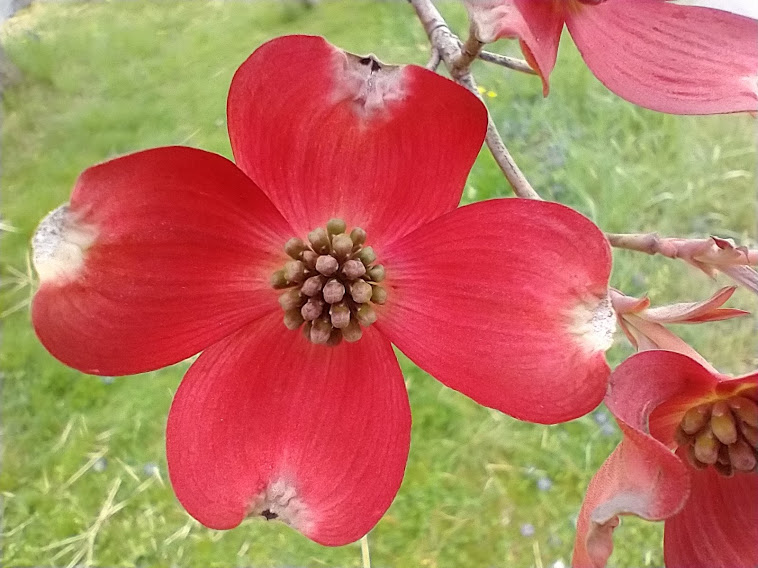
1. All the violets!
2. The guarddogwoods are about to burst into bloom.
3. Creative projects
4. Wakefulness
5. The wisdom of high school students.

May we walk in Beauty!


The Soul, it sees by synesthesia
Tasting light caressed by song
A touch is like a descant fire
resonant and strong.
—Craig Sottolano


“I’m not as cooperative as you might want a woman to be.” —Carrie Fisher


“The unconscious wants truth. It ceases to speak to those who want something else more than truth.” —Adrienne Rich


And did you get what
you wanted from this life, even so?
I did.
And what did you want?
To call myself beloved, to feel myself
beloved on the earth.
-—Raymond Carver’s Late Fragment, inscribed on his tombstone


Put down the weight of your aloneness and ease into
the conversation.
The kettle is singing
even as it pours you a drink, the cooking pots
have left their arrogant aloofness and
seen the good in you at last.
All the birds
and creatures of the world are unutterably
themselves. Everything is waiting for you.
—David Whyte


“Not all of us can do great things. But we can do small things with great love.”
―Mother Teresa


“Walking. I am listening to a deeper way. Suddenly all my ancestors are behind me. Be still, they say. Watch and listen. You are the result of the love of thousands.”
―Linda Hogan


“This will be our reply to violence:
to make music more intensely,
more beautifully,
more devotedly than ever before.”
―Leonard Bernstein

NPM Day Fifteen: Ekphrastic

Frida Kahlo painting. Use this or another piece of art as the source of your poem.

Write an ekphrastic poem. Ekphrastic poetry (the Greek word for description) is based on an image, using an image to make a strong description or to tell a story. Find a compelling painting or photo, and write a poem to it. Use a picture of your beloved, find a surreal image on Google (Google “surreal black and white photo”), or find an image from a famous artist. I especially like to do this with images of a person, or misty or mysterious landscapes. Take a moment to step inside the image, and begin writing.


Gratitude List:
1. Mending
2. Scent of rosemary essential oil
3. Dark bitterness of morning coffee
4. Morning inspirations that pop me out of bed to tweak a lesson plan
5. Dreams about community

May we walk in Beauty!


“Let me tell you what I do know though…
I know mountains grow because of their fault lines. I know lakes turn that gorgeous shade of turquoise because of their silt. I know jewels are formed under pressure. I know trees can grow through rocks, and rivers can break canyons.
I know there are 120 crayola crayons to choose from, so you can color yourself any which way you like.
I know the earth smells fabulous after a hard rain, and I know she breathes. I know out of the destruction of forest fires, new and stronger ecosystems can emerge. I know there is life in the deepest depths of the ocean and her tides can soften stone.
I know there can be no shadows without light. I know the passion is in the risk.
I know time heals, and most things will be okay eventually. I know you are made of the star stuff, and I know out there somebody loves you; exactly the way you are, even if you haven’t found them yet.
I know all these things, and tell them to you — in case you forgot to remember.” —Jacquelyn Taylor


“It is certain, in any case, that ignorance, allied with power, is the most ferocious enemy justice can have.” —James Baldwin


“We have tried to create a watertight social system so that mercy is not needed, nor even attractive. Mercy admits and accepts that not all problems can be solved by our techniques, formulas, and technology. The ‘superfluous’ opening of the human heart that we call mercy is essential for any structure or institution to remain human and humanizing.” —Richard Rohr


“I do not at all understand the mystery of grace—only that it meets us where we are but does not leave us where it found us.”
—Anne Lamott


“Your heart and my heart are very, very old friends.” —Hafiz


“Now I see the secret of making the best person, it is to grow in the open air and eat and sleep with the earth.” —Walt Whitman


“Nature’s peace will flow into you as sunshine flows into trees.” —John Muir


“So Matilda’s strong young mind continued to grow, nurtured by the voices of all those authors who had sent their books out into the world like ships on the sea. These books gave Matilda a hopeful and comforting message: You are not alone.” —Roald Dahl


“A writer is not so much someone who has something to say as she is someone who has found a process that will bring about new things she would not have thought of if she had not started to say them.” —William Stafford (but I have changed the pronouns to feminine)


“America stands for exactly what Americans will stand for. History doesn’t write itself. It must be lived and practiced.” —Jesse Williams

NPM Day Fourteen: Dactyls

Write a Poem using Dactyls. A dactyl is a three-beat foot of poetry which uses a waltzy, juggling sort of rhythm. The Dactyl goes BUM-ba-dum. Longfellow uses it a lot in “Evangeline” and Tennyson uses it in “Charge of the Light Brigade.” Use a few feet of dactyls sprinkled here and there, or make a whole dactylic poem.

Here’s my off-the-cuff attempt (you could waltz to it):

Here we are, singing and dancing like fools,
wandering into the woods and the leas,
leaving the stores and the churches and schools:
Follow your fancy and join us now, please.

(I just had a thought: Write a Terribledactyl poem. You know, like pterodactyl? Heh.)


Gratitude List:
1. Yesterday was tough, energy-wise–I had a big energy crash in the middle of the day, fortunately during my prep and lunch periods. Still, I am grateful that I am recovering, and this morning I feel a new surge of returning energy. I’ll conserve energy again today, but it’s nice to start out strong again.
2. Last week, one of my beloveds gave me some hand-me-downs. I LOVE hand-me-downs! And whenever I wear a shirt or a pair of pants or shoes that she gave me, I think about her during the day, and it makes me feel happy and connected.
3. Yesterday in Creative Writing, I introduced the unit project of each of us creating a chapbook with the best of the poems that we write during this unit. Halfway through the day, one of my CW students had emailed me a slideshow, beautifully designed, with several poems, just to check if she was on the right track. I love when they’re inspired by the projects.
4. Also in Creative Writing, I have given more extensions on the short story project than usual, not because people were overwhelmed or procrastinating (though there’s that element, too), but because they’ve gotten deeply into the stories, and want to extend them. There have been several earnest requests describing their process and their visions for their final stories. I feel a little like the students in these two classes are themselves elevating the class to a college level.
5. In one of my English 101 classes yesterday, the students began a spontaneous conversation on the differences between curse words and slurs. They’re very articulate and open-hearted and woke. They said they love this class because they can talk and have discussions. I tried to tell them it’s really them, as much as it’s the class–they just have this way, as a group, of building on each other’s ideas.

May we walk in Intention.


“Grief is normal. It’s not like you’ll have a life someday with no grief. Life is all about loss, but grief is the medicine for that loss. Grief is not your problem. Grief is not the sorrow. Grief is the medicine. The people that have grief cultural awareness are always turning all of their losses into beauty in order to make more life instead of just trying to get through it and then forget about it.” —Martin Prechtel


“The only weapon we have is our bodies, and we need to tuck them in places so wheels don’t turn.” —Bayard Rustin


“My turn shall also come: I sense the spreading of a wing.” —Osip Mandelstam, Russian poet and essayist


“There is a sacredness in tears. They are not the mark of weakness, but of power. They speak more eloquently than ten thousand tongues. They are the messengers of overwhelming grief, of deep contrition, and of unspeakable love.” ―Washington Irving


“Gratitude is not a passive response to something we have been given, gratitude arises from paying attention, from being awake in the presence of everything that lives within and without us. Gratitude is not necessarily something that is shown after the event, it is the deep, a-priori state of attention that shows we understand and are equal to the gifted nature of life.” ―David Whyte


“Our strategy should be not only to confront empire, but to lay siege to it. To deprive it of oxygen. To shame it. To mock it. With our art, our music, our literature, our stubbornness, our joy, our brilliance, our sheer relentlessness—and our ability to tell our own stories. Stories that are different from the ones we’re being brainwashed to believe.
“The corporate revolution will collapse if we refuse to buy what they are selling—their ideas, their version of history, their wars, their weapons, their notion of inevitability.
“Remember this: We be many and they be few. They need us more than we need them.
“Another world is not only possible, she is on her way. On a quiet day, I can hear her breathing.”
―Arundhati Roy, War Talk


“And this brings us back to the Hen Wife—that figure of magic who dwells comfortably among us, not off by the crossroads or in the dark of the woods; who is married, not solitary; who is equally at home with the wild and domestic, with the animal and human worlds. She is, I believe, among us still: dispensing her wisdom and exercising her power in kitchens and farmyards (and the urban equivalent) to this day—anywhere that women gather, talk among themselves, and pass knowledge down to the next generations.” ―Terri Windling

NPM Day Twelve: Embody an Animal

Embody an animal in a poem today.
Sit still for a moment and call an animal into your mind’s eye.
Feel within yourself what it feels like to have wings, flipper, tail, claws.
Write a poem from inside the perspective of that animal.
Be mythical, if you like.


Gratitude List:
Tabula Rasa, again. Starting fresh. New chances to succeed.


I called through your door,
“The mystics are gathering in the street. Come out!”
“Leave me alone. I’m sick.”
“I don’t care if you’re dead!
Jesus is here, and he wants to resurrect somebody!” —Rumi


“Don’t be satisfied with stories, how things have gone with others. Unfold your own myth.” ―Rumi


“Thousands of candles can be lit from a single candle, and the life of the candle will not be shortened. Happiness never decreases by being shared.” ―Buddha


Some words on my River, from Robert Louis Stevenson:
“I have been changed from what I was before;
and drunk too deep perchance the lotus of the air,
Beside the Susquehanna and along the Delaware.”
―Robert Louis Stevenson


“. . .and as I saw, one after another, pleasant villages, carts upon the highway and fishers by the stream, and heard cockcrows and cheery voices in the distance, and beheld the sun, no longer shining blankly on the plains of ocean, but striking among shapely hills and his light dispersed and coloured by a thousand accidents of form and surface, I began to exult with myself upon this rise in life like a man who had come into a rich estate. And when I had asked the name of a river from the brakesman, and heard that it was called the Susquehanna, the beauty of the name seemed to be part and parcel of the beauty of the land. As when Adam with divine fitness named the creatures, so this word Susquehanna was at once accepted by the fancy. That was the name, as no other could be, for that shining river and desirable valley.” ―Robert Louis Stevenson


“There may be times when we are powerless to prevent injustice, but there must never be a time when we fail to protest.” ―Elie Wiesel


Rob Brezsny:
Plato said God was a geometer who created an ordered universe imbued with mathematical principles. Through the ages, scientists who’ve dared to speak of a Supreme Being have sounded the same theme. Galileo wrote, “To understand the universe, you must know the language in which it is written. And that language is mathematics.”
Modern physicist Stephen Hawking says that by using mathematical theories to comprehend the nature of the cosmos, we’re trying to know “the mind of God.”
But philosopher Richard Tarnas proposes a different model. In his book “Cosmos and Psyche,” he suggests that God is an artist—more in the mold of Shakespeare than Einstein.
For myself―as I converse with God every day―I find Her equally at home as a mathematician and artist.

NPM Day Eleven: Make a List

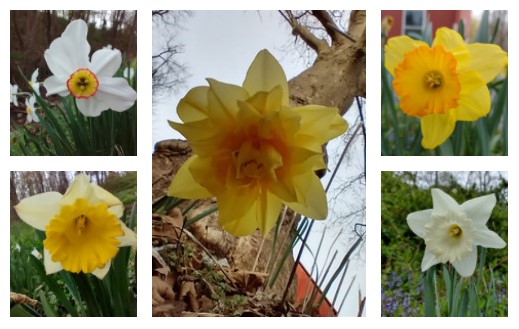
Here is a visual list of five varieties of daffodils on Goldfinch Farm.

Write a list poem.
When I first began writing Gratitude Lists, I quickly became aware of the fact that each one is really a little poem, that the seemingly unconnected items on the list spoke to and informed each other, created a magic in the randomness. And some days I would order them so they would either flow or crunch up against each other, intentionally poeming. I took up the discipline of gratitude lists at the same time I took up poetry as a discipline, and the two paths began to teach each other and to become intermingled.

In a list poem, what happens if “buy red ink for the printer” sits next to “write an apology to X for yelling at them” or next to “seek World Peace”? I’m fond of to-do lists as poems, but you can make a grocery list, a gratitude list, a vengeance list, a how-to-solve-the-problems-of-the-world list. Try a list of your favorite things, or things you see out your window.

Here’s mine, spontaneously:
April

is violet grape hyacinth
bluebells we called them
purple deadnettle
gill on the ground or the grass
violet myrtle

is golden forsythia flaming
in every hedgerow
yellow teeth of the lion
dotting the lawn and
a dozen kinds of daffodil

is pink skirts of cherry trees
whirling in breezes
rosy magnolia stately queen
pink orchards preparing
the fruits of the summer

is green almost glowing
life force in everything
growing new life
emerald grasses and new tender shoots
green vines weaving the season to come.


Gratitude List:
1. Purples and violets
2. Pinks, roses, and fuschias
3. Greens, emeralds, and viridians
4. Blues, ceruleans, and indigos
5. All that carries color

May we walk in Beauty!


“We have all hurt someone tremendously, whether by intent or accident. We have all loved someone tremendously, whether by intent or accident. it is an intrinsic human trait, and a deep responsibility, I think, to be an organ and a blade. But, learning to forgive ourselves and others because we have not chosen wisely is what makes us most human. We make horrible mistakes. It’s how we learn. We breathe love. It’s how we learn. And it is inevitable.” —Nayyira Waheed


“To me, it’s all right if you look at a tree, as the Hindus do, and say the tree has a spirit. It’s a mystery, and mysteries don’t compromise themselves—we’re never gonna know. I think about the spiritual a great deal. I like to think of myself as a praise poet.” —Mary Oliver


“When you hold a child in your arms, or hug your mother, or your husband, or your friend, if you breathe in and out three times, your happiness will be multiplied at least tenfold.” —Thich Nhat Hanh


“I stuck my head out the window this morning, and spring kissed me BANG in the face.” —Langston Hughes


“In the morning, wonder and be generous like the sun.
In the evening, meditate and be kind like the moon.”
—Debasish Mridha


“There is a huge silence inside each of us that beckons us into itself, and the recovery of our own silence can begin to teach us the language of heaven.” —Meister Eckhart


“Every spring is the only spring—a perpetual astonishment.” —Ellis Peters

NPM Day Ten: Find a Poem

Today, Find a Poem.
Finding a poem is kind of like making a quilt, where you take small pieces of fabric and stitch them together to become something beautiful and wholly your own. When you find a poem, you do the same thing with words, taking words and short phrases that catch your fancy like bright pieces of cloth, and then you decide how to stitch them together.

Here are a couple ways to find a poem:
1. Tear out a page from an old magazine or book (yes, really–I keep several on hand just for this purpose). Scan the page for words you like, words that might go well together, either making a certain sense, or simply sounding interesting together. Circle them. Cross out the others. Decorate the page. You can also do this with junk mail, or papers that you are throwing away. (If you’re a student, try one of those essays or term papers.) You can tape the page into your journals, take a photo of the finished process, or type it out.
2. As you listen to conversations today, or scroll through your social media, write down words and short phrases that you see or hear on little pieces of paper. Sit down with a stack of these, and shuffle them around on a flat surface until they resolve themselves into a poem. Tape the pieces together or type it up.

Poetic forms always have their rules, and I am a firm believer in the intellectual process of trying to create something that fits those rules–I think it refines the poet’s capacity for sensing inherent rhythms and sounds. But I also strongly advocate for breaking and revising the rules when they don’t suit you–that’s one of the ways new forms are born. There is one rule in Found Poetry that I recommend following pretty closely: Don’t take too many words in a row. The final poem should be yours. If you simply must take that entire sentence or complete phrase, then make sure to credit your source in your final poem.


Gratitude List:
1. Such fine care from my Beloveds. Hand-me-down clothes, stones to hold, scents to smell, advice for healing, images to meditate upon, reminders to rest. I love you, I love you, I love you.
2. Weekend!
3. The goldfinches are goldening
4. Trees in bud everywhere
5. Poeming saves me. When the world gets either frantic or flat, poeming grounds and centers.

May we walk in Beauty!


“Stay close to anything that makes you glad you are alive.” —Hafiz


“The problem is that you think you are separate from others.” —Richard Rohr


“You have to want a thing enough to reach out for it.” —Lailah Gifty Akita


“To wait within the moment for the coming dawn,
To breathe the single breath of all that lives,
To walk the web on which we all belong,
To face the newborn day with love instead of fear.
To listen for the whisper of the Spirit’s wind,
To feel Creator’s heartbeat in the world around,
To hear the grace of the Beloved in my neighbor’s voice,
To embrace the sacred space between the past and change.”
—Beth Weaver-Kreider


“Hope is a dimension of the soul. . .an orientation of the spirit, an orientation of the heart. It transcends the world that is immediately experienced and is anchored somewhere beyond its horizons. . . .It is not the conviction that something will turn out well, but the certainty that something makes sense regardless of how it turns out.” —Vaclav Havel


“When time comes for us to again rejoin the infinite stream of water flowing to and from the great timeless ocean, our little droplet of soulful water will once again flow with the endless stream.” —William E. Marks


“We are not to simply bandage the wounds of victims beneath the wheels of injustice, we are to drive a spoke into the wheel itself.” —Dietrich Bonhoeffer


“Healing is not pouring your energy into another, but activating the widening field of possibility around yourself, so the other may glimpse their own majesty forming on the horizon.” —Toko-pa Turner