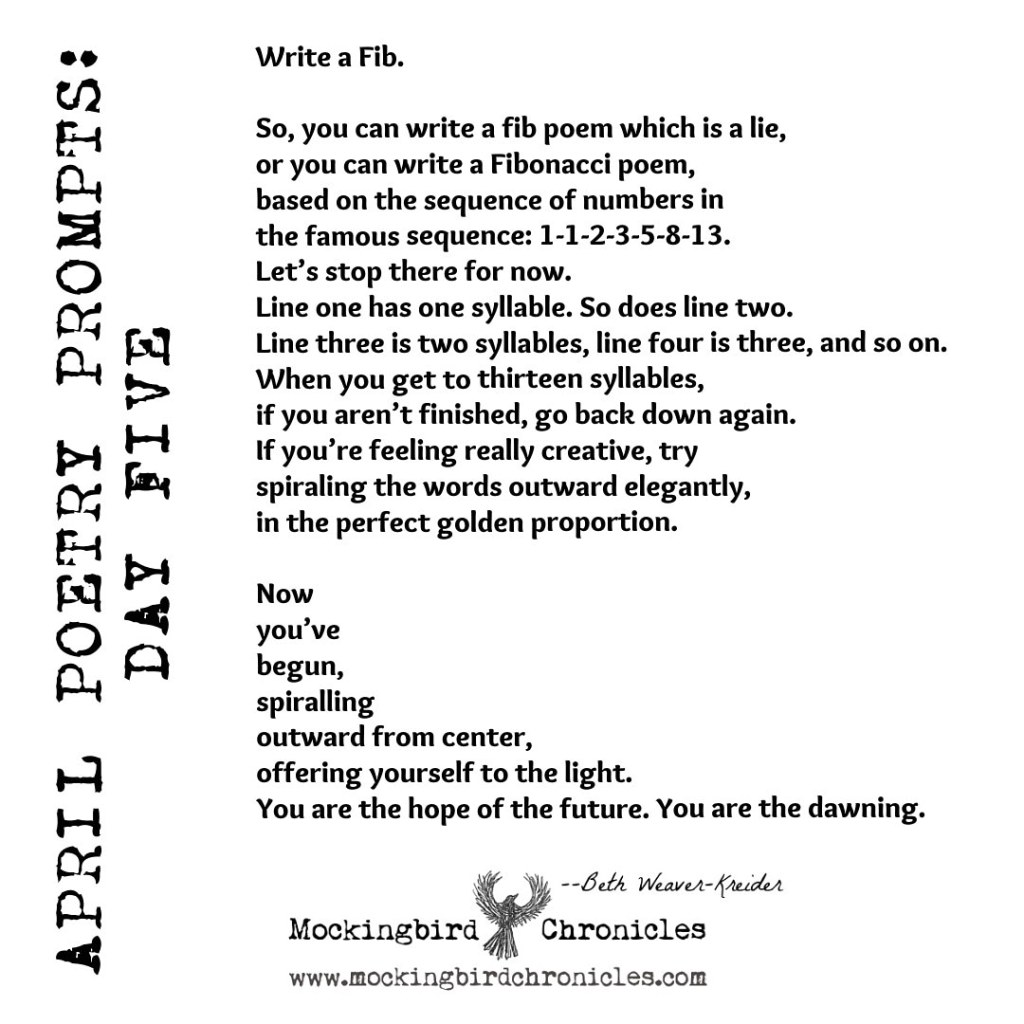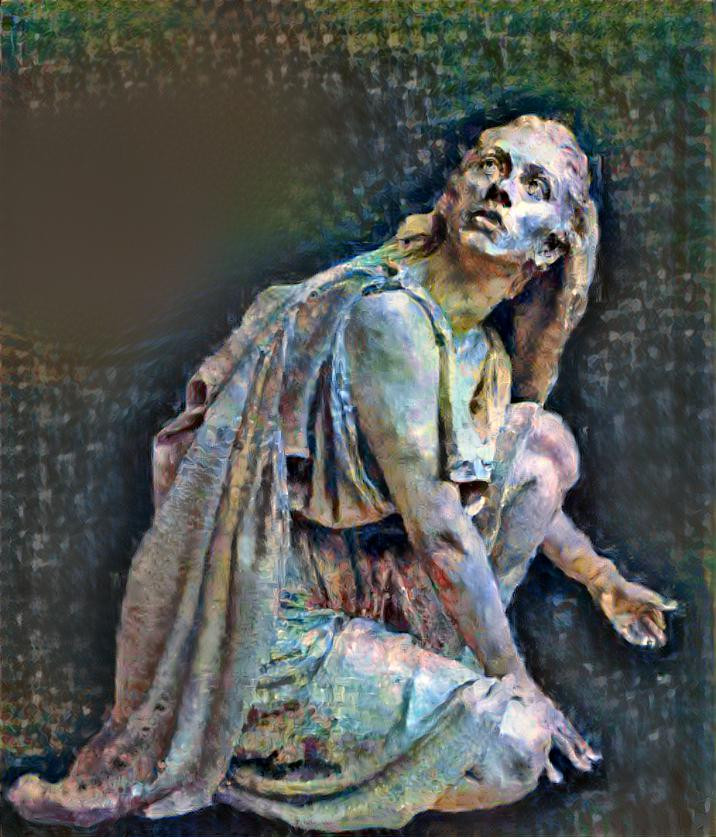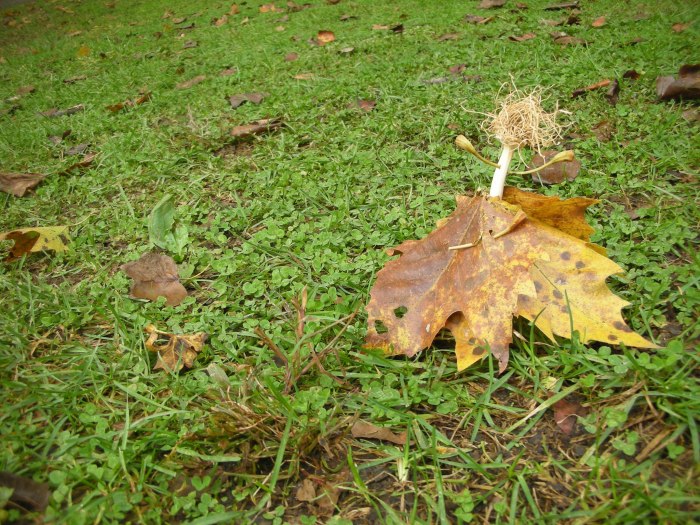
NPM Day 5: Fib!

This photo is a fib. Can you spot it?

Gratitudes:

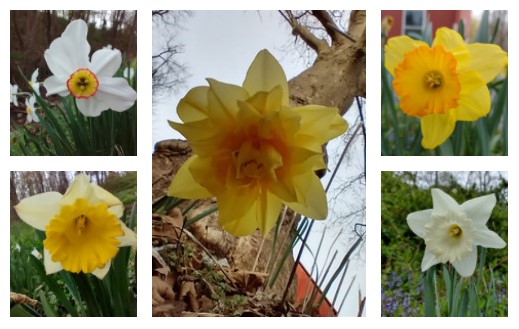
Time with the family. Leftovers. Baked goods. The color yellow. Rest.

May we walk in Beauty!


“My wish for you is that you continue. Continue to be who and how you are, to astonish a mean world with your acts of kindness.” —Maya Angelou


“If you pour a handful of salt into a cup of water, the water becomes undrinkable. But if you pour the salt into a river, people can continue to draw the water to cook, wash, and drink. The river is immense, and it has the capacity to receive, embrace, and transform. When our hearts are small, our understanding and compassion are limited, and we suffer. We can’t accept or tolerate others and their shortcomings, and we demand that they change. But when our hearts expand, these same things don’t make us suffer anymore. We have a lot of understanding and compassion and can embrace others. We accept others as they are, and then they have a chance to transform.” —Thich Nhat Hanh


“I have decided to stick with love. Hate is too great a burden to bear.” —Martin Luther King, Jr.


“When we plant trees, we plant the seeds of peace and seeds of hope.” —Wangari Maathai


“We write to taste life twice.” —Anais Nin

NPM Day 4: Loss and Redemption

I offered this as a short story prompt on my FB page the other day, and the results were compelling and moving. Let’s make it into a poem for today.

Write a three- to five-line poem in which you tell a story of loss and redemption.

The veil is torn.
“Why are you weeping?”
Tell me where they’ve taken his body.
“Mary.”
Morning dawns.


I love that Easter happens so often right near the beginning of April. although he is many archetypes–healer, teacher, revolutionary, dying god, redemptive force–one of my favorites is the Sacred Fool, and I never cease to be moved at the way the story plays this out in Easter and its aftermath, in the stories of Mary in the garden, Thomas the skeptic, Peter the shamed, and the travelers on the road to Emmaus. Each time, hope and relief burst in upon the devastation and despair.

The first one is with Mary in the garden. He approaches he and lets the truth of the story dawn on her in her time, lets the surprise flood in to her devastated heart without trying to push the discovery. And how does she hear the truth that he is alive? When he says her name.

It is my hope that, no matter what your spiritual story, that you will know you are Beloved, that you will be truly named.

Here is a Mary poem I wrote in 2017:

Turning the Wheel
by Beth Weaver-Kreider

it can be that quick
the change from one state to another
there’s that moment of devastating awareness
the kick in the gut and the tumble into the terrible truth
then the cold crypt of devastation
the going numb

but there’s that moment when you turn your face
away from the shadows and into the glare
and you don’t know yet who is it you see
but there’s something in the stance
something about the voice
the why are you weeping
and you don’t dare to hope
but then you hear your own name
and it all falls away
and the wheel has turned
and Love is there


Gratitude List:
1. How the light shines in
2. Holy surprises
3. Stories that bring hope to life
4. So many circles of care
5. Love

May we walk in Love!


“‘Kindness’ covers all of my political beliefs. No need to spell them out. I believe that if, at the end, according to our abilities, we have done something to make others a little happier, and something to make ourselves a little happier, that is about the best we can do. To make others less happy is a crime. To make ourselves unhappy is where all crime starts. We must try to contribute joy to the world. That is true no matter what our problems, our health, our circumstances. We must try. I didn’t always know this and am happy I lived long enough to find it out.” —Roger Ebert


In a mist of light
falling with the rain
I walk this ground
of which dead men
and women I have loved
are part, as they
are part of me. In earth,
in blood, in mind,
the dead and living
into each other pass,
as the living pass
in and out of loves
as stepping to a song.
The way I go is
marriage to this place,
grace beyond chance,
love’s braided dance
covering the world.
—Wendell Berry
(The Wheel)


”You have to begin to tell the story of your life as you now want it to be, and discontinue the tales of how it has been or of how it is.” —Esther Hicks

NPM Day 3: Rhyme Play!

For National Poetry Month, some of my poetry shelves.

Poetry Prompt for Day Three of National Poetry Month–

Rhyme Play!
Why do we assume that the rhyme has to happen at the ends of lines? Write a poem (maybe four lines, or eight, or twelve) in which the first words of the lines rhyme, instead of the last. Or make the middle word in each line rhyme. Make ALL the words rhyme? Make the first word of each line rhyme with the last word of the previous line—essentially, you’re sticking your two rhyming words together, separated only by the line break. Give yourself an extra challenge and make the first word and last word of the poem rhyme, and you’ll make it a complete circle.

What does that do to the poem when you switch up the rhyme? How does it affect the tone and the energy and the way the line moves from beginning to end?

Here’s an attempt at the last one:
When I think of how you’ve loved me,
see the thread of your tender care,
there in my self-absorbed cocoon,
crooning myself a lullaby,
I wish I had a poem to give you
to tell you how you’ve saved my heart again.


Gratitude List:
1. The fine distinctions of flavor, and the joy of concentrating on scent and flavor
2. Brown creeper sidling up the little oak
3. Delicious supper last night: Thank you, Val! I can now distinguish mocha
4. Succulents. I repotted some of my classroom succulents yesterday. I think they grew happily because I was gone for so long and didn’t overwater them
5. Spring birdsong

May we walk in Beauty!


“Sound or vibration is the most powerful force in the universe. Music is a divine art, to be used not only for pleasure but as a path to Awakening.” —Yogananda


“As above, so below, as within, so without, as the universe, so the soul.” —Hermes Trismegistus


“The greatest danger to our future is apathy.” —Jane Goodall


“Did I offer peace today? Did I bring a smile to someone’s face? Did I say words of healing? Did I let go of my anger and resentment? Did I forgive? Did I love? These are the real questions. I must trust that the little bit of love that I sow now will bear many fruits, here in this world and the life to come.” —Henri Nouwen


“In the end, we’ll all become stories.” —Margaret Atwood


“Privilege is when you think something’s not a problem because it’s not a problem to you personally.” —attributed to many authors


“If they don’t give you a seat at the table, bring a folding chair.” —Shirley Chisholm

NPM Day 2: Acrostic

I made this bulletin Board this week. As people write poems on leaves, I will staple them on, and we’ll watch the tree leaf out. I might have to make some apples to add.

(NPM=National Poetry Month)
Write an Acrostic Poem
Choose a word—your name, your favorite word, your password (just kidding!), the name of your town, April—and begin each line of your poem with the letters of the word.

For example:
Please understand:
Once upon a time,
Everything hurt
My feelings.

Write one word per line, or make long and rambling prosy lines. Make it rhyme or eschew rhyme.
Acrostics can be addictive. You probably can’t stop with just one.

This one’s more prosey, perhaps, than poetic, but it’s part of my ongoing chronicle:

Obviously, you can
Live without this one,
Fairly easily. When they
Ask, “Which sense
Could you not bear
To lose?” no one speaks
Of smell. But every day, I
Rest my face in roses, hoping.
Yes, today, the tiniest whiff.


Gratitude List:
1. Succulents. It’s not true that you can’t kill them–I have–but they make such pleasant companions
2. The red leaf-buds on the trees against that blue true dream of sky (eec)
3. My sense of smell is beginning–slowly–to return
4. For all its flaws, The Lord of the Rings. We watched The Fellowship again last night, and it is such a marvelous story to drop into.
5. A long weekend. I’ll say it again: A long weekend!

May we walk in Beauty!


“What we seek, at the deepest level, is inwardly to resemble, rather than physically to possess, the objects and places that touch us through their beauty.” —Alain de Botton


“We are capable of suffering with our world, and that is the true meaning of compassion. It enables us to recognize our profound interconnectedness with all beings. Don’t ever apologize for crying for the trees burning in the Amazon or over the waters polluted from mines in the Rockies. Don’t apologize for the sorrow, grief, and rage you feel. It is a measure of your humanity and your maturity. It is a measure of your open heart, and as your heart breaks open there will be room for the world to heal.” —Joanna Macy


“We should have respect for animals because it makes better human beings of us all.” —Jane Goodall


“Let yourself be silently drawn
by the strange pull of what you love.
It will not lead you astray.” —Rumi


“If you hear the dogs, keep going. If you see the torches in the woods, keep going. If there’s shouting after you, keep going. Don’t ever stop. Keep going. If you want a taste of freedom, keep going.” —Harriet Tubman


“The little grassroots people can change this world.” —Wangari Maathai


“Some form of the prayer of quiet is necessary to touch me at the unconscious level, the level where deep and lasting transformation occurs. From my place of prayer, I am able to understand more clearly what is mine to do and have the courage to do it. Unitive consciousness—the awareness that we are all one in Love—lays a solid foundation for social critique and acts of justice.” —Richard Rohr


“You don’t have to attend every argument you’re invited to.” —Anonymous

Shapeshifting and Foolery

April POETRY PROMPTS:
Day One–

The Fool, of course!
Today is about shapeshifting, foolery, jesting.

Write a three-line poem (call it haiku, if you need to) that seems like one thing in the first two lines, but shifts to something else in the third line. Bring in a surprise.

Maybe March goes out like a lamb, and the third line brings the lion roaring in.
Maybe you step in the door of the first lines only to step out the door in the third.
Maybe you show your masked self in the first two lines and take off the mask (metaphorically, of course) in the third.

You don’t have to go for a big surprise. It can be a dawning, a quiet wave of change, a whisper, the unfurling of a leaf in the wasteland.

Here’s one I wrote a couple weeks ago:

feathers by the trail
cardinal takes flight
in the belly of the hawk


Gratitude List:
1. Blue carpet of Speedwell
2. Purple carpet of Deadnettle
3. Green carpets of Chickweed and other spring friends
4. Feeling better every day
5. A long weekend to recover in

May we walk in Beauty!


“The fullness of joy is to behold God in everything.” —Julian of Norwich


“Loneliness does not come from having no people about one, but from being unable to communicate the things that seem important to oneself, or from holding certain views which others find inadmissible.” —Carl Jung


“The historical Jesus probably looked like an average Syrian refugee. You know…the ones we turn away.” —Rebecca James Hecking


“Poems are maps to the place where you already are.”
—Jane Hirshfield


“Be still, and the world is bound to turn herself inside out to entertain you. Everywhere you look, joyful noise is clanging to drown out quiet desperation. The choice is to draw the blinds and shut it all out, or believe.” —Barbara Kingsolver, High Tide in Tucson


“When you do not know you need mercy and forgiveness yourself, you invariably become stingy in sharing it with others. So make sure you are always waiting with hands widely cupped under the waterfall of mercy.” —Richard Rohr


“All four gospels insist that when all the other disciples are fleeing, Mary Magdalene does not run. She stands firm. She does not betray or lie about her commitment to Jesus—she witnesses. Hers is clearly a demonstration of either the deepest human love or the highest spiritual understanding of what Jesus was teaching—perhaps both. But why—one wonders–do Holy Week liturgies tell and re-tell the story of Peter’s threefold denial of Jesus, while the steady and unwavering witness of Magdalene is passed over—not even noticed? How would our understanding of the paschal story change if instead of reflecting upon Jesus dying alone and rejected if we were to reinforce the fact that one person stood by him and did not leave? For this story of Mary Magdalene is as firmly stated in scripture as the denial story. How would this change the emotional timbre of the day? How would it affect our feeling of ourselves? How would it reflect upon how we have viewed, and still view, women in the church? About the nature of redemptive love?” —Cynthia Bourgeault, Episcopal Priest


“When I feel this fog rolling in on me, I light fires of affection in the hearts of others. I tell them in tangible ways how the life they live makes me live mine differently, how precious and important they are to the rest of us. That fire then becomes like a beacon which burns through the grey and which I can sail towards.” –Toko-pa Turner


It’s good to leave each day behind,
like flowing water, free of sadness.
Yesterday is gone and its tale told.
Today new seeds are growing.
—Rumi

Listening for Stirrings of Spring

Happy Groundhog’s Day, Bright Ones! For today, I offer a collage of writings from past Imbolc days:

What do you bring up into the light today?
What has been developing within you during your Winter Sleep?
What does the dawning light tell you about your shadows?
How does the coming sun define the shape of you?
Groundhog’s Day is a modern version of the ancient celebration of the Goddess Brigid, who became syncretized with the Catholic Saint Brigid, whose feast day is February 1 or 2, depending on whom you ask. Brigid asks: What path will you commit yourself to in the coming season?


SONG FOR POETS: A POEM FOR BRIGHID’S DAY
by Beth Weaver-Kreider, Feb 2013

(Today we look for that jolly rodent, and also we commemorate Brighid, triple goddess and patroness of Ireland, Saint of Kildare. Smithcraft, poetry, and healing arts are her realms.)

Sacred wells, undying flame.

We forge our words on your anvil,
listening for the sweet ping
of hammer on metal,
watching the sparks fly outward,
shaping and crafting.

We seek them like wild herbs
found only on the side of a mountain
for a short season each year.

We search under bracken,
through briar and thorn,
stepping through bogs,
listening for the birdsong
that tells us we have arrived
at the proper place.

We give ourselves to words,
not waiting for inspiration,
but chasing it like skuthers of fog
over the misty hills.
Seeking the solace and healing
that words offer,
and turning our minds
to do that healing work.
Crafting our words
into tools and enticements.

A year and a day
the old ones would pledge
to your service.
So may it be.
One year of poetry,
making it, reading it.

Oh Lady, give us poetry.

Questions to Contemplate in the Season of Brigid:
This is the season of sunlight and shadow:
What is the shape of my shadow?
How does it hamper me?
How does it hold me?
How does it tell me the shape of my soul?

Brigid is the Smith, she who works the forges:
What within me is being tempered this season?
What is being shaped and shifted?
What sacred patterns are being traced along my edges?
What useful tool am I being forged to become?

Brigid is the Healer.
The waters of her well bring wholeness.
What spaces within me need the touch of her waters?
What dis-ease drains my vitality?
How can I offer the waters of healing to others?

Brigid is Patroness of Poets.
How do words shape my reality, like iron is shaped in the forge?
How do my words bring healing, like water from the well?
How can I speak poetry into the cold and the shadows
of the season which is upon us?
Can I offer my daily words with the care and the artfulness of the poet?


Gratitudes:
1. My neighbor and his snow blower. We got some good exercise shoveling about a third of the driveway, for about an hour. Then Ron brought his snow blower over and finished up the rest in five minutes.
2. We might be covered in a foot of snow, but the birds are singing spring songs.
3. Breathing out. Starting afresh. My new semester is feeling like a field of unbroken snow, waiting for us to cover it with our little birdy tracks.
4. Two snow days right when I need them.
5. Professional development. I learned a new thing–sort of by accident–about how to design Google Slides this morning. And I’ve listened to Sonya Renee Taylor talking about Accountability vs. Cancel Culture. Take a deep, deep breath. Yes, Call people out, when the situation warrants. Call people in when you can. But, she says, let’s call on each other. Don’t be “bound to the binary” of calling out or calling in. “Your amygdala is your business.”

Walk in Beauty, Beloveds!


“Stay away from negative people. They have a problem for every solution.” —Albert Einstein


“Never forget that justice is what love looks like in public.” —Cornel West


“It is the scientist whose truth requires a language purged of every trace of paradox; apparently the truth which the poet utters can be approached only in terms of paradox.
“T. S. Eliot said that in poetry there is ‘a perpetual slight alteration of language, words perpetually juxtaposed in new and sudden combinations.’ It is perpetual; it cannot be kept out of the poem; it can only be directed and controlled.
“The tendency of science is necessarily to stabilize terms, to freeze them into strict denotations; the poet’s tendency is by contrast disruptive. The terms are continually modifying each other, and thus violating their dictionary meanings.” —Cleanth Brooks, “The Language of Paradox”


“Poetry always remembers that it was an oral art before it was a written art. It remembers that it was first song.” —Borges


“Stories you read when you’re the right age never quite leave you. You may forget who wrote them or what the story was called. Sometimes you’ll forget precisely what happened, but if a story touches you it will stay with you, haunting the places in your mind that you rarely ever visit.” —Neil Gaiman

Song for Brigid’s Day

You know how a little task, left to smolder, grows and builds until it’s a raging, impossible fire? I let that happen this past semester with some of the grading that needed to get done. It just got out of hand. I can make all the excuses: the distraction of election and insurrection, winter depression, the frustration of trying to work with assignment submissions online and students who simply cannot seem to figure out how to submit so they email you or leave the documents in their shared folder. Still, it was me not getting it done.

My friend Gloria says she’s read that incorrigible procrastination (my adjective) is related to low self esteem. I think I must have work to do there, and of course that feeds into the sense of depression and the further procrastination.

Last night, at about three, I finally put the first semester to rest. It’s a relief, but the chronic nature of my procrastination has now created a lingering sense of inadequacy that dogs me, makes it hard to celebrate joyfully.

But here is a breathing space: Today is Brigid’s Day. Brigid was a goddess of the British Isles, who became conflated with Saint Brigid. Notice her in whatever guise she calls to you–she is the Teacher I need for this moment. She calls for commitment to your purpose, calls for responsibility and accountability. Not a heavy and forced and angry accountability, but a joyful and purposeful walk into your destiny.

Like our friend the groundhog takes stock of shadows and light, of what will be needful for the next six weeks as we walk out of winter and into spring, today (this season) is for taking stock, for considering what inner and mental health resources we may have on hand, what we will need to search out in the coming weeks, in order to make it through.

So, on the night when so many of my friends were tending their hearthfires in honor of Brigid, and meditating on her healing and inspiration, on how she stirs the Earth and Her creatures to waken, I was finishing a task, slipping in just under the wire to be accountable to my work, celebrating this seasonal shift toward awakening with my own wakeful process, my commitment to my task, late and haphazard as it felt.

The wakefulness of this moment, when the Earth begins to stir beneath her blanket of snow, requires acknowledgement and tallying of the past, and striving and moving into the future. Commitment to make a change. I have been telling myself at the beginning of every semester that I will be on top of things THIS time. And still, I fall and I fail. Perhaps I need to get some help in this coming season. Our school, in conjunction with a local mental health organization, offers at least one free session with a trained counselor in a year. Perhaps my commitment on this Brigid’s day should be different than my usual bombastic “I can do this myself!” Perhaps it should be to seek help, find resources that will support me to meet my goals.


Gratitudes:
1. Resolve
2. Awakening
3. Wisdom of the Grandmothers
4. Snow Day
5. This cat Sachs, who is trying to rest in the circle of my arms as I type. He keeps putting his paw on my hand. He is purring. He likes snow days as much as I do.

May we walk in wisdom and Beauty!

Song for Brigid’s Day
by Beth Weaver-Kreider

Do you feel how the world comes alive?
How even underneath its coat of snow,
inside the bright crystals of the ice,
something in the Earth is stirring?

Within your own eyes I see it rising–
in this breath,
and now this one–
the Dreamer is awakening.

The dawn has come,
spreading its golden road before you,
asking, “Will you step upon the pathway?”

As you move out onto the road,
Brigid’s sun upon your face
will trace your outline full behind you,
defining you in the Shadow
which will be your soul’s companion
into spring.

Image may contain: text

“The human heart is the first home of democracy. It is where we embrace our questions. Can we be equitable? Can we be generous? Can we listen with our whole beings, not just our minds, and offer our attention rather than our opinions? And do we have enough resolve in our hearts to act courageously, relentlessly, without giving up—ever—trusting our fellow citizens to join with us in our determined pursuit of a living democracy?” —Terry Tempest Williams


We are capable of suffering with our world, and that is the true meaning of compassion. It enables us to recognize our profound interconnectedness with all beings. Don’t ever apologize for crying for the trees burning in the Amazon or over the waters polluted from mines in the Rockies. Don’t apologize for the sorrow, grief, and rage you feel. It is a measure of your humanity and your maturity. It is a measure of your open heart, and as your heart breaks open there will be room for the world to heal. That is what is happening as we see people honestly confronting the sorrows of our time. And it is an adaptive response.” —Joanna Macy


“No need to hurry. No need to sparkle. No need to be anybody but oneself.” —Virginia Woolf


“Close your eyes and follow your breath to the still place that leads to the invisible path that leads you home.” —St. Teresa of Avila


“You can build walls all the way to the sky and I will find a way to fly above them. You can try to pin me down with a hundred thousand arms, but I will find a way to resist. And there are many of us out there, more than you think. People who refuse to stop believing. People who refuse to come to earth. People who love in a world without walls, people who love into hate, into refusal, against hope, and without fear. I love you. Remember. They cannot take it.” ―Lauren Oliver, Delirium


“You can never leave footprints that last when you are walking on tiptoes.” ―Leymah Gbowee

She Would Have Been a Good Woman

In her story “A Good Man Is Hard to Find,” Flannery O’Connor brings a family face-to-face with a serial killer called the Misfit, who, along with his minions, kills the family, one by one. It’s a stark and horrifying story, not only of the cold-blooded murders, but of the character of the matriarch of the family, a grandmother who believes in her goodness, her self-satisfied sense of privilege. She is blind to her bias, and willfully committed to her ideas of caste and race and privilege. At the very end, just before the Misfit kills her, she shows the merest hint of self-understanding, the briefest light of awakening to the truth. Standing over her dead body the Misfit proclaims: “She would have been a good woman if it had been somebody there to shoot her every minute of her life.”

Please understand that I am not advocating violence here in these violent times, but I kept hearing the Misfit in my head these past few days, beginning with watching Lindsey Graham speak with such passionate fervor in the dark hours between Wednesday and Thursday. Others, too, spoke with eloquence and zeal about how the terror of the preceding hours made them take a long look at how denying the fairly-cast electoral votes delegitimized the process and led to the type of unrest that caused the terror attack on their own building.

And yet, here we are, three days later, and they pull back, they equivocate. They condemn the acts of violence and the destruction, but they continue to press the false narratives that got us to this point in the first place. It now appears that the Vice President’s life was probably truly in danger, as many of us suspected, that among the hooligans and yahoos was a very organized group of would-be assassins intent on turning a protest into an insurrection (which they achieved) and an insurrection into an assassination and a bloody coup. And yet the Vice President remains silent. He dithers and equivocates as he has always done.

On Wednesday afternoon, Congress met the Misfit, and for a few brief hours, in the shock of terror, some of them woke up to the horror that lay beyond the web of lies they’ve been weaving. A glimmer of light shone through on Epiphany. But they seem to be settling back into silent complacency that only furthers the lies of the powerful who seek to loot and plunder our democracy as surely as the insurrectionists looted its halls and offices on Wednesday.

The landscape is littered with lies,
seeded with falsehoods like landmines,
like bombs hidden in the halls of justice.
The fabric of reality is stained,
torn and twisted, threads cut and tangled.

It’s nothing new, this rhetoric of insurrection.
For years now, they’ve been spreading it on,
lie by lie, suggestion by suggestion,
layer by seditious layer, whipping the masses
into a frenzy of rage and disenfranchisement.

Now is the time for clear-headed cleaning,
gathering threads of Truth where we find them,
patching and weaving, healing the fabric,
stitching and mending, finding our way
to the source of the lies and destruction.

Long before terror and chaos pillaged the building,
the lies were laid to pillage the truth, to bend
the will of the gullible and power-hungry masses
to do the silent bidding of the suited pirates
who have laid the groundwork of sedition.

Calling for calm and understanding only veils the carnage,
drawing another layer of lies to cover the wreck.
Now is the time for the stark strands of truth
to stand out and carry the narrative
back from the brink of destruction.


Gratitude:
Today I am grateful for truth, for narratives that center stories of people who have been cut from the narratives told by the powerful to skew the truth to their own agenda. I am grateful for the weavers and menders and spinners who pick up the torn and tangled threads and get to work to repair the tapestry of our story, holding the lie-mongers to account, and weaving in the threads of truth.


“A man is either free, or he is not. There cannot be an apprenticeship for freedom.” —Amiri Baraka


“Beloved community is formed not by the eradication of difference but by its affirmation, by each of us claiming the identities and cultural legacies that shape who we are and how we live in the world.” ―bell hooks, killing rage: Ending Racism


“Consider whether great changes have not happened deep inside your being in times when you were sad. The only sadnesses that are unhealthy and dangerous are those we carry around in public in order to drown them out. Like illnesses that are treated superficially, they only recede for a while and then break out more severely. Untreated they gather strength inside us and become the rejected, lost, and unlived life that we may die of. If only we could see a little farther than our knowledge reaches and a little beyond the borders of our intuition, we might perhaps bear our sorrows more trustingly than we do our joys. For they are the moments when something new enters us, something unknown. Our feelings grow mute in shy embarrassment, they take a step back, a stillness arises, and the new thing, which no one knows, stands in the midst of it all and says nothing.” —Rainer Maria Rilke


“After silence,
that which comes nearest to
expressing the inexpressible,
is music.” —Aldous Huxley


“Listen to the mustn’ts, child. Listen to the don’ts.
Listen to the shouldn’ts, the impossibles, the won’ts.
Listen to the never haves, then listen close to me…
Anything can happen, child. Anything can be.”
—Shel Silverstein

Epiphany Witch & The Holy Aha!

I hoped to wake up on Epiphany morning with a final fascinating dream to spool out into meaning to carry into my year, but the moment I woke the cobwebs of sleep were swept aside, and the dreamscapes dissipated.

Here is a poem I wrote a couple years ago for Epiphany, about Old Befana, the Epiphany Witch from Italian folklore. In the stories, Befana takes good care to sweep and tidy her house every day, and tends to get caught up in all that needs to be done in the mundane world. One day, three strange characters come through her village. They are dressed in colorful and sumptuous robes. They’re riding camels. They carry with them gold, and frankincense and myrrh to give to a king they seek. They have seen portents in the sky, a star they believe they will lead them to this king, this Christ-child.

Befana hosts them in her humble house for the night, bustling about, cooking and cleaning and sweeping in all the corners. In the morning, when they begin the next stage of their journey, they ask Old Befana if she would like to come with them to seek the Holy Child. She can’t make up her mind, can’t decide, can’t get ready. There’s just so much to do, so much sweeping! And before she realizes what has happened, their caravan bells are just whispers in the distance. And suddenly, Befana knows that she must go along! She MUST catch that caravan! She grabs her broom and ties her scarf around her neck, and races after them, but she’s too late! She never catches up.

It sounds like such a story of loss and missed opportunity, and it is, but it’s also about what happens next. Old Befana dedicates the rest of her life to finding the Holy Child, flying about the world on her broom, listening for the bells of the Magicians’ caravan, sweeping the cobwebs from the sky, seeking the Christ-Child. On the way, she offers treats and gifts to all the children she passes.

So it’s a story about missing the holy and the magical and the sublime because we–like Old Befana–are too focused on the daily details in front of our faces. It’s a reminder to look up and out and stay aware for the Holy Visitors. But also a reminder that we can give our lives to the beauty of seeking the holy, and bless others with the gifts of our search. Each one we meet just might lead us closer to the Holy Child.

La Befana: Epiphany Witch
by Beth Weaver-Kreider

She’d got her eyes fixed
on what was right in front of her,
the dust and the dirt
and the everyday mess.

Wanted to be ready
for the coming of the child
but couldn’t see beyond
the day she was in.

Believe me, I know
what the old one
was up to–and I don’t
sweep and dust–
but I too get caught
by the fishhook of the present,
stuck in the nextness
of each task ahead,
forget to lift my eyes
to see the shine and sparkle
of my arriving guests,
can’t put down my broom,
my pen, my daily rhythm,
to look up and outward.

Like Old Befana, I catch, too late,
the jingle of the caravan bells
as they turn the corner in the distance,
see the disappearing cloud of dust.

Hastening to grab my cloak and bag,
I’ve lost their trail before I reach
the distant corner, left behind,
bereft, alone, dust-covered,
traveling bag in one hand
and broom in the other,
destined to spend my life
sweeping the skies,
chasing down the Holy Aha.


Gratitudes:
1. I’m still so happy about having two working toilets in this house of four people. I know it’s a luxury that many people don’t have, and I don’t take it for granted. In our lives, with a teenager who likes to stay up quite late, and then putters around in the bathroom in the middle of the night, creaking the floor and sometimes humming, it’s better for our sleep. And no more yelled negotiations at the bathroom door when one person has an urgent need to go and someone else is still in the shower.
2. Reminders to keep looking for the Holy One, even in the mundane moments.
3. The work of spinning and weaving, mending and healing.
4. A friend of mine is gathering data and ideas for a dissertation, and asked me to be something of a guinea pig for a project that includes taking photos and writing about mindfulness in my teaching process. I love doing things like this, and of course it’s like a little professional development retreat in the middle of it all.
5. All the people who seek Goodness, who follow the distant sound of the caravan bells, who clear the cobwebs that hinder clear vision of the Truth, who tend to each child along the way as though they are meeting the Child of Light.

May we do justice, love mercy, and walk humbly in Beauty!


“Epiphany. The light floods in. The eyes open. And open again. See. See further. Aha!” —Moonbat, ‘14


“With an eye made quiet by the power of harmony, and the deep power of joy, we see into the life of things.” —William Wordsworth


“A Woman in harmony with her spirit is like a river flowing. She goes where she will without pretense and arrives at her destination prepared to be herself and only herself.” —Maya Angelou


“In such ugly times, the only true protest is beauty.” —Phil Ochs


“The sense-making in poetry is about getting behind the brain. A poem is a door. Sometimes poets make sturdy, locked, exclusive club doors that you can only enter if you are one of ‘us,’ or if you can speak (or pretend to know) the password. A really good and satisfying poem is an open and inviting doorway that frames the view in a particularly compelling way. ‘Look!’ it says. ‘Stand and stare. Take a deep breath. Then tell me what you see.’
“Good poetry, I think, holds a paradoxical perspective on language itself: it acknowledges the inadequacy of words to completely map an inner geography, and it also steps with reverence and awe into the sacred space that language creates between writer and reader. Words are both inadequate and holy.” —Beth Weaver-Kreider, 2014


“Where does despair fit in? Why is our pain for the world so important? Because these responses manifest our interconnectedness. Our feelings of social and planetary distress serve as a doorway to systemic social consciousness. To use another metaphor, they are like a ‘shadow limb.’ Just as an amputee continues to feel twinges in the severed limb, so in a sense do we experience, in anguish for homeless people or hunted whales, pain that belongs to a separated part of our body—a larger body than we thought we had, unbounded by our skin. Through the systemic currents of knowing that interweave our world, each of us can be the catalyst or ‘tipping point’ by which new forms of behavior can spread. There are as many different ways of being responsive as there are different gifts we possess. For some of us it can be through study or conversation, for others theater or public office, for still others civil disobedience and imprisonment. But the diversities of our gifts interweave richly when we recognize the larger web within which we act. We begin in this web and, at the same time, journey toward it. We are making it conscious.” —Joanna Macy


“In a time that would have us believe there is always more to strive for, more to accumulate, more enlightenment to reach – the most radical stance we can take is enoughness.
What if we quit trying to be spiritual and aspired to be human instead?
What if there is nothing to fix because we are already whole?
What if there was no time to prove ourselves, because we’re consumed with marveling at life?
What if there is no reason to hold back our gifts, because they are meant to be given?
What if every morsel, every glance, every moment and every breath is a miracle of enough?” —Dreamwork with Toko-pa


“It was miraculous. It was almost no trick at all, he saw, to turn vice into virtue and slander into truth, impotence into abstinence, arrogance into humility, plunder into philanthropy, thievery into honor, blasphemy into wisdom, brutality into patriotism, and sadism into justice. Anybody could do it; it required no brains at all. It merely required no character.” ―Joseph Heller, Catch 22

Deep Sleep and Fleeting Dreams

Last night’s sleep was deep and dreams were fleeting.

Gratitudes:
1. Deep sleep
2. Yesterday I saw a bald eagle, right here at the house
3. Baking
4. I’ll see my parents today, if fleetingly
5. All of you, candles and stars, lights twinkling in your own particular constellations, bringing the light.

May we walk in Beauty!


Christmas Eve Ponderings:
“Be happy for this moment. This moment is your life.”
—Omar Khayyám


“In our heart and soul we are each like Mary, holding the possibility for a birth that can change the world.” —Llewellyn Vaughan Lee, Quote from A Prayer at the Winter Solstice (2012)


Go placidly amid the noise and haste, and remember what peace there may be in silence.
As far as possible without surrender be on good terms with all persons.
Speak your truth quietly and clearly; and listen to others, even the dull and ignorant; they too have their story.
Avoid loud and aggressive persons, they are vexations to the spirit.
If you compare yourself with others, you may become vain and bitter;
for always there will be greater and lesser persons than yourself.
Enjoy your achievements as well as your plans.
Keep interested in your career, however humble; it is a real possession in the changing fortunes of time.
Exercise caution in your business affairs; for the world is full of trickery.
but let this not blind you to what virtue there is; many persons strive for high ideals;
and everywhere life is full of heroism.
Be yourself.
Especially, do not feign affection.
Neither be cynical about love; for in the face of all aridity and disenchantment it is as perennial as the grass.
Take kindly the counsel of the years, gracefully surrendering the things of youth.
Nurture strength of spirit to shield you in sudden misfortune but do not distress yourself with imaginings.
Many fears are born of fatigue and loneliness. Beyond a wholesome discipline, be gentle with yourself.
You are a child of the universe, no less than the trees and the stars;
you have a right to be here.
And whether or not it is clear to you, no doubt the universe is unfolding as it should.
Therefore, be at peace with God, whatever you conceive Him to be,
and whatever your labors and aspirations, in the noisy confusion of life keep peace with your soul.
With all its sham, drudgery and broken dreams, it is still a beautiful world. Be careful. Strive to be happy.
—Max Ehrmann 1927