Tendrils of thought whisper through ether, through thin air, through wires which fire like synapses, brain waves. The medium notices, raises awareness, opens her notebook, types in a rhythm, a patter of notes, of letters on keyboards. She knows the byways of platforms and scaffolds in digital apps and media, and touches the stories of others through digital narratives, traces the pain she reads back to its sources. She wanders through doorways of future possibilities, opens new pathways for potential. She sees you through the mirror of your screen and knows the appropriate application to help you find your direction.
The prompts today were Quirk and Earth–lovely little sound play there! This happened while I was out walking:
Sentience by Beth Weaver-Kreider
What is this being human, but the quirk of birth into this form of organism here on Earth? Are you more person than the plants who daily give you grateful breath, receiving yours in sacred reciprocity? Am I more being than the stones made of the minerals that map my own bones and blood?
What is sentience, but knowing oneself within one’s place? And that flat rock up on the hillside does it with much more grace than either you or I. Rocks and rivers, ibises and spiders, fish and fox— all inhabit their beingness with as much instinct and awareness as you or I could hope to muster.
What is the human drive to settle always at the top, to strive for dominance, defining us as something always more complete, more comprehensive, more masterfully apt, than ape or aster?
Hasn’t this been the root of our disaster, the lines we draw between ourselves and the living, breathing world around us? Thus we place ourselves outside of place, when we refuse to acknowledge other knowing, other forms of growing into personhood and being.
Better we should recognize the neighborhood of beings who surround us, each with their own song and story, each with their own wisdom, if we knew only how to notice.
Today’s prompts were Galaxy (or galaxy-type things) and love/anti-love:
Sometimes by Beth Weaver-Kreider
Sometimes when I say I am seeking the Beloved, it is your wise eyes I see, your expectant face, your eloquent and tender hands.
Sometimes when I listen for the humming of the stars, it’s your voice my ears remember, your quiet murmur, your trilling whistle, clear and bright.
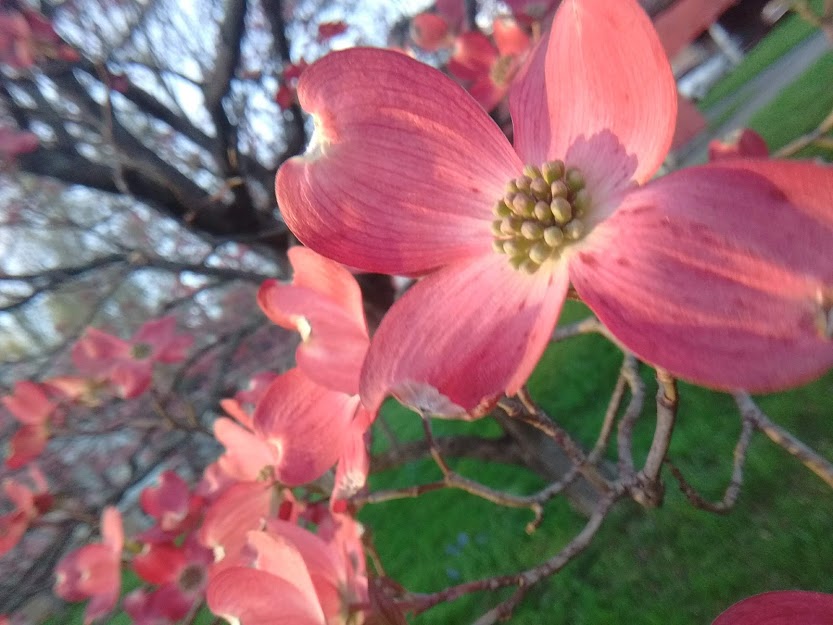
Sometimes when I pause in the middle of the trail and catch the aroma of lilac or hyacinth sifting into the clearing, it’s your scent I’m sensing, and I am held in your arms as surely as if you were here.
In honor of Earth Day tomorrow, I have recorded Jane Yolen’s “Earth Day.”
Isolation and the Seven Sins by Beth Weaver-Kreider
The first one is coughing, right? Or. . .coughing without covering your mouth, or coughing into your hand instead of your elbow. Does sneezing belong here, too, or is it just a matter of degree: an uncovered cough goes ten feet while a sneeze blasts twenty-seven.
The second is touching your face. Don’t touch your face! Don’t scratch your nose! Don’t rub your eyes!
Then there’s forgetting to wash your hands, or not using soap, or not singing Happy Birthday twice through while you wash. I’m having a whole lot of birthdays lately.
Getting too close to people who don’t live in your house, that’s the fourth one— sidling up to strangers in stores, saying, “Is this the line?” while they edge away from you as politely as they dare.
Three more? Okay. Here’s one: Not wearing a mask in public. Don’t go to the bank unless you look you’re going to rob the bank. You’ve got to learn how to smile with your eyes.
Number six is definitely hoarding. Nobody needs that much toilet paper, hon.
And the seventh. Sloth? Is that one? I’m pretty sure I heard that one, but maybe that’s a deadly sin. Aren’t these deadly sins, too?
One of today’s Prompts is Month. The other is to use these six words in a sentence: bump, embrace, fixture, howl, lonely, resolve (all created by Shakespeare).
Song for a New Way a sestina of Shakespearean words by Beth Weaver-Kreider
Coyote is something of a fixture in the myth of the landscape, a lonely figure trotting atop the ridge. A howl echoes into the hollow, an embrace of wildness and winsome, where we bump against our own internal resolve
to enter wildness, our stout resolve to live less burdened by the fixtures of modern existence, in the bump and whirl of the rat race, this lonely place in the crowd. Today we embrace our freedom from form with a wild howl.
Set free from the commute, the howl of the markets that weakened our resolve to fight the forces that tempted us to embrace acquisition and consumerism, that fixture of capitalism that is the root of our lonely longing for stuff that stops us, a bump
on the road to enlightenment. We bump into the stuff, the stuff, the stuff. We howl with the frustration, knowing we’d be less lonely if we could only find our inner resolve and let our inner existence be the fixture that would lead us to a stronger embrace
of what matters. For example, we would embrace kindness and empathy, the places where we bump against each other would be the fixture of our ideals. We’d learn to how to howl our deep longings and we would resolve to make each other less lonely.
Only in the search for connection will our lonely lust for power be ended. When we embrace all beings as siblings, and resolve to avoid the stumble and bump of collecting more trophies. The howl of lost enchantment no longer a fixture.
We can resolve that we will no longer be lonely. The fixture of our new story will be the embrace. We’ll bump fists and hips, and howl.
Today’s poem prompts were “train” and “message.” I was wandering through the long grasses of the long A sound in train, and ended up at the Amazingville Station. One day, years ago, when the poetry was so heady and giddy I could hardly keep from floating away, someone wrote on someone else’s poem, “You are sleeping with everyone in Amazingville,” and Mara wrote a poem beginning with that phrase. I have wanted so terribly to travel again to Amazingville, so I figured out today that perhaps you need to take the train.
Someone in one of my groups said he likes this poem, but he doesn’t really understand it, which it exactly how I feel, too. I responded with this, and maybe it makes a little more sense to me now: “I’m not sure I understand it, actually. My seven and seven is the final two lines that turn the haiku to tanka, so the haiku is perhaps a summoning spell, a way to bring me back to Amazingville, too, and I will finish the incantation with my two lines of sevens.”
Here’s the weirdness, and then a video of last year’s Easter Magdalene poem:
Taking the Train to Amazingville by Beth Weaver-Kreider
When you get off the train at Amazingville Station, send me a message that you have arrived.
Make it a five seven five, American haiku, and let the cutting word be one that sets me free.
Then bring me around with the sweet music, the alluring scent of your season word.
Call me home with haiku and I’ll come to you on the next train, with my seven and seven.
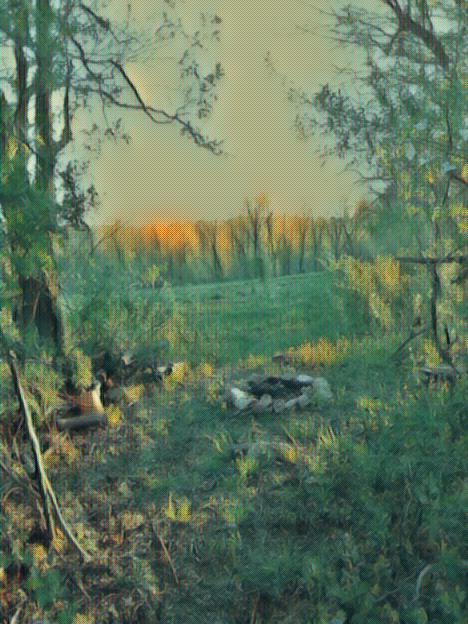
A small pool in the base of twin trees along the new trail.
Today’s Prompts were Spider and Exotic. I don’t know if re-mything Spider Mystery is exotic or not, but this is what I came up with.
Spider by Beth Weaver-Kreider
Not all stories start the same. Try this one: In the ending. . . We’re bending the tale around a whole new fulcrum, following Hansl’s trail of crumbs from wicked witch to angry stepmother, or over other paths not yet traversed within the standard myth.
In the ending was Spider, marking her eternal spiral, spinning her infinite web, wrapping her magical bundles (don’t become one of those).
You wonder how she got to this moment, your mind on the lines that connect from beam to sill, from ledge to beam again. You want to know the structure, sense the essence of the plot, the way from there to here.
But when you live within the spin of infinity, beginnings become irrelevant. Endings, too, for that matter, fade to insignificance. The middle, that’s the place where twist and whirl tingle, where living blossoms out of nothing, and you catch the sticky thread of the moment, knowing you can shift from arm to arm of time, like Spider, who even now is watching you from the center of her web.
In the middle. . . Now there’s a thread to hand a tale by.
The prompts today are “bar” and “The Last _______.” Yesterday, I was mulling what the lore of these days might be, and the word Apocalypticon floated through my brain. It turns out there’s already a book by that name, but I thought it might be a good name for a poem.
The Apocalypticon: The Last Revelation by Beth Weaver-Kreider
One That spring, Grace found her first morel on the west-facing slope of the ridge. Everyone was finding them, actually, that spring. Everyone was eating morels, and Emily planted a gangster garden. Bootleggers and mob bosses graced her green. All we had seen before was somehow new now, more verdant.
Two One of us began receiving messages from a golden koi who circled slowly beneath the lilies of a lake. She would not tell us what the Lady told her, only: “Take what you need. Too much is at stake.”
Three I did battle with poison ivy that spring, apologizing a hundred times a day for cutting her thousand arms, but ivy laughed in crimson leaves and grew like the Revolution was at hand.
Four Some of us sat with our demons, telling old tales of battles long gone, bellying up to the bar of lost memories, or singing them to sleep with old songs, while Clare chanted exorcisms in the sleet on windy mountains pushing back the forces that threaten to submerge the story. I know of two who nearly lost the trail, wandering far into the shadows.
Five We stopped using the word normal, re-wove older linguistic threads, spun ancient stories into the chapters we were writing. We re-worded our vocabularies, re-ordered our syntax, re-discovered voices we thought had forgotten how to speak.
Six We caught our own flocks of wild yeast, planted potatoes in neat rows, learned new words for magic and for prayer, exploring layer after layer of mysteries, parting the curtains, and watching the ways of the moon.
The grumbling is getting louder. The anxiety is rising. People are starting to toss the words “rights” and “freedom” around. People are afraid that this is all power-plays by the leadership to cow us, subject us, hold us in our places. And why shouldn’t they be afraid? When have we ever known the (mostly) rich (mostly) white (mostly) male ruling class to work on behalf of the people, to remember their sweetly quaint little title of “public servant”? Who should we trust?
The doctors. And scientists. We can, hopefully, trust the scientists and the physicians. And the story. Trust the story. Watch how it has played out across the globe. Remember Italy. Remember China.
It’s very likely that some of the governors are working out of self-interest and electability, that some are too cautious and timid, that others are hungrily consolidating power in a time when people are vulnerable. So I will trust the leaders who seem to be trusting the doctors and the scientists and the story. It hasn’t been difficult to find an example of a leaders who isn’t trusting the science, who is inexorably manipulating the narrative to feed his own ego and his own power. And if you want to start talking about freedom and rights, let’s begin with the ways in which he has been harming the freedom and the rights of the common people since the day he took office. I’m going to cast my lot in with the governors on this one.
This doesn’t have to be an American frontier epic contest between your fear and your freedom. That’s an old and worn-out trope, and it’s a false dichotomy, a fairy tale told to us by end-stage capitalism. The governors are not Big Bart riding into town with all guns blazing, ordering the women and children to cower in their homes. In this story, we make the choice to stay home, to wait, to isolate, in order to protect the vulnerable ones among us, in order to protect our health care workers.
As far as I know, my parents and my immuno-compromised beloveds are all safe. But if we resume business as usual too soon, they may all be in danger, and those you love, too. It’s not about whether or not you or I personally fear death. It’s about whether we have the deep communal compassion to do something that protects the most vulnerable among us. Remember, this is the Exile for the Good of the Realm.
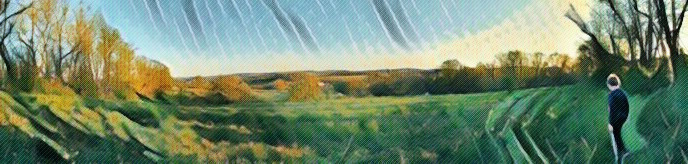
Gratitude List: 1. The Iron Lady Trail. My Project Manager says I shouldn’t call it that, that it’s still unnamed, but he initially called it the Iron Lady, and so I’m calling it that for now. Josiah is marking and clearing a series of deer trails in the woods above the pond. He calls himself the Project Manager, and her has enlisted his progenitors to assist with the cutting of poison ivy and brambles. Yesterday after our schoolwork, we cleared a side trail that links the Iron Lady (I mean Unnamed) Trail to a second entrance to the fields. This one emerges from the woods beneath a curving limb of a cherry tree. For too long, the poison ivy has kept us out of the woods. We are going to try to keep the trails maintained so we can have some passages through the woods. 2. The passion with which my kids follow their interests. It can be tiring to listen to hours of discourse on the minute differences between the Tesla models, or how to build a very detailed something-or-other in Minecraft, or the many reasons why a particularly obscure piece of technology is either illegal or shady or brilliant. Still, I love that they can be passionate about things that have near-zero interest for me. 3. Homemade oatmeal protein bars. I don’t know why I got away from making them. And of course, I have no recipe, so I have to go back and recreate it. The ones I made last night are too crumbly. But they taste good! 4. The veils of green appearing through the woods. 5. I am loving the poetry-writing process right now. It’s very much like the energy of April 2012 (I think that was the year), when I felt something click and sizzle. This is perhaps less giddy, more grounded, but it tingles. I’m especially grateful for my poet-community right now.
Take care of each other. Walk in Beauty!
The Soul, it sees by synesthesia Tasting light caressed by song A touch is like a descant fire resonant and strong. —Craig Sottolano
“I’m not as cooperative as you might want a woman to be.” —Carrie Fisher
“The unconscious wants truth. It ceases to speak to those who want something else more than truth.” —Adrienne Rich
And did you get what you wanted from this life, even so? I did. And what did you want? To call myself beloved, to feel myself beloved on the earth. -—Raymond Carver’s Late Fragment, inscribed on his tombstone
Put down the weight of your aloneness and ease into the conversation.
The kettle is singing even as it pours you a drink, the cooking pots have left their arrogant aloofness and seen the good in you at last.
All the birds and creatures of the world are unutterably themselves. Everything is waiting for you. —David Whyte
“Not all of us can do great things. But we can do small things with great love.” ―Mother Teresa
“Walking. I am listening to a deeper way. Suddenly all my ancestors are behind me. Be still, they say. Watch and listen. You are the result of the love of thousands.” ―Linda Hogan
“This will be our reply to violence: to make music more intensely, more beautifully, more devotedly than ever before.” ―Leonard Bernstein





 Mockingbird Chronicles