Three years ago, I ran a couple of my short poems through Google Translate to see what would happen. From English to Pashto and back again. From English to Pashto to Hindi to Javanese and back again. How does meaning become fractured through the algorithmic translation process? Last week, I tried it again. I started with:
Long have I longed for and dreaded this moment of darkness, belonging to silence, sure of my shadows.
Then I ran it through Sinhala —> Tajik —> Swahili —> Malayalam —> Pashto —> back to English
Here is what happened. Look how it pulled a rhyme in there for me (afraid/shade), and the meaning has definitely shifted, but I’m really happy with it. I added punctuation at the end for clarification. I actually like it better than my original. I’ve been waiting a long time. Don’t be afraid. At this point: Dark, In silence, I believe in shade.
Then I tried Mr. McConnell’s famous Truth: Nevertheless she persisted. Ran it through Punjabi —> Bangla —> Hmong —> Kyrgyz —> Tamil —> English Ended up with: The reality is, however, there is more. This changes the meaning a little more than I really want to, but it is an interesting end.
I tried a third, another of my tiny poems. This time, that fifth line changed anger to sex. Hmmm. Take a deep breath. Find the place inside you that remembers how truth feels; remember that there are kinds of anger that are more effective than blind outrage.
Tamil —> Javanese —> Cebuano —> Hindi —> Kazakh —> English
Take a deep breath. Find a place in your stomach The cruelty of truth is considered; Remember Sex is scary It was very effective Especially the blind.
Ah, well. I like putting the essence of meaning outside of my control for a moment and seeing what happens.
In Creative Writing classes, many of the exercises I have students do are to encourage us to move behind that space in our brain that controls the meanings. Part of the reason for this is that is helps us to discover hidden wells and springs of words and ideas within ourselves that we didn’t know were there, like finding the secret room in your house in the dream. At a basic level, it helps us learn that there are a thousand ways to say a thing, a thousand hues of meaning. Giving up control in the immediate moment, as with an exercise like this, helps us learn to take control, to refine and define our meanings.
Gratitude List: 1. Singing in the pit for our school’s musical. It’s a rather big commitment, but I love it. 2. Yesterday after I dropped a Big Boy off for tech prep for the play, I had a couple hours just to be by myself. I went shopping, of all things. Hit the Goodwill pay-by-the-pound bins, and A.C. Moore’s going out of business sale. I bought Small Boy a stack of canvases for painting–half price. 3. The Small Boy hasn’t painted for months, but at the moment he is creating a marvelous abstract cloud-like scene with watercolors. Hmm. Now he is adding some acrylics on top of that. Experiment, Kid! 4. Silver hair. When I see photos of myself now, my first awareness is of a middle-aged, grey-haired, gnome-like woman. I’m okay with that. No, I’m actually happy with that. I like being middle-aged, and I like having unicorn hair. 5. The way the sun casts shadows in the bosque across the road when it slides up and over the opposite ridge in the mornings. All those tree-shadows!
Josiah was really quiet in the other room just now, and then he said, “I count eight bluebirds.” I joined him, and he pointed out not only eight, but more than a dozen, in the branches of the sycamore and the walnut, on the ground beside the shop, in a patch of yellow aconite. And all the while someone else–house finch, perhaps–was singing a spring song. Spring is on its way. Listen for the things the morning birds are telling you, feel it in the breezes, even on a chilly day. It’s coming.
Gratitude List: 1. The great cloudowl, one morning last week, that flew above us in the morning sunrise, grey feathers spread above the coming sun, magenta belly borne by the sun rays rising. 2. Pretzels with creamy pub-style horseradish 3. My incredible students. Students Council sells singing serenades for Valentines Day, and all day Friday, my classes were briefly and beautifully interrupted by wandering minstrels singing love songs. 4. The Emergency Women’s Shelter. Volunteers staff a 40-person shelter in St. Mary’s church social hall all through the coldest months of the year. This is a web, a safety net, a community basket. 5. Bluebirds waking into spring.
May we walk in Beauty!
My friend Sue asked me to weave some poems and bloggy bits together for a talk at her church this morning. The concept is Longing and Belonging: Creating a Culture of Care in Community. Here’s what I put together.
Culture of Care: Longing and Belonging
Good morning–I’ll start with a poem: Take a breath Sit down in the silence of the room of this moment in time
watch how the moments flow over you when you release your grasp on the one ahead watch how the space of this room takes shape around you watch how your breath blooms into the air
Feel the vast spaces within you, knowable, unexplored, waiting for you to enter and experience who you are in your deepest self. Listen for the whisper of your own voice in the echoes of your dreams. Stretch your hands up and out. Draw in deep breaths. Stretch and stretch. You are larger on the inside.
First, I want to point out that I am a poet, not a preacher; not a theologian, but a dreamer. As an English teacher, I teach students to create a strong and arguable thesis, to develop careful supporting details and evidence, and to conclude their argument with a discussion of the implications and applications. When I approach questions that deal with inner landscapes and spiritual ideas, however, I am less likely to work in the realms of supportable arguments and more in the world of metaphor and image, spinning ideas of different colors and textures together to make a whole web. It’s less linear, and more circular–like a web. Some of what I am going to share today is prosey bits I’ve pulled off my blog, some is poetry–mine and others’–and some is connective tissue, more lines drawn to hold the web together. So, let’s speak of longing and belonging.
One of the phrases that Sue offered me for this morning was to consider how communities create cultures of care. Let’s draw a bright asterisk of shining strands with that one, the foundation strands of the web, anchored in human relationships of listening well, of speaking truth, of the deep desire for connection, of belongingness, and of knowing that we are beloved children of the Creator of the One Who Made Us.
Since we have just come through Valentine’s Day, here’s a little Valentine poem about the web of community:
To all my Valentines, you and you and someone else: we draw these webs between us, made of chocolate and sunlight and tentative smiles and the toothy grins of our children and the hope of helping out a little bit and seeking our roots and our sources together and following traditions and breaking traditions and going a little bit wilder and dancing until the chickens come home to roost. When your heart goes skipping through windows, you’ll know one of us is thinking of you.
One of the books I am reading at the moment is Matthew Fox’s Naming the Unnameable: 89 Wonderful and Useful Names for God. While he finds whimsical and imaginative images as well as historically and theologically-based ones, I am pretty sure that he does not include Spider in his list. I hope no one here is too arachnophobic. But if we’re to spin out this metaphor into a strong web on this asterisk of community care which we have placed into the room, we have to place The Holy One at the center of the web, spiralling outward, still making the world, watching her strands, feeling the way the energy of the web shifts as breezes blow past and events occur along its lengths. And we, too, are spiders, spinning our own smaller webs among the spaces between us, emulating the one who Spun it all into being.
We live in a woodsy area, and we just can’t keep all the critters out of our old house. One morning, I walked in morning darkness into the kitchen, and right into a spider’s web. I wrote a little poem about it. I don’t think I knew at the time that I was writing about God.
All night the spider spins her careful message, stringing the gossamer web across the kitchen: You are not alone. Fine strands connect you to the Universe. Remember, you belong in the net of all that is.
Perhaps the spider had other ideas about the meaning of that event.
Before belonging is longing. The writer Starhawk says that the glue at the center of the universe is love, is desire, is the longing for connection. The Creator gives us a clue in the very structure of the atom, of particles whirling around a central core, continually seeking their source, longing toward center, drawn outward in the spin, but longing always inward. And in the center of our own human atoms, our individual webs, is that very craving for connection.
And sometimes that feels like a design flaw, doesn’t it? This deep longing we carry within us, that seems to be imprinted into the very strands of our DNA, when unfulfilled, leaves us feeling awkward at best, and cut off and isolated at worst.
The 12th century Persian Sufi poet Hafez writes of this longing in this poem. (This is a Daniel Ladinsky translation.) He also offers a way to respond to the sometimes overwhelming desire to be loved and noticed and accepted:
Admit something: Everyone you see, you say to them, “Love me.” Of course you do not do this out loud, otherwise Someone would call the cops. Still, though, think about this, this great pull in us to connect. Why not become the one who lives with a Full moon in each eye that is always saying, With that sweet moon language, what every other eye in This world is dying to hear?
So there, at the end of the poem, is the beginning of the answer to how to deal with the pain of the longing for belonging: To offer the words that everyone else is longing to hear. Build our own connections.
Contemporary US poet Martha Collins writes similarly in her poem “Lines”: Draw a line. Write a line. There. Stay in line, hold the line, a glance between the lines is fine but don’t turn corners, cross, cut in, go over or out, between two points of no return’s a line of flight, between two points of view’s a line of vision. But a line of thought is rarely straight, an open line’s no party line, however fine your point. A line of fire communicates, but drop your weapons and drop your line, consider the shortest distance from x to y, let x be me, let y be you.
What would our webs look like, were they all made visible? Connecting point to connecting point–what lines are drawn between ourselves and those who have gone before, between ourselves and others in the world today? Between ourselves and the planet? And God?
As we circle the lines of our webs outward, line to line, we move from the deep longing to offering belonging to others. The principal of the public elementary school where my fifth grader attends (he happens to be a Messiah College grad) taught his students the South African Zulu greeting, “Sawabona,” which means, “I see you.” The response is “Sawabona shikhona,” which seems to mean: “Because you see me, I am here.” Our ability to look at each other, to catch and hold eyes, is one of the possible keys to belongingness. What a powerful tool to offer to elementary students, a script for belonging and connection in each spoken greeting.
My good friend Gloria, a professor in EMU’s Center for Justice and Peacebuilding, often signs off from our typed online conversations, “I See you,” capital S. It is neither a flip nor a throwaway greeting, but a deeply honoring gift, acknowledging our belonging to each other. What is this longing for belonging that we have encoded within us but a desire to be truly seen and cherished? I See you. How simple. Like Moana, we can look into the burning rubble of each other’s pain and say, “I know your name. I know who you truly are.”
Here’s a poem I wrote after a wonderful evening with a group of my college friends, a group of people who have offered each other an unconditional and unwavering belonging, love, tenderness:
Sit with your beloveds in a circle, and feel the truth of how your hearts are woven together every bit as real as that basket under the hall table where a fine cat is purring.
You will hear the echoes of the ego towers that have fallen, see the memory of rubble in the eyes. Say out loud, “I see you.” Say, “I witness.” Weave the new strands together. See how your stories are one singular tale.
Feel the starlight making a net around you, a silver basket reflecting your own.
When we build conscious webs of connection between ourselves, in churches, in classrooms, in families, in friendship groups, among strangers, we participate with the Creator in a mystical act of creation. We mirror the invisible webs of energy and force that surround us, that are built into the very structure of the created order. One of our greatest scientists–Albert Einstein–said that in the end, of all the natural forces present in the world, the greatest is love.
A year or two ago, I wrote a piece on my blog about how my church’s celebration of World Communion Sunday brought me into connection and community on a day when I was feeling a deep disconnect with US Christians. I feel a strong bond with the people of my church, but it had been a week of US Christians doing and supporting some pretty terrible and unjust things, and I was angry. While I have no problem taking communion with my church, I had a memory in my head of taking communion at Ephrata Mennonite Church, when we would file through the little room behind the pulpit, sit with the pastors and bishops, and answer the question, “Are you at peace with God and man?” I wasn’t feeling at all at peace with many men, and quite a few women, too. I wanted nothing to do with a wider communion that included people who could glibly support an administration that tore children from their parents and locked them up in detention centers. Even within my own beloved community, I wasn’t sure I could see through my rage to participate in a symbol of unity with Christians everywhere.
I’m pretty sure it was the bread that made me weep. The cup was on the table, but there was no bread. (Truth be told, I was already in tears by that time, from the moment of the offertory song: “She’s got the whole word in her hands.”)
“Today’s bread comes from all around the world,” they said. But where was the bread? It was not the lack of bread that made me weep, but the bringing of it. As they spoke of pita, and the Syrian people who have been caught between warring fronts for seven years, a mother brought her children and pita to the tables, children who have relatives in Lebanon, Syria’s neighbor and a country healing from its own civil war.
Then while a mother and her child brought tortillas, the bread of her homeland Honduras, to place upon the tables, they reverently recalled to us those from Central America who have suffered, whose children have been torn from parents’ arms when they come to our borders seeking safety.
And then while a father from Indonesia brought his son with steamed Indonesian bread for the tables, they spoke of the tsunami and devastation.
They reminded us of Puerto Rico and of hurricanes and of how it feels not to be believed when you tell your terrible stories, and a grandmother and her small one came forward with a baked loaf like we eat in the United States.
I thought perhaps I couldn’t take Communion today, I who want nothing to do with so many who call themselves followers of Jesus. I thought perhaps I shouldn’t. Perhaps the anger would keep me away from the table. Until the table was filled with bread and tears. Until grief stepped in to the place of anger, and I, too, felt like I could belong at the table.
When they are babies or small children, each child at my church is held and blessed by one of our pastors, and told: “You are known and loved by God.” You are known and loved by God. You are known. You are beloved. Whatever your word for that great and unknowable–but personal and tender–Mystery, know this today and always: The One who is the Source and Cause of all being, all Beauty, all Knowing, all Making, loves you. Knows you. As intimately as a painter who cherishes the tiny green dot of color in a painting, which she knows is there, which she placed there with purpose. You are deeply and singularly beloved. You are Seen, capital S.
There is a moment, in the baptism story of Jesus, when the Spirit of the Holy One appears in the form of a dove and speaks to those gathered, saying, “This is my beloved child, in whom I am well pleased.” My prayer for you, for me, for all of us in this coming year, is that our significant dawnings and discoveries may be accompanied by the absolute shining certainty that we are the Beloved Children of the Universe. That the One who watches us, who wings above us, who blows through us, who shines light into our confusion and grief and fear, the spider at the center of the web of all that is, is well pleased with us. It is one of my most deeply held beliefs that this is true, although it is sometimes hard to hold onto. You are Beloved. I am Beloved.
I’m going to end with a poem I wrote one Thanksgiving as I was pondering the building of tables instead of walls. We are all the travellers and pilgrims. Like Moana and her people, we wander. And like Moana, we carry within us and upon us the maps which will bring us home to each other. And we are all of us the home, holding within us webs that reach outward to draw each other in.
Blessing for the Visitor
May you who wander, who sojourn, who travel, may you who make your way to our door find rest for your tired feet and weary heart, food to fill your bellies and to nourish your minds, and company to bring you cheer and inspiration. May you find comfort for your sorrows, belonging to ease your loneliness, and laughter to bring you alive. And when your feet find themselves again upon the road, may they remember the way back to our door.
“The breeze at dawn has secrets to tell you. Don’t go back to sleep. You must ask for what you really want. Don’t go back to sleep. People are going back and forth across the doorsill Where the two worlds touch. The door is round and open. Don’t go back to sleep.” ~~Rumi
Everywhere you look, Open doorways beckon.
See, there between those two trees? Look, the still waters of the pond are doors which open inward. Who enters when the breezes wrinkle the waters’ surface? Someone has just walked out the doorway of that clump of tall grass, Leaving the door ajar. Hurry! Perhaps we can follow!
Wander the hill and the hollow. Follow the wayward winds that rush and tumble over the thresholds. Listen in the dawn for the voices.
The chickadee who scolds you from the apple tree Is the herald of someone soon to enter. Wash your hands and face. Stand up straight. You have guests to greet.
Draw water from the spring. Set extra places at the table And throw another log on the fire.
Prepare a feast and pour out libations. Be ready! Who knows who will arrive?
Gratitude List: 1. Colleagues: Chances to connect with people I see in the rush of the day, to relax, talk, settle in, play games. I work with good people. 2. Connecting, making the web wider. I was in two small sessions yesterday afternoon that gave me hope and heart, both for myself and the possibilities of better managing the workload (in ways that will push my students to take more responsibility for their own progress), and also for the future for students who get marginalized and ignored. 3. Being fed. Physically, intellectually, spiritually. 4. Hymnsing! 5. Going home again. Eager to see my family.
Look what the goddess does when she is sad: She takes up a tambourine, made of taut skin and rimmed with castanets of brass, and she begins to dance. The sound blares out wildly, reaching even to the depths of the underworld, so loud, so clamorous is it.
Look what the goddess does when she is sad: She finds the wildness in herself, and as she does, she finds that there is joy there too. –Patricia Monaghan (attr. to Euripides)
Gratitude List: 1. One young snow goose in the flock of a thousand Canadas across the road from my parents’ house yesterday. 2. Anticipation: I have an education conference coming up at the end of the week, and I always look forward to the feeling of a little retreat. All the mundane tasks are taken care of. I get my own little room with my own little bed. I love getting to talk to colleagues and others, but also having time completely to myself. 3. Stories that inspire and heal 4. How breath lifts spirit 5. All the people who are working for justice.
Ugh. Insomnia. And it’s the fuzzy-headed kind. Trying to head off a cold, I took a tablet before bed that has zinc and valerian in it. I slept soundly for about five hours, and then that was it. Sometimes I can starting listing the countries of the world, and I’ll fall back to sleep before I can fill a continent, but tonight I got through all of them, and here I am, still awake. By the time I got through South America and was working my way through Africa, I knew I was done for. And now, it’s only half an hour until my alarm goes off, so I might as well start the process of waking up.
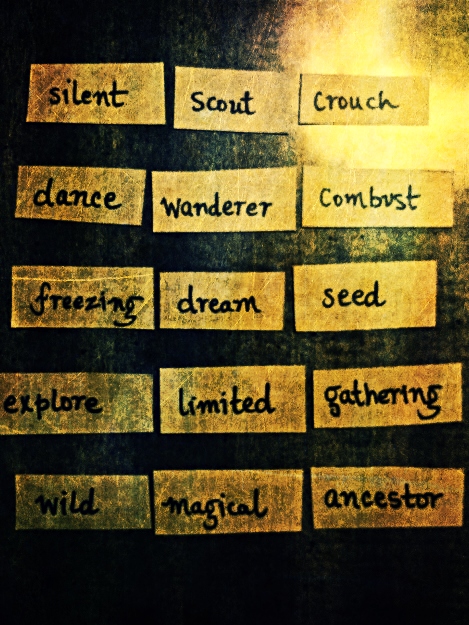
Today in Creative Writing, we’ll look at the pictures and poems that people put together with their random words. I showed several of my own on Friday as examples, so I don’t know if I’ll put up pictures like this one. I just pulled fifteen random cards from my word tickets and arranged them together. I’m not sure I like the line “dance wanderer combust.” The flow feels wrong, like I’m packing too many syllables into it. I like the word wanderer on its own, but in some contexts, that “-erer” can sound like a car with an engine that won’t turn over.
I hope my students are feeling the sense of freedom from prescribed meaning that I am feeling from working with word pools. We’ll get into intentional meanings soon enough, but it’s a nice breath to begin the semester with nonsense and random associations. It’s been an odd experience for me, a little risky. I feel sort of vulnerable, like I am letting my students in to my own personal crazy. I keep worrying that they’ll start rolling their eyes, that they won’t get it. And this is so deeply connected to the way my brain works that I feel like I might feel a greater sense of personal rejection if they can’t get into it. Enough of them have sent me fantastic random word projects, however, that I am feeling less anxious about it.
Gratitude List: 1. The shadows that swoop through the woods behind the house when vultures are flying in front of the sun. 2. Random meanings plucked from odd associations 3. Even though sleep was short, I did get some good solid hours of deep sleep 4. The ones who work for justice 5. Warm blankets
On the way to and from school, on the days when we’re all in the carpool, we listen to audio books. Lately, we’ve been listening to Maggie Stiefvater’s Raven Cycle. Her writing is clever and witty without being chummy or manipulative, her stories are compelling, and she can introduce characters who make you wince and cringe, and then make you love them with a deep and unswerving loyalty. It’s narrated by Will Patton, who can create a character with the smallest shift of tone in his voice.
Yesterday, just as we got to school, we came to a little phrase, “the muzzy mist.” I don’t think I have ever heard the word muzzy, but it grabbed me. It means indistinct, befuddled, unclear. In Creative Writing, we are creating Word Pools, collecting words that interest us, and then doing interesting things with them, like taking pictures of things that we label with them, or making poems and short stories with them. So “muzzy” went right into my word pool.
Here’s a little poem I wrote with using “muzzy” and several other words in my word pool. The idea is to push ourselves to use words in different ways than we normally do. I found myself breaking up the sense of sentences with greater ease than normal.
Muzzy
Today I am a muzzy fuzzle, brain a-muddle, all verhoodled.
Yesterday I was eagle-eyed, a green rogue, and wild divine.
Sharp I was, sharp as dash but now I am dangerous blood, with an elephant on my chest.
Last week, we introduced ourselves to the class with Acrostic Poems about our names. Some students simply chose a different adjective for every letter of their name, and these were beautiful and tender. Others wrote poems with longer lines and phrases beginning with the letters of their names, and these were elegant and flowing. Some even allowed themselves to practice a little enjambment, breaking up the flow of a phrase across a line. In one of my classes, the first four of us to read ours used the word Anxious for our A. I wonder what the implications of that are. Here’s mine. I used my whole name:
Every time I Look in the mirror I see someone different: Zealous Anxious Bold Eager Timid. How can I be all these things And one person at the same time? Names and rhythms, New and intricate rhymes Work within me. Each one of us is An ocean, a Veritable Ecology of Adjectives, Revealing layers of human attributes. Kindness and Revolution can Exist in tandem. Individual truths are Defined by complex webs Experiences within me. Reality is many-faceted.
Gratitude List: 1. Weekend! 2. Clear moments that remind me that I am where I should be. Teaching can be rough, especially in the fall and winter, especially when the grading piles up, especially when I am feeling inadequate. Sometimes I wonder if I am where I should be. And then there are weeks where it all aligns, where I can see how even the really challenging bits have led up to a particular moment. How I am changed and transformed by this work. How I actually have some internal characteristics and skills that make this a good fit. (So synchronous: my sister just sent me a text at this moment that added one more little golden thread to this sense of rightness.) 3. A little bit of snow 4. Getting it done 5. Words. Word pools. Word hoards. Word spews.
While the saber-rattlers practice their stern faces in mirrors, we gather our children and see the reflections of the eyes of mothers on the other side of endless wars, holding their children to their own hearts.
While the war profiteers add up their numbers, we count too, numbering our young people, knowing that somewhere, in that distant land, other mothers pull sons and daughters away from that red line in the sand, other teachers are doing the math of the beloved scholars ripening to the age of soldier.
We know, as those others know, that collateral damage means someone’s child, someone’s empty arms, someone’s heart torn apart. We know that the men who make war, the maestros who orchestrate the grand drama, are not the ones who do the war, are not the ones who live it.
We know, as the women of Iran know, as the war-makers can never seem to understand, that every casualty has a mother.
Gratitude List: 1. That quiet doe who slipped across the road in yesterday’s headlights, reminding me of shy tenderness, of the need to take great care in all things, to pay attention. 2. The people of Lancaster, standing in the freezing cold, holding up the hope of peace between nations. Young and old, and everyone’s toes like ice, but hearts warm and determined. 3. Doing the last-minute hopeful tweaks on second-semester classes. I love jumping in to second semester, despite the stress of the overlay of first semester’s finish on second semester’s start. Tabula rasa. Anything can be. 4. Last night I heard a story of a former student (before my time here) whose family has recently been reaching out to the school to share how much the school helped to shape–in often quiet and seemingly small respects–the life of their son. I’m grateful for all the ways in which the little things we do for each other open us to deeper connection–in ways we might not always be able to express. 5. The shine of snow-covered landscapes. Winter is not simply dark and drear. Some days, it dazzles!
I wrote this a year or two ago, not realizing how extremely similar the title was to Jan Richardson’s World Communion Sunday poem. Clearly, her phrase sank deeply into my psyche. So I added a little dedication to the title to recognize her original.
May your table be wide,
may your arms be laden
with the bounty of harvest,
may your heart be willing.
May your feast be filling,
may your beloved’s eyes
be filled with laughter,
may your table be wide.
May your doors be open,
may strangers be welcome
to sit at your table,
may your feast be filling.
May your heart be willing, may stories flow like wine poured into glasses, may your doors be open. May your table be wide.
Gratitude List: 1. Poets and poetry, especially Jan Richardson’s blessings 2. Anticipating time with my parents and my siblings and my niblings 3. Wind: scouring, releasing, revealing, energizing 4. Pie 5. Open hearts, open arms, open tables
Poem from a year or so ago: Prayers and Rage by Beth Weaver-Kreider
What can we give besides our prayers and rage?
And what will that avail?
Send out the story on October winds.
Fling it high, where crows are flying.
Send the message echoing into earth
with every pounding step you take.
Listen.
Let the shells of your ears gather the story.
Reel in the gossamer strands of the tale
and weave them into the veil you wear.
Listen for the stories of those who weep,
those who rage, those who only speak
with the shrug of a shoulder,
with a sigh, with a shudder.
Listen, too, to those who walk right in,
who step into your circle without invitation.
Listen to the voices that are hard to hear.
Offer only the bread that is yours to give.
Be like the old gods, with the raven Wisdom
on one shoulder and Memory on the other,
and Reason perched upon your hat.
Offer what is yours: your rage, your prayer, your watchful quiet heart.
And another, more thematically whimsical: Duck, duck, goose. Goose, goose, wren. Mist, moon, mist. October.
Gratitude List: 1. Finding my way again to deep breath. 2. Chilly autumn rain. Yes, really. The melancholy of a rainy fall day can be satisfying even for sanguine personalities. 3. While I have never been a big fan of the cold season, I love wearing layers and leggings, and that season has returned, and so I feel much more comfortable in clothing. 4. This full-spectrum lamp that Jon bought to help boost us through the coming winter. Light-bathing. 5. The distinctly autumn sounds of the calls of geese and jays and crows. I feel my animal self more distinctly in these days, pulling between the longing to migrate and the longing to hunker down and burrow in.
Rainbow Reflections on a bench at the Harriet Tubman Underground Railroad Historic Park.
I need to sit quietly and spend some time understanding all that I have learned and experienced in the last three days as we’ve explored the Harriet Tubman Byway near Cambridge, Maryland. Words like inspiring and life-changing don’t quite do it justice.
Meanwhile, here is a poem I wrote in 2015 after a church meal at the house of friends. I had plans then to revise it, and never did. Perhaps that might be the task of the week ahead.
The Cherry Tree
After we had eaten, the adults shared stories in a circle underneath the trees.
The children rode the tractor wagon down the hill to splash and wander up the creek almost out of hearing or gather sweet black raspberries to pass around in paper cups, each set of fingers smashing down the fruit below until all was sludge scooped out and licked from purple hands: a sacrament.
Back from the creek and the fields and the barn they came, dripping water, straw in their hair, trailing jewelweed, clothes and fingers and smiles stained purple from berries.
We gathered beneath the cherry tree with buckets and bags. We all were children then, in the kingdom of the cherry tree, laughing, leaping high to catch her boughs to draw the clusters down within our reach. We could not hope to get them all, even when the children scampered up into her branches.
We laughed and were amazed at the wild abundance of the tree. And this was church as ever church can be, all of us filled, dazzled, alit.
May your mouth be filled with sweetness. May your ears be filled with the laughter of children. May your heart be as wide and open as the blue sky. And may your stories blend with the stories of others, reaching out and upward like the branches of a tree.



 Mockingbird Chronicles