When this is all over, I wonder how it will have affected my teaching? I try to create a student-centered classroom, and I think my normal (non-Exile) classroom is very student-focused, but I still found myself spending a lot of time as the sage on the stage. But now, in the past week and a half, I have probably erred on the side of not enough teaching, and more on project-style instruction. I am working toward finding a balance. I hope that as I travel this new pedagogical pathway I can integrate old and new aspects of my teaching self. Maybe, hopefully, I will come out of this a better teacher.
How are you faring in your new rhythms? Are you able to consider that the new ways of doing things in this time-out-of-time might actually improve your understanding of yourself? It’s okay if you feel like you are in a holding pattern, or like you’re losing ground. Or if you’re back and forth (truth be told, that’s a more accurate picture of my status–it’s just that morning brings a clarity that is not always completely present for me all day).
My heart is with you, who must still go out daily to do essential jobs for the good of the community. May your immune system be as strong as your good heart.
My heart is with you, who have been laid off, or who will be laid off. May you find a settled place within, to face the uncertainty of these days. May help come soon.
My heart is with you, who live alone in Exile. May you find alternate ways to do community, from a safe distance.
My heart is with you, who suddenly have two or more overwhelming jobs: working from home or out in the community, and still supervising your children’s schooling, or caring for the emotional needs of family members and beloveds. May you find rest and may you settle into the new rhythms with grace. You are doing enough. You are enough.
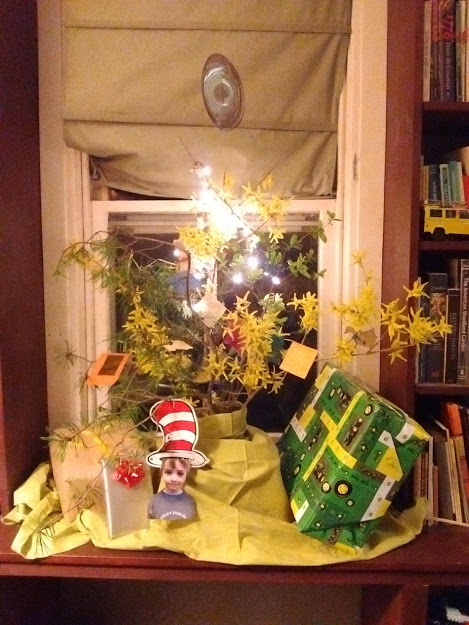
Gratitude List: 1. The birthday bush (I thought tree, but I have been corrected by the soon-to-be-birthday-boy) survived the night. Before we went to bed, I repeatedly reminded the cats that it was their responsibility to protect the tree from goblins in the night. They’re less likely to destroy something (like sleep or a birthday bush) if they have been charged with its protection. 2. I realized yesterday that I will likely be home this year when Oriole returns. My heart rises in anticipation. To sit on the porch all day and listen to him calling in his beloved is one of my great joys. 3. Yesterday, I managed to keep up with the minute-by-minute work as well as catch up significantly on pre-Friday-the-13th work. I am feeling more on top of things, school-wise, than I have felt since the beginning of the semester. Now if only I can try to end my school day at 5 today, then I will be golden. 4. The way humans rise to a crisis. And I know not all humans are rising. But the regular people, often those with the most to lose, have been settling in and creating community, reaching out, looking after each other. I really do love humans. 5. The bird feeders. If I go back to teaching in my physical school building this spring, I am going to have to figure out how to set up some bird feeders on the roof outside my windows. It brings me such great joy to watch the birds.
Take care of each other!
This morning my grandmother is teaching me that the easiest (and most elegant) way to defeat an army of hatred, is to sing it beautiful songs until it falls to its knees and surrenders.
It will do this, she says, because it has finally found a sweeter fire than revenge. It has found heaven. It has found HOZHO. —Lyla Johnston
“It’s dark because you are trying too hard. Lightly child, lightly. Learn to do everything lightly. Yes, feel lightly even though you’re feeling deeply. Just lightly let things happen and lightly cope with them. I was so preposterously serious in those days… Lightly, lightly – it’s the best advice ever given me…So throw away your baggage and go forward. There are quicksands all about you, sucking at your feet, trying to suck you down into fear and self-pity and despair. That’s why you must walk so lightly. Lightly my darling…” —Aldous Huxley
“We travel, some of us forever, to seek other states, other lives, other souls.” —Anaïs Nin
“What a miracle to be awake inside your breathing!” —Hildegard of Bingen
Definition of Weald: wild, forested lands, uncultivated regions
“Religion is at its best when it makes us ask hard questions of ourselves. It is at its worst when it deludes us into thinking we have all the answers for everybody else.” —Archibald Macleish
“This poem is not housebroken.” —Anne Haines
*I have already lost touch with a couple of people I used to be.” —Joan Didion
“Give yourself time to make a prayer that will become the prayer of your soul. Listen to the voices of longing in your soul. Listen to your hungers. Give attention to the unexpected that lives around the rim of your life. Listen to your memory and to the inrush of your future, to the voices of those near you and those you have lost. Out of all of that attention to your soul, make a prayer that is big enough for your wild soul, yet tender enough for your shy and awkward vulnerability; that has enough healing to gain the ointment of divine forgiveness for your wounds; enough truth and vigour to challenge your blindness and complacency; enough graciousness and vision to mirror your immortal beauty. Write a prayer that is worthy of the destiny to which you have been called.” —John O’Donohue
If you have never read Toko-pa Turner’s work, begin by buying her book Belonging. It will be a comforting and enlightening companion for your Exile.
My classroom has cats. I think Sachs would approve of the look this filter gave him.
Because this is how we live now.
Gratitude List: 1. Slowly, but surely, I am catching up on some of my pre-Friday-the-13th work. It has been really difficult to adjust schedules and plans to fit online learning. I’m beginning to carve out spaces for big grading in the midst of the daily tasks. 2. Maybe it’s the fat coffee (cream and butter, coconut oil and protein powder), or maybe it’s the new schedule, but I realized yesterday that I don’t feel run down and exhausted anymore. Even though I am working almost all the time, I feel charged and up to the tasks of my day. 3. From the Mixed-Up Files of Mrs. Basil E. Frankweiler. Josiah and I finished that one yesterday, and I love the reminder that the real adventure is the one that takes you inside yourself. That adventure is always available. 4. Goldfinches. They’re going to show up a lot on here because they’re my constant visual companions right now, and getting shinier by the day. I live on Goldfinch Farm, and we named it that for a reason, and in these challenging days, that reason has become one of my grounding delights. 5. Yesterday I saw the phoebe! Sitting on a branch above the bluff, dipping her tail. I have been hearing them, but there’s something about catching that glimpse. . .
Take care of each other!
“Let us keep courage and try to be patient and gentle. And let us not mind being eccentric, and make distinction between good and evil.” —Vincent van Gogh
“Age is foolish and forgetful when it underestimates youth.” —Albus Dumbledore
Love the earth and sun and the animals, despise riches, give alms to everyone that asks, stand up for the stupid and crazy, devote your income and labor to others, hate tyrants, argue not concerning God, have patience and indulgence toward the people, take off your hat to nothing known or unknown, or to any man or number of men, go freely with powerful uneducated persons, and with the young, and with the mothers or families, re-examine all you have been told in school or church or in any book, and dismiss whatever insults your own soul; and your very flesh shall be a great poem. —Walt Whitman, from the Preface to Leaves of Grass
THE OLD WISDOM
When the night wind makes the pine trees creak And the pale clouds glide across the dark sky, Go out my child, go out and seek Your soul: The Eternal I. For all the grasses rustling at your feet And every flaming star that glitters high Above you, close up and meet In you: The Eternal I. Yes, my child, go out into the world; walk slow And silent, comprehending all, and by and by Your soul, the Universe, will know Itself: the Eternal I. —Jane Goodall
“If you believe peace is the absence of war, you’ve missed the mark. There will never be full peace until we treat each other the way we want to be treated. Peace is allowing an individual or group of people to command their space in the way they know how without the violent intervention from another.” —Leymah Gbowee
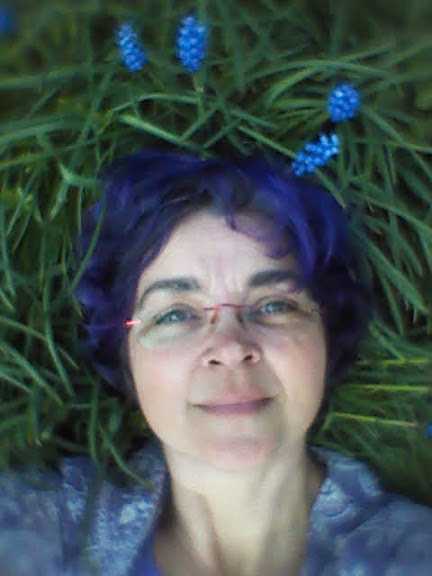
I don’t usually do selfies on here, but purple hair is making me very happy today.
Last Thursday, I made a little PSA video for my students, to try to encourage them to stay home, to heed the cautions so they can be part of this great effort to Flatten the Curve. I told them that even if they feel invincible, they should be invincible at home.
Yesterday, I acted like I was invincible at home. I thought I would take a break from walking as my exercise, and do something for the good of the farm, so I went out with a big clipper and a string trimmer, and I attacked a bramble patch up on the top of the bluff. I felt a few twinges in my back, but did I stop? No! I was in-vinc-ible!
But evening, I was in pain. I couldn’t sit, couldn’t lie down, couldn’t walk. I usually try to avoid pain-killers for muscle-type pains because I think pain is a messenger, and if I don’t feel it, I might further damage whatever body part if aching. But I figured I wouldn’t do any damage in my sleep, so I took some ibuprofen, and after trying three different surfaces, I fell asleep on the futon–the fam opened that up for me.
So I am learning something about invincibility. The Old French vincere means “to overcome.” My lower back muscles were overcome, but my sense of sturdy physical dependability has been seriously overcome. I am not invincible, and I need to know my limits. When she leads us in morning yoga online, my friend Yasmin reminds us to find our edges, but not to go past them.
Living life in Exile is about finding our edges. Some edges have been imposed upon us, and bless you for keeping those edges–you are protecting the more vulnerable, and helping to ease the decisions that our health care workers are going to need to face in the coming weeks. But other edges exist for us to find: How much clearing of brush will damage a 52-year-old back. How much time we can spend in a house with small people needing our attention. How much binge-watching of The Office we can do before we start talking like Dwight Shrute. What is the edge of loneliness? What is the edge of anxiety about the future?
Some of my friends have been dealing with the edges in really creative ways. Loneliness and disappointment can’t, perhaps, be cured by walking in the park, keeping a safe distance from others, but it can be mitigated. Anxiety can be mitigated by yoga and meditation, by phoning a friend. The demands of children can be somewhat mitigated by a slight lessening of screen time rules in order to give oneself a break. A sense of inefficacy can be mitigated by reaching out to others through the available technology, by baking bread, by planting a garden.
After all, this whole Exile is about mitigation. Vocabulary.com says this about the word mitigate: “Choose the verb mitigate when something lessens the unpleasantness of a situation. . . . The somewhat formal verb mitigate comes from the Latin roots mitis ‘soft’ and agere ‘todo/act,’ which add to to ‘to soften.’ It is often used with words that indicate an outcome or something harmful.”
Let’s soften. Let’s act. Let’s not pretend we are invincible. This is a time to act upon our softness. Hang in there, Friends. There will be an ending. We just have to live through the middle first. Let’s find our edges–and accept them–and mitigate as much of the trouble as we can.
Gratitude List: 1. My back feels SO MUCH better this morning! 2. Exile is a good time to make the whole hairdo purple. I might never go back to non-purple hair. 3. All the people who are working in all the ways to mitigate the harmfulness of this pandemic. 4. The world of the woods and the hollow, the creek and the pond, the fields and the sky–all goes on out there as normal. The world turns to spring. 5. Yellow and gold. All those shades: goldfinches turning, Golda the gold-orange koifish, blooming forsythia so yellow they seem to be on fire.
Take care of each other!
Today’s Poem for the Exile
“To oppose something is to maintain it. They say here ‘all roads lead to Mishnory.’ To be sure, if you turn your back on Mishnory and walk away from it, you are still on the Mishnory road. To oppose vulgarity is inevitably to be vulgar. You must go somewhere else; you must have another goal; then you walk a different road.” —Estraven, in The Left Hand of Darkness, Ursula K Le Guin
“The Messenger of Allah [Muhammed], peace and blessings be upon him, said, ‘The parable of the believers in their affection, mercy, and compassion for each other is that of a body. When any limb aches, the whole body reacts with sleeplessness and fever.’” —Al-Nu’man ibn Bashir
Once or twice in a lifetime A man or woman may choose A radical leaving, having heard Lech l’cha — Go forth.
God disturbs us toward our destiny By hard events And by freedom’s now urgent voice Which explode and confirm who we are.
We don’t like leaving, But God loves becoming.
by Rabbi Norman Hirsh
“Only those who attempt the absurd will achieve the impossible.” —M. C. Escher
“Everything in nature invites us constantly to be what we are. We are often like rivers: careless and forceful, timid and dangerous, lucid and muddied, eddying, gleaming, still.” ―Gretel Ehrlich, The Solace of Open Spaces
“The Word is living, being, spirit, all verdant greening, all creativity. This Word manifests itself in every creature.”
“The earth is at the same time mother, she is mother of all that is natural, mother of all that is human. She is the mother of all, for contained in her are the seeds of all. The earth of humankind contains all moisture, all verdancy, all germinating power. It is in so many ways fruitful. All creation comes from it. Yet it forms not only the basic raw materials for humankind, but also the substance of Incarnation.” —Hildegard of Bingen
“. . .life is so lifey, but that is going too easy on it.” —Anne Lamott
“Spring has returned. The Earth is like a child that knows poems.” ―Rainer Maria Rilke
Sky over Skunk Hollow: Dove, or angel, or ashy wisps of phoenix after the egg is laid and the transformation is set in motion?
Gratitude List: 1. Community 2. Cats 3. Morning coffee 4. There is always another poem 5. Puzzles
Take care of each other.
Friday’s Finds: “We take our stand on the solidarity of humanity, the oneness of life, and the unnaturalness and injustice of all special favoritisms, whether of sex, race, country or condition. If one link of the chain be broken, the chain is broken. A bridge is no stronger than its weakest part, and a cause is not worthier than its weakest element.” —Anna Julia Cooper
“…now is all there ever is…” —Eckhart Tolle
The moon is most happy When it is full. And the sun always looks Like a perfectly minted gold coin That was just polished And placed in flight By God’s playful kiss. And so many varieties of fruit Hang plump and round From branches that seem like a sculptor’s hands. I see the beautiful curve of a pregnant belly Shaped by a soul within, And the Earth itself, And the planets and the Spheres– I have gotten the hint: There is something about circles The Beloved likes. Hafiz, within the Circle of a Perfect One There is an Infinite Community Of Light. —Hafiz
“The church says: The body is a sin. Science says: The body is a machine. Advertising says: The body is a business. The body says: I am a fiesta.” —Eduardo Galeano
“It is the scientist whose truth requires a language purged of every trace of paradox; apparently the truth which the poet utters can be approached only in terms of paradox.
“T. S. Eliot said that in poetry there is ‘a perpetual slight alteration of language, words perpetually juxtaposed in new and sudden combinations.’ It is perpetual; it cannot be kept out of the poem; it can only be directed and controlled.
“The tendency of science is necessarily to stabilize terms, to freeze them into strict denotations; the poet’s tendency is by contrast disruptive. The terms are continually modifying each other, and thus violating their dictionary meanings.” —Cleanth Brooks, “The Language of Paradox”
If you must look back, do so forgivingly. If you must look forward, do so prayerfully. However, the wisest thing you can do is be present in the present. . .gratefully. —Maya Angelou
Dreaming in the Exile: There are whales in a large pool/ pond at little town where I am staying. I remember watching a video of a woman who could talk to whales, so I try making those sounds, and they come to where I am. One of them, a little orca with a toothy grin, keeps finding colored dice on the bottom of the pool and spitting them out of the water at me. When I throw them back, the little orca chases them–like a dog–and brings them back.
Later, I take a dawn walk from my bungalow through the village. I stop to check on friends, and hear beautiful piano music from the front of the house (my friends rent the back). I realize that the man who lives there knows I make this walk every day, and plays his piano every morning just for me. Later, someone in the village is hurting, and one of my students stands up and takes charge, without any panic, and calmly takes the person to the hospital. I am proud or her.
Thinking: I have dreamed of whales before, and it always seems to signal some big thing in my deeper layers of self, something wanting to make itself known. Usually I encounter dream-whales in pools and ponds. This one was in a village, and so I think it may be connected to something in my Deep Self connecting to the importance of my village right now, of the ways we check up on each other, the ways we play, the ways we make music and poetry and art to delight each other, the way we rise to the needs of the occasion. I am proud of us. Of you.
( My family does not like dice games as much as I do, but today, I think I am going to do the mama-beg, and get them to play some Tenzi with me.)
Gratitude List: 1. Phoebe and red-winged blackbird have added their voices to the chorus. 2. Redbuds and cherry trees are blooming. Forsythia is blooming. Welcome, Spring! 3. In the midst of chaos and anxiety, I love the strong voice and careful speech of PA’s Secretary of Health, Dr. Rachel Levine. She exudes competence. 4. The Village of All of You. 5. Jon Weaver-Kreider
A Random Catalog of Thoughts During Exile: 1. The rhythm of my days is much gentler and more self-paced, but it’s not really less busy. The work is still there, and perhaps there’s even more work. Instead of relying on a well-sketched idea and my own charisma to carry a class, I have to communicate my lesson plans extremely carefully and clearly for my students. I love this, too, but it’s a lot of determined work. 2. There are different kinds of tired. The tired feeling after one of those days of charismatic engagement with students is different from the tiredness of spending most of the day attached to my computer, communicating with people through a screen. 3. I miss my students. I didn’t think that would happen so soon, but I think the worry about everything has me thinking more about them, too, wondering how they are, missing the daily jokes in second period AP Comp, the earnestness of first period, the wild creativity, the sleepy good humor of others. Yesterday, I had Office Hours via Google Meet for my AP Comp classes, and I loved checking in with those who showed up. I don’t know how long this will go, but I am going to start having one or two periods of time every school day in which I have Office Hours, and anyone may stop in to talk. 4. I think I am doing pretty well at handling the anxiety, at being Rumi’s “Guest House,” and welcoming in all the challenging feelings. But I think I have let my anxiety lodge in my lower back. I rarely have back pain for more than a few hours. This week, it’s been a lot more prolonged. It may be partly the longer walks up hill and down, and the increased time sitting at a computer, but if I am honest, I think it’s also connected to the anxiety. Yoga has been incredibly helpful. 5. One of those goldfinches has a white forehead. I wonder if it’s a mutation, or just a bit of molting weirdness? 6. Here in the eastern US, where I live, Spring will arrive today, just before the turning of the day into tomorrow: 11:49. For the past six years, I have not had the chance to observe the shift into spring so closely. Happy Equinox, Friends! 7. That cardinal out in the grey wet morning is shining out like a glowing coal. 8. I need to work even harder to establish daily rhythms. I am a work-on-it-until-it’s-done person. I don’t take enough breaks. I need to work on chunking my activities a little more intentionally. 9. There needs to be more baking in this house during the Exile. 10. One son has a Flexible Instructional Day Plan. If I didn’t interrupt him occasionally, he would work from the moment he gets up (late morning) until midnight, with a few breaks to play Minecraft. This kid was built for cyber-schooling. I don’t think his teachers are assigning him too much work. I think he just likes to go down his own rabbit trails. Now I need to make sure he is keeping up with the reading and writing, too. 11. The other son has no FID plan. He re-arranges his room. He plays online games. He asks me to play games with him. He rejects all my suggestions for projects and activities. “I might do that later.” I haven’t been able to help him out much because I have been focused on my own school work. Tomorrow is a day off, so I will spend some time helping him to develop a plan. 12. I love that some people are calling these Jammy Days and living in their pajamas. On the other hand, I find that dressing in the morning gives me a certain energy and wakefulness. This is not true for everyone, of course, but I don’t feel fully ready for the day until I am dressed.
Gratitude List: 1. Cardinal shining through the rain. Birdlife at the feeder. 2. Establishing new rhythms. The first few days were hard. Keep your head down and slog through. Make it work. Now, I am seeing my way to establishing the home rhythm. 3. Baking. Yesterday it was scones. Today it might be scones again: I have to practice, don’t I? 4. Online connections. I give myself limits and parameters to social media use during the day, and I will be creating even more careful structure in the future. Still, outside connections are keeping me sane and grounded. 5. The way crises open up spaces for new paradigms. How Mutual Aid is rising as an important social construct. I love people.
May we walk in Beauty!
“Think of the magic of that foot, comparatively small, upon which your whole weight rests. It’s a miracle, and the dance is a celebration of that miracle.” —Martha Graham
“What in your life is calling you, When all the noise is silenced, The meetings adjourned. . . The lists laid aside, And the Wild Iris blooms By itself In the dark forest. . . What still pulls on your soul?” —Rumi
“For to the bee a flower is a fountain of life And to the flower a bee is a messenger of love And to both, bee and flower, the giving and the receiving is a need and an ecstasy.” —Khalil Gibran
“Find the sweetness in your own heart, then you may find the sweetness in every heart.” —Rumi
“There is in Celtic mythology the notion of ‘thin places’ in the universe where the visible and the invisible world come into their closest proximity. To seek such places is the vocation of the wise and the good—and for those that find them, the clearest communication between the temporal and eternal. Mountains and rivers are particularly favored as thin places marking invariably as they do, the horizontal and perpendicular frontiers. But perhaps the ultimate of these thin places in the human condition are the experiences people are likely to have as they encounter suffering, joy, and mystery.” —Peter Gomes
“You are personally responsible for becoming more ethical than the society you grew up in.” —Eliezer Yudkowsky
“I like nonsense, it wakes up the brain cells. Fantasy is a necessary ingredient in living.” —Dr. Seuss
March by James Wright
A bear under the snow Turns over to yawn. It’s been a long, hard rest. Once, as she lay asleep, her cubs fell Out of her hair, And she did not know them. It’s hard to breathe In a tight grave: So she roars, And the roof breaks. Dark rivers and leaves Pour down. When the wind opens its doors In its own good time, The cubs follow that relaxed and beautiful woman Outside to the unfamiliar cities Of moss.
Spring Follows Winter Once More by Tom Hennen
Lying here in the tall grass Where it’s so soft Is this what it is to go home? Into the earth Of worms and black smells With a larch tree gathering sunlight In the spring afternoon And the gates of Paradise open just enough To let out A flock of geese.
Perhaps I have said this before: I don’t get very sick very often. I often live with feeling tired and run-down, but I think my general immunity is pretty strong. I am not particularly worried about the virus for myself or my family. But my parents and many of my Beloveds are in the age range where the danger rises. And many of my students have immune issues of their own. I have committed myself to wash my hands as frequently as possible, to use hand sanitizer, to greet people without touching, to minimizing the possibilities that I could pass the virus on unawares. You too? Let’s do our part to stop the spread.
Gratitude List: 1. Parent Teacher Conferences. It breaks the rhythm, and enlivens the two days, and I love to talk to the parents of my kids about my kids. Over the years, I have had my share of really difficult and challenging conferences, but mostly it’s just a really nice chance for two groups of people to talk about someone they mutually love. 2. Because of conferences, I have a couple extra hours in my classroom today during which I will begin to tidy and organize for The Big Move (we’re moving out of our rooms at the end of the year for summertime renovations). 3. I’m feeling satisfied right now. It might be that deep river of joy, or it might be resting in the inevitability of seasons and changes and things staying the same, but it feels like satisfaction. Simple and comfortable satisfaction. Let’s call it the current color of my joy. This doesn’t mean that I don’t have flare-ups of rage and anxiety about politics and coronavirus and getting the work done. It’s something deeper than the flares, though. 4. I’ve gone back to fat in my morning coffee: butter, cream, and coconut oil. I think it revs me up a bit in the morning, and I feel more ready to get into the day, less in a fog. Plus, it tastes like a gourmet treat. 5. Health care workers. Place of honor on my gratitude list today. And also a plea for blessing their health as they stand on the front lines of a world crisis. A thousand blessings on all who are caring for those who are sick.
May we walk in Beauty!
“Until you can discover and delight in the souls of other things, even trees and animals, I doubt you can discover your own soul.” —Richard Rohr
“Magic is a relationship forged in the ordinary. It is our endurance through the unknown, unyielding times. It is faith in the as yet unmanifest. It is the invocation of the large, but while praising the small. Magic is the redoubling of our vow when disappointment befalls us, a shoulder to the wheel of our intent.” —Toko-pa Turner
Quotidian Mysteries: “Change the burned-out lightbulb. Water the plants. Take your vitamins. Wash the dishes. Bow down to the Great Mystery. Take out the garbage.” —Rob Brezsny
“It is often said that before you die your life passes before your eyes. It is in fact true. It’s called living.” ―Terry Pratchett
“A Word that Breathes Distinctly Has not the Power to Die” ―Emily Dickinson
“For me, I am driven by two main philosophies: Know more about the world than I knew yesterday, and lessen the suffering of others. You’d be surprised how far that gets you.” —Neil DeGrasse Tyson
So every day I was surrounded by the beautiful crying forth of the ideas of God,
Three years ago, I ran a couple of my short poems through Google Translate to see what would happen. From English to Pashto and back again. From English to Pashto to Hindi to Javanese and back again. How does meaning become fractured through the algorithmic translation process? Last week, I tried it again. I started with:
Long have I longed for and dreaded this moment of darkness, belonging to silence, sure of my shadows.
Then I ran it through Sinhala —> Tajik —> Swahili —> Malayalam —> Pashto —> back to English
Here is what happened. Look how it pulled a rhyme in there for me (afraid/shade), and the meaning has definitely shifted, but I’m really happy with it. I added punctuation at the end for clarification. I actually like it better than my original. I’ve been waiting a long time. Don’t be afraid. At this point: Dark, In silence, I believe in shade.
Then I tried Mr. McConnell’s famous Truth: Nevertheless she persisted. Ran it through Punjabi —> Bangla —> Hmong —> Kyrgyz —> Tamil —> English Ended up with: The reality is, however, there is more. This changes the meaning a little more than I really want to, but it is an interesting end.
I tried a third, another of my tiny poems. This time, that fifth line changed anger to sex. Hmmm. Take a deep breath. Find the place inside you that remembers how truth feels; remember that there are kinds of anger that are more effective than blind outrage.
Tamil —> Javanese —> Cebuano —> Hindi —> Kazakh —> English
Take a deep breath. Find a place in your stomach The cruelty of truth is considered; Remember Sex is scary It was very effective Especially the blind.
Ah, well. I like putting the essence of meaning outside of my control for a moment and seeing what happens.
In Creative Writing classes, many of the exercises I have students do are to encourage us to move behind that space in our brain that controls the meanings. Part of the reason for this is that is helps us to discover hidden wells and springs of words and ideas within ourselves that we didn’t know were there, like finding the secret room in your house in the dream. At a basic level, it helps us learn that there are a thousand ways to say a thing, a thousand hues of meaning. Giving up control in the immediate moment, as with an exercise like this, helps us learn to take control, to refine and define our meanings.
Gratitude List: 1. Singing in the pit for our school’s musical. It’s a rather big commitment, but I love it. 2. Yesterday after I dropped a Big Boy off for tech prep for the play, I had a couple hours just to be by myself. I went shopping, of all things. Hit the Goodwill pay-by-the-pound bins, and A.C. Moore’s going out of business sale. I bought Small Boy a stack of canvases for painting–half price. 3. The Small Boy hasn’t painted for months, but at the moment he is creating a marvelous abstract cloud-like scene with watercolors. Hmm. Now he is adding some acrylics on top of that. Experiment, Kid! 4. Silver hair. When I see photos of myself now, my first awareness is of a middle-aged, grey-haired, gnome-like woman. I’m okay with that. No, I’m actually happy with that. I like being middle-aged, and I like having unicorn hair. 5. The way the sun casts shadows in the bosque across the road when it slides up and over the opposite ridge in the mornings. All those tree-shadows!
Josiah was really quiet in the other room just now, and then he said, “I count eight bluebirds.” I joined him, and he pointed out not only eight, but more than a dozen, in the branches of the sycamore and the walnut, on the ground beside the shop, in a patch of yellow aconite. And all the while someone else–house finch, perhaps–was singing a spring song. Spring is on its way. Listen for the things the morning birds are telling you, feel it in the breezes, even on a chilly day. It’s coming.
Gratitude List: 1. The great cloudowl, one morning last week, that flew above us in the morning sunrise, grey feathers spread above the coming sun, magenta belly borne by the sun rays rising. 2. Pretzels with creamy pub-style horseradish 3. My incredible students. Students Council sells singing serenades for Valentines Day, and all day Friday, my classes were briefly and beautifully interrupted by wandering minstrels singing love songs. 4. The Emergency Women’s Shelter. Volunteers staff a 40-person shelter in St. Mary’s church social hall all through the coldest months of the year. This is a web, a safety net, a community basket. 5. Bluebirds waking into spring.
May we walk in Beauty!
My friend Sue asked me to weave some poems and bloggy bits together for a talk at her church this morning. The concept is Longing and Belonging: Creating a Culture of Care in Community. Here’s what I put together.
Culture of Care: Longing and Belonging
Good morning–I’ll start with a poem: Take a breath Sit down in the silence of the room of this moment in time
watch how the moments flow over you when you release your grasp on the one ahead watch how the space of this room takes shape around you watch how your breath blooms into the air
Feel the vast spaces within you, knowable, unexplored, waiting for you to enter and experience who you are in your deepest self. Listen for the whisper of your own voice in the echoes of your dreams. Stretch your hands up and out. Draw in deep breaths. Stretch and stretch. You are larger on the inside.
First, I want to point out that I am a poet, not a preacher; not a theologian, but a dreamer. As an English teacher, I teach students to create a strong and arguable thesis, to develop careful supporting details and evidence, and to conclude their argument with a discussion of the implications and applications. When I approach questions that deal with inner landscapes and spiritual ideas, however, I am less likely to work in the realms of supportable arguments and more in the world of metaphor and image, spinning ideas of different colors and textures together to make a whole web. It’s less linear, and more circular–like a web. Some of what I am going to share today is prosey bits I’ve pulled off my blog, some is poetry–mine and others’–and some is connective tissue, more lines drawn to hold the web together. So, let’s speak of longing and belonging.
One of the phrases that Sue offered me for this morning was to consider how communities create cultures of care. Let’s draw a bright asterisk of shining strands with that one, the foundation strands of the web, anchored in human relationships of listening well, of speaking truth, of the deep desire for connection, of belongingness, and of knowing that we are beloved children of the Creator of the One Who Made Us.
Since we have just come through Valentine’s Day, here’s a little Valentine poem about the web of community:
To all my Valentines, you and you and someone else: we draw these webs between us, made of chocolate and sunlight and tentative smiles and the toothy grins of our children and the hope of helping out a little bit and seeking our roots and our sources together and following traditions and breaking traditions and going a little bit wilder and dancing until the chickens come home to roost. When your heart goes skipping through windows, you’ll know one of us is thinking of you.
One of the books I am reading at the moment is Matthew Fox’s Naming the Unnameable: 89 Wonderful and Useful Names for God. While he finds whimsical and imaginative images as well as historically and theologically-based ones, I am pretty sure that he does not include Spider in his list. I hope no one here is too arachnophobic. But if we’re to spin out this metaphor into a strong web on this asterisk of community care which we have placed into the room, we have to place The Holy One at the center of the web, spiralling outward, still making the world, watching her strands, feeling the way the energy of the web shifts as breezes blow past and events occur along its lengths. And we, too, are spiders, spinning our own smaller webs among the spaces between us, emulating the one who Spun it all into being.
We live in a woodsy area, and we just can’t keep all the critters out of our old house. One morning, I walked in morning darkness into the kitchen, and right into a spider’s web. I wrote a little poem about it. I don’t think I knew at the time that I was writing about God.
All night the spider spins her careful message, stringing the gossamer web across the kitchen: You are not alone. Fine strands connect you to the Universe. Remember, you belong in the net of all that is.
Perhaps the spider had other ideas about the meaning of that event.
Before belonging is longing. The writer Starhawk says that the glue at the center of the universe is love, is desire, is the longing for connection. The Creator gives us a clue in the very structure of the atom, of particles whirling around a central core, continually seeking their source, longing toward center, drawn outward in the spin, but longing always inward. And in the center of our own human atoms, our individual webs, is that very craving for connection.
And sometimes that feels like a design flaw, doesn’t it? This deep longing we carry within us, that seems to be imprinted into the very strands of our DNA, when unfulfilled, leaves us feeling awkward at best, and cut off and isolated at worst.
The 12th century Persian Sufi poet Hafez writes of this longing in this poem. (This is a Daniel Ladinsky translation.) He also offers a way to respond to the sometimes overwhelming desire to be loved and noticed and accepted:
Admit something: Everyone you see, you say to them, “Love me.” Of course you do not do this out loud, otherwise Someone would call the cops. Still, though, think about this, this great pull in us to connect. Why not become the one who lives with a Full moon in each eye that is always saying, With that sweet moon language, what every other eye in This world is dying to hear?
So there, at the end of the poem, is the beginning of the answer to how to deal with the pain of the longing for belonging: To offer the words that everyone else is longing to hear. Build our own connections.
Contemporary US poet Martha Collins writes similarly in her poem “Lines”: Draw a line. Write a line. There. Stay in line, hold the line, a glance between the lines is fine but don’t turn corners, cross, cut in, go over or out, between two points of no return’s a line of flight, between two points of view’s a line of vision. But a line of thought is rarely straight, an open line’s no party line, however fine your point. A line of fire communicates, but drop your weapons and drop your line, consider the shortest distance from x to y, let x be me, let y be you.
What would our webs look like, were they all made visible? Connecting point to connecting point–what lines are drawn between ourselves and those who have gone before, between ourselves and others in the world today? Between ourselves and the planet? And God?
As we circle the lines of our webs outward, line to line, we move from the deep longing to offering belonging to others. The principal of the public elementary school where my fifth grader attends (he happens to be a Messiah College grad) taught his students the South African Zulu greeting, “Sawabona,” which means, “I see you.” The response is “Sawabona shikhona,” which seems to mean: “Because you see me, I am here.” Our ability to look at each other, to catch and hold eyes, is one of the possible keys to belongingness. What a powerful tool to offer to elementary students, a script for belonging and connection in each spoken greeting.
My good friend Gloria, a professor in EMU’s Center for Justice and Peacebuilding, often signs off from our typed online conversations, “I See you,” capital S. It is neither a flip nor a throwaway greeting, but a deeply honoring gift, acknowledging our belonging to each other. What is this longing for belonging that we have encoded within us but a desire to be truly seen and cherished? I See you. How simple. Like Moana, we can look into the burning rubble of each other’s pain and say, “I know your name. I know who you truly are.”
Here’s a poem I wrote after a wonderful evening with a group of my college friends, a group of people who have offered each other an unconditional and unwavering belonging, love, tenderness:
Sit with your beloveds in a circle, and feel the truth of how your hearts are woven together every bit as real as that basket under the hall table where a fine cat is purring.
You will hear the echoes of the ego towers that have fallen, see the memory of rubble in the eyes. Say out loud, “I see you.” Say, “I witness.” Weave the new strands together. See how your stories are one singular tale.
Feel the starlight making a net around you, a silver basket reflecting your own.
When we build conscious webs of connection between ourselves, in churches, in classrooms, in families, in friendship groups, among strangers, we participate with the Creator in a mystical act of creation. We mirror the invisible webs of energy and force that surround us, that are built into the very structure of the created order. One of our greatest scientists–Albert Einstein–said that in the end, of all the natural forces present in the world, the greatest is love.
A year or two ago, I wrote a piece on my blog about how my church’s celebration of World Communion Sunday brought me into connection and community on a day when I was feeling a deep disconnect with US Christians. I feel a strong bond with the people of my church, but it had been a week of US Christians doing and supporting some pretty terrible and unjust things, and I was angry. While I have no problem taking communion with my church, I had a memory in my head of taking communion at Ephrata Mennonite Church, when we would file through the little room behind the pulpit, sit with the pastors and bishops, and answer the question, “Are you at peace with God and man?” I wasn’t feeling at all at peace with many men, and quite a few women, too. I wanted nothing to do with a wider communion that included people who could glibly support an administration that tore children from their parents and locked them up in detention centers. Even within my own beloved community, I wasn’t sure I could see through my rage to participate in a symbol of unity with Christians everywhere.
I’m pretty sure it was the bread that made me weep. The cup was on the table, but there was no bread. (Truth be told, I was already in tears by that time, from the moment of the offertory song: “She’s got the whole word in her hands.”)
“Today’s bread comes from all around the world,” they said. But where was the bread? It was not the lack of bread that made me weep, but the bringing of it. As they spoke of pita, and the Syrian people who have been caught between warring fronts for seven years, a mother brought her children and pita to the tables, children who have relatives in Lebanon, Syria’s neighbor and a country healing from its own civil war.
Then while a mother and her child brought tortillas, the bread of her homeland Honduras, to place upon the tables, they reverently recalled to us those from Central America who have suffered, whose children have been torn from parents’ arms when they come to our borders seeking safety.
And then while a father from Indonesia brought his son with steamed Indonesian bread for the tables, they spoke of the tsunami and devastation.
They reminded us of Puerto Rico and of hurricanes and of how it feels not to be believed when you tell your terrible stories, and a grandmother and her small one came forward with a baked loaf like we eat in the United States.
I thought perhaps I couldn’t take Communion today, I who want nothing to do with so many who call themselves followers of Jesus. I thought perhaps I shouldn’t. Perhaps the anger would keep me away from the table. Until the table was filled with bread and tears. Until grief stepped in to the place of anger, and I, too, felt like I could belong at the table.
When they are babies or small children, each child at my church is held and blessed by one of our pastors, and told: “You are known and loved by God.” You are known and loved by God. You are known. You are beloved. Whatever your word for that great and unknowable–but personal and tender–Mystery, know this today and always: The One who is the Source and Cause of all being, all Beauty, all Knowing, all Making, loves you. Knows you. As intimately as a painter who cherishes the tiny green dot of color in a painting, which she knows is there, which she placed there with purpose. You are deeply and singularly beloved. You are Seen, capital S.
There is a moment, in the baptism story of Jesus, when the Spirit of the Holy One appears in the form of a dove and speaks to those gathered, saying, “This is my beloved child, in whom I am well pleased.” My prayer for you, for me, for all of us in this coming year, is that our significant dawnings and discoveries may be accompanied by the absolute shining certainty that we are the Beloved Children of the Universe. That the One who watches us, who wings above us, who blows through us, who shines light into our confusion and grief and fear, the spider at the center of the web of all that is, is well pleased with us. It is one of my most deeply held beliefs that this is true, although it is sometimes hard to hold onto. You are Beloved. I am Beloved.
I’m going to end with a poem I wrote one Thanksgiving as I was pondering the building of tables instead of walls. We are all the travellers and pilgrims. Like Moana and her people, we wander. And like Moana, we carry within us and upon us the maps which will bring us home to each other. And we are all of us the home, holding within us webs that reach outward to draw each other in.
Blessing for the Visitor
May you who wander, who sojourn, who travel, may you who make your way to our door find rest for your tired feet and weary heart, food to fill your bellies and to nourish your minds, and company to bring you cheer and inspiration. May you find comfort for your sorrows, belonging to ease your loneliness, and laughter to bring you alive. And when your feet find themselves again upon the road, may they remember the way back to our door.






 Mockingbird Chronicles