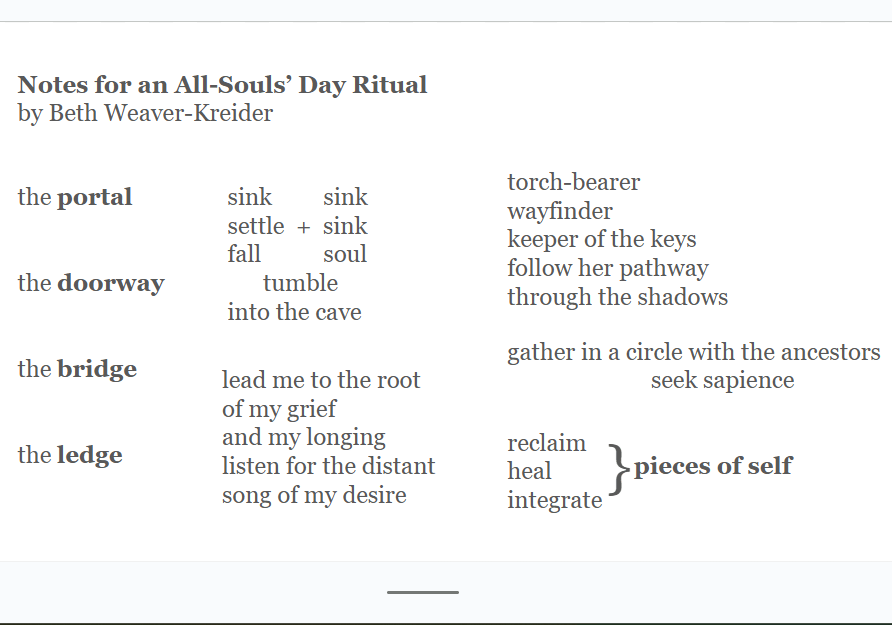
It’s November, so it is time to begin Poem-a-Day again. As I was looking for inspiration for this first day’s poem, I saw some notes I had made for the work I am doing with Kore/Persephone, Demeter, and Hecate. I wanted to set the poem onto the page in a format similar to the way I take notes.
Poem-a-Day Rules for Myself: 1. I am free to write utter crap. 2. My intention is to post a poem every day in November, no matter how small, no matter how late in the day. 3. If I get one good poem out of the month, I will celebrate.
Gratitude List: 1. My parents are safe and well in their new apartment. 2. The way the light angles in during this season. 3. My incredible students–I love watching the seniors create and present their Local Legends and Lore presentations on our Halloween Trail every year. I had to miss it this year because of my parents’ move, but helping them prepare is always a highlight. 4. An extra hour of sleep tonight. 5. Rituals to mark the changing seasons (externally and internally) May we walk in Beauty!
This one is inspired by Martín Espada’s “Rules for Captain Ahab’s Provincetown Poetry Workshop”
Rules for Aunt Elizabeth’s School for Young Witches by Beth Weaver-Kreider
No dogmas allowed in the house.
Keep your karma tuned up at all times.
No reading of others’ auras without consent.
For that matter, do no magic on anyone without consent. This particularly applies to love potions. Go ahead and make yourself lovely and loveable, but refrain from compelling others to love you.
Remember to empty your pockets of crystals and twigs and butterfly wings and feathers and toads and marbles and nails and broken glass before you put your robes in the wash.
Your wands are extensions of your fingers, and it isn’t polite to point fingers, so do not point your wands at others.
Keep your cauldrons clean. Residual spellwork in an unclean cauldron may cause unintended reactions in future potion-making.
Tend to your ongoing spells. Expired spells may increase in potency, resulting in dangerous side effects.
Keep that nose out of the air. No task is too humble for a witch. Sometimes the strongest spells are created in the completion of the humblest of tasks.
Listen when the trees are talking to you. Do not ignore the questions that the rocks put forth. Do not interrupt the speeches of the rivers.
Greet all beings politely, whether human, animal, mineral, plant, or magical.
We are doing 30 Days of Gratitude at school right now, so some of my gratitudes are responding to those specific prompts.
Gratitude List: 1. That pink sky this morning, and the pastel greens of the fields below 2. Three small things: gemstones, kittens, little succulent plants 3. Something in the room: my students 4. A person: Leymah Gbowee ( and her continuing work for justice and human rights) 5. First Trimester Grades are done and submitted May we walk in Beauty!
“I want to live the rest of my life, however long or short, with as much sweetness as I can decently manage, loving all the people I love.” —Audre Lorde
“We need another… perhaps a more mystical concept of animals… In a world older and more complete than ours they move finished and complete, gifted with extensions of the senses we have lost or never attained, living by voices we shall never hear.” —Henry Beston
“One must say Yes to life, and embrace it wherever it is found – and it is found in terrible places. … For nothing is fixed, forever and forever, it is not fixed; the earth is always shifting, the light is always changing, the sea does not cease to grind down rock. Generations do not cease to be born, and we are responsible to them because we are the only witnesses they have. The sea rises, the light fails, lovers cling to each other and children cling to us. The moment we cease to hold each other, the moment we break faith with one another, the sea engulfs us and the light goes out.” —James Baldwin, The Fire Next Time, 1963
“Walk fearlessly into the house of mourning, for grief is just love squaring up to its oldest enemy.” —Kate Braestrup
“Honesty matters. Vulnerability matters. Being open about who you were at a moment in time when you were in a difficult or an impossible place matters more than anything.” —Neil Gaiman
“Yesterday we obeyed kings and bent our necks before emperors, but today we kneel only to truth, follow only beauty, and obey only love.” —Kahlil Gibran
“To write is to ask questions. It doesn’t matter if the answers are true or puro cuento. After all and everything only the story is remembered, and the truth fades away like the pale blue ink on a cheap embroidery pattern.” —Sandra Cisneros, Caramelo
“With guns, you can kill terrorists. With education, you can kill terrorism.” —Malala Yousufsai
“The wo/man who moves a mountain begins by carrying away small stones.” —Confucius, The Analects
“We learn from our gardens to deal with the most urgent question of the time: How much is enough?” —Wendell Berry
“She’s a lean vixen: I can see the ribs, the sly trickster’s eyes, filled with longing and desperation, the skinny feet, adept at lies.
Why encourage the notion of virtuous poverty? It’s only an excuse for zero charity. Hunger corrupts, and absolute hunger corrupts absolutely,” ― Margaret Atwood, Morning in the Burned House
I’ve begun to hit the first bumps in the poem-a-day month. Usually it begins to happen sooner than the mid-point, so I am definitely not complaining. Feeling fresh out of ideas and uninspired, I turned to Robert Lee Brewer’s prompt for the day over at Write Better Poetry (a Writers Digest blog). He suggested writing a form poem, so I decided on a Nonet. Begin the first line with nine syllables, use eight for the second line, seven for the third, and so on until that last line is a single syllable.
Shift a nonet by Beth Weaver-Kreider
At first you hardly notice the change you’re traveling the same old road, but somewhere along the way, the colors start to shift, the images blur, and the safety you thought you knew is gone.
“We live in a world of theophanies. Holiness comes wrapped in the ordinary. There are burning bushes all around you. Every tree is full of angels. Hidden beauty is waiting in every crumb. Life wants to lead you from crumbs to angels, but this can only happen if you are willing to unwrap the ordinary by staying with it long enough to harvest its treasure.” —Macrina Wiederkehr
“It was one of those days you sometimes get latish in the autumn when the sun beams, the birds toot, and there is a bracing tang in the air that sends the blood beetling briskly through the veins.” —P.G. Wodehouse
“You deserve a lover who takes away the lies and brings you hope, coffee, and poetry.” —Frida Kahlo
“And so poetry is not a shopping list, a casual disquisition on the colors of the sky, a soporific daydream, or a bumpersticker sloganeering. Poetry is a political action undertaken for the sake of information, the faith, the exorcism, and the lyrical invention, that telling the truth makes possible. Poetry means taking control of the language of your life. Good poems can interdict a suicide, rescue a love affair, and build a revolution in which speaking and listening to somebody becomes the first and last purpose to every social encounter.” —June Jordan
“I touch God in my song as the hill touches the far-away sea with its waterfall. The butterfly counts not months but moments, and has time enough.” —Rabindranath Tagore
Clarissa Pinkola Estes: “We are needed, that is all we can know. And though we meet resistance, we will meet great souls who will hail us, love us and guide us and we will know them when they appear. Didn’t you say you were a believer? Didn’t you say you pledged to listen to a voice greater? Didn’t you ask for grace? Don’t you remember that to be in grace means to submit to the voice greater?
“One of the most calming and powerful actions you can do to intervene in a stormy world is to stand up and show your soul. Soul on deck shines like gold in dark times. The light of the soul throws sparks, can send up flares, builds beacons, causes proper matters to catch fire. To display the lantern of of soul in shadowy times like these—to be fierce and to show mercy toward others; both are acts of immense bravery and greatest necessity.”
“Speak to your children as if they are the wisest, kindest, most beautiful and magical humans on earth, for what they believe is what they will become.” —Brooke Hampton
“Apprehend God in all things, for God is in all things. Every single creature is full of God and is a book about God. Every creature is a word of God. If I spent enough time with the tiniest creature—even a caterpillar— I would never have to prepare a sermon. So full of God is every creature.” —Meister Eckhart
Yes
It could happen any time, tornado, earthquake, Armageddon. It could happen. Or sunshine, love, salvation.
It could you know. That’s why we wake and look out–no guarantees in this life.
But some bonuses, like morning, like right now, like noon, like evening. —William Stafford
“The world is indeed full of peril, and in it there are many dark places; but still there is much that is fair, and though in all lands love is now mingled with grief, it grows perhaps the greater.” ―J.R.R. Tolkien
I’ve written about this one before, but it really is a fascinating way to break out of a rut. It’s a common problem for me, at least, looking back through poems I have written and noticing that I use the same words, the same phrasing rhythms, the same ideas, over and over again. Part of this is Voice, and I want to keep honing and focusing my Voice in my poetry, but part of it is the worn place on the carpet where everyone walks, the dip in the marble step where centuries of feet have worn the stone away. Again, there is a certain character to the worn places, but there’s value, too, in forging the new path, finding the new word, creating a new bounce to the rhythm.
Take a poem you’ve written, or write one for the occasion.
Here’s mine, which I am going to write as soon as I finish this sentence:
First it was five deer two does and three fawns moving through the meadow and then five starlings in formation a W against the sky. And was it a pensive and beautiful moment followed by another? Or was it the Mother whispering, Follow this trail, seek this path and pattern?
Then, copy and paste it, go to Google translate, paste it in the box, and translate it into any of the listed languages. Then switch the boxes so the new poem–in Urdu or Tagalog or Malayalam–is in the Translate box. You can either simply translate it back into English, or choose another language. I like to go through eight or ten languages before I come back to English. Errors happen on the way, and often the errors actually enhance the poem, and usually they give me some insight into the way my mind works to create ideas. Sometimes I keep parts of what happens when I come back to English, and sometimes I mash up bits from the “translation” with bits of the original.
I tried it in ChatGPT, asking for specific languages, but that AI has gotten so good that, after translating it into Malayalam, then Swahili, then Spanish, then Japanese, then Urdu, then back to English, the only difference was that it had translated “pensive” to “contemplative.” That’s a lovely synonym, but I am looking for crunchier bits.
I copied the Urdu from the ChatGPT session into Google Translate to begin. I love the look of the Urdu script: سب سے پہلے پانچ ہرن تھے، دو مادائیں اور تین بچے، جو میدان میں حرکت کر رہے تھے۔ پھر پانچ ستارے تھے، جو آسمان پر ‘W’ کی شکل بنا رہے تھے۔ کیا یہ ایک سوچنے والا اور خوبصورت لمحہ تھا، جس کے بعد دوسرا لمحہ آیا؟ یا یہ ماں تھی جو سرگوشی کر رہی تھی، “اس راستے کی پیروی کرو، اس راستے اور نمونہ کو تلاش کرو؟”
Then Hawaiian, then Icelandic, then Assamese. Look at the Assamese script! আৰম্ভণিতে পাঁচটা হৰিণ, দুজনী মহিলা আৰু তিনিটা ল’ৰা-ছোৱালী, পথাৰত খোজ কাঢ়িছিল। তাৰ পিছত আকাশত “W” আকৃতিৰ পাঁচটা তৰা আছে। চিন্তাশীল নে সুন্দৰ মুহূৰ্ত, তাৰ পিছত আন এটা মুহূৰ্ত? নে এই মাতৃয়ে ফুচফুচাই কৈছে, “এই পথ অনুসৰণ কৰক, এই পথ আৰু এই উদ্দেশ্য বিচাৰি?” Then Samoan, Hmong, Swahili, Kazakh, Telugu. I am swooning at the Telugu script: మొదట్లో పొలంలో ఐదు జింకలు, ఇద్దరు మహిళలు, ముగ్గురు పిల్లలు నడుస్తున్నారు. అప్పుడు ఆకాశంలో ఐదు నక్షత్రాలు “W” ఉన్నాయి. లోతైన లేదా అందమైన అనుభూతి, మొదలైనవి? ఈ తల్లి “ఇటువైపు వెళ్ళు, ఈ ప్రయోజనం కోసం ఈ దారిని వెతుకు” అని గుసగుసలాడుతుందా? Takij, Krio, Ewe, Dogri (another incredible script), Xhosa, and finally back to English. Here is the fascinating result:
The first five deer, two females and three calves were roaming the wild. Then there are five stars “W” in the sky. Deep emotions or beauty etc? This mother is shouting “go over here, find this way to this goal”?
Oh my heart! Some bits are funny, and others really move me. The final three lines, although the question mark survived, are no longer a question, and the Mother–THIS mother–is no longer whispering, but shouting. Hmmm. Maybe shouting is better. I tend to see the moment of visionary and intuitive awareness as a Holy Whisper, but maybe it is actually a Divine Shout? I’m going to try keeping the new sentence structure of the first lines–it takes it into a mythological sort of place rather than simply sounding like my retelling of the moment.
I ran “pensive and beautiful” through several layers of translation and ended with “retired and handsome,” which is no closer to the specific adjectives I want, so I’ll leave that part as is for now. Here’s a mashup.
The first five deer, two does and three fawns, were roaming the wild. Then there were five starlings, a “W” in the sky. A pensive and beautiful moment followed by another? Or the Mother shouting, Follow this trail, go over here, whispering, seek this path and pattern?
I like how the translator eliminated some of my little introductory bits to my sentences and phrases. I can certainly afford to simplify. I think I like having the Mother both shouting and whispering, but I’m not sure. I might tinker with that some more. I think it has taken my moment from the contemplative and pensive to the mystical and mythical, which is what I am seeking to do with my poetry in this season.
Gratitude List: 1. Such bountiful and beautiful communities that hold and support. 2. Hope and Joy. Finally. Hope and Joy! 3. School begins next week! And In-service starts this Friday! I am intensely eager to get back to it! 4. Holy shouts and whispers from The Mother. 5. Thermal delight after weeks of thermal discomfort. May we walk in Beauty all around!
“Be softer with you. You are a breathing thing. A memory to someone. A home to a life.” ―Nayyirah Waheed
“This beautiful word “mother” is so sweet and kind in itself that it cannot be attributed to anyone but God.”—Julian of Norwich, Revelations 60, trans. M. Starr
Late Fragment
And did you get what you wanted from this life, even so? I did. And what did you want? To call myself beloved, to feel myself beloved on the earth. ―Raymond Carver
Powerful words from Rob Brezsny: “The real secret of magic is that the world is made of words,” said Terence McKenna in “Alien Dreamtime,” “and that if you know the words that the world is made of, you can make of it whatever you wish.”
Here’s my version of that hypothesis: What world you end up living in depends at least in part on your use of language.
Do you want to move and breathe amidst infertile chaos where nothing makes sense and no one really loves anyone? Then speak with unconscious carelessness, expressing yourself lazily. Constantly materialize and entertain angry thoughts in the privacy of your own imagination, beaming silent curses out into eternity.
Or would you prefer to live in a realm that’s rich with fluid epiphanies and intriguing coincidences and mysterious harmonies? Then be discerning and inventive in how you speak, primed to name the unexpected codes that are always being born right in front of your eyes. Turn your imagination into an ebullient laboratory where the somethings you create out of nothings are tinctured with the secret light you see in your dreams of invisible fire.
“The power of love is stronger than the power to destroy.” ―Vandana Shiva
“And then– and then your eyes will open as if waking from a dream or waking into a dream and the dew-drenched grasses will sparkle before you like gold in the morning and you will know.
You will know what it is you have come for.” ―Beth Weaver-Kreider
“Writing is one of the most ancient forms of prayer. To write is to believe communication is possible, that other people are good, that you can awaken their generosity and their desire to do better.” ―Fatema Mernissi
“We don’t read and write poetry because it’s cute. We read and write poetry because we are members of the human race. And the human race is filled with passion. And medicine, law, business, engineering, these are noble pursuits and necessary to sustain life. But poetry, beauty, romance, love, these are what we stay alive for.” ―Robin Williams as Mr. John Keating in Dead Poets Society
“Well, I don’t only think that the biosphere is in trouble, I know it is. I just have to look around in the environment, in which I live. In my own part of the part of the world, I keep telling people, let us not cut trees irresponsibly. Let us not destroy especially the forested mountains. Because if you destroy the forests on these mountains, the rivers will stop flowing and the rains will become irregular and the crops will fail and you will die of hunger and starvation. Now the problem is, people don’t make those linkages.” —Wangari Maathai
“You’re only given a little spark of madness. You mustn’t lose it.” —Robin Williams
“All these squalls to which we have been subjected are signs that the weather will soon improve and things will go well for us, because it is not possible for the bad or the good to endure forever, and from this it follows that since the bad has lasted so long, the good is close at hand.” —Miguel de Cervantes, Don Quixote
“I saw three ways to look at the Motherhood of God. The first is that she created our human nature. The second is that she took our human nature upon herself, which is where the motherhood of grace begins. And the third is motherhood in action, in which she spreads herself throughout all that is, penetrating everything with grace, extending to the fullest length and breadth, height and depth. All One Love.” —Julian of Norwich, Revelations 60, trans. M. Starr
Here’s a common poetry prompt, taught in workshops and classes. It’s commonly called a copy-change. You simply take a few lines of poetry that move or inspire you, and use the structure of that poem like a template into which you insert your own words, kind of like a Mad Lib. And in this form of poetry, you must always give credit to the original poet. It’s called copy-change because you are copying the style or structure or voice of a poet, and changing it into your own piece.
George Ella Lyon made it a favorite of US English Language teachers after she published her poem “Where I’m From” and realized that teachers were using her format as a template for teaching the writing of poetry as a form of self-exploration. She created a template of her poem with missing words, encouraging students and writers to insert words that described their own lives. Or, if they want, they can just use her poem as inspiration and write whatever they want. Click this link to go to her page.
The Astrologer Rob Brezsny has created a similar exercise using a stanza from a Rainer Maria Rilke poem, which encourages his social media followers to explore symbols of their inner life. He suggests using the second stanza of this poem:
Widening Circles by Rainer Maria Rilke (translated by Joanna Macy)
I live my life in widening circles that reach out across the world. I may not complete this last one but I give myself to it.
I circle around God, around the primordial tower. I’ve been circling for thousands of years and I still don’t know: am I a falcon, a storm, or a great song?
Here’s my copy-change of stanza 2, formatted as I would format the poem in order to be sure that I am giving credit for the original. I used Rilke’s first stanza verbatim, so I italicized it, to add another signal that this part is not mine:
Deepening Spirals by Elizabeth Weaver-Kreider after by Rainer Maria Rilke (translated by Joanna Macy)
I live my life in widening circles that reach out across the world. I may not complete this last one but I give myself to it. (Rilke)
I spiral into the Goddess, toward the center of Earth. I’ve been descending for a thousand lifetimes and I still don’t understand: am I a snake, a labyrinth, or a wild dance?
This exercise has various benefits for the beginning or blooming or stuck poet: It gets you past the freeze that sometimes happens with the blank page. It’s a super low-stakes poem–because it’s “just an exercise,” you don’t have to perform on the page, and so you can break more rules and boundaries, and let go of the control of your brain for a little while. I especially love that it’s a Voice experiment–you get to try on different poets’ voices, see how they fit, feel the way someone else’s words and phrases inform yours. And as a reader, it gets you into the poet’s head and helps you to make sense of their diction and lyricism.
Here is your challenge: Visit Lyon’s page to write a “Where I’m From” poem, or use Brezsny’s Rilke prompt. Or go seeking a short piece of poetry that inspires you and create your own copy-change poem. Don’t forget to credit both yourself and the author. Share it with someone!
Gratitude List: 1. My wise and tender and compassionate friends. I often wonder how I got so lucky. 2. Daily grounding and centering. And other rhythms of grounding–the yearly reunion with my college friends is an incredibly powerful reset and re-centering for me. 3. The nibling-weddings! Because family celebrations! 4. The several delightful years we got to spend with our marvelous vampire cat, Erebus. 5. My school community. May we walk in Beauty!
“Be wary of any influence in your environment which dismisses or judges your enthusiasm. Without it, we would become anaesthetised to life itself. Anyone who demands this smallness of you is in danger themselves and may have contracted this insidious, deadening monotone. Enthusiasm is the vitality of spirit expressing itself through us and its grace in our voice should be welcomed and cherished. The word originates in the early 17th century, from the Greek enthousiasmos meaning ‘possessed by god.’ Now, more than ever, the world needs your enlargement, your weirdness, your fiery crescendos of rebellion from boring.” —Toko-pa Turner
“Write a short story every week. It’s not possible to write 52 bad short stories in a row.” —Ray Bradbury
“How do you think you’ll ever see the fairy underneath the flowers, if you never stop to notice the flowers themselves?” —Marie Winger, storyteller
“I wish I could show you, when you are lonely or in darkness, the astonishing Light of your Being.” —Hafiz
“We do not become healers. We came as healers. We are. Some of us are still catching up to what we are. We do not become storytellers. We came as carriers of the stories we and our ancestors actually lived. We are. Some of us are still catching up to what we are.
“We do not become artists. We came as artists. We are. Some of us are still catching up to what we are.
“We do not become writers, dancers, musicians, helpers, peacemakers. We came as such. We are. Some of us are still catching up to what we are.
“We do not learn to love in this sense. We came as Love. We are Love. Some of us are still catching up to who we truly are.” —Dr. Clarissa Pinkola Estes
“Language is very powerful. Language does not just describe reality. Language creates the reality it describes.” —Desmond Tutu
“Be kind whenever possible. It is always possible.” —Dalai Lama
“You were wild once. Don’t let them tame you.” —Isadora Duncan
“If the only prayer you say in your life is thank you, that would suffice.” —Meister Eckhart
“We keep each other alive with our stories. We need to share them, as much as we need to share food. We also require for our health the presence of good companions. One of the most extraordinary things about the land is that it knows this—and it compels language from some of us so that as a community we may converse about this or that place, and speak of the need.” —Barry Lopez
I think I may have made up that title: Wordpool Poem. But the practice of this playful prompt for starting a poem has been around a long time. Early in the days when I was beginning to call myself a poet, I read an exercise by Gwendolyn Brooks in which she gave six words and said to set a timer (was it for five minutes? Eight?) and write a poem using her wordpool.
Here is the edited and refined result of that exercise, as it appears in my 2013 book, The Song of the Toad and the Mockingbird:
Chasing Chickens by Beth Weaver-Kreider
I’ve counted my chickens. A dozen times or more they’ve dashed— Dashed, I tell you— Into blackberry canes, Wings whirring. White clouds of dust engulf me. Their voices chuckle from the cliff’s edge. Don’t tell me about chickens. I’m green, baby. Green. And I don’t know how I’m getting home from here.
I love how the imperative of fitting those random words into a poem set me off-kilter enough to write something that felt new and fresh, and held the angst and anxiety of my life at the time in a layer beneath the surreal “story.”
Here is my take on the Wordpool poem game: Scrolling for Words–
Open up one of your social media pages. If you aren’t on social media, find a book or magazine. Set a timer for one minute. Your goal is to harvest 8-10 at least mildly interesting words in one minute. Turn the timer on, and scroll (or skim, if you’re using printed text), copying down words that catch your eye. Pace yourself. You don’t want to end up with 30 words, and if you end up with fewer than 8, you might want to start over.
Once you have your wordpool (at least 8-10!), reset your timer for 8 minutes. Your challenge is: In that 8-minute time period, write a poem using your words. (You may change forms and parts of speech as you go.) Take a deep breath, unhitch the horse of your brain to go racing through the meadow, and GO!
Write, write, write, don’t think!
What a ride! What a rush! Can’t stop, can’t ponder, can’t let the brain take over! But now here’s the grace. Take whatever time you need to edit and revise. Shift line lengths. Listen for sounds that you can enhance or repeat, rhythms you can lean into. Just try to keep your wordpool words there in some form.
Here is my revised and tweaked poem, with the wordpool words in bold:
Chasing the Vision by Beth Weaver-Kreider, July 2024
I believe in the fire of that vision, in the possibilities you created when the other world trickled through, its light sifting into the collection you’d made of saints’ icons in glass canning jars, the blue of that other place shining in your eyes.
I believe in the small angel who crawled through your doorway, sank into the feral dreams of your four-poster bed, in the way you harbored those ghosts in your head, how you’ve been feeding the schemes of the trickster and learning a new way to exist in the between.
Behold! today you will see a new thing (no false vision this), never seen by human eyes: a wing on a fawn, or a cryptical creature of moss and fur, fangs, and scales, and dream. Make the most of the message before it dissipates like mist over the River on those impossible mornings in fall.
Amazingly, somehow–despite the fact that my brain was unhitched and frantically seeking to just get all the words in–this poem feels like an accurate and holy weaving of several conversations I have had in the past week about magic and mystical and cryptical experiences. I’ll come back to it another day to see if it is finished, if it needs more work.
As I tell my students: Break the Rules. The rules are there to give you a specific field in which to play, but you can discard or change the rules I’ve made up at any point that you feel life they’re holding you captive.
Variations: 1. Use a random word generator online. Ask it to give you a set of random words. 2. Eavesdrop. Collect a batch of words throughout your day to use as a wordpool. 3. Try using the same wordpool for two different poems. 4. Generate a wordpool with a friend, and write your own poems using the same pool. 5. For a little harder challenge, begin each line with one of the words in the wordpool.
Gratitude List: 1. My amazing kids, who figured out what was wrong when the water stopped, and fixed the pump. 2. Mystical encounter with a fawn (mine did not have visible wings like the one in the poem) 3. A lovely group of folks in my magical doll-making class yesterday. Meeting online friends in person. Making new connections. 4. People who respond to crises with kindness, by unleashing more goodness into the world. 5. It’s okra season! And even if our heirloom tomatoes aren’t ready, Flinchbaugh’s sells them! May we walk in Beauty!
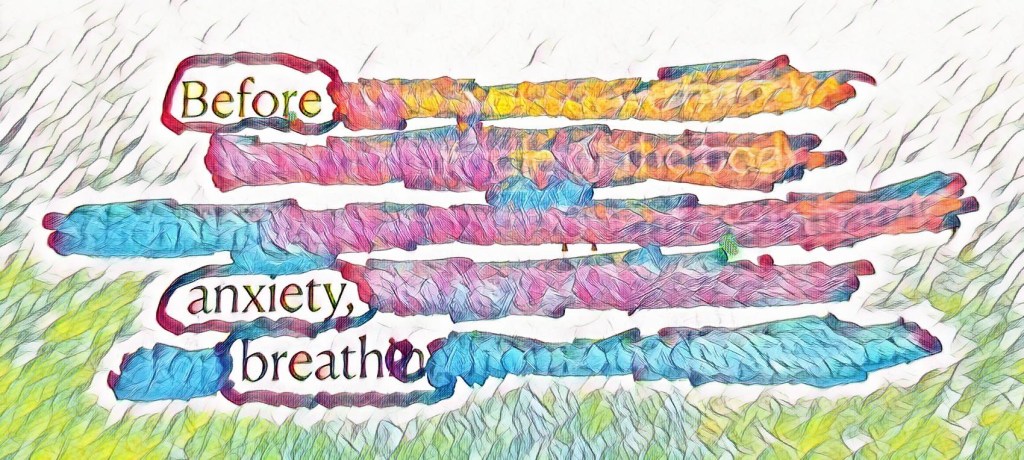
“Before anxiety, breathe.” Found redacted poem (that’s a prompt for another day) by one of my ninth graders. I ran it through a filter for some color.I love how she got to that last word and decided she needed to manipulate the word to suit her purposes.
Here’s a little refresh for the page: Poetry Prompts!
A few days ago, I re-tolled a fun prompt I sometimes use to get myself out of a rut, using predictive text to break me out of my overused words and rhythms. Wordplay and found poetry help me to find new ways to breathe into a poem, and sometimes offer profoundly new ways of expression. “Let go of the reins of the horse of your brain, and let it wander where it wants to for a while,” I sometimes tell my students. I find that the beautiful balance of letting go, and being ready to step in and actively create (as my student did in the image above) not only informs my poetic process, but my living as well.
So here are some initial ideas for using predictive text to restart your poetic mojo. If you don’t think of yourself as a poet (I disagree, btw–if you put words together in your own way, you are a poet), you can use these exercises to play and explore language. I’ll call the prompts Games, just to make it clear that we’re starting playing here.
One note before we begin: Each Game has rules. Try to follow them, to give the game a little structure and challenge. But be ready to break them if the Poem Gnome taps you on the shoulder and suggests you try something different.
Game 1: You’re going to write a six- or eight-line poem. You are in charge of the word or short phrase that begins each line. Then let predictive text finish the lines for you. Here’s an example, with my words in bold. Of course, I have stolen the words for this one, for the sake of play: Roses are the only thing I need. Violets are the only thing I have. Sugar and honey roasted figs with you And now I’m waiting for the bus. So are you. So it will be.
Game 2: Let’s try the same thing, only alternating words with the predictive text. I find this one creates more tension as I try to direct the predictive text. I actually fought it a little and changed the predictive text generator’s (PTG’s) “look” to “looked.” And I actually let the PTG suggest “whenever” instead of the “when” I was considering. Wafting to the bottom of Pandora’s pool, my little feather was almost ready for you. Dreams of her own box of possibilities flew out of the grove in the rain, and now she has forgotten about her last lover, how the clouds looked whenever he was leaving.
NOTES: 1. You might notice, like I do, that you find yourself backtracking and choosing different words in order to force the PTG to offer you better choices. Feels like chess with the computer. 2. Maybe what you came up with, like mine, is laughable trash. But maybe it gives you an idea for something to do next with your own line breaks and cadences. Steal that and run with it! 3. Likely the poem itself it not a publishable gem. But perhaps there’s a line in there that sings? Take it an spin it into another poem of your own! 4. I love that the PTG gave me “Pandora’s,” but I didn’t want to let it force me into using “box.” But my work in the poem quickly became about telling Pandora’s story. I think I should change the “my” to “her.”
Gratitude List: 1. The wild creatures of Goldfinch Farm. 2. Although there is a lot to accomplish in my summer days, I like how I can choose and plot the course with my own intentions. 3. This lavender-filled collar that I put in the freezer and then wear about my neck when the heat feels overwhelming. 4. These teenagers. I love their company, quiet and reserved as it is. Comfortably being together in the house. 5. The creative urge. Making stuff. May we walk in Beauty!
I’m flying a little by the seat of my pants these days, trying to maintain all my daily rhythms, and still not get stressed by all the little things to keep up with. SO last night, I just didn’t do my daily April poem-a-day post here. Sometimes I beat myself up a bit for not being the energy powerhouse that so many of my friends seem to be. I need to protect my energy, gather and store.
Gratitude List: 1. The Dawn Chorus these days. Oh, the birdsong! 2. All the different smells 3. Friends and beloveds who invest time and heart in each other 4. How the beauty just explodes all of a sudden here in the spring. One minute you notice the leaves of the bleeding hearts appearing, and then SUDDENLY they’ve bloomed! 5. Movements for peace and justice. The people who are doing the work, whatever their piece of the work may be. May we walk in Beauty!
“I love to write to you – it gives my heart a holiday and sets the bells to ringing.” Emily Dickinson
“Sorrow prepares you for joy. It violently sweeps everything out of your house, so that new joy can find space to enter. It shakes the yellow leaves from the bough of your heart, so that fresh, green leaves can grow in their place. It pulls up the rotten roots, so that new roots hidden beneath have room to grow. Whatever sorrow shakes from your heart, far better things will take their place.” —Rumi
I called through your door, “The mystics are gathering in the street. Come out!” “Leave me alone. I’m sick.” “I don’t care if you’re dead! Jesus is here, and he wants to resurrect somebody!” —Rumi
“Don’t be satisfied with stories, how things have gone with others. Unfold your own myth.” ―Rumi
“Thousands of candles can be lit from a single candle, and the life of the candle will not be shortened. Happiness never decreases by being shared.” ―Buddha ****” Some words on my River, from Robert Louis Stevenson: “I have been changed from what I was before; and drunk too deep perchance the lotus of the air, Beside the Susquehanna and along the Delaware.” ―Robert Louis Stevenson
“. . .and as I saw, one after another, pleasant villages, carts upon the highway and fishers by the stream, and heard cockcrows and cheery voices in the distance, and beheld the sun, no longer shining blankly on the plains of ocean, but striking among shapely hills and his light dispersed and coloured by a thousand accidents of form and surface, I began to exult with myself upon this rise in life like a man who had come into a rich estate. And when I had asked the name of a river from the brakesman, and heard that it was called the Susquehanna, the beauty of the name seemed to be part and parcel of the beauty of the land. As when Adam with divine fitness named the creatures, so this word Susquehanna was at once accepted by the fancy. That was the name, as no other could be, for that shining river and desirable valley.” ―Robert Louis Stevenson
“There may be times when we are powerless to prevent injustice, but there must never be a time when we fail to protest.” ―Elie Wiesel
Rob Brezsny: Plato said God was a geometer who created an ordered universe imbued with mathematical principles. Through the ages, scientists who’ve dared to speak of a Supreme Being have sounded the same theme. Galileo wrote, “To understand the universe, you must know the language in which it is written. And that language is mathematics.” Modern physicist Stephen Hawking says that by using mathematical theories to comprehend the nature of the cosmos, we’re trying to know “the mind of God.” But philosopher Richard Tarnas proposes a different model. In his book “Cosmos and Psyche,” he suggests that God is an artist—more in the mold of Shakespeare than Einstein. For myself―as I converse with God every day―I find Her equally at home as a mathematician and artist.
Gratitude List: 1. Makin’ little ‘zines–so satisfying 2. Our History teacher is having her tenth-graders make a Hooverville as they study the Great Depression. They’ve actually made a little box town outside where they’ll be having class for the next few days. They have signs with the boxes, and they’ve written paragraphs about them, and now she’s given all the Middle Division teachers a note-sheet with reflection questions so we can take our classes out to experience it, basically turning it into a whole school lesson. So inspiring. Brilliant pedagogy. 3. Roasted cauliflower. Our school has a healthy living committee which challenged us to strive for five a day (veggies and fruits) in the month of March. We are definitely eating more fruits and veg in the WK household. 4. Track and field coaches–I’m grateful for all the time and heart they invest in our kid and his classmates 5. Yellow. I had a fascinating conversation with a friend a few weeks ago about tetrachromatism, the condition where the eyes have more rods or cones or something, causing them to actually see more colors than other people, and how people with tetrachromatism often don’t really like the color yellow. I think I probably don’t have it. Yellow makes me jubilant. May we walk in Beauty!
“Our task is to take this earth so deeply and wholly into ourselves that it will resurrect within our being.” —Rainer Maria Rilke
“We have no symbolic life, and we are all badly in need of the symbolic life. Only the symbolic life can express the need of the soul – the daily need of the soul, mind you! And because people have no such thing, they can never step out of this mill – this awful, banal, grinding life in which they are “nothing but.” —C. G. Jung
Listen by Shel Silverstein
Listen to the MUSTN’TS, child, Listen to the DON’TS Listen to the SHOULDN’TS, the IMPOSSIBLES, the WON’TS Listen to the NEVER HAVES, Then listen close to me- Anything can happen, child, Anything can be.
If you are a dreamer by Shel Silverstein
If you are a dreamer, come in, If you are a dreamer, a wisher, a liar, A hope-er, a pray-er, a magic bean buyer… If you’re a pretender, come sit by my fire For we have some flax-golden tales to spin. Come in! Come in!
“It doesn’t have to be the blue iris, it could be weeds in a vacant lot, or a few small stones; just pay attention, then patch a few words together and don’t try to make them elaborate, this isn’t a contest but the doorway into thanks, and a silence in which another voice may speak.” —Mary Oliver
“Unless someone like you cares a whole awful lot, nothing is going to get better. It’s not.” —Once-ler, in Dr. Seuss’s The Lorax
“No one is born hating another person because of the color of his skin, or his background, or his religion. People must learn to hate, and if they can learn to hate, they can be taught to love, for love comes more naturally to the human heart than its opposite.” ―Nelson Mandela
Twelve Things I Have Learned So Far: (1) You do not always have to be right. (2) People can change. (3) Loss comes to us all, but so does grace. (4) We can disagree and still be together. (5) Kindness is the greatest treasure I have to give away. (6) We are all healed even if it does not happen on our timeline. (7) Imagination is a form of prayer. (8) I own nothing. (9) Life is full of sacred signs if only we look to see them. (10) The ancestors are real. (11) Not all of my friends and mentors are human. (12) Now is eternal and it is my home. —Steven Charleston
Gratitude List: 1. Cosmic Events 2. The community of people all enjoying the same thing 3. Mac ‘n’ Cheese 4. Sheri S. Tepper’s world-building 5. We went owl-watching today! May we walk in Beauty!
“You have to really hug the [one] you are holding. You have to make him or her very real in your arms.. breathing consciously and hugging with all your body, spirit, and heart. Hugging meditation is a practice of mindfulness. “Breathing in, I know my dear one is in my arms, alive. Breathing out, he or she is so precious to me.” If you breathe deeply like that, holding the person you love, the energy of your care and appreciation will penetrate into [them] and they will be nourished and bloom like a flower.” —Thich Nhat Hanh
“For everything that lives is holy, life delights in life.“ —William Blake
We, unaccustomed to courage, exiled from delight, live coiled in shells of loneliness until love leaves its high holy temple and comes into our sight to liberate us into life.“ —Maya Angelou
“On the whole, I do not find Christians, outside of the catacombs, sufficiently sensible of conditions. Does anyone have the foggiest idea what sort of power we so blithely invoke? Or, as I suspect, does no one believe a word of it? The churches are children playing on the floor with their chemistry sets, mixing up a batch of TNT to kill a Sunday morning. It is madness to wear ladies’ straw hats and velvet hats to church; we should all be wearing crash helmets. Ushers should issue life preservers and signal flares; they should lash us to our pews. For the sleeping god may wake someday and take offense, or the waking god may draw us out to where we can never return.” —Annie Dillard in Teaching a Stone to Talk
“For instance, on the planet Earth, man had always assumed that he was more intelligent than dolphins because he had achieved so much—the wheel, New York, wars and so on—whilst all the dolphins had ever done was muck about in the water having a good time. But conversely, the dolphins had always believed that they were far more intelligent than man—for precisely the same reasons.” ―Douglas Adams, The Hitchhiker’s Guide to the Galaxy
“Where there’s life there’s hope, and need of vittles.” ―JRR Tolkien
“We are the ones we have been waiting for.” ―June Jordan
“Our task must be to free ourselves from this prison by widening our circle of compassion to embrace all living creatures and the whole of nature in its beauty.” ―Albert Einstein
“We are all the leaves of one tree. We are all the waves of one sea.” ―Thich Nhat Hanh
“It is respectable to have no illusions―and safe―and profitable and dull.” ―Joseph Conrad
“I would like to beg you dear Sir, as well as I can, to have patience with everything unresolved in your heart and to try to love the questions themselves as if they were locked rooms or books written in a very foreign language. Don’t search for the answers, which could not be given to you now, because you would not be able to live them. And the point is to live everything. Live the questions now. Perhaps then, someday far in the future, you will gradually, without even noticing it, live your way into the answer.” ―Rainer Maria Rilke
“Our job is to love others without stopping to inquire whether they are worthy.” —Thomas Merton
Rilke: God speaks to each of us as [s]he makes us, then walks with us silently out of the night.
These are the words we dimly hear:
You, sent out beyond your recall, go to the limits of your longing. Embody me.
Flare up like a flame and make big shadows I can move in.
Let everything happen to you: beauty and terror. Just keep going. No feeling is final.
Don’t let yourself lose me. Nearby is the country they call life. You will know it by its seriousness.
Give me your hand.
“What if we reframed “living with uncertainty” to “navigating mystery”? There’s more energy in that phrase. The hum of imaginative voltage. And is our life not a mystery school, a seat of earthy instruction?” —Martin Shaw





 Mockingbird Chronicles