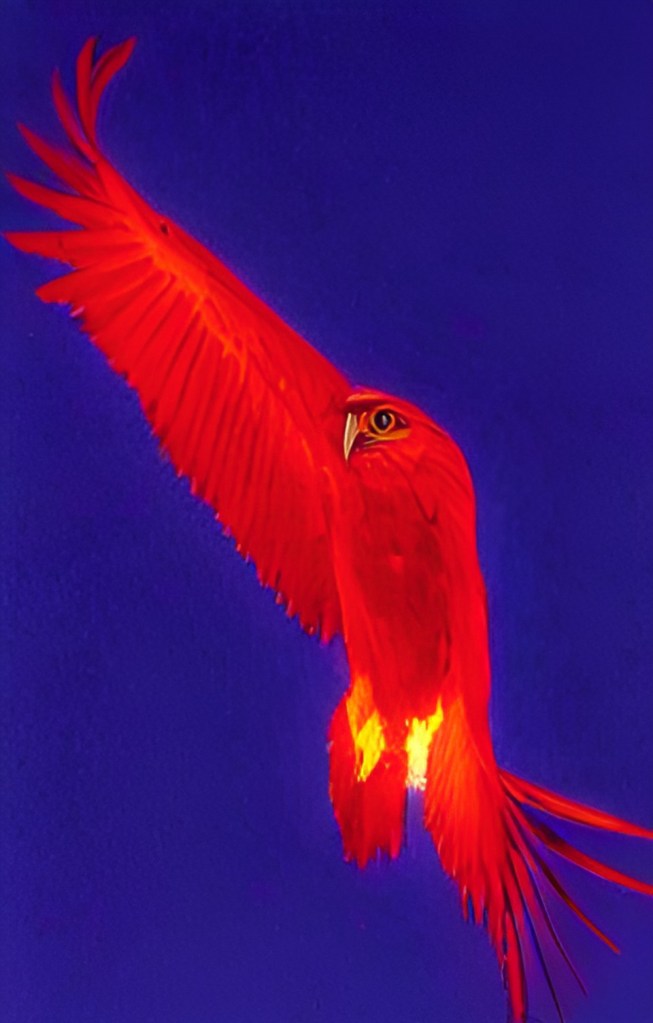
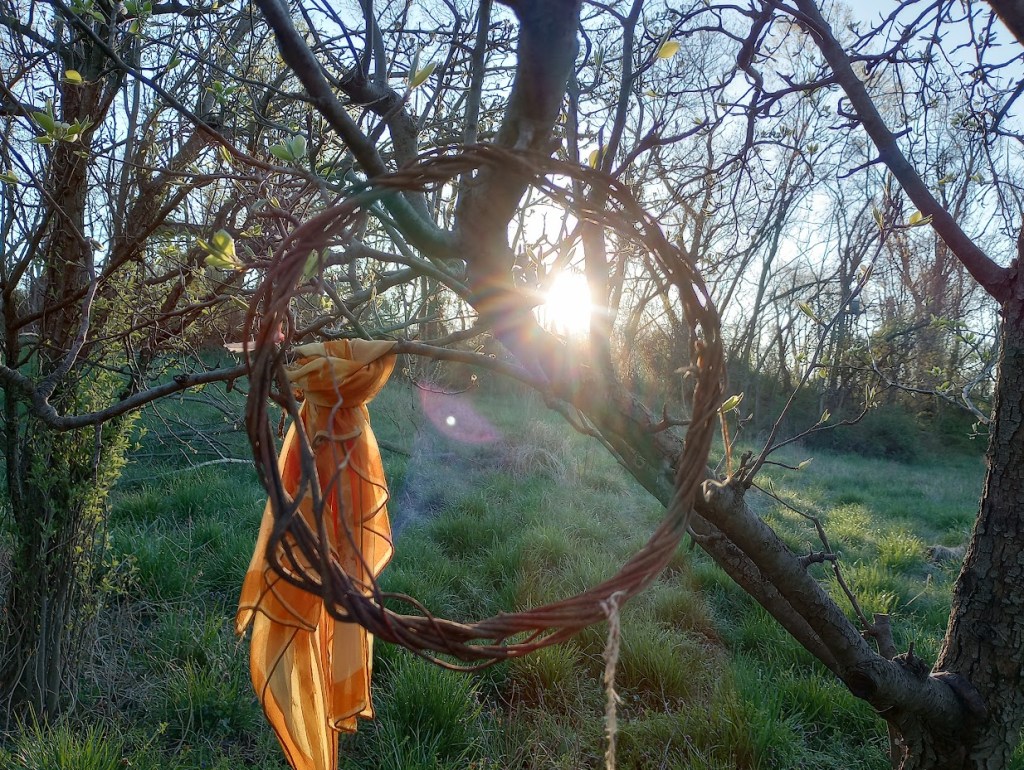
Prompt : Forgiveness

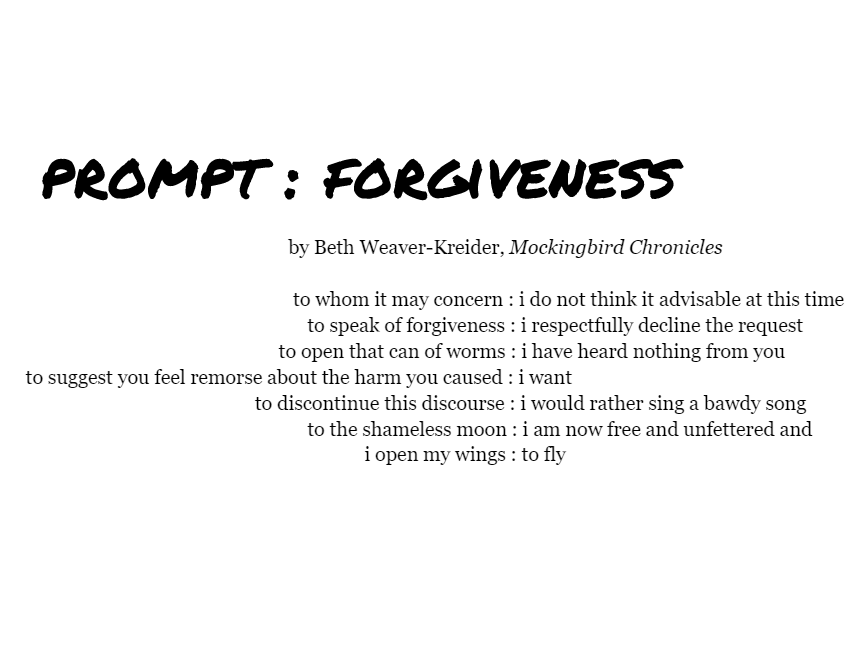
Now that I have finished my friend Tim’s seven Rilke prompts, I am heading back to Write Better Poetry, Robert Lee Brewer’s blog on the Writer’s Digest site. I like the old name of the blog so much better: Poetic Asides. Now all their blogs are Write Better _________. Bland and unpoetic. But Brewer is still a good one to follow. Today’s prompt is to write about forgiveness. Ever defiant, I chose to write about the opposite. Perhaps it won’t seem very spiritually evolved. . . I’m not too fussed.

Gratitude List:
1. Warm weather
2. We’re doing poetry by analyzing people’s favorite song lyrics right now. Everybody wants to participate. They’re clamoring to participate.
3. Crochet Club. Finally enough of them are beginning to get it that it’s getting to be fun. Soon, we’ll be making hearts and stars and evil eyes.
4. I seem to be through that last period of intense inflammation. I was again beginning to dread getting out of the chair to walk. Sleeping felt like a dangerous thing–I was waking up with neck aches and numb shoulders and back aches. Feeling SO much better now.
5. The dawn chorus these days is riotous!
May we walk in Beauty!


“But it is over now; I have survived it.” —Rainer Maria Rilke


“I pray to the birds. I pray to the birds because I believe they will carry the messages of my heart upward. I pray to them because I believe in their existence, the way their songs begin and end each day—the invocations and benedictions of Earth. I pray to the birds because they remind me of what I love rather than what I fear. And at the end of my prayers, they teach me how to listen.” ―Terry Tempest Williams, Refuge: An Unnatural History of Family and Place


“Until we are all free, we are none of us free.” ―Emma Lazarus


“Live the full life of the mind, exhilarated by new ideas, intoxicated by the Romance of the unusual.” ―Ernest Hemingway


“Poetry is when an emotion has found its thought and the thought has found words.” ―Robert Frost


“What I have seen is the totality recapitulated as One,
Received not in essence but by participation.
It is just as if you lit a flame from a live flame:
It is the entire flame you receive.”
―St. Symeon the New Theologian (949-1022)


“We love the things we love for what they are.” ―Robert Frost


“You talk when you cease to be at peace with your thoughts.” ―Kahlil Gibran, The Prophet


“I have loved the stars too fondly to be fearful of the night.” ―Sarah Williams


“Resist much, obey little.” ―Walt Whitman, Leaves of Grass


“Unbeing dead isn’t being alive.” ―e. e. cummings


“If we do not mean that God is male when we use masculine pronouns and imagery, then why should there be any objections to using female imagery and pronouns as well?” ―Carol P. Christ


“Subversive language, however, must be constantly reinvented, because it is continually being co-opted by the powerful.” ―Carol P. Christ

Seeking the Holy Mountain

Today’s line from Rilke is the last of the series. On this spiritual journey, it can so often feel like I should have known this thing before, should be wiser already, should be more enlightened. I keep needing to remind myself that it’s ALL a journey. We never get to the holy mountain in this life. I want to be seeking it always, but we don’t reach it until we die, so there’s no hurry to finish the job of enlightenment.

Every moment is a learning moment. And yes, we’ve learned so much already, and sometimes today’s lessons seem an awful lot like last year’s lessons, or last decade’s lessons. But we’re at a higher level, learning the finesse of the broad lessons we experienced in our youth. And sometimes we need refreshers, too.

Gratitude List:
1. This weather. I don’t care if it makes me sneeze thirteen times in a row. I love this.
2. Poetry and image and dream, fairy tale and folk tale and wisdom tale–the side doors to spiritual inquiry. I’m not a fan of the theological doors that so many people seem to enter by. And there are so many people wandering through these side doors. There’s great company!
3. Making knots in yarn and ending up with a heart or an eye or a star.
4. One of my students who has been struggling with motivation got to work on a poem today, and then walked it around to several of his teachers to show it off. He was so proud, and I was so proud of him!
5. Have I mentioned the weather? Glorious!


“I love to write to you – it gives my heart a holiday and sets the bells to ringing.”
Emily Dickinson


“Sorrow prepares you for joy. It violently sweeps everything out of your house, so that new joy can find space to enter. It shakes the yellow leaves from the bough of your heart, so that fresh, green leaves can grow in their place. It pulls up the rotten roots, so that new roots hidden beneath have room to grow. Whatever sorrow shakes from your heart, far better things will take their place.” —Rumi


I called through your door,
“The mystics are gathering in the street. Come out!”
“Leave me alone. I’m sick.”
“I don’t care if you’re dead!
Jesus is here, and he wants to resurrect somebody!” —Rumi


“Don’t be satisfied with stories, how things have gone with others. Unfold your own myth.” ―Rumi


“Thousands of candles can be lit from a single candle, and the life of the candle will not be shortened. Happiness never decreases by being shared.” ―Buddha
****”
Some words on my River, from Robert Louis Stevenson:
“I have been changed from what I was before;
and drunk too deep perchance the lotus of the air,
Beside the Susquehanna and along the Delaware.”
―Robert Louis Stevenson


“. . .and as I saw, one after another, pleasant villages, carts upon the highway and fishers by the stream, and heard cockcrows and cheery voices in the distance, and beheld the sun, no longer shining blankly on the plains of ocean, but striking among shapely hills and his light dispersed and coloured by a thousand accidents of form and surface, I began to exult with myself upon this rise in life like a man who had come into a rich estate. And when I had asked the name of a river from the brakesman, and heard that it was called the Susquehanna, the beauty of the name seemed to be part and parcel of the beauty of the land. As when Adam with divine fitness named the creatures, so this word Susquehanna was at once accepted by the fancy. That was the name, as no other could be, for that shining river and desirable valley.” ―Robert Louis Stevenson


“There may be times when we are powerless to prevent injustice, but there must never be a time when we fail to protest.” ―Elie Wiesel


Rob Brezsny:
Plato said God was a geometer who created an ordered universe imbued with mathematical principles. Through the ages, scientists who’ve dared to speak of a Supreme Being have sounded the same theme. Galileo wrote, “To understand the universe, you must know the language in which it is written. And that language is mathematics.”
Modern physicist Stephen Hawking says that by using mathematical theories to comprehend the nature of the cosmos, we’re trying to know “the mind of God.”
But philosopher Richard Tarnas proposes a different model. In his book “Cosmos and Psyche,” he suggests that God is an artist—more in the mold of Shakespeare than Einstein.
For myself―as I converse with God every day―I find Her equally at home as a mathematician and artist.

Dea Ex Machina

I think I have given this name to at least one poem before. I am a dog worrying the same bone, over and over again, a rainstorm eroding the same patch of earth until a rut is formed, then a stream, a river, a rift, a gorge. How there is something of the Holy in every atom, every galaxy, every sound and color and thought.

Here is the sixth Rilke riff from the set my friend Tim offered. He actually tucked a seventh into the mix after his initial suggestion, so I may take that up tomorrow and make a full week of it.

Gratitude List:
1. Deep sleep last night, and the help of Melatonin to take me there
2. This cool, cool evening after a day of thermal delight
3. Cycles, seasons, shifts–inner change often seems to happen on the coattails of a seasonal shift
4. The circles of beloveds who surround us, the interlocking nets and webs of support
5. Flaming forsythia
May we walk in Beauty!


“A good plan isn’t one where someone wins, it’s where nobody thinks they’ve lost.” —Terry Pratchett


“We have all hurt someone tremendously, whether by intent or accident. We have all loved someone tremendously, whether by intent or accident. it is an intrinsic human trait, and a deep responsibility, I think, to be an organ and a blade. But, learning to forgive ourselves and others because we have not chosen wisely is what makes us most human. We make horrible mistakes. It’s how we learn. We breathe love. It’s how we learn. And it is inevitable.” —Nayyira Waheed


“To me, it’s all right if you look at a tree, as the Hindus do, and say the tree has a spirit. It’s a mystery, and mysteries don’t compromise themselves—we’re never gonna know. I think about the spiritual a great deal. I like to think of myself as a praise poet.” —Mary Oliver


“When you hold a child in your arms, or hug your mother, or your husband, or your friend, if you breathe in and out three times, your happiness will be multiplied at least tenfold.” —Thich Nhat Hanh


“I stuck my head out the window this morning, and spring kissed me BANG in the face.” —Langston Hughes


“In the morning, wonder and be generous like the sun.
In the evening, meditate and be kind like the moon.” —Debasish Mridha


“There is a huge silence inside each of us that beckons us into itself, and the recovery of our own silence can begin to teach us the language of heaven.” —Meister Eckhart


“Every spring is the only spring—a perpetual astonishment.” —Ellis Peters


“Nothing is more terrifying to evil than joy!” —Cannoc, in The Beatryce Prophecy, by Kate DiCamillo

Out of the Box

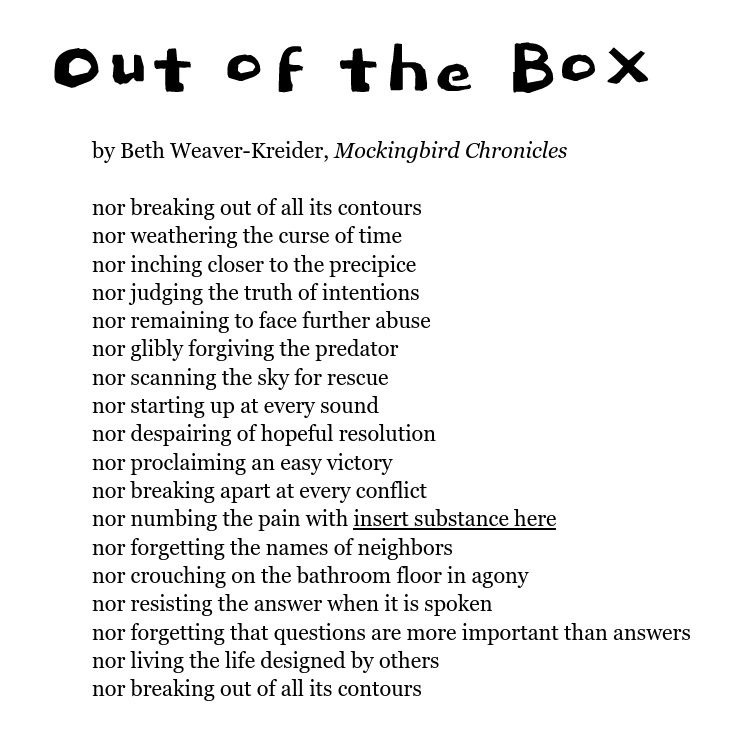
This is the fifth day of riffing on phrases from Rilke. I love the choices my friend Tim made, choosing phrases with odd beginnings. I am a little compulsive about following my own rules, and I decided right away for some reason that I would begin every poem with the Rilke line, no matter how awkward. I can already feel it affecting my sentence structure, my sense of the sentence. This one begins with Nor. How do you begin with Nor and create something that makes real sense? It’s forcing my brain to explore different pathways. I’m liking this new view.

Gratitude List:
1. Cats: they’re such good company
2. Daffodils
3. This phrase from a student today: “If this last stanza of the poem were sentient, I would hug it!” (Jimmy Santiago Baca’s “I Am Offering this Poem”)
4. National Poetry Month
5. Praying/Meditating with my body
May we walk in Beauty!


“When I interviewed Maya Angelou, she told me to write this sentence on my notepad and to never forget it:
EVERY STORM RUNS OUT OF RAIN.
I still think of that to this day. ” —Alex Banyan


“Stay close to anything that makes you glad you are alive.” —Hafiz


“The problem is that you think you are separate from others.” —Richard Rohr


“You have to want a thing enough to reach out for it.” —Lailah Gifty Akita


“To wait within the moment for the coming dawn,
To breathe the single breath of all that lives,
To walk the web on which we all belong,
To face the newborn day with love instead of fear.
To listen for the whisper of the Spirit’s wind,
To feel Creator’s heartbeat in the world around,
To hear the grace of the Beloved in my neighbor’s voice,
To embrace the sacred space between the past and change.”
—Beth Weaver-Kreider


“Hope is a dimension of the soul. . .an orientation of the spirit, an orientation of the heart. It transcends the world that is immediately experienced and is anchored somewhere beyond its horizons. . . .It is not the conviction that something will turn out well, but the certainty that something makes sense regardless of how it turns out.” —Vaclav Havel


“When time comes for us to again rejoin the infinite stream of water flowing to and from the great timeless ocean, our little droplet of soulful water will once again flow with the endless stream.” —William E. Marks


“We are not to simply bandage the wounds of victims beneath the wheels of injustice, we are to drive a spoke into the wheel itself.” —Dietrich Bonhoeffer


“Healing is not pouring your energy into another, but activating the widening field of possibility around yourself, so the other may glimpse their own majesty forming on the horizon.” —Toko-pa Turner


“An ant crosses your carpet. A spider weaves a pattern older than mammals beneath your stairs. Just nod, breathe, and think, “Good. It’s all still here. The forest, the mountains, the desert. At home in my home.” The sterile white box is the stranger. Not the ant. Not the spider.” —Jarod Anderson, The Cryptonaturalist

In the Garden

It’s no secret that I am a little obsessed with Mary Magdalene, with her story, her lore, her myth. And in the Jesus narrative, my favorite moments are the Jesus the Happy Trickster moments following the Resurrection, when he reveals himself to Mary in the garden, to Thomas in the upper room, to Peter and friends along the shore, to the friends walking to Emmaus.

I’ve tried, again and again, to capture the moment of Mary’s moment of turning in the garden in poetry. I think I’ve been successful. Yet I return to the moment over and over, as if saying it yet another way will open the story that one inch more fully. There’s that moment when she turns, from the cool shadows of the empty tomb to the glaring light of day. Maybe she already guesses that it isn’t the gardener, or that it is the Gardener. I don’t mean to be glib about one of the most powerful moments of story I know, but there’s a Schrodinger’s moment here as Mary is turning, when she both knows and doesn’t know, when a thousand thousand possibilities bloom in the space between not knowing and knowing, and gnowing.

And in the series of Rilke lines that my friend Tim offered me for poems this week, today’s was the perfect opening line for a deeper reflection on this moment of dawning truth.

Gratitude List:
1. A weekend with family.
2. Making music with my siblings.
3. My church community–earnest, loving, joyful, Present
4. Morning prayers in the grove. The pear trees are blooming.
5. Coming alive
May we walk in Beauty!


“Our task is to take this earth so deeply and wholly into ourselves that it will resurrect within our being.” —Rainer Maria Rilke


“We have no symbolic life, and we are all badly in need of the symbolic life. Only the symbolic life can express the need of the soul – the daily need of the soul, mind you! And because people have no such thing, they can never step out of this mill – this awful, banal, grinding life in which they are “nothing but.” —C. G. Jung


Listen
by Shel Silverstein

Listen to the MUSTN’TS, child,
Listen to the DON’TS
Listen to the SHOULDN’TS,
the IMPOSSIBLES, the WON’TS
Listen to the NEVER HAVES,
Then listen close to me-
Anything can happen, child,
Anything can be.


If you are a dreamer
by Shel Silverstein

If you are a dreamer, come in,
If you are a dreamer, a wisher, a liar,
A hope-er, a pray-er, a magic bean buyer…
If you’re a pretender, come sit by my fire
For we have some flax-golden tales to spin.
Come in!
Come in!


“It doesn’t have to be
the blue iris, it could be
weeds in a vacant lot, or a few
small stones; just
pay attention, then patch
a few words together and don’t try
to make them elaborate, this isn’t
a contest but the doorway
into thanks, and a silence in which
another voice may speak.”
—Mary Oliver


“Unless someone like you cares a whole awful lot, nothing is going to get better. It’s not.” —Once-ler, in Dr. Seuss’s The Lorax


“No one is born hating another person because of the color of his skin, or his background, or his religion. People must learn to hate, and if they can learn to hate, they can be taught to love, for love comes more naturally to the human heart than its opposite.” ―Nelson Mandela


Twelve Things I Have Learned So Far: (1) You do not always have to be right. (2) People can change. (3) Loss comes to us all, but so does grace. (4) We can disagree and still be together. (5) Kindness is the greatest treasure I have to give away. (6) We are all healed even if it does not happen on our timeline. (7) Imagination is a form of prayer. (8) I own nothing. (9) Life is full of sacred signs if only we look to see them. (10) The ancestors are real. (11) Not all of my friends and mentors are human. (12) Now is eternal and it is my home. —Steven Charleston

Conjuring the Eternal

Riffing on a line from Rilke, day #3:


Gratitude List:
1. Exploring a bookstore with a young friend
2. That dream of the Gardener from several days ago. How it sticks with me, her gentle, nonjudgmental wave, although I had nearly stolen a crystal from her Garden. How the next morning, I found a quartz crystal in my collection which was exactly like the one I picked up in my dream.
3. The Mary Magdalene Mysteries–listening for the Beloved to speak her/my/your name
4. This tender, fragile, open space of now. A space where healing can happen.
5. Sweet rest
May we walk in Beauty!


“You have to really hug the [one] you are holding. You have to make him or her very real in your arms.. breathing consciously and hugging with all your body, spirit, and heart. Hugging meditation is a practice of mindfulness. “Breathing in, I know my dear one is in my arms, alive. Breathing out, he or she is so precious to me.” If you breathe deeply like that, holding the person you love, the energy of your care and appreciation will penetrate into [them] and they will be nourished and bloom like a flower.” —Thich Nhat Hanh


“For everything that lives is holy, life delights in life.“ —William Blake


We, unaccustomed to courage, exiled from delight, live coiled in shells of loneliness until love leaves its high holy temple and comes into our sight to liberate us into life.“ —Maya Angelou


“On the whole, I do not find Christians, outside of the catacombs, sufficiently sensible of conditions. Does anyone have the foggiest idea what sort of power we so blithely invoke? Or, as I suspect, does no one believe a word of it? The churches are children playing on the floor with their chemistry sets, mixing up a batch of TNT to kill a Sunday morning. It is madness to wear ladies’ straw hats and velvet hats to church; we should all be wearing crash helmets. Ushers should issue life preservers and signal flares; they should lash us to our pews. For the sleeping god may wake someday and take offense, or the waking god may draw us out to where we can never return.” —Annie Dillard in Teaching a Stone to Talk


“For instance, on the planet Earth, man had always assumed that he was more intelligent than dolphins because he had achieved so much—the wheel, New York, wars and so on—whilst all the dolphins had ever done was muck about in the water having a good time. But conversely, the dolphins had always believed that they were far more intelligent than man—for precisely the same reasons.” ―Douglas Adams, The Hitchhiker’s Guide to the Galaxy


“Where there’s life there’s hope, and need of vittles.” ―JRR Tolkien


“We are the ones we have been waiting for.” ―June Jordan


“Our task must be to free ourselves from this prison by widening our circle of compassion to embrace all living creatures and the whole of nature in its beauty.” ―Albert Einstein


“We are all the leaves of one tree.
We are all the waves of one sea.” ―Thich Nhat Hanh


“It is respectable to have no illusions―and safe―and profitable and dull.” ―Joseph Conrad


“I would like to beg you dear Sir, as well as I can, to have patience with everything unresolved in your heart and to try to love the questions themselves as if they were locked rooms or books written in a very foreign language. Don’t search for the answers, which could not be given to you now, because you would not be able to live them. And the point is to live everything. Live the questions now. Perhaps then, someday far in the future, you will gradually, without even noticing it, live your way into the answer.” ―Rainer Maria Rilke


“Our job is to love others without stopping to inquire whether they are worthy.” —Thomas Merton


Rilke:
God speaks to each of us as [s]he makes us,
then walks with us silently out of the night.

These are the words we dimly hear:

You, sent out beyond your recall,
go to the limits of your longing.
Embody me.

Flare up like a flame
and make big shadows I can move in.

Let everything happen to you: beauty and terror.
Just keep going. No feeling is final.

Don’t let yourself lose me.
Nearby is the country they call life.
You will know it by its seriousness.

Give me your hand.


“What if we reframed “living with uncertainty” to “navigating mystery”? There’s more energy in that phrase. The hum of imaginative voltage. And is our life not a mystery school, a seat of earthy instruction?” —Martin Shaw

The Silence of Friday

I was wrong yesterday. My friend had been telling me about an article on dreaming in different languages, and then he went on to chat about a book of Rilke poetry he bought. When he suggested the six phrases for us to use as the basis for some poeming, I didn’t realize they were lines from Rilke, which somehow increases the fun of this project. The first two lines of today’s poems are Rilke.


Gratitude List:
1. The goldfinches have gone golden.
2. This year is this year and not last year.
3. The pear trees in the orchard are blooming.
4. Apple Crisp, fresh from the oven.
5. Milkweed and dogbane cordage.
May we walk in Beauty!


“Hope is an embrace of the unknown and the unknowable, an alternative to the certainty of both optimists and pessimists. Optimists think it will all be fine without our involvement; pessimists take the opposite position; both excuse themselves from acting. (Hope) is the belief that what we do matters even though how and when it may matter, who and what it may impact, are not things we can know beforehand.” —Rebecca Solnit


“Bitterness is like cancer. It eats upon the host. But anger is like fire. It burns it all clean.” —Maya Angelou


“God invites everyone to the House of Peace.” —The Holy Quran


“Political language is designed to make lies sound truthful and murder respectable, and to give the appearance of solidity to pure wind.” —George Orwell


“What a pity that so hard on the heels of Christ came the Christians.”
—Annie Dillard


“The arc of history is long, and what we’re here to do is make a mark. . . . You do the work because you’re slowly moving the needle. There are times in history when we feel like we’re going backward, but that’s part of the growth.” —Barack Obama


“Each moment from all sides rushes to us the call to love.” —Rumi


“You are a co-creator of love in this world.” —Richard Rohr


“Trust your instinct to the end, though you can render no reason.” —Ralph Waldo Emerson


“When we let ourselves respond to poetry, to music, to pictures, we are clearing out a space where new stories can root; in effect we are clearing a space for new stories about ourselves.”
—Jeanette Winterson


“The greatest thing you’ll ever learn
Is just to love and be loved in return.” —Eden Ahbez


“Remember, the ugly, old woman/witch
is the invention of dominant cultures.
The beauty of crones is legendary:
old women are satin-skinned,
softly wrinkled, silver-haired, and awe-inspiring
in their truth and dignity.” —Susun Weed

Maundy Thursday

Today is Maundy Thursday. If you live your life by stories, and if the Jesus story is one of those, this is a night about the intimacy of friendship, about vulnerability and awkwardness, about love and impending loss, about betrayal and suspicion. It’s about the revolution of upside-down: the last will be first and the first will be last.

If this and the coming days are important parts of your story, I wish you blessings in the contemplation. Meanwhile, Passover continues, and blessings to those of you who mark that season. Meanwhile, the fasting month of Ramadan continues, and blessings to you who mark that season. Meanwhile, we are in the season of Ostara which leads to Beltane, and blessings to you who mark that season.


Last night my friend Tim sent me a message. He’d pulled six evocative lines from an article he was reading about dreaming in different languages, and he suggested that we each write poems using those lines. I love this challenge.

Here is my first poem. The first and last lines of the poem are the first phrase he suggested. I am playing with form here. I was teaching my Creative Writers today about Terrance Hayes’ Golden Shovel form, in which he takes Gwendolyn Brooks’ Poem “We Real Cool” and ends each line with a word of her poem. If you just read down the right side of his poem, you’ll see hers embedded at the ends of the lines. He has two parts to his poem, and the second stanza is incredibly innovative, fracturing words in odd places, giving the sense of something having broken in between the two stanzas, which are labeled 1981 and 1991.

So I took the idea of the Golden Shovel. I began and ended the poem with the same line. In the first stanza, I embedded the words of the phrase down the left side of the lines, and in the second, I embedded the words at the right, as in a Golden Shovel. I feel like I made a box, hemming in the poem with the starter line on top and bottom and running down parts of left and right sides.


Gratitude List:
1. Community rituals
2. Knowing how to breathe and ground when I begin to feel anxious and panicky
3. Kind, loving souls who live with grace
4. Learning, always learning to Become
5. Re-Wilding my spirit
May we walk in Beauty!


“Stories of imagination tend to upset those without one.” —Terry Pratchett


The Happy Virus
by Hafez
I caught the happy virus last night
When I was out singing beneath the stars.
It is remarkably contagious—
So kiss me.


“It is our mind, and that alone,
that chains us or sets us free.” —Dilgo Khyentse Rinpoche


“Political language is designed to make lies sound truthful and murder respectable, and to give the appearance of solidity to pure wind.” —George Orwell


“We must live from the center.” —Bahauddin, father of Rumi


“Some days I am more wolf than woman and I am still learning how to stop apologising for my wild.” —Nikita Gill


“Whoever undertakes to set himself up as a judge of Truth and Knowledge is shipwrecked by the laughter of the gods.” —Albert Einstein


“Writer’s block results from
too much head. Cut off your head.
Pegasus, poetry, was born of Medusa
when her head was cut off.
You have to be reckless when writing.
Be as crazy as your conscience allows.”
—Joseph Campbell


“Ask yourself: Have you been kind today? Make kindness your daily modus operandi and change your world.” —Annie Lennox


“Anyone out there want to sing with me while we finish this march? I realize it may seem a little counter-intuitive right now, with so many in a somber mood, but the harder the walk gets, the more I think we need to meet its challenge with strong hearts and voices. The singing becomes our anthem, a rebuke to the powers of pain and an exaltation of the indomitable human spirit. If we must move forward against all odds, then let us do so singing. Let them hear us coming. Let them know we have only just started to hit our stride.” —Steven Charleston

Back To National POETRY MONTH

Last year, when I made this with the help of an AI model, I called it “St. Martha Tames the Dragon.” Today, I am calling it: “St Martha Re-Wilds the Dragon.”

I have been away from the blog for a time. I am practicing living shamelessly, so this is a recognition of the hiatus and not a confession of neglect. I have missed this space. Somehow, the shift in my life has meant I don’t head here as often to voice my thoughts and ideas. I have been settling for the immediacy of conversation and Facebook, both of which are satisfying, but which don’t leave a record in the way that the blog does.

Today was a hard day, remembering how my world began to crumble this day last year, remembering how naive I was to think that someone with more power and say-so would help me to navigate the waters of a focused stalking and attack, to protect me. I’ve been on the edge of panic a couple times today. Small things, like worrying I had made a calendar mistake for the family–an oh-shucks moment became an I’ve-let-everybody-down moment. I’m pretty good at talking my brain out of those panic holes, and I’ve become good at focused breathing to get my body out of the fight/flight/freeze moments. Still, I’ll be glad to get through the visceral memories into calmer space.

On the other hand, today was a really pleasant day: My students bring me joy, the weather was great, I managed to do some excellent planning work for a couple things I am responsible for in the next couple of days, supper was delicious, I picked up my kid at track on time, I wrote a poem I am proud of. When I told a friend how on this day last year I was suddenly outed as a tarot reader in the Christian school where I taught, shamed and interrogated, and eventually forced to resign, she asked me to read a card for her, and afterward sweetly wished me a happy anniversary–turned it upside-down. And, a colleague offered some wonderful professional development tips on how to help scaffold and support anxious students to do the hard things instead of excusing them from doing the hard things–more strategies for my inner work as well.

All this to say, we CAN do hard and scary things. And it’s going to look different for everyone. A beloved of mine sent me a little cartoon yesterday of a person in a fetal position, hugging a pillow. It said, “Sometimes this is what resilience looks like.” I opened up the text right as I woke up from a nap, so it fit.

Great, great gratitude to all my beloveds who walked the hard road with me. You’ve modeled how to be Present to someone in grief and anxiety and rage. We are all, as Ram Dass says, walking each other home.


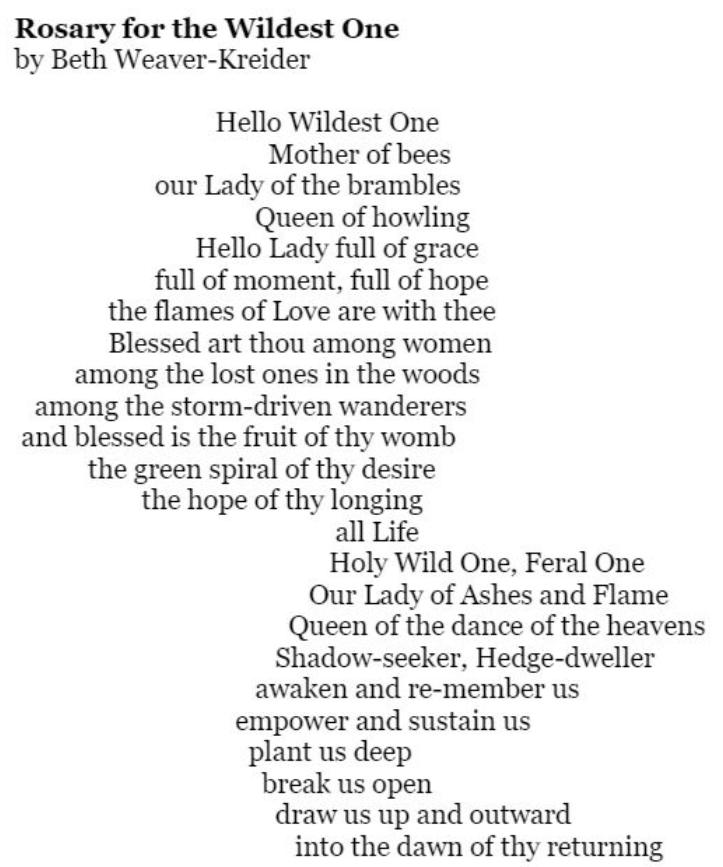
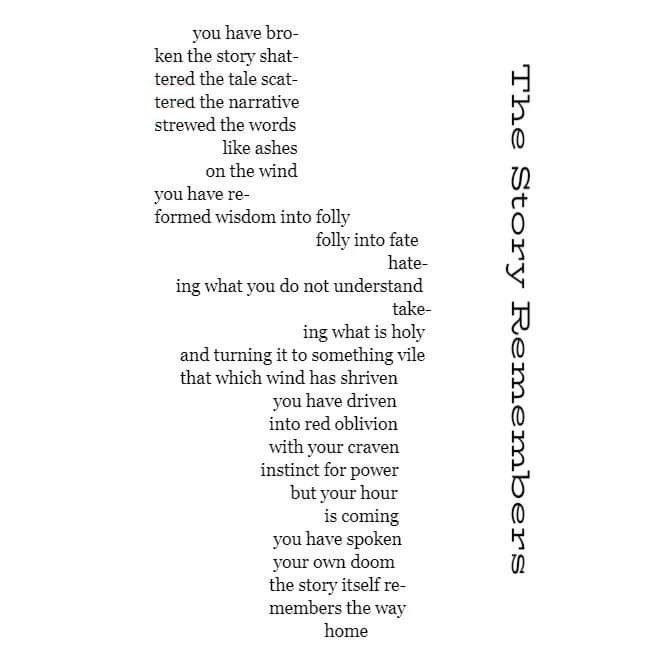
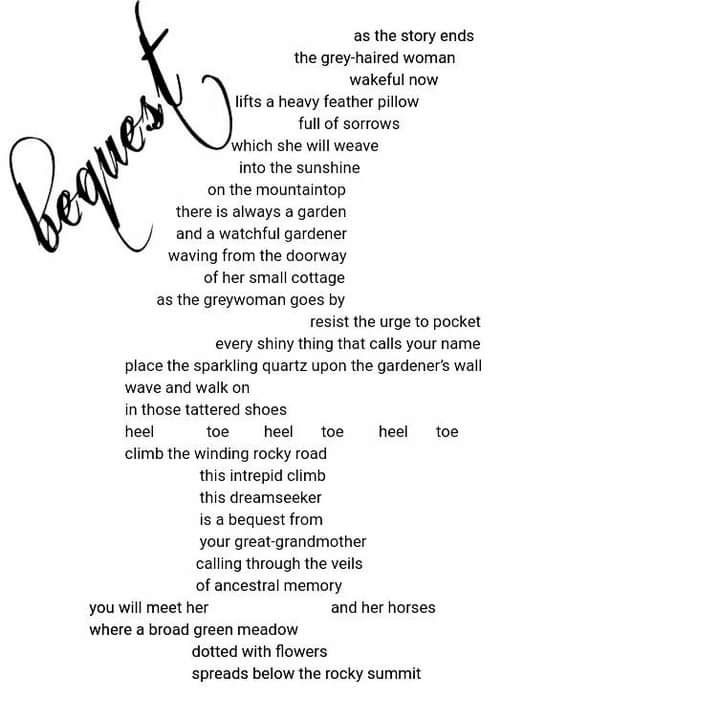
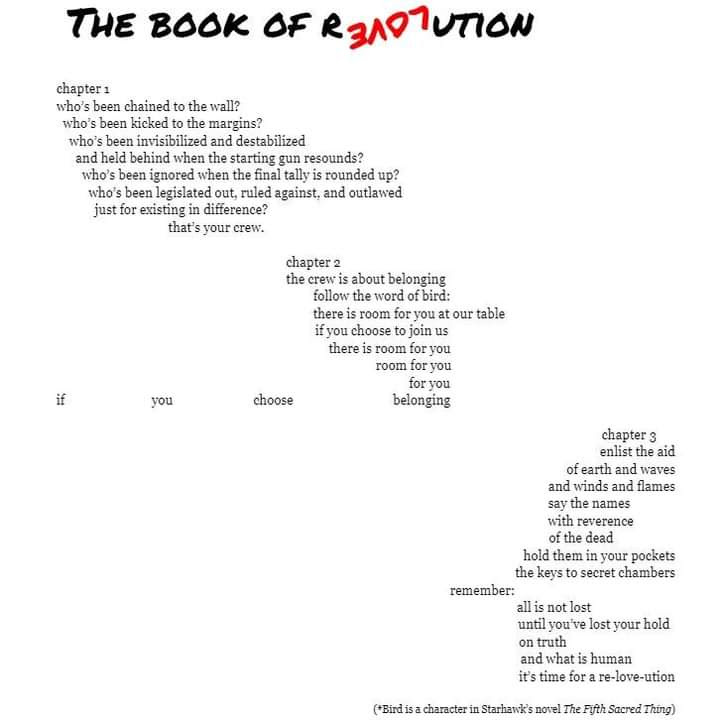
So it’s day 5 of National Poetry Month. Although I have not yet posted here, I have been writing a poem a day. Emily Dickinson wrote, “If I feel physically as if the top of my head were taken off, I know that is poetry.” a week or so ago, I read my first batch of CAConrad poems, and I knew exactly what she meant. It was like a total revelation. CAConrad makes poems that are sculptures on the page, and I have begun playing with making my poems more sculptural, not with the physical-representation of a typical concrete poem, but with a sense of abstract structure. Some of these are attempts at poetic sculptures.

Let the Women Come

I keep re-writing this sentence, and deleting it. There is no prose to say it, even to frame the context of the poem, which is the local news from Columbia, PA. Only, this is grief and horror and outrage because men keep harming women and children, keep killing women and children, because patriarchy makes of us commodities, makes of our children tools, makes the not-man a disposable object for a men to use as they please.

Let the Women Come
by Beth Weaver-Kreider

Let the women come.
Let the young women come
pounding drums and rattling spears.
Let the mothers come, bearing bowls to hold the tears,
and blankets to wrap her in.
Let the old women come, with sharpened knives and with cauldrons
holding coals, and feathered fans to call the coals to flame.

Let them come.
Let them come.

Let the bone women come, and the bear women,
Let the dragon women come, women of fang and flame.
Let the falcon women come, and the vulture women.
The lion women. The mighty swan women.

Let them come.
Let them come.

See, our hair is wild, and tangled in the branches of moonlight.
See, our heads are shorn, and our skulls reflect the heat of the noon sun.
See, we emerge from the darkest hidden places of the forests,
from the caves, from the fields, from the mountains.
See how we rise from the seas and the rivers.
See us circling in great wheeling flocks above your towns and cities.
We step from the shadows of your nightmares.
We dance forth from the spiraling hallways of memory,
which you carry from long before you were born.

Let the others come and stand, each behind a woman.
Hear our keening and wailing.
Hear us gnashing our teeth, hear us howling, hear us screaming.
Hear the cacophony of our grief and our rage.

We form a circle around our sisters.
We form a circle around our daughter, around all our children.
We form a circle around our elders.

See, our eyes are shining in the moonlight.
See, our teeth are bared, and our nails are sharp.
See, our bodies are painted with the signs that ward off evil.

We are chanting the blessing for the dead,
that she may find welcome on the other side.
We are chanting the healing runes for our wounded sisters,
for our lost children.
We are calling out a warning to the ones who do the harm.
We are weaving spells to trip and to bind them,
to strip them of power, to grip their souls
with the ice of their own deeds.

In the moonlight, we form our circle.
In the heat of the noon sun, our circle is cast.
In the fullness of day and under the rich cloak of night,
our words go forth to protect and to ward,
to bind, and to turn the evil back upon itself.

Let the women come.
Let them come.


In lieu of a gratitude list today as I am processing my grief and outrage at the horror of recent local (Columbia, PA) news, I offer my version of the Hail Holy Queen Rosary Prayer:

Hail, Holy Queen!
Hail, Mother of Mercy.
Hail, our life, our sweetness, and our hope.
To thee do we cry, we poor lost children of Eve.
To thee do we lift up our sighs and petitions,
our ardent longings, our earnest devotion, and our great gratitude.
Then turn, Most Gracious Advocate, thine eyes of mercy upon us,
and after this our long exile,
show unto us the blessed fruit of thy womb.
O clement! O wise! O sweet, loving Mother!
Pray for us, Queen of Heaven,
that we may be always returning home
to the promises of love.

Blessed Be!


Sunday’s Words:
“Do not be dismayed by the brokenness of the world. All things break. And all things can be mended. Not with time, as they say, but with intention. So go. Love intentionally, extravagantly, unconditionally. The broken world waits in darkness for the light that is you.” —L.R. Knost


“When a foreigner lives with you in your land, don’t take advantage of him. Treat the foreigner the same as a native. Love him like one of your own. Remember that you were once foreigners in Egypt. I am God, your God.” —Leviticus, 19:33


“In keeping silent about evil, in burying it so deep within us that no sign of it appears on the surface, we are implanting it, and it will rise up a thousand fold in the future. When we neither punish nor reproach evildoers, we are not simply protecting their trivial old age, we are thereby ripping the foundations of justice from beneath new generations.” ―Aleksandr I. Solzhenitsyn, The Gulag Archipelago 1918–2008


“In times of uncertainty, the most difficult thing to do is to stop searching for detours. It can be tempting to act from the desperation one feels when an abyss opens around you, but all of the ego’s equipment is useless in these dark regions. Instead, consider this an invitation to deepen your trust – to renew your committed heart to its course. After all, every creation was first seeded in an absence.” —Dreamwork with Toko-pa


“We delight in the beauty of the butterfly, but rarely admit the changes it has gone through to achieve that beauty.” —Maya Angelou


“When we enter this world with waking consciousness we put on our earthly suit of clothes. We move slower, but the principles are the same. Sometimes I like to move through this conscious realm as if I were dreaming. In dreaming we are more in touch with how our thoughts create immediately and dynamically. If I think myself into the heart of the song, there I am, or a plant, or a knot of pain that is asking for forgiveness, there I am. So much knowing opens up then. We are all part of each other.” —Joy Harjo


“Clouds come floating into my life, no longer to carry rain or usher storm, but to add color to my sunset sky.” ―Rabindranath Tagore


“I really only love God as much as I love the person I love the least.” ―Dorothy Day


“Franciscan alternative orthodoxy doesn’t bother fighting popes, bishops, Scriptures, or dogmas. It just quietly but firmly pays attention to different things—like simplicity, humility, non-violence, contemplation, solitude and silence, earth care, nature and other creatures, and the ‘least of the brothers and sisters.'” —Richard Rohr


“Go deeper than love, for the soul has greater depths,
love is like the grass, but the heart is deep wild rock
molten, yet dense and permanent.
Go down to your deep old heart, and lose sight of yourself.
And lose sight of me, the me whom you turbulently loved.
Let us lose sight of ourselves, and break the mirrors.
For the fierce curve of our lives is moving again to the depths
out of sight, in the deep living heart.
But say, in the dark wild metal of your heart
is there a gem, which came into being between us?
is there a sapphire of mutual trust, a blue spark?
Is there a ruby of fused being, mine and yours, an inward glint?”
—D. H. Lawrence