Gratitude List: 1. Hummingbird. I thought perhaps this might be a year without them, but a lovely little female has been visiting the petunias and stopping to hover outside my window and look in. 2. Golden: flowers, people, sunlight. 3. Hope 4. Work 5. Wise friends
May we do justice, love mercy, and walk humbly in Beauty!
So. You don’t get to post # savethechildren posts and memes and then vote for the man who partied with Jeff Epstein, who said of Ghislaine Maxwell, “I wish her well.” You just can’t.
You can’t post # savethechildren and then support tearing children from their families to be kept in detention centers. You just can’t.
You can’t post # savethechildren and ignore the predations of priests and nuns and church leaders and powerful men. You just can’t.
You can’t post # savethechildren and vote to take away children’s health care, to remove their safety nets at every turn, to cut welfare, to reduce affordable housing. You just can’t.
You can’t post # savethechildren and cavalierly send them back to crowded schools during a pandemic without a thought or plan for how to keep them safe. You just can’t.
“Let my teaching fall like rain and my words descend like dew, like showers on new grass, like abundant rain on tender plants.” —Deuteronomy 32:2
“There is no way of telling people that they are all walking around shining like the sun.” —Thomas Merton (Oh, but I am going to try, Thomas Merton. I am going to try.)
“It is better to err on the side of daring than the side of caution.” —Alvin Toffler
“What comes, will go. What is found, will be lost again. But what you are is beyond coming and going and beyond description. You are It.” —Rumi
“Though my soul may set in darkness it will rise in perfect light. I have loved the stars too fondly to be fearful of the night.” —Attributed to Galileo
“Do not be daunted by the enormity of the world’s grief. Do justly, now. Love mercy, now. Walk humbly, now. You are not obligated to complete the work, but neither are you free to abandon it.” —from The Talmud
“An artist is a dreamer consenting to dream of the actual world.” —George Santayana
“I imagine one of the reasons people cling to their hates so stubbornly is because they sense, once hate is gone, they will be forced to deal with pain.” ―James Baldwin
Here is something I wrote yesterday: Our grief should place us onto a similar plane of understanding. Stories of Black youth being held at gunpoint and endangered by police officers who were called to protect those particular lives are not a competition with the story of a White child who was murdered. The murder or mistreatment of a child is a terrible thing no matter their race or circumstance.
Our horrors and griefs should be taking us to the same well, where we can hold each other’s stories, feel each other’s pain, and know we are walking the same valleys.
Saying Black Lives Matter is not meant to compete with or demean your very real grief about the horror stories you hear. It’s not intended to politicize the lives of those who have died. It’s intended to shake us up and wake us up to the continuing grief of Black families, to hold in reverence the lives that have been taken simply because of someone’s race.
I see you asking, “Can’t we grieve him too?” Of course we can. Of course we should. Our hearts are meant to break open with such pain. But asking that question as a response to someone expressing their grief over one more senselessly lost or threatened Black life is politicizing both deaths.
Take a deep breath. Feel your feelings. Weep with those who mourn.
Something I notice about people in these months of pandemic is that we seem to be experiencing, as they say, All The Feels. I think we’re more vulnerable to sad stories, to outrage, to anxiety, and this makes us vulnerable to trolls, to bots, to conspiracy theories. For me, living in that fluttery place of reactivity to emotion is not healthy or sustainable, and it makes me much more susceptible to suggestion that doesn’t require thinking. Denying those fluttery emotions doesn’t help either. They’re there, and they’re going to affect me. I need to lean into them, to give them their space, ask them–like ghosts that haunt a house–what they need of me in this moment. I need to name them as they appear.
This poem, by Jalaluddin Rumi, translated into English by Coleman Barks, helps:
The Guest House
This being human is a guest house. Every morning a new arrival.
A joy, a depression, a meanness, some momentary awareness comes as an unexpected visitor.
Welcome and entertain them all! Even if they are a crowd of sorrows, who violently sweep your house empty of its furniture, still, treat each guest honorably. He may be clearing you out for some new delight.
The dark thought, the shame, the malice. meet them at the door laughing and invite them in.
Be grateful for whatever comes. because each has been sent as a guide from beyond.
“I think ultimately people become extremists not necessarily because of the ideology. I think that the ideology is simply a vehicle to be violent. I believe that people become radicalized, or extremist, because they’re searching for three very fundamental human needs: identity, community and a sense of purpose.
“If, underneath that fundamental search is something that’s broken — I call them potholes — is there abuse or trauma or mental illness or addiction? … [T]here are so many marginalized young people, so many disenfranchised young people today with not a lot to believe in, with not a lot of hope, they tend to search for very simple black and white answers.” ―Christian Picciolini, former skinhead
“Nazis are a lot like cats: If they like you, it’s probably because you’re feeding them.” ―John Oliver
“Until the killing of Black men, Black mothers’ sons Is as important as the killing of White men, White mothers’ sons… We who believe in freedom cannot rest, we who believe in freedom cannot rest until it comes.” ―Sweet Honey in the Rock
“The future, good or ill, was not forgotten, but ceased to have any power over the present. Health and hope grew strong in them, and they were content with each good day as it came, taking pleasure in every meal, and in every word and song.” —J.R.R. Tolkien (The Fellowship of the Ring)
“There is a way that nature speaks, that land speaks. Most of the time we are simply not patient enough, quiet enough, to pay attention to the story.” ― Linda Hogan
“Silence my soul, these trees are prayers.” ―Rabindranath Tagore
“Whoever you are, now I place my hand upon you, that you be my poem, I whisper with my lips close to your ear. I have loved many women and men, but I love none better than you.” —Walt Whitman, “To You”
“You gain strength, courage and confidence by every experience in which you really stop to look fear in the face. You are able to say to yourself, ‘I have lived through this horror. I can take the next thing that comes along.’ You must do the thing you think you cannot do.” ―Eleanor Roosevelt
“Shaped language is strangely immortal, living in a meadowy freshness outside of time. But it also lives in the moment, in us. Emotion, intellect, and physiology are inseparably connected in the links of a poem’s sound. It is difficult to feel intimacy while shouting, to rage in a low whisper, to skip and weep at the same time.” ―Jane Hirshfield
“I have always been spiritually promiscuous, lying down with any God who will have me. When I drop down into these ancient texts, I feel the breath of the God of Love on my face. It makes me crazy. In the very best way.” —Mirabai Starr
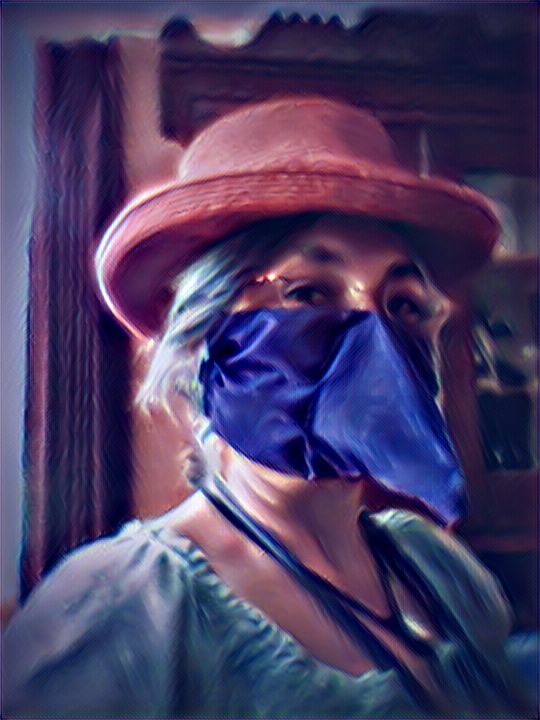
13 Ways of Looking at a Mask: 1. When you are in a meeting, people can’t see you yawn. 2. You can stick out your tongue at people who annoy you, and they will never know. 3. Makes you look mysterious. 4. It’s a fashion accessory. Add bling! Make a statement! 5. You can walk down the street talking quietly to yourself, and no one watching would know you’re off your rocker. 6. No one will see your cold sore, or the zit on the end of your nose. 7. It helps to mask bad breath. Go ahead and eat the garlic and onions for lunch! (And if the mask doesn’t work, you’ve got help with the social distancing.) 8. Superheroes wear masks. Maybe you’re a superhero too? 9. Spinach stuck in your teeth? Who cares? You’re wearing a mask! 10. If you are an allergy sufferer, it helps to filter out pollens and allergens that make you snuffly and sneezy. 11. It protects others, and yourself, from getting the virus. 12. It’s been mandated for public health and safety by the PA governor. 13. It’s like wearing a seatbelt, or a bike helmet. It’s like washing your hands before you eat, or wearing shoes and a shirt into a restaurant. It’s basic good common sense.
Some thoughts on Mind/Body and Anxiety: This might be true for you as well: When I am in times of high anxiety, my brain tends to pull me outside of my sense of being in a body. Anxiety is a mental activity that demands mental energy. The work of the body goes to feed the fluttery brainwork of responding to the sense of crisis.
If you’re like me in this, try some of these things to self-soothe: * Breathe deeply and intentionally, into your gut, into your toes, into the tips of your fingers. * Try moving your arms in time with your breath, as if you are the Maestro of Breathing. Begin with your arms at your sides, and raise your arms as you breathe in as if pulling the music to a crescendo. Pause a moment at the peak of motion and inbreath, and then gently and slowly release. * When you yawn, give yourself to to the process. Yawn deeply and fully. * Gather a bowlful of smooth stones, and run them through your fingers. Dried corn or beans also work. * Find a pillow or throw or sweater that has a silky surface or a knubbly texture. Keep it handy to run your fingers across the surface when you feel anxious. * Pop the bubbles in the bubble wrap. * Make hot drinks, even in summer. Steam is calming and comforting. * Find a source of running water–a brook, a fountain, a river. (We bought a water fountain for our cats, and it’s been a soothing sound to listen to.) * Wake up early enough in the morning to listen to birdsong. * Load up a calming jam on PC or phone. Sometimes loud and dissonant music can be cathartic, but I would be careful with using it in anxious moments because it can also jar you out of the body on the way to catharsis. * Find a purring cat. * Smell the flowers. In public places, don’t worry what people will think if you stop to smell the flowers. Bring flowers inside if you don’t have allergies–smell them. * Find a couple essential oils that calm and relax you. Add some drops to a little spray bottle of water (a little alcohol in the mix helps to keep the oil from jamming the sprayer), and spray yourself, your pillow, your clothes, your couch. Mist it into the air when you feel yourself getting out of yourself. * Bake brownies or bread. Make mint tea. Slice an orange. (This will ground you in scent and taste). * For people like me, the natural response to anxiety is to ground myself through eating. I need to be super careful here. But we, too, can use taste to ground ourselves. Herbal teas with a little honey are grounding without the numbing effect of sugar and carbs. A small handful of nuts or a piece of cheese. A piece of fruit. Extra hot peppers in the dinner plans. * Surround yourself with color. Paint a picture to hang in your work space. Find a brightly colored rug or cloth with colors that please. Really looking deeply at color can be incredibly grounding. That viney hill and woodsy area out my window is not just “green.” It’s a thousand greens. * When you are with people, remember to look them in the eyes. Eyes are what we have, now that we cover the rest of our faces. Pause and enjoy the moments of greeting in the day. Let your contacts with people be grounding for you. Phone calls. Messages and conversations through social media. Each of those contacts is a chance to connect deeply to your (and their) human self.
Gratitude List: 1. The catfam all have homes, and we have a plan for Adoption Day at the end of August. This actually makes me sad as well as deeply relieved. It has been a great weight of responsibility to care for and worry about these guests, but I have loved it, and am sad to see them dispersed. Without intervention, we would have four breeding feral cats in the neighborhood, and Mama would drive the youngsters away eventually, and they would be susceptible to disease and coyotes and the road. Instead, they will all have loving homes. Grateful. 2. The goldenrod is beginning to bloom and shine. 3. The work gets done. It sometimes feels frantic and frazzled, but it gets done. 4. Physical comforts. One of my anchors right now is physical comforts: soft and textured fabrics, rich and evocative scents, complex flavor, bright color, haunting and gentle music. 5. Wonderful colleagues.
May we do justice, love mercy, and walk humbly in Beauty!
“Words don’t have meaning without context.” —Ta-Nehisi Coates
“The point is, art never stopped a war and never got anybody a job. That was never its function. Art cannot change events. But it can change people. It can affect people so that they are changed… because people are changed by art – enriched, ennobled, encouraged – they then act in a way that may affect the course of events… by the way they vote, they behave, the way they think.” ―Leonard Bernstein
“Maybe happiness is this: not feeling like you should be elsewhere, doing something else, being someone else.” —Isaac Asimov
Albert Camus: “If there is a sin against life, it consists perhaps not so much in despairing of life as in hoping for another life and in eluding the implacable grandeur of this one.”
“If you do follow your bliss you put yourself on a kind of track that has been there all the while, waiting for you, and the life that you ought to be living is the one you are living. Follow your bliss and don’t be afraid, and doors will open where you didn’t know they were going to be.” —Joseph Campbell
“We do not have to live as though we are alone.” ―Wendell Berry
“We are made and set here to give voice to our astonishments.” ―Annie Dillard
“Writing is one of the most ancient forms of prayer. To write is to believe communication is possible, that other people are good, that you can awaken their generosity and their desire to do better.” ―Fatema Mernissi
“Through trial and fire, against the odds, you have grown to trust that the world can be a safe place and you have every right to walk here. You have made parents of your instincts, intuition and dreaming; you have allowed love into where it had never before been received; you have grown life where once it was barren. With just a few found and trustworthy seeds, you have nurtured the greatest harvest there is in this, your humble life of belonging.” ―Toko-pa Turner
“But I don’t want to go among mad people,” Alice remarked. “Oh, you can’t help that,” said the Cat: “we’re all mad here. I’m mad. You’re mad.” “How do you know I’m mad?” said Alice. “You must be,” said the Cat, “or you wouldn’t have come here.” ―Lewis Carroll, Alice in Wonderland
Gertrude Stein defined love as “the skillful audacity required to share an inner life.”
“When your soul awakens, you begin to truly inherit your life. You leave the kingdom of fake surfaces, repetitive talk and weary roles and slip deeper into the true adventure of who you are and who you are called to become.” ―John O’Donohue
Dream: I’m in Dreamtown. I don’t know what else to call it, but it’s a place I often go in dreams. Sometimes I even recognize streets or buildings from dream to dream, but not often. I just know its the same city. There are other dream towns, too.
My sister parks her van and puts the keys under the seat, says she’ll see me later. I am going to wander in town a bit and check out some of these yard sales. It’s a little surprising that people are having yard sales during this time, but they sort of seem to be social distancing. I don’t remember seeing them in masks, but masks have not really entered my dreams yet.
After a while, I go to get in the van to drive home, and in the few hours I have been there, a whole bunch of foxtails have grown up between the cab and the bed of the pick-up (it is now my old red F150 instead of Valerie’s Van). I’m kind of glad to be driving the old pick-up again. I back out of the parking lot onto the road, put it in first and accelerate, but the truck keeps going in reverse. The brakes don’t work. The gears won’t shift into forward. I am hurtling backwards down a steep city hill.
That’s where I woke up. I have a sneaking suspicion that this was a school dream, or a dream about the feelings I am experiencing right now. It’s all so out of control. Even the vehicle has changed. The weeds grew up while I was away. Everybody out there is going about their normal business as though nothing has changed. I’m hurtling backward downhill. I can’t focus enough to get any serious school planning done. I can’t get it in the right gear.
Breathe. Pray. Sit in the chair. Do the work. Be ready for plans to change. Steer the truck.
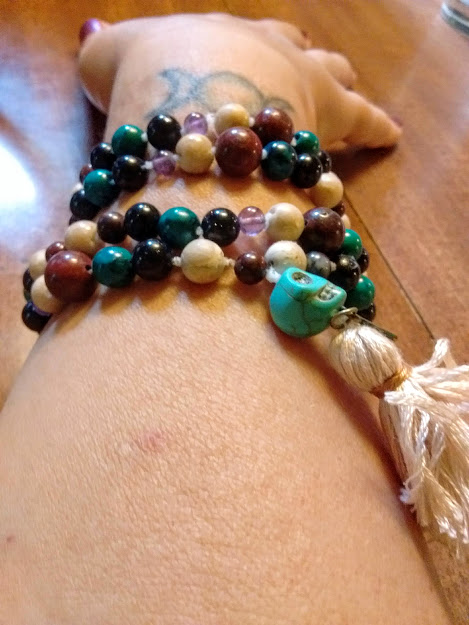
Yesterday, on my birthday, I made myself a set of prayer beads. It’s based on the 108 beads of the Tibetan mala, but I am not Buddhist, so I hesitate to call it anything that specific. I am very intentional about not buying new things for new projects, but using up what I have, so I scrounged stone beads from my collection, and used a turquoise skull bead for my main bead. I chose the skull bead intentionally, as the symbol often associated with Mary Magdalene, who perhaps had more reason than most of us to contemplate the mysteries of life and death. With the tassel on the end, the skull looks like La Calavera Catriona on her way to the dance, which adds a nice layer of meaning. I added a dangle-bead Hand of Fatima, which represents protection and safety.
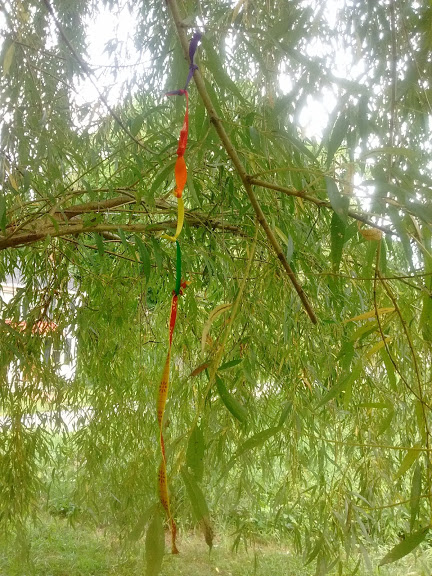
Here are the things I am going to do to try to deal with these anxieties: 1. Sit at my desk and Do My Work. 2. Keep hanging my worries on the willow. 3. Carry my prayer beads with me. In these early days of wearing it, I want to let the prayers kind of form themselves as I notice the worries that arise. (The cording is nylon, so I can disinfect them when I wear it to school.) 4. Be as conscientious in the classroom about cleaning and disinfecting as possible. Be strict about masking and distancing. 5. Meditate on the web. So many wonderful people have reached out to say they are praying for teachers, and thinking about us as we prepare for the coming year. I feel like I am on a golden web of people’s prayers and energies, along with my colleagues and students. 6. Breathe, breathe, breathe.
Really, I am still fairly grounded and centered. I am like a lion, I think, quick to rage or jump into action in response to attack or hunger, but mostly lying around, still and quiet, unbothered. Both. It takes a quirky dream or another announcement from the governor or scary numbers in the news to get me to jump up and take off. But the worries are always there, and in the meantime, I have to be as prepared as possible for school to begin.
Gratitude List: 1. Such an overflowing bowl of birthday greetings yesterday! I’m so grateful for all my beloveds, in both my physical and virtual worlds. 2. Goldfinches on the thistles. 3. Chocolate ice cream cake. 4. Making things. 5. Bright fingernail polish. I always feel a little like I’m in drag or something when I wear make-up or fingernail polish. They don’t feel quite like me. But I love shiny colors on my fingertips, and I will keeping painting my nails until I get bored or tired of touching up the chipped bits.
May we do justice, love mercy, and walk humbly in Beauty!
“Poetry is just the evidence of life. If your life is burning well, poetry is just the ash.” —Leonard Cohen
“No matter what people tell you, words and ideas can change the world.” —Robin Williams
“One gives one’s life to be and to know, rather than to possess.” —Teilhard de Chardin
“Sorrow prepares you for joy. It violently sweeps everything out of your house, so that new joy can find space to enter. It shakes the yellow leaves from the bough of your heart, so that fresh, green leaves can grow in their place. It pulls up the rotten roots, so that new roots hidden beneath have room to grow. Whatever sorrow shakes from your heart, far better things will take their place.” —Rumi
Pied Beauty by Gerard Manley Hopkins
Glory be to God for dappled things – For skies of couple-colour as a brinded cow; For rose-moles all in stipple upon trout that swim; Fresh-firecoal chestnut-falls; finches’ wings; Landscape plotted and pieced – fold, fallow, and plough; And áll trádes, their gear and tackle and trim. All things counter, original, spare, strange; Whatever is fickle, freckled (who knows how?) With swift, slow; sweet, sour; adazzle, dim; He fathers-forth whose beauty is past change: Praise him.
“There’s a thread you follow. It goes among things that change. But it doesn’t change. People wonder about what you are pursuing. You have to explain about the thread. But it is hard for others to see. While you hold it you can’t get lost. Tragedies happen; people get hurt or die; and you suffer and get old. Nothing you do can stop time’s unfolding. You don’t ever let go of the thread.” –William Stafford
“Perfectionism is a virus which keeps us running on the treadmill of never-enoughness. It is inherently deadening for how it strives and never arrives. Failure is embedded in its very pursuit, for our humanity can never be homogenised. The only antidote is to turn away from every whiff of plastic and gloss and follow our grief, pursue our imperfections, exaggerate our eccentricities until they, the things we once sought to hide, reveal themselves as our true majesty.” –Toko-pa Turner
Fifty-Two wasn’t a bad year, although it had a pandemic in it. It has also had kittens, so there’s something good to add to the stew. Overall, it was a learning year. All the most joyful moments of this past half of a year have been in the context of knowing how fragile life is. Still, the terrible has not outweighed the abundant and joyful. There was a hummingbird a couple days ago, and there’s been so much poetry. The aforementioned kittens. Time with my family–lots of that! Time with my wider circles of beloveds–not as much or as huggy as I could wish for, but sweet and precious.
Fifty-Two is twice Twenty-Six, so I could say it was a double-marathon year, and this second half has been one long, hilly race, that’s for certain.
Today I enter Fifty-Three. I always have to say it: Because of the way we count birthdays, I am actually entering my Fifty-Fourth year. I get to wear the Fifty-Three, because we label our birthdays by how many we have accomplished, and in a pandemic year, there’s a bit of buzzy edge to that sense of accomplishment. In a pandemic year, reaching a birthday is perhaps something of an accomplishment.
So, at Fifty-Three, I am entering my prime, divisible only by myself and One.
If I reduce my birthday, according to the standard numerological reduction–by adding the month (8) to the day (10) to the year (2020)–this is a Thirteen year for me, a Death year, which sounds terrifying unless you consider the deep implications that Death represents not only the ending, but the preparation for a new beginning. It’s about Big Transformation. Perhaps the losses and grievings of this pandemic time can help me to remove old skins that hold me back from more transformative growth.
Thirteen is also a number the represents the deep female knowledge and intuitive processes that have been driven underground through the centuries, through witch hunts and religious persecutions and patriarchal oppressions. Perhaps this is a year that I can sink into trusting my deep inner knowledge, and learn to more fully trust my instincts, to more fully take up the Work.
Whatever meaning we attach to numbers, birthdays offer the invitation to introspection, to taking stock of what has been, and envisioning what might be. This has been a difficult and beautiful year, full of pain, full of growth, with lots of small but deep joys. I’m grateful to have walked it with so many beautiful hearts.
(Yesterday, I felt like I wanted to do something sort of big in order to mark the end of Fifty-Two. I wanted to accomplish something in the margins of another year. So I pushed myself to ride further than I ever have, and went the whole distance from Columbia to the Riverfront Park Pavilion seven miles away, and then back to Columbia, fourteen miles total. I know I attempted a long bike ride once when I was a teenager, with lots of stops to rest, and lots of complaining. I don’t think I have ever before ridden fourteen miles without stopping. That might not seem significant to most people, but for someone with my sedentary nature, it was a milestone. I am proud of myself.)
Today’s Birthdays: Snoopy Hieronymus Praetorius (composer) Herbert Hoover Hilda Doolittle (the poet H.D.) Jimmy Dean Ian Anderson (Jethro Tull!) Mark Doty (poet and writer) Antonio Banderas Riddick Bowe (boxer, born in 1967) and me (also 1967)
Seems like a good cohort. Nobody too far out there, but all steady in their work.
BirthdayGratitude List: 1. A year with kittens in it. 2. A year with you and you and you in it. 3. A year that has included learning to push myself beyond my basic comfort zone, in many areas. 4. So much to reflect on and process, in order to grow. 5. So much to envision and plan, and hope for.
May we do justice, love mercy, and walk humbly in Beauty!
“Nature gives you the face you have at twenty; it is up to you to merit the face you have at fifty.” —Coco Chanel
“By virtue of the Creation and, still more, of the Incarnation, nothing here below is profane for those who know how to see. On the contrary, everything is sacred.” —Teilhard de Chardin
“Soul of my soul … be water in this now-river.” —attr. to Rumi
“You are the Soul of the Soul of the Universe, and your name is Love.” —attr. to Rumi
“There is one masterpiece, the hexagonal cell, that touches perfection. No living creature, not even human, has achieved, in the centre of one’s sphere, what the bee has achieved on her own: and if intelligence from another world were to descend and ask of the earth the most perfect creation, I would offer the humble comb of honey.” —Maurice Maeterlinck, The Life Of The Bee, 1924
“It’s not only those who have succumbed to hate who have to change. We need to learn to love bigger, to bring them back.” —Alexandria Ocasio-Cortez
“If it is bread that you seek, you will have bread. If it is the soul you seek, you will find the soul. If you understand this secret, you know you are that which you seek.” —atrr. to Rumi
“In these cataclysmic times, living in what Michael Meade calls the ‘slow apocalypse,’ despair can be dangerously seductive. Our lives may feel inadequate to the terrible momentum of our times, but it is in those moments that we must remember the difference between despair and grief.
“While despair traps us in the bog of despondency, grief carries us into life. Grief calls us into a deeper engagement with those things that we love. And even as we are losing them, grief wants to exalt their beauty.
“If we let grief move us into expression, it will sing the blood into our songs, colour the vividness into our paintings, and slip the poetry between our words.
“Rumi says, “All medicine wants is pain to cure.” And so we must cry out in our weakness, our ineptitude, our beautiful inadequacy and make of it an invitation that medicine might reach through and towards us.” —Toko-pa Turner
One of my most common school anxiety dreams is that the semester has begun, and I don’t get there until a few days or weeks or months in to the semester. Things have already begun without me. Other teachers are running the class. I basically have no idea what is going on.
One of my most common recurring dreams about doing my inner work involves discovering rooms or places filled with things that I have somehow inherited.
Last night’s dream includes both elements: I am a couple weeks late to begin a new teaching assignment in a middle school. When I get there, the substitute is a man, a college professor, who is teaching them as though they understand deep literary critique, referencing obscure writers and texts. There’s also an assistant in the classroom, and she is sitting in the desk at the front of the room while the professor teaches.
I don’t really introduce myself when I come in, but I put on an audio story for them to listen to. It’s engrossing, very literary, and sort of mysterious. The kids and the other two teachers are immediately into it. Meanwhile, I start to clean up the two desks at the front of the room. The previous teacher left all her stuff, and the surface of the desks are covered with knick knacks. I actually want to look at each one and decide which ones I will keep. It’s kind of an exciting process. Underneath the desk are little hidden drawers and doors, and dozens of keys!
The story ends just as the children are to be dismissed for the day. I thank the other teachers, and tell the children we will have formal introductions tomorrow. I’m eager to meet them, and they seem ready to take me on as their teacher.
I am not nearly where I want to be in terms of fall planning. I’ve let my anxiety keep me whirling in a tornado of what-ifs, and I’ve found myself unable to focus on plans. This year demands stronger plans with more options, so I need to get myself together, and not show up to the party late. If I am to really connect with my students in this season, I need to leave the professor at home, and keep reeling them in with captivating narrative.
At the same time that I have not been getting a handle on the actual nuts and bolts preparation for the semester, I have been reading Ta-Nehisi Coates’s Between the World and Me and Stamped by Jason Reynolds and Ibram X. Kendi, the teen version of Kendi’s longer work Stamped from the Beginning. I think there are all sorts of inner doors and drawers that I am finding access to in the wake of these texts, new ways to frame how I can teach in antiracist ways, not self-consciously layering discussions of racism into literary discussion, but letting a deeper knowledge of US history infuse the ways I lead discussions about texts.
I’m not sure what the tchotchkes on the surface of the desk represent, unless it is simply that in the midst of my anxiety about opening school, I am looking forward to exploring all the little shining things that represent the everyday school experience.
A couple days ago, during a video-call, a cousin of mine exhorted me to be aware of how my worry affects me, to consider ways that I might proactively deal with the anxiety I am experiencing. He suggested giving myself one day a week to worry, making a list of the things my brain wants to worry about, and then checking in with the list on one day a week. Chances are, some of those worries might have evaporated week to week. Of course, the worry about school just gets bigger and bigger, but I am really moved and inspired by the encouragement to lay it down a bit. And yesterday, my pastor’s sermon was in a similar vein.
I need rituals to mark the inner work that I am doing, physical representations of the energies I am trying to shift. So today, I am going to meditate a little about the school worries, and then I am going to choose some ribbons to represent the things that most frighten me, and hang those on my willow tree. She is strong, and also not rigid. She flows. She listens well.
I can’t change the decisions that my school and my son’s school are making. I can be vocal about the safety issues that I see, asking for accountability to strong safety measures. In the end, unless I choose to strike or quit (which I just can’t do because I love my school and my administrators and teaching), I need to simply buckle down, do what I can to keep myself and my students safe, and find joy in the experience of reconnecting, of opening those little drawers and doors, of finding the right keys, of discovering the shiny things that will be part of everyday life back at school.
If you pray, if you do magic, if you work with energy, work prayers and magic and energy for our safety, please. For all the teachers and the students, for our families.
Gratitude List: 1. Social media posts about people’s food preservation. I haven’t done any of that this year, and I don’t plan to, but I can look at the beautiful rows of my friends’ canned beans and pickles and relish. I can see the binsful of corn transformed into baggies of golden sunshine that will wait in their freezers for winter. This makes me happy. 2. Kittens 3. Learning to push my body past its initial inertia, to get on the bike, to pedal even when its hard going. 4. Beloveds who remind me to deal with my worry and not just leave it lying around where it can keep pouncing on me. 5. Messages from dreams.
May we do justice, love mercy, and walk humbly in Beauty!
“We should ask ourselves: Do we know what enough is inside of our lives? Once I know that, it’s much harder for capitalism to catch me, right? Because I’m not susceptible to this constant sale of myself or my soul to any other force.” —adrienne maree brown
“I hold the line, the line of strength that pulls me through the fear.” —Peter Gabriel
“Children grow into the intellectual life of those around them.” —Lev Vygotsky
“It was books that taught me that the things that tormented me most were the very things that connected me with all the people who were alive, who had ever been alive.” —James Baldwin
“Three things cannot be hidden: the Moon, the Sun and the Truth.” —Gautama Buddha
“Those doing soul work, who want the searing truth more than solace or applause, know each other right away. Those who want something else turn and take a seat in another room. Soul-makers find each other’s company.” —Rumi
“Going within is the only way out.” —Toko-pa Turner
“What can we gain by sailing to the moon if we are not able to cross the abyss that separates us from ourselves? This is the most important of all voyages of discovery, and without it, all the rest are not only useless, but disastrous.” —Thomas Merton
“Let me fall, if I must. The one I will become will catch me.” —Baal Shem Tov
“The sky itself Reels with love.” —Rumi
“That’s a tough spirituality. That’s not any kind of sweet-by-and-by spirituality. That’s a spirituality that takes on the world as it is and says, ‘I’m gonna figure this out one way or another.’ The mystic and the Moses.” —Vincent Harding (On Being interview)
“May you know the fearlessness of an open heart. May you never meet anyone you consider a stranger, and know that no matter what, you are not alone. May you have compassion for others’ suffering and joy in their delights. May you be free to give and receive love.” —Sharon Salzberg
“In our culture, we use the word ‘dreamy’ derogatively to describe someone who is unrealistic or without ambition. But what thrills and amazes me about dreamwork is how truly grounding it is. One of the reasons this is true, is because dreams are expressions of that larger ecosystem in which we are embedded, and which has a design for our lives within that greater context! So rather than taking our cues from consensus culture, instead we are listening to the mystery which combines us. As Jungian analyst Ann Bedford Ulanov puts it, “the Self is that within us that knows about God.” —Dreamwork with Toko-pa
The last day of July is Lughnasadh Eve, one of the four cross-quarter points between the Solstices and Equinoxes, along with Halloween (Samhain), Groundhog’s Day (Imbolc), and May Day (Beltane)–their traditional Celtic names are in parentheses. Unlike the others, which have found their way through webs of lore and story to more modern and playful traditions, Lughnasadh (sometimes also called Lammas) no longer lingers in the modern psyche.
Lughnasadh is the celebration of the time of the sun’s heat, the mid-harvest, when the summer crops are plentiful and abundant, when berries and corn, tomatoes and zucchini, fill our bellies and our dreams, offering us coolness and nourishment. What we longed for in the stinging winds of February now surrounds us, almost numbing us into a cloying sense of enoughness.
I haven’t preserved much food for several years now, because the beginning of August is always the race to prepare for the beginning of school. But on social media, I am enjoying photos of friends canning applesauce, freezing corn, making pickle relishes, living into the traditions of their ancestors and creating a hopeful future from the abundance of the present. If you use your imagination, you can feel that sense of deep anticipation in the frigid dark of December when you go to the freezer and pull out a bag of golden kernels of corn, how you will bring the sunshine of this moment into the cold of the future.
My house is ancient, and we have a single air conditioner in the living room that keeps us cool on the hottest days. This summer, we put a second free-standing air conditioner on the second floor to make sleeping more bearable. Still, this pre-menopausal body is struggling against the heat, not letting me sleep. I sneak downstairs, open the door to the balcony, and try to sleep in the recliner with the cool night breezes that seem to pass by the upstairs windows. Funny how my February dreams of summer never seem to include the sense of overwhelming heat, the burden of humidity. Conversely, my summer self seems to forget the beauty of shadow, the silence of snowfall, the twinkling of winter starlight, in my memories of the unbearable cold. I’m so human.
Perhaps that is the main lesson of living by seasons, of making internal notes to carry us from point to point on the compass rose of the year: Remembering that we’re humans in a big, big world. These shifts may be semi-arbitrary in the ways that we mark them, but they remind us that we’re here in these human bodies to experience what matters. We are en-mattered, living by sensation, of cold and heat, of bellies full and empty, of muscle and sinew, breath and bone. Of sight and hearing, touch and taste and smell. Of pleasure and pain, ache and longing, desire and love.
Lughnasadh in particular was once a celebration of the bread. The first wheat had been harvested. People made elaborate designs with wheat to bring good luck and mark the year–the original corn dollies. Bread was made to celebrate, loaves fashioned, butter churned, and berries made into jam. The seeds were planted, the harvest was ready, and the work of saving the harvest began.
What will you make of the harvest in this coming season? How will you shape the loaves of your year? This year, we’ve hunkered down, masked up, read and learned about antiracist work. We’ve called Congresspeople, expressed our desires for justice, stood up, marched, learned some more. How do we make this real, save this harvest for the future, that it may feed those who come after us? We must not leave it in the fields to rot and die. The truth this season tells us is that there is abundance, enough for everyone. We must participate in its harvest and preservation, and make sure that everyone gets their share.
Yesterday, I caught bits and pieces of the funeral of John Lewis, and I plan to go back in the coming days and listen again, to plant the seeds of his words and deeds into my own psyche as deeply as I can, to take the yeast he has offered, and to work to shape loaves that are just and hopeful. Let us work to preserve the harvest of his work and legacy, so that his golden light may shine far into the future.
As he said in his final words: “Walk with the wind.” Walk with the wind, soulkin, sun on your shoulders.
Gratitude: The life and work and legacy of John Lewis. Perhaps we have been called to these times, to follow his legacy, to take his work into the future, to make the United States what we dream it can be, a nation where all people–no matter their race or creed, their sexuality or physical or mental ability, their gender or national origin, their class or status or education–can be free and equal.
“Morning prayer: “Release all bitterness. Hold only love, only peace in your heart, knowing that the battle of good to overcome evil is already won. Choose confrontation wisely, but when it is your time don’t be afraid to stand up, speak up, and speak out against injustice.” —John Lewis
Instead of trying to practice nonviolence, let us try to practice the connections that make violence both inappropriate and impossible. —Sharif M. Abdullah
“Let us be grateful to the people who make us happy; they are the charming gardeners who make our souls blossom.” —Marcel Proust
Naomi Shihab Nye: “You are living in a poem.”
“Every woman must own her story; otherwise we are all part of the silence.” —Zainab Salbi, founder of Women for Women International
“Don’t just be yourself. Be all of your selves.” —Joss Whedon
“Some people have a wonderful capacity to appreciate again and again, freshly and naively, the basic goods of life, with awe, pleasure, wonder, and even ecstasy.” —Abraham H. Maslow
“You become. It takes a long time. That’s why it doesn’t happen often to people who break easily, or have sharp edges, or who have to be carefully kept. Generally, by the time you are Real, most of your hair has been loved off, and your eyes drop out and you get loose in your joints and very shabby.
But these things don’t matter at all, because once you are Real you can’t be ugly, except to people who don’t understand.” —Margery Williams -The Velveteen Rabbit
I have three things I’d like to say today. First, while you were sleeping last night, 30,000 kids died of starvation or diseases related to malnutrition. Second, most of you don’t give a shit. What’s worse is that you’re more upset with the fact I just said “shit” than you are that 30,000 kids died last night. —Tony Campolo
“Democracy is not a state. It is an act, and each generation must do its part to help build what we called the Beloved Community, a nation and world society at peace with itself.” —John Lewis
“Though I may not be here with you, I urge you to answer the highest calling of your heart and stand up for what you truly believe. In my life I have done all I can to demonstrate that the way of peace, the way of love and nonviolence is the more excellent way. Now it is your turn to let freedom ring.” —John Lewis
“So I say to you, walk with the wind, brothers and sisters, and let the spirit of peace and the power of everlasting love be your guide.” —John Lewis
John Lewis, who is a sterling example of thoughtful and compassionate and fierce and determined political leadership in this country, called repeatedly for the people to stir up Good Trouble. What Good Trouble will you make in his honor today?
Gratitude List: 1. All the people who are making Good Trouble. Keep it up, soulkin! You are making a difference. 2. Exercise. This has never been a priority of mine, but as I notice the current effects of aging on my body, and think about where I want to be in ten, twenty years, I have chosen this mantra: limber, healthy, strong. I’m trying to get a long walk or a long bike ride in every day, sometimes both. I definitely feel stronger. 3. Wise friends. 4. Smoothies with lots of fresh fruit. 5. My tiny tribe of succulents. I repotted everyone a couple days ago, and they’re looking so much happier now. I am trying to start a few new ones with leaves that I culled as I was repotting.
May we do justice, love mercy, and walk humbly in Beauty!
“Some say you’re lucky If nothing shatters it.
But then you wouldn’t Understand poems or songs. You’d never know Beauty comes from loss.
It’s deep inside every person: A tear tinier Than a pearl or thorn.
It’s one of the places Where the beloved is born.” ―Gregory Orr
“And the wood is tired, and the wood is old, and we’ll make it fine, if the weather holds. But if the weather holds, then we’ll have missed the point. And that’s where I need to go.” ―The Indigo Girls
“The goal of life is to make your heartbeat match the beat of the universe, to match your nature with Nature.” ―Joseph Campbell
“Friendship … is born at the moment when one says to another “What! You too? I thought that no one but myself . . .” ― C.S. Lewis
“There is a pervasive form of contemporary violence to which the idealist most easily succumbs: activism and overwork. The rush and pressure of modern life are a form, perhaps the most common form, of its innate violence. To allow oneself to be carried away by a multitude of conflicting concerns, to surrender to too many demands, to commit oneself to too many projects, to want to help everyone in everything, is to succumb to violence. The frenzy of our activism neutralizes our work for peace. It destroys our own inner capacity for peace. It destroys the fruitfulness of our own work, because it kills the root of inner wisdom which makes work fruitful.” ―Thomas Merton
“To say ‘I don’t know’ is an unparalleled source of power, a declaration of independence from the pressure to have an opinion about every single subject. It’s fun to say. Try it: ‘I don’t know.’ Let go of the drive to have it all figured out: ‘I don’t know.’ Proclaim the only truth you can be totally sure of: ‘I don’t know.’ Empty your mind and lift your heart: ‘I don’t know.’ Use it as a battle cry, a joyous affirmation of your oneness with the Great Mystery: ‘I don’t know.’ (To revel in this reverie can be a respite, a vacation. Any time you feel ready, you can return to the more familiar state of ‘I know! I know! I know!’)” ―Rob Brezsny
“Declare amnesty for the part of you that you don’t love very well. Forgive that poor sucker. Hold its hand and take it out to dinner and a movie. Tactfully offer it a chance to make amends for the dumb things it has done.
And then do a dramatic reading of this proclamation by the playwright Theodore Rubin: ‘I must learn to love the fool in me—the one who feels too much, talks too much, takes too many chances, wins sometimes and loses often, lacks self-control, loves and hates, hurts and gets hurt, promises and breaks promises, laughs and cries. It alone protects me against that utterly self-controlled, masterful tyrant whom I also harbor and who would rob me of human aliveness, humility, and dignity but for my fool.'” ―Rob Brezsny
“We all receive water from her, we receive food from her, we receive air from her, anything that is received as a gift from the Earth and from nature has to be a commons, it cannot be privatised, that is why privatisation of life forms through patents or water through privatisation schemes driven by the World Bank, or the privatisation of the atmosphere and the air through carbon trading and emissions trading are all illegal and illegitimate in a legal framework based on the Earth’s rights.” ―Vandana Shiva
“The tyrant grinds down his slaves and they don’t turn against him; they crush those beneath them.” ―Emily Bronte
“Cautious, careful people, always casting about to preserve their reputation and social standing, never can bring about a reform. Those who are really in earnest must be willing to be anything or nothing in the world’s estimation, and publicly and privately, in season and out, avow their sympathy with despised and persecuted ideas and their advocates, and bear the consequences.” ―Susan B. Anthony
“To truly know the world, look deeply within your own being; to truly know yourself, take real interest in the world.” ―Rudolf Steiner
I think that was a white fragility dream. Weird. I occasionally dream dreams where I am more of an observer than a character, like watching a movie. This was one of those.
The character in this dream was a man driving a car. In my dream-mind, I called him The White Man. He was trying to get to a place where he could get rid of the body in the back of his car. It was important to note, in the dream, that he was “innocent.” He believed he was not responsible for the death of the body, but there it was in the trunk of his car, and he had to deal with it. He knew that if anyone saw the body, or if he was stopped by police, he would be culpable, even though he had nothing to do with the body being in his car.
That was important in the dream–The White Man was totally innocent, himself. He just needed to get rid of this body in his trunk before he was caught with it, because he would not be held guiltless if caught. (sounds familiar, right? “But my ancestors didn’t own slaves!” “But I believe that everyone is equal!” “But. . .”)
I am working on doing my inner work, trying to be open and transparent with myself and others about my biases and unaddressed prejudices. My psyche had to throw up a movie-style story to get me to notice that I must be trying to hide my own biases, my own vulnerabilities, while I am trying to fix myself and my problem. I’m insisting on my own innocence, even while I am driving around with a body in the trunk of my car.
There was one significant clue in the dream, a clue that insisted that The White Man is me: He wore a little bag around his neck with his wallet and keys in it, just like I wear when my clothes don’t have pockets.
Time to work more seriously on vulnerability, on not hiding my ugly truths, on accepting that there really is no such thing as the innocence I insist upon as long as I am hiding a body in the trunk.
Gratitudes: 1. Rest 2. Work 3. Exercise 4. Cool water and nourishing food 5. Dreams that keep me unsettled enough to keep moving
May we do justice, love mercy, and walk humbly in Beauty!
“To be brave is to behave bravely when your heart is faint. So you can be really brave only when you really ain’t.” —Piet Hein
“It is difficult to get a man to understand something when his salary depends on his not understanding it.” —Upton Sinclair
“You can never go down the drain.” —Mr. Rogers
“Good People, most royal greening verdancy, rooted in the sun, you shine with radiant light.” ―Hildegard of Bingen
“Just living is not enough said the butterfly, one needs sunshine, freedom and a little flower.” ―Hans Christian Anderson
“I have found that the greatest degree of inner tranquillity comes from the development of love and compassion. The more we care for the happiness of others, the greater is our own sense of well-being.” ―Dalai Lama
“You are not Atlas carrying the world on your shoulder. It is good to remember that the planet is carrying you.” ― Vandana Shiva
“You can tell people of the need to struggle, but when the powerless start to see that they really can make a difference, nothing can quench the fire.” ―Leymah Gbowee
“I remember Hushpuppy at the end of Beasts of the Southern Wild, just trying to take some food home to her daddy Wink, finally turning to face the hideous beast on the bridge, facing it down and saying, “I take care of my own.”
“I take care of my own. You are my own, and I am yours—I think this is what God is saying, or trying to, over the din. We are each other’s. There are many forms of thirst, many kinds of water.” ―Anne Lamott
“When, however, one reads of a witch being ducked, of a woman possessed by devils, of a wise woman selling herbs, or even of a very remarkable man who had a mother, then I think we are on the track of a lost novelist, a suppressed poet, of some mute and inglorious Jane Austen, some Emily Bronte who dashed her brains out on the moor or mopped and mowed about the highways crazed with the torture that her gift had put her to. Indeed, I would venture to guess that Anon, who wrote so many poems without signing them, was often a woman.” —Virginia Woolf
I am suffering from some serious internal whiplash these days.
Within the past week, I have experienced some incredibly healing times safely social distanced with some of my best beloveds, looking into twinkling eyes, hearing laughter and wisdom and articulate questions. I have had some deeply reviving time in nature despite the heat.
And at the same time, one thought can set my nerves jangling, twanging the wires of anxiety, clashing and clanging waves of worry. School.
While teaching students to read and write–to communicate, to learn to express emotion and articulate new ideas–is clearly my vocational mission, I have an underlying agenda which is just as important as English Language Arts: To create a safe space for young people to explore who they are and learn how to be comfortable and confident in the world. In the spring, when we were sent home to do our learning, we lost that safe space together. I lost the opportunity to make eye contact in the halls with someone who worried that nobody would ever notice them, lost the chance to listen to a student come into my room ranting about some injustice they wanted to remove from the world, lost the chance to watch laughter displace worry or sadness or fear, lost the chance to tell someone that they are stronger than they think.
And now, we’re planning to meet again in the fall, and I will get some of that back on a limited basis, but I don’t feel safe, for me or for them, for our families and beloveds. This virus has stripped us of our safety. I want so desperately to return to classes, but something in me feels like it isn’t yet time, like my Safe Place is still unsafe. I find myself hoping that the governor calls off school again, so we won’t have to navigate these waters, so I won’t have to add to my duties the policing of students’ spacing and masking in the halls, so I won’t have to worry that every sneeze or cough could result in someone’s grandmother fighting for her life, so every day won’t feel like a risk.
I know that we need to open schools again when it is safe to do so. I know that many students’ mental health depends upon it. But it feels like a dangerous experiment with our physical health, and the health of our families to do it now, when my state can’t seem to get its numbers under control, when adults who should know better are refusing to do the simple things to keep us all safe.
I breathe a lot to ground myself, during these days when I struggle through allergies to catch the deepest breaths and yawns. I go to my beloveds, online and in safe circles. I anchor myself in the green and the blue, in earth and air and water. I search for Beauty, and find my grateful center. It helps me a little, a least to ride the top of the anxiety waves. It’s harder than usual to hold onto a calm center, when grief and rage and worry knot themselves into a little ball inside my spirit.
Some Things to Be Grateful For: 1. The twinkling eyes of my beloveds 2. Blue and green, and golden sun 3. Birdfolk 4. Water 5. Laughter.
May we walk in Beauty!
“May hope rise within you. May peace wash over you.” —Charlene Costanzo
“You don’t have anything if you don’t have the stories.” —Leslie Marmon Silko, Ceremony
“If you have come here to help me, you are wasting your time. But if you have come because your liberation is bound up with mine, then let us work together.” —Lilla Watson
“A poem is not a puzzle, even if it’s puzzling at first. Instead, it’s a highly selected parcel or capsule of language meant to burst into your psyche and change you in some way. Poetry is the life blood of our language, and it’s meant for everyone, not just academics or young people in school. Poetry is in a word: consciousness.” —Cathryn Hankla
Ring the bells that still can ring Forget your perfect offering There is a crack in everything That’s how the light gets in. —Leonard Cohen
Tom Joad, from John Steinbeck’s Grapes of Wrath: I been thinking about us, too, about our people living like pigs and good rich land layin’ fallow. Or maybe one guy with a million acres and a hundred thousand farmers starvin’. And I been wonderin’ if all our folks got together and yelled…
As long as I’m an outlaw anyways… maybe I can do somethin’… maybe I can just find out somethin’, just scrounge around and maybe find out what it is that’s wrong and see if they ain’t somethin’ that can be done about it. I ain’t thought it out all clear, Ma. I can’t. I don’t know enough.




 Mockingbird Chronicles