Getting to the Next Story

The Bird Watcher

In last night’s dream: I am trying to find my way to the second floor of the building I am in, but the stairs are really hard to negotiate. They a metal rail stair/ladder that starts four feet off the ground. If I can scramble up onto them, I’ll have to squeeze through a tiny little hole in order to get to the next story.

(Huh. Getting to the next story, eh?)

After I search all over, I finally find an elevator and stand there waiting with some others, and it suddenly hits me–within the dream itself–that this is a constant pattern in my dreamtime: I am very often trying to find the next level, the next story, and I am thwarted by challenging climbs and claustrophobic entrances. Occasionally, there are broad and wide staircases, or hidden safe passages, and there’s the occasional elevator that might just take me anywhere.

I wonder if I am experiencing a period of disjuncture between my heart and my head, unable to find my way safely between the two? That’s got a dream-worker’s reasonableness to it, and I will definitely explore that as an ongoing theme in my life with such a powerful symbol recurring again and again and again.

Or perhaps I feel myself and my world in a time of transition between one thing and the next, and the route from point A to point B feels particularly treacherous and difficult.

That last certainly suits my sense of the times. Here we are on this level where we’ve always done things a certain way (which has for so many, been tragic and deadly), and we need to make it to that next level. We need to climb and crawl and wriggle into the next story. In the case of our national dream, people’s lives depend upon it. We must get to the next story, and we’re going to have to help each other reach that ladder way up there, and when we get to the top, each of us is going to have to deal with our own discomfort and anxiety as we wriggle through the birth passage into the next reality.

Can we do it?


Gratitude List:
1. All the anti-racism resources for learning and growth that are floating around social media right now. Quite a lot of the books on the lists were already on my list to read, but I will make extra time for them this summer, and I am going to compile some lists to post in my classroom.
2. I don’t like taking allopathics if I can help it. I have, as usual, been trying all the herbal and other remedies and therapies for my allergies, but every once in a while, I just need something huge to calm down my body’s hyperactive response to defend me from tree pollen. I’m glad I have that option. My body has definitely shifted out of crisis mode for the moment.
3. The hospitable strangers of the Swann Street Siege. While a twisted tableau of faux faith was occurring down the way, Rahul and his neighbors–whatever their belief system–were acting in the way that The Good Teacher asked humans to act toward each other, harboring people who were frightened and harmed, feeding them and tending their injuries, and managing the boundaries of their homes to keep their guests safe. Hospitality has been a sacred trust between humans in many cultures around the world since first we knew ourselves human.
4. I am grateful for statements and resources being offered by institutions that I love and belong to. Mennonites as a group got it so wrong in the 50s and 60s, holding back, not speaking out (except for individuals). To read the Mennonite Church USA statement yesterday, supporting those who are demanding racial justice and explaining why All Lives Matter is tone-deaf and inappropriate was satisfying. My school has put out a statement of solidarity and a list of resources. The church I attend has formulated a statement of support as well. Yes, we have to put our feet in the story, too, but statements are like signposts for people to follow.
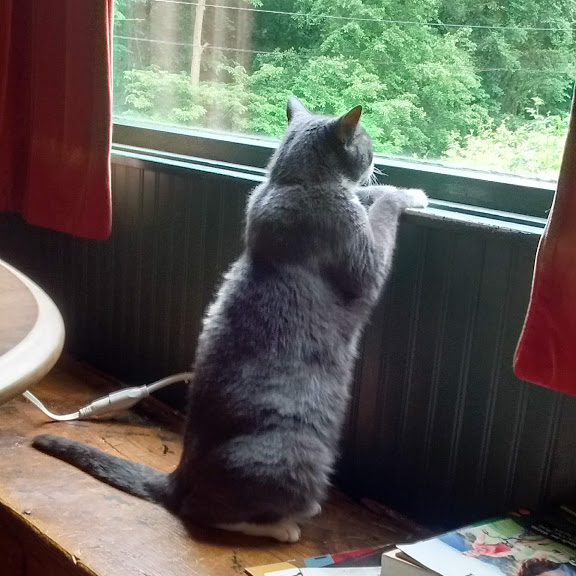
5. Lots of windows. I am on a critical lockdown at the moment, keeping the house closed and not venturing outside while the trees are in the height of their pollen-producing time. Still, I can look out and watch the squirrel with the excessively long tail, the chonky chipmunk, and all the wingfolk flashing by.

May we walk in Beauty! And Solidarity.


“We will not know our own injustice if we cannot imagine justice. We will not be free if we do not imagine freedom. We cannot demand that anyone try to attain justice and freedom who has not had a chance to imagine them as attainable.”
―Ursula K. Le Guin


“Each of us has lived through some devastation, some loneliness, some weather superstorm or spiritual superstorm. When we look at each other we must say, I understand. I understand how you feel because I have been there myself. We must support each other because each of us is more alike than we are unalike.” ―Maya Angelou


TS Eliot:
“We shall not cease from exploration
And the end of all our exploring
Will be to arrive where we started
And know the place for the first time.”


“Authentic spirituality is always about changing yourself. It is not about trying to change anyone else.” ―Richard Rohr


“Isn’t it nice to think that tomorrow is a new day with no mistakes in it yet?” ―L.M. Montgomery


“I have always imagined that Paradise will be a kind of library.” ―Jorge Luis Borges

Dystopia

What a dystopian movie I watched last night. I didn’t catch the name–it was something like Evening News. It was a powerful commentary on what happens when empire uses religion to prop itself up. The opening image in the movie is a birds-eye view of a park in a marbled city. There are clouds of tear gas wafting above the park, and crowds of peaceful protesters running to safety. There is the sound of concussion grenades exploding. Cut to a close-up of a man gasping for breath, holding his stomach, where he’s been hit by a rubber bullet. Through the veils of tear gas, you can see a phalanx of black-suited riot police with their shields up, moving in on the panicked crowd.

The nation in the film is experiencing an uprising of thousands and thousands of people taking to the streets to demand justice for ALL the people instead of just for the ones who had historically claimed power. There is looting and burning and violence, and there are thousands upon thousands of peaceful protesters.

There is a shift to a scene of the nation’s autocratic ruler ranting about using any force necessary to quell the violence and looting. “We cannot allow the righteous cries and peaceful protesters to be drowned out by an angry mob,” he rants, and you realize that the violent gassing and dispersal of the crowd in the opening credits was of those very “righteous and peaceful protesters.”

Cut to the dictator (it’s not clear in the movie what to call him, but he seems kind of like a dictator) walking with his minions and ministers (they all seemed to be men in the world of this movie) past barricades and marble buildings to a house of worship on the edge of the park. He stalks up to the front of the church, lifts a Bible in his hand, smirks for the camera, and stalks off again.

I actually haven’t seen the end of the movie. It’s still going on. But it was a brilliant piece of cinematography. The soulless look in the eyes of the leader. The blatant use of religious symbols and spaces to attempt to give validity to the violent quelling of protest. The lies about protecting the very people they were at that moment violently removing from the park so the dictator could use the religious building like a movie set.

I’m not sure how it’s going to play out. The religious people have to see it now, don’t they? The soullessness, the way their beautiful Teacher is being used as an agent of the violence of empire.

Usually in these stories, the people, after their hundreds of years of oppressive rule, throw off the mighty arm of the empire and create a new and better reality in its place. Sometimes everything is destroyed and the new and beautiful thing is built from the ashes of the violent past. I’m going to keep tuning in.


Gratitude List:
1. The marchers in Lancaster yesterday, and Michelle Johnson who filmed it all for five hours, live. There were some powerful moments when the police chief was speaking, and people began to yell their pain and rage, and he just handed the bullhorn over and listened. He said he had to go to a meeting, and somebody yelled out that they were there to march because they couldn’t escape this reality, and he nodded his head, skipped his meeting, and joined the marchers.
2. I got two emails from students yesterday about the current national emergency. I am so grateful that they’re reaching out, that they’re thinking and processing and deciding what their role in this world should be. I’m so proud of them.
3. Snugglecats. Really, every household needs at least one cat. One of mine is snoring.
4. Hummingbird dipping into the petunia basket, a strand of cobweb held in her claws.
5. People are finding their voices in the midst of this. Keep articulating. Keep talking it through. Keep speaking up.

May we walk in Beauty!


“The women said feel how we are not open
fields waiting for their strike. They cannot not bury us
deep, call us things of war and be surprised
when we land mine.” —Kelly Grace Thomas


“The necessary thing is to be solitary, the way one was solitary as a child.” ―Rainer Maria Rilke


“Words are things, I’m convinced. They get in your wallpaper. They get in your rugs, in your upholstery, in your clothes, and finally, into you. We must be careful about the words we use.” ―Maya Angelou


“I’d rather have a mind opened by wonder than one closed by belief.” ―Gerry Spence


“Life is a lot more interesting if you are interested in the people and the places around you. So, illuminate your little patch of ground, the people that you know, the things that you want to commemorate. Light them up with your art, with your music, with your writing, with whatever it is that you do. Do that, and little by little, it might gradually get to be, if not a better world, then a better understood world.” ―Alan Moore

Protect Each Other

These days demand such centeredness within ourselves and our intentions.
There are malicious forces out there actively working to discredit and destroy.
Check out the organizers of the protests before you go.
Wash your hands.
Go to the protests.
Sit in the streets.
Wear your mask.
Social distance as possible.
When white people in the crowds incite violence, don’t trust them.
Protect each other.
Learn how to tend to eyes that have been pepper-sprayed.
Destroy white supremacy.
Amplify black and brown voices.
Admit when you’re wrong.
When you make a mistake, own it, and do better.
Stay on message: Black Lives Matter. No more police brutality. Justice for George Floyd.
White Supremacy is an evil beast, and it isn’t going down without a fight.
And when the marches and the protests are over, we still have more work to do, to overcome our own internal biases.


Gratitude List:
1. The people in the streets
2. New schedules. More spaces in the schedule with my name on them.
3. Books to read
4. People who do the right thing
5. Cool mornings mean cats are snugglier.

May we walk in Beauty!


“Sit quietly,
and listen for a voice
that will say,
‘Be more silent.’”
—Rumi


“All wizards, including writers, are extremely
careful about their spells.” —Ursula K.Le Guin


“We have always needed good art to sustain us, to strengthen us, even to console us for being born human. Where better can we learn to see through the eyes of others, to gain compassion, to try to make sense of the world outside ourselves and the world within ourselves? —Lloyd Alexander


“Language is the house of Being.” —Martin Heidegger


“And the women said feel the way we became campfire
how we ghost storied into this dangerous beauty.”
—Kelly Grace Thomas


“So often we armour ourselves thinking we are sparing others the burden of our pain, but the truth is that we are depriving them the opportunity to nurture. Our vulnerability is what brings out compassion in others. As Rumi says, ‘Where lowland is, that’s where water goes. All medicine wants is pain to cure.'” —Dreamwork with Toko-pa


“At the end of my life, with just one breath left,
if you come, I’ll sit up and sing.”
―Rumi


“Although the world is full of suffering, it is also full of the overcoming of it.” —Helen Keller


“Run from what’s comfortable.
Forget safety.
Live where you fear to live.
Destroy your reputation.
Be notorious.”
—Rumi


“The soul of the Soul of the Universe is Love.”
—Rumi

Silent Sunday

Gratitude List:
1. Yesterday’s Drive-by Graduation.
2. A day of rest that is truly rest–no obligations.
3. The articulate voice speaking for justice and change.
4. Making things with my hands
5. Time to read books.

May we walk in Beauty!


“God is our mother as truly as God is our father…. we come from the Womb of the Eternal. We are not simply made by God; we are made of God.” —Julian of Norwich


“Everything that is in the heavens, on the earth, and under the earth, is penetrated with connectedness.” —Hildegard of Bingen


“But we [writers] are crucial. That is what I hope you have learned. We listen for and collect and share stories. Without stories there is no nation and no religion and no culture. Without stories of bone and substance and comedy there is only a river of lies, and sweet and delicious ones they are, too. We are the gatherers, the shepherds, the farmers of stories. We wander widely and look for them and gather them and harvest them and share them as food. It is a craft as necessary and nutritious as any other, and if you are going to be good at it you must double your humility and triple your curiosity and quadruple your ability to listen.” ―Brian Doyle


“What if your drive to experience pleasure isn’t a barrier to your spiritual growth? Consider trying out the hypothesis that cultivating joy can make you a more ethical and compassionate person. Imagine that feeling good has something important to teach you on a regular basis.” —Rob Breszny


“Stop this day and night with me and you shall possess the origin of all poems,
You shall possess the good of the earth and sun, (there are millions of suns left,)
You shall no longer take things at second or third hand, nor look through
the eyes of the dead, nor feed on the spectres in books,
You shall not look through my eyes either, nor take things from me,
You shall listen to all sides and filter them from your self.”
—Walt Whitman (Happy Birthday!)

Fire and Shadow

Look. I know you probably wouldn’t gas and burn
your city’s police precinct station.
I know you’re not a fan of the flaming
and looting of private property,
first and most sacred commandment
of our common capitalist religion.
But if cities inside you are not burning,
perhaps you haven’t been paying attention.
If it’s easier to condemn the people
who make their rage into a massive
public art demonstration, setting their symbols
of oppression raging through the streets,
than it is to condemn the smug and public
murder of a man in those same streets,
perhaps you need to get an education.
Perhaps you need to study the whole cloth
of an ethic of respect for human life.
Listen to the rage. It has a reason.


Gratitude List:
1. Snuggling my shadows (I wrote this one last year, and while I forget the context, it feels right for right now).
2. Grades aren’t done, but I can rest for a day or two now.
3. Oh dear. I’m just copying and pasting bits of last year’s list. Call me lazy, but this fits right now, too: Curiosity. When people get curious about each other. Curiosity is a fine engineer, building bridges of gossamer web and light across chasms. But stronger bridges than you can imagine.
4. Living in layers of memory.
5. Even this one, slightly re-tooled from last year: Cool breezes. This means exactly what it says, because our house can get hot as a sauna. But then it means more than that because your poems and your wisdom and your presence in the world are cool breezes to me, my friends.

May we walk in Beauty!


“Jesus often said, ‘It’s very hard here. Have you eaten? Look―you all stick together, go to the beach and have some fish. Share what you have. We’ll talk later.'” ―Anne Lamott


Take the contradictions
Of your life
And wrap them around
You like a shawl
—Alice Walker


“Those who love peace must learn to organize as effectively as those who love war.” ―Martin Luther King Jr.


“A [person] should hear a little music, read a little poetry, and see a beautiful picture everyday in order that worldly cares may not obliterate the sense of Beauty which God has implanted in the human soul.” ―Johann Wolfgang von Goethe


“This is what you shall do; Love the earth and sun and the animals, despise riches, give alms to every one that asks, stand up for the stupid and crazy, devote your income and labor to others, hate tyrants, argue not concerning God, have patience and indulgence toward the people, take off your hat to nothing known or unknown or to any man or number of men, go freely with powerful uneducated persons and with the young and with the mothers of families, read these leaves in the open air every season of every year of your life, re-examine all you have been told at school or church or in any book, dismiss whatever insults your own soul, and your very flesh shall be a great poem and have the richest fluency not only in its words but in the silent lines of its lips and face and between the lashes of your eyes and in every motion and joint of your body.” ―Walt Whitman


“Empathy has no script. There is no right way or wrong way to do it.
It’s simply listening, holding space, withholding judgment, emotionally connecting, and communicating that incredibly healing message of
‘you’re not alone.’” ―Brene Brown


“Don’t die with your music still inside of you.” —Wayne Dyer


“You will do foolish things, but do them with enthusiasm.” —Colette


“Rest is the conversation between what we love to do and how we love to be. Rest is not stasis but the essence of giving and receiving. Rest is an act of remembering, imaginatively and intellectually, but also physiologically and physically. To rest is to become present in a different way than through action, and especially to give up on the will as the prime motivator of endeavor, with its endless outward need to reward itself through established goals.” —David Whyte


“Soul is not a thing, but a perspective. It’s the slow courtship of an event which turns it into a meaningful experience. It’s the practice of trusting that if one sits silently and long enough with the absence of magic, the miraculous will reveal itself. Nothing is sacred until we make it so with the eloquence of our attention, the poetry of our patience, the parenting warmth of our admiration.” —Toko-Pa Turner


“It seems to me that almost all our sadnesses are moments of tension, which we feel as paralysis because we no longer hear our astonished emotions living. Because we are alone with the unfamiliar presence that has entered us; because everything we trust and are used to is for a moment taken away from us; because we stand in the midst of a transition where we cannot remain standing. That is why the sadness passes: the new presence inside us, the presence that has been added, has entered our heart, has gone into its innermost chamber and is no longer even there, – is already in our bloodstream. And we don’t know what it was. We could easily be made to believe that nothing happened, and yet we have changed, as a house that a guest has entered changes. We can’t say who has come, perhaps we will never know, but many signs indicate that the future enters us in this way in order to be transformed in us, long before it happens. And that is why it is so important to be solitary and attentive when one is sad: because the seemingly uneventful and motionless moment when our future steps into us is so much closer to life than that other loud and accidental point of time when it happens to us as if from outside. The quieter we are, the more patient and open we are in our sadnesses, the more deeply and serenely the new presence can enter us, and the more we can make it our own, the more it becomes our fate.” —Rainer Maria Rilke

Last Day of School

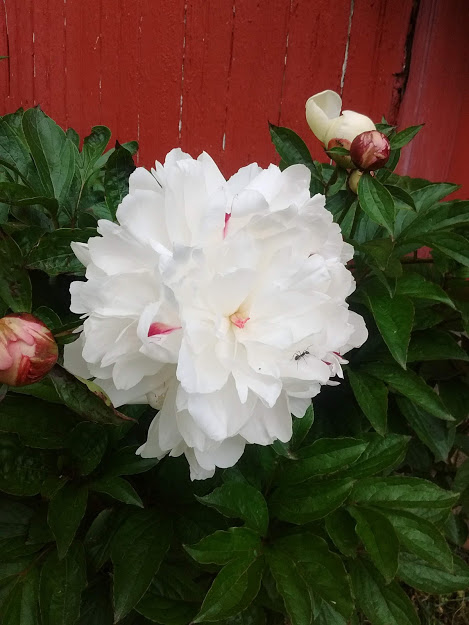
A peony with her attendant priestess.

Gratitude List:
1. Last Day of School, and I think I am going to get everything done on time. Saturday is graduation, so I will get to see and say goodbye to so many students I love, so that’s some closure, even if this online business feels like leaving an open wound. (Hmmm. That seems to decrease the import of the gratitude, doesn’t it? It’s just that the yuckiness of ending this way is the reality I cannot escape, so I am grateful for an alternative method of closure that’s more real while still being safe.)
2. The smells! Yesterday I was walking and suddenly I was hit by a wall of scent. I know that they’re terrible for the trees, but one of the climbing multiflora roses whacked me in the nose with its scent as I passed. So beautiful. And then when I got home, I spent some time communing with the opening peonies. Their scent reminds me of the grandmothers.
3. The Faerie Grove. That little grove of trees down by Skunk Hollow Lane where the wild rose is exploding into bloom is where I have seen the cedar waxwings twice. At the base of the trees is the rooty log of another tree that fell years ago, with plenty of nooks and crannies for a hundred apartments for small living things. I often see goldfinches congregating there. And the vultures tend to kettle over that field.
4. Rain. It feels just right to have rain on the last day of school. Change, movement, shift.
5. The coming days are full. There’s so much writing to do, knitting and bookmaking, reading (so MUCH to read!), house projects, walking, hanging out with Jon and the kids.

May we walk in Beauty!


Words for Today:
(and Maya Angelou reaches through the veils of time to hold us in the way that only she could)


“When fascism comes to America it will be wrapped in the flag and carrying a cross.” —Sinclair Lewis


“I would rather have questions that can’t be answered than answers that can’t be questioned.” —attr. to Richard Feynman


”The most remarkable feature of this historical moment on Earth is not that we are on the way to destroying the world—we’ve actually been on the way for quite a while. It is that we are beginning to wake up, as from a millennia-long sleep, to a whole new relationship to our world, to ourselves and each other.” —Joanna Macy


“I’ve learned that no matter what happens, or how bad it seems today, life does go on, and it will be better tomorrow. I’ve learned that you can tell a lot about a person by the way he/she handles these three things: a rainy day, lost luggage, and tangled Christmas tree lights. I’ve learned that regardless of your relationship with your parents, you’ll miss them when they’re gone from your life. I’ve learned that making a “living” is not the same thing as making a “life.” I’ve learned that life sometimes gives you a second chance. I’ve learned that you shouldn’t go through life with a catcher’s mitt on both hands; you need to be able to throw something back. I’ve learned that whenever I decide something with an open heart, I usually make the right decision. I’ve learned that even when I have pains, I don’t have to be one. I’ve learned that every day you should reach out and touch someone. People love a warm hug, or just a friendly pat on the back. I’ve learned that I still have a lot to learn. I’ve learned that people will forget what you said, people will forget what you did, but people will never forget how you made them feel.”
―Maya Angelou


“Live in the sunshine, swim in the sea, drink the wild air.” —Ralph Waldo Emerson

We’re All Coopers

As an English teacher, one of the disciplines I try to teach my students is analysis. Take a situation, a piece of art, a novel, a political view, a fight you had with your friend. Lay it out in front of you and examine it from every angle. Check out its component parts, and start asking yourself questions. How does this cog fit into that cog and make this crankshaft turn? How does this word combined with this biblical or pop culture allusion develop this tone that creates in the reader a sense of satisfaction or humor or existential dread? How does the painter use indigo to create a sense of depth perception in this painting?

So often, when we see a painting, or read a poem, or experience a national moment, we rush into our conclusions, and that’s not necessarily bad or un-intellectual. I think first impressions are really important in analysis. How did it make you feel? The first reactions lead the analyst into deeper questions, beginning questions: Why did she do that, I wonder? What caused him to react that way? How would I have acted in that situation?

Here’s why I am ranting about analysis today: Amy Cooper woke me up really early this morning. She’s the most recent national “Karen,” a white woman calling the police on a black person for being in a public space. Yesterday, I had First Reactions. Remember, first conclusions are not invalid. They’re the spark that takes us deeper into analysis. Why am I so angry? What was she thinking? Yesterday, Amy Cooper stepped out of her individual story and into the boat of an archetype. She’s a “Karen.” She’s a morality lesson. She’s an example of implicit bias and unquestioned entitlement and white supremacy. And when she floated into my mind at 4:30 this morning, I wasn’t getting back to sleep.

I do not know Amy Cooper, and any guesses I make about her motivations and choices are a complete disservice to her as an individual. I’m pretty sure she had no intention of stepping onto the stage and becoming a player in a National Morality Play. But she did do so. And now her part in this story has become the setting for necessary cultural analysis.

There are a lot of possible points of analysis here. The most obvious, of course, is race. The setting, however, has to do with civic duty and entitlement. Again, I do not know Ms. Cooper or why she would walk through a sensitive wildlife habitat, past signs that read Dogs Must Be Leashed At All Times, and let her dog run free of the leash. (Just this week, a friend of mine was injured while walking her own leashed dog, by a rambunctious unleashed dog in a park with Leash Your Dog Signs. “Oh, he’s friendly!” called the scofflaw owners of the leash-free pup just moments before the dog barreled exuberantly into my friend and her dog.) What is this entitlement that causes people to assume that basic laws and guidelines of civic and community co-existence don’t apply to me? There’s fodder for a whole article here. I would guess that we could all find some of these rules that we would scoff at personally. My favorites are the Homeowners’ Associations that forbid gardens in front lawns or washlines or wildflower patches. This piece of the analysis gets to the root of who we are as a society: Where does your freedom end and mine begin? Are there necessary “rules” for how we behave together in shared spaces? Don’t we need rules that protect the Earth and animals, which cannot speak for themselves? Should we regulate industries that pollute the air and earth and water that we all share? Can we ask each other to wear masks in public in order to protect each other from a pandemic? American individualism versus community health and well-being. Anarchy, individualism, authoritarianism, communitarianism, civic-mindedness all crunch together. There are whole articles to be written on this one.

Obviously, the main issue in this story, however, is the race issue. A white woman calling the police on a black man. Birding while black. Upholding community standards while black (he was simply asking her to leash her dog). In the context of the murder of a Minneapolis man by the police this week, the possible danger she placed him in cannot be discounted or minimized. Amy Cooper said later that she saw the police as protectors. As a black man in America, Christian Cooper (no relation) has every historical reason to fear the police when a white woman says, “I am afraid!” There are historical echoes in Amy Cooper’s phone call, echoes of Carolyn Bryant Donham calling down white wrath on Emmett Till, echoes of white slave-holding women maintaining cultural supremacy by placing black men in the role of dangerous savage from whom they needed protection.

And the moment I get into that territory, I need to recognize the gender story here. While this is a Morality Play about Race, we can’t ignore the gender question, the fact that women fear public spaces. I’m not sure how to parse the general fears of women from the racialized use of that fear that Amy Cooper played upon. A woman alone hiking in the woods has to contend with fear of male violence. Women grow up knowing we’re prey in some men’s minds. It doesn’t matter that most men would not harm us. We learn to be watchful and vigilant, to feel unsafe. We who look through Christian Cooper’s camera feel no sense of threat toward Amy Cooper. Yet we don’t know what traumas she may have experienced in her life that might have sent her into her reptilian brain for responses. We do hear her name race in her call, repeatedly. (Echo. Echo.) Still, simple gendered fear has to be taken into account not as an excuse, but as a factor.

You could analyze the surreality of their names. Were you to write this as a short story about race and gender and social entitlement in the US today, surely you wouldn’t name them the same thing. And yet, there’s something that awes me about this detail, some universal synchronicity that says: In the midst of it all, you’re the same. You’re related. You may think you’re the opposite on every imaginable scale–race, gender, age, civic engagement–but you’re really the same. You’re coopers, barrel-makers. You take the different elements of wood and metal and put the pieces together with such skill that the water and the wine stay safely within.

You could analyze their age difference. You could do a psychological exploration of the role of fear in this encounter. You could look at her treatment of the dog. You could look at the subculture of birders, and wonder about the warblers that Christian Cooper was most likely watching that day. You could explore their religious and political leanings (she appears to fall on the liberal side of the spectrum, if you’re making assumptions).

To do this justice, I would parse each piece in much greater detail, examine every element, but this is a blog-journal and not a professional article. It’s personal ramblings and not an English essay. Instead of trying to wrap it up neatly, I want to take it back to what I wrote yesterday, about curiosity. After all this muddling through today, I’m still angry. I still think Amy Cooper needs to be held accountable for calling the police on a black man who just wanted her to follow the rules and leash her dog, despite that fact that the story may have human complexity that extends beyond the symbolic and archetypal significance we place upon it.

But now I am curious. I wonder how this story would play out as deliberate fiction, what it might tell us about ourselves and how we live in the world. I’m curious about how Amy Cooper will find her way into life again as herself after living as an archetype. I wonder what would happen if Mr. Cooper and Ms. Cooper could be brought together in a mediation situation where they could tell each other their stories. I wonder what would happen if we would all begin to tell each other our stories, if we would all explore our internal biases, if we could maintain curiosity as a constant, if we would choose to encounter each other–with all our differences in age and race and gender and social awareness and civic-mindedness–as somehow inherently the same. This really is a morality play in which each character holds layers of symbolism. It’s a Jungian dream, in which each of us is equally each of the characters, bringing with us the distinct elements of race and gender and age and experience that make us distinct. We’re all Coopers.


Gratitude List:
1. We’re all different. We’re all the same. Being human is messy, but it’s so beautiful.
2. Wonder and curiosity
3. The way dawn came this morning on an aural wave, first the night insects and the early twittering of birds, along with an occasional rumble of a bullfrog in the pond, then louder, more voices joining, echoes resonating in the bowl of the hollow.
4. Finding closure
5. Blackberry blossoms covering the bluff like snow.

May we walk in Beauty!


“What does it mean to be pro-life if you defend the life of a child in the womb, but not the life of a child on the border?” —James Martin SJ


“It simply isn’t an adventure worth telling if there aren’t any dragons.” —Sarah Ban Breathnach


“Forests will always hold your secrets,
as that’s what forests are for.
To envelop things.
They’re the blankets
of the earth,
grown to protect,
to comfort, to hide,
to carry, to seep
into our chests,
and to teach.
Your sharpest aches
and bygone dreams
will be scattered across
these knowing trees
while the ancient contrasts
of shadow and light
whisper once again
that we are built to seek.
It is here in this space
where we’ll rediscover
the rhythms of roots
and what it fully means
to renew.
To revive.
To breathe.” —by Victoria Erickson


“Live in the sunshine, swim in the sea, drink the wild air.”
—Ralph Waldo


“The more clearly we can focus our attention on the wonders and realities of the universe about us, the less taste we shall have for destruction.” ―Rachel Carson


“In nature’s economy, the currency is not money. It is life.” —Vandana Shiva

Open-Hearted Curiosity

Yesterday, I watched that new Mark Rober video that everyone has been passing around the internet, in which he completely overengineers an anti-squirrel bird feeder, creating a ninja-warrior course and making friends with his team of squirrel subjects in the process. He learned things. The squirrels learned things. Everybody evolved.

I’m a fan of Mark Rober. I think he models open-hearted curiosity. He began the process in frustration: The squirrels, no matter what little modifications he made to his bird feeder, always won. He played the next step in the process as an attempt to outwit the squirrels, but by that point, his curiosity had already taken over. He was no longer really concerned about beating the squirrels. He realized that he had an opportunity on his hands here to explore something. Already his vision and his attention and his perspective had evolved.

(You have to watch the video. Note: No animals were harmed in the making of this video. Further note: You just may come away with a deeper appreciation of the animal life in your neighborhood.)

Watching the video brought into sharper focus for me something I believe, but haven’t explored very thoroughly in words, that open-hearted curiosity is at the heart of learning, and is a primary step in evolutionary processes. Lately, I’ve been hyper-focused on the way disruptions and challenges sprk evolution and transformation and change. We get pushed out of our easy status quo and we must adapt or flounder. So we adapt, sometimes kicking and screaming and lashing out at our neighbors who are having BBQs or our neighbors who urge everyone to be cautious and wear a mask.

How can I approach the frustrations and inconveniences, and even deep anxieties, of this experience with a more open-hearted and curious frame of mind? People aren’t squirrels, of course, but are there ways that we can engage each other more playfully that might bring about learning and evolution for all of us? I think we’re in a place–nationally and globally–where we have to evolve, and evolve quickly. If we can begin to approach the challenges with a greater sense of curiosity, hearts open to whatever possibilities the future holds, perhaps we can find our way through.


Gratitude List:
1. Sometimes my gratitude list becomes a little like a bird-watcher’s log, but here is a Big Joy from yesterday: On our walk yesterday morning, Jon and I saw a flock of cedar waxwings. Later, we saw them again, in the walnut tree by the barn. This isn’t the first time we’ve seen them in the hollow, but it’s been a long time. They’re so dapper and elegant, both in their coloring and their way of flying. It made me wish we had more early-fruiting berries.
2. Taking stock, and finding my way through a couple thorny things. I need to listen carefully to my own advice about curiosity and approach a couple of my current personal challenges less like a slog, and more like an interesting challenge. Can she do it? Can she make her way through the obstacle course of Issue X without falling? When she falls, can she get up again? It’s just good to have a plan.
3. Curiosity
4. Adapting, changing, evolving, transforming
5. The little joys that people share. It keeps everyone’s hearts softer and more open.

May we walk in Beauty!


“Let this be a voice for the mountains
Let this be a voice for the river
Let this be a voice for the forest
Let this be a voice for the flowers
Let this be a voice for the ocean
Let this be a voice for the desert
Let this be a voice for the children
Let this be a voice for the dreamers
Let this be a voice of no regret” —John Denver


“Just as we are taught that our universe is constantly expanding out into space at enormous speeds, so too our imagination must expand as we search for the knowledge that will in its turn expand into wisdom, and from wisdom into truth.” —Madeline L’Engle

Naming the Colors

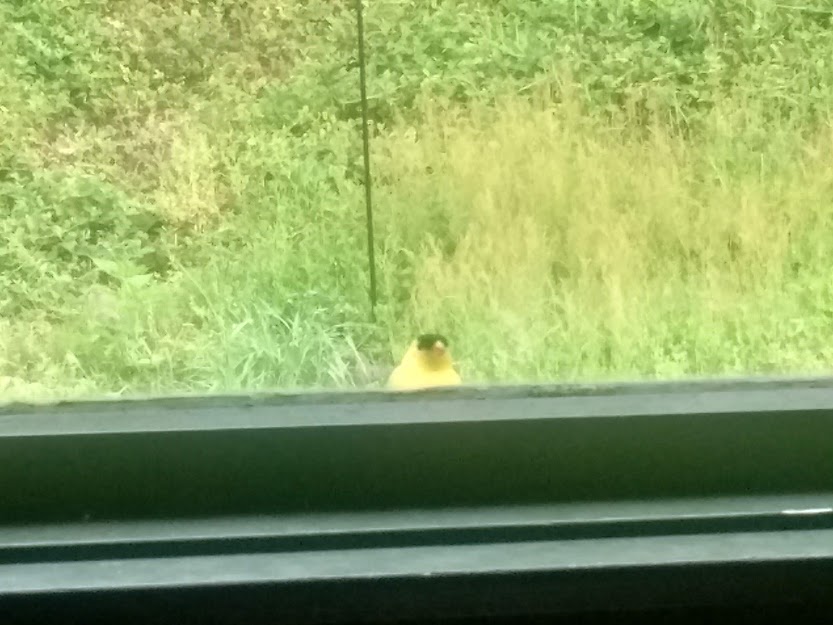
A golden person peeked in my window this morning while I was writing about colors.

Here’s a little Noticing Exercise for today:
Go outside, or stand at your window, and look around. Take a few deep breaths, of course. Feel your feet on the ground. Now, start naming the colors you see. Maybe start with the spectrum. Hang out with old Roy G. Biv for a few moments.

Find something red (it can be something human-wrought, but it’s especially satisfying to do this only with naturally-occurring colors). Breathe in red.

Orange might be harder, unless you have a family of resident orioles chasing each other across your view, but look really closely at the turnings of color at the tips of a patch of weeds, or the hidden shades of turned earth in the flowerbed. See if you can find it. Breathe in orange.

Yellow is pretty easy if you’ve got a dandelion patch, or goldfinches. Breathe yellow.

Green–it’s everywhere, but don’t forget to breathe it in.

Blue. Also easy, perhaps, particularly if the sky is cloudless. Breathe blue.

Indigo: We’re not really trained to notice indigo. If you have a bunting or a bluebird handy, the indigo is really the deep well of blue that pools beneath the flash and shine. Or look at a cloud–what we call the silver lining of a cloud is actually indigo. Really look at it. Then look into it. Without a cloud, you can do this with shadows. Indigo is the deepest layer of shadow. If you think you’re really only imagining it, you’re probably in the presence of indigo. Indigo is mysterious, almost elusive. Breathe in indigo.

Violet is in the gill-on-the-grass, the edges of asters, the pulsing life force in the newest branches. Find violet. Breath in violet.

Now you’ve breathed a rainbow. Won’t it just be a glorious day from here on out?


Gratitude List:
1. Things are zoomy and bright out there in birdland. In all the years we’ve been here, I really don’t know when I have seen such a healthy flock of local goldfinches.
2. Last night’s weekly Birding Club (I mean Family) Zoom call. If you think I talk a lot about birds, you need to meet my family. In the Before, I might sometimes go a couple months without seeing or talking to my siblings. Now, I talk to them Every Week. I just got a little teary writing that. Even when I am raging at the losses, here is a gift. Such a gift.
3. This is the last week of school. I am so terribly torn. There really is a part of me that dreads this. The lack of closure is extremely painful. It feels wrong. I think I have been keeping myself from anticipating the end of the semester because I don’t know how to close this out. But I so desperately need this break, the chance to re-group, to make art without feeling like I should be doing something else, the opportunity to write what I want when I want, and the movement out of this incredibly sedentary life.
4. Sunshine and cool breezes. Thermal Delight.
5. Color!

May we walk in Beauty!


“Perfectionism is a virus which keeps us running on the treadmill of never-enoughness. It is inherently deadening for how it strives and never arrives. Failure is embedded in its very pursuit, for our humanity can never be homogenised. The only antidote is to turn away from every whiff of plastic and gloss and follow our grief, pursue our imperfections, exaggerate our eccentricities until they, the things we once sought to hide, reveal themselves as our true majesty.” —Toko-pa Turner


“The fact is, I don’t know where my ideas come from. Nor does any writer. The only real answer is to drink way too much coffee and buy yourself a desk that doesn’t collapse when you beat your head against it.” —Douglas Adams


“Finish every day and be done with it. You have done what you could; some blunders and absurdities no doubt crept in; forget them as soon as you can. Tomorrow is a new day; you shall begin it serenely and with too high a spirit to be encumbered with your old nonsense.” —Ralph Waldo Emerson


“Somewhere, something incredible is waiting to be known.” —Carl Sagan


“UNLESS someone like you
cares a whole awful lot,
nothing is going to get better.
It’s not.”
—The Onceler, Dr. Seuss

Stories Will Save Us

“Don’t build walls around your passions. Don’t be a gatekeeper to enthusiasm. Don’t scorn the uninitiated or treasure exclusivity. Instead, cultivate your loves into a vast forest. Build many paths there and, when you encounter a stranger beneath the trees, greet her as a friend.” —Jared Anderson, The Cryptonaturalist


I live on Earth at present,
and I don’t know what I am.
I know that I am not a category.
I am not a thing—a noun.
I seem to be a verb,
an evolutionary process—
an integral function of the universe.”
—R. Buckminster Fuller


Aging is an extraordinary process where you become the person you always should have been.” ―David Bowie


“A good half of the art of living is resilience.” ―Alain de Botton


“Everyone needs a practice which polishes them, to wear away at the obscuring mindstuff which settles like debris on one’s way of seeing. In our hearts, we know there is meaning to it all, an ordering nature to the chaos, but like a dream which slips away into forgetting, we have to practice at coming into its coherency. Without such a practice, we fall prey to the belief that the toxic fog of consensus culture is the real reality. When in fact, it is only the ‘not-beauty’ behind which beauty is hiding.” ―Dreamwork with Toko-pa