I have been fuzzy in my civic understanding of the differences and similarities between a democracy and a republic, and to what degree my own nation is one or both of those. This morning, alarmingly, I have seen two articles posted online, one warning that our democracy is dying, the other that our republic is in its death throes. I suppose it’s time I develop a clearer understanding of the terms so that I can better understand what it is we are in danger of losing.
I think we are an oligarchy. I think we are in end-stage capitalism. I think that greed and self-interest have become the MO of our most powerful public servants. Serving the will of the people, and doing the right thing, have taken second place to staying in office, and garnering personal political power and wealth. The ideals of democracy and republic have failed to serve us as a nation.
There have been some bright spots in this impeachment process, some fine speechmaking and oratory, some grand ideals expressed, some hope for a society that governs itself according to core principles of freedom and justice for all. Still, the defensiveness and bullying, the sense of threat hanging over the whole proceeding, begins to make the story feel ominous and tragic.
A society that cares more about protecting the assets of its wealthiest members rather than providing for the basic needs of its most vulnerable members is headed for implosion.
Gratitude List: 2. This is my tabula rasa morning. I’ve been living in semester two for two weeks, but finishing up the grading for semester one. I will hit the Grades Ready for Registrar button in half an hour, and then the last rocks blocking this tunnel will crumble and disintegrate, and I will walk into the full light of the new story. 3. Wise people. Wise women. Helpful, thoughtful, perceptive friends. I don’t know how I would get by without those serendipitous and intentional moments of wisdom and care that you share. 1. Not everything is dire and tragic. So much is beautiful and wise and thoughtful and hopeful. You are here, and so am I, and we hold the ideals of a civilization that protects the environment and cares for the vulnerable. 5. Stretching, releasing breath, grounding, centering. 4. The breathing spaces in the day to come.
“Like water, be gentle and strong. Be gentle enough to follow the natural paths of the earth and strong enough to rise up and reshape the world.” ―Brenda Peterson
“Tyrants fear the poet.” —Amanda Gorman, U.S. Youth Poet Laureate
In the very end, civilizations perish because they listen to their politicians and not to their poets.” —Jonas Mekas
“Are you enhancing your power to discern the difference between rash risks motivated by fear and smart gambles driven by authentic intuition?” —Rob Brezsny
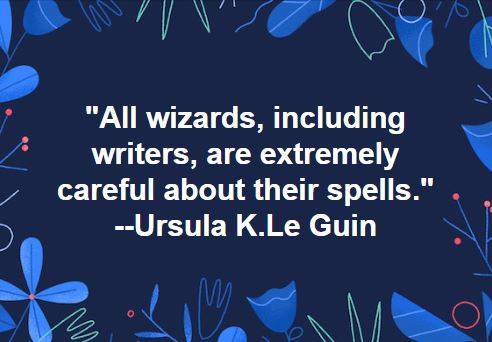
“I think hard times are coming, when we will be wanting the voices of writers who can see alternatives to how we live now, and can see through our fear-stricken society and its obsessive technologies, to other ways of being. And even imagine some real grounds for hope. We will need writers who can remember freedom: poets, visionaries—the realists of a larger reality. Right now, I think we need writers who know the difference between production of a market commodity and the practice of an art. The profit motive is often in conflict with the aims of art. We live in capitalism. Its power seems inescapable; so did the divine right of kings. . . . Power can be resisted and changed by human beings; resistance and change often begin in art, and very often in our art—the art of words. I’ve had a long career and a good one, in good company, and here, at the end of it, I really don’t want to watch American literature get sold down the river. . . . The name of our beautiful reward is not profit. Its name is freedom.” ―Ursula Le Guin
“I wonder how the world would be different if we grew down?” —Someone in my House, a few years ago
Gratitude List: 4. Planning and processing 3. The shades of gold, saffron, yellow, ochre 2. Grilled cheese and sauerkraut sandwiches with all the condiments 1. The way the eyes make sense of what they see. The way the create meaning: Tree branches that curve into the shape of a fish. Clouds that are dragons. A rough patch in the ceiling that is an old woman smiling. 5. Light at the end of the tunnel. I tend to visualize the light at the end of the tunnel as a gleam at the end of a long straight railroad tunnel. Sometimes it turns out that you’ve got lots of rock and debris to move from the pathway, or that it’s just a little opening, and you’ve got to dig yourself out. No matter what shape the tunnel is in, the light is there to inspire and guide.
Welcome, rain. Welcome, dawn on this chilly morning. Welcome, work of the day, of the weekend. Welcome, time yet to come when the work is done. Welcome, clean new pages to write my next chapter.
Gratitude List: 1. Yesterday’s dawn. It began as we pulled out of the driveway, with pink streaks on the horizon over Spicher’s field. On the way to pick up our car pool, we passed the small paddock where two mountainously fluffy sheep graze, and the sky was beginning to glow gently magenta against the woolly clouds, the grass a green almost glowing. The River, as we crossed, flowed pink beneath the old bridge to the south, and the lamps were still twinkling along its span. By the time we reached school, the sky colors had shifted out of indigos and violets and pinks, to tangerine, and rays of coming sun shot upward through the low-flung clouds. 2. Rain and reflections on a Saturday morning 3. People who stand up for peace 4. People who stand up to bullying behavior 5. Poetry
Grades are due Monday. I’m focusing on the day ahead, the weekend ahead, on getting it done. Fueled by coffee, hope, and the wild burst of procrastinator’s eleventh-hour mania. I am good at getting things done on time, but not in a timely fashion, if that makes any sense. Always hoping to rectify that, and sometimes, like now, finding myself deeper in the hole than ever.
Gratitude List: 1. Good colleagues. I love working with these earnest and compassionate people. And they’re funny, too. 2. There are some clear-thinking, justice-aware folks in that room in Washington. I don’t think I am really hopeful at all that the rule of law will prevail, that justice will be done, that the democracy will be saved. Still, some people are standing up for truth and democracy and justice. 3. Reading through student journals yesterday about people they admire. Some of their answers were my colleagues (see point number one), and others were family members. One student write a gripping couple paragraphs about being inspired by Bernstein and Woodward. Another write a page and a half about Tolstoy as an inspirational model for living. I love these young people. 4. Animal companions 5. Flannel sheets
A few years ago, a friend of mine told me about some online quizzes that help you learn world geography. I play them every few months, and every time I come back, I have lost fewer of them. Now I put myself to sleep at night by reciting the names of the nations of the world. It’s time for a new challenge. I am going to start on flags now, and then capitals, I think.
One of the powerful benefits of this has been that when I read headlines about the people of The Gambia suing Myanmar for the genocide of the Rohingya people, I no longer think, “Somewhere in Africa” or “Somewhere in Asia.” I see the place on the map. As tensions with Iran have increased, I see Iran in my head, where it is in relation to the countries around it. When students say they come from Thailand, or South Korea, or Singapore, or Ghana, I can picture where they come from on the map in my head. And so I have increased the sense of my own place, my own places, too.
It also increases my anxiety at times. A couple years ago when the Caribbean was torn apart by massive hurricanes, I knew the names of the islands in their paths, could sense the vulnerability in ways I had been previously unable to imagine. But some painful knowings are important knowings, and help me to better understand my own connection to others.
As we apply ourselves to the study of our own inner maps, I think we have similar experiences. When I dare to memorize the shape and location of sadness and despair within myself, then perhaps I can be more attentive when I see it in someone else. “I recognize that!” Joy. Confusion. Satisfaction. Secretiveness. Deviousness. Compassion and Empathy. They all take on more recognizable shapes as I explore their geography within me. And the anxious knowing applies as well. How will your small islands weather the hurricanes of grief and loss and stress? Can you pick up the pieces and set up a new infrastructure when the storms rage through? Hang in there. Put out a call for help to others to send boats and aid, to airlift hope and helping hands.
Gratitude List: 1. Asian New Year celebration at my school today. Such talented students. Songs, drumming, and K-Pop Dancers. Incredible! 2. Half a day to grade. Catching up with myself. 3. I’ve been reading the poetry of Reginald Dwayne Betts in the spaces of the day. His word-work is so inspiring. 4. That samosa a student brought me from their Ethnic Foods class (or maybe it was just Ethnic Foods Unit in a regular Foods class?) 5. Walking, stretching, being good to the organism that is me.
Is this a blog entry about petting cats or about getting used to themself?
The problem with writing a blog of random musings is that, over time, a writer is bound to repeat themself.
Here is a little metacognition moment: I woke up this morning with Thor-the-cat butting his head into my hand for a head scratch, and I started ruminating on that idea of the sweet pleasure relationship between human beings and the animals that live with us, how scientists believe the cats and wolves came to live with us because we were a stable food source, and we let them come because they helped us to deal with rodents who ate our own food. How that certainly explains the exchange of energy in a certain way, but how it doesn’t explain the pleasure exchange, how we humans get such pleasure from the feel of fur, and from the sensation of the animal’s pleasure. How my distant cousin David Kline writes in his book Scratching the Woodchuck of encountering a groundhog sleeping in the sun, how he reached out his walking stick to gently touch it, how it leaned into the scratch, how satisfying it was to him. How I saw an online video yesterday of a goose tickling a puppy with its beak: Everyone wants to pet the puppy.
But I am pretty sure I have written that before, and then I started writing it anyway, and I came upon that perfect opportunity to practice the singular “they.” (There’s where the metacognition begins.) So today’s musing is not really about the mutual pleasure cycle between humans and animals, after all, but about the process of shifting their (one’s/our) language to include alien-seeming ideas and structures.
We do it all the time, unconsciously or semi-consciously: pick up new words and phrases and ways of saying things. Teenagers do it at such an alarming pace that sometimes they seem to be speaking another language, and those of us whose synapses are getting hard and calcified find it challenging to keep up, to interpret the cant and the jargon. But we do it too. There’s that but at the beginning of the last sentence. “Never,” my teachers told me, “put a but at the beginning of a sentence.” But I do it all the time now. Too often perhaps. It expresses a sense of the fragmentary thought, how my brain experiments with holding an idea, and then skitters over to its complement or opposite. New words and linguistic patterns have a way of seeping in to enhance and brighten our communication.
The injunction against singular they, however, seems to have a particular staying power. My starting sentence up there feels clunky and awkward to me, not just in the fact that its using a “plural” pronoun to refer to a singular human, but because it actually singularizes the plural: themself. Because I identify as female, it would have been perfectly logical for me to use herself in that sentence. Were I someone who identified as male, however, to use the masculine pronoun in a sentence about a generic human being would have taken on political meaning, a sense of masculine as default.
As a teenager, I took the common practice of identifying every generic human in my writing as the “default” he/him, trying to believe that it meant people of any gender, no matter that I saw a distinctly male person in my mind when I tried to picture the sentence. As my consciousness shifted, I rejected the male default, and began to use he or she for a time, or he/she, or s/he, and there’s a certain satisfaction in that, but it does get clunky in the speaking, especially when you start tossing in the him or her. For a while, I tried the pompous-sounding one, but those sentences can get laborious and babbly and, as I said, pompous.
To return to both the meaning and the revelation of that first sentence, I think that along with writing previously about petting puppies and kittens, I have written about singular they before. Shakespeare did it. According to this Oxford English Dictionary blog entry (click the link), we’ve been doing it since at least the 1300s. They (generic use–I don’t know who I am referring to) discuss the attempts by grammatical structuralists in the 18th century to eliminate the use of singular they. But hey, if it was good enough for Shakespeare, it’s good enough for me, and he occasionally began a sentence with he, and finished off using they for the exact same antecedent. If he’s allowed to be so messy, I’m just going to wade right in.
There is plenty of reason to challenge my discomfort, besides my own feminist consciousness. Sure, I can sprinkle lots of generic she into my writing to startle and inspire, but singular they has become a fight for recognition of identity. As we welcome the blooming sense of personal identity and power that non-binary folx are expressing, it’s important for those of us who identify comfortably (say: privilege) on the binary to let ourselves get a little unsettled in the linguistic world, and then to embrace new forms and structures. Embracing new ways of using pronouns is a way to embrace the people who use them.
That first sentence is awkward in my ear. I am comfortable with singular they in many flowing contexts, but that one up there stopped me. Even Shakespeare didn’t use it so jarringly. But why should I try to rephrase it to make it gentler and more flowing to our ears? Instead, I am going to leave it there, to give us both a chance to begin exploring the possibility of new ways of using singular they. We can handle it. In recent years we’ve absorbed so many new words and ways of putting them together, and we’ve hardly looked up from our screens long enough to ponder the significance of all the changes. We can let themself slip in, too.
One way to make non-binary folx in a room feel more embraced and included is to put our own pronouns on our nametags, so they’re not the only ones with the burden. Another is to start using the pronouns in new and creative, and sometimes jarring (deliciously jarring) ways.
Gratitude List: 1. Expanding the brain by using words in new ways 2. Soft fur and purring 3. Vs of geese enlivening the sky 4. Getting the work done. I began to see the light at the end of the tunnel 5. So far, I seem to be holding this cold slightly at bay. Lots of zinc, lots of elderberry
Ugh. Insomnia. And it’s the fuzzy-headed kind. Trying to head off a cold, I took a tablet before bed that has zinc and valerian in it. I slept soundly for about five hours, and then that was it. Sometimes I can starting listing the countries of the world, and I’ll fall back to sleep before I can fill a continent, but tonight I got through all of them, and here I am, still awake. By the time I got through South America and was working my way through Africa, I knew I was done for. And now, it’s only half an hour until my alarm goes off, so I might as well start the process of waking up.
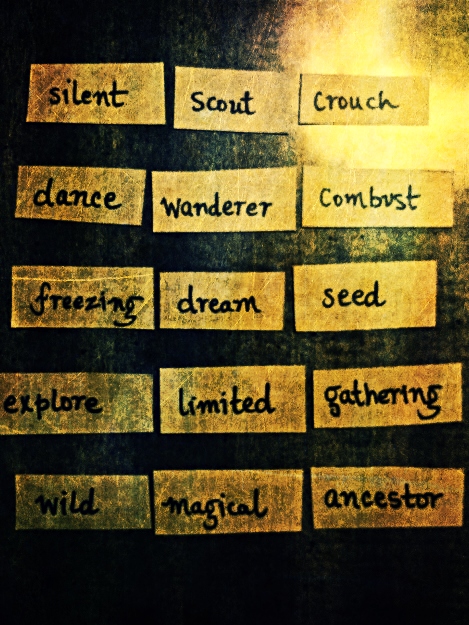
Today in Creative Writing, we’ll look at the pictures and poems that people put together with their random words. I showed several of my own on Friday as examples, so I don’t know if I’ll put up pictures like this one. I just pulled fifteen random cards from my word tickets and arranged them together. I’m not sure I like the line “dance wanderer combust.” The flow feels wrong, like I’m packing too many syllables into it. I like the word wanderer on its own, but in some contexts, that “-erer” can sound like a car with an engine that won’t turn over.
I hope my students are feeling the sense of freedom from prescribed meaning that I am feeling from working with word pools. We’ll get into intentional meanings soon enough, but it’s a nice breath to begin the semester with nonsense and random associations. It’s been an odd experience for me, a little risky. I feel sort of vulnerable, like I am letting my students in to my own personal crazy. I keep worrying that they’ll start rolling their eyes, that they won’t get it. And this is so deeply connected to the way my brain works that I feel like I might feel a greater sense of personal rejection if they can’t get into it. Enough of them have sent me fantastic random word projects, however, that I am feeling less anxious about it.
Gratitude List: 1. The shadows that swoop through the woods behind the house when vultures are flying in front of the sun. 2. Random meanings plucked from odd associations 3. Even though sleep was short, I did get some good solid hours of deep sleep 4. The ones who work for justice 5. Warm blankets
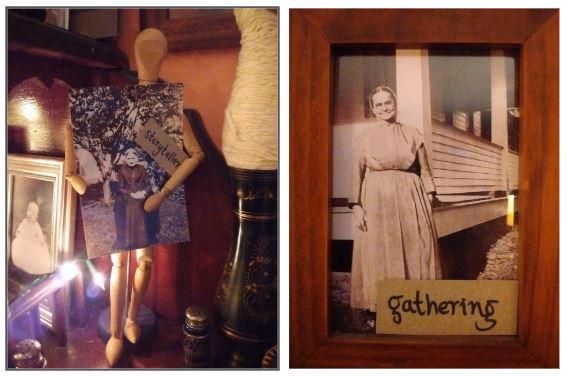
Winsome Chaos: I pulled random words from my word pool tickets to label photos and objects.
Why are poetry and fiction so important in human cultures? What is it about the imaginative telling of a thing that thrills listeners of all ages, makes our minds sit up–criss-cross applesauce–and hang on the smallest word of the storyteller? Nonfiction and biography, the “true” story, is also compelling and engaging, but there is something about fiction, about the fantastic, the imaginative, the made-up, that sets fire to human imagination, across times and cultures.
Ursula Le Guin, in her profound introduction to The Left Hand of Darkness, wrote of truth and lies in storytelling: “I talk about the gods, I am an atheist. But I am an artist too, and therefore a liar. Distrust everything I say. I am telling the truth. The only truth I can understand or express is, logically defined, a lie. Psychologically defined, a symbol. Aesthetically defined, a metaphor.”
In his famous essay, “Of Truth,” Francis Bacon discusses how the human mind bends toward the lie, how earlier philosophers spoke of poetry’s vinum daemonum, wine of the devil, the lies that draw the reader down the delicious pathway of imagination.
In my own estimation, Madeleine L’Engle got most deeply at the heart of this in her discussion of the differences between truth and facts. “Truth,” she said, “is what is true, and it’s not necessarily factual. Truth and fact are not the same thing. Truth does not contradict or deny facts, but it goes through and beyond facts. This is something that it is very difficult for some people to understand.”
“Tell all the truth,” said Emily Dickinson, “but tell it slant.”
More steps in the creation of meaning: Finding the deep truth within the fictive or poetic “lie.” Seeking new and startlingly relevant meanings in the strange juxtaposition of seemingly unrelated facts and ideas. One of my students added the word “speaking” to her word pool. “Is it okay,” she asked, “if I put this word with a photo of a woman with a zipper across her mouth?” Yes, oh yes, please–that’s the point here. And in that little “lie”–the woman, unable to speak, labeled “speaking”–you may have told a deeper truth than any of us can express in straight talk.
Gratitude List: 1. People who let themselves cry. There’s a priestly quality to profound and honest tears in public gatherings. Suddenly everyone has just a little more permission to be human, too. Feelings are invited into the circle. 2. A day off. 3. The legacy of Martin Luther King, Jr., the way his words continue to echo their challenges today. Will we listen to the challenges as well as the inspirations? 4. The deep truths that make themselves available in poetry and fiction and art. 5. Red cardinals in the sere winter landscape.
Cup of Coffee: I might be having too much fun with the business of labeling things with random words.I hope my students are having half as much fun as I am.I should make sure to credit Susan Goldsmith Woolridge for the idea, in her marvelous book: poemcrazy.
One of the things about the Judeo-Christian creation story that always captures my attention is the idea that the humans are tasked with the work of naming. The Holy One breathes life into the clay to make a living person, and then the people set about the task of breathing out the names of their companions, the animals. I wish I could figure out how to make a seamless connection here to the sort-of-silly and whimsically-fun project of labeling people and things with random words from our Word Pools that we are doing in my Creative Writing class.
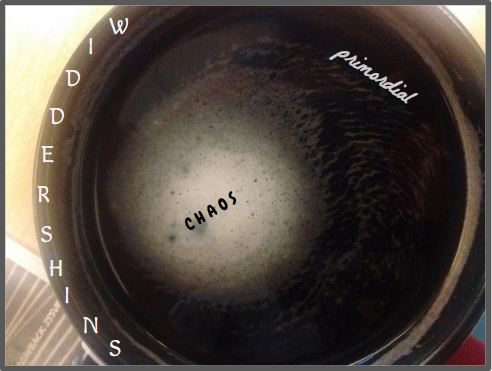
There’s something mind-expanding about taking the random word “chaos” and using it to label the foamy swirl in the middle of my cup of coffee. When I added “widdershins” to the outward spiral of the cup, I was being less whimsical, because the old word for the leftward spiral is widdershins. And “chaos” begat “primordial,” so that, too, was association rather than simple randomness.
Even so, I can see how, turned loose to run in its own pathways, my brain played a simple associative game with words and ideas, building up tidbits of meaning into a cohesive whole. And that’s the process I want my students to be finding. Breaking it all down to the little bits, and rebuilding up new structures and associative maps of meaning. Beginning, like First Human, with words for things, and then building up relationships and intricate and complex webs of patterns and thoughts.
Speaking of words and the structuring of meaning, for some reason this morning, my mind has pulled the words “ort” and “crot” out of the stew of my brain. An “ort” is a small piece of something, particularly a leftover bit from a meal. I am thinking of all these little random words that we have pulled out of the webs of sentences and ideas and thrown onto other objects, like the crumbs dropped from the table of a messy eater. A “crot” is a piece of a phrase, an abrupt fragment of meaning used to create movement and rapid transitions in a piece of writing.
Begin with the crumbs, the orts, that fall out of the meal of a conversation. Grab twenty random words. Thirty? Forty? Taste them. Memorize them. Write them. Throw them against the wall. Toss them together and see which ones stick together. Combine them into crots, little strands of potential. Knot them. Twist and spin them. Form them into longer strands and webs, phrases, sentences, ideas. Follow the footsteps of First Human. Breathe that Holy air into your lungs, and breathe out Words. Orts. Crots and phrases. Make a new thing.
Gratitude List: 1. Orts and Crots: Tiny pieces and fragments of meaning that get thrown and tossed and jumbled together to create meanings and ideas and conceptual frameworks. 2. Breath. Breathing. In. Out. Gratitude and compassion. Hope and fortitude. Breathe. Breathe. Breathe. 3. Goldfinches on the thistle sock. (Thistle sock–that’s fun to say.) 4. Morning writing while my small architect designs a house made of shipping containers. He has taped four pieces of graph paper together to create his idea. 5. A little bit of snow remains on the ground. I’d like some deeper snow at least once this winter, please.
On the way to and from school, on the days when we’re all in the carpool, we listen to audio books. Lately, we’ve been listening to Maggie Stiefvater’s Raven Cycle. Her writing is clever and witty without being chummy or manipulative, her stories are compelling, and she can introduce characters who make you wince and cringe, and then make you love them with a deep and unswerving loyalty. It’s narrated by Will Patton, who can create a character with the smallest shift of tone in his voice.
Yesterday, just as we got to school, we came to a little phrase, “the muzzy mist.” I don’t think I have ever heard the word muzzy, but it grabbed me. It means indistinct, befuddled, unclear. In Creative Writing, we are creating Word Pools, collecting words that interest us, and then doing interesting things with them, like taking pictures of things that we label with them, or making poems and short stories with them. So “muzzy” went right into my word pool.
Here’s a little poem I wrote with using “muzzy” and several other words in my word pool. The idea is to push ourselves to use words in different ways than we normally do. I found myself breaking up the sense of sentences with greater ease than normal.
Muzzy
Today I am a muzzy fuzzle, brain a-muddle, all verhoodled.
Yesterday I was eagle-eyed, a green rogue, and wild divine.
Sharp I was, sharp as dash but now I am dangerous blood, with an elephant on my chest.
Last week, we introduced ourselves to the class with Acrostic Poems about our names. Some students simply chose a different adjective for every letter of their name, and these were beautiful and tender. Others wrote poems with longer lines and phrases beginning with the letters of their names, and these were elegant and flowing. Some even allowed themselves to practice a little enjambment, breaking up the flow of a phrase across a line. In one of my classes, the first four of us to read ours used the word Anxious for our A. I wonder what the implications of that are. Here’s mine. I used my whole name:
Every time I Look in the mirror I see someone different: Zealous Anxious Bold Eager Timid. How can I be all these things And one person at the same time? Names and rhythms, New and intricate rhymes Work within me. Each one of us is An ocean, a Veritable Ecology of Adjectives, Revealing layers of human attributes. Kindness and Revolution can Exist in tandem. Individual truths are Defined by complex webs Experiences within me. Reality is many-faceted.
Gratitude List: 1. Weekend! 2. Clear moments that remind me that I am where I should be. Teaching can be rough, especially in the fall and winter, especially when the grading piles up, especially when I am feeling inadequate. Sometimes I wonder if I am where I should be. And then there are weeks where it all aligns, where I can see how even the really challenging bits have led up to a particular moment. How I am changed and transformed by this work. How I actually have some internal characteristics and skills that make this a good fit. (So synchronous: my sister just sent me a text at this moment that added one more little golden thread to this sense of rightness.) 3. A little bit of snow 4. Getting it done 5. Words. Word pools. Word hoards. Word spews.




 Mockingbird Chronicles