In today’s prompt, Brewer suggests titling a poem with the name of a painter and then writing the poem.
Artemisia Gentileschi
The magical properties of artemisia absinthium include the opening of the third eye, general enhancement of psychic awareness, profound protection, and the banishment of anger and negativity. If you steep it in your vodka with some anise and fennel, you might see a fairy dressed in green.
The name didn’t save her, though, unless it brought her the visions, showed her the most vibrant color for blood, gave her the fire to hold to her truth when they tightened the screws to her artful thumbs.
The paintings are angry enough– there’s little evidence that emotion was banished from her soul, but Judith’s eyes hold something else– a knowing? a determination? a getting down to business?–as she severs the general’s head. And her handmaid is equally attentive to the task. They could be butchering a cow.
Likewise, Jael looks meditative as she holds the hammer aloft to drive the spike into the skull of Sisera. She could be gazing into the watery vision of a crystal ball or tucking in a sleeping child.
That anger, unbanished, transformed itself to purpose, exposing the sins of the patriarchs, showing the bloody strength of women doing what must be done.
Her colors were her arsenal, those tortured hands wielding her paintbrushes like weapons. She mined the hidden stories of the Bible to tell and retell her own story: observer, victim, vanquisher, and hero. In the end, perhaps, her name revealed the layers she could look into.
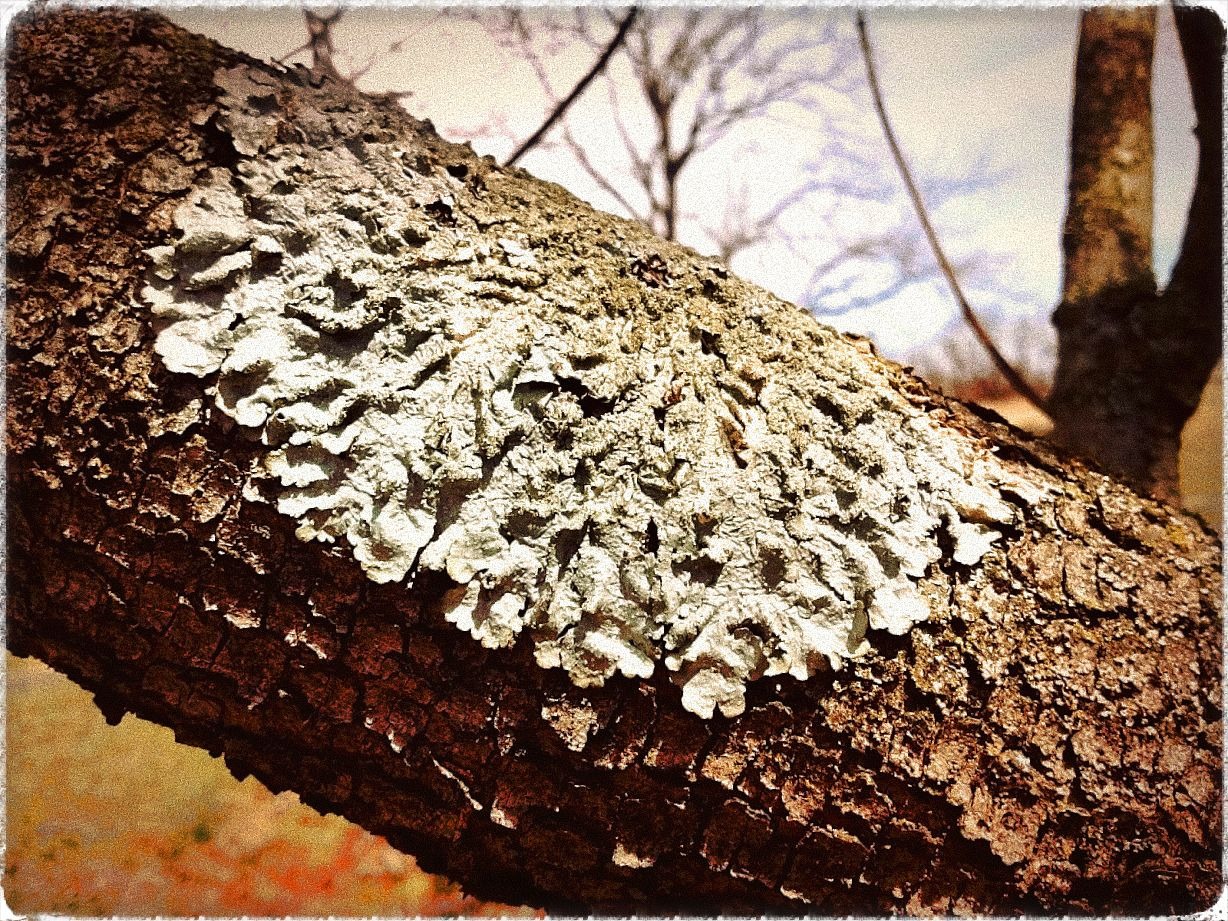
Lichen on a branch like a lace doily on the arm of a grandmother’s chair.
Brewer’s prompt today is to write an animal poem. As usual, when I leave the poem until the end of the day, my mind has scrambled down too many tunnels to form a coherent poem.
On the green carpet, a golden patch of sunlight. A question-mark cat.
Brewer’s prompt for the second day of National Poetry Month is a two-fer: Write a best case/worst case scenario poem. I can’t get Dickens out of my head on this one. I want to do a best of times/worst of times sort of thing. It’s only the second day, and I have left my poem until it’s almost too late to think.
Scenarios
There could be snow. There could be sun. We could all live to a ripe old age, or be mowed down by disease or accident in our youth, or our prime, or our golden years.
There could be an extra cup of coffee tomorrow, or no time for the necessary drug of the second cup. We could change our ways and turn it all around, or keep racing pell mell toward certain destruction.
We could save each other from our worst impulses or we could drive each other into bad decisions. We could choose at least the process of our fate instead of letting it rule us and wreck us.
It’s another April. This year, grades were due at 8 a.m. on April first, so I didn’t even consider Poem-a-Day until after I’d muddled my way through the day, taken a nap, and eaten supper. But here I am. It’s a strange compulsion, this drive to write a daily poem, knowing that the next four weeks will have their own share of other stresses, that there will come a day, mid-month, when I will hate the way poetry is holding the whip above my head, when I will write a grocery list and call it a poem, just to get through the day. But now, on the first day of the month, everything seems bright and shiny, and I feel up for anything.
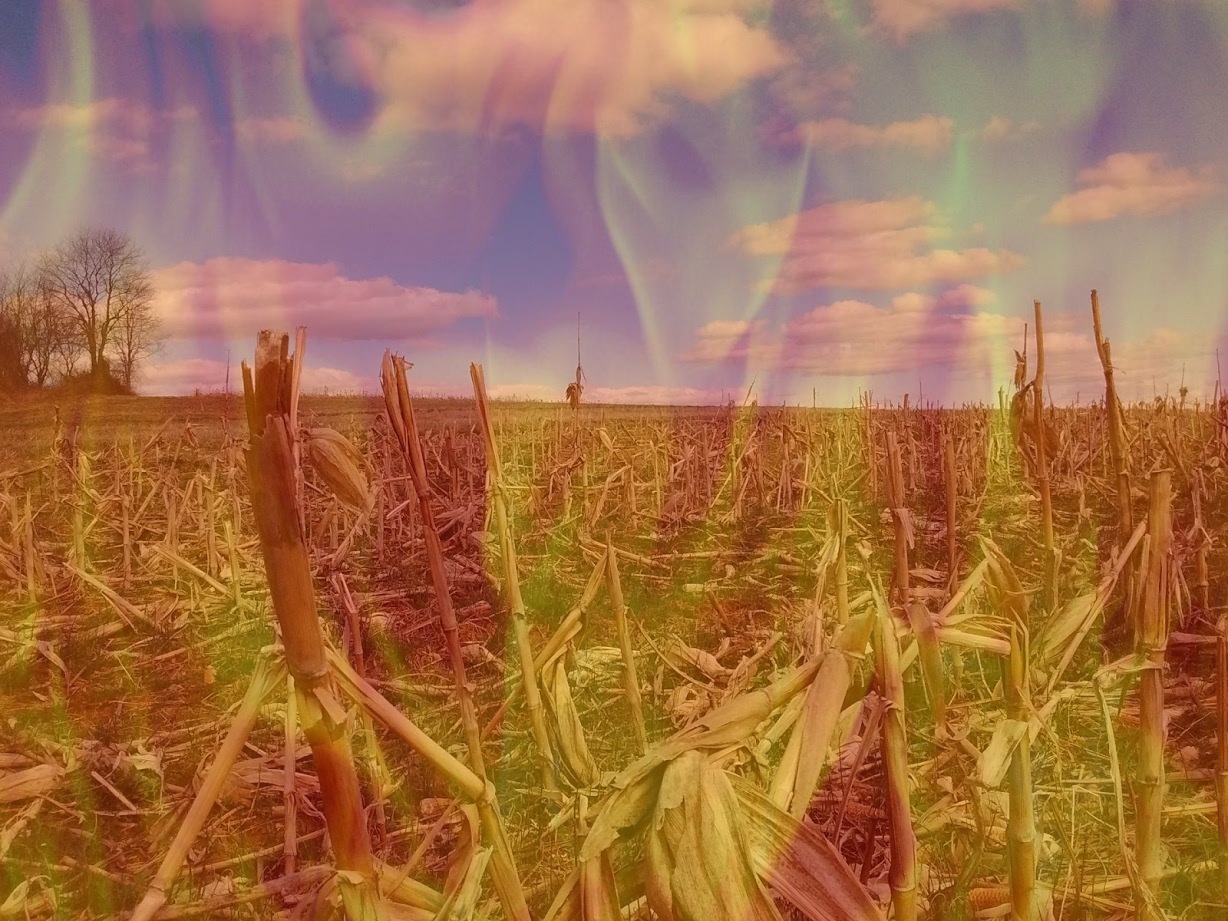
Brewer’s prompt today is to write a morning poem. I worked up a photo of this morning’s magenta cloud in a blue sky to go with it.
Finishing the Grades
The battle cry of yesterday’s ghost startled me into morning at precisely 4:38 according to the clock, and as I couldn’t wrestle the monster back into oblivion, I strapped on the day like a rusty sword and went downstairs in the chilly dark, to coffee and a blue screen, to the silent dread of numbers on a page, and the certainty of this day’s wave of work receding, while the pull of the next wave began its undertow toward the rising sun.
During the season of Lent, the worship materials for the Mennonite Church suggest a more ritualized confession time, not particularly about confessing sin, but expanding it to confess what we believe. As part of the ritual, a few people each week are asked to come forward and bring their confessions in the form of a poem or a piece of art or a story or a reflection of some sort. Today, I have been asked to be part of the ritual, answering the question: “Who will trust in God today?” Here’s my poem:
Whom shall we trust?
When hurricanes and charlatans
destroy the weak?
When the meek are set
to inherit a world laid waste by greed?
When human need bats last,
long after lust for money, sex, and power?
Whom shall we trust
in this hour when so much has been lost?
When the cost seems too high
for such a simple thing
as resting in belief
that the Holy One has time
for grief about our trials and tribulations.
The pillars of the past no longer hold.
They’ve had feet of clay all along,
and wrong upon wrong upon wrong
has brought the ancient houses down.
There’s no more room here for illusion.
How, then, shall we trust?
Shall we just ignore the lancing fear
that tears our sense of safety from its moorings?
That bears us outward into territories
we’ve not known before?
Perhaps it’s not a matter
of ignoring what we face,
but rather an attempt
to place our anxious thoughts
within the context of the Greater Power.
I will put my trust in Mystery, in that ineffable presence we call God, in the Knowable Unknowing, and in the One who put on shoes like us and trod the roads we walk, and spoke as one who knew the course of human suffering. I’ll trust us to the Holy Wind of Spirit, who hears our songs and knows our fears, who causes us to rise, though we resist; in our resistance fills our sails, the wind that pulls against the kite and makes us rise to higher height.
Perhaps nothing can be truly known, no comfortable future gardens sown with seeds of certainty. But we can trust the certainty of seed, the trusty breeze of Spirit and the rains of the Creator on these fields we bear within us.
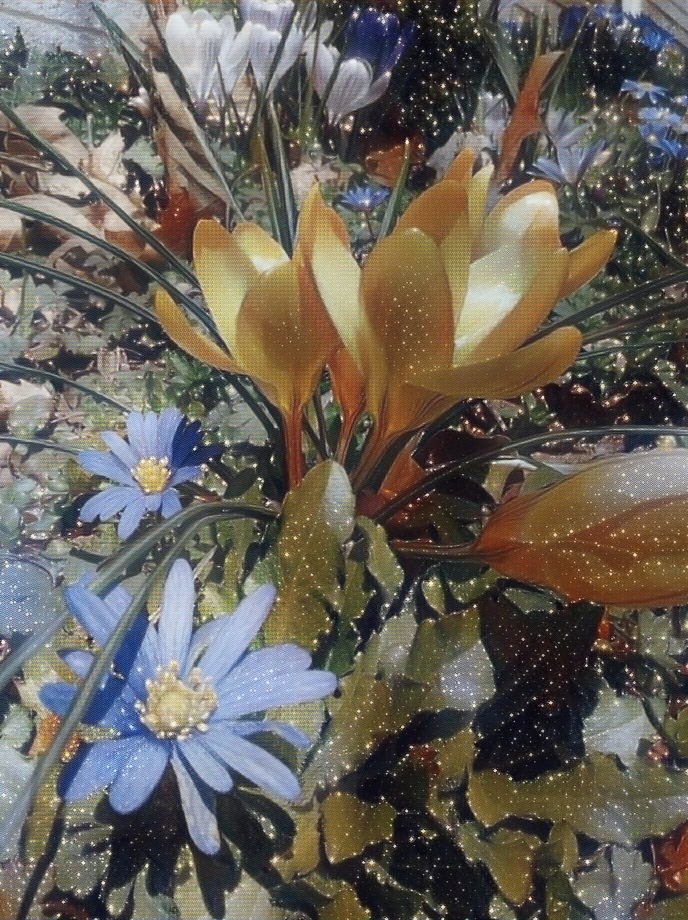
Gratitude List: 1. The Little Sisters buzzing for pollen among the crocus and anemones 2. A fun afternoon of pond play yesterday with my kid 3. This man who makes the most amazing birthday cakes 4. The opportunities for my soon-to-be-teenager to learn to do the tech things he loves 5. Summer break is on its way
We are two days in to the season of Awakening, of Hatching, of Breaking Open. Two days in, through wind and sunshowers, through gusting rain and rushing cloud. Last year, on the second day of spring, a foot of snow fell in the hollow. This year, a seemingly endless drench of rain.
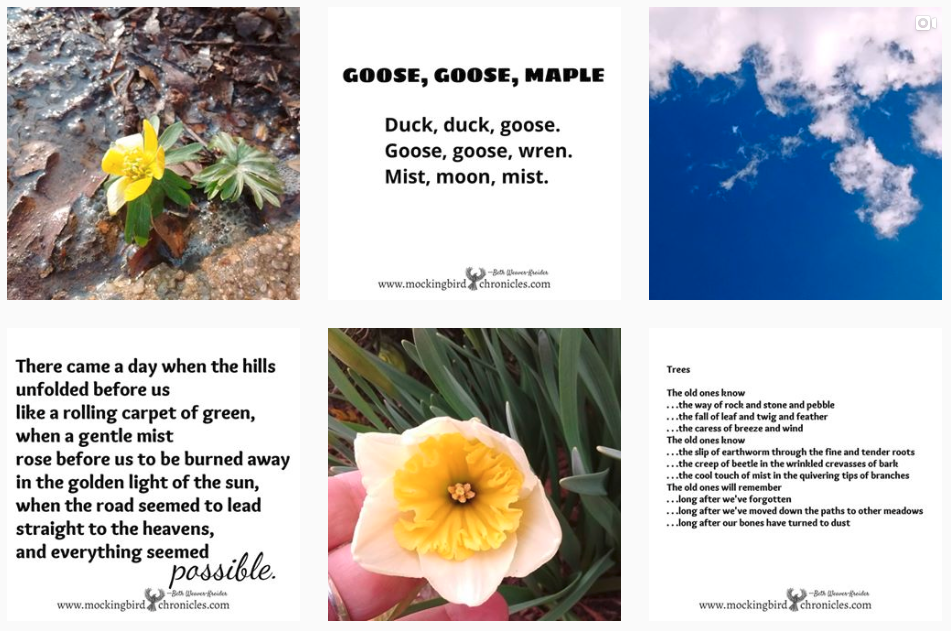
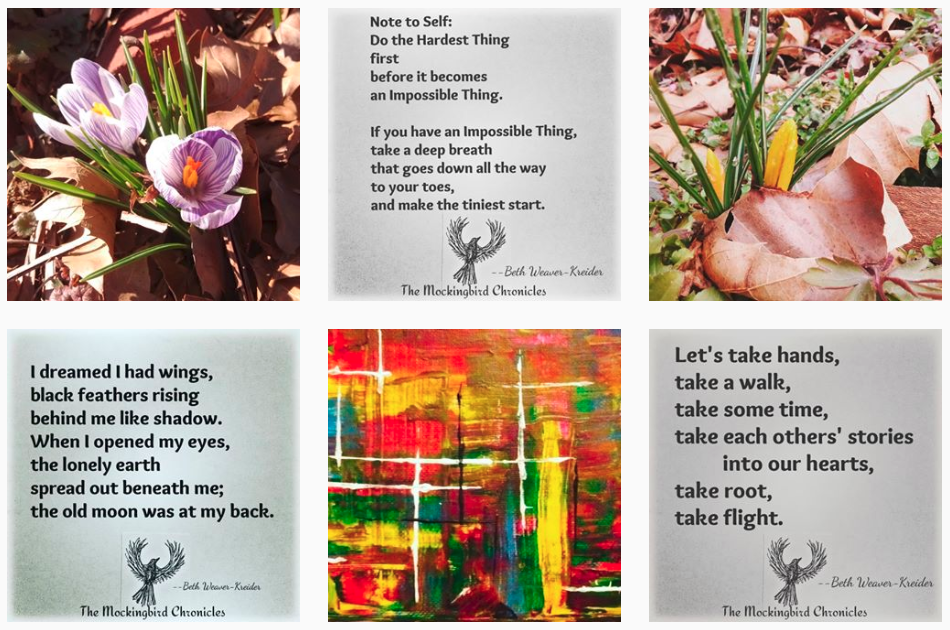
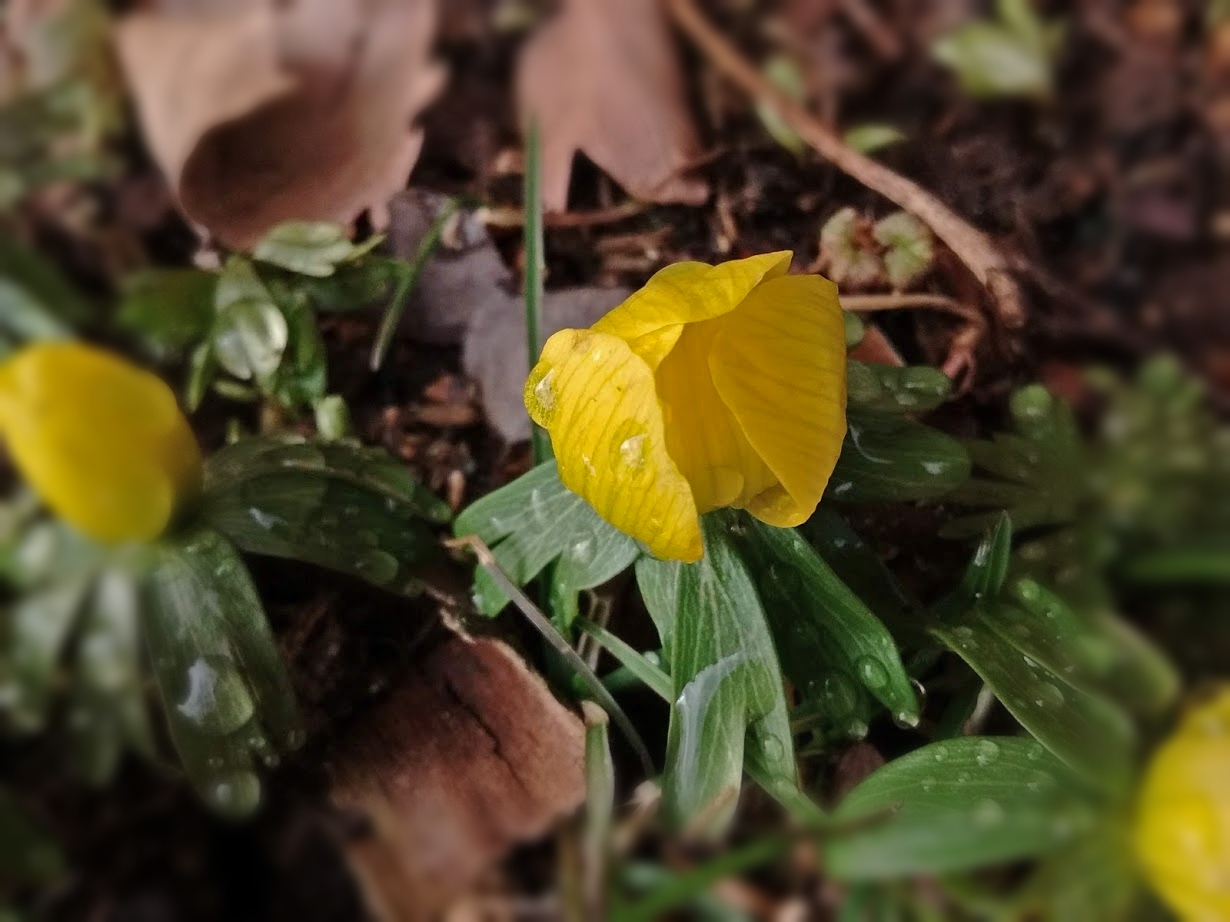
In the season of Brigid, back in February, we felt the Earth stirring, noticed the sap rising, watched pull toward birth and sprouting. Now we feel the promise, watch the winter aconite drop seeds for next years golden cups, and Persephone’s footprints–all shades of crocus–springing up across the lawns, uncontainable by flower beds.
What, in you, is hatching now? What thing, which has lain long and silently within you like a seed in the darkness, now seeks the sun and breezes? Hold that thing within you, like a seed. See the rough, hard casing which has protected it in its dreamstate. Breathe in the sun of spring, the chill air biting as it enters, and feel your lungs, your belly, your capacity, expand. Watch the casing of your dreamseed break open, and feel the roots push downward within you. Feel the sprout nosing upwards to the light and warmth of spring. What is being born within you? What new capacity? What new heartspace? What plan and purpose? Blessed be your seeds. Crack open. Seek the sun. Feel the rains of spring caress your growing roots.
Gratitude List: 1. The groundhog who is nosing around on the hillside behind the house 2. A day off, to ponder and paint, and catch up on the work 3. The fog of winter is lifting 4. Watching the children grow and become so gallantly themselves 5. The seeds which are sprouting
Today I am home from school with a sick child. It’s a nice chance for some slow, quiet time in between checking his temperature and beating him mercilessly at a game of Monopoly.
It’s Ash Wednesday, the beginning of that 40-day journey before Easter, a moon-bound season between the season of Brigid and the season of Ostara. As spokes on the eight-pointed solar wheel, Brigid and Ostara occur on the same days every solar year: Groundhog’s Day and Spring Equinox, ancient celebrations of the quickening of life in the earth, and the time of hatching and birth that is spring. But Lent is fluid, floating along the surface of the solar year, woven into the cycles of the moon and its dance with that Equinox sun. On Brigid’s February morning, we look to our shadows and consider whether the light we have within us will serve us until the spring. We take stock of our inner reserves and resources. In Lent, we take that question further, considering the question of enough.
During Lent, we look inward and wonder at the holes and spaces within. We see our lack, and instead of shrinking away in fear and despair, we say, “Yes,” and “Yes” again. Here is who I am. I know that I can be one who betrays the Holy One, one with the potential to deny my beloved. I know how I can cringe in fear, hide in shadow, whimper and whine in dread and shame. And I know, too, that I can walk toward those shadows within myself, because only in walking through those shadows will I encounter the shining lights that sparkle on the other side–also within me.
Last night, I gathered with a group of colleagues and students from my school to participate in the first of five Racial Justice Trainings (workshops? seminars? mentoring sessions?) that will happen throughout the spring. During the evening, our facilitator, Dr. Amanda Kemp, challenged us to keep a journal during these weeks of trainings, to ground and center ourselves so that we can hold space for transformation, to walk toward our fear, to challenge our assumptions and implicit biases. It feels to me like just the discipline to take up on this moon-clad journey toward Easter, to consider this time of training as my Lenten Work.
So often we get Lent wrong. We think we have to do penance for our evil ways, to enshroud ourselves in shame, to bewail our miserable selves. But when we simply throw it all off as just an exercise in self-flagellation, I think we get it wrong, too. This is a time to look realistically at who we are inside, what our strengths and our failings are. Lent is a time of discipline–not beatings and beratings, but careful training and thoughtful self-education. Amanda inspires me to take hold of this coming season as a time to consider my accountability, to look at the ways in which I participate in the unjust systems of today, just as the religious elite at the turn of the millennium participated in the destructive systems of their day. In this season, I commit myself to assess my inner world, to take stock of my role in the breaches and breaks, to walk toward my fears, to become a mender and repairer of the web.
This morning on the way to school, a long, rangy V of geese flew over the highway. It took me a moment to realize that they were snow geese rather than the Canada geese we see almost every day. A few miles later another V slid through the low clouds, this one in perfect formation, only a dozen or so birds, and again, I needed to re-arrange my sense of what I was seeing. This was no flock of geese, but a small flock of swans, their long necks a clear sign of who they were.
A week or so ago, my friend Suzy and I were talking about what swans mean: grace, flow, surrender to what is, trust in the process. I needed that conversation. I have been feeling like I haven’t been trying hard enough to figure out how to make more time in my life to write. I feel guilty because I can’t keep up with the work of teaching, and then guiltier still because I am pushing the writer’s life aside while I try to make peace with the grading. Surrender to the flow, said Suzy. Abide. Trust. Stop trying to push the river. Flow with it instead. I don’t know quite where that leads me toward making peace with my teacher/writer divide, but it eases the pressure.
And today the swans, following the geese, trailing behind them those words: “You do not have to be good.” Because that’s always what the geese say, since Mary. And today in class, a student did a presentation on a poet. His poet was Mary Oliver. And his featured poem? “The Wild Geese.” So it’s message upon message upon message.
There are words racing across the sky, in birds, in snowflakes, in cloud formations. And flowing in the rivers and streams, across lakes and oceans. And scattered in pebbles and plant-life all around us on the earth. So much to learn from. So much to listen to. So many texts to be read and understood.
Gratitude List: 1. Swans and snow geese, and the Canadas too. 2. The talented teamwork of the cast of our school’s musical. They were amazing! 3. Leaning in to the hard questions 4. Reconciliations 5. Tea
May we walk in Beauty!
Monday’s Messages:
“Dominator culture has tried to keep us all afraid, to make us choose safety instead of risk, sameness instead of diversity. Moving through that fear, finding out what connects us, revelling in our differences; this is the process that brings us closer, that gives us a world of shared values, of meaningful community.”
―bell hooks, Teaching Community: A Pedagogy of Hope
“Especially now, when views are becoming more polarized, we must work to understand each other across political, religious and national boundaries.” ―Jane Goodall
“When the people were great stones
we silently watched the dawn
we listened to the wind rushing over the mountains
we spoke the language of mist and dreams
and we could feel the pulsing rhythm
of the living heartbeat of the Earth.”
―Beth Weaver-Kreider
“A woman cannot make the culture more aware by saying ‘Change.’ But she can change her own attitude toward herself, thereby causing devaluing projections to glance off. She does this by taking back her body. By not forsaking the joy of her natural body, by not purchasing the popular illusion that happiness is only bestowed on those of a certain configuration or age, by not waiting or holding back to do anything, and by taking back her real life, and living it full bore, all stops out. This dynamic self-acceptance and self-esteem are what begins to change attitudes in the culture.”
―Dr. Clarissa Pinkola Estes
“Compassion is not a relationship between the healer and the wounded. It’s a relationship between equals. Only when we know our own darkness well can we be present with the darkness of others. Compassion becomes real when we recognize our shared humanity.”
―Pema Chödrön
“Ours is not the task of fixing the entire world at once,
but of stretching out to mend the part of the world
that is within our reach.”
—Clarissa Pinkola Estes
It’s a little like flying, but it’s more like falling without touching the ground. When I was a child, I did it frequently enough in my dreams that I was convinced I could do it in waking life, too. Perhaps I could.
I’m trying to get somewhere fast in a dream, usually down a hillside. Instead of the frustrating and dreaded molasses-feet dreams, in which my feet won’t move, no matter how hard I will them, in a skimming dream I am so intent on getting where I am going that I stop actually putting my feet on the ground. Momentum carries me down the mountainside and I just keep my feet off the surface, sort of like skiing on air. Last night’s mountainside was really muddy, and I knew I’d get stuck, so I just coasted downhill through the air. It was a little hairy at moments, getting through the trees, and worrying that I might run into a bear.
It was exhilarating, feeling it happen, remembering how to do it with a body-memory similar to riding a bike. This morning, I feel it like I did when I was seven, that inner knowing that I can ski the air. Perhaps it’s a message from my Deep Self that I can slip the leaden bonds of winter, and move through the world again with more grace and ease.
Has it been worse this year? I think it’s been worse. The dullness, the bone-weariness, the loss of zip and vim. The sleepiness compounded by insomnia, anxiety-ridden, with sudden nighttime joltings-awake. The Wintertime nightbird sitting on the chest, crying, “Shame! Loss! Devastation! Rage! Woe!” The burden. The Burden.
Winter is an enormous, lumpy, grey gunny sack full of dirty laundry that I must carry around on my back. It gets heavier and heavier by the day. Some years, it’s an act of sheer, daily endurance to make it through. There’s no extra energy to look around and see just how grey it’s all become. I just have to plod forward into the mist.
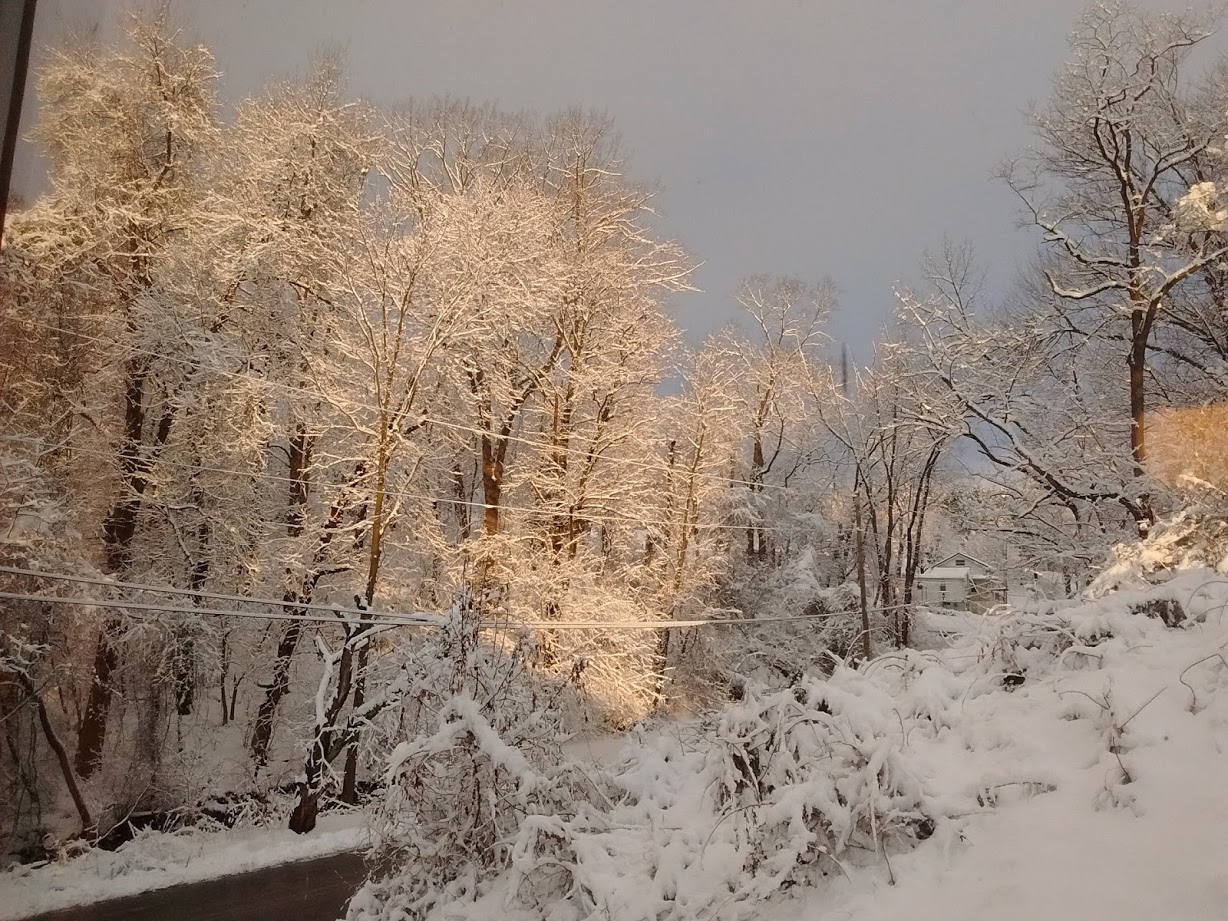
There are momentary compensations—shining blue days when sun sparkles on ice and snow, sky-heavy days when snowflakes whirl and dance through the air. Yes, momentary compensations. Breaks in the clouded heaviness. Few and far between. Just enough to keep me trudging in the direction of that pinprick of light in the far distance ahead.
And then the light begins to creep back in. The momentary compensations begin to string themselves together like shining beads. People like me, the ones who’ve been caught in Winter’s steely grey net—we lift our heads like small creatures catching a new scent on the breeze. We feel the wind in our whiskers, smell the freshness of the air, and catch a flashing glimpse of yellow aconite or blue-violet crocus.
We’ve still got a bit of a trudge until we can lay down the burden of Winter and roll in the warm grass of Spring, but knowing that the end is in sight makes the Burden lighter. It’s one of those things, for me, where I don’t know quite how bad it is until I’m coming through the other side. When you’re focused on the endurance, you don’t stop to wonder if this time around is worse than the last one. You just put the next foot forward.
And now, I have those shiny beads: earlier sun in the mornings, the aconite slipping out of the mud of the garden, the birds of morning singing their Springtime songs, the geese, the swans, the caress of warmth in the afternoon air.
Gratitude List: 1. Morning birdsong and the Hope of Spring 2. The fun of the Youth Group Auction, a night when we all come together to support the young people. 3. This kid here at the table next to me, carefully and deliberately putting together his new Ertl tractor model, which he got at the auction. He gets frustrated and stops, saying he can’t do it. Then his curiosity and will overcome his frustration, and he gets back to it, solving the problems that seemed insurmountable. (Hmm. I think I am telling myself a story to live by.) 4. Magical conversations. Not simply deep and thoughtful, but full of synchronicities that fill the air of the room like a humming web. Like it’s the two of you talking, and then maybe fairies or angels joining in, the Great Mystery guiding the stories and images. 5. Watching these children grow. Sometimes, I am sad that the babies are gone, gone, gone. But they are Becoming so delightfully themselves. Yesterday, the dentist removed a baby molar from Child 1, to make room for the big tooth coming in. It was his last baby tooth. Another step toward adulthood.
May we walk in Beauty!
Words for Sunday Meditation:
“Humanity, take a good look at yourself. Inside, you’ve got heaven and earth, and all of creation. You’re a world—everything is hidden in you.” —Hildegard of Bingen
“Because that’s what Hermione does,’ said Ron, shrugging. ‘When in doubt, go to the library.” ―J.K. Rowling
“Crystals are living beings at the beginning of creation.” —Nikola Tesla
“Don’t limit a child to your own learning, for she was born in another time.”
― Rabindranath Tagore
“I wanted you to see what real courage is, instead of getting the idea that courage is a man with a gun in his hand. It’s when you know you’re licked before you begin, but you begin anyway and see it through no matter what.” —Atticus Finch in To Kill a Mockingbird, by Harper Lee
“The real damage is done by those millions who want to ‘survive.’ The honest men who just want to be left in peace. Those who don’t want their little lives disturbed by anything bigger than themselves. Those with no sides and no causes. Those who won’t take measure of their own strength, for fear of antagonizing their own weakness. Those who don’t like to make waves—or enemies. Those for whom freedom, honour, truth, and principles are only literature. Those who live small, mate small, die small. It’s the reductionist approach to life: if you keep it small, you’ll keep it under control. If you don’t make any noise, the bogeyman won’t find you. But it’s all an illusion, because they die too, those people who roll up their spirits into tiny little balls so as to be safe. Safe?! From what? Life is always on the edge of death; narrow streets lead to the same place as wide avenues, and a little candle burns itself out just like a flaming torch does. I choose my own way to burn.” ―Sophie Scholl
“I wanted a perfect ending. Now I’ve learned, the hard way, that some poems don’t rhyme, and some stories don’t have a clear beginning, middle, and end. Life is about not knowing, having to change, taking the moment and making the best of it, without knowing what’s going to happen next. Delicious Ambiguity.” ―Gilda Radner
“You can safely assume you’ve created God in your own image when it turns out that God hates all the same people you do.” —Anne Lamott
“And these children that you spit on
as they try to change their worlds
are immune to your consultations.
They’re quite aware of what they’re going through.” ―David Bowie
“A revolutionary poem will not tell you who or when to kill, what and when to burn, or even how to theorize. It reminds you. . .where and when and how you are living and might live, it is a wick of desire.” —Adrienne Rich
“Justice is what love looks like in public.” —Dr. Cornel West
“Deserves it! I daresay he does. Many that live deserve death. And some that die deserve life. Can you give it to them? Then do not be too eager to deal out death in judgement. For even the very wise cannot see all ends.” ―Gandalf, J.R.R. Tolkien, The Fellowship of the Ring
“There may be times when we are powerless to prevent injustice, but there must never be a time when we fail to protest.”
―Elie Wiesel
“As my sufferings mounted I soon realized that there were two ways in which I could respond to my situation―either to react with bitterness or seek to transform the suffering into a creative force. I decided to follow the latter course.” ―Martin Luther King Jr.
“It helps to think of our swamps of despair as the necessary muddle before clarity. Actually, swamps are incredibly fertile places full of life. In mythology the heroine must cross such a place in her darkest hour, where she comes to face her unlived life―meeting each of the divine allies disguised as regret, doubt, and insufficiency which swell up from the mud of her despondency. If she is willing to consummate the full encounter, they will reveal themselves in service to the vitality of her true being.” ―Dreamwork with Toko-pa





 Mockingbird Chronicles