Getting Back to Work

In the dream: I am working in an office. It seems like it’s a fairly new business, or else a lot of the employees are new, because people are trying to figure out what is the best way to make things run efficiently and equitably. There’s a general discussion about whether a couple should be allowed to do their work while snuggling together on one chair, as one couple is doing.

It’s a very open office plan, with many work stations set up on tables, and cubicles that are more like library carrels, and the walls between rooms are glass. People are bustling about, doing their work. One guy, dressed in a green shirt and a tie with wide black and white stripes, is trying to hand out Christmas cards, but he doesn’t know who is who, so a group of us is pointing out people for him. Everyone is dressed very formally, but playfully so, with bright colors and prints.

My friend works as an administrative assistant, and is having terrible luck getting people to sign documents for her. People aren’t answering their phones or returning her emails. I start to ask whether her husband, who is also an admin assistant in the company, manages to get people to respond, and she snaps, “Of course they respond to him. He’s a man.”

Retelling this dream exhausts me. It puts me on edge much more than it seems it should from the surface. Perhaps it’s a dream about getting back to school tomorrow, getting the work done, even when it seems like no one is really listening and responding.

Mid-day edit: I just accidentally opened my camera on the selfie side and it brought back some troubling images from a dream fragment. I look in a mirror, and my face looks kind of red, and a few moments later I look again, and my face is covered in a raised rash. My chin and cheeks are swelling. I don’t remember what happened after that.


Gratitudes:
1. A good long walk at High Point yesterday.
2. Sorting through the ideas to prioritize projects and create plans for how to finish some of them.
3. Ham and bean soup. Leftover Christmas ham in leftover black-eyed peas from New Years, with leftover roasted roots from another meal. The beets turned the soup a beautiful borschty red.
4. The trees of Goldfinch farm: sycamore and walnut, locust and willow and oak, maple, and the poplar stump, who is so incredibly alive.
5. The sounds of birds outside. We haven’t even opened the curtains, but the wren and the nuthatch have been chattering on the balcony where Jon put up a thistle feeder and a suet feeder.

May we walk in Beauty!


“For last year’s words belong to last year’s language
And next year’s words await another voice.
And to make an end is to make a beginning.”
—T.S. Eliot


“Jesus was not brought down by atheism and anarchy. He was brought down by law and order allied with religion, which is always a deadly mix. Beware those who claim to know the mind of God and are prepared to use force, if necessary, to make others conform. Beware those who cannot tell God’s will from their own. Temple police are always a bad sign. When chaplains start wearing guns and hanging out at the sheriff’s office, watch out. Someone is about to have no king but Caesar.” —Barbara Brown Taylor


“He said the wicked know that if the evil they do is of sufficient horror men will not speak against it. That men have only stomach for small evils and only these will they oppose.”
—Cormac McCarthy, The Crossing.


“Before you tell your life what you intend to do with it, listen for what it intends to do with you. Before you tell your life what truths and values you have decided to live up to, let your life tell you what truths you embody, what values you represent.”
―Parker J. Palmer


“We shall not cease from exploration, and the end of all our exploring will be to arrive where we started and know the place for the first time.”
―T. S. Eliot


We need for the earth to sing
Through our pores and our eyes.
The body will again become restless
Until your soul paints all its beauty
Upon the sky.
—Hafiz (Ladinsky)


“Perhaps the uprising of women around the world is the earth’s own immune system kicking in.”
—Nina Simons, Bioneers


“The trouble with having an open mind, of course, is that people will insist on coming along and trying to put things in it.”
—Terry Pratchett

Listening in Dreams

One of the ways I try to remember my dreams is, when I wake up in the night after a dream, I note the main points in my head before I fall back to sleep, and then in the morning, I gran those little phrases, like pieces of paper swirling in a wind, and try to tack them down in writing first thing in the morning. There were several of these last night, but the clearest, most compelling dream was right as I was waking up.

I am at some sort of church service/picnic (I do not recognize the people there from waking life). I know that at 3:30, as things are winding down, I am to meet with one of the women about some sort of planning, but I forget, and by the time my child is getting antsy and begging me to go, it’s 3:58. Another woman approaches me. Apparently, she had written me an email (and I hadn’t seen it) that she wanted to meet with me at 4:00 to talk about her child.

We sit down to talk. She pulls out papers, color photocopies of photographs and notes she’s been taking. Her teen child is coming out as trans, and she wants to talk to me about it. She is open and accepting of the child, at least on the surface, but she is agitated. She worries about what her conservative Mennonite family will think. She worries about how the relatives in Argentina will respond. She keeps tearing the papers. At one point she gets up to go ask someone else a question, and I gather up the pieces of paper, wondering how they could be so shredded–I hadn’t seen her tearing these.

This one seems–perhaps deceptively–straightforward. I teach at a private Christian school. I have very intentionally made it part of my role to be ready to listen to parents of LGBTQ+ kids, to hear their questions and worries, to try to walk them through their own anxieties and stereotypes, to help them find their way to expressing their deep unconditional love for their children in the midst of their own confusion. Perhaps the dream points to deeper agitation, maybe for myself as well as the parents. The torn pieces of paper stand out to me, as well as the frustration of not being able to finish a sentence, not being able to help the mom relax enough to settle into an understandable narrative.

There’s also my own anxiety about keeping appointments. I missed the one I had planned, and almost missed this one because I hadn’t checked my email. Ugh. I hate the way meetings and appointments disrupt the flow of a day. That’s been one of the side blessings of this pandemic time–fewer meetings.


Honoring collective work and community responsibility, ujima, with my friends who are celebrating Kwanzaa.
I love that ujima comes after kujichagulia, self-determination. When we each get our own house in order, our own mojo going, then we can work together to build and strengthen our communities. Here in these days of stillness as the earth is poised to swirl back into the Long Day, what a wonderful idea to contemplate: How can I carry my own energies into community-building in the New Year?
And of course, Kwanzaa is an African American holiday, so the question for me becomes: How can I use the privilege I was born with to support and strengthen the community-building work of BIPOC?


“I’m restless. Things are calling me away. My hair is being pulled by the stars again.” ―Anaïs Nin


“We do not think ourselves into new ways of living. We live ourselves into new ways of thinking.
It seems that we Christians have been worshiping Jesus’ journey instead of doing his journey. The worshiping feels very religious; the latter just feels human and ordinary. We are not human beings on a journey toward Spirit, we are already spiritual beings on a journey toward becoming fully human, which for some reason seems harder precisely because it is so ordinary.” ―Richard Rohr


“Language is very powerful. Language does not just describe reality. Language creates the reality it describes.” ―Desmond Tutu


“We enter solitude, in which also we lose loneliness. True solitude is found in the wild places, where one is without human obligation. One’s inner voices become audible. One feels the attraction of one’s most intimate sources. In consequence, one responds more clearly to other lives. The more coherent one becomes within oneself as a creature, the more fully one enters into the communion of all creatures.” —Wendell Berry

Fragments and Anxieties

So many random dream images from last night. They’re fragmented, but they all seem connected somehow.

Josiah and I buy sandwiches in some sort of sunny outdoor courtyard. People are setting up for some sort of event, so we put together a couple of chairs and sit down. One of the custodians from school makes a chair for himself and eats with us.

Jon and I are in a classroom. I think we’re back in elementary school. We’re ahead of the class, so we get to sit near the back and read the next material on our own. The class is finished with the work, but the teacher can’t find the test. I have little plastic animals set up all around my desk and on the windowsill behind me. I’m a little claustrophobic in the space, worried I’ll send my little animals tumbling if I move.

I’m in a Victorian sort of house with two other young women. It’s the next class (after the one in the previous paragraph), and we’re reading a Shakespeare play together. The one woman gets bored and wanders off. I am helping the other to read the parts. It sounds more like Jane Austen than Shakespeare. The other woman tires out, but we’ve been reading for half an hour, so we quit.

I am frantically calling people and trying to find out where my baby is. Someone took him and said they’d bring him right back, but I can’t get in touch with anyone.

I’m on a sort of courtroom, and the proceedings have been going on for hours. I’m bored. Suddenly I notice that the one lawyer is terribly sick. His eyes are red and puffy and he’s sneezing. No one else seems to notice, but I am frantic about finding my mask and putting it on. I move to a corner of the room near a window.

I find a telephone and try to remember how to dial my parents’ number to tell them about the missing baby. This never goes well in dreams, but this time when I pick up the old-fashioned receiver, my mother is right there, on the other end of the line! I think that perhaps everything is going to be okay.

I decide to rid my bike through the countryside to get home to my parents. This is common in dreams for me. I get to a place that is familiar to my dream-self, except that the corn has grown up on all the corners. Someone has placed blankets on the corn all around, as if they needed somewhere to hang a thousand blankets to dry. The road to the right should be the right way to go, but it seems to curve up ahead in a way that it isn’t supposed to. I ride several yards up toward the curve, but it actually turns back upon itself in a loop and ends up heading back the way I have come. Someone has planted their corn across the road! Just as I decide to ride back the way I have come, I wake up.

The odd thing in the waking up was that I thought I was hearing people speaking, so faintly it could have been my imagination (which it probably was). I thought maybe one of the kids was up really early, listening to a video somewhere in the house. But there’s no sign of anyone. Maybe it was the heat coming on that sounded in my dreambrain like people talking.

This set has a lot of little anxieties: the lost child, the inability to get to my parents, the unprepared teacher, the claustrophobia, the coronavirus, the confusing pathway home. So many of these are my dream-tropes for lostness and confusion. In each one, I am just going along, trying to muddle through each scene the best I can, which is what Jon and I are doing here, trying to make the best of this strange year. This will be a lovely introverts’ holiday, all of us together here, but we also need our people, and we can’t quite see how the road ahead will lead us to them. It seems to be recursive, bending back upon itself.

If there’s a message here, it’s to tend to my anxieties, to notice how the worry affects my choices.


Gratitude:
1. The messages of dreams
2. Quiet holidays
3. Loving hearts, even at a distance
4. There will be an end to this
5. All the people who are working to keep us safe, and to bring an end to this.

May we do justice, love mercy, and walk humbly in Beauty!


Someday soon, we all will be together, if the Fates allow. . .”


“Our goal should be to live life in radical amazement. . . .get up in the morning and look at the world in a way that takes nothing for granted. Everything is phenomenal; everything is incredible; never treat life casually. To be spiritual is to be amazed.” —Rabbi Abraham Joshua Heschel


“From the halls of power to the fortress tower,
not a stone will be left on stone.
Let the king beware for your justice tears
every tyrant from his throne.
The hungry poor shall weep no more,
for the food they can never earn;
These are tables spread, ev’ry mouth be fed,
for the world is about to turn.
My heart shall sing of the day you bring.
Let the fires of your justice burn.
Wipe away all tears,
For the dawn draws near,
And the world is about to turn.”
—Rory Cooney, from “Canticle of the Turning”


Making the House Ready for the Lord
by Mary Oliver
Dear Lord, I have swept and I have washed but
still nothing is as shining as it should be
for you. Under the sink, for example, is an
uproar of mice–it is the season of their
many children. What shall I do? And under the eaves
and through the walls the squirrels
have gnawed their ragged entrances–but it is the season
when they need shelter, so what shall I do? And
the raccoon limps into the kitchen and opens the cupboard
while the dog snores, the cat hugs the pillow;
what shall I do? Beautiful is the new snow falling
in the yard and the fox who is staring boldly
up the path, to the door. And still I believe you will
come, Lord: you will, when I speak to the fox,
the sparrow, the lost dog, the shivering sea-goose, know
that really I am speaking to you whenever I say,
as I do all morning and afternoon: Come in, Come in.


“I am a hole in a flute
that the Christ’s breath moves through
listen to this music
I am the concert from the mouth of every creature
singing with the myriad chorus” —Hafiz (Ladinsky)


“May I be the tiniest nail in the house of the universe, tiny but useful.” ―Mary Oliver


“We’re all just walking each other home.” —Ram Dass


“I learned from Whitman that the poem is a temple—or a green field—a place to enter, and in which to feel.” ―Mary Oliver

Season of Dreaming

This is the season of dreaming, these nights and days between the Solstice and Epiphany.
I mine my dreams in these days carefully, for words and feelings and images, symbols I can use to put the old year to rest, or to carry into the creation of the coming year.

This is going to seem more like a personal journal, perhaps, than a blog. In some ways that is what the blog is. Feel free to read along. I follow a fairly Jungian path to dream interpretation, looking at myself in the story of it, reading it like a fairy tale, watching for images and people to stand out to me, for relationships to reveal themselves. I try to write my dreams in present tense, so it draws me back into the moment of experiencing the dream. I am open to hearing your thoughts about symbols and archetypes in the dream. I tend to close myself off to “This is what your dreams means,” finding my inner world much more open to “This is what I see or hear in your dream.”

Last night: I am taking a student home. While people in my dreams are often archetypal stand-ins, this is an actual student in an actual class of mine right now, a sensitive and thoughtful young woman who has been finding this year to be an emotional roller coaster. We are in Lancaster. Parts of it are recognizably Lancaster, but much of it is dream creation. Also, we are not in a car. I am pushing her in a large stroller.

At one point, we get stuck waiting in traffic, and she starts to suggest we go left, but I am already on it. We pull out of traffic and go through a neighborhood which is almost entirely brick. Orange brick–big, rounded orange bricks. All the houses, the cobbled walkways, and the street itself. “We call this Peter’s thumbs,” she tells me.

I say that it’s good exercise to go up over this way, and she says, “Oh, I don’t believe in that whole weight loss thing.”

This touches a nerve for me because, while I am being really careful right now about not gaining more weight (I gained al lot in the spring of the pandemic), I make it a point to never ever use the words weight loss diet in front of students. So I make a little half-lie: “Oh, I just meant exercise. I want to be healthy and strong. I don’t care about diets and weight loss.” (This is the lie I tell myself in real, waking, life in order to try to make it a truth. When the numbers on the scale are troubling to me. Even at 53, I still struggle with body image.)

At one point our journey takes us up a street that’s more of a tunnel, underneath a heavy, dark skywalk. I’m talking more about exercise and deepening my lie about not caring about my weight. At the top of the hill, when we get into the light, I realize that she’s no longer in the stroller thing. I panic. I’ve lost her! She emerges from the doorway behind me: “Oh, I just thought I’d walk for myself for a little while.” She’s wearing an orange acrobat’s leotard.

That’s when the alarm goes off. As I was writing that, I kept getting flashes of the dream that preceded it, of a small blond boy (perhaps one of mine) following an older child around a camp. They cover themselves in mud. They run down to the river to wash. I have a moment of panic that the small child will drown, and have that moment of vision when I see myself diving into the muddy river, frantically searching for a drowning child, but it passes, and I hold back on my panic as they run laughing into the water.

I think this dream hits right at the center of my anxieties about parenting and teaching–the weight of responsibility, of protecting (both physically and psychically) the young ones in my care. Unfortunately, when I get anxious about the physical well-being of my children, I do get momentary visions of worst-case scenarios sometimes. I do find myself spooling out the dreads. My Dream-spinner was showing me that part of myself, I think.

And also about my own lifelong battle with learning to love being in this particular body, of dealing with shame for my up-and-down weight, of very intentionally not speaking of diet in front of students, particularly female students. In general, I think teachers and adults need to be open about our struggles with students, not spilling all our secrets and pain, but letting them know that we, too, go through challenges. But this whole diet thing is pernicious and insidious. Hearing others talk about dieting has always been a trigger for me, and I want to be extra cautious about that with students.

Like the panic about the boy in the river, I had a similar panic when the student (who is struggling in real life) approached the topic of weight loss. I felt the heaviness of being responsible for someone else’s emotional health. But the reality, at the end of the dream, was that I was not actually pushing her. She was coming out on her own power, and indeed, with grace and agility and strength, as an acrobat.

I think the words for this dream are: Responsibility, Care, Anxiety. Maybe Diet or Body Image. The color orange: Sacral Chakra. Tend to the creative and sensual.
I have no idea what the heck Peter’s Thumbs are doing in the dream!


Gratitudes:
1. When I cannot be with my beloveds, memories really do warm my heart
2. New things arising and old things passing out of the picture
3. Messages from the Dream-spinner
4. Today is the last day of school until January–I need this break
5. Today I am healthy. And I hope you are, too. Stay well.

May we do justice, love mercy, and walk humbly in Beauty!


“You were once wild here. Don’t let them tame you.” —Isadora Duncan


“There is really only one way to restore a world that is dying and in disrepair: to make beauty where ugliness has set in. By beauty, I don’t mean a superficial attractiveness, though the word is commonly used in this way. Beauty is a loveliness admired in its entirety, not just at face value. The beauty I’m referring to is metabolized grief. It includes brokenness and fallibility, and in so doing, conveys for us something deliciously real. Like kintsukuroi, the Japanese art of repairing broken pottery with powdered gold, what is normally seen as a fatal flaw is distinguished with value. When we come into contact with this kind of beauty, it serves as a medicine for the brokenness in ourselves, which then gives us the courage to live in greater intimacy with the world’s wounds.” —Toko-pa Turner


“God has scattered the haughty ones.
God has cast down the powerful from their places of power
and has lifted up the lowly.
God has filled the hungry with good things,
and sent the rich away empty.” —Mary


“No human relation gives one possession in another—every two souls are absolutely different. In friendship or in love, the two side by side raise hands together to find what one cannot reach alone.” —Kahlil Gibran


“Always there comes an hour when one is weary of one’s work and devotion to duty, and all one craves for is a loved face, the warmth and wonder of a loving heart.” —Albert Camus


“Be like a tree and let the dead leaves drop. ” —Rumi (Barks)


My heart is moved by all I cannot save:
so much has been destroyed
I have to cast my lot with those
who age after age, perversely,
with no extraordinary power
reconstitute the world.
—Adrienne Rich

Breathe and Pray

This morning, I wrote this:

Beloveds, I don’t really have much in the way of words to offer this morning, to wade through the bog of my own anxiety to offer hope or resilience. I’m here in my bog, listening. I need to be a teacher today, especially for students who are equally as enmired as I am.

Here in the anxious bog of me today, I sit like an angry old spider. I cast a line from me to you. Catch. Send out webs of your own. While we wait for things to ravel or unravel, we weave and spin and hold our own webs as steady as we may. We are stronger when we are together.

Black lives STILL matter.
Love is STILL love is STILL love.
Your name and pronouns STILL belong to you.
Your body is STILL your own.
You STILL have agency.
The Planet STILL needs us.
The elderly and vulnerable STILL need protection from the coronavirus.
STILL, nobody is illegal.
Justice is STILL important.


This morning felt so dire, so much a repetition of 2016. Jon and I both woke up at 2:30, and made the perhaps unwise choice to check the returns. My heart was racing, and I figured I wouldn’t get to sleep until I saw something to confirm or allay the anxiety. Look the wolf in the eye, they say. I felt in a visceral way how the anxiety and sense of tragedy of the 2016 election had lodged in my body, and how it replayed itself in the night four years later.

This afternoon, there are a few more reasons to hope. The morning, said Vassilissa’s doll in the Baba Yaga stories, is wiser than the evening. Today, the afternoon is wiser than the morning. Get some distance. Get some rest. Get some perspective.

It’s not over, and won’t be for a long time, but it doesn’t feel like we’ve completely shattered the Democracy quite yet. And the popular vote seems to be pretty definitely against the tyrant.

Here’s the one thing that sticks with me, however, like a grief: It wasn’t a clear and obvious win. My neighbors, good people and salt of the earth in so many ways, have not–by and large–passed the test, choosing instead to vote for white supremacy and patriarchy, for homophobia and transphobia, against the poor and the ill and the immigrants. And I do not know what to do with that.


I don’t feel like I can muster appropriate Gratitudes today. Perhaps a couple Commitments might stand in:
1. I commit to not respond smugly if Biden wins. I will express relief and hope if it happens (because I am human and must live my emotions), but I will not be smug, and especially I will try to be open to the pain and confusion of people for whom that is frightening, even though I do not understand it.
2. No matter who wins this election, I commit to standing for justice and compassion, for Black and Indigenous People and other People of Color, for LGBTQ+ folx, for women, for immigrants, for poor and houseless people, for all who are harmed by our systems. I commit to pushing whoever is president for the next four years (and other elected officials) to do right by the people, especially whose who have not been truly free and equal.
3. I commit to harbor no illusions that the lesser of two evils is the savior.
4. I commit to walk this together with you, my Beloveds, and to ask for help when I am sinking.

May we do justice, love mercy, and walk humbly. In Beauty.

Listening to Hummingbird

Wangari Maathai, the winner of the 2004 Nobel Peace Prize and founder of the Green Belt Movement in Kenya (and now around the world), told a story about a hummingbird.

When the great forest was on fire, and all the animals were fleeing for their lives, the tiny Hummingbird zipped to the river, gathered a beakful of water, and zipped back to release the water onto the raging flames. Again and again, she carried her tiny beakfuls of water to try to put out the flames. The other animals noticed, and told her how futile her efforts were, but Hummingbird kept on and on, believing that it was her duty–no matter what–to do her one little thing.

Perhaps some of the other animals were inspired to get down to work, to do their own little thing, to pass on the hope of a thousand small actions. Perhaps the fire raged on despite their efforts. Perhaps they held it back. Perhaps they even put it out in the end.

During these days which, in the deepest of the dark insomniac nights, feel a little like the Beginning of the End of Things, Hummingbird has been sipping sweetness from the petunia basket outside my window, resting sometimes on the wire, nabbing gnats out of the air, hovering right at the window and peering in at me.

When I brought my first baby home from the hospital more than 14 years ago (a world ended and a world began with his birth), I settled into the recliner, exhausted and full of great satisfaction and wonder, to nurse the tiny person who had entered our world. Looking up from the babe, I saw Hummingbird hovering at the window for what seemed like ten seconds or more (an eternity of seconds), and she seemed to be watching the New Person, and marveling with me. In the succeeding years, I have marveled back at the wonder of her own young, at their tenacity and resilience, surviving lashing storms in their bottle-cap-sized nest. At their first fledgings. At the blur of their wings as they sip sweetness. At the self-contained unself-consciousness of their existence.

And now, in a time when I am bending all my mental and emotional and physical will toward resilience and tenacity, when I am terrified for my children, my students, my parents, my self, I have Hummingbird in my days, quietly doing her thing, going about her business, checking on me through the window.

She leaves me with questions. Perhaps you want to ponder them, too:
* What, in these days of going back to school, will be your sips of sweetness to fuel you through the moments of high challenge and frustration and worry?
* What, as Wangari Maathai asked, is your “one little thing”? What is that thing you will do to stem the tides of destruction, even when it seems like only a beakful of water?
* What does resilience look like to you? (For me, I want to picture myself in my classroom BEING tenacious and resilient.)
* In the story, Hummingbird simply did her work and did not ask for help. I am not Hummingbird, and she leaves me with that question, too: How will you remember to ask for help when you need it?

So. Whatever our tasks in this time of great trouble, whatever our capacities to meet the challenges before us, let us fly with strength and power, knowing that we are doing our part. Around us are so many who are joining in the work. Let us be resilient and vulnerable, earnest and tenacious, willing to ask for help when we need it, offering to give others a spell when they reach exhaustion.

As the Talmud says: “Do not be daunted by the enormity of the world’s grief. Do justly now, love mercy now, walk humbly now. You are not obligated to complete the work, but neither are you free to abandon it.”


Gratitude List:
1. Messages from Hummingbird
2. Help from a friend when I didn’t even think to ask for help
3. Colleagues. I love my colleagues.
4. The custodial staff at my school. They make me feel safe. They care for the building and the spaces we inhabit. And, they’re so good-humored.
5. Air conditioning in my classroom. If, on top of everything else, I had to go into a 90-degree classroom to teach in my mask, I think I would have given up. I don’t think I could have mustered that much resilience. Air conditioning! I have air conditioning in my classroom!

May we all do our Little Thing, doing justice loving mercy, and walking humbly.


“By expanding our self-interest to include other beings in the body of Earth, the ecological self also widens our window on time. It enlarges our temporal context, freeing us from identifying our goals and rewards solely in terms of our present lifetime. The life pouring through us, pumping our heart and breathing through our lungs, did not begin at our birth or conception. Like every particle in every atom and molecule of our bodies, it goes back through time to the first spinning and splitting of the stars.

“Thus the greening of the self helps us to re-inhabit time and own our story as life on Earth. We were present in the primal flaring forth, and in the rains that streamed down on this still-molten planet, and in the primordial seas. In our mother’s womb we remembered that journey wearing vestigial gills and tail and fins for hands. Beneath the outer layers of our neocortex and what we learned at school, that story is in us—the story of a deep kinship with all life, bringing strengths that we never imagined. When we claim this story as our innermost sense of who we are, a gladness comes that will help us survive.” —Joanna Macy


“Late have I loved you, O Beauty ever ancient, ever new, late have I loved you! You were within me, but I was outside, and it was there that I searched for you. In my unloveliness I plunged into the lovely things which you created. You were with me, but I was not with you. Created things kept me from you; yet if they had not been in you they would have not been at all. You called, you shouted, and you broke through my deafness. You flashed, you shone, and you dispelled my blindness. You breathed your fragrance on me; I drew in breath and now I pant for you. I have tasted you, now I hunger and thirst for more. You touched me, and I burned for your peace.” —St. Augustine (I’m not usually a great fan of St. A, but I find this really moving)


“Eating with the fullest pleasure—pleasure, that is, that does not depend on ignorance—is perhaps the profoundest enactment of our connection with the world. In this pleasure we experience and celebrate our dependence and our gratitude, for we are living from mystery, from creatures we did not make and powers we cannot comprehend.” —Wendell Berry


“Literature irrigates the deserts that our lives have become.” —C.S. Lewis


“A good organizer is a social arsonist who goes around setting people on fire.” —Fred Ross


The Peace of Wild Things

When despair for the world grows in me
and I wake in the night at the least sound
in fear of what my life and my children’s lives may be,
I go and lie down where the wood drake
rests in his beauty on the water, and the great heron feeds.
I come into the peace of wild things
who do not tax their lives with forethought
of grief. I come into the presence of still water.
And I feel above me the day-blind stars
waiting with their light. For a time
I rest in the grace of the world, and am free.
—Wendell Berry

Being a Guest House

Here is something I wrote yesterday:
Our grief should place us onto a similar plane of understanding. Stories of Black youth being held at gunpoint and endangered by police officers who were called to protect those particular lives are not a competition with the story of a White child who was murdered. The murder or mistreatment of a child is a terrible thing no matter their race or circumstance.

Our horrors and griefs should be taking us to the same well, where we can hold each other’s stories, feel each other’s pain, and know we are walking the same valleys.

Saying Black Lives Matter is not meant to compete with or demean your very real grief about the horror stories you hear. It’s not intended to politicize the lives of those who have died. It’s intended to shake us up and wake us up to the continuing grief of Black families, to hold in reverence the lives that have been taken simply because of someone’s race.

I see you asking, “Can’t we grieve him too?” Of course we can. Of course we should. Our hearts are meant to break open with such pain. But asking that question as a response to someone expressing their grief over one more senselessly lost or threatened Black life is politicizing both deaths.

Take a deep breath. Feel your feelings. Weep with those who mourn.


Something I notice about people in these months of pandemic is that we seem to be experiencing, as they say, All The Feels. I think we’re more vulnerable to sad stories, to outrage, to anxiety, and this makes us vulnerable to trolls, to bots, to conspiracy theories. For me, living in that fluttery place of reactivity to emotion is not healthy or sustainable, and it makes me much more susceptible to suggestion that doesn’t require thinking. Denying those fluttery emotions doesn’t help either. They’re there, and they’re going to affect me. I need to lean into them, to give them their space, ask them–like ghosts that haunt a house–what they need of me in this moment. I need to name them as they appear.

This poem, by Jalaluddin Rumi, translated into English by Coleman Barks, helps:

The Guest House

This being human is a guest house.
Every morning a new arrival.

A joy, a depression, a meanness,
some momentary awareness comes
as an unexpected visitor.

Welcome and entertain them all!
Even if they are a crowd of sorrows,
who violently sweep your house
empty of its furniture,
still, treat each guest honorably.
He may be clearing you out
for some new delight.

The dark thought, the shame, the malice.
meet them at the door laughing and invite them in.

Be grateful for whatever comes.
because each has been sent
as a guide from beyond.


“I think ultimately people become extremists not necessarily because of the ideology. I think that the ideology is simply a vehicle to be violent. I believe that people become radicalized, or extremist, because they’re searching for three very fundamental human needs: identity, community and a sense of purpose.

“If, underneath that fundamental search is something that’s broken — I call them potholes — is there abuse or trauma or mental illness or addiction? … [T]here are so many marginalized young people, so many disenfranchised young people today with not a lot to believe in, with not a lot of hope, they tend to search for very simple black and white answers.” ―Christian Picciolini, former skinhead


“Nazis are a lot like cats: If they like you, it’s probably because you’re feeding them.” ―John Oliver


“Until the killing of Black men, Black mothers’ sons
Is as important as the killing of White men, White mothers’ sons…
We who believe in freedom cannot rest,
we who believe in freedom cannot rest until it comes.”
―Sweet Honey in the Rock


“The future, good or ill, was not forgotten,
but ceased to have any power over the present.
Health and hope grew strong in them,
and they were content with each good day as it came,
taking pleasure in every meal, and in every word and song.”
—J.R.R. Tolkien (The Fellowship of the Ring)


“There is a way that nature speaks, that land speaks. Most of the time we are simply not patient enough, quiet enough, to pay attention to the story.”
― Linda Hogan


“Silence my soul, these trees are prayers.” ―Rabindranath Tagore


“Whoever you are,
now I place my hand upon you,
that you be my poem,
I whisper with my lips close to your ear.
I have loved many women and men,
but I love none better than you.”
—Walt Whitman, “To You”


“You gain strength, courage and confidence by every experience in which you really stop to look fear in the face. You are able to say to yourself, ‘I have lived through this horror. I can take the next thing that comes along.’ You must do the thing you think you cannot do.”
―Eleanor Roosevelt


“Shaped language is strangely immortal, living in a meadowy freshness outside of time.
But it also lives in the moment, in us. Emotion, intellect, and physiology are inseparably connected in the links of a poem’s sound. It is difficult to feel intimacy while shouting, to rage in a low whisper, to skip and weep at the same time.” ―Jane Hirshfield


“I have always been spiritually promiscuous, lying down with any God who will have me. When I drop down into these ancient texts, I feel the breath of the God of Love on my face. It makes me crazy. In the very best way.” —Mirabai Starr

Wearing a Mask, and Grounding

13 Ways of Looking at a Mask:
1. When you are in a meeting, people can’t see you yawn.
2. You can stick out your tongue at people who annoy you, and they will never know.
3. Makes you look mysterious.
4. It’s a fashion accessory. Add bling! Make a statement!
5. You can walk down the street talking quietly to yourself, and no one watching would know you’re off your rocker.
6. No one will see your cold sore, or the zit on the end of your nose.
7. It helps to mask bad breath. Go ahead and eat the garlic and onions for lunch! (And if the mask doesn’t work, you’ve got help with the social distancing.)
8. Superheroes wear masks. Maybe you’re a superhero too?
9. Spinach stuck in your teeth? Who cares? You’re wearing a mask!
10. If you are an allergy sufferer, it helps to filter out pollens and allergens that make you snuffly and sneezy.
11. It protects others, and yourself, from getting the virus.
12. It’s been mandated for public health and safety by the PA governor.
13. It’s like wearing a seatbelt, or a bike helmet. It’s like washing your hands before you eat, or wearing shoes and a shirt into a restaurant. It’s basic good common sense.


Some thoughts on Mind/Body and Anxiety:
This might be true for you as well: When I am in times of high anxiety, my brain tends to pull me outside of my sense of being in a body. Anxiety is a mental activity that demands mental energy. The work of the body goes to feed the fluttery brainwork of responding to the sense of crisis.

If you’re like me in this, try some of these things to self-soothe:
* Breathe deeply and intentionally, into your gut, into your toes, into the tips of your fingers.
* Try moving your arms in time with your breath, as if you are the Maestro of Breathing. Begin with your arms at your sides, and raise your arms as you breathe in as if pulling the music to a crescendo. Pause a moment at the peak of motion and inbreath, and then gently and slowly release.
* When you yawn, give yourself to to the process. Yawn deeply and fully.
* Gather a bowlful of smooth stones, and run them through your fingers. Dried corn or beans also work.
* Find a pillow or throw or sweater that has a silky surface or a knubbly texture. Keep it handy to run your fingers across the surface when you feel anxious.
* Pop the bubbles in the bubble wrap.
* Make hot drinks, even in summer. Steam is calming and comforting.
* Find a source of running water–a brook, a fountain, a river. (We bought a water fountain for our cats, and it’s been a soothing sound to listen to.)
* Wake up early enough in the morning to listen to birdsong.
* Load up a calming jam on PC or phone. Sometimes loud and dissonant music can be cathartic, but I would be careful with using it in anxious moments because it can also jar you out of the body on the way to catharsis.
* Find a purring cat.
* Smell the flowers. In public places, don’t worry what people will think if you stop to smell the flowers. Bring flowers inside if you don’t have allergies–smell them.
* Find a couple essential oils that calm and relax you. Add some drops to a little spray bottle of water (a little alcohol in the mix helps to keep the oil from jamming the sprayer), and spray yourself, your pillow, your clothes, your couch. Mist it into the air when you feel yourself getting out of yourself.
* Bake brownies or bread. Make mint tea. Slice an orange. (This will ground you in scent and taste).
* For people like me, the natural response to anxiety is to ground myself through eating. I need to be super careful here. But we, too, can use taste to ground ourselves. Herbal teas with a little honey are grounding without the numbing effect of sugar and carbs. A small handful of nuts or a piece of cheese. A piece of fruit. Extra hot peppers in the dinner plans.
* Surround yourself with color. Paint a picture to hang in your work space. Find a brightly colored rug or cloth with colors that please. Really looking deeply at color can be incredibly grounding. That viney hill and woodsy area out my window is not just “green.” It’s a thousand greens.
* When you are with people, remember to look them in the eyes. Eyes are what we have, now that we cover the rest of our faces. Pause and enjoy the moments of greeting in the day. Let your contacts with people be grounding for you. Phone calls. Messages and conversations through social media. Each of those contacts is a chance to connect deeply to your (and their) human self.


Gratitude List:
1. The catfam all have homes, and we have a plan for Adoption Day at the end of August. This actually makes me sad as well as deeply relieved. It has been a great weight of responsibility to care for and worry about these guests, but I have loved it, and am sad to see them dispersed. Without intervention, we would have four breeding feral cats in the neighborhood, and Mama would drive the youngsters away eventually, and they would be susceptible to disease and coyotes and the road. Instead, they will all have loving homes. Grateful.
2. The goldenrod is beginning to bloom and shine.
3. The work gets done. It sometimes feels frantic and frazzled, but it gets done.
4. Physical comforts. One of my anchors right now is physical comforts: soft and textured fabrics, rich and evocative scents, complex flavor, bright color, haunting and gentle music.
5. Wonderful colleagues.

May we do justice, love mercy, and walk humbly in Beauty!


“Words don’t have meaning without context.” —Ta-Nehisi Coates


“The point is, art never stopped a war and never got anybody a job. That was never its function. Art cannot change events. But it can change people. It can affect people so that they are changed… because people are changed by art – enriched, ennobled, encouraged – they then act in a way that may affect the course of events… by the way they vote, they behave, the way they think.” ―Leonard Bernstein


“Maybe happiness is this: not feeling like you should be elsewhere, doing something else, being someone else.” —Isaac Asimov


Albert Camus: “If there is a sin against life, it consists perhaps not so much in despairing of life as in hoping for another life and in eluding the implacable grandeur of this one.”


“If you do follow your bliss you put yourself on a kind of track that has been there all the while, waiting for you, and the life that you ought to be living is the one you are living. Follow your bliss and don’t be afraid, and doors will open where you didn’t know they were going to be.” —Joseph Campbell


“We do not have to live as though we are alone.” ―Wendell Berry


“We are made and set here to give voice to our astonishments.” ―Annie Dillard


“Writing is one of the most ancient forms of prayer. To write is to believe communication is possible, that other people are good, that you can awaken their generosity and their desire to do better.” ―Fatema Mernissi


“Through trial and fire, against the odds, you have grown to trust that the world can be a safe place and you have every right to walk here. You have made parents of your instincts, intuition and dreaming; you have allowed love into where it had never before been received; you have grown life where once it was barren. With just a few found and trustworthy seeds, you have nurtured the greatest harvest there is in this, your humble life of belonging.” ―Toko-pa Turner


“But I don’t want to go among mad people,” Alice remarked.
“Oh, you can’t help that,” said the Cat: “we’re all mad here. I’m mad. You’re mad.”
“How do you know I’m mad?” said Alice.
“You must be,” said the Cat, “or you wouldn’t have come here.”
―Lewis Carroll, Alice in Wonderland


Gertrude Stein defined love as “the skillful audacity required to share an inner life.”


“When your soul awakens, you begin to truly inherit your life. You leave the kingdom of fake surfaces, repetitive talk and weary roles and slip deeper into the true adventure of who you are and who you are called to become.” ―John O’Donohue

Hanging My Worries on the Willow

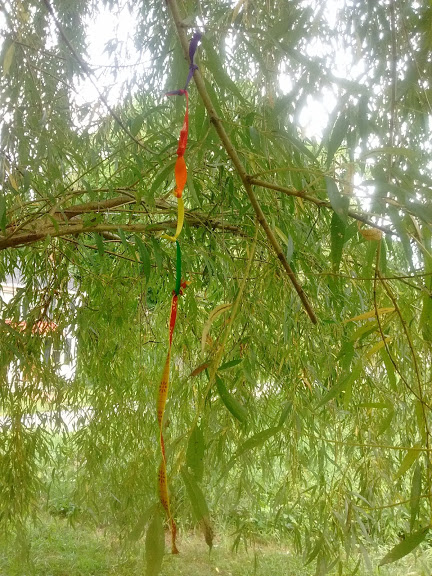
A string of worries hanging from the willow.

One of my most common school anxiety dreams is that the semester has begun, and I don’t get there until a few days or weeks or months in to the semester. Things have already begun without me. Other teachers are running the class. I basically have no idea what is going on.

One of my most common recurring dreams about doing my inner work involves discovering rooms or places filled with things that I have somehow inherited.

Last night’s dream includes both elements:
I am a couple weeks late to begin a new teaching assignment in a middle school. When I get there, the substitute is a man, a college professor, who is teaching them as though they understand deep literary critique, referencing obscure writers and texts. There’s also an assistant in the classroom, and she is sitting in the desk at the front of the room while the professor teaches.

I don’t really introduce myself when I come in, but I put on an audio story for them to listen to. It’s engrossing, very literary, and sort of mysterious. The kids and the other two teachers are immediately into it. Meanwhile, I start to clean up the two desks at the front of the room. The previous teacher left all her stuff, and the surface of the desks are covered with knick knacks. I actually want to look at each one and decide which ones I will keep. It’s kind of an exciting process. Underneath the desk are little hidden drawers and doors, and dozens of keys!

The story ends just as the children are to be dismissed for the day. I thank the other teachers, and tell the children we will have formal introductions tomorrow. I’m eager to meet them, and they seem ready to take me on as their teacher.

I am not nearly where I want to be in terms of fall planning. I’ve let my anxiety keep me whirling in a tornado of what-ifs, and I’ve found myself unable to focus on plans. This year demands stronger plans with more options, so I need to get myself together, and not show up to the party late. If I am to really connect with my students in this season, I need to leave the professor at home, and keep reeling them in with captivating narrative.

At the same time that I have not been getting a handle on the actual nuts and bolts preparation for the semester, I have been reading Ta-Nehisi Coates’s Between the World and Me and Stamped by Jason Reynolds and Ibram X. Kendi, the teen version of Kendi’s longer work Stamped from the Beginning. I think there are all sorts of inner doors and drawers that I am finding access to in the wake of these texts, new ways to frame how I can teach in antiracist ways, not self-consciously layering discussions of racism into literary discussion, but letting a deeper knowledge of US history infuse the ways I lead discussions about texts.

I’m not sure what the tchotchkes on the surface of the desk represent, unless it is simply that in the midst of my anxiety about opening school, I am looking forward to exploring all the little shining things that represent the everyday school experience.

A couple days ago, during a video-call, a cousin of mine exhorted me to be aware of how my worry affects me, to consider ways that I might proactively deal with the anxiety I am experiencing. He suggested giving myself one day a week to worry, making a list of the things my brain wants to worry about, and then checking in with the list on one day a week. Chances are, some of those worries might have evaporated week to week. Of course, the worry about school just gets bigger and bigger, but I am really moved and inspired by the encouragement to lay it down a bit. And yesterday, my pastor’s sermon was in a similar vein.

I need rituals to mark the inner work that I am doing, physical representations of the energies I am trying to shift. So today, I am going to meditate a little about the school worries, and then I am going to choose some ribbons to represent the things that most frighten me, and hang those on my willow tree. She is strong, and also not rigid. She flows. She listens well.

I can’t change the decisions that my school and my son’s school are making. I can be vocal about the safety issues that I see, asking for accountability to strong safety measures. In the end, unless I choose to strike or quit (which I just can’t do because I love my school and my administrators and teaching), I need to simply buckle down, do what I can to keep myself and my students safe, and find joy in the experience of reconnecting, of opening those little drawers and doors, of finding the right keys, of discovering the shiny things that will be part of everyday life back at school.

If you pray, if you do magic, if you work with energy, work prayers and magic and energy for our safety, please. For all the teachers and the students, for our families.


Gratitude List:
1. Social media posts about people’s food preservation. I haven’t done any of that this year, and I don’t plan to, but I can look at the beautiful rows of my friends’ canned beans and pickles and relish. I can see the binsful of corn transformed into baggies of golden sunshine that will wait in their freezers for winter. This makes me happy.
2. Kittens
3. Learning to push my body past its initial inertia, to get on the bike, to pedal even when its hard going.
4. Beloveds who remind me to deal with my worry and not just leave it lying around where it can keep pouncing on me.
5. Messages from dreams.

May we do justice, love mercy, and walk humbly in Beauty!


“We should ask ourselves: Do we know what enough is inside of our lives? Once I know that, it’s much harder for capitalism to catch me, right? Because I’m not susceptible to this constant sale of myself or my soul to any other force.” —adrienne maree brown


“I hold the line, the line of strength that pulls me through the fear.” —Peter Gabriel


“Children grow into the intellectual life of those around them.” —Lev Vygotsky


“It was books that taught me that the things that tormented me most were the very things that connected me with all the people who were alive, who had ever been alive.” —James Baldwin


“Three things cannot be hidden: the Moon, the Sun and the Truth.” —Gautama Buddha


“Those doing soul work, who want the searing truth more than solace or applause, know each other right away. Those who want something else turn and take a seat in another room. Soul-makers find each other’s company.” —Rumi


“Going within is the only way out.” —Toko-pa Turner


“What can we gain by sailing to the moon if we are not able to cross the abyss that separates us from ourselves? This is the most important of all voyages of discovery, and without it, all the rest are not only useless, but disastrous.” —Thomas Merton


“Let me fall, if I must. The one I will become will catch me.” —Baal Shem Tov


“The sky itself
Reels with love.”
—Rumi


“That’s a tough spirituality. That’s not any kind of sweet-by-and-by spirituality. That’s a spirituality that takes on the world as it is and says, ‘I’m gonna figure this out one way or another.’ The mystic and the Moses.” —Vincent Harding (On Being interview)


“May you know the fearlessness of an open heart. May you never meet anyone you consider a stranger, and know that no matter what, you are not alone. May you have compassion for others’ suffering and joy in their delights. May you be free to give and receive love.” —Sharon Salzberg


“In our culture, we use the word ‘dreamy’ derogatively to describe someone who is unrealistic or without ambition. But what thrills and amazes me about dreamwork is how truly grounding it is. One of the reasons this is true, is because dreams are expressions of that larger ecosystem in which we are embedded, and which has a design for our lives within that greater context! So rather than taking our cues from consensus culture, instead we are listening to the mystery which combines us. As Jungian analyst Ann Bedford Ulanov puts it, “the Self is that within us that knows about God.” —Dreamwork with Toko-pa

Anxious Days and Gratitude

Gull on a bad hair day.

I am suffering from some serious internal whiplash these days.

Within the past week, I have experienced some incredibly healing times safely social distanced with some of my best beloveds, looking into twinkling eyes, hearing laughter and wisdom and articulate questions. I have had some deeply reviving time in nature despite the heat.

And at the same time, one thought can set my nerves jangling, twanging the wires of anxiety, clashing and clanging waves of worry. School.

While teaching students to read and write–to communicate, to learn to express emotion and articulate new ideas–is clearly my vocational mission, I have an underlying agenda which is just as important as English Language Arts: To create a safe space for young people to explore who they are and learn how to be comfortable and confident in the world. In the spring, when we were sent home to do our learning, we lost that safe space together. I lost the opportunity to make eye contact in the halls with someone who worried that nobody would ever notice them, lost the chance to listen to a student come into my room ranting about some injustice they wanted to remove from the world, lost the chance to watch laughter displace worry or sadness or fear, lost the chance to tell someone that they are stronger than they think.

And now, we’re planning to meet again in the fall, and I will get some of that back on a limited basis, but I don’t feel safe, for me or for them, for our families and beloveds. This virus has stripped us of our safety. I want so desperately to return to classes, but something in me feels like it isn’t yet time, like my Safe Place is still unsafe. I find myself hoping that the governor calls off school again, so we won’t have to navigate these waters, so I won’t have to add to my duties the policing of students’ spacing and masking in the halls, so I won’t have to worry that every sneeze or cough could result in someone’s grandmother fighting for her life, so every day won’t feel like a risk.

I know that we need to open schools again when it is safe to do so. I know that many students’ mental health depends upon it. But it feels like a dangerous experiment with our physical health, and the health of our families to do it now, when my state can’t seem to get its numbers under control, when adults who should know better are refusing to do the simple things to keep us all safe.

I breathe a lot to ground myself, during these days when I struggle through allergies to catch the deepest breaths and yawns. I go to my beloveds, online and in safe circles. I anchor myself in the green and the blue, in earth and air and water. I search for Beauty, and find my grateful center. It helps me a little, a least to ride the top of the anxiety waves. It’s harder than usual to hold onto a calm center, when grief and rage and worry knot themselves into a little ball inside my spirit.

Some Things to Be Grateful For:
1. The twinkling eyes of my beloveds
2. Blue and green, and golden sun
3. Birdfolk
4. Water
5. Laughter.

May we walk in Beauty!


“May hope rise within you. May peace wash over you.” —Charlene Costanzo


“You don’t have anything
if you don’t have the stories.”
—Leslie Marmon Silko, Ceremony


“If you have come here to help me, you are wasting your time. But if you have come because your liberation is bound up with mine, then let us work together.” —Lilla Watson


“A poem is not a puzzle, even if it’s puzzling at first. Instead, it’s a highly selected parcel or capsule of language meant to burst into your psyche and change you in some way. Poetry is the life blood of our language, and it’s meant for everyone, not just academics or young people in school. Poetry is in a word: consciousness.” —Cathryn Hankla


Ring the bells that still can ring
Forget your perfect offering
There is a crack in everything
That’s how the light gets in.
—Leonard Cohen


Tom Joad, from John Steinbeck’s Grapes of Wrath:
I been thinking about us, too, about our people living like pigs and good rich land layin’ fallow. Or maybe one guy with a million acres and a hundred thousand farmers starvin’. And I been wonderin’ if all our folks got together and yelled…

As long as I’m an outlaw anyways… maybe I can do somethin’… maybe I can just find out somethin’, just scrounge around and maybe find out what it is that’s wrong and see if they ain’t somethin’ that can be done about it. I ain’t thought it out all clear, Ma. I can’t. I don’t know enough.