Catching the Ferry

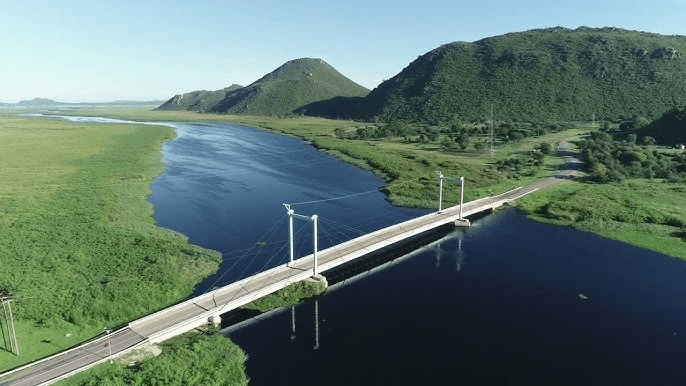
Kirumi Bridge, across the Mara River: Ming’aro Pictures Empire

Brewer’s prompt today is to write a Childhood Object poem. A couple days ago, I was scrolling around Tanzania on Google Earth, and saw a bridge over the Mara River where we used to cross by ferry when I was a child. I think the last time I was there in 1988, there was already a bridge, but I was suddenly flooded with memories of waiting for the ferry at the Mara River. There’s even a little video of drone footage of the bridge on Youtube.

I have never seen it, but there’s
a bridge there now across the Mara,
steel and concrete on the Sirari Road.
You used to need to catch the ferry to cross,
waiting on the eastern shore of the river,
bulrushes and papyrus lining the banks.
What crocodile would have been bold enough
to lurk among them, with the rattle and rev
of lorries and garis lined up for the next crossing?
Even fifty years later, and half a world away,
I pass a truck idling diesel fumes,
and I am back again on that riverbank,
the sun sparkling on the water, the hum of Swahili
in the drowsing afternoon, the distant ferry
approaching from from the Mwanza side.


Gratitude List:
1. The threads which connect dreams to waking life
2. My colleagues–daily I am grateful for this thoughtful and caring group of people
3. Ethiopian food–Jon shared his leftovers
4. Origami–I love the meditative nature of paper folding–I have been making zhen xian bao (Google it)
5. Weaving the pieces together.
May we walk in Beauty!


“No warmth, no cheerfulness, no healthful ease,
No comfortable feel in any member—
No shade, no shine, no butterflies, no bees,
No fruits, no flowers, no leaves, no birds—
November!”
—Thomas Hood, No!


“I could not be a poet without the natural world. Someone else could. But not me. For me the door to the woods is the door to the temple.” —Mary Oliver


“Nourish beginnings, let us nourish beginnings. Not all things are blest, but the seeds of all things are blest. The blessing is in the seed.” —Muriel Rukeyser


“We discover the Earth in the depths of our being through participation, not through isolation or exploitation. We are most ourselves when we are most intimate with the rivers and mountains and woodlands, with the sun and the moon and the stars in the heavens… We belong here. Our home is here. The excitement and fulfillment of our lives is here… Just as we are fulfilled in our communion with the larger community to which we belong, so too the universe itself and every being in the universe is fulfilled in us.” —Thomas Berry, The Sacred Universe


Words of Howard Zinn:
“We don’t have to engage in grand, heroic actions to participate in the process of change. Small acts, when multiplied by millions of people, can transform the world. Even when we don’t ‘win,’ there is fun and fulfillment in the fact that we have been involved, with other good people, in something worthwhile. We need hope.

“An optimist isn’t necessarily a blithe, slightly sappy whistler in the dark of our time. To be hopeful in bad times is not just foolishly romantic. It is based on the fact that human history is a history not only of cruelty, but also of compassion, sacrifice, courage, kindness. What we choose to emphasize in this complex history will determine our lives. If we see only the worst, it destroys our capacity to do something.

“If we remember those times and places—and there are so many—where people have behaved magnificently, this gives us the energy to act, and at least the possibility of sending this spinning top of a world in a different direction. And if we do act, in however small a way, we don’t have to wait for some grand utopian future. The future is an infinite succession of presents, and to live now as we think human beings should live, in defiance of all that is bad around us, is itself a marvelous victory.”


“Come, come, whoever you are. Wanderer, worshiper, lover of leaving. It doesn’t matter. Ours is not a caravan of despair. Come, even if you have broken your vows a thousand times. Come, yet again, come, come.” ―Jelaluddin Rumi


“It doesn’t matter who you are or what you look like, so long as somebody loves you.” –Roald Dahl, The Witches


“For women who are tied to the moon, love alone is not enough. We insist each day wrap its’ knuckles through our heart strings and pull. The lows, the joy, the poetry. We dance at the edge of a cliff. You have fallen off. So it goes. You will climb up again.” –Anais Nin


“The creation of a thousand forests is in one acorn.”
–Ralph Waldo Emerson


“On such a day each road is planned
To lead to some enchanted land;
Each turning meets expectancy.
The signs I read on every hand.
I know by autumn’s wizardry
On such a day the world can be
Only a great glad dream for me–
Only a great glad dream for me!”
–Eleanor Myers Jewett, “An Autumn Day”


“Change is not merely necessary to life, it is life.”
–Alvin Toffler


“In the morning I went out to pick dandelions and was drawn to the Echinacea patch where I found a honeybee clinging to one of the pink flowers. She seemed in distress, confused and weak. She kept falling off the flower and then catching herself in midair and flying dizzily back. She kept trying to get back to work, to collect her pollen and nectar to take home to the hive to make honey but she was getting weaker and weaker and then she fell into my hand. I knew she would never make it back to her hive. For the next half hour she rested in my palm, her life slowly ebbing away as a thunderstorm started to brew. I sat on the earth waiting for death with her. The lightening flashed over the mountains, a family of turkeys slowly walked the ridge, a wild dog keyed into what was happening circled past us. The trees appeared startlingly vivid and conscious as the wind blew up and the thunder cracked and then her death was finished. She was gone forever. But in her going she taught me to take every moment as my last flower, do what I could and make something sweet of it.” –Layne Redmond


Let me seek, then, the gift of silence, and poverty, and solitude, where everything I touch is turned into prayer: where the sky is my prayer, the birds are my prayer, the wind in the trees is my prayer, for God is all in all.
–Thomas Merton


“Beware; for I am fearless, and therefore powerful.”
–Mary Wollstonecraft Shelley, author of Frankenstein


“Learn to tell the story of the red leaves against water.
Read the alphabet of walnut branches newly bared for winter.
Become literate in the language of cricket and of wren,
of the footsteps of skunk and the changeability of weather.

Interpret the text of the wind in the hollow.
Scan the documents of cloud and constellation.
Enter the tale of rose hip and nettle and sassafras.
Study Wisdom and she will find you.”
–Beth Weaver-Kreider


“Wake at dawn with a winged heart and give thanks for another day of loving.” –Khalil Gibran


“Awake, my dear! Be kind to your sleeping heart. Take it out into the vast fields of Light and let it breathe.” ―Hafez (Ladinsky)


“We who hobnob with hobbits and tell tales about little green men are used to being dismissed as mere entertainers, or sternly disapproved of as escapists. But I think perhaps the categories are changing, like the times. Sophisticated readers are accepting the fact that an improbable and unmanageable world is going to produce an improbable and hypothetical art. At this point, realism is perhaps the least adequate means of understanding or portraying the incredible realities of our existence.” —Ursula K. Le Guin

Mercy Now: There is a Place for You

“There is still a place for you at our table, if you will choose to join us,” the young man said.
“Yes,” people chorused, “even now, there is a place for you.”
–Starhawk, The Fifth Sacred Thing

At the end of The Fifth Sacred Thing, when the military forces are over-running their city, Maya and the others decide on this strategy: They approach the soldiers and tell them they have set a place for them at the community table. They know that some of them, in the moment of invitation, will be shot and killed. They know the situation is dire. But they decide to appeal to the humanity of their enemies.

Can I say to the fiercely adamant Trump supporter on my Facebook threads: “There is a place for you at our table of welcome, if you choose to join us?”

Can I say it to the racists who are spouting venom and hatred?

Can I say it to the fear-mongers who scapegoat immigrants and Muslims and Latinx?

Could I say it to Mr. Smucker, my local representative, who consistently votes against everything I stand for, and for everything I stand against?

Could I say it to a denier of the climate Crisis? To a Monsanto exec?

Could I say it to Mitch McConnell? To Mr. Trump?

It’s an invitation that requires some self-reflection: “. . .if you choose to join us.” It doesn’t condone the soldier’s violence. It begs a different relationship, a sideways step across the line. It offers a way out for the individual trapped in a cycle of violent words and actions.

I am unsettled and twitchy these last few days about my own position in this story, my own lack of empathy and welcome. I’ve been working really hard at keeping the conversation to a high level. Still, in conversation this weekend, I said something to the effect that this administration has drawn the racist and homophobic cockroaches into the light. A dear and wise friend firmly and kindly called me on it. Just days after I wrote something calling out the president for calling people animals, I was calling people cockroaches. In my defense, I was being metaphorical. I didn’t intend to dehumanize, I tell myself. But what did I intend? Why use such metaphors? We tend to stomp on cockroaches. There’s a verbal violence for you. I can’t defend such language.

My friend encouraged us to look at people’s needs, to ask what needs are not being met when a person chooses, either verbally or physically, to harm another. This is the beginning of empathy.

In The Fifth Sacred Thing, the community was willing to risk their lives for the truth of this question. Am I willing to risk letting go of some of my protective rage so I , too, can invite people to the table? What will we be asked to risk if we offer this invitation? It’s not about destroying healthy boundaries. The community was actively standing up to the soldiers. Still, they chose to offer their enemies a choice, a way out.

My personal rhetoric in these difficult times has had a strong edge of boundary to it. I believe that to fight the evil (yes, evil) that is harming children and families and communities, we must declaim the truth. When a president uses a constant barrage of lies in order to confuse and demoralize the populace, truth-telling is a necessary and powerful act.

I wonder if there are ways that I can hold firmly to the truth-telling, and still set the tables in the rooms of my words in ways that invite my rivals to sit and eat and be nourished. Can I speak against the lies in ways that invite those who believe them to tell their stories and share their pain? And perhaps become transformed rather than entrenched?

“We die. That may be the meaning of life. But we do language. That may be the measure of our lives,” said Nobel Laureate Toni Morrison, who joined the realm of the ancestors this week. She told the truth, directly and fiercely. And she also knew the power of words to heal, the power of narrative to create a bridge to a more just future: “This is precisely the time when artists go to work. There is no time for despair, no place for self-pity, no need for silence, no room for fear. We speak, we write, we do language. That is how civilizations heal.”

And further: “Is there no context for our lives? No song, no literature, no poem full of vitamins, no history connected to experience that you can pass along to help us start strong? You are an adult. The old one, the wise one. Stop thinking about saving your face. Think of our lives and tell us your particularized world. Make up a story. Narrative is radical, creating us at the very moment it is being created. We will not blame you if your reach exceeds your grasp; if love so ignites your words they go down in flames and nothing is left but their scald. Or if, with the reticence of a surgeon’s hands, your words suture only the places where blood might flow. We know you can never do it properly–once and for all. Passion is never enough; neither is skill. But try. For our sake and yours forget your name in the street; tell us what the world has been to you in the dark places and in the light. Don’t tell us what to believe, what to fear. Show us belief’s wide skirt and the stitch that unravels fear’s caul. You, old woman, blessed with blindness, can speak the language that tells us what only language can: how to see without pictures. Language alone protects us from the scariness of things with no names. Language alone is meditation.” ―Toni Morrison, The Nobel Lecture In Literature, 1993

I don’t know if I can do it with grace and brilliance, with fierceness and tenderness. But I can try, as Morrison requests. Language has magic to it. As a teacher of language and a writer, I take that seriously. Let’s apprentice ourselves to the powerful human magic that language offers us, to create spaces within our words where our rivals may find a space to rest and consider, where we may all be transformed, and the future may be created with love.

As an epilogue, I offer you this song by Mary Gauthier, “Mercy Now.” Click the link, sit back, and listen.

Mirrors and Reflections

One of my recent obsessions is taking photographs of light reflected in windows, so that it falls on the landscape outside, or seems to hover between realities, like a doorway or window between worlds. Mirrors, reflections, shadows: light and shadow create images that show us another version of reality, enable us to see things from a different perspective.

At the beginning of the year, instead of choosing a single word for my meditations throughout the year, I felt a nudging on Epiphany day just to keep the three that had risen to the top of my list: Bird, Bridge, Boundary. They’ve been weaving and reweaving themselves through my contemplations in the past month. And a week later, I felt the compulsion to add a fourth: mirror.

The season of Brigid calls us to consider mirrors and reflections and shadows, those otherworldly, deeper layers that offer us images of who we really are in the world. Look. Then look deeper. See, then See again. Open your eyes, and then open your eyes, and then open your eyes. The Groundhog takes on a priestly role, reminding us to examine what reflections we are making in the world, what shape is the shadow that we cast behind and around us.

Two nights ago, I dreamed about going on an adventure with one of my beloveds. I wrote and told her of the dream the next morning. During our conversation, she offered me the gift of mirroring, of showing me the shape she sees me casting into the world. It was a different image than my own perceptions offered me, and gentler. My own sense of inadequacy, my fierce judgement of myself, has cast another layer of shadow into my own perceptions, and made me see myself with too critical an eye. It took the gaze of a friend, the tending perception of another, to shift the view for me.

Light is funny that way. Send it through water, and the image is distorted, shifted slightly. The kingfisher knows this, and automatically corrects for refraction, aiming straight for the minnows despite the tricks of the light. I’ve let myself be seduced by the critical angle of the light, viewing myself with a distorted lens. It helps to have a beloved willing to gently mirror a different perception back to me. My contemplative lens will be clearer now, and perhaps my work will blossom as I view it through another’s eyes.

I’m intentionally mixing the images here: mirror, light, shadow, image, refraction, reflection. Their meanings are like different layers of light viewed in the reflections on a window, each with its own truth to offer, but all part of the layered image.

May your reflections in this season bring you insight into your truest self.
May your beloveds be tender mirrors to guide you to images which help you blossom.
May your inner gaze be kind, offering yourself space to grow and change.

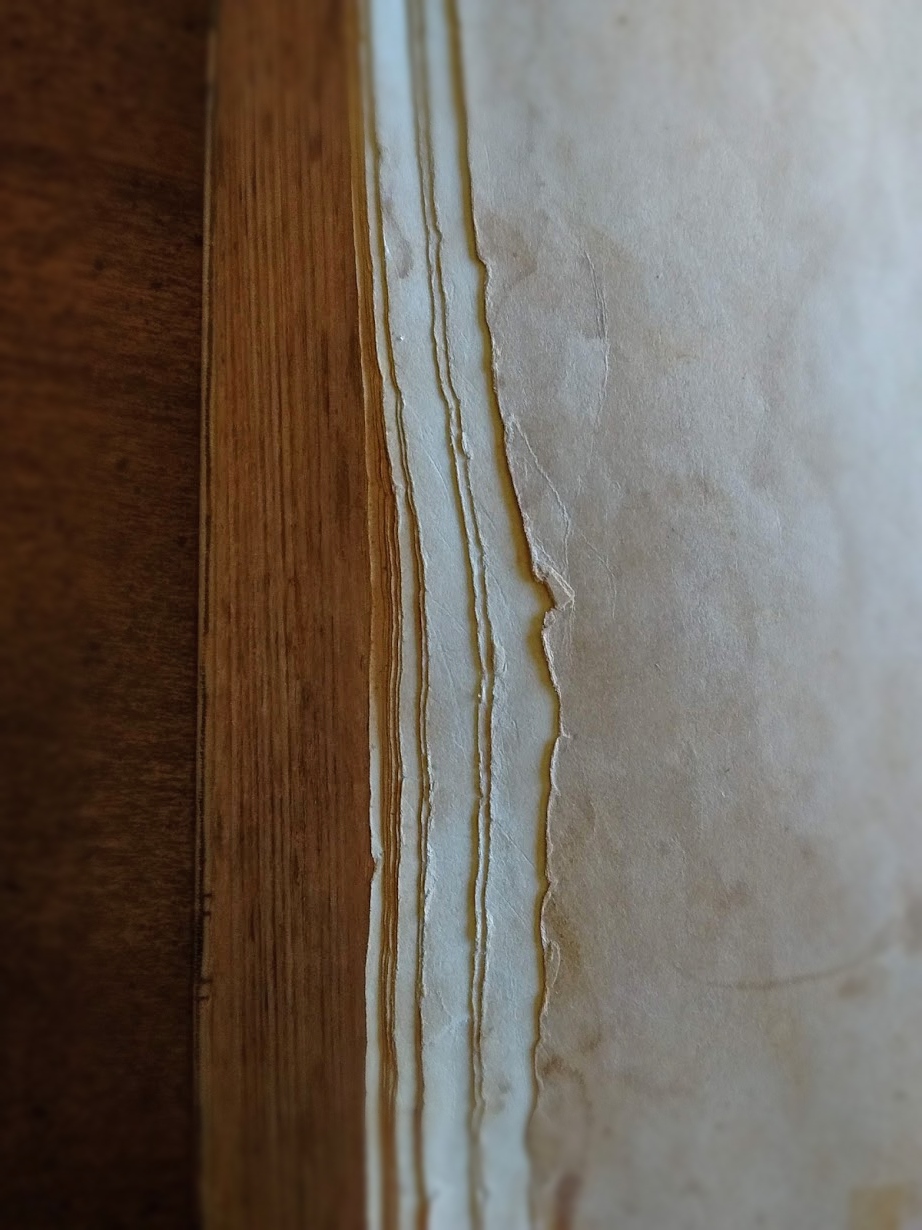
Postscript: This image of the back pages of my grandmother’s copy of The Mennonite Community Cookbook is also a reflection of sorts, a mirror that shows me my reflection in the past, in my own ancestors, or perhaps their reflection/refraction into the image of me. When I am searching for a recipe, fanning the pages with my thumb, there’s a moment when I feel this little arc in the paper, this spot worn away by the years of my grandmother’s own thumb flipping the pages of her cookbook, and I can almost feel her reflected into the moment, into me.

In the Dreamtime, Day 13

We’re still within the twelve days of Christmas, but since I start counting the Dreamtime at Solstice, we’re on to Day 13 now in this little pocket of my counting of time.

One of the things I begin to discover at this point in the process of collecting the words and images from my dreams is that I start to catch echoes of my collection in the world around me. Bridges and boundaries are common enough metaphors, but because they’ve been swirling around in my dream-soup, when I catch references to them in people’s daily speech, it feels like I am receiving secret messages. I am listening for echoes now, affirmation that the words and images I am sanding and honing are the ones I should put in my internal medicine pouch to carry into the coming year.

In last night’s dream, Jon and I and a child (perhaps an amalgam of the two boys) are trying to get somewhere, hitching rides on the trains like hobos. It’s really dangerous, and I am terribly worried that the child will fall off. We finally decide to stop taking the risks and walk, but by this time we are far out in the wilderness, in the woods, and getting to civilization will take days. We sleep in the woods, and find our food where we can. Despite the long walk and the uncertainty, it feels like the right choice. I think the child is really me, and some of the recent choices I am making about the way I work, and the boundaries I set, are making the journey harder and lonelier perhaps, but safer for that inner child. Good choices.

In other dreams I am trying to text Jon that my meeting has gone really short and I can take Ellis home from school after all. Technology and phones never seem to work in dreams. I cannot find the numbers or the right app to text. Typical anxiety dream. Will Deep Self really be able to get the necessary messages across to Waking Self?


Gratitude List:
1. The dawning of women. I was unprepared for quite how relieved I would feel yesterday looking at the images of those joyful, powerful women entering Congress. I thought I had experienced all the joy when I learned they had been elected, but yesterday was a joyful day.
2. The three million women of Kerala who made a chain to tell the world that it is the time of women.
3. It’s the Tuesday of my work week, but it’s Friday. I really needed this slow start.
4. Michelle Obama’s book. She weaves words and ideas well. Her story is so completely her own story and her family’s story, but she deftly weaves the connection of her story to the experiences of black families in the past century, so that as I am learning her own history, I am developing a deeper context for understanding the Great Migration, white flight from cities, and the persistence of structural racism.
5. Dean’s pies. Every year my colleague makes a tableful of pies (8? 10? 12?) for us. It creates truly impossible choices. I take tiny slivers of several. And it’s sublime. Yesterday was a delicious day.

May we walk in Beauty!


“The glory of friendship is not the outstretched hand, not the kindly smile, nor the joy of companionship; it is the spiritual inspiration that comes to one when you discover that someone else believes in you and is willing to trust you with a friendship.” —Ralph Waldo Emerson


“We use language to build the structures upon which we hang our ideas. Language is the scaffold upon which we develop whole structures of thought. Language anchors and shapes and breathes life into thought and idea. Conventional thinking, and conventional language, can end up being a pretty tight little box of a windowless building that doesn’t let in the light. The air in there gets pretty stale. When language—and its attendant ideas—become calcified and crippled into arthritic patterns, poetic image and word-use can find new ways to say things, can break windows into the walls of those airless rooms and build ornate new additions onto the old structures. Poetry jars the cart of language out of its constricting wheel ruts. This is why poets and writers can make good revolutionaries—if they know their work and do their jobs well.” —Beth Weaver-Kreider, 2014


“The nuclear arms race is like two sworn enemies standing waist-deep in gasoline, one with three matches, the other with five.” —Carl Sagan


Mary Oliver, on the Great Horned Owl: “I know this bird. If it could, it would eat the whole world.” And then: “The world where the owl is endlessly hungry and endlessly on the hunt is the world in which I too live. There is only one world.”


Fierce Wild Joy
by Beth Weaver-Kreider, 2016

May this year bring you joy
like crows rising from the fields

fierce
wild joy

yelling full-voice
into the wind

rowing through the tempest
with nothing but feathers.


“Have patience with everything
that remains unsolved in your heart.
Try to love the questions themselves,
like locked rooms and like books
written in a foreign language.
Do not now look for the answers.
They cannot now be given to you
because you could not live them.
It is a question of experiencing everything.
At present you need to live the question.
Perhaps you will gradually,
without even noticing it,
find yourself experiencing the answer,
some distant day.”
―Rainer Maria Rilke


“With life as short as a half taken breath, don’t plant anything but love.”
―Jalaluddin Rumi

The Day of Sunreturn

This photo is from Solstice afternoon. 

The sun is not yet rising on this morning of Sunreturn. That’s a term I think I made up myself. Over the years, I have felt the need to slightly separate my Solstice observance from my deep celebration of the next day. I need to keep a space for both: for marking the full darkness, and for joyful honoring of the returning of the light. So I made up a word for it, unless I stole it from someone else.

On Solstice, I settle into the darkness, feel the long night, the blanket of winter. But on Sunreturn, I delight in the turning back to the sun. Yesterday, we reached the end of the tunnel. I could sit in the darkness and feel the satisfaction of another year’s journey to the outer reaches. Today, we turn our faces again to the sun, and begin the journey toward that light.

So my word for today is Sunreturn. May the sun shine upon you. As I have written this, drinking coffee with my sister and my father, hearing the wind whistling around outside, the day has gently dawned into grey morning.


Gratitude List:
1. Christmas karaoke in chapel yesterday
2. The Welcoming Place at MCC
3. Last night’s Solstice Celebration at Community Mennonite.
4. The young man did not jump off the bridge. I might not be able to ever wash that image from my brain, seeing him sitting there, officers and caregivers and concerned citizens gathered around and below him. I suppose all those helpers gathered around were, in their way, Clarence the Angel. I will listen for the bells of the season with a different ear this year.
5. Sunreturn

May we walk in beauty!

(I feel like I should explain #4. On the way here to the Welcoming Place from school yesterday, the traffic on 222 slowed suddenly and measurably. As we approached a bridge that goes over the highway, we noticed that traffic was completely stopped on the other side, beginning at the bridge. I speculated that someone had stood on the overpass and thrown things down on passing motorists, because there were people gathered on the bridge. Only as we approached did I see that they were gathered at a short distance from a clearly distraught young man sitting on the edge of the bridge. The highway was closed for a couple of hours. News reports say that a police officer eventually “grabbed” the man, and he was taken to a hospital for observation.)


“There is really only one way to restore a world that is dying and in disrepair: to make beauty where ugliness has set in. By beauty, I don’t mean a superficial attractiveness, though the word is commonly used in this way. Beauty is a loveliness admired in its entirety, not just at face value. The beauty I’m referring to is metabolized grief. It includes brokenness and fallibility, and in so doing, conveys for us something deliciously real. Like kintsukuroi, the Japanese art of repairing broken pottery with powdered gold, what is normally seen as a fatal flaw is distinguished with value. When we come into contact with this kind of beauty, it serves as a medicine for the brokenness in ourselves, which then gives us the courage to live in greater intimacy with the world’s wounds.” —Toko-pa Turner


“God has scattered the proud in their conceit.
God has cast down the mighty from their thrones
and has lifted up the lowly.
God has filled the hungry with good things,
and sent the rich away empty.” —Mary


“No human relation gives one possession in another—every two souls are absolutely different. In friendship or in love, the two side by side raise hands together to find what one cannot reach alone.” —Kahlil Gibran


“Always there comes an hour when one is weary of one’s work and devotion to duty, and all one craves for is a loved face, the warmth and wonder of a loving heart.” —Albert Camus


“Be like a tree and let the dead leaves drop. ” —Rumi


My heart is moved by all I cannot save:
so much has been destroyed

I have to cast my lot with those
who age after age, perversely,

with no extraordinary power
reconstitute the world.
-—Adrienne Rich


Response Poem

Today’s prompt is to write a response to one of the previous poems from the month. I chose my April 27 poem.

There once was a girl
who was so afraid of spiders
that when a web of song,
a web of prayer,
came floating to her
on a breeze, she ran
as fast as she could
in the other direction.

There once was a girl
who was so afraid of darkness
that when a quiet veil
of comforting shadows
fell about her,
she fell down in terror
and hid her head
until the staring sun
came out again.

There once was a girl
who was so afraid of heights
that when her friends
sang bridges that led
to safer meadows,
she could not unfreeze
her footsteps from the Earth
to flee toward the havens.

Whenever she ran from her fears,
they always caught her.
Whenever she froze in terror,
she found herself engulfed.
I would like to say she learned
to reach her hands toward her friends
and find her way home.


Gratitude:
I am grateful today for the concentric and interlocking circles of community in my life, for the people who keep their protective eyes on my children, who teach and mentor them and love them.

May we walk in Beauty!

Singing Them Safe

clover
Today’s prompt is to write a story poem.

There once was a girl
who could sing such a web
of fractured light
that the ones who came
to devour her children
fell to the ground
blinded.

There once was a girl
who could sing such a veil
of soft gentle darkness
that the ones who came
to harm her beloveds
lost their way
and forgot their names.

There once was a girl
who could sing such a bridge
of delicate stories
that all those she loved
could cross to safety
and live free of fear.


Gratitude List:
1. “You will be found.” My favorite line from the school’s current show.
2. Deadnettle and dandelions: purple and yellow
3. Making connections, webs, bridges
4. Poem in Your Pocket Day in Wrightsville. Always a delight.
5. Weekend

May we walk in Beauty!

Battle the Fear

Today’s prompt was a fill-in-the-blank title: Battle __(blank)__

Battle the Fear

Walk this way without shame.
Your head will touch the clouds.
Your eyes will shine with the glow
of the new-risen moon.

The Fear will track you
through the wastelands
like a wolf on a scent.
It will hunt you like a lion
across the wide fields.

Listen to the ticking of your heart
and the gentle whisper of breath
as it slides in and out of the bags of your lungs.

Blood and breath will be your companions.
Carry your bowl of stones and feathers
and do not look back.

Whistle in the darkness.
Sing your heart’s own melody.
Remember, always,
the light at the center
of your being.

(www.farmpoem.wordpress.com)

The Bridge is Fraying

I remember drawing this five years ago after I had a little dream about a little gnome/elf/spirit-being who chose to be my helper.

Sometimes lately, I feel as though the bridge can’t hold. The gulf between us is widening, and the the bridge is strained almost beyond repair. This cultural divide in the US keeps growing, keeps expanding. What words can we string together into lines and cables to hold the space between us? Or do we just give up? Wave goodbye across the chasm? Accept that we no longer have common ground? It has torn the fabric of my church, torn the roots of families and friendships, of social groups and communities.

I know I am part of the problem. My own ideals and values keep me settled on one side of the chasm. I must speak up and speak out for what I believe to be right and against what I believe to be great wrong. I can no more shift my position than I could leap into air and fly across the widening gulf. But there are places of common ground between us–I am certain of that, and I don’t know how to connect them when the space between us grows so rapidly.

What I think we need to recognize is that when we are torn apart from each other in these ways, something within us is also torn. When you and I can no longer touch or hear each other across this chasm, something within each of us also becomes unmoored, unhinged. If the bridge breaks, we all lose something of ourselves.

Gratitude List:
1. That golden moment of sun touching the snowy tops of the trees as it enters the hollow.
2. The spring songs of sparrow and wren and titmouse.
3. As frustrating as his attention is at 5 am, I love the way this little ginger cat loves me.
4. Catching up. Yesterday brought me a lot closer to being caught up.
5. The threads that hold us together.

May we walk in Beauty!

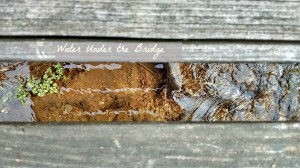
Water Under the Bridge

Sigh. I don’t have the time to do a sketch every day. I am going to try to maintain the practice, at least periodically, though perhaps I won’t always post them here, and just see where it takes me.

I love that photo of the water under the bridge. I didn’t notice until I pulled it up a few minutes ago that the reflections in the water look like script.


Gratitude List:
1. Deliberation.
2. Fajitas for supper.
3. The writing on the water.
4. The sweet-faced, open-hearted batch of students this semester.
5. The little songs of cats.

May we walk in Beauty!