Rules

This one is inspired by Martín Espada’s “Rules for Captain Ahab’s Provincetown Poetry Workshop”

Rules for Aunt Elizabeth’s School for Young Witches
by Beth Weaver-Kreider

  1. No dogmas allowed in the house. 
  2. Keep your karma tuned up at all times.
  3. No reading of others’ auras without consent.
  4. For that matter, do no magic on anyone without consent. This particularly applies to love potions. Go ahead and make yourself lovely and loveable, but refrain from compelling others to love you.
  5. Remember to empty your pockets of crystals and twigs and butterfly wings and feathers and toads and marbles and nails and broken glass before you put your robes in the wash.
  6. Your wands are extensions of your fingers, and it isn’t polite to point fingers, so do not point your wands at others.
  7. Keep your cauldrons clean. Residual spellwork in an unclean cauldron may cause unintended reactions in future potion-making.
  8. Tend to your ongoing spells. Expired spells may increase in potency, resulting in dangerous side effects.
  9. Keep that nose out of the air. No task is too humble for a witch. Sometimes the strongest spells are created in the completion of the humblest of tasks.
  10. Listen when the trees are talking to you. Do not ignore the questions that the rocks put forth. Do not interrupt the speeches of the rivers.
  11. Greet all beings politely, whether human, animal, mineral, plant, or magical.

We are doing 30 Days of Gratitude at school right now, so some of my gratitudes are responding to those specific prompts.

Gratitude List:
1. That pink sky this morning, and the pastel greens of the fields below
2. Three small things: gemstones, kittens, little succulent plants
3. Something in the room: my students
4. A person: Leymah Gbowee ( and her continuing work for justice and human rights)
5. First Trimester Grades are done and submitted
May we walk in Beauty!


“I want to live the rest of my life, however long or short, with as much sweetness as I can decently manage, loving all the people I love.” —Audre Lorde


“We need another… perhaps a more mystical concept of animals… In a world older and more complete than ours they move finished and complete, gifted with extensions of the senses we have lost or never attained, living by voices we shall never hear.” —Henry Beston


“One must say Yes to life, and embrace it wherever it is found – and it is found in terrible places. … For nothing is fixed, forever and forever, it is not fixed; the earth is always shifting, the light is always changing, the sea does not cease to grind down rock. Generations do not cease to be born, and we are responsible to them because we are the only witnesses they have. The sea rises, the light fails, lovers cling to each other and children cling to us. The moment we cease to hold each other, the moment we break faith with one another, the sea engulfs us and the light goes out.” —James Baldwin, The Fire Next Time, 1963


“Walk fearlessly into the house of mourning, for grief is just love squaring up to its oldest enemy.” —Kate Braestrup


“Honesty matters. Vulnerability matters. Being open about who you were at a moment in time when you were in a difficult or an impossible place matters more than anything.” —Neil Gaiman


“Yesterday we obeyed kings and bent our necks before emperors, but today we kneel only to truth, follow only beauty, and obey only love.” —Kahlil Gibran


“To write is to ask questions. It doesn’t matter if the answers are true or puro cuento. After all and everything only the story is remembered, and the truth fades away like the pale blue ink on a cheap embroidery pattern.” —Sandra Cisneros, Caramelo


“With guns, you can kill terrorists.
With education, you can kill terrorism.” —Malala Yousufsai


“The wo/man who moves a mountain
begins by carrying away small stones.”
—Confucius, The Analects


“We learn from our gardens to deal with the most urgent question of the time: How much is enough?” —Wendell Berry


“She’s a lean vixen: I can see
the ribs, the sly
trickster’s eyes, filled with longing
and desperation, the skinny
feet, adept at lies.

Why encourage the notion
of virtuous poverty?
It’s only an excuse
for zero charity.
Hunger corrupts, and absolute hunger
corrupts absolutely,”
― Margaret Atwood, Morning in the Burned House

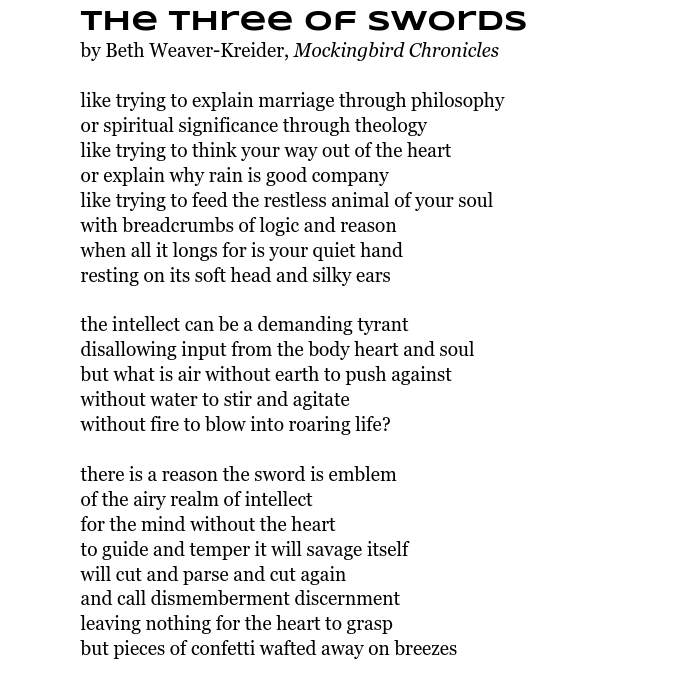
The Three of Swords

Today’s prompt from Robert Lee Brewer was to write an animal poem. That, and an article I read in The New Yorker about philosopher Agnes Callard’s ideas about marriage, sparked this poem. I did like her ideas about marriage as an aspirational state, a pairing in which two people draw each other toward developing themselves into better people–individuals working on becoming more evolved themselves, and their relationship being a space which nurtures them both to imagine themselves as better than they are. But she seemed to see aspiration as the highest goal, negating contentment as a stagnating force to be avoided. I think a strong marriage lies somewhere in the paradox of those two poles: aspiration and contentment. In the end, as important as it is to me that my partner be someone who stimulates and challenges me intellectually (which he does), I don’t think the mystical-emotional aspects of marriage can be explained in intellectual terms. In much the same way that theology can cudgel living poetic spirituality to death, philosophically explaining marriage deadens the poetic aliveness of the magic of the pairing.

Here I am, trying to confront her ideas with philosophical structures of my own. And really, my poem does not disparage intellectual exploration of ideas–but it does call for integrating intellect with heart and soul and body.


Gratitude List:
1. The lasting pink! The cool weather and minimal rain have kept the pink on the trees much longer than usual. It would now be fine with me for us to get some good intense rains.
2. Integrating heart and mind and body and soul.
3. Personal day tomorrow. Rest and catch up on work.
4. The perfect temperature for my body’s comfort.
5. My current mantra: Restoring, re-energizing, rewilding. How the repetition of a mantra makes it grow inside me.
May we walk in Beauty!


“Life will break you. Nobody can protect you from that, and living alone won’t either, for solitude will also break you with its yearning. You have to love. You have to feel. It is the reason you are here on earth. You are here to risk your heart. You are here to be swallowed up. And when it happens that you are broken, or betrayed, or left, or hurt, or death brushes near, let yourself sit by an apple tree and listen to the apples falling all around you in heaps, wasting their sweetness. Tell yourself you tasted as many as you could.” —Louise Erdrich


“To light a candle is to cast a shadow…”
―Ursula K. Le Guin


“Everyone discusses my art and pretends to understand, as if it were necessary to understand, when it is simply necessary to love.” ―Claude Monet


“We realize the importance of our voices only when we are silenced.” ―Malala Yousafzai


I called through your door,
“The mystics are gathering in the street. Come out!”
“Leave me alone. I’m sick.”
“I don’t care if you’re dead! Jesus is here,
and he wants to resurrect somebody!”
―Jalaludin Rumi (trans. by Barks)


“Your hand opens and closes, opens and closes. If it were always a fist or always stretched open, you would be paralysed. Your deepest presence is in every small contracting and expanding, the two as beautifully balanced and coordinated as birds’ wings.”
―Jalaluddin Rumi (trans. by Barks)


“Something is always born of excess: great art was born of great terror, great loneliness, great inhibitions, instabilities, and it always balances them.”
―Anaïs Nin


“Everything has boundaries. The same holds true with thought. You shouldn’t fear boundaries, but you should not be afraid of destroying them. That’s what is most important if you want to be free: respect for and exasperation with boundaries.”
―Haruki Murakami


“All great spirituality is about what we do with our pain. If we do not transform our pain, we will transmit it to those around us.” —Richard Rohr

Definition

I’m trying to get at the idea that women and others who refer to themselves as witches very often do so because in the first place they have been marginalized because they cannot be pinned down in the rigid categories of the religious establishment. The label or identity of witch does not necessarily mean that one situates herself outside the bounds of church or religion, but that her spiritual practices or ways of seeing the world and the holy are threatening to the religious status quo. Witch may be a chosen identity marker, but it may also be an identity conferred by religious dogmatists. Although I have been revising and re-revising, it still feels to me as though this is a poem in process.

Witch (noun) wich,
SEE ALSO HERETIC,
a word used by the spiritual gatekeepers
within religious and social establishments
(no matter how nominal their own piety)
to denote those who cross the hedge
between the status quo and the wildlands
of spiritual inquiry.

the witch is an excuse
the witch is a scapegoat
the witch cannot be catalogued
the witch will not denounce her truth
the witch disrupts the proceedings
the witch does not offer herself up
to be easily understood

What they do not understand,
they call the Devil,
and banish and punish and shun.

When difference is disciplined,
how do the tamed ones
manage their sameness?

What they do not understand
is that they will snare themselves
in their own rules of order.

For when one question is proscribed,
who knows which questions
will lead to the mine field?
Better to eliminate questions altogether.

the witch is feral and free
the witch is both/and
the witch is a shapeshifter
the witch will ask a thousand questions
and expect more questions in response
the witch has already given herself a name


Gratitude List:
1. A winter-bare tree filled with crows in a drizzling mist
2. People who trust my essential goodness and don’t require me to prove my piety
3. Lunch and good conversations with beloveds
4. The joy of the last week of school before vacation
5. Clean windows. (It’s been a while. Don’t judge.)
May we walk in Beauty!


“The wrong shall fail, the right prevail, with peace on earth, goodwill to all.” —Henry Wadsworth Longfellow


“Organic images are destroyed if we subject them to linear thinking. How often we judge them as “bizarre” or “weird.” They need to be allowed to grow like plants in a spiraling movement. They carry emotional and imaginative energy as well as intellectual meaning, and as they spiral they are illumined with nuances of feeling. Hence their power to bring wholeness.” —Marion Woodman


“We need beauty because it makes us ache to be worthy of it.” —Mary Oliver


“Beauty is not a luxury but a strategy for survival.” —Terry Tempest Williams


“The insects and birds and animals are singing themselves into being; this autumn land is dreaming and I am part of that dreaming.” -Sharon Blackie


“I am out with lanterns, looking for myself.” —Emily Dickinson

Exile

Exile is the theme of today’s Poetic Asides Prompt:

There are bubbles of belonging inside these spaces of separation,
places where true soul contact lies, and understanding lives.
It gives the exile a chance to feel connected, even in the crowd
of loud and angry judges who seek to cut away the sinners
from the inner group of those who belong, the righteous ones.

I’m done with trying to seek favor with the hoarders of grace
who place the ancient blood rules and regulations above
the call of love. I’ve chosen my exile and it only remains
to name the spaces where the outcasts can gather together,
our Cafes of Emigres, where grace and mercy are served with the tea.

Love Trumps Doctrine

In honor of civil rights activist and wise man Dr. Vincent Harding, a powerful voice for justice whom the world lost yesterday.  The form is a syllable count style called shadorma (3/5/3/3/7/5).
“Love trumps doctrine, every time.”
–Vincent Harding   (July 25, 1931-May 19, 2014)

Every time
like the ace of spades
like Grandma
like berries
in your breakfast cereal
love will trump doctrine.

The surface of this poem is sweet, and there was great gentleness in Vincent Harding, too.  But it must be noted that his deep love was connected to his work in the struggle for Civil Rights in the United States.  The love he spoke of was not only about simple tenderness, but about willfully choosing to love your enemies.  And then to live by that choice no matter what.

What are the doctrines and dogmas that I hold dear, that you cling to, that keep us from loving as we ought?  It’s just so easy for me to look at someone else and point out the way love gets shredded by creeds.  But then I let myself off the hook.  This week at least, in honor of Dr. Harding, I commit myself to focusing on my own story of intolerance, to seeking those hidden places within me where I grasp ideology more tightly than love.


Gratitude List:
1. People who live by love rather than dogma.
2. Even though they both kick, the occasional night when a snuggly boy joins us in bed.
3. Sorting and tidying.  Here, in the mundane realm.  Up there, in the brain.
4. Possibilities.  If the thing you are doing isn’t working the way you want it to, you can change it.  Or not.
5. Buttercups.  I followed my up-road neighbor’s lead and mowed around them.  They shine so happily at me.

May we walk in Love!