Found Tanka

Lorax
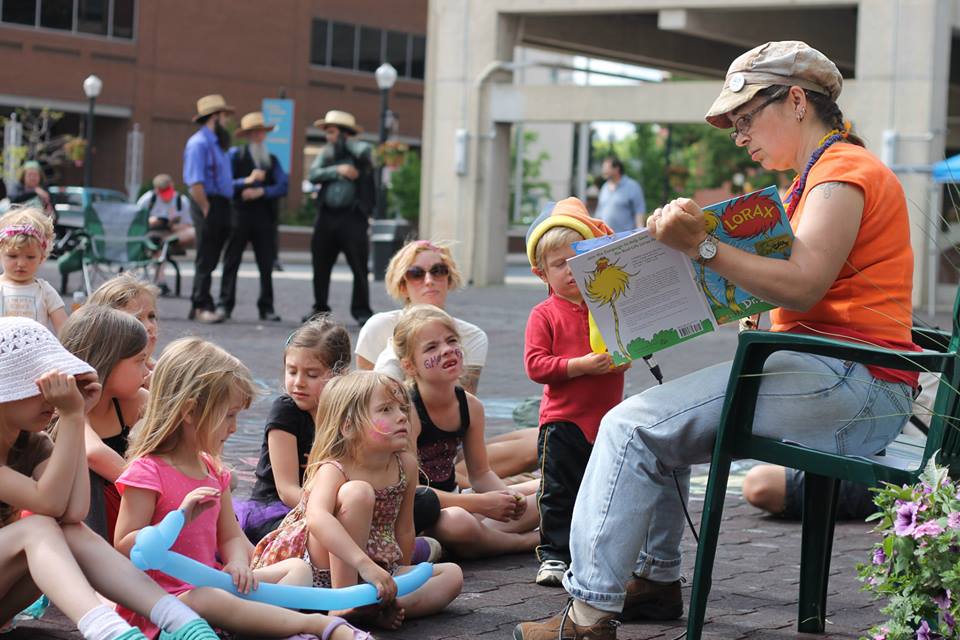
Reading The Lorax to the children at The March
Against Monsanto in Lancaster yesterday.  Photo by
Michelle Johnson.

Now for a very random poem.  I am opening up this ninth grade literature book at random pages and pulling out lines to weave together for a tanka:

trunk in the attic
they heard the the goddess Circe
a stillness greatens
from the heresy of rain
stop to look fear in the face

It turned out a little ominous, I think.  Perhaps it has to do with the youthy angst of writing which is chosen for teens.  I did not spend a lot of time sorting and choosing and arranging.  I like to play with random poetic constructions sometimes, to break out of some of my own typical patterns and images.  Exercises like this help me see new possibilities for juxtapositions, new ways to fracture sentences to open up new meanings, new sound and rhythm connections.

line 1: Truman Capote, “A Christmas Memory”
line 2: Homer, “The Odyssey”
line 3: Richard Wilbur, “The Writer”
line 4: James Hurst, “The Scarlet Ibis”
line 5: Eleanor Roosevelt

Gratitude List:
1.  Pianos in the city.  If you want to add fun and liveliness to your city, what better way than to get people to paint a bunch of upright pianos in wild and beautiful designs, and then place them in protected nooks around the city.  Spontaneous parties and songfests arise.  Way to go, Lancaster!  That’s delightful community-building.
2.  The March Against Monsanto.  The good, hopeful energy.  Reading The Lorax to the kids.  Selling tomato plants and talking healthy food with people.  The Amish buggy next to my stand with “Say No to GMO” cahled on its side.  The voice of the people.  Knowing our march was one of many around the world.
3.  Rhythm.  Daily, seasonal, poetic, musical. . .
4.  Books.  I am overwhelmed by all the reading I want to do and should be doing, especially with a house to clean and acres to mow and children to tend and a farm to run.  But I love wading into the stacks of books and opening up a poem or a short story.  The novel I am reading at the moment is Sherman Alexie’s The Absolutely True Diary of a Part-Time Indian.  I recommend it.
5. The deep red/purple of the Japanese maple on the back hill.  It’s just about big enough now to be a little fort this summer for small people.

May we walk in Beauty.

Creeds

(Commercial Prelude: Today is the Worldwide March Against Monsanto.  Very possibly there is one happening in a town or city near you.  We have one happening in Lancaster, PA, today in the center of the city at 2, with a rally and Awareness Fair afterward.  Join us, wherever you are.  For the bees.)

What are the ideas and assumptions you live by?  What are the beliefs that give meaning to your life?  I know they change from day to day, moment to moment, but if you fling your butterfly net into the brisk morning air of your spirit this morning, what might you catch in there?  How about writing five to start with, and as fast as you can, without thinking, without trying to find really cool ones, but just the ones that first float to the surface.  It strikes me that “creed” might not be the most accurate term, but somehow that’s the one I want to use.

Here are a few that I found in my net this morning.  Remember, this is just a quick, top of the head free association.  That’s the point.  It will be raw, but hopefully it will catch some meaningful tidbits that my thinking mind would overlook or dismiss.  Try it!

1.  Love.  Whatever promotes and supports deep and faithful and trusting Love.  Wanton Love of all that is around us.  Answer the question with Love.
2.  Notice.  Notice as much as possible.  Every detail.  Color, shape, movement, flickers of energy.  Like Sug said in The Color Purple: “I think it pisses God off if you pass by the color purple in a field and don’t notice it.”  I think the converse (or is it the inverse?) is true: I think it makes her intensely happy if you DO notice it.
3.  There’s a place for everyone at the table.  I believe this and I want to live by it, but there are people I don’t want at my table, and I don’t know how to reconcile it.  I think I mean that compassion (not just the broad love of #1) ought to somehow be extendable to all, but I want to have my compassion for the rapists and murderers and frackers and oil executives and warmongers from a distance.  Still it’s an ideal I believe in, even if I can’t live it yet.
4.  Listening.  I work so hard at this, and I still get caught up in telling and spilling and requiring you to listen to me instead.  But I think there is something incredibly holy in the act of listening, something that strengthens and fortifies that web that connects us all.
5.  Treasuring the web of all life.  In one sense, I think we’re all one organism of many parts.  Trying to see the world this way helps with the compassion dissonance of #3, I think.  We are all one.  What we do to the Earth, we do to ourselves.  What harm I do to you, I do to me, too.  And when we spread love outward, it heals ourownselves.

So a really interesting thing happened there.  Originally, I wrote ten as the suggestion for a number, but I found that by the time I hit the fifth one, I had started to engage my brain, had started to worry what people would say (“That’s too religious!”  “That’s not religious enough!”), had started to delete and re-type, delete and re-type.  Five seems to be a good number for quick reflection, before the brain gets too involved, too Editorial.


Gratitude List
1.  This amazing and perfect spiderweb outside my window.  Thrive, little spider.  May you and your offspring eat well here in the hollow.
2.  The voice of the people.  Daily I become more cynical about whether the democratic process has any more validity in a system where the richest candidate wins, where corporations and lobbyists can donate huge sums of money to campaigns so that the candidates become beholden to their causes.  I get pretty twisted up inside about it.  But I still think the people have a duty to make our voices heard, perhaps now more than ever.  When this chapter gets written, I want it to be noted that people spoke up.  So, today I join the people in the agora.  For the health of our children.  For the bees and the monarchs.  For the future of the planet.  I am grateful for the voice of the people.
3.  Short fiction.  I am finding it difficult to get a good overall view of the English 9 course I will be teaching in the fall, because I have gotten stuck reading the short stories.  I guess I just have to sit down and read them all so I can focus on the big picture.  What a lovely chore to have.
4.  Belly laughing with the kids
5.  Watching my 8-year-old beginning to develop grace and fluidity to his movements.  Body confidence.  Dancing and climbing and jumping and running.  I think even the klutziest among us (like me) probably went through those phases in childhood where we began to live in our bodies with more awareness.  Today, treasure your body and the ways it moves, the way it propels you from place to place, whether you run or whether you hobble.  What an amazing thing it is that those nerves and synapses within us all work so beautifully.

May we walk in Beauty!

My March Against Monsanto Speech

My friend Michelle asked whether I would be posting my speech from the March Against Monsanto, so I am going to post it here.

This blog is about me becoming more comfortable in my writer’s skin, about not being snarky and rude to myself about what I write, so I will not be the Teacher with The Red Pen telling you what I think is wrong with this piece.  It’s not bad, really.  Some of it is pretty good, I think.  It’s just that as I wrote it, it didn’t feel inspired.  It didn’t feel world-changing or earth-shaking.  That’s okay with me.  I was happy with how it fit into the story of the day, how it hopefully helped people there to make a connection with a farmer.  I think this piece was sort of like a good friend during the speeches, fitting into the group and helping the others to shine because of its presence there.  I’m going to post it here in its “speech-y” format.

Here it is:

Being a farmer is hard work.  You’re never quite finished with anything, and you live constantly with the feeling of having left something undone, some weed patch unmowed, some carrot field unweeded, some bean bed unpicked.  It’s rewarding, too, especially when your customers rave about the produce, or tell stories about how their children who used to be picky about vegetables will eat yours, because they know Farmer Jon, and they love the farm.  And that is satisfying to hear, to know that the chemical-free, GMO-free produce we raise is nourishing the bodies of growing children.

I am not here to demonize my colleagues, conventional farmers who are using the methods they believe to be the most efficient, the most effective, to make a living, to feed their families and their own customers.  I believe we need to bring them in gently as allies, asking at the farm stands and stores where we buy our potatoes or sweet corn:  “Is this genetically engineered?”  I think we need to raise awareness, let local farmers know that we’re interested in food that has not been tampered with, that there is a market ready and waiting for the pure stuff.

And we need to go to the source of the problem, which is what today is about.  We need to let the Corporate-Industrial-Food complex know that we are paying attention, that we demand our right to know what is in the food that we eat.  This system relies on the public to support it by consuming the things that it produces.  In this case, food.

Here are some of the things that concern me about Monsanto and the other giants of the Corporate-Industrial-Food Complex:
–The science that Monsanto uses to claim that its GE seed is safe is all paid for by Monsanto itself.  We the public are supposed to trust Monsanto’s own paid scientists.  When Monsanto-outsiders have been able to smuggle seed past Monsanto’s rigorously guarded contracts, studies have shown adverse effects to laboratory animals that alarmingly contradict Monsanto’s “science.”
There are some proponents of GE agriculture who want to label anti-GMO advocates as anti-science.  In reality, I would say that it is Monsanto that is anti-science–that closely guarding its own scientific data within its walls without outside peer review or trials that extend over time–that is anti-science.  Surely food security in the US would demand that many scientific trials by scientists unrelated to the company take place.
–Food security is compromised.  No longer a real understand of conflict of interest in politics:
Supreme Court Justice Clarence Thomas has been a Monsanto attorney
FDA administrator Michael Taylor is a former Monsanto lobbyist
US Sec’y of Ag Tom Vilsack a leading advocate for Monsanto and for agricultural biotechnology
USDA’s chief of National Institute of Food and Ag Roger Beachy is former president of
Monsanto’s non-profit Danforth Plant Science Center
Many others. . .
–GE crops have already contaminated “pure” seed crops.  Beets and chard in the Willamette Valley in Oregon, corn, soy and canola in the Midwest, even old varieties of corn in the highlands of Mexico, wheat and alfalfa from supposedly test-only crops.
–Monsanto modifies soy and corn to be resistant to its own pesticides, meaning that farmers who buy the pairing of seed and pesticide can spray their crops with impunity.  Instead of decreasing pesticide use, as Monsanto has claimed, use of Monsanto’s  Roundup has actually risen.  Glyphosate, the active chemical in Roundup, has recently been fingered as one of the possible causes of Colony Collapse in honeybee populations.
–Monsanto says it wants to feed the world through the use of biotechnology and genetically modified seeds.  Instead, Monsanto’s highly priced seeds have not significantly increased yields, resisted droughts or increased nutrition, nor have they improved soil conditions.  Instead farmers around the world now find themselves saddled with expensive contracts for GE seeds and their matching pesticides, unable to save seeds for coming years, and the health of their soil depleted.  This is a social justice issue.  My heart breaks when I hear of the alarming rate of farmer suicides in India–people who have given up hope after continued failure of cotton crops planted with Monsanto seed plunged them into hopeless debt.  Monsanto controls 95% of cotton seed market.

So that’s the problem.  What about solution?
–Even for those of us who are trying to make fresh local fruits and vegetables the main part of our diet, most of us still buy things like flour and sugar and grains and other staples at supermarkets.  We have a right to know if those food products are genetically engineered.  Urge requirement to LABEL.  At least 64 countries have laws requiring the labeling of Genetically Engineered foods.  When people say this movement is shrill and anti-science, I say, Are these 64 countries all shrill, all ignorant of current science?
–Don’t buy into the Corporate-Industrial-Food Complex whenever possible.
Eat locally grown food.
Support farmers who refuse to buy GE seed.
When buying processed and boxed foods, try to buy from companies that voluntarily label non-GE foods.
Cook for yourself.
Learn to savor the flavor of real, unprocessed, food eaten in season.
Save seeds.  Share and exchange them.
Don’t try to do it all at once–if you go home today convinced that you need to forage for your supper and can this winter’s tomato sauce by November 1st, you’re liable to give up in despair.  Make one change today.  Practice it, make it part of your routine.  Then make another change and another.

And Grow something.  Turn your yard into an edible landscape bit by bit.  Or grow a cherry tomato plant beside your back door, or plant some parsley in pots on you windowsill, or a couple lettuces.

After today, let’s all call ourselves farmers, people with a direct connection–in some form–to the Earth which provides our nourishment.  Let’s be eaters, rebels against that culture that instead would label us consumers, and would study our consuming habits in order to better market to our consumption patterns.  And because I believe in the power of poetry, I offer you the words of farmer-poet-philosopher-wiseman Wendell Berry.  I propose a

Manifesto: The Mad Farmer’s Liberation Front

Love the quick profit, the annual raise,
vacation with pay. Want more
of everything ready-made. Be afraid
to know your neighbors and to die.
And you will have a window in your head.
Not even your future will be a mystery
any more. Your mind will be punched in a card
and shut away in a little drawer.
When they want you to buy something
they will call you. When they want you
to die for profit they will let you know.

So, friends, every day do something
that won’t compute. Love the Lord.
Love the world. Work for nothing.
Take all that you have and be poor.
Love someone who does not deserve it.
Denounce the government and embrace
the flag. Hope to live in that free
republic for which it stands.
Give your approval to all you cannot
understand. Praise ignorance, for what man
has not encountered he has not destroyed.

Ask the questions that have no answers.
Invest in the millennium. Plant sequoias.
Say that your main crop is the forest
that you did not plant,
that you will not live to harvest.
Say that the leaves are harvested
when they have rotted into the mold.
Call that profit. Prophesy such returns.

Put your faith in the two inches of humus
that will build under the trees
every thousand years.
Listen to carrion – put your ear
close, and hear the faint chattering
of the songs that are to come.
Expect the end of the world. Laugh.
Laughter is immeasurable. Be joyful
though you have considered all the facts.
So long as women do not go cheap
for power, please women more than men.
Ask yourself: Will this satisfy
a woman satisfied to bear a child?
Will this disturb the sleep
of a woman near to giving birth?

Go with your love to the fields.
Lie down in the shade. Rest your head
in her lap. Swear allegiance
to what is nighest your thoughts.
As soon as the generals and the politicos
can predict the motions of your mind,
lose it. Leave it as a sign
to mark the false trail, the way
you didn’t go. Be like the fox
who makes more tracks than necessary,
some in the wrong direction.
Practice resurrection.

Manifesto: The Mad Farmer Liberation Front” from The Country of Marriage, copyright © 1973 by Wendell Berry
 

Back to the Streets

Several years ago, when our nation was plunging headlong into wars in Iraq and Afghanistan, I found myself going to street protests sometimes twice in a week.  The level of work and focus and organizing was exhausting, but the community experience of standing silent witness together helped me to get through some of the really shadowy spaces I inhabited during those times.  Still, I burned out.  And when I moved to the farm and had children, and our country settled in for the long haul in these wars, I found myself slipping out of the realm of the activist.

So it was with a little trepidation and a little excitement that I tucked my children into the car today to run to Lancaster for the March Against Monsanto.  My youngsters are really too young to understand the implications of Genetically Modified Organisms, and I don’t want to bring them too close to the shadowy places where I walk in regard to this story: the sense that nothing we can do will change things, that we can have a majority of Americans wanting to know what’s in their food but that we still can’t change the system because it’s not really about democracy, it’s about money.  You see how I spiral down into it?  So I try to protect them from it, let them get the sense that somehow speaking out will make a difference.  And I try to believe that, too.

It’s fun to imagine that Monsanto execs went into their ivory tower this evening and said, “Well, time to wrap it up, folks.  The people have spoken.  They don’t want us.”  But I don’t think we did anything to frighten the monster today.

I do think that we raised a lot of energy today, all over the world, like a prayer, like a magic spell.  There was deep respect and joy and energy and hope at the march today.  It was a lovely experience, and I was glad that I took my children.  If we can just all grab hold of a little of that energy, spread it around a little, throw out strands of it like a great web, keep raising consciousness tenderly and with compassion, keep remembering that to withhold our dollars from the beast is the best way to starve it. . .then just maybe we can make a difference.

I have to believe that.

Gratitude List:
1.  Taking to the Streets
2.  Watching the boys play together up the hill, discovering the spray of mist leaking from the irrigation hose.
3.  Believing in the future
4.  Our Little Sisters the Bees
5.  Rhubarb Tort

May we walk in beauty.