Is Love Really the Answer?

Perhaps you’ve been reading my posts since I began writing this blog. In that case, you may be wondering if my title suggests that I am having an existential crisis, wondering if I think I need to change my essential character in order to fight the powers that be. The answer is probably a bit of yes and no. I hope that in times of great political and social upheaval we all do the powerful soul-work of existential renovation, exploring whether our inner lives have what it takes to meet the challenges of the times. Are my core values and principles strong enough to carry me into these perilous days with courage and conviction to stand up to the soul-rending cruelty of the powermongers?

Yes, at some level, I have not changed my basic orientation–that Love is the answer, that the universe is held together by Love, that we are born of Love and borne on the wings of Love. I believe with Rhiannon Giddens that our work is to change the song of hate into a song of Love.

And. . . And I also find myself more frequently using the martial language I have long eschewed as I look at the work ahead of us. I will unapologetically speak of doing battle with hatred, of being a warrior for justice and due process and human rights. Of fighting for those who have no one to fight for them.

This feels a little too close to the Spiritual Warfare stuff I long ago turned my back on from those evangelical youth conferences of my teenaged years, so I step gingerly on this ground. Still, I feel like we are battling forces of cruelty and greed, power and hatred–psychopathic forces that have taken root in certain segments of our culture (perhaps not ironically in that very evangelical setting where I first heard the words Spiritual Warfare). So yes, these days my prayer to the Mother is that I may be one of the Luminous Warriors, courageous and confident and ready to step in and harbor those who are vulnerable to these waves of hatred and cruelty, to fight for their safety and protection with whatever means are given to me.

Don’t worry. I’m not going to start punching Nazis. But I might not be actively judging a new acquaintance who apparently did so. I’m not ready to start fire-bombing Teslas, but something in me might celebrate when I read of the ones who do. I’m not getting a gun. I’m not plotting violence. But I am also not going to sit quietly and say that Love is the Answer without putting my heart and my head and my hands and feet into the struggle to make it so.

Some people I know cringe at the words nonresistance and pacifism which have long been part of my identity, and rightly so–under certain definitions. My approach to Love as the Answer is akin to my understanding of the deep meaning of these words: Nonresistance is about actively bringing our moral truth to bear on the situation, not becoming like the hatemongers in a tit-for-tat exchange, but standing strong on the high ground, courageously ready to stand in the gap and be a witness and an example. Pacifism, likewise, is a commitment to being Present in the conflict, not turning to violence, but not cringing away either. My Anabaptist Ancestors called this a Third Way. I want to take that third path, neither reacting in violence nor reacting in fear, but intentionally bringing my Presence to the conflict.

I also believe that there are people out there who are beginning to ask questions, people who may have always been close to the fence, who are wondering how they ever got into the position where they’re defending Nazis, who are beginning to see with a little more nuance and compassion, and who need us to come at them with curiosity and questions and understanding rather than judgement and pitchforks. It’s not just Us and Them, but also the Ones Between, who may need to know it’s safe to leap the fence. How can I bring my soul force, my Love, to conversations with such people when I am burning with rage at the willingness they had to ignore the racism and homophobia and misogyny and colonialism and imperialism and authoritarianism. . .?

Yes, my MO will always be Love. It would feel like spiritual amputation to try to shift that as my grounding. And also, I need to train and strengthen my soul force, my moral force, my love force, my Mama Bear force, and get out into the fray in whatever way I am personally able to do that.

So if what you do is pray, pray fiercely and with Love. If what you do is fight, fight with honor and with Love. If what you do is stand up and speak out, do so with courage, with fervor, with fortitude, grounded in Love. If what you do is support others, bring your full Loving Presence to the act.

No, I’m not going to call for a hopeful loving that believes that if we love hard enough, the cruel people will simply change their hearts. I will call on the Lady to change their hearts, to break them utterly open with compassion. And also, I will take Love to the fight. Too many people are losing their freedom and their livelihoods and their lives for me to sit quietly by, muttering sweet words. I want to call us to a fierce and fearsome Love that puts its boots on, stands in the square, raises its voice (and probably its fist), and says, “Not on my watch!”

Halfway Through Poetry Month

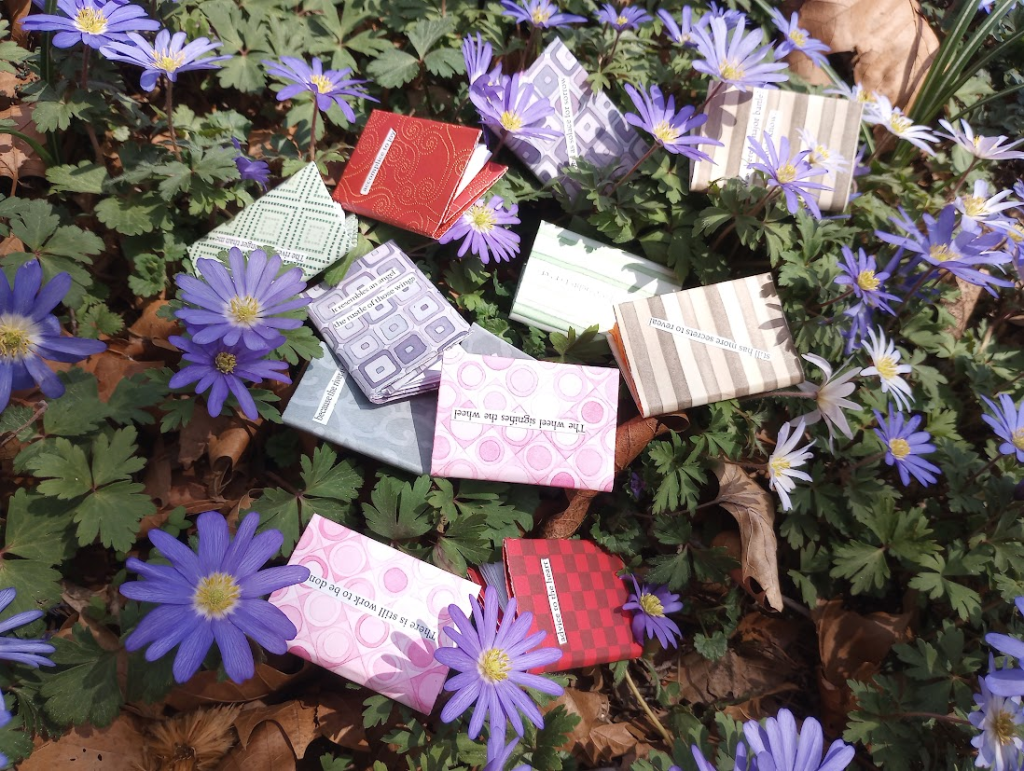
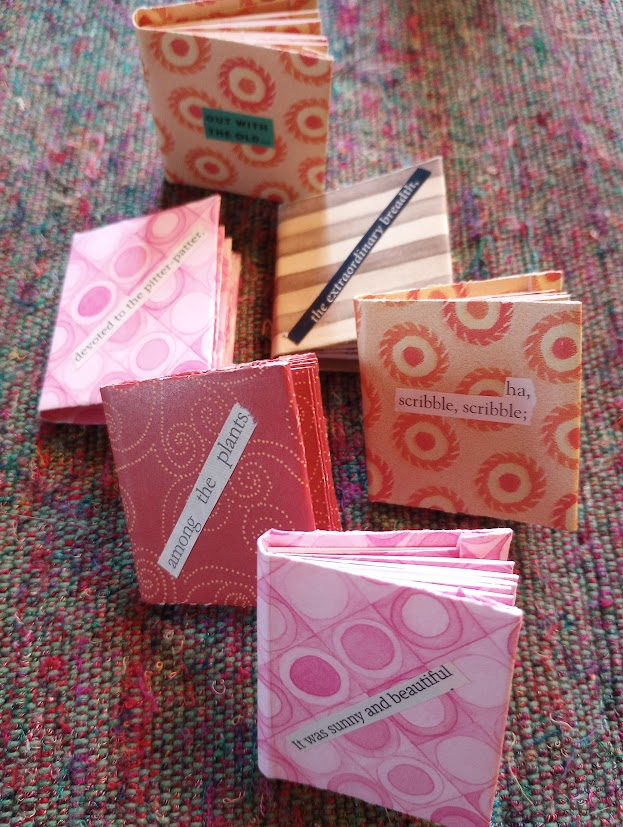
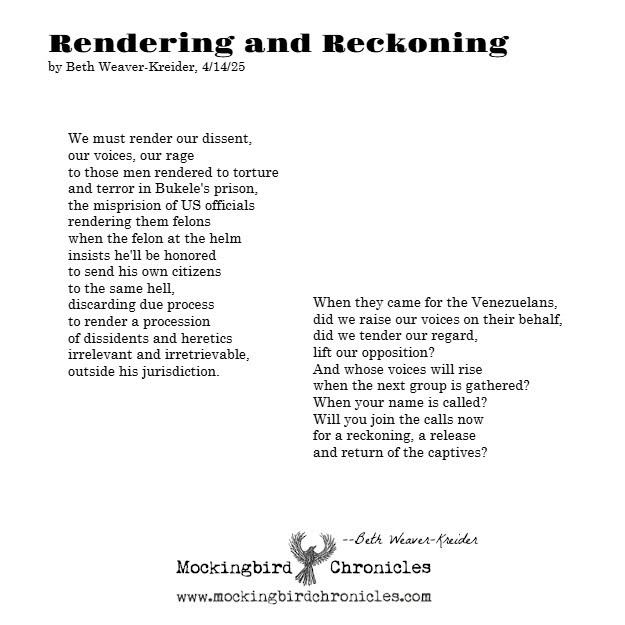
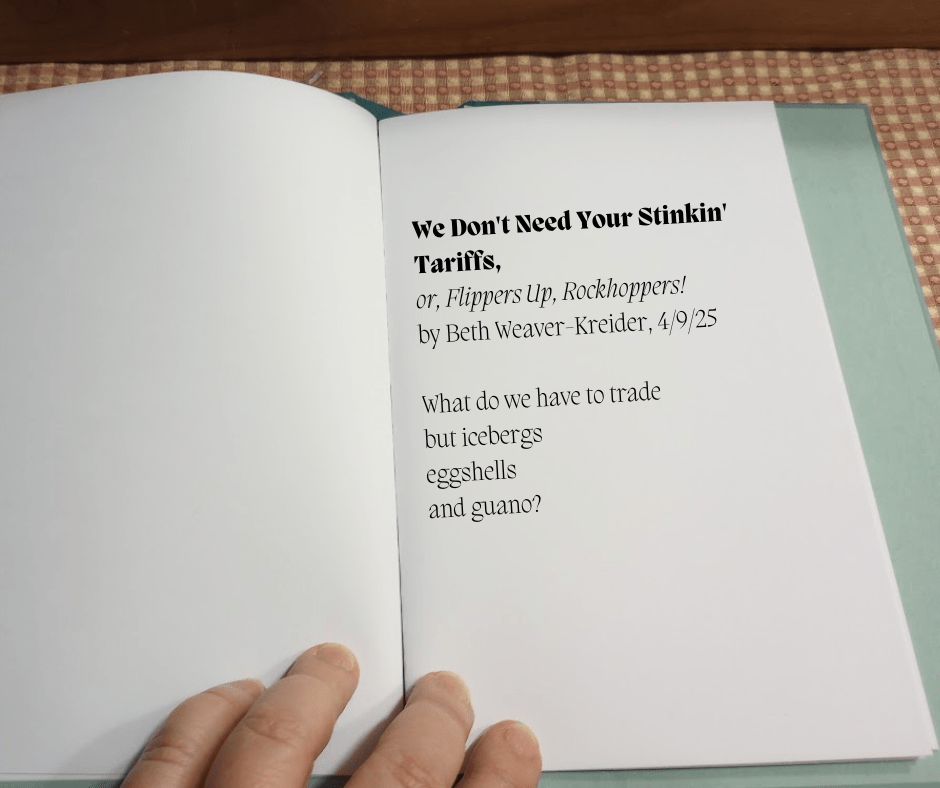
I have been writing. Really! I just haven’t been posting here. This season, I have gotten myself into a little bit of a bind with the artistic disciplines. I’m doing #The100DayProject, making a book a day, and I’m writing a poem a day in April. These are the things that keep my mind alive and questing during the stress of the spring season at school. The quick publish/post for daily poem and book has been Instagram and Substack, and so I will post a catalogue of some of my favorite poems and books here today.

November Poetry

I’ve had quite a few ideas about how I wanted to organize this year’s November Poem-a-Day. Try on a different persona every day? Do a month’s worth of epigraph poems? Do two days on each of the fifteen Mysteries of the Rosary? Write a daily ekphrastic poem based on drawing a tarot card? Do a month’s worth of found poems? Make each a magic spell?

Today I hadn’t yet settled on an organizing motif, and I’d sketched out the beginnings of several ideas for today’s poem, when I picked up The Best American Poetry 2000 (edited by Rita Dove) to read during Library Period while my students were independently reading.

One of the poets described how his poem in the anthology had taken him three years to write. Three years!?! How does a poet sustain the energy and attention for a single poem over three years? My own process has become very tied to my poem-a-day cycles in April and November, a discipline that tends to place practice over craft, a way to ensure that even when I go through dry times, I’ll always come back to a writing practice twice a year.

Even as I wrote that last sentence, I began to quibble with myself, because the practice, messy as it is, has definitely honed and sharpened my craft, and I always come back, select the best of the month’s harvest, and subject them to more careful crafting. I’m not just a word-vomit poet. I take crafting seriously.

But this poet who took three years to craft a poem! Perhaps it’s my own squirrelly attention span, or the mediocrity of my poetic sensibility, but I have never been able to imagine the process when poets talk about lengthy poem-crafting, the aching strain of shaping an idea over such a span of time. What was the poem doing in those years? Was it like a painting waiting for the artist to dab a few dabs of paint a day? Or half-abandoned like one of my knitting projects that gets stuck in the bottom of a basket for months before I remember to work on it again? Was it working on the poet’s psyche every day?

Perhaps the poem that rushed from me as I considered this poet and his process, and my own slap dash throw-it-on-the-page method of writing, made me a little defensive. I don’t really intend the tone to be snarky–toward him or myself. I was invigorated by the rush of ideas, the whoosh and whisper as the words winged in.

Perhaps this is one I will return to more deliberately, to craft into a gem. It will not take me three years, and yet, despite that essential lie, I feel like I’ve found some gold inside today’s idea.

Three Years
by Beth Weaver-Kreider

This poem has taken me three years to write.
First, it was a simple spot of blood, blooming
crimson on the white petal of the page,
glowing slightly, touched with were-light.
It hovered in that state for months, in stasis
while I hammered out the form,
the quiet exhalations of its line breaks,
the humming tension of occasional enjambment
heightening the tautness of the structure,
driving the metrical processional
to the first stanza’s end. That was the first year.

In the second year, I crawled about, blindly,
in the dusty rooms of the poem, gathering shadows
like cobwebs stuck to my knees, my hair, my teeth.
Here and there I tugged transitions into place,
opened blinds to let light in, took myself in hand
and faced the demon labyrinth of the second stanza
with every scrap of strength my soul could muster.
Perhaps you can sense, Sensitive Reader,
the longing that fed me forward
to the exhausting conclusion of the second year?

The third year was filled with howling and wrangling,
attempting to tame the wild creature of the poem
without breaking its will, feeding it symbols and reasons,
assonance, consonance, rhythms and patterns to live for,
then recanting the dominion within me that sought
to subject it, to coax and corral it under my will.
I gave it some rein for its wildness,
then set it free. And just today I heard it nickering
on the hill behind the orchard, its gentle form
slipping through the mists to return to me complete.


Gratitude List:
1. Writing Practice
2. Writing Craft
3. How golden sunlight fills the bowl of woods, of hollow.
4. Weekend
5. No matter what happens, people will continue to work for good.
May we walk in Beauty!


“I am passionate about everything in my life, first and foremost, passionate about ideas. And that’s a dangerous person to be in this society, not just because I’m a woman, but because it’s such a fundamentally anti-intellectual, anti-critical thinking society.” —bell hooks


“Bless the light and the darkness, the love and the fear.” —Rabbi Olivier BenHaim


“It doesn’t matter who you are or what you look like, so long as somebody loves you.” —Roald Dahl, The Witches


“For women who are tied to the moon, love alone is not enough. We insist each day wrap its knuckles through our heart strings and pull. The lows, the joy, the poetry. We dance at the edge of a cliff. You have fallen off. So it goes. You will climb up again.” —Anais Nin


“The creation of a thousand forests is in one acorn.” —Ralph Waldo Emerson


“In the morning I went out to pick dandelions and was drawn to the Echinacea patch where I found a honeybee clinging to one of the pink flowers. She seemed in distress, confused and weak. She kept falling off the flower and then catching herself in midair and flying dizzily back. She kept trying to get back to work, to collect her pollen and nectar to take home to the hive to make honey but she was getting weaker and weaker and then she fell into my hand. I knew she would never make it back to her hive. For the next half hour she rested in my palm, her life slowly ebbing away as a thunderstorm started to brew. I sat on the earth waiting for death with her. The lightning flashed over the mountains, a family of turkeys slowly walked the ridge, a wild dog keyed into what was happening circled past us. The trees appeared startlingly vivid and conscious as the wind blew up and the thunder cracked and then her death was finished. She was gone forever. But in her going she taught me to take every moment as my last flower, do what I could and make something sweet of it.” —Layne Redmond


“Let me seek, then, the gift of silence, and poverty, and solitude, where everything I touch is turned into prayer: where the sky is my prayer, the birds are my prayer, the wind in the trees is my prayer, for God is all in all.” —Thomas Merton


“Beware; for I am fearless, and therefore powerful.” —Mary Wollstonecraft Shelley, author of Frankenstein


Audre Lorde:
“For women, then, poetry is not a luxury. It is a vital necessity of our existence. It forms the quality of the light within which we predicate our hopes and dreams toward survival and change, first made into language, then into idea, then into more tangible action.
.
Poetry is the way we help give name to the nameless so it can be thought. The farthest external horizons of our hopes and fears are cobbled by our poems, carved from the rock experiences of our daily lives.
.
As they become known and accepted to ourselves, our feelings, and the honest exploration of them, become sanctuaries and fortresses and spawning grounds for the most radical and daring of ideas, the house of difference so necessary to change and the conceptualization of any meaningful action. Right now, I could name at least ten ideas I would have once found intolerable or incomprehensible and frightening, except as they came after dreams and poems. This is not idle fantasy, but the true meaning of “it feels right to me.” We can train ourselves to respect our feelings, and to discipline (transpose) them into a language that matches those feelings so they can be shared. And where that language does not yet exist, it is our poetry which helps to fashion it. Poetry is not only dream or vision, it is the skeleton architecture of our lives.”


“Wake at dawn with a winged heart and give thanks for another day of loving.” —Khalil Gibran


Marge Piercy:
Forgive the dead year. Forgive
yourself. What will be wants
to push through your fingers.
The light you seek hides
in your belly. The light you
crave longs to stream from
your eyes. You are the moon
that will wax in new goodness.


“Surrender is not passively resigning yourself to something. . .it is a conscious embracing of what is.” —Cynthia Bourgeault

Found Poem: Predictive text Helper

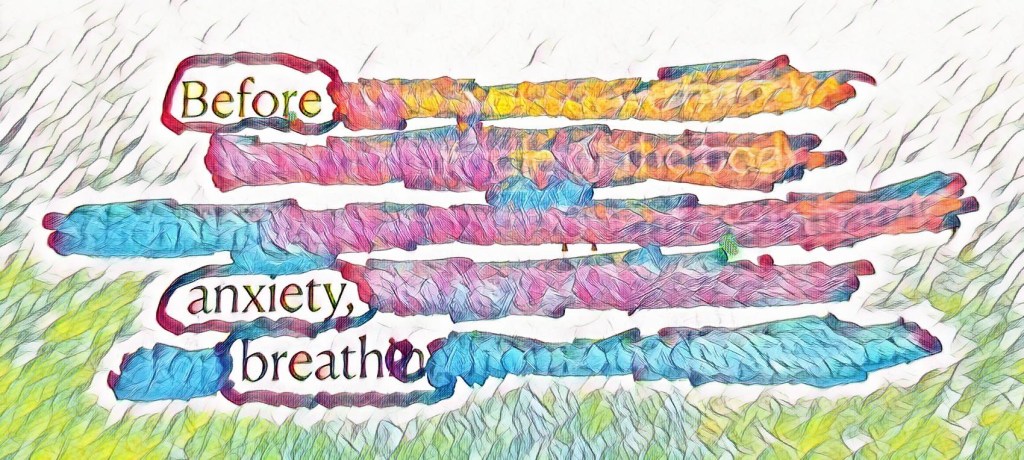
“Before anxiety, breathe.” Found redacted poem (that’s a prompt for another day) by one of my ninth graders. I ran it through a filter for some color. I love how she got to that last word and decided she needed to manipulate the word to suit her purposes.

Here’s a little refresh for the page: Poetry Prompts!

A few days ago, I re-tolled a fun prompt I sometimes use to get myself out of a rut, using predictive text to break me out of my overused words and rhythms. Wordplay and found poetry help me to find new ways to breathe into a poem, and sometimes offer profoundly new ways of expression. “Let go of the reins of the horse of your brain, and let it wander where it wants to for a while,” I sometimes tell my students. I find that the beautiful balance of letting go, and being ready to step in and actively create (as my student did in the image above) not only informs my poetic process, but my living as well.

So here are some initial ideas for using predictive text to restart your poetic mojo. If you don’t think of yourself as a poet (I disagree, btw–if you put words together in your own way, you are a poet), you can use these exercises to play and explore language. I’ll call the prompts Games, just to make it clear that we’re starting playing here.

One note before we begin: Each Game has rules. Try to follow them, to give the game a little structure and challenge. But be ready to break them if the Poem Gnome taps you on the shoulder and suggests you try something different.

Game 1:
You’re going to write a six- or eight-line poem. You are in charge of the word or short phrase that begins each line. Then let predictive text finish the lines for you. Here’s an example, with my words in bold. Of course, I have stolen the words for this one, for the sake of play:
Roses are the only thing I need.
Violets are the only thing I have.
Sugar and honey roasted figs with you
And now I’m waiting for the bus.
So are you.
So it will be.

Game 2:
Let’s try the same thing, only alternating words with the predictive text. I find this one creates more tension as I try to direct the predictive text. I actually fought it a little and changed the predictive text generator’s (PTG’s) “look” to “looked.” And I actually let the PTG suggest “whenever” instead of the “when” I was considering.
Wafting to the bottom of Pandora’s pool,
my little feather was almost ready for you.
Dreams of her own box of possibilities
flew out of the grove in the rain,
and now she has forgotten about her last lover,
how the clouds looked whenever he was leaving.

NOTES:
1. You might notice, like I do, that you find yourself backtracking and choosing different words in order to force the PTG to offer you better choices. Feels like chess with the computer.
2. Maybe what you came up with, like mine, is laughable trash. But maybe it gives you an idea for something to do next with your own line breaks and cadences. Steal that and run with it!
3. Likely the poem itself it not a publishable gem. But perhaps there’s a line in there that sings? Take it an spin it into another poem of your own!
4. I love that the PTG gave me “Pandora’s,” but I didn’t want to let it force me into using “box.” But my work in the poem quickly became about telling Pandora’s story. I think I should change the “my” to “her.”


Gratitude List:
1. The wild creatures of Goldfinch Farm.
2. Although there is a lot to accomplish in my summer days, I like how I can choose and plot the course with my own intentions.
3. This lavender-filled collar that I put in the freezer and then wear about my neck when the heat feels overwhelming.
4. These teenagers. I love their company, quiet and reserved as it is. Comfortably being together in the house.
5. The creative urge. Making stuff.
May we walk in Beauty!

Playing Catch Up

I’m trying to catch up on some of the poems I missed during the frantic days of last week.

One prompt was to write an Even poem. I began with the word, just followed the sounds without trying to force a meaning, until about halfway through, when I began to realize what the poem was about:

Farewell to the Faerie Child
Even now as I leave
through the window
I know you believe
that I grow as I go
into something stranger
maybe more dangerous
or greater than the safe
little waif of your imagining
dashing through wind-riven
shallows and groves
facing the dangers
of hailstorms and snow
to dance in the storm
and prance in the gale
and be ever the puck
of your next faerie tale.


One prompt was to write an Animal Poem. I turned myself into a bloodhound, still trying to figure out the starting juice for a poem.

On the Trail
There never was a perfect answer
to how to begin, how to set down the line
and follow it, like a hound on a scent trail
nose to the ground, after a sound, a sense,
an indefinable inside nudge.


This one is sort of a toss-off, but a fun word-game, and probably a learning experience, too. The prompt was to write a “customized” poem, so I took a Shakespearean sonnet, kept the first and last word of each line (with a couple tweaks), and customized each line to suit my purpose. I would definitely like to try this again, with a little more time and effort.

Customizing Shakespeare’s Sonnet 78
So, this is one way to invoke the Muse
And seek new pathways for my verse.
As technique I use or hope to use
And long to see the writer’s block disperse.
This method just might help my lines to sing
And teach my words to launch and fly,
Have given rhythm to my poet’s wing
And taught the lion of my phrasing majesty.
Yet down the plodding line I fast compile,
Whose tortured syntax does not work for me:
In search of my own voice and style,
And I am just a Shakespeare wannabe;
But to work this way will certainly advance
My style from basic ignorance.


Gratitude List:
1. Sheep on the opposite ridge of the hollow
2. Rich and deep conversations about the inner world
3. Having my say
4. A day that feels sort of like a retreat
5. Thanksgiving leftovers supper (I’m going to try that thing where you add a couple eggs and some broth to your stuffing, and press it in a waffle maker.)
May we walk in Beauty!


“You pray for the hungry. Then you feed them.
That is how prayer works.” —Pope Francis


“Allow dark times to season you.” —Hafiz


“I don’t have to respond whenever provoked.
No one does.
Steward your energy well.
We have justice work to do.
And strategy to outline.
And self-care to prioritize.
And love to live.
It’s okay to let provocateurs leave empty-handed.”
—Bernice King


“A quiet secluded life in the country, with the possibility of being useful to people to whom it is easy to do good, and who are not accustomed to have it done to them; then work which one hopes may be of some use; then rest, nature, books, music, love for one’s neighbor—such is my idea of happiness.” —Leo Tolstoy


“I don’t have to chase extraordinary moments to find happiness. It’s right in front of me, if I’m paying attention and practicing gratitude.” —Brené Brown


“Oh, to love what is lovely, and will not last!” —Mary Oliver


“I don’t have to figure it all out. I don’t have to be perfect for every moment. I just need to be Present. I just need to show up.” —Beth Weaver-Kreider (My past self is preaching to my present self.)


“The ego forgets that it’s supposed to be the little traveler with its bindle bag over its shoulder, following behind [not ahead] the radiant Soul who walks as more wise, more tender, more loving, more peaceful trailblazer throughout our lives.
.
Ego aspires sometimes to wear the garments of the Soul, which are way too big, making the ego trip over the miles of radiant robes it tries to wrap itself in, instead of following the light those robes give off. And tending to the Soul’s needs, the Soul’s directions.
Yet with Soul in the lead, and ego following the lead of the Soul, then we can fulfill the vision of the Holy People…” —Dr. Clarissa Pinkola Estes


“Driven by the forces of love, the fragments of the world are seeking one another.” —Teilhard de Chardin


“There’s a fine line between genius and insanity. I have erased this line.” ―Oscar Levant


“Scriptures, n. The sacred books of our holy religion, as distinguished from the false and profane writings on which all other faiths are based.” —Ambrose Bierce (1842-1914), [The Devil’s Dictionary, 1906]


“There are real world implications to ‘just having opinions’ and those implications almost always involve doing deep harm to marginalized communities.” —Kaitlin Shetler

The Happy Heretic Hits 56

But, first things first: My book is born!

Ten years ago, I ventured into the world of self-publishing. I created my own little imprint called Skunk Holler Poetryworks (we live in a dip between the arms of Pisgah Ridge casually known as Skunk Hollow). Then I published a book of Poetry called The Song of the Toad and the Mockingbird. It’s a mouthful of a name, which is often the burden of first children. A year later, Skunk Holler Poetryworks published a second volume: Holding the Bowl of the Heart. Then I dithered. The company I use to publish the books can print a single copy or dozens, as demand requires. That means no up-front capital for me unless I buy a batch of author copies. The downside of this marvelous situation is that the company is an Amazon company, and I feel like I am working within the belly of the beast. So for years, I just didn’t publish anything. I haven’t been able to find another company with the incredibly user-friendly design system, the marketing potential, and the one-off printing. So I didn’t publish for almost a decade.

But then last year happened. I became The Heretic. I wrote some of my best poems. And The Heretic’s Book of Prayer was born. I wanted to publish it, but I am essentially an unknown poet, and I like having total control of everything from font to layout to organization to cover design, so I jumped back into the belly of the beast.

This is definitely my best book so far. The poems are stronger and more confident. The organization tells a story that I want to tell. The focus is crisper. And in the sorting and editing of poems, I actually found that I have enough poems for a second book, possibly titled Seasons of the Witch.

You can buy The Heretic’s Book of Prayer on Amazon. My dream is to eventually set up a page on The Mockingbird Chronicles website where you can order all of my books directly from me, but I am not that smart yet. I’ll need some tutoring to manage it, and my IT Guy is leaving for college in two weeks.

Shameless ad: Buy my book, please!


And. It’s my birthday! I’m turning 56. I’ve done my yearly research, and there doesn’t appear to be anything mathematically interesting about the number 56. There’s something about it being the sum of the first six triangular numbers, making it a tetrahedral number, so there’s that.

The angel number and numerology people all seem to agree that 56 is a number of transformation and change. I’ll take that! As I have been praying along with the current Way of the Rose Novena, I have been asking for focus and determination, and somehow that seems to have translated to the focus I needed to get this book done. Also, I recently asked my doctor how I can deal with the exhaustion and aches. She suggested, I start eating a careful Mediterranean diet, and exercising more. Exercise has always been my bugaboo, but then I thought about the fact that I am already spending 30-40 minutes a day saying my rosary–What if I would walk during that time? So I’ve added a brisk walk every day. In a week and a half, I am feeling a change. So maybe the transformative aspect of 56 can help me continue to develop greater health in the coming year.

I asked if I could write the blurb about the saint for today on The Way of the Rose novena page. I chose St. Harriet Tubman. You should be able to read it by clicking here.


Gratitude List:
1. How people circle ’round to protect the vulnerable.
2. Examples of people who offered their lives for justice for others.
3. Goldfinches along the roads these days, how they fly up twittering so joyfully.
4. The little fairy birds that flitted ahead of me on my walk today. I think they must be field sparrows, but in the dusk they looked tiny and fairy-like.
5. Aging. Yes, really. Despite the aches and the hormone shifts and the new and edgy anxieties. I love how we change and ripen, how our faces begin to show the art of our living. Birthdays remind me that I am always on the turning wheel, and what a glorious ride it can be!

May we walk ever in Beauty!


“Mockingbirds are the true artists of the bird kingdom. Which is to say, although they’re born with a song of their own, an innate riff that happens to be one of the most versatile of all ornithological expressions, mocking birds aren’t content to merely play the hand that is dealt them. Like all artists, they are out to rearrange reality. Innovative, willful, daring, not bound by the rules to which others may blindly adhere, the mockingbird collects snatches of birdsong from this tree and that field, appropriates them, places them in new and unexpected contexts, recreates the world from the world. For example, a mockingbird in South Carolina was heard to blend the songs of thirty-two different kinds of birds into a ten-minute performance, a virtuoso display that serve no practical purpose, falling, therefore, into the realm of pure art.”
― Tom Robbins


Even
after
all this time
the sun never says to the earth,

“You owe me.”

Look
what happens
with a love like that —

It lights the whole
world.
—Hafiz


“The Seven of Pentacles”
by Marge Piercy

Under a sky the color of pea soup
she is looking at her work growing away there
actively, thickly like grapevines or pole beans
as things grow in the real world, slowly enough.
If you tend them properly, if you mulch, if you water,
if you provide birds that eat insects a home and winter food,
if the sun shines and you pick off caterpillars,
if the praying mantis comes and the lady bugs and the bees,
then the plants flourish, but at their own internal clock.

Connections are made slowly, sometimes they grow underground.
You cannot tell always by looking what is happening.
More than half a tree is spread out in the soil under your feet.
Penetrate quietly as the earthworm that blows no trumpet.
Fight persistently as the creeper that brings down the tree.
Spread like the squash plant that overruns the garden.
Gnaw in the dark and use the sun to make sugar.

Weave real connections, create real nodes, build real houses.
Live a life you can endure: make love that is loving.
Keep tangling and interweaving and taking more in,
a thicket and bramble wilderness to the outside but to us
interconnected with rabbit runs and burrows and lairs.

Live as if you liked yourself, and it may happen:
reach out, keep reaching out, keep bringing in.
This is how we are going to live for a long time: not always,
for every gardener knows that after the digging, after the planting,
after the long season of tending and growth, the harvest comes.


“Life…is a wonder. It is a sky laden with clouds of contradictions.” —Naguib Mahfouz


“Nature gives you the face you have at twenty; it is up to you to merit the face you have at fifty.” —Coco Chanel


“By virtue of the Creation and, still more, of the Incarnation, nothing here below is profane for those who know how to see. On the contrary, everything is sacred.” —Teilhard de Chardin


“Soul of my soul … be water in this now-river.” —Rumi


“You are the Soul of the Soul of the Universe, and your name is Love.” —Rumi


“There is one masterpiece, the hexagonal cell, that touches perfection. No living creature, not even human, has achieved, in the centre of one’s sphere, what the bee has achieved on her own: and if intelligence from another world were to descend and ask of the earth the most perfect creation, I would offer the humble comb of honey.” —Maurice Maeterlinck, The Life Of The Bee, 1924


“If it is bread that you seek, you will have bread. If it is the soul you seek, you will find the soul. If you understand this secret, you know you are that which you seek.” —Rumi


“In these cataclysmic times, living in what Michael Meade calls the ‘slow apocalypse,’ despair can be dangerously seductive. Our lives may feel inadequate to the terrible momentum of our times, but it is in those moments that we must remember the difference between despair and grief.

“While despair traps us in the bog of despondency, grief carries us into life. Grief calls us into a deeper engagement with those things that we love. And even as we are losing them, grief wants to exalt their beauty.

“If we let grief move us into expression, it will sing the blood into our songs, colour the vividness into our paintings, and slip the poetry between our words.

“Rumi says, “All medicine wants is pain to cure.” And so we must cry out in our weakness, our ineptitude, our beautiful inadequacy and make of it an invitation that medicine might reach through and towards us.” —Toko-pa Turner

Artemis at Midlife

I have been doing magic to enhance my focus and intention in these flowing days of wibbly-wobbly summer time, in this larger season of my life which has lost its focus and drive, when I have left so many of my little (and big) dreams lying somewhere along the path. Every summer for the past nine years, I have told myself I would organize my poetry into another book, and September always slides in and I have nothing to show.

Call it fear of failure, or of success.
Call it undiagnosed ADHD.
Call it setting aside my own needs for the needs of others.
Call it laziness and procrastination.
Call it addiction to distractions.
Call it the overwhelm of having TOO MANY poems to sort through.

Whatever it is, I have stood behind this wall of it for nearly a decade now, and I am ready to move on. This summer something shifted. Here I am in the vestibule of July, and I have two very messy collections of poetry that I am working on. Oh, they’re nothing like ready. I have arranging and editing and cutting to do, and maybe something to add here or there. But I have TWO actual pools of poems headed toward publication. I’m not entirely sure what brought about the change.

Call it the magic spells.
Call it the recent 54-day novena in which I told the Mother my heart’s desire was to finish another book.
Call it finally crawling out of the psycho-spiritual constraints of existing within a Mennonite institution.
Call it the new fire of midlife.

Whatever it is, I am grateful.

Today begins a new 54-day novena with The Way of the Rose, and I don’t mind making public my plea. I am asking for Focus. I have been imagining the Goddess Diana with her bow, focused laser-like on her object. This morning during my prayers I got an image in my head of Artemis at Midlife. I came down from the pear grove and wrote that poem:


Artemis at Midlife

One of her greatest attributes is vibrant youth,
like her bow, like her swarm of leggy hounds,
like her fierce protection of the wilds
and of her own wild autonomy.

She was never supposed to get old.
Her eyes have blurred and softened, so now
she relies upon her sense of her body in space,
her inner eyes, to find the target.

Her weight has settled and gathered
in her belly and her thighs, and so
she hides no longer in the slender saplings
but among the tumbled rocks.

The whip-quick Alani who swirled
like mist around her thighs, barking
and racing to confront the wayward hunter
in the green wood, rest now in grassy hollows

like sleepy bears in the moonlight,
raising their heads as the goddess
rises to cool herself in the stream
after one more inexorable hot flash.

There was a day when she ran fleetly
through the forest, leaping from rock
to log, and lightly across ravines. No more.
Her body has found its home in gravity,

and she wanders quietly, no longer
baying the wild stag with hounds,
but waiting, silent, under a great oak,
for the regal beast to come to her.


Gratitude List:
1. Finding Focus, though with softer vision
2. Breakthrough and Shift
3. The wide-open splendor of a summer’s day
4. Making friendship bracelets with kids
5. The way a poem helps to shape meaning
May we walk in Beauty!


“The doors to the world of the wild self are few but precious. If you have a deep scar, that is a door. If you have an old, old story, that is a door. If you love the Sky and water so much you almost cannot bear it, that is a door. If you yearn for a deeper life, a full life, a sane life, that is a door.” —Clarissa Pinkola Estes


“Land, then, is not merely soil; it is a fountain of energy flowing through a circuit of soils, plants and animals.” —Aldo Leopold


“Recognize the invisible hands that guide you, the breath that breathes you, the walls and roof that keep cold from chilling you, the water that magically springs from your taps, the long line of ancestors whose every step made your incarnation possible. You belong to these holy helpers. You have undisputed membership. In your recognition of this wealth, your own life cannot help but become an offering back to that which feeds you.” —Toko-pa Turner


“The very form of our thinking has to be re-formed from “thinking about” to “thinking within,” and Silence is the teacher. . . . Silence is intelligence. . . . As we enter into Silence, we enter into Wisdom. We do not become wise but enter into the objective Wisdom of world processes. Judgment, as the primary mode of our thinking, ceases or is taken up only when needed for our practical life. As we enter into the Wisdom of Silence, we allow ourselves to be taught by the things of the world.” —Robert Sardello


“To disobey in order to take action is the byword of all creative spirits. The history of human progress amounts to a series of Promethean acts. But autonomy is also attained in the daily workings of individual lives by means of many small Promethean disobediences, at once clever, well thought out, and patiently pursued, so subtle at times as to avoid punishment entirely.” —Gaston Bachelard


“Walking. I am listening to a deeper way. Suddenly all my ancestors are behind me. Be still, they say. Watch and listen. You are the result of the love of thousands.” ―Linda Hogan


“I didn’t mean to tell you,” Mrs Whatsit faltered. “I didn’t mean ever to let you know. But, oh, my dears, I did so love being a star!” —Marlene L’Engle


“Some black cats are witches in disguise. Some witches are black cats in disguise.” —Folklore of Wales


“Faith is the willingness to give ourselves over, at times, to things we do not fully understand…the full engagement with this strange and shimmering world.” —Alan Lightman


“The possibilities that exist between two people, or among a group of people, are a kind of alchemy. They are the most interesting thing in life. The liar is someone who keeps losing sight of these possibilities.” —Adrienne Rich


“Lying is done with words, and also with silence.” —Adrienne Rich


“Women have been driven mad, “gaslighted,” for centuries by the refutation of our experience and our instincts in a culture which validates only male experience. The truth of our bodies and our minds has been mystified to us. We therefore have a primary obligation to each other: not to undermine each other’s sense of reality for the sake of expediency; not to gaslight each other.

Women have often felt insane when cleaving to the truth of our experience. Our future depends on the sanity of each of us, and we have a profound stake, beyond the personal, in the project of describing our reality as candidly and fully as we can to each other.

[…]

When a woman tells the truth she is creating the possibility for more truth around her.” —Adrienne Rich

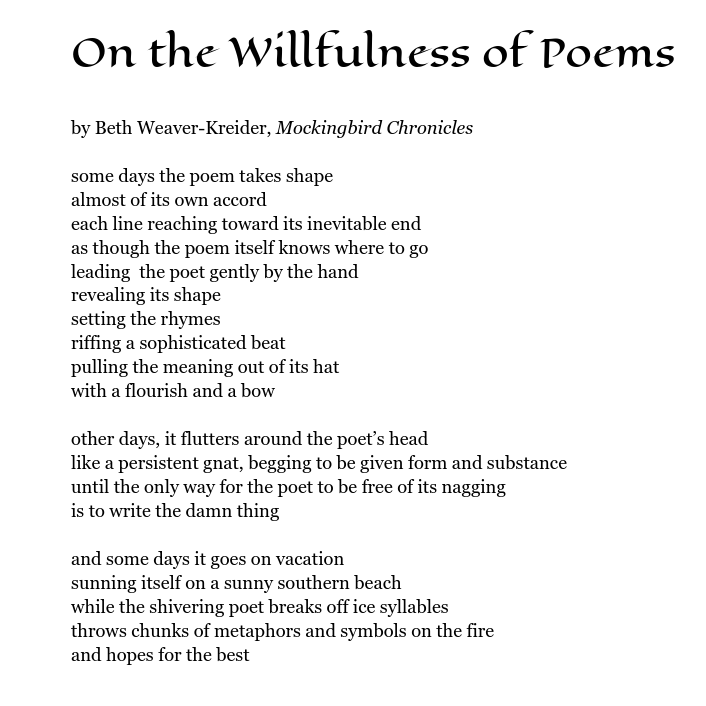
On the Willfulness of Poems

After several false starts today, I just wrote about the difficulty of catching a poem.


Gratitude List:
1. That moment in Math class when we were doing a division drill, and a student suddenly looked up with wonder in her eyes and said, “I get it! This is just the opposite of multiplication!” Yes, oh yes, oh yes! It doesn’t matter that I had already said it and pointed it out over and over and over again–until her brain was ready to make the connection, it didn’t make sense. But today she got it. On her own.
2. Spring rain. I was chilly all day. Still, it feels like this is how spring is supposed to feel.
3. Support systems, webs, communities of care
4. Book sales! Kreutz Creek Valley Library began its sale today
5. All the colors of green
May we walk in Beauty!


“The great affair, the love affair with life, is to live as variously as possible, to groom one’s curiosity like a high-spirited thoroughbred, climb aboard, and gallop over the thick, sun-struck hills every day. Where there is no risk, the emotional terrain is flat and unyielding, and, despite all its dimensions, valleys, pinnacles, and detours, life will seem to have none of its magnificent geography, only a length. It began in mystery, and it will end in mystery, but what a savage and beautiful country lies in between.” —Diane Ackerman


“I take literally the statement in the Gospel of John that God loves the world. I believe that the world was created and approved by love, that it subsists, coheres, and endures by love, and that, insofar as it is redeemable, it can be redeemed only by love. I believe that divine love, incarnate and indwelling in the world, summons the world always toward wholeness, which ultimately is reconciliation and atonement with God.” ―Wendell Berry


“A crone is a woman who has found her voice. She knows that silence is consent. This is a quality that makes older women feared. It is not the innocent voice of a child who says, “the emperor has no clothes,” but the fierce truthfulness of the crone that is the voice of reality. Both the innocent child and the crone are seeing through the illusions, denials, or “spin” to the truth. But the crone knows about the deception and its consequences, and it angers her. Her fierceness springs from the heart, gives her courage, makes her a force to be reckoned with.” —Jean Shinoda Bolen


“Go as far as you can see; when you get there you’ll be able to see farther.” —Thomas Carlyle


“At the end of the day, I’d rather be excluded for who I include than included for who I exclude.” —Eston Williams


“Free me. . .from words, that I may discover the signified, the word unspoken in the darkness.” —Byzantine Prayer


“Father, Mother, God,
Thank you for your presence
during the hard and mean days.
For then we have you to lean upon.
For those who have no voice,
we ask you to speak.
For those who feel unworthy,
we ask you to pour your love out
in waterfalls of tenderness.
For those who live in pain,
we ask you to bathe them
in the river of your healing.
Dear Creator, You, the borderless
sea of substance, we ask you to give to all the
world that which we need most—Peace.”
—Maya Angelou


“This will be our reply to violence: to make music more intensely, more beautifully, more devotedly than ever before.”
—Leonard Bernstein


Stillness. One of the doors
into the temple.”
—Mary Oliver


“If you just learn a single trick, Scout, you’ll get along a lot better with all kinds of folks. You never really understand a person until you consider things from his point of view… Until you climb inside of his skin and walk around in it.” —Harper Lee


“Some days, you don’t know whether
you are stepping on earth or water or air.
Place each foot carefully before you
and offer your weight gratefully to
whatever it is that holds you.”
—Beth Weaver-Kreider

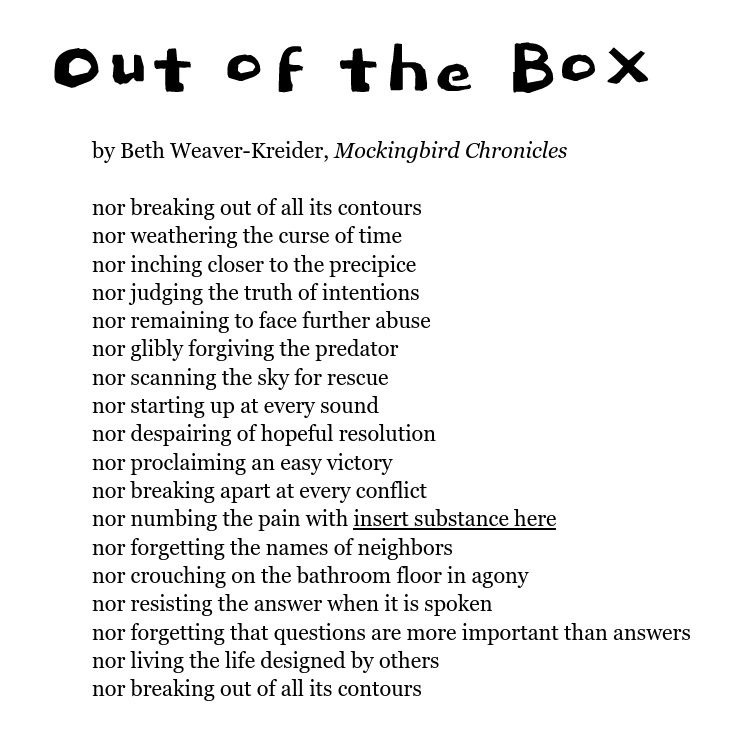
Out of the Box

This is the fifth day of riffing on phrases from Rilke. I love the choices my friend Tim made, choosing phrases with odd beginnings. I am a little compulsive about following my own rules, and I decided right away for some reason that I would begin every poem with the Rilke line, no matter how awkward. I can already feel it affecting my sentence structure, my sense of the sentence. This one begins with Nor. How do you begin with Nor and create something that makes real sense? It’s forcing my brain to explore different pathways. I’m liking this new view.

Gratitude List:
1. Cats: they’re such good company
2. Daffodils
3. This phrase from a student today: “If this last stanza of the poem were sentient, I would hug it!” (Jimmy Santiago Baca’s “I Am Offering this Poem”)
4. National Poetry Month
5. Praying/Meditating with my body
May we walk in Beauty!


“When I interviewed Maya Angelou, she told me to write this sentence on my notepad and to never forget it:
EVERY STORM RUNS OUT OF RAIN.
I still think of that to this day. ” —Alex Banyan


“Stay close to anything that makes you glad you are alive.” —Hafiz


“The problem is that you think you are separate from others.” —Richard Rohr


“You have to want a thing enough to reach out for it.” —Lailah Gifty Akita


“To wait within the moment for the coming dawn,
To breathe the single breath of all that lives,
To walk the web on which we all belong,
To face the newborn day with love instead of fear.
To listen for the whisper of the Spirit’s wind,
To feel Creator’s heartbeat in the world around,
To hear the grace of the Beloved in my neighbor’s voice,
To embrace the sacred space between the past and change.”
—Beth Weaver-Kreider


“Hope is a dimension of the soul. . .an orientation of the spirit, an orientation of the heart. It transcends the world that is immediately experienced and is anchored somewhere beyond its horizons. . . .It is not the conviction that something will turn out well, but the certainty that something makes sense regardless of how it turns out.” —Vaclav Havel


“When time comes for us to again rejoin the infinite stream of water flowing to and from the great timeless ocean, our little droplet of soulful water will once again flow with the endless stream.” —William E. Marks


“We are not to simply bandage the wounds of victims beneath the wheels of injustice, we are to drive a spoke into the wheel itself.” —Dietrich Bonhoeffer


“Healing is not pouring your energy into another, but activating the widening field of possibility around yourself, so the other may glimpse their own majesty forming on the horizon.” —Toko-pa Turner


“An ant crosses your carpet. A spider weaves a pattern older than mammals beneath your stairs. Just nod, breathe, and think, “Good. It’s all still here. The forest, the mountains, the desert. At home in my home.” The sterile white box is the stranger. Not the ant. Not the spider.” —Jarod Anderson, The Cryptonaturalist

Justice

Since I began this project of creating a tarot deck cooperatively with an online AI generator, the AI itself has evolved so rapidly, and the creators of the generator itself have added so many new features that within the six months since I began, the initial artwork is beginning to feel clunky and old-fashioned. I realize that the work I did to create it was a helpful process, not only in terms of my ideas about the the inner journey and about the tarot, but also in terms of my sense of the artistic and poetic process of cooperating with an AI. I find myself wanting to begin again. Maybe this process will never have an end product, but will simply be a part of my own inner growth. Perhaps I will end up instead creating an oracle deck with the characters that inhabit my own inner meditations: The Psychopomp, the Witch, The Dreamer-Mother, the Two Elves, The Gnomes of Beautiful Vision and Music, The Companion, The Golden One, Death, The Bees, Eagle, Six Crows, The Dancing Fox, Running Deer, The Golden-Crowned Tree, The Lady of the Labyrinth, The Darkness. . . Or perhaps, even, they will merge in some inexplicable way.

So here, halfway through the Major Arcana of the Tarot, I will finish this series for now, with Justice.

What does Justice mean to you? Is it the blind goddess holding her scales and a sword? I find it really interesting that Cupid and Justice are both portrayed in blindfolds: Love and Justice–an odd cosmic balance there.

Is Justice a balance of vengeance? Eye for eye? You hurt me, so I get to extract my pound of flesh from your stony heart.

Is it about karma? The bad stuff we do will come back to haunt us, so we can all relax, knowing that our enemies will eventually get their cosmic comeuppance? I know karma is a lot more complicated and nuanced than that, but I think we sometimes reduce it to this little dance of joy over cosmic rebalancing, celebrating the downfall of the evil-doer.

I want the people who hurt people to be held accountable. I want the ones who are injured and harmed to be seen and heard and listened to, to receive apology or remuneration or recompense for their injury. I don’t need an eye for an eye, but I need the harm to stop. I need the tools of the narrative to be wrested from the hands of the ones who do the injury and handed to the ones who were injured.

Restorative Justice has become a bit of a catchword in institutions these days, especially church-based institutions. When understood and practiced with depth and skill, it’s a wonderful tool for healing and returning to balance, offering a circle of story-telling, where the injured party can speak of their pain and suffering, and the ones who caused harm listen, and take account of what they have done to cause harm. In the process, they, too, get to speak, to tell their own pieces of the experience. We enter restorative justice circles with a recognition that harm has been done, and that healing is possible, but only if we meet ourselves and each other at deep, deep levels of accountability can we hope to repair the breaches in relationships.

Saying that you practice restorative justice, but doing the work half-heartedly or simply to score social points only causes more harm in the long run. Institutions, clubs, churches, and organizations that claim to do restorative justice work but only implement the process when the most powerful members of the group want to exercise controls over less powerful members of the group is an abuse of power and is the antithesis of restorative justice.

The Justice card holds us to keep high moral and ethical codes that include ourselves as well as others. We hold ourselves to the standards we demand of others. We offer others the grace and mercy we would show ourselves. Sounds a little like the Golden Rule.


Tomorrow is November. I am hoping to do a poem a day for the month.


Gratitude List:
1. My compassionate and tender-hearted and fun-loving colleagues. They made Halloween so special and magical and fun for the kids (while also managing to keep things educational).
2. The turning of the wheel. We step into a new season. We can change, metamorphose, transform.
3. Presence. Accompaniment. Companionship.
4. Cats
5. Golden, golden, golden: light and leaves and hearts.
May we walk ever in Beauty!


The wheel turns.
The harvest is in.
The veil parts.
We walk into the dark time.
Dream well.
Bright Blessings.
—Beth WK


“The moon has awoken with the sleep of the sun, the light has been broken; the spell has begun.” —Midgard Morningstar


“A labyrinth is a symbolic journey . . . but it is a map we can really walk on, blurring the difference between map and world.” —Rebecca Solnit


“Turn inward: If you’re asking ‘why’, also ask why ‘why’? If your power is to question, also question the questioner in you.” —Shunya


“Everybody is trying to make their journey till death comfortable. In the process they are missing the moments that can open the door to immortality.” —Shunya


“Walk through the veil of the season.
Carry your own little light into the dark time.
Celebrate the inward spiral.” —Beth WK