It was a ripple a glimmer a golden ray shimmering just a moment shining on the twilit waves percolating like a cooling stream of water trickling down my soul just a whisper in the wilderness a fragment of a fragment of a fragment of an almost-remembered dream, and nearly as ethereal, yet almost tangible too a brewing of hope on the horizon
Gratitude List: 1. A moment of Hope 2. Remembering beauty and goodness 3. Chocolate-covered Holiday Star cookies 4. Music to calm the anxious spirit 5. Good stories May we walk in Beauty!
Saturday’s Falling and Getting Up Again: “Both when we fall and when we get up again, we are kept in the same precious love.” ―Julian of Norwich
“What if I should discover that the poorest of the beggars and the most impudent of offenders are all within me; and that I stand in need of the alms of my own kindness, that I, myself, am the enemy who must be loved–what then?” ―Carl Jung
“I think, at a child’s birth, if a mother could ask a fairy godmother to endow it with the most useful gift, that gift should be curiosity.” ―Eleanor Roosevelt
“If I had influence with the good fairy, I would ask that her gift to each child be a sense of wonder so indestructible that it would last throughout life.” ―Rachel Carson
“Your problem is you’re too busy holding onto your unworthiness.” ―Ram Dass
“In giving of yourself, you will discover a whole new life full of meaning and love.” ―Cesar Chavez
“While there is a lower class, I am in it, while there is a criminal element, I am of it, and while there is a soul in prison, I am not free.” ―Eugene V. Debs
“I’ll be in the way kids laugh when they’re hungry and they know supper’s ready, and when the people are eatin’ the stuff they raise and livin’ in the houses they build – I’ll be there, too. Ma Joad: I don’t understand it, Tom. Tom Joad: Me, neither, Ma, but – just somethin’ I been thinkin’ about.” ―Tom Joad, from the movie Grapes of Wrath
“And don’t we all, with fierce hunger, crave a cave of solitude, a space of deep listening—full of quiet darkness and stars, until we hear a syllable of God echoing in the core of our hearts?” —Macrina Wiederkehr
“Of course the people don’t want war. But after all, it’s the leaders of the country who determine the policy, and it’s always a simple matter to drag the people along whether it’s a democracy, a fascist dictatorship, or a parliament, or a communist dictatorship. Voice or no voice, the people can always be brought to the bidding of the leaders. That is easy. All you have to do is tell them they are being attacked, and denounce the pacifists for lack of patriotism, and exposing the country to greater danger.” —Herman Goering at the Nuremberg trials
“The way that I understand it, dreaming is nature naturing through us. Just as a tree bears fruit or a plant expresses itself in flowers, dreams are fruiting from us. The production of symbols and story is a biological necessity. Without dreams, we could not survive. And though it is possible to get by without remembering our dreams, a life guided and shaped by dreaming is a life that follows the innate knowing of the earth itself. As we learn to follow the instincts of our inner wilderness, respecting its agreements and disagreements, we are also developing our capacity for subtlety. This sensitivity is what makes us more porous and multilingual, bringing us into conversation with the many languages of the world around us.” — Toko-pa Turner
Here is a conjuring for Day Two of November Poem-a-Day
First Conjuring by Beth Weaver-Kreider
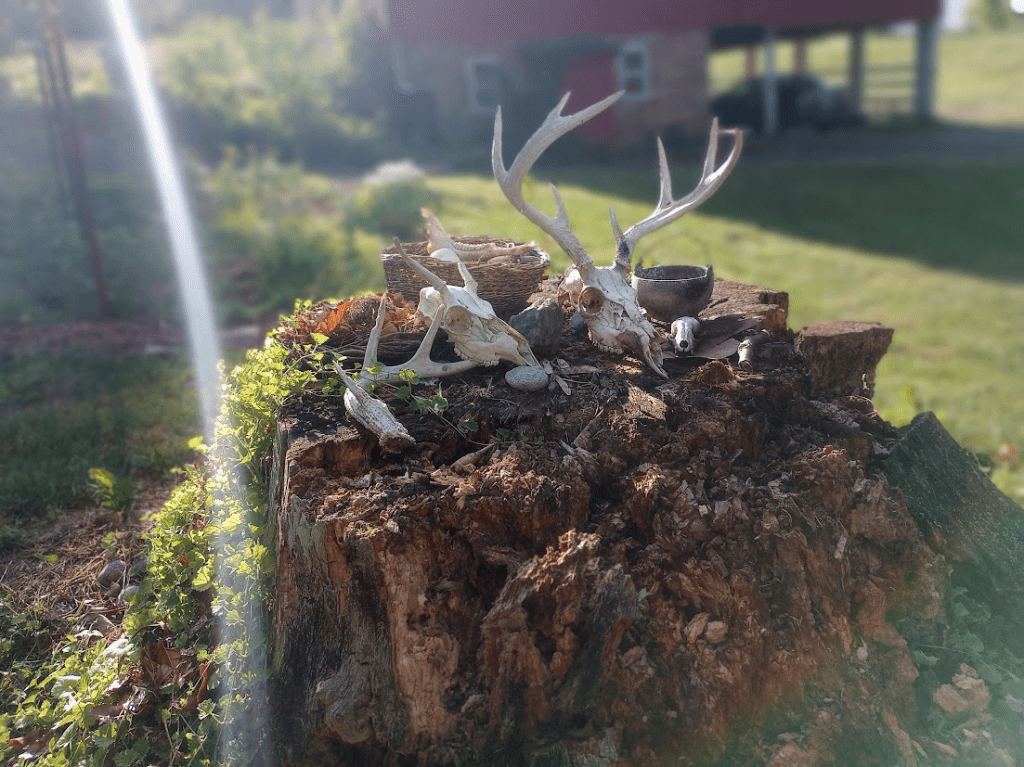
Deer Mother! Falcon Mother! Be the watching in my sunrise, the quiet waiting at the gates between breath and breath, heartbeat and heartbeat, between day and day again.
Fox Mother! Bear Mother! Walk me deep into forest dreaming, where wind will whistle through my fur, where earth will rise into my padded paws and my eyes will turn to embers.
Rabbit Mother! Trout Mother! I will go to a rabbit, to a silvery trout. Give me quick-running feet, grant me quick-swimming fins, give me breath for my flashing from shadow to shadow.
Vulture Mother! Crow Mother! Enfold me in the robes of your black wings. Draw my very substance down into earth and up into sky that I may see, and seeing, take flight.
Gratitude List: 1. That brown sugar bourbon ice cream 2. I got hours of work done on a project today–still hours to go, but fewer than when I began 3. No matter what happens people will still keep doing good and advocating for justice 4. Good writing–C S E Cooney can’t come up with her sequel to St. Death’s Daughter fast enough for me–her use of words is exhilarating 5. Standing in the early morning chill with a bunch of other cross country parents to watch as the police and fire department escort came down with the bus on the way to States May we walk in Beauty!
“Come, come, whoever you are. Wanderer, worshiper, lover of leaving. It doesn’t matter. Ours is not a caravan of despair. Come, even if you have broken your vows a thousand times. Come, yet again, come, come.” ―Jelaluddin Rumi
“No warmth, no cheerfulness, no healthful ease, No comfortable feel in any member— No shade, no shine, no butterflies, no bees, No fruits, no flowers, no leaves, no birds— November!” —Thomas Hood, No!
“I could not be a poet without the natural world. Someone else could. But not me. For me the door to the woods is the door to the temple.” —Mary Oliver
“Nourish beginnings, let us nourish beginnings. Not all things are blest, but the seeds of all things are blest. The blessing is in the seed.” —Muriel Rukeyser
“We discover the Earth in the depths of our being through participation, not through isolation or exploitation. We are most ourselves when we are most intimate with the rivers and mountains and woodlands, with the sun and the moon and the stars in the heavens… We belong here. Our home is here. The excitement and fulfillment of our lives is here… Just as we are fulfilled in our communion with the larger community to which we belong, so too the universe itself and every being in the universe is fulfilled in us.” —Thomas Berry, The Sacred Universe
Words of Howard Zinn: “We don’t have to engage in grand, heroic actions to participate in the process of change. Small acts, when multiplied by millions of people, can transform the world. Even when we don’t ‘win,’ there is fun and fulfillment in the fact that we have been involved, with other good people, in something worthwhile. We need hope.
“An optimist isn’t necessarily a blithe, slightly sappy whistler in the dark of our time. To be hopeful in bad times is not just foolishly romantic. It is based on the fact that human history is a history not only of cruelty, but also of compassion, sacrifice, courage, kindness. What we choose to emphasize in this complex history will determine our lives. If we see only the worst, it destroys our capacity to do something.
“If we remember those times and places—and there are so many—where people have behaved magnificently, this gives us the energy to act, and at least the possibility of sending this spinning top of a world in a different direction. And if we do act, in however small a way, we don’t have to wait for some grand utopian future. The future is an infinite succession of presents, and to live now as we think human beings should live, in defiance of all that is bad around us, is itself a marvelous victory.”
“It doesn’t matter who you are or what you look like, so long as somebody loves you.” –Roald Dahl, The Witches
“For women who are tied to the moon, love alone is not enough. We insist each day wrap its’ knuckles through our heart strings and pull. The lows, the joy, the poetry. We dance at the edge of a cliff. You have fallen off. So it goes. You will climb up again.” –Anais Nin
“The creation of a thousand forests is in one acorn.” –Ralph Waldo Emerson
“On such a day each road is planned To lead to some enchanted land; Each turning meets expectancy. The signs I read on every hand. I know by autumn’s wizardry On such a day the world can be Only a great glad dream for me– Only a great glad dream for me!” –Eleanor Myers Jewett, “An Autumn Day”
“Change is not merely necessary to life, it is life.” –Alvin Toffler
“In the morning I went out to pick dandelions and was drawn to the Echinacea patch where I found a honeybee clinging to one of the pink flowers. She seemed in distress, confused and weak. She kept falling off the flower and then catching herself in midair and flying dizzily back. She kept trying to get back to work, to collect her pollen and nectar to take home to the hive to make honey but she was getting weaker and weaker and then she fell into my hand. I knew she would never make it back to her hive. For the next half hour she rested in my palm, her life slowly ebbing away as a thunderstorm started to brew. I sat on the earth waiting for death with her. The lightening flashed over the mountains, a family of turkeys slowly walked the ridge, a wild dog keyed into what was happening circled past us. The trees appeared startlingly vivid and conscious as the wind blew up and the thunder cracked and then her death was finished. She was gone forever. But in her going she taught me to take every moment as my last flower, do what I could and make something sweet of it.” –Layne Redmond
Let me seek, then, the gift of silence, and poverty, and solitude, where everything I touch is turned into prayer: where the sky is my prayer, the birds are my prayer, the wind in the trees is my prayer, for God is all in all. –Thomas Merton
“Beware; for I am fearless, and therefore powerful.” –Mary Wollstonecraft Shelley, author of Frankenstein
“Learn to tell the story of the red leaves against water. Read the alphabet of walnut branches newly bared for winter. Become literate in the language of cricket and of wren, of the footsteps of skunk and the changeability of weather.
Interpret the text of the wind in the hollow. Scan the documents of cloud and constellation. Enter the tale of rose hip and nettle and sassafras. Study Wisdom and she will find you.” –Beth Weaver-Kreider
“Wake at dawn with a winged heart and give thanks for another day of loving.” –Khalil Gibran
“Awake, my dear! Be kind to your sleeping heart. Take it out into the vast fields of Light and let it breathe.” ―Hafez (Ladinsky)
“We who hobnob with hobbits and tell tales about little green men are used to being dismissed as mere entertainers, or sternly disapproved of as escapists. But I think perhaps the categories are changing, like the times. Sophisticated readers are accepting the fact that an improbable and unmanageable world is going to produce an improbable and hypothetical art. At this point, realism is perhaps the least adequate means of understanding or portraying the incredible realities of our existence.” —Ursula K. Le Guin
I’ve had quite a few ideas about how I wanted to organize this year’s November Poem-a-Day. Try on a different persona every day? Do a month’s worth of epigraph poems? Do two days on each of the fifteen Mysteries of the Rosary? Write a daily ekphrastic poem based on drawing a tarot card? Do a month’s worth of found poems? Make each a magic spell?
Today I hadn’t yet settled on an organizing motif, and I’d sketched out the beginnings of several ideas for today’s poem, when I picked up The Best American Poetry 2000 (edited by Rita Dove) to read during Library Period while my students were independently reading.
One of the poets described how his poem in the anthology had taken him three years to write. Three years!?! How does a poet sustain the energy and attention for a single poem over three years? My own process has become very tied to my poem-a-day cycles in April and November, a discipline that tends to place practice over craft, a way to ensure that even when I go through dry times, I’ll always come back to a writing practice twice a year.
Even as I wrote that last sentence, I began to quibble with myself, because the practice, messy as it is, has definitely honed and sharpened my craft, and I always come back, select the best of the month’s harvest, and subject them to more careful crafting. I’m not just a word-vomit poet. I take crafting seriously.
But this poet who took three years to craft a poem! Perhaps it’s my own squirrelly attention span, or the mediocrity of my poetic sensibility, but I have never been able to imagine the process when poets talk about lengthy poem-crafting, the aching strain of shaping an idea over such a span of time. What was the poem doing in those years? Was it like a painting waiting for the artist to dab a few dabs of paint a day? Or half-abandoned like one of my knitting projects that gets stuck in the bottom of a basket for months before I remember to work on it again? Was it working on the poet’s psyche every day?
Perhaps the poem that rushed from me as I considered this poet and his process, and my own slap dash throw-it-on-the-page method of writing, made me a little defensive. I don’t really intend the tone to be snarky–toward him or myself. I was invigorated by the rush of ideas, the whoosh and whisper as the words winged in.
Perhaps this is one I will return to more deliberately, to craft into a gem. It will not take me three years, and yet, despite that essential lie, I feel like I’ve found some gold inside today’s idea.
Three Years by Beth Weaver-Kreider
This poem has taken me three years to write. First, it was a simple spot of blood, blooming crimson on the white petal of the page, glowing slightly, touched with were-light. It hovered in that state for months, in stasis while I hammered out the form, the quiet exhalations of its line breaks, the humming tension of occasional enjambment heightening the tautness of the structure, driving the metrical processional to the first stanza’s end. That was the first year.
In the second year, I crawled about, blindly, in the dusty rooms of the poem, gathering shadows like cobwebs stuck to my knees, my hair, my teeth. Here and there I tugged transitions into place, opened blinds to let light in, took myself in hand and faced the demon labyrinth of the second stanza with every scrap of strength my soul could muster. Perhaps you can sense, Sensitive Reader, the longing that fed me forward to the exhausting conclusion of the second year?
The third year was filled with howling and wrangling, attempting to tame the wild creature of the poem without breaking its will, feeding it symbols and reasons, assonance, consonance, rhythms and patterns to live for, then recanting the dominion within me that sought to subject it, to coax and corral it under my will. I gave it some rein for its wildness, then set it free. And just today I heard it nickering on the hill behind the orchard, its gentle form slipping through the mists to return to me complete.
Gratitude List: 1. Writing Practice 2. Writing Craft 3. How golden sunlight fills the bowl of woods, of hollow. 4. Weekend 5. No matter what happens, people will continue to work for good. May we walk in Beauty!
“I am passionate about everything in my life, first and foremost, passionate about ideas. And that’s a dangerous person to be in this society, not just because I’m a woman, but because it’s such a fundamentally anti-intellectual, anti-critical thinking society.” —bell hooks
“Bless the light and the darkness, the love and the fear.” —Rabbi Olivier BenHaim
“It doesn’t matter who you are or what you look like, so long as somebody loves you.” —Roald Dahl, The Witches
“For women who are tied to the moon, love alone is not enough. We insist each day wrap its knuckles through our heart strings and pull. The lows, the joy, the poetry. We dance at the edge of a cliff. You have fallen off. So it goes. You will climb up again.” —Anais Nin
“The creation of a thousand forests is in one acorn.” —Ralph Waldo Emerson
“In the morning I went out to pick dandelions and was drawn to the Echinacea patch where I found a honeybee clinging to one of the pink flowers. She seemed in distress, confused and weak. She kept falling off the flower and then catching herself in midair and flying dizzily back. She kept trying to get back to work, to collect her pollen and nectar to take home to the hive to make honey but she was getting weaker and weaker and then she fell into my hand. I knew she would never make it back to her hive. For the next half hour she rested in my palm, her life slowly ebbing away as a thunderstorm started to brew. I sat on the earth waiting for death with her. The lightning flashed over the mountains, a family of turkeys slowly walked the ridge, a wild dog keyed into what was happening circled past us. The trees appeared startlingly vivid and conscious as the wind blew up and the thunder cracked and then her death was finished. She was gone forever. But in her going she taught me to take every moment as my last flower, do what I could and make something sweet of it.” —Layne Redmond
“Let me seek, then, the gift of silence, and poverty, and solitude, where everything I touch is turned into prayer: where the sky is my prayer, the birds are my prayer, the wind in the trees is my prayer, for God is all in all.” —Thomas Merton
“Beware; for I am fearless, and therefore powerful.” —Mary Wollstonecraft Shelley, author of Frankenstein
Audre Lorde: “For women, then, poetry is not a luxury. It is a vital necessity of our existence. It forms the quality of the light within which we predicate our hopes and dreams toward survival and change, first made into language, then into idea, then into more tangible action. . Poetry is the way we help give name to the nameless so it can be thought. The farthest external horizons of our hopes and fears are cobbled by our poems, carved from the rock experiences of our daily lives. . As they become known and accepted to ourselves, our feelings, and the honest exploration of them, become sanctuaries and fortresses and spawning grounds for the most radical and daring of ideas, the house of difference so necessary to change and the conceptualization of any meaningful action. Right now, I could name at least ten ideas I would have once found intolerable or incomprehensible and frightening, except as they came after dreams and poems. This is not idle fantasy, but the true meaning of “it feels right to me.” We can train ourselves to respect our feelings, and to discipline (transpose) them into a language that matches those feelings so they can be shared. And where that language does not yet exist, it is our poetry which helps to fashion it. Poetry is not only dream or vision, it is the skeleton architecture of our lives.”
“Wake at dawn with a winged heart and give thanks for another day of loving.” —Khalil Gibran
Marge Piercy: Forgive the dead year. Forgive yourself. What will be wants to push through your fingers. The light you seek hides in your belly. The light you crave longs to stream from your eyes. You are the moon that will wax in new goodness.
“Surrender is not passively resigning yourself to something. . .it is a conscious embracing of what is.” —Cynthia Bourgeault
I think I may have made up that title: Wordpool Poem. But the practice of this playful prompt for starting a poem has been around a long time. Early in the days when I was beginning to call myself a poet, I read an exercise by Gwendolyn Brooks in which she gave six words and said to set a timer (was it for five minutes? Eight?) and write a poem using her wordpool.
Here is the edited and refined result of that exercise, as it appears in my 2013 book, The Song of the Toad and the Mockingbird:
Chasing Chickens by Beth Weaver-Kreider
I’ve counted my chickens. A dozen times or more they’ve dashed— Dashed, I tell you— Into blackberry canes, Wings whirring. White clouds of dust engulf me. Their voices chuckle from the cliff’s edge. Don’t tell me about chickens. I’m green, baby. Green. And I don’t know how I’m getting home from here.
I love how the imperative of fitting those random words into a poem set me off-kilter enough to write something that felt new and fresh, and held the angst and anxiety of my life at the time in a layer beneath the surreal “story.”
Here is my take on the Wordpool poem game: Scrolling for Words–
Open up one of your social media pages. If you aren’t on social media, find a book or magazine. Set a timer for one minute. Your goal is to harvest 8-10 at least mildly interesting words in one minute. Turn the timer on, and scroll (or skim, if you’re using printed text), copying down words that catch your eye. Pace yourself. You don’t want to end up with 30 words, and if you end up with fewer than 8, you might want to start over.
Once you have your wordpool (at least 8-10!), reset your timer for 8 minutes. Your challenge is: In that 8-minute time period, write a poem using your words. (You may change forms and parts of speech as you go.) Take a deep breath, unhitch the horse of your brain to go racing through the meadow, and GO!
Write, write, write, don’t think!
What a ride! What a rush! Can’t stop, can’t ponder, can’t let the brain take over! But now here’s the grace. Take whatever time you need to edit and revise. Shift line lengths. Listen for sounds that you can enhance or repeat, rhythms you can lean into. Just try to keep your wordpool words there in some form.
Here is my revised and tweaked poem, with the wordpool words in bold:
Chasing the Vision by Beth Weaver-Kreider, July 2024
I believe in the fire of that vision, in the possibilities you created when the other world trickled through, its light sifting into the collection you’d made of saints’ icons in glass canning jars, the blue of that other place shining in your eyes.
I believe in the small angel who crawled through your doorway, sank into the feral dreams of your four-poster bed, in the way you harbored those ghosts in your head, how you’ve been feeding the schemes of the trickster and learning a new way to exist in the between.
Behold! today you will see a new thing (no false vision this), never seen by human eyes: a wing on a fawn, or a cryptical creature of moss and fur, fangs, and scales, and dream. Make the most of the message before it dissipates like mist over the River on those impossible mornings in fall.
Amazingly, somehow–despite the fact that my brain was unhitched and frantically seeking to just get all the words in–this poem feels like an accurate and holy weaving of several conversations I have had in the past week about magic and mystical and cryptical experiences. I’ll come back to it another day to see if it is finished, if it needs more work.
As I tell my students: Break the Rules. The rules are there to give you a specific field in which to play, but you can discard or change the rules I’ve made up at any point that you feel life they’re holding you captive.
Variations: 1. Use a random word generator online. Ask it to give you a set of random words. 2. Eavesdrop. Collect a batch of words throughout your day to use as a wordpool. 3. Try using the same wordpool for two different poems. 4. Generate a wordpool with a friend, and write your own poems using the same pool. 5. For a little harder challenge, begin each line with one of the words in the wordpool.
Gratitude List: 1. My amazing kids, who figured out what was wrong when the water stopped, and fixed the pump. 2. Mystical encounter with a fawn (mine did not have visible wings like the one in the poem) 3. A lovely group of folks in my magical doll-making class yesterday. Meeting online friends in person. Making new connections. 4. People who respond to crises with kindness, by unleashing more goodness into the world. 5. It’s okra season! And even if our heirloom tomatoes aren’t ready, Flinchbaugh’s sells them! May we walk in Beauty!
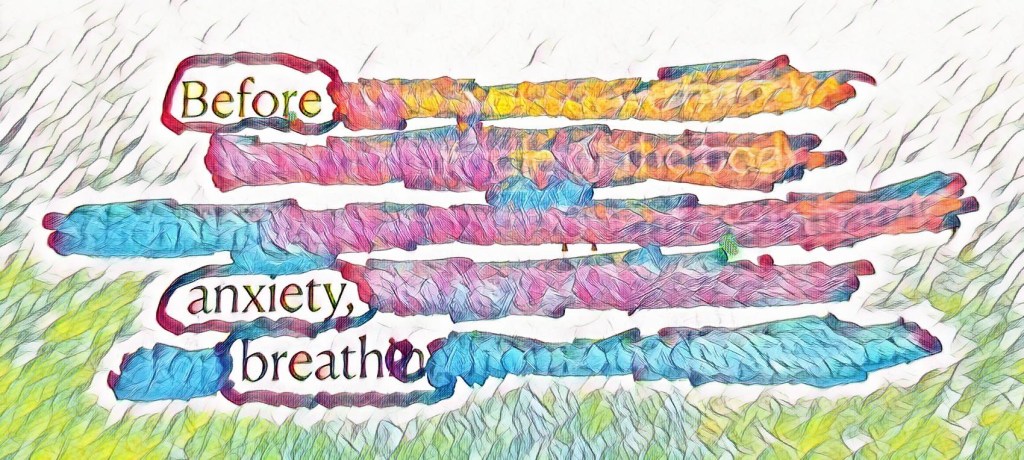
“Before anxiety, breathe.” Found redacted poem (that’s a prompt for another day) by one of my ninth graders. I ran it through a filter for some color.I love how she got to that last word and decided she needed to manipulate the word to suit her purposes.
Here’s a little refresh for the page: Poetry Prompts!
A few days ago, I re-tolled a fun prompt I sometimes use to get myself out of a rut, using predictive text to break me out of my overused words and rhythms. Wordplay and found poetry help me to find new ways to breathe into a poem, and sometimes offer profoundly new ways of expression. “Let go of the reins of the horse of your brain, and let it wander where it wants to for a while,” I sometimes tell my students. I find that the beautiful balance of letting go, and being ready to step in and actively create (as my student did in the image above) not only informs my poetic process, but my living as well.
So here are some initial ideas for using predictive text to restart your poetic mojo. If you don’t think of yourself as a poet (I disagree, btw–if you put words together in your own way, you are a poet), you can use these exercises to play and explore language. I’ll call the prompts Games, just to make it clear that we’re starting playing here.
One note before we begin: Each Game has rules. Try to follow them, to give the game a little structure and challenge. But be ready to break them if the Poem Gnome taps you on the shoulder and suggests you try something different.
Game 1: You’re going to write a six- or eight-line poem. You are in charge of the word or short phrase that begins each line. Then let predictive text finish the lines for you. Here’s an example, with my words in bold. Of course, I have stolen the words for this one, for the sake of play: Roses are the only thing I need. Violets are the only thing I have. Sugar and honey roasted figs with you And now I’m waiting for the bus. So are you. So it will be.
Game 2: Let’s try the same thing, only alternating words with the predictive text. I find this one creates more tension as I try to direct the predictive text. I actually fought it a little and changed the predictive text generator’s (PTG’s) “look” to “looked.” And I actually let the PTG suggest “whenever” instead of the “when” I was considering. Wafting to the bottom of Pandora’s pool, my little feather was almost ready for you. Dreams of her own box of possibilities flew out of the grove in the rain, and now she has forgotten about her last lover, how the clouds looked whenever he was leaving.
NOTES: 1. You might notice, like I do, that you find yourself backtracking and choosing different words in order to force the PTG to offer you better choices. Feels like chess with the computer. 2. Maybe what you came up with, like mine, is laughable trash. But maybe it gives you an idea for something to do next with your own line breaks and cadences. Steal that and run with it! 3. Likely the poem itself it not a publishable gem. But perhaps there’s a line in there that sings? Take it an spin it into another poem of your own! 4. I love that the PTG gave me “Pandora’s,” but I didn’t want to let it force me into using “box.” But my work in the poem quickly became about telling Pandora’s story. I think I should change the “my” to “her.”
Gratitude List: 1. The wild creatures of Goldfinch Farm. 2. Although there is a lot to accomplish in my summer days, I like how I can choose and plot the course with my own intentions. 3. This lavender-filled collar that I put in the freezer and then wear about my neck when the heat feels overwhelming. 4. These teenagers. I love their company, quiet and reserved as it is. Comfortably being together in the house. 5. The creative urge. Making stuff. May we walk in Beauty!
I’m flying a little by the seat of my pants these days, trying to maintain all my daily rhythms, and still not get stressed by all the little things to keep up with. SO last night, I just didn’t do my daily April poem-a-day post here. Sometimes I beat myself up a bit for not being the energy powerhouse that so many of my friends seem to be. I need to protect my energy, gather and store.
Gratitude List: 1. The Dawn Chorus these days. Oh, the birdsong! 2. All the different smells 3. Friends and beloveds who invest time and heart in each other 4. How the beauty just explodes all of a sudden here in the spring. One minute you notice the leaves of the bleeding hearts appearing, and then SUDDENLY they’ve bloomed! 5. Movements for peace and justice. The people who are doing the work, whatever their piece of the work may be. May we walk in Beauty!
“I love to write to you – it gives my heart a holiday and sets the bells to ringing.” Emily Dickinson
“Sorrow prepares you for joy. It violently sweeps everything out of your house, so that new joy can find space to enter. It shakes the yellow leaves from the bough of your heart, so that fresh, green leaves can grow in their place. It pulls up the rotten roots, so that new roots hidden beneath have room to grow. Whatever sorrow shakes from your heart, far better things will take their place.” —Rumi
I called through your door, “The mystics are gathering in the street. Come out!” “Leave me alone. I’m sick.” “I don’t care if you’re dead! Jesus is here, and he wants to resurrect somebody!” —Rumi
“Don’t be satisfied with stories, how things have gone with others. Unfold your own myth.” ―Rumi
“Thousands of candles can be lit from a single candle, and the life of the candle will not be shortened. Happiness never decreases by being shared.” ―Buddha ****” Some words on my River, from Robert Louis Stevenson: “I have been changed from what I was before; and drunk too deep perchance the lotus of the air, Beside the Susquehanna and along the Delaware.” ―Robert Louis Stevenson
“. . .and as I saw, one after another, pleasant villages, carts upon the highway and fishers by the stream, and heard cockcrows and cheery voices in the distance, and beheld the sun, no longer shining blankly on the plains of ocean, but striking among shapely hills and his light dispersed and coloured by a thousand accidents of form and surface, I began to exult with myself upon this rise in life like a man who had come into a rich estate. And when I had asked the name of a river from the brakesman, and heard that it was called the Susquehanna, the beauty of the name seemed to be part and parcel of the beauty of the land. As when Adam with divine fitness named the creatures, so this word Susquehanna was at once accepted by the fancy. That was the name, as no other could be, for that shining river and desirable valley.” ―Robert Louis Stevenson
“There may be times when we are powerless to prevent injustice, but there must never be a time when we fail to protest.” ―Elie Wiesel
Rob Brezsny: Plato said God was a geometer who created an ordered universe imbued with mathematical principles. Through the ages, scientists who’ve dared to speak of a Supreme Being have sounded the same theme. Galileo wrote, “To understand the universe, you must know the language in which it is written. And that language is mathematics.” Modern physicist Stephen Hawking says that by using mathematical theories to comprehend the nature of the cosmos, we’re trying to know “the mind of God.” But philosopher Richard Tarnas proposes a different model. In his book “Cosmos and Psyche,” he suggests that God is an artist—more in the mold of Shakespeare than Einstein. For myself―as I converse with God every day―I find Her equally at home as a mathematician and artist.
Gratitude List: 1. Makin’ little ‘zines–so satisfying 2. Our History teacher is having her tenth-graders make a Hooverville as they study the Great Depression. They’ve actually made a little box town outside where they’ll be having class for the next few days. They have signs with the boxes, and they’ve written paragraphs about them, and now she’s given all the Middle Division teachers a note-sheet with reflection questions so we can take our classes out to experience it, basically turning it into a whole school lesson. So inspiring. Brilliant pedagogy. 3. Roasted cauliflower. Our school has a healthy living committee which challenged us to strive for five a day (veggies and fruits) in the month of March. We are definitely eating more fruits and veg in the WK household. 4. Track and field coaches–I’m grateful for all the time and heart they invest in our kid and his classmates 5. Yellow. I had a fascinating conversation with a friend a few weeks ago about tetrachromatism, the condition where the eyes have more rods or cones or something, causing them to actually see more colors than other people, and how people with tetrachromatism often don’t really like the color yellow. I think I probably don’t have it. Yellow makes me jubilant. May we walk in Beauty!
“Our task is to take this earth so deeply and wholly into ourselves that it will resurrect within our being.” —Rainer Maria Rilke
“We have no symbolic life, and we are all badly in need of the symbolic life. Only the symbolic life can express the need of the soul – the daily need of the soul, mind you! And because people have no such thing, they can never step out of this mill – this awful, banal, grinding life in which they are “nothing but.” —C. G. Jung
Listen by Shel Silverstein
Listen to the MUSTN’TS, child, Listen to the DON’TS Listen to the SHOULDN’TS, the IMPOSSIBLES, the WON’TS Listen to the NEVER HAVES, Then listen close to me- Anything can happen, child, Anything can be.
If you are a dreamer by Shel Silverstein
If you are a dreamer, come in, If you are a dreamer, a wisher, a liar, A hope-er, a pray-er, a magic bean buyer… If you’re a pretender, come sit by my fire For we have some flax-golden tales to spin. Come in! Come in!
“It doesn’t have to be the blue iris, it could be weeds in a vacant lot, or a few small stones; just pay attention, then patch a few words together and don’t try to make them elaborate, this isn’t a contest but the doorway into thanks, and a silence in which another voice may speak.” —Mary Oliver
“Unless someone like you cares a whole awful lot, nothing is going to get better. It’s not.” —Once-ler, in Dr. Seuss’s The Lorax
“No one is born hating another person because of the color of his skin, or his background, or his religion. People must learn to hate, and if they can learn to hate, they can be taught to love, for love comes more naturally to the human heart than its opposite.” ―Nelson Mandela
Twelve Things I Have Learned So Far: (1) You do not always have to be right. (2) People can change. (3) Loss comes to us all, but so does grace. (4) We can disagree and still be together. (5) Kindness is the greatest treasure I have to give away. (6) We are all healed even if it does not happen on our timeline. (7) Imagination is a form of prayer. (8) I own nothing. (9) Life is full of sacred signs if only we look to see them. (10) The ancestors are real. (11) Not all of my friends and mentors are human. (12) Now is eternal and it is my home. —Steven Charleston
Gratitude List: 1. Cosmic Events 2. The community of people all enjoying the same thing 3. Mac ‘n’ Cheese 4. Sheri S. Tepper’s world-building 5. We went owl-watching today! May we walk in Beauty!
“You have to really hug the [one] you are holding. You have to make him or her very real in your arms.. breathing consciously and hugging with all your body, spirit, and heart. Hugging meditation is a practice of mindfulness. “Breathing in, I know my dear one is in my arms, alive. Breathing out, he or she is so precious to me.” If you breathe deeply like that, holding the person you love, the energy of your care and appreciation will penetrate into [them] and they will be nourished and bloom like a flower.” —Thich Nhat Hanh
“For everything that lives is holy, life delights in life.“ —William Blake
We, unaccustomed to courage, exiled from delight, live coiled in shells of loneliness until love leaves its high holy temple and comes into our sight to liberate us into life.“ —Maya Angelou
“On the whole, I do not find Christians, outside of the catacombs, sufficiently sensible of conditions. Does anyone have the foggiest idea what sort of power we so blithely invoke? Or, as I suspect, does no one believe a word of it? The churches are children playing on the floor with their chemistry sets, mixing up a batch of TNT to kill a Sunday morning. It is madness to wear ladies’ straw hats and velvet hats to church; we should all be wearing crash helmets. Ushers should issue life preservers and signal flares; they should lash us to our pews. For the sleeping god may wake someday and take offense, or the waking god may draw us out to where we can never return.” —Annie Dillard in Teaching a Stone to Talk
“For instance, on the planet Earth, man had always assumed that he was more intelligent than dolphins because he had achieved so much—the wheel, New York, wars and so on—whilst all the dolphins had ever done was muck about in the water having a good time. But conversely, the dolphins had always believed that they were far more intelligent than man—for precisely the same reasons.” ―Douglas Adams, The Hitchhiker’s Guide to the Galaxy
“Where there’s life there’s hope, and need of vittles.” ―JRR Tolkien
“We are the ones we have been waiting for.” ―June Jordan
“Our task must be to free ourselves from this prison by widening our circle of compassion to embrace all living creatures and the whole of nature in its beauty.” ―Albert Einstein
“We are all the leaves of one tree. We are all the waves of one sea.” ―Thich Nhat Hanh
“It is respectable to have no illusions―and safe―and profitable and dull.” ―Joseph Conrad
“I would like to beg you dear Sir, as well as I can, to have patience with everything unresolved in your heart and to try to love the questions themselves as if they were locked rooms or books written in a very foreign language. Don’t search for the answers, which could not be given to you now, because you would not be able to live them. And the point is to live everything. Live the questions now. Perhaps then, someday far in the future, you will gradually, without even noticing it, live your way into the answer.” ―Rainer Maria Rilke
“Our job is to love others without stopping to inquire whether they are worthy.” —Thomas Merton
Rilke: God speaks to each of us as [s]he makes us, then walks with us silently out of the night.
These are the words we dimly hear:
You, sent out beyond your recall, go to the limits of your longing. Embody me.
Flare up like a flame and make big shadows I can move in.
Let everything happen to you: beauty and terror. Just keep going. No feeling is final.
Don’t let yourself lose me. Nearby is the country they call life. You will know it by its seriousness.
Give me your hand.
“What if we reframed “living with uncertainty” to “navigating mystery”? There’s more energy in that phrase. The hum of imaginative voltage. And is our life not a mystery school, a seat of earthy instruction?” —Martin Shaw
Day 6: Write a fib. There are two ways to write a fib poem. One is to write a lie, tell a tall tale, let loose a whopper of a fiction. Startlingly, the truth can sometimes be found in the margins of a lie.
Or, write in the form of a fib–Fibonacci, that is. In the Fibonacci Sequence, each number in the pattern is derived from the addition of the previous two numbers: 1, 1, 2, 3, 5, 8, 13, 21. So in a Fib poem, the first line is a single syllable, as is the second. The third line has two syllables, the fourth has three, and so on. I usually don’t go higher than 13, and sometimes I write a second stanza and come back down to one again.
Gratitude List: 1. Chris’s Dogboys, Solly and Gabe. Gabe is such a smoochy pooch. Snuggly. 2. Storytelling and songs 3. Anticipating eclipse 4. I’ve said it before, and I will say it again: BLUUUUUUUE sky! (Oy, was that ever a long stretch of grey rainy days.) 5. Quinoa salad with veggies, tahini, roasted rosemary grapes May we walk in Beauty!
“Hope is an embrace of the unknown and the unknowable, an alternative to the certainty of both optimists and pessimists. Optimists think it will all be fine without our involvement; pessimists take the opposite position; both excuse themselves from acting. (Hope) is the belief that what we do matters even though how and when it may matter, who and what it may impact, are not things we can know beforehand.” —Rebecca Solnit
“I am not giving up on peace, even if, right now, it is taking some heavy blows. I still believe justice will not desert the innocent. And I will always believe that truth will find its way to the light. These bedrock visions guide me into the future. They hold me up when the going gets rough. Conflict may have the upper hand now, but never count love out. The Spirit has a few surprises to offer in the days to come. Signs of hope will find us wherever we may be. I am not giving up.” —Steven Charleston
“Bitterness is like cancer. It eats upon the host. But anger is like fire. It burns it all clean.” —Maya Angelou
“God invites everyone to the House of Peace.” —The Holy Quran
“Political language is designed to make lies sound truthful and murder respectable, and to give the appearance of solidity to pure wind.” —George Orwell
“What a pity that so hard on the heels of Christ came the Christians.” —Annie Dillard
“The arc of history is long, and what we’re here to do is make a mark. . . . You do the work because you’re slowly moving the needle. There are times in history when we feel like we’re going backward, but that’s part of the growth.” —Barack Obama
“Each moment from all sides rushes to us the call to love.” —Rumi
“You are a co-creator of love in this world.” —Richard Rohr
“Trust your instinct to the end, though you can render no reason.” —Ralph Waldo Emerson
“When we let ourselves respond to poetry, to music, to pictures, we are clearing out a space where new stories can root; in effect we are clearing a space for new stories about ourselves.” —Jeanette Winterson
“The greatest thing you’ll ever learn Is just to love and be loved in return.” —Eden Ahbez
“Remember, the ugly, old woman/witch is the invention of dominant cultures. The beauty of crones is legendary: old women are satin-skinned, softly wrinkled, silver-haired, and awe-inspiring in their truth and dignity.” —Susun Weed
My Saturday has gotten away with me, and my head is not in a poetry place. Sigh. I wish I had done better for the librarians. They deserve more. Every time I started getting into it, I veered into rage at all the ways in which school boards and local commissioners and sanctimonious, self-righteous outrage hounds are attacking libraries and librarians these days. In my local community just a week ago, our public library received a bomb threat, and the library director received a bomb threat at her house.
Support your local library. Stand up and speak out when the hordes attack. Trust librarians.
Keepers of democracy, they stand on the front lines of free speech, offering equal access to all who seek wisdom in the written word. Do you need a recipe for risotto or revolution? A book on planets or inclined planes or things to do on a rainy day? The librarian will tell you where to find it, and you just might find your sense of purpose in the stacks, in those cathedral corridors of shelves. You might discover yourself in a book you had never thought to open.
Gratitude List: 1. The River, and the sun on the River 2. The sycamores along the River 3. Librarians (Happy National Librarian Day!) 4. Rosemary roasted grapes 5. Those red, red tulips! May we walk in Beauty!
“Stories of imagination tend to upset those without one.” —Terry Pratchett
The Happy Virus by Hafez I caught the happy virus last night When I was out singing beneath the stars. It is remarkably contagious— So kiss me.
“It is our mind, and that alone, that chains us or sets us free.” —Dilgo Khyentse Rinpoche
“Political language is designed to make lies sound truthful and murder respectable, and to give the appearance of solidity to pure wind.” —George Orwell
“We must live from the center.” —Bahauddin, father of Rumi
“Some days I am more wolf than woman and I am still learning how to stop apologising for my wild.” —Nikita Gill
“Whoever undertakes to set himself up as a judge of Truth and Knowledge is shipwrecked by the laughter of the gods.” —Albert Einstein
“Writer’s block results from too much head. Cut off your head. Pegasus, poetry, was born of Medusa when her head was cut off. You have to be reckless when writing. Be as crazy as your conscience allows.” —Joseph Campbell
“Ask yourself: Have you been kind today? Make kindness your daily modus operandi and change your world.” —Annie Lennox
“Anyone out there want to sing with me while we finish this march? I realize it may seem a little counter-intuitive right now, with so many in a somber mood, but the harder the walk gets, the more I think we need to meet its challenge with strong hearts and voices. The singing becomes our anthem, a rebuke to the powers of pain and an exaltation of the indomitable human spirit. If we must move forward against all odds, then let us do so singing. Let them hear us coming. Let them know we have only just started to hit our stride.” —Steven Charleston



 Mockingbird Chronicles