What Do You Break Down? What Do You Build?

A week ago, I came across the call for an economic blackout from September 16-20. Someone made the suggestion that the real impact would be for as many people as possible to stop using social media for the duration because Facebook and Instagram and their ilk are also owned by the big-money folks, so I stepped off social media for the week as well. Yesterday, I talked with my friend and mentor Sarah Preston about boycotts and protest and change. Here are some of my thoughts in response to our conversation and this past week:

  • I’m not sure this particular economic boycott had much effect. Probably the more affective economic protest this week was the Disney+ cancellations in the wake of the Jimmy Kimmel suspension.
  • Sarah pointed out that writing to the company/ies you are boycotting to explain what you are doing ought to be part of the boycott. Write to Disney-ABC Home Entertainment and Television Distribution, 500 S. Buena Vista St., Burbank, CA 91521-3515. Perhaps those of us who can’t really boycott because we don’t have Disney/ABC ties can write letters anyway.
  • What do we want from boycotts? Is it just to force the billionaire bros to notice how they hurt the people by supporting an authoritarian regime? If we want to make lasting change, will a short-term boycott of the soulless corporations do that work? Likely not. They might have some excellent short-term effects, but in the long run, we have to have other tools in our basket.
  • Audre Lorde said, “The master’s tools will never dismantle the master’s house.” Let’s get to thinking outside of the master’s toolbox.
  • The billionaires are definitely part of the problem. Also, their fortunes are made on speculative economies, of stocks and bonds and “imaginary” wealth. That imaginary and speculative wealth is certainly powerful in the world today, but what if we move more and more to economies that work outside their paradigm? That seems to be at least part of the intention of a boycott. But what if we began functioning more completely and permanently within our local economies? What if we did more barter? More gift economy? More sharing? More creating and growing and making? It’s all well and good to refuse to go to Walmart for a week or to temporarily stop ordering from Amazon, but what if we refused, en masse, to ever buy from them again?
  • Ugh. That means I have to find the will and the creativity to republish my books of poetry in some other format, instead of the Amazon-adjacent KDP. (Here’s another reason to join temporary boycotts, even if you don’t think they’re going to do much to actually change anything: they change you. I need to follow up on this.)
  • Also, when there is an economic boycott or a buy nothing week, consider local impacts. Instead of simply refusing to take part in any economy, use times of boycotting the billionaire bros to flood the local economy. Buy from local stores, local farmer’s markets, local businesses. Strategize more permanent change to working within the local economies. Let these experiments in shifting economic power become permanent shifts in your buying habits.
  • That brings me to my title: Yes, a lot of our work in these days is about breaking down. Breaking the power of the billionaire class, breaking the power of the authoritarians and the theocrats and the demagogues, smashing the patriarchy. But what are we creating to replace those structures? What can you and I do right now to begin developing the just and safe community-based world we envision? This has been a time of great network-forming, such marvelous web-building. How can we look to these webs as the basis for the future?
  • I admit, the networking and community-building can often be exhausting for me. I am realizing that I can be a part of creating and supporting and participating in the webs without it feeling like I have to attend every potluck and party and teach-in.
  • The social media fast for the past week has been good for my mental health.
  • Also, I have missed that web of community. I feel like my social media connections have been an important part of building the community webs I have been talking about here. But they’re all on platforms owned by the billionaire bros, and they support those very structures I want to tear down. I’m not sure how to shift this. I know lots of people have abandoned FB for Substack and others. I totally get it. AND–I am also hesitant to make that shift complete. I don’t do social media because of the amount of influence I can build, but because of the particular people I have connected to there. If I leave FB or IG, I may develop connections on another platform, but I lose the particular (and meaningful) connections on those sites.

I’ve been attending Menno Action’s Tuesday evening Zoom meetings called Courage School for the past few weeks. One of the images they keep referring to is the idea that we think of the power structures as a pyramid with a strong, wide base, impossible to break down. In reality, it’s more like an inverted pyramid, propped up by church, community organizations, schools, businesses, corporations. If we can begin to very deliberately pull out the support of those struts, the structure will collapse. So yes, I think boycotts can be at least a temporary part of influencing those props to shift away from supporting the empire. And also, we need to be strategic about pulling out those props, and using them to build the world we envision.

Let’s keep staying grounded, keep breathing, keep loving, keep checking in with each other, keep reaching out, keep building, keep nurturing, keep protesting. . . Breathe, ground, dance, hug, write, sing, hum, hold babies, paint, remember, tell stories–whatever you need to do to stay with the process, to hold onto hope and truth and peace and your sense of your truest self.

What’s Your Little Thing?

Near the top of my list of People to Emulate is Wangari Maathai, the biologist and environmental and women’s rights activist who started the Green Belt Movement in Kenya in 1977 to build communities–particularly among women–that would work together to address erosion and to plant trees. Over time, the GBM began to advocate with the Kenyan government for more democratic leadership, for the release of political prisoners, and for an end to land grabs that were destroying Kenya’s rich ecological systems.

“It’s the little things citizens do. That’s what will make the difference. My little thing is planting trees,” she said. And that little thing turned into a big thing, a major project of change and conservation and stability for human rights in Kenya. It didn’t end the struggles. But it has made, and continues to make (years after her death), positive and sustainable change for good.

If you live in the United States in these days of national instability and cruelty, what is your little thing? What is the thing you will do to hold back the tides of cruelty? Can you find a local refugee family and be a friend and guide, someone to help them feel safe? Can you print out Red Cards–Know Your Rights Cards–and pass them out to people in your communities? Can you write letters to the editor? Call your reps? Make art that challenges the cruelty? Go to protests? Make signs for protests? Boost the signal on your social media? Join a local group that is organizing to create safe spaces? Speak up in a school board meeting? Run for office? Can you pray?

That last one, though. Some people say prayer changes things. Other people say it’s a way to get out of doing anything “real.” I pray believing that at the very least, prayer changes me. These days, in my rosary prayers, I am calling on Our Lady of Guadalupe, who is also Tonantzin, and to Ix Chel, who was the Lady long ago in regions of Central America, and to Hekate of ancient Greece who guided wanderers through the darkness. I imagine I am praying with the captives who were shipped to that mega-prison in El Salvador without due process, with the mothers and children (at least one who is in desperate need of medical treatment) who were deported to Honduras, with the university students who are experiencing the cruelty of US prisons as they wait to be released or deported. I know the Lady hears me, hears us, and I feel Her working on me, giving me confidence and courage, nudging me to act and to love more deeply. The prayer is changing me.

The Contrarian journalist Jennifer Rubin calls this administration’s barrage of destruction the “cruelty train.”

How do we stop a cruelty train? Not by sending our own cruel train after it. But by turning all our little things into sand that clogs the gears, into wrenches that break the cogs–our prayers, our signs,
our public songs, our letters, our calls, our knowledge, our commitment to democracy, to due process, to checks and balances, to separation of church and state, to the Constitution, to basic human rights, to the power of Love.

What will be your little thing? Small person that I am, I cannot stop the cruelty train simply by standing in its way with my little thing, or praying that it will derail. But together, all our little things–all our prayers, all our will, our shouting, our fierce Love–become a barrier that just might stop the train. Perhaps Wangari Maathai didn’t know that helping women to plant trees would build into a movement that would slow the train of ecological destruction in East Africa, or perhaps she guessed, but her movement is doing so.

Blessed be.


Here are some little things to try:
1. Make a list of your own People to Emulate. What got them moving? How did they step into their sense of their ability to change the world?
2. Pray. Daily. Or if prayer is not your thing, make a mantra of Courage and Confidence that you can say every day to build you up for the tasks ahead. Be ready for it to change you.
3. Make art and poetry and songs. Sing and dance.
4. Laugh together with others. Joy is Resistance. Laughter–real, deep, heartfelt, soulful laughter–frightens fascists.
5. Join a group or two–get the emails from Indivisible (your local groups), or 50501, or other local initiatives that are dedicated to science and human rights and safety for immigrants and refugees and brave spaces for trans and other LGBTQ people.
6. Call your reps. Start with once a week, if you’re anxious. Pat yourself on the back when you make the calls. Take a deep breath, and get ready to make more calls the next week, or the next day.
7. Write letters to the editors. Write op-eds.
8. Join a rally, or convene your own. Get out in the streets with signs and make some noise.
9. Love your neighbor.
10. Stay curious, even in the midst of your rage. Perhaps that aunt who repeats your uncle’s MAGA talking points is really beginning to wonder whether she’s on the wrong side. Ask her what she believes, believe in her goodness, be curious about her. Remind her that she can change her mind when she learns new information.

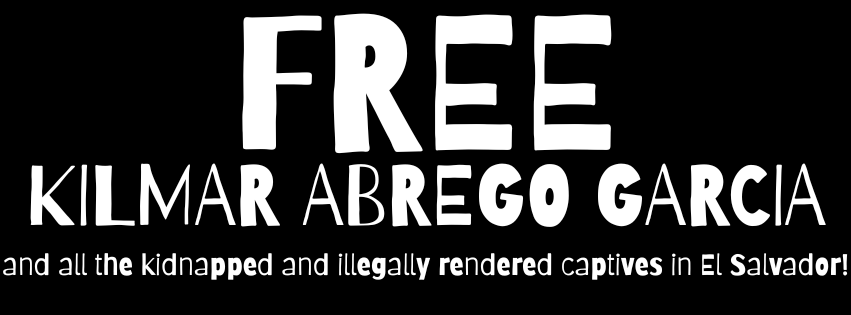
Free the Captives!

I don’t understand. I don’t understand. Forty percent of Americans think the US administration should keep deporting people to El Salvadorian hellhole prisons despite the court order to stop. Despite the utter lack of due process. Despite the obvious inhumanity. Who are these cruel people? That’s more than a third of us! Heather Cox Richardson, trying to express the idea that poll numbers supporting the administration’s illegal kidnapping and deportation of immigrants were actually falling, said that “only 40%” are in favor of the deportations! ONLY?!? Only almost half of us? Doesn’t anyone remember history? Does no one remember reading Elie Wiesel or Anne Frank in school?

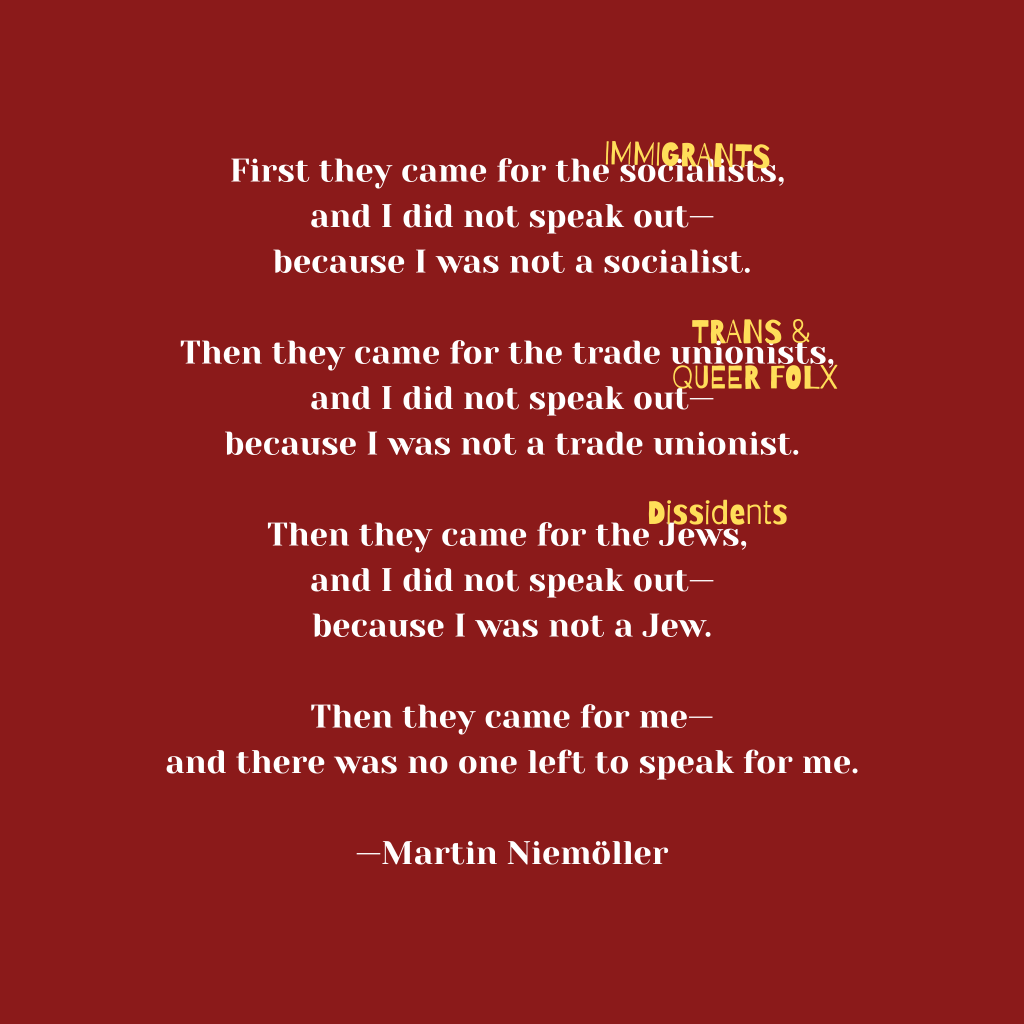
And, for what it’s worth, a truly compassionate and empathetic heart won’t be looking for that last stanza of the poem. When you see them coming for the immigrants, your heart should break, not in fear for your lonely future self, but for the inhumanity and cruelty being perpetrated by your representative government.

Feel free to post the images here on all social media, as widely and freely as you want.

I Have a White Rose

Munich, 1942: The year before they were arrested and beheaded for writing and disseminating anti-Nazi pamphlets. Left to Right: Hans Scholl, Sophie Scholl, Christoph Probst.

The called themselves The White Rose. A group of young people, propelled by their deep desire for justice, their faith, their profound belief in doing what it right. They began writing pamphlets, an underground newspaper of sorts, detailing the reasons for their resistance against Hitler and the Nazis, and leaving them around their university and town for people to find and read.

Three of them, siblings Hans and Sophie Scholl and their friend Christoph Probst, were arrested on February 18, 1943, and sent to the guillotine on February 22, less than a week later. They were all under the age of 25. At the trial before their execution, Sophie appeared with a broken leg, apparently sustained during torture. The defendants were not given a chance to speak, but Sophie called out: “Somebody had to make a start! What we said and wrote are what many people are thinking. They just don’t dare say it out loud!”

On the back of the indictment that pronounced her death sentence, Sophie wrote, “Freedom!”

Her last words, apparently recorded by a guard present at her execution, were: “How can we expect righteousness to prevail when there is hardly anyone willing to give himself up individually to a righteous cause? Such a fine, sunny day, and I have to go, but what does my death matter, if through us, thousands of people are awakened and stirred to action?”

Read more about the story of the White Rose here.

This poem inspired the name of the White Rose (Die Weiße Rose):

I Have a White Rose to Tend (Verse XXXIX)
by José Martí

I have a white rose to tend
In July as in January;
I give it to the true friend
Who offers his frank hand to me.
And for the cruel one whose blows
Break the heart by which I live,
Thistle nor thorn do I give:
For him, too, I have a white rose.

CULTIVO UNA ROSA BLANCA… (Verso XXXIX)

Cultivo una rosa blanca,
En julio como en enero,
Para el amigo sincero
Que me da su mano franca.
Y para el cruel que me arranca
El corazón con que vivo,
Cardo ni oruga cultivo:
Cultivo la rosa blanca.


Gratitude List:
1. How my students are present for each other. Yesterday, two in particular ministered (I just can’t think of a word that says it more clearly) to another student who was in pain. Natural, appropriate, immediate responses. The kids are all right.
2. Black History Month Chapel at my school yesterday. These young folks are educators, incredible teachers, wise souls. I’m so proud to know them.
3. All the birds! Yesterday as I was walking out of school, a group of nuthatches were angrily scolding in the maple tree at the corner of the parking lot (nyerk! nyerk! nyerk!). I noticed that they were hollering at a robin. Looking closer, I saw a junco sitting on a branch next to the robin. Then a downy woodpecker began shimmying up the main branch, and in front of her, a bluebird was murmuring along with the nuthatch racket. All in one tree! That was incredibly amazing in itself, but. . .
4. . . .just at the moment, the two people on campus that I knew would appreciate such a sight happened to come along, from two different directions. One a teacher and one a student. So I could share the amazing sight immediately with people who also experienced the wonder.
5. Speaking of birds, there’s a glorious red-bellied woodpecker out there right now chipping away at the suet block.
6. The examples of so many people of courage: Sophie Scholl and the White Rose, John Lewis (whose birthday was yesterday), you.

May we walk in Beauty! So much Beauty!