Integrating

View of Engitati Hill, the Round Table Hill, in the Ngorongoro Crater.

A week ago, I returned from a trip to the town of my early childhood–Shirati, Tanzania–and several days in game parks. One of my words for the trip, and for the current phase of my life, is INTEGRATION.

How do I integrate the layers of my life: the past, present, future selves?
How do I integrate the sense of myself in a safe and loving childhood in a beautiful and tender community, with the awareness of how mission and religion has been an agent of colonialism in the world?
How do I integrate my deep connection to the Jesus story with my adoration of his mother, with my universalism and witchiness?
How do I integrate the activism and the contemplation, the magic and the prayer, the wildness of spirit with the deepening wisdom of middle age?

Within a day of our return, I received word that a beloved friend, a former student, had died. Now, how to integrate the bliss of my Tanzania Trip with the deep welling grief of losing someone I loved and admired? How to integrate my own grief with that of the many circles of community who loved him?

I’ve been going back through some of our text and message threads to find the poems and songs and kind thoughts Ash sent me over the years, revisiting some of the writings we shared with each other, the ideas we hatched, integrating those with the memories people have been posting to his Facebook page.

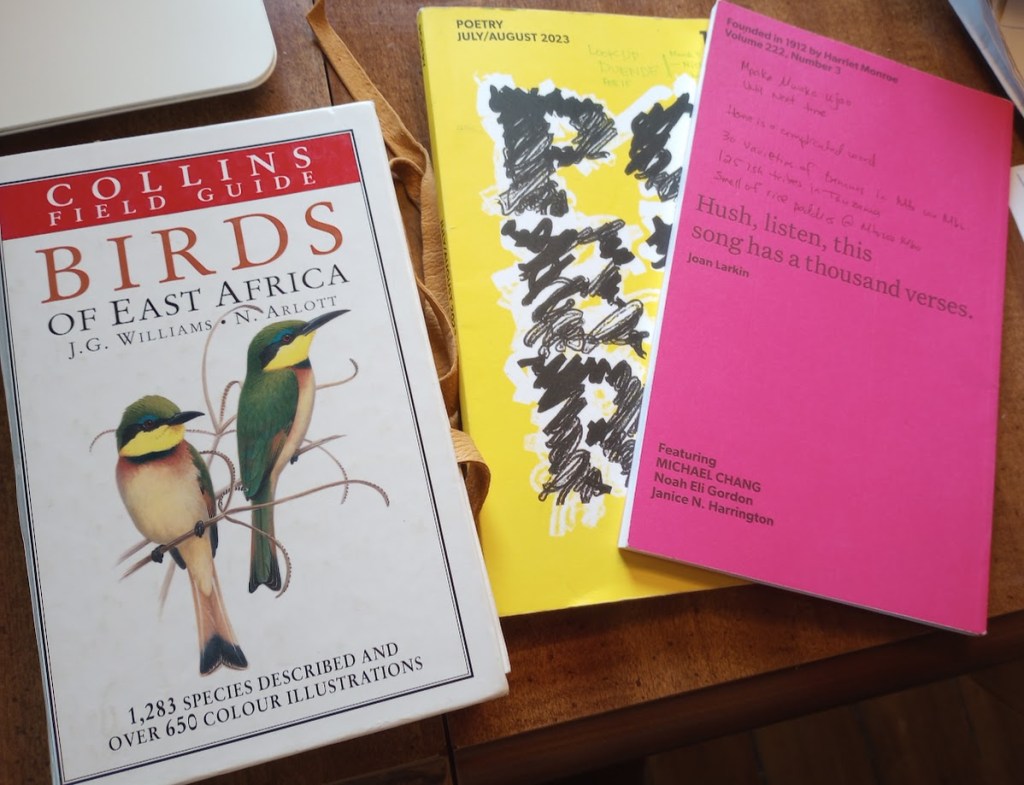
Before I went to Tanzania, I created a journal for the trip, an altered book made from an old copy of Birds of East Africa. True to Bethie form, I ended up taking notes not only in the journal, but in two of the Poetry journals I had taken along, and in the Notes app on my phone. This week, I hope to spend my Spring Break making sense of the various notes, sorting through photos, and integrating the sense experience with memories and scraps of poetry that have been filtering through. Somehow even the fact that I must weave together the various threads of my note-taking feels like part of the bigger process of sorting and integrating joy and grief and memory.
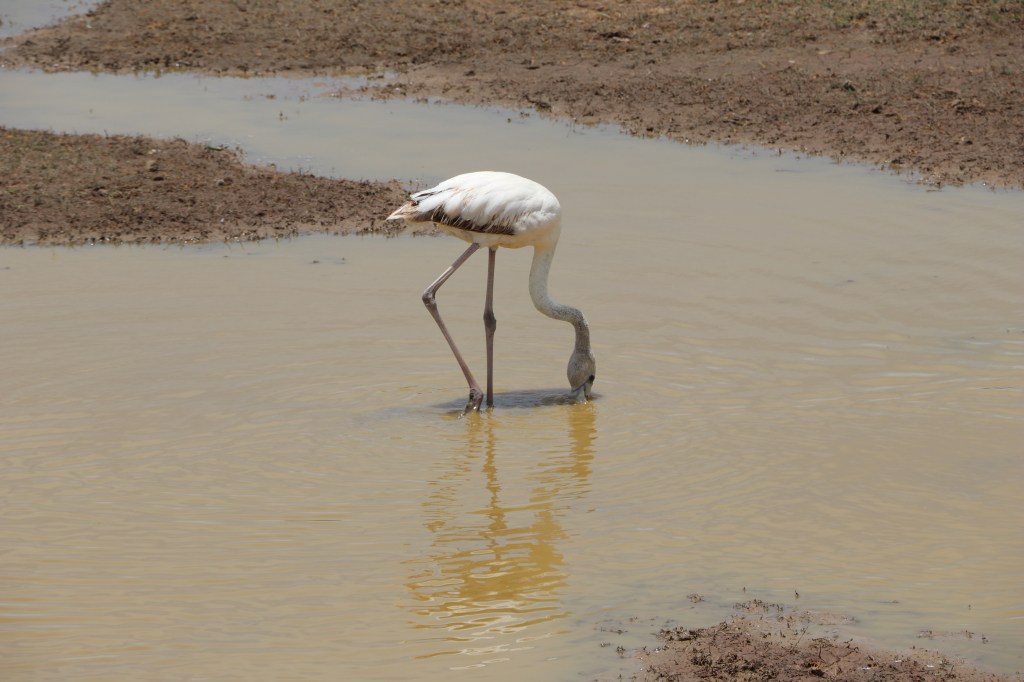
Ash was one of the editors of the literary magazine I directed at the high school where I used to teach. The magazine’s symbol was the flamingo, and I had promised Ash I would send him pictures of flamingos when I returned. I never had the chance. Here, Ash, are some flamingo pictures for you.

Check in on your beloveds. Remind them they are loved. And when hope seems far away, hold on for one more day. The morning, as they say, is wiser than the evening.


Gratitude List:
1. The beautiful journey. Return, belonging, joy, wildness, friendship, beauty
2. The privilege of knowing Ashton Clatterbuck, whose life touched so many, whose activism will continue to inspire and light the way, whose sense of justice will push me to stand up and speak out, whose courage knew no bounds
3. The birds of Goldfinch Farm and Skunk Hollow
4. The house lions: Erebus, Thor, and Sachs
5. The process of integrating heart and mind, memory and sense, grief and bliss, dream and reality
May we walk in Beauty!


“Our capacity to create must overwhelm their capacity to destroy.” —Occupy Movement Quote


“Wrong will be right, when Aslan comes in sight,
At the sound of his roar, sorrows will be no more,
When he bares his teeth, winter meets its death,
And when he shakes his mane, we shall have spring again.”
—C.S. Lewis, The Lion, the Witch, and the Wardrobe


“At times the world may seem an unfriendly and sinister place, but believe that there is much more good in it than bad. All you have to do is look hard enough. and what might seem to be a series of unfortunate events may in fact be the first steps of a journey. ” —Lemony Snicket


“Scared is what you’re feeling. Brave is what you’re doing.” —Emma Donoghue


“Confront the dark parts of yourself, and work to banish them with illumination and forgiveness. Your willingness to wrestle with your demons will cause your angels to sing.” —August Wilson


“Don’t be satisfied with stories, how things have gone with others. Unfold your own myth.” —Rumi


“You cannot swim for new horizons until you have courage to lose sight of the shore.” —William Faulkner


“For one human being to love another is the most difficult task, the ultimate, the last test and proof. It’s the work for which all other work is mere preparation.” —Rainer Maria Rilke


Teilhard de Chardin said: “Some day after we have mastered the winds, the waves and gravity, we will harness for God the energies of love; and then for a second time in the history of the world, humans will have discovered fire.”


Emma Goldman: “The most vital right is the right to love and be loved.”


“Everything I understand, I understand only because I love.” —Leo Tolstoy


“If you do not love too much, you do not love enough.” —Blaise Pascal


“Who I was meant to be was a breaker of some stories and a maker of others.” —Rebecca Solnit


“You are not required to set yourself on fire in order to keep other people warm.” —Anonymous


“The job — as well as the plight, and the unexpected joy — of the artist is to embrace uncertainty, to be sharpened and honed by it.” —Dani Shapiro


“Wholeness does not mean perfection: it means embracing brokenness as an integral part of life.” —Parker Palmer


“For education among all kinds of [people] always has had, and always will have, an element of danger and revolution, of dissatisfaction and discontent.” ―W.E.B DuBois


“The phoenix must burn to emerge.” —Janet Fitch


“If you’re not prepared to be wrong, you’ll never come up with anything original.” —Ken Robinson


“When you take risks you learn that there will be times when you succeed and there will be times when you fail, and both are equally important.” —Ellen DeGeneres


“I have not failed. I’ve just found 10,000 ways that won’t work.” —Thomas A. Edison


“Geometry draws the soul towards truth.” —Plato


“In which of the fairy tales does this wandering stream appear? Perhaps a golden trout swims through here every morning at dawn, or the three riders who pass Baba Yaga’s courtyard stop here to water their horses. A frog beneath that brightest mossy rock awaits your kiss. Just beyond your vision, through those trees, is a little cottage made of gingerbread and candy. An old man appears each day at dusk to sit on the tallest rock and ask you for a favor when you approach the stream for a drink.” –Beth Weaver-Kreider


Of Love
by Beth Weaver-Kreider
(after Mary Oliver)

It’s a process repeated everywhere you look:
the way the beech tree catches and holds the wind in her hair,
the way the meadow grasses gather around the tentative feet of the fox,
the way the hands of the clay hold and guide the flow of waters.

What is attention, but a kind of loving?
Living in awareness is a constant tumble into loves.
The way your eyes twinkle when you tell a story.
The way your listening hands reach outward.
The way a new thought is born in your eyes.
The hearty abandon of your laughter,
the caress of your voice,
the shine that surrounds you.

And Now for Something Completely Different

Robert Lee Brewer’s prompt today is to write an And Now For Something Completely Different poem, trying something you’ve never tried before. I’ve been delighting in deconstructing the shape of the poem this month, making sculptures of poems, inspired by the work of the brilliant CAConrad. Playing with lines has led to a certain new freedom in the placement of words and the structuring and de-structuring of sentences in poetic form.

So for my completely different poem, I decided to play with a couple of phrases one of my children said several years ago when he was just playing with the sounds of words as they came out of his mouth, and see what happened if I just followed the rabbit trail of that into the weeds.

It’s hard for me to unhitch the horse of the brain. Sometimes when I get a good flow of nonsense or newness in a poem or a sentence I am writing, my brain suddenly lights up with ideas about where to take it, how to do it again and differently. Kind of like the friend who was always interrupting the flow of imaginary play with a, “Guys! I have a great idea! How ’bout if we. . .?” Which was well and good and often provided hours of fun, but sometimes it was simply interruption upon interruption and it pulled us out of the essential imagination zone. My brain kept being that friend as I wound my way through this poem. I would get into a series of sounds and suddenly brain was inserting words that added sense. I’m actually kind of happy with the tension that created, the veering from sense to sound and back again.


Gratitude List:
1. Noticing the roadside plants as we walked along the road just before dusk: aster, mustards, bedstraw, chickweed, roadside penny cress, sorrel dandelion, purple and white violets, wild daffodils
2. The garlicky bite of penny cress, the bitter tang of dandelion
3. Vespersong: Field sparrows and red-winged blackbirds, robin, titmouse, chickadee, mockingbird. . .
4. Kind and thoughtful neighbors
5. Quiet contemplative time
May we walk in Beauty!


“My turn shall also come: I sense the spreading of a wing.” —Osip Mandelstam, Russian poet and essayist


“Be wary of any influence in your environment that dismisses or judges your enthusiasm. Without it, you would become anaesthetized to life itself. Anyone who demands this smallness of you is in danger themselves and may have contracted this insidious, deadening monotone. Enthusiasm is the vitality of spirit, expressing itself through us, and its grace in our voice should be welcomed and cherished. The word originates in the early 17th century, from the Greek enthousiasmos meaning ‘possessed by god.’ Now, more than ever, the world needs your enlargement, your weirdness, your fiery crescendos of rebellion from boring.” —Toko-pa Turner


“Grief is normal. It’s not like you’ll have a life someday with no grief. Life is all about loss, but grief is the medicine for that loss. Grief is not your problem. Grief is not the sorrow. Grief is the medicine. The people that have grief cultural awareness are always turning all of their losses into beauty in order to make more life instead of just trying to get through it and then forget about it.” —Martin Prechtel


“The only weapon we have is our bodies, and we need to tuck them in places so wheels don’t turn.” —Bayard Rustin


“There is a sacredness in tears. They are not the mark of weakness, but of power. They speak more eloquently than ten thousand tongues. They are the messengers of overwhelming grief, of deep contrition, and of unspeakable love.” ―Washington Irving


“Gratitude is not a passive response to something we have been given, gratitude arises from paying attention, from being awake in the presence of everything that lives within and without us. Gratitude is not necessarily something that is shown after the event, it is the deep, a-priori state of attention that shows we understand and are equal to the gifted nature of life.” ―David Whyte


“Our strategy should be not only to confront empire, but to lay siege to it. To deprive it of oxygen. To shame it. To mock it. With our art, our music, our literature, our stubbornness, our joy, our brilliance, our sheer relentlessness—and our ability to tell our own stories. Stories that are different from the ones we’re being brainwashed to believe.
.
“The corporate revolution will collapse if we refuse to buy what they are selling—their ideas, their version of history, their wars, their weapons, their notion of inevitability.
“Remember this: We be many and they be few. They need us more than we need them.
“Another world is not only possible, she is on her way. On a quiet day, I can hear her breathing.”
―Arundhati Roy, War Talk


“And this brings us back to the Hen Wife—that figure of magic who dwells comfortably among us, not off by the crossroads or in the dark of the woods; who is married, not solitary; who is equally at home with the wild and domestic, with the animal and human worlds. She is, I believe, among us still: dispensing her wisdom and exercising her power in kitchens and farmyards (and the urban equivalent) to this day—anywhere that women gather, talk among themselves, and pass knowledge down to the next generations.” ―Terri Windling


“‪Birds have a fascinating evolutionary history winding back to the dinosaurs. Except flamingos. Flamingos resulted from a child’s drawing brought to life by a birthday wish.” —Jarrod Andersen, The Cryptonaturalist

Into the Dark, December 15

Every year at this time, I feel the anxiety and restlessness begin to rise within me, and the cold settles into my bones. Every year, I need to consciously ease my spirit into the season. This year, from the beginning of December until Epiphany, I will set it down here on the blog. May we journey into the darkness with intention and tenderness.

This week in Creative Writing class, students have been presenting poetic forms of their choice, and we’ve been exploring writing in each one. I particularly love working with poetic forms and ideas that fracture meaning by re-arranging words, like in Billy Collins’s joke form, the Paradelle, which uses two repeated lines, and then re-mixes the words in those lines. Abstract poetry, too, often makes use of fractured and oddly mixed words to create a sense of meaning that transcends the direct line of thought. As intentionally goofy as Collins’s form is, it does something sort of exciting to the brain to shift words around and break up their linear meaning.

Habits and rhythms can become ruts. When I have my winter blinders on, trudging through the muck of dark and cold just to get through it, I find that the linear tracks I am making sometimes become deep and worn ruts, making it hard to find meanings in the days and moments other than the ones that make the direct and prosy sentences of my days. I need to rearrange things on the pages of my days, step out of the worn tracks, break the sense of the sentences, shift the meanings. Add a new thing today, even if it’s a new stretch in my yoga routine. Drop another habit, perhaps the quick check of email or FB when I get home from being away.

Here is an attempt at a Paradelle. I’m not sure if it works to put serious thought into a joke form, but it feels satisfying to use the fracturing of the the form to break up the mental trudge:

Walking through the haze of winter days.
My feet step in the same weary tracks.
Through the step of haze, the weary feet,
my winter tracks in same walking days.

I’ve worn a rut both long and deep.
Confined myself to pooling shadows.
To a rut I’ve both shadows confined,
pooling deep both worn and long myself.

And made myself a hidden prison.
Of raw endurance and force of habit. 
Of raw endurance and force of habit.
Force. Prison. Endurance: myself of raw,
and made of hidden and a habit.

Winter and a force of  endurance,
walking in a haze, same feet, shadows:
the raw and hidden habit, long and confined,
both to step through the weary prison rut
worn tracks of my pooling deep, 
I’ve made days of myself. Myself.


Gratitude List:
1. Long, deep mornings to write
2. Tree-shadows against the sky
3. Hunger that wakes me up
4. The way my students react with a natural aversion to injustice in literature.
5. Twinkling lights

May we walk in Beauty!


“How does a woman know? She listens. She listens in. Like light on waves.” —Margaret Atwood


“Every moment is a gift of life.” —Thich Nhat Hanh


“Only a fool knows everything.” —African proverb


“Note to self: If you want to have loving feelings, do loving things.” —Anne Lamott

Taking the Measure

imag2382November hosta

Tomorrow, in mid-afternoon, we are invited to join the Water Protectors at Standing Rock to pray and meditate. I will pray for their safety, for the success of their cause. I will pray with thanksgiving for the work that they have done and are doing, in gratitude for their fearlessness and resolve. I will pray for the continuation of the movement. I will pray that the hearts of those who must hear will be softened, and that the people who have the power to protect them and their lands and waters will have the courage and wisdom to do the right thing.  Join me?

Today’s Poetry Prompt is to write a tape poem.

Taking the Measure
by Beth Weaver-Kreider

Along the top of the green shelf my father made when we moved here,
I’ve lined the three jars of herbs the demolition crew found in the wall
of my grandmother’s house, a rambling old Victorian taken down
the month after we bought this place in the hills west of the River.

My great-grandmother’s butter paddle, an ancient pair of reading glasses,
an onyx vase from India full of goose feathers from the pond
near my parents’ house where the children like to look for baby swans,
and a tall, thin ebony carving of a Maasai warrior in a beaded skirt.

Coiling around and through them all, like a frayed yellow snake,
my mother’s mother’s tape measure, which used to wrap around a waist
or along a length of hem to perfect her stitching and mending,
now takes the measure of the memories I’ve collected.

Gratitude List:
1. Senses. Color, hue, and texture–in sight and sound and smell, in taste and touch. How being human is a constant exploration of the complexity of senses. The more I pay attention to color, the more color I see. The more I notice scent and aroma, the more fully I am able to distinguish the subtle shifts and changes in the smells around me. The more carefully I listen, the more easily I can begin to sense changes in the temperature and color of sound. I love this business of being in a body.
2. All those handsome and thoughtful raptor youngsters standing sentinel on posts and poles along the highway today.
3. Crowdsourcing. Whether it’s where to buy local goat meat, how to handle the post-Downton Abbey blues, what poem to read to my classes, or what to do about a flagging Prius battery, I’ve gotten very helpful advice from my friends on social media. We saved ourselves from making a potentially very expensive bad choice by researching the Prius battery situation with friends on Facebook.
4. Sam at Sams Auto. We sent him a Facebook message the night before Thanksgiving, and he responded in five minutes. He is a real expert on the Prius, and perhaps a little obsessed. We are in good hands, and we should finally have our car home a driveable by Tuesday.
5. Reason. Clear logic. But also emotional intelligence. Heart logic. Gut reasoning. Intuitive intelligence. Wise instinct.

May we walk in Beauty!

Trying to Break the Sense

My assignment for myself was to try to break the sense, break the sentence.  I was going to use the half-hour sessions of writing during the last three days to create fodder for this poem.  I stumbled a bit on that, and I never really broke out of the sentence.  But I have a little something interesting, I think.

Green is the toad word the
song of the morning the
hush of  a wee slamander
crouching beneath stars

I would be indigo
arcing through waterfall
I would be waterfall
dripping and gushing
I wonder when singing
reflects the rainbow
or whether my wandering greenness
displays a museum of dreams

Now that’s the brown metaphor
I was hunting
the hitching of zing to aha
There we go
Here we go
Falling beneath the wheel of the moment

And here’s a sunbeam
or off to the races we dance
but the moonlight is ticklish
and you’ve been in tangles
so when do we settle
like spiders in corners
to ponder the morning?


Gratitude List:
1.  “I love my snow day!” says Joss.  I concur.  Making snow people and eating snow and sledding.
2.  The beautiful necklace Ellis made for himself.  Focused work for hours.  And no self-consciousness about what is “gender appropriate.”
3.  That scrappy little wren who is threatening to make a nest in my garage.
4.  Finding the inner discipline to plan out my extremely busy week.  Planning ahead has actually become something that I have a great deal of resistance to, inwardly.  Pushing through whatever that is makes me feel like I have really accomplished something.
5.  Making the pizza myself, crust and all.  Why don’t we do that more often?

May we walk in beauty.

2013 March 149

Poetry Prompt: Breaking the Sentence, Breaking the Sense

I used to write Morning Pages.  Religiously.  I think I wrote for an hour every morning, fast and without pondering.  Julia Cameron said it would help me learn to know my inner artist, and so I did it.  That was about fifteen years ago, and I was writing many poems during that year and finding richness in the writing.  Ask me why I stopped and I can fire off a dozen excuses, some of them actually sort of reasonable.

Just a few weeks ago, at a writers’ retreat in York, John Terlazzo asked us do a similar process in response to several writing prompts, and then encouraged us to pick it up as a daily practice.  And so I have taken up the practice again.

Yesterday, this came out on the page as I was writing: “The idea is that I am trying to break up the sentence, to pull back that veil of sense that covers my brain.  To let myself go.”  One of my favorite ways to write poetry is to string apparently unrelated images together, collage-style, until a unified and profound whole emerges.  I have been wanting to take this process a step further and string words and sounds together in a similar way.  I’m not quite ready for my shoo-be-do-be-doo poem.  And I found that even breaking the sentence was challenging for me.  I’m still stringing images together.  But I’m getting there.  And I want to take it further.

Then this lovely quotation visited my Facebook Feed yesterday.  I agree with many of the people who responded when I posted it (find that conversation here) that many scientists and mathematicians value poetic language to describe the world they explore.  But the basic idea, of the poet approaching truth through paradox–that grabs me:

“It is the scientist whose truth requires a language purged of every trace of paradox; apparently the truth which the poet utters can be approached only in terms of paradox.

“T. S. Eliot said that in poetry there is ‘a perpetual slight alteration of language, words perpetually juxtaposed in new and sudden combinations.’ It is perpetual; it cannot be kept out of the poem; it can only be directed and controlled.

“The tendency of science is necessarily to stabilize terms, to freeze them into strict denotations; the poet’s tendency is by contrast disruptive. The terms are continually modifying each other, and thus violating their dictionary meanings.”

—Cleanth Brooks, “The Language of Paradox”

This will be my homework for myself in the next few days, for Monday’s poem:

Poetry Prompt:
To write without stopping for half an hour each day for the next three days, ignoring sentence sense, trying to bring myself into a patter-spatter of images and words.  To break the sentence, to step behind the veil of sense.  Then, sometime on Monday, to glean a poem from among those writings.  Will you join me?


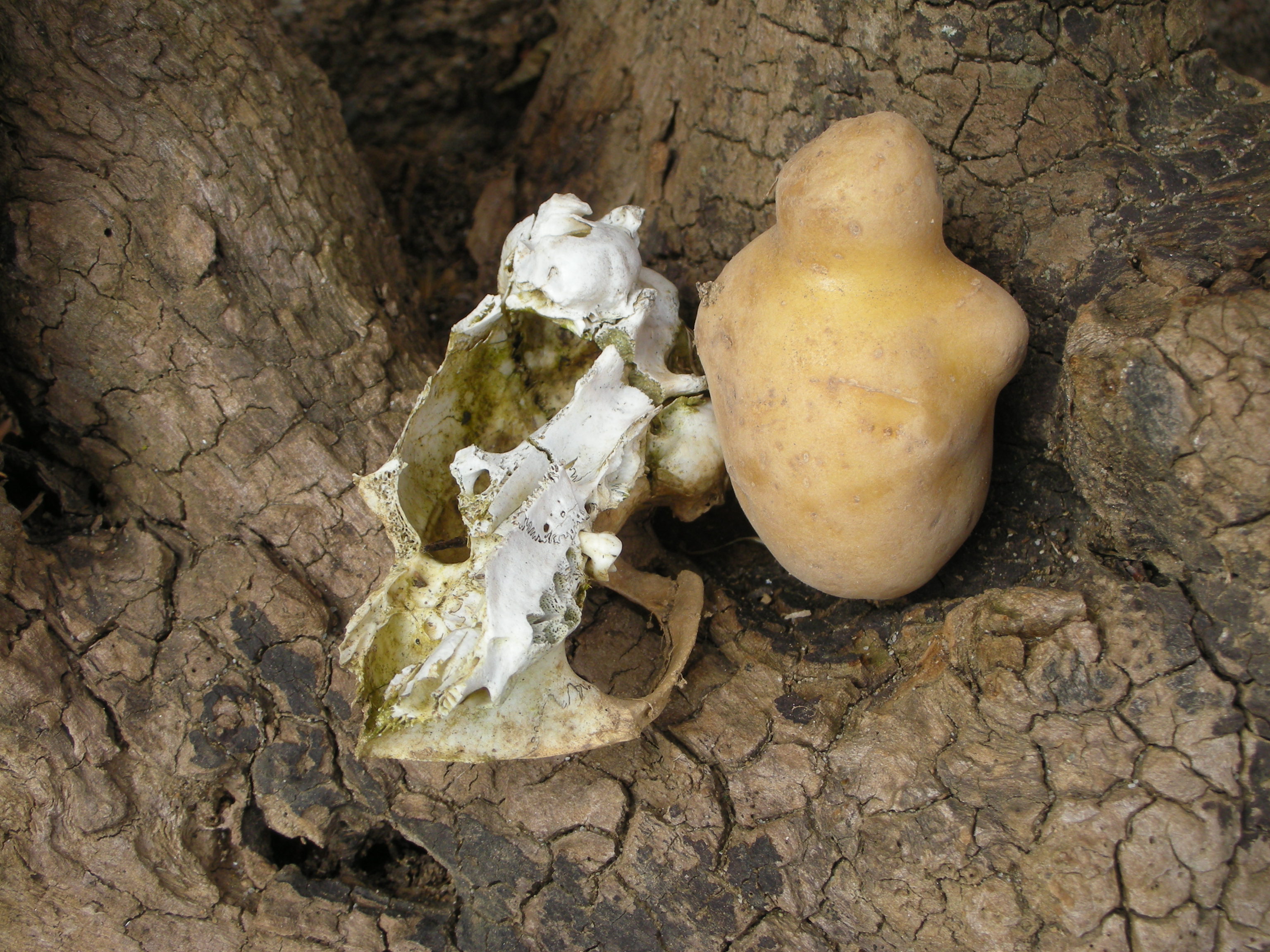
Groundhog skull an Goddess Potato:2013 March 098