Sentence on the High Wire

Write a sentence poem, he says, and I am an English teacher, and so I took the only way out of this poetic escape room that I knew how:

Out on the high wire,
an introductory prepositional phrase
steps carefully over a verb and its gentle adverb
into a prepositional phrase with a compound object
and a further series of prepositional phrases,
its feet poised for the absolute phrases,
its absolute phrases bunching together, and

LEAPS

into a surprising compound predicate.
(The crowd goes wild!)


Gratitude List:
1. Meeting people I’ve met online IRL. Today’s connection was beautiful and sweet, and her children brought me sprigs of mountain mint
2. Mountain mint–such a gently invigorating aroma
3. This happy lamp–staving off the time change blues
4. Uji (millet porridge)–I think I am finally getting the hang of the fermenting process–it tastes like childhood memories
5. The way the autumn sun hits the tips of the oak trees in the morning and evening just as it makes its entry into and exit from the hollow
May we walk in Beauty!


“Tyrants fear the poet.” —Amanda Gorman


“Don’t be ashamed to weep; ’tis right to grieve. Tears are only water, and flowers, trees, and fruit cannot grow without water. But there must be sunlight also. A wounded heart will heal in time, and when it does, the memory and love of our lost ones is sealed inside to comfort us.” ―Brian Jacques


“Those who contemplate the beauty of the Earth find reserves of strength that will endure as long as life lasts.” ―Rachel Carson, The Sense of Wonder


“Love is the bridge between you and everything.” ―Rumi


“Come senators, congressmen
Please heed the call
Don’t stand in the doorway
Don’t block up the hall
For he that gets hurt
Will be he who has stalled
There’s a battle outside
And it is ragin’
It’ll soon shake your windows
And rattle your walls
For the times they are a-changin’.”
―Bob Dylan


“To open our eyes, to see with our inner fire and light, is what saves us. Even if it makes us vulnerable. Opening the eyes is the job of storytellers, witnesses, and the keepers of accounts. The stories we know and tell are reservoirs of light and fire that brighten and illuminate the darkness of human night, the unseen. They throw down a certain slant of light across the floor each morning, and they throw down also its shadow.” —Linda Hogan


What do you do
when the gods of the dreamings
offer you maps for the journey?

How will you answer
when the night-folk cry out:
“Give us the hope of our meanings!”
―Beth Weaver-Kreider

Trying to Break the Sense

My assignment for myself was to try to break the sense, break the sentence.  I was going to use the half-hour sessions of writing during the last three days to create fodder for this poem.  I stumbled a bit on that, and I never really broke out of the sentence.  But I have a little something interesting, I think.

Green is the toad word the
song of the morning the
hush of  a wee slamander
crouching beneath stars

I would be indigo
arcing through waterfall
I would be waterfall
dripping and gushing
I wonder when singing
reflects the rainbow
or whether my wandering greenness
displays a museum of dreams

Now that’s the brown metaphor
I was hunting
the hitching of zing to aha
There we go
Here we go
Falling beneath the wheel of the moment

And here’s a sunbeam
or off to the races we dance
but the moonlight is ticklish
and you’ve been in tangles
so when do we settle
like spiders in corners
to ponder the morning?


Gratitude List:
1.  “I love my snow day!” says Joss.  I concur.  Making snow people and eating snow and sledding.
2.  The beautiful necklace Ellis made for himself.  Focused work for hours.  And no self-consciousness about what is “gender appropriate.”
3.  That scrappy little wren who is threatening to make a nest in my garage.
4.  Finding the inner discipline to plan out my extremely busy week.  Planning ahead has actually become something that I have a great deal of resistance to, inwardly.  Pushing through whatever that is makes me feel like I have really accomplished something.
5.  Making the pizza myself, crust and all.  Why don’t we do that more often?

May we walk in beauty.

2013 March 149

Poetry Prompt: Breaking the Sentence, Breaking the Sense

I used to write Morning Pages.  Religiously.  I think I wrote for an hour every morning, fast and without pondering.  Julia Cameron said it would help me learn to know my inner artist, and so I did it.  That was about fifteen years ago, and I was writing many poems during that year and finding richness in the writing.  Ask me why I stopped and I can fire off a dozen excuses, some of them actually sort of reasonable.

Just a few weeks ago, at a writers’ retreat in York, John Terlazzo asked us do a similar process in response to several writing prompts, and then encouraged us to pick it up as a daily practice.  And so I have taken up the practice again.

Yesterday, this came out on the page as I was writing: “The idea is that I am trying to break up the sentence, to pull back that veil of sense that covers my brain.  To let myself go.”  One of my favorite ways to write poetry is to string apparently unrelated images together, collage-style, until a unified and profound whole emerges.  I have been wanting to take this process a step further and string words and sounds together in a similar way.  I’m not quite ready for my shoo-be-do-be-doo poem.  And I found that even breaking the sentence was challenging for me.  I’m still stringing images together.  But I’m getting there.  And I want to take it further.

Then this lovely quotation visited my Facebook Feed yesterday.  I agree with many of the people who responded when I posted it (find that conversation here) that many scientists and mathematicians value poetic language to describe the world they explore.  But the basic idea, of the poet approaching truth through paradox–that grabs me:

“It is the scientist whose truth requires a language purged of every trace of paradox; apparently the truth which the poet utters can be approached only in terms of paradox.

“T. S. Eliot said that in poetry there is ‘a perpetual slight alteration of language, words perpetually juxtaposed in new and sudden combinations.’ It is perpetual; it cannot be kept out of the poem; it can only be directed and controlled.

“The tendency of science is necessarily to stabilize terms, to freeze them into strict denotations; the poet’s tendency is by contrast disruptive. The terms are continually modifying each other, and thus violating their dictionary meanings.”

—Cleanth Brooks, “The Language of Paradox”

This will be my homework for myself in the next few days, for Monday’s poem:

Poetry Prompt:
To write without stopping for half an hour each day for the next three days, ignoring sentence sense, trying to bring myself into a patter-spatter of images and words.  To break the sentence, to step behind the veil of sense.  Then, sometime on Monday, to glean a poem from among those writings.  Will you join me?


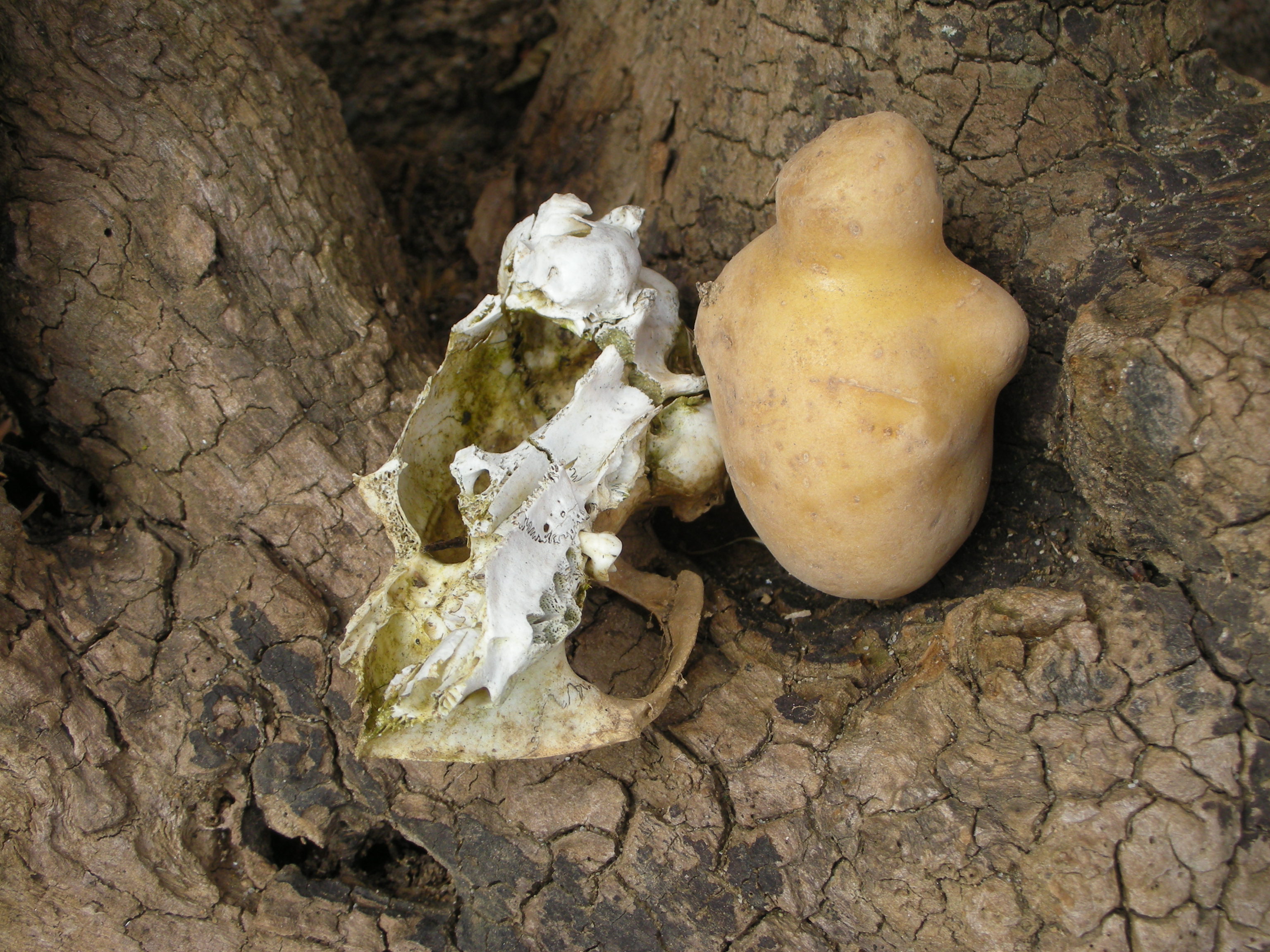
Groundhog skull an Goddess Potato:2013 March 098