Gratitude List:
1. Rays of crows flying out from the trees in front of a magenta sunset cloud
2. The way stories come when you call them
3. Finding center, finding balance
4. Light. There’s always light somewhere.
5. The dark. There’s comfort in the dark when I move past the panic of losing light.
May we walk in Beauty!
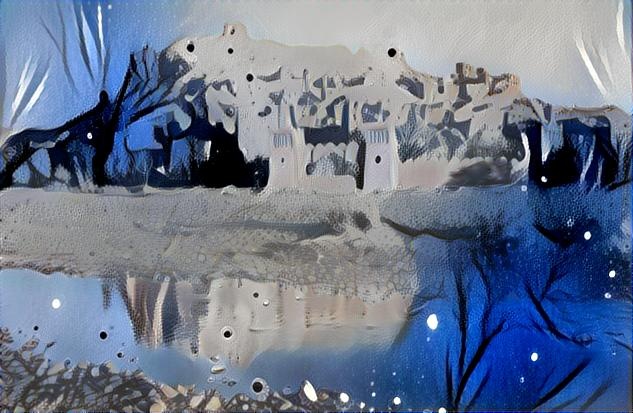
I woke in the wee hours this morning with this phrase in my head:
The wolves of Samarkand have greenish eyes.
I looked up Samarkand, thinking I was going to be telling a story of the far north, where snow blows around the city walls, only to discover that Samarkand is a city in Uzbekistan, a much warmer place than my mind had conjured. But there are wolves. In fact, Genghis Khan, who conquered Samarkand in 1220, was known as the Blue Wolf. I don’t think I have it in me to write anything so epic as a Genghis Khan story at this point in time. In fact, not being familiar with the words and ways of Uzbekistan, I will change the spelling of my city to make it more mine, though I think I will keep it in the steppes of a place similar to central Asia.
The Wolves of Zammarqand
The wolves of Zammarqand have greenish eyes. At night, when the sheep and the children of the city have been safely enclosed within the walls, Leeta the Storymaker stands on the high wall overlooking the valley and watches for the green glow of their eyes in the starlight, the shadowy forms moving restlessly in moonlight. She hears their singing from the high ridge across the river.
Legends live long in these hills. Leeta is the Storymaker charged with remembering, with telling the ancient tales. Leeta remembers the hi’Story of the ancient Wolf-Queens, when the strong looked after the weak, the powerful encircled the vulnerable, when the city’s power was determined by the strength of its ability to care for all of its members.
Centuries have passed since the times of the Wolf-Queens, since the good of the pack gave way to might and ferocity, since power over others became the rule. The Wolf is still the city’s symbol, a snarling face with bared teeth and angry eyes. But when Leeta wanders the streets, she can find the ancient face of the mother wolf–eyes watchful, patient–carved into the stones of pillars and temples, painted above doorways. As the city was repeatedly re-built upon itself over centuries, it covertly remembered its mothers in quietly lupine statuary and artwork. Anyone with eyes to see–and half a desire to do so–could find them.
On moonlit nights, Leeta goes by secret ways, out of the city, returning in the hushed moments before dawn, leaving a trail of footprints in the dew.
The daughters of Leeta the hi’Storian all have green eyes.




 Mockingbird Chronicles