Last Days into Darkness

lamp

One more step into the quiet darkness
One more step into the night
One more step toward the winter
One more step toward the coming of the light

One more step into the labyrinth
One more step to play your part
One more step toward the daybreak
One more step toward the Mother’s heart

Stand within this dusk-bright moment
Feel the heartbeat of the waiting Earth
Hold your head high, listening for starsong
Be still and silent, ready for the birth

Gratitude List:
1. Endarkening. My friend Michele gave me this word today, and I treasure it. I am grateful for people willing to talk me through the dark time. I am waiting, listening, being enfolded in the darkness. Hush.
2. How, even in times of silence and stillness, there is work being done beneath the surfaces of things. Crystals forming beneath the earth. Seeds coming undone.
3. Walking the labyrinth into the very center. Inanna had to relinquish something of herself at every turning. I, too, am being stripped of that which no longer serves me.
4. Sharkey finally lost that tooth today, brave boy. The big tooth has come all the way in behind it, and the baby tooth stuck straight out from the gum for weeks, making him look slightly vampiric. Tonight he pulled the thing right out, and then for good measure, he pulled the splinter out of his foot.
5. The people who let their hearts be broken by the pain of the world. All together now, we break open, and we pray, and we call for peace, and we hope, and we stand up, and we shout, and we sing, and we dance.  It is time to be who we have been becoming.

May we walk in Beauty!

Antidotes

lightreturnYes. It’s the same photo as yesterday, melded with a different filter. I like this one, because it emphasizes the interplay of light and darkness.

In his blog post of last Thursday, Robert Reich lists The 4 Dangerous Signs of Passivity in the Face of Trump Tyranny: Normalizer Syndrome, Outrage Numbness Syndrome, Cynical Syndrome, and Helpless Syndrome.  I’ve been thinking about what the antidotes might be, because other than the Normalizer one, I have fallen victim to the others, and to their sister, Outright Despair Syndrome.

Here are some Antidotes to the Four Dangerous Signs of Passivity:
1. Practice Deliberate Kindness: You don’t have to look far to see the acts and words of meanness that have erupted in the wake of the election. In such a climate, deliberate and pointed acts of kindness are revolutionary, a way to say, “We will not be party to this.”
2. Be an ally: To everyone. When you witness meanness, stand in the gap. Be the one who asks if you can help. Be canny. When you think someone is being bullied, become Present in the situation. Make sure the bullies know they are being watched and held accountable for their behavior. Make it clear that bullying will not be tolerated.
3. Speak Up. Tell the stories of kindness that you witness. Share the stories of meanness, too, and strategize how to better respond the next time.
4. Laugh. A lot. And not just at the cynical things. Find good healthy things that make you laugh. Try to make other people laugh. Share delight.
5. Believe in the Goodness. The last few weeks have made it harder than ever to believe in the basic goodness in people. How could so many people not let the racism and xenophobia and misogyny NOT be a deal-breaker? It’s tempting to make the next sentence be something about how people really are selfish and racist and xenphobic and misogynistic. Maybe some of them are, but most people also have a lot of goodness in them. Even Anne Frank, in hiding from the Nazis, said, “Despite everything, I still believe that people are really good at heart.” If she can see it, maybe I can at least try.
6. Gratitude. It’s been really hard for me lately to do this particular spiritual job. Everything seems the same. I feel as though I have run out of gratitude lately. Still, it’s a muscle I want to keep flexing, especially when it’s hard. And I think it’s a powerful antidote to despair and her passive sisters.

What other Antidotes do you suggest?

Gratitude List:
1. People who help to talk things through.
2. Joyful is the Dark--I think this is my favorite song in church, especially the second verse, about the Raven. Every year we sing it at Advent, and it always comes just I have begun to lose hope that the light will return. The Dark is important. As Jan Richardson says, “Darkness is where Incarnation begins.”
3. Antidotes
4. Visualizing the best things
5. Loving and Being Loved. Belovedness. Remember, always, that you are Beloved.

May we walk in Beauty!

Learning Chess

sunrise

Gratitude List:
1. Playing Chess. I am so bad at it. I think of myself as being fairly intelligent, but I am miserable at chess. I do dumb things. But I am loving playing, and loving being schooled by my ten-year-old.
2. Crawling out from under the rock.
3. Long sleeps.
4. The light will return. The light will return. The light will return. Wednesday at 5:44, to be precise.
5. The Great Horned Owl calling in the bosque.

May we walk in Beauty!

****

I’m not sure where I am going with this story. I may take more time off. I seem to have shifted out of the voice in which I began it, and it’s becoming tedious to write it without that initial fire. Perhaps its next steps will have to happen during summer vacation.

****
Deep in the lower ring of the city, where the bustle of the market lasted from early in the morning to late in the evenings, where the fruit and vegetable vendors set up their brightly-colored stalls along the main street out to the gates, where the shops of the bakers and the butchers lined the ancient walls in a rumble-tumble fashion–there where the press of humanity was greatest, in the back of the shop of Bilhah the Baker, there grew up a secret school for women and girls.

While educating females was expressly forbidden by law, many families saw fit to “teach” their daughters to read and write and do simple sums in order that they might help with the family businesses.  As long as no one pushed against the law and tried to send their daughters to school, the spirit of the law could be bent for the good of the family economy.

In recent years, however, the generals had begun to take a firmer hand. King Astra Djin, they whispered secretly amongst themselves, was soft. He wanted easy living, fine wine, gentle and docile women, and lots of gold. His hardest edges were reserved for the collection of taxes, which he raised in greater amounts with each succeeding year.  The generals believed, to a man, that the city-state of Zammarqand needed a heavy-fisted rule. The king could have his cushy life, and the generals would keep him content, fat and happy, while they set about the careful enforcement of law and order in the city.

Simply Gratitude

door1

Gratitude List:
1. It’s not Lyme Disease. I asked for the blood test because I did pull a little tick off my neck last week. But the test was negative.
2. Sore throat is going away
3. Friday nights mean long sleeps
4. Reminders that I am in charge of my own story
5. Amazing student musicians. The choral concert this weekend is going to be incredible.

May we walk in Beauty!

Depleted

in-prints

I did not write yesterday. This flu/cold/encroaching darkness has been a little soul-sapping. I’m not suffering, not falling apart. Just extremely weary. The last days before Winter Solstice are always harder. It’s like the cave in the dream–you know that for every step you take inward, you’ll have that many more steps to take to get you out again. And in this one, you don’t get to choose–you just have to keep going into the darkness, one more step each day until you get there. I managed it last year, and the year before that. I will manage the final week this year, too. Somehow this year seems grayer, darker, more menacing. My physical malaise of the past week is just a perfect metaphor for the psychological/spiritual/political malaise of the moment.

Goodness. I should re-iterate that I am not falling apart here–just living the season. I love the lights and the songs and the way the children anticipate the holiday. I love peppermint things and the extra chocolate and lots of citrus. The sky is still beautiful many mornings and lots of evenings. My colors are still rich. People are still working for justice, still letting their hearts break for the pain of others, still trying to make the world a better place. All of that is intact and hopeful. It’s just that I’ve seen the nastiness more closely and clearly this year, too, so the need to find the balance is ever dearer.

I want to get back to writing my story, but it will probably be a few days before my head settles out of the fog of flu and winter. I need to be extra careful with where I place my energies in the coming week or two.

Gratitude List:
1. Full moon in the morning, setting over the ridge.
2. Warm cat on my lap
3. Peppermint things
4. New snuggly dresses
5. Hot lemon tea with honey

May we walk in Beauty!

Simply Gratitude

hosta

Gratitude List:
1. The musical directors at my school. This evening’s Middle School Band, Orchestra, and Choir concert was really delightful.
2. Diverse music
3. I know the moon is there, even though it’s cloudy
4. I know you’re there, even when you’re quiet
5. I slept until the alarm this morning. It’s always sort of notable, and it feels so good to wake up, knowing I have been really sleeping.

May we walk in Beauty!

More story another night. Tonight I will do my work and then sleep.

That Moon!

Gratitude List:
1. That Moon!
2. Starting to get the energy back
3. Those Thai ads about kindness. Ellis has to find a video about random kindness for class, so we were looking at the Thai ads. I had to make myself stop, I was getting too weepy.
4. Music. Today’s soundtrack is Mindy Nolt and Siobhan Miller.
5. This marvelous recliner.

May we walk in Beauty!

scrolls

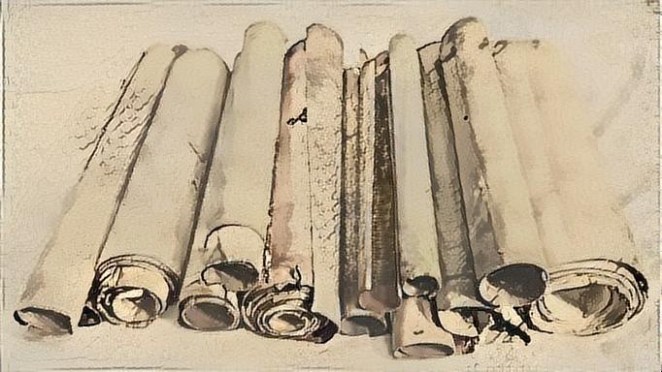
They knew instinctively that the scrolls must be kept secret and safe. Gormlek cleared away the rubble of the fallen wall, patched and repaired it, leaving a little doorway that even his granddaughter had to stoop to get through, and covered the door with a wooden cabinet that could be rolled aside for entry, but looked solid and immovable enough to a scanning eye.

In the evenings, when the day’s baking and sales were finished and Gormlek had returned from his day’s work in the Houses of the Dead, the little family would take a scroll from the hidden annex, and read the ancient hi’Stories of the Queens of Zammarqand.

“These sound like the fairy tales that Granny tells me when I visit her in the village!” Leeta told her mother. “There’s the one about the Prince of Karadzu, who came to Zammarqand to seek for the hand of Princess Jinna in marriage, but Jinna did not want to marry him, so she challenged him to a game of chess. If he won, she would marry him, but if she did, he would give her his proud stallion and walk home. That stallion made Princess Jinna the winner of every horse race in the city for years afterward.”

Bilhah’s eyes were bright. “I’ve been thinking that, too, how Granny seems to know these hi’Stories, how her tales are little mirrors of the stories in these parchments. Do you think they’re true, Abba? Or are they just someone’s written-down version of the fairy tales?”

Gormlek carefully studied the parchment at hand, the candle-light flickering over his face. Finally, he said, “Our hi’Story does not begin with the Wolf Kings–I am certain of it–although that is what we boys were taught in school, that the city began when Chinngis Djin settled the river valley. But those hi’Stories always say he conquered the people of the city, so there must have been a city before the Wolf King’s reign. All my life, I have heard the stories of Granny and the others, of a different life, a different city, a different hi’Story. Even the grannies say that their stories are nonsense, little ditties to be told to the children and ignored by everyone else. But now I think that they have been keeping the oldest hi’Stories alive in their tellings.

<More on this part of the story tomorrow>

Nannies and Grannies

light

Gratitude List:
1. Crows in fields, in trees, in sky, and snow
2. The Children’s Program at church this morning–baby angels tossing their halos into the air, kings wearing their crowns at jaunty angles over their ears, little drummers and shepherds and all
3. Taking a nap at my parents’ house this afternoon–having someone just take care of me
4. Hot chocolate
5. That family of four deer that came down the hill in the bosque, crossed the stream and the road, and went up the bluff and over the ridge.

May we walk in Beauty!

*****
Even kings have grandmothers, and nannies. It might be the grannies and nannies who hold the world together, or who bring it back around to rights when it’s gone off the deep end. Slow and steady, one story at a time.

The Eighth Wolf King, Astra Djin, had three children, the youngest born the same month of the same year as Bilhah the Baker. The two boys, Mussa and Ahmbra, were educated in the traditional military academy where there father and grandfathers had also learned to read and write, to rule, to fight, and to venerate the Djin-Wolf, fiercest of all gods. The middle child, Behna, was a girl, and she was instructed in palace graces and etiquette by her mother and her many governesses. In the late afternoons, when the boys’ schooling was finished, and Behna had completed her palace duties, their nanny would take up her spinning and the children would settle around her like kittens and wait for her to begin spinning a tale.

“Once upon a time,” she would begin, for all good stories begin thus, “the city was ruled by a Wolf-Queen.”

The children would laugh and protest: “Nanny! There’s no such thing as a ruler queen!”

“This is a fairy tale, my darlings. Only a fairy tale,” she would tell them, her eyes glowing in her crinkly smiling face.  “Once upon a time, there was a Wolf-Queen named Rama-Shala-Mehbaz. But the people just called her Queen Rama, or Your Majesty. She was a great ruler and loved by her people. When she was Queen, all the girls in the city went to school, too, just like the boys. And no one in the city ever starved for lack of food, and there were no soldiers in the streets, and there was a great temple in the center of the city to honor the Wolf Mother.”

“Nanny, that’s just wrong,” protested Mussa. “There is only the Djin-Wolf. You must not say Wolf Mother, as though it were another god as great as Djin-Wolf. Even for a story. And even you know that we must have soldiers in the streets to keep the peace. Otherwise the people might fight and kill each other. The people are like children, and they must be treated with harshness and a firm hand.”

“Perhaps,” said Nanny to the boy, whose face was a mass of grey confusion. “Don’t worry, my princeling. This is only a story, and I am a silly old woman. Would you like to hear more? Well, it was said that the Queen would often disappear on nights when the moon was dark. She would walk out of the city, not returning until the first rays of dawn rose over the river, leaving a trail of bare footprints in the dew.

“The legends say that when she reached the riverbank, she would transform into a great wolf, and stand in the darkness, singing the wolf songs until all the wolves in all the hills around the city would meet her there on the riverbank.  One morning, she returned from the river carrying a tiny squirming wolf cub in her arms. She carried it to the palace, and before the day was out, the cub had transformed into a human child, and Queen Rama raised her as a daughter, and she became queen in her turn.  It is said that all the ancient queens were shape-shifters, gift-cubs from the wolves, and that is why the city was so peaceful–they lived as wolves do, caring for the sick and the young and the elderly, looking out for the good of all.”

Mussa’s face was still cloudy. “But it’s only a story, isn’t it, Nanny?”

“Hmmm? A story? Yes, it’s a story, certainly. Now off to bed with you.”

The Secret Ways of Hi’Story

wolf

Gratitude List:
1. Help with the tale
2. Feeling better every day
3. Getting work done
4. Crusty bread, toasted and buttered
5. Hot chocolate

May we walk in Beauty!

*****
These stories are becoming something of a family project. I read a few at a time to the children, and then they ask what will happen next, and what bits of the story I will reveal next. Or they make suggestions about how to unpack something in the next bit of story. I don’t quite know where all this is going. Perhaps if they come together into some sort of form, I will edit and revise them and try to publish them some day, but for now, it’s a pleasant thread to follow.

I think I will continue to spell it “hi’story,” to emphasize the story piece of it. Because Chinngis Djin tried to erase the Wolf Queens, the era of the Wolf Queens has become legend, and Story is a crucial part of keeping them alive.

While I have chosen to separate my story from the real Samarkand by changing its name a little, and placing it in something of a fantasy realm, I found the story of the sack of the city by Genghis Khan in 1220 to be rather compelling, and so I have kept him in the parallel. Several sources call him the Blue Wolf, and in one source, he is spelled Chinngis Khan.  At this point in the process, I do not intend to do the careful research necessary to make this an academically accurate historical/cultural novel. I just want to follow the thread of this hi’story, and see where it takes me.

The Secret Ways of Hi’Story

The hi’story of Zammarqand seemed to begin with the coming of Chinngis Djin, the Blue Wolf of the North. In the year 1220, the Blue Wolf and his hordes had ridden down the steppes like a mighty wind, conquering the villages and cities in their path, setting up fierce and brutal warriors to control the lands they overthrew. In the city of Zammarqand and it surrounding villages, the subjugation included an overthrow of hi’story. The great library was burned, the temples torn down, and the sacred groves were uprooted and laid waste. The Wolf Mother shrines that lined the inner walls of the city were simply plastered over, along with the dozens of small shops that were built right into the city walls.

The Wolf-Queen, daughter in a line of a thousand queens before her, was deposed and slain publicly in the market square, her children dragged off as slaves with Chinngis Djin’s southward-surging army, never to be seen in Zammarqand again. The peaceful rule of the mothers was ended, and a new day of military might and harsh rule began.

In the days of Leeta the Storymaker, three hundred years after the coming of the Blue Wolf, the governance of the city had settled into a patriarchal rhythm that had a great deal less surface brutality than it had in the first century following the coming of the Blue Wolf, though its deep reality was one of repression of the city’s daughters, and a near-complete erasure of the city’s hi’story prior to the coming of Chinngis Djin.

But hi’story has a way of making itself found. Images of the tender-eyed Wolf Mother proliferated in secret places in the city, for those who had the eyes to see. Grandmothers faithfully remembered the fairy tales and stories, passing them on to daughters and granddaughters. Young women would dream dreams of a great and watchful She-wolf sitting in the gateway to the city. Travelers would come upon wild groves of trees growing in near-perfect circles. And in the city, in houses that were built right up against the city walls, occasionally a plaster wall would give way, and a little room would open up, a small chamber holding a statue of a nursing wolf or a bust of the Wolf Mother.

When she was eight, in her sleeping room at the back of the little shop of Bilhah the Baker, Bilhah’s daughter Leeta one day discovered a crack in the wall. She had been ill for three days, and boredom was beginning to grow greater than the illness that kept her to her room. The child began to pick at the crack. Her mother, pulling a large tray of mooncakes from the ovens, heard a rumble and a crash. Racing back to her daughter’s room, she discovered Leeta unhurt, but covered in plaster dust, standing awed in the entrance to a newly opened chamber into the city wall behind the house.

The walls of the chamber were lined with shelves and each shelf was filled with scrolls, perfectly preserved through the centuries. The plastered walls that had been intended to erase the city’s hi’Story had instead preserved it perfectly for distant generations.  A plaque on one wall read “ElSheba Hi’Storian.”

Gormlek the Mourner had taught his daughter and then his granddaughter to read, a minimally revolutionary act in a city where only boys attended school, and the education of girls was frowned on or scoffed at.  Leeta and her mother wasted no time in reading and cataloging their new treasures.

Moon Cakes

Gratitude List:
1. Those UNICEF kids. I didn’t think I would have the energy to help them pull off a party tonight, but they came together and set up with a real will. What a terrific bunch of teenagers.
2. Flan. LaRice makes the best flan I have ever tasted.
3. A weekend to rest up.
4. Crows
5. Walt Whitman

May we walk in Beauty!

moon-cakes
Moon Cakes

Rana the Baker needed an apprentice, and her niece Bilhah needed work that would keep her closer to her foster daughter instead of out in the fields and orchards. Bilhah took to her work like a wagon wheel to the rutted lanes of Low Street, steady and sure.  She often worked with baby Leeta tied onto her back with a long strip of cloth.

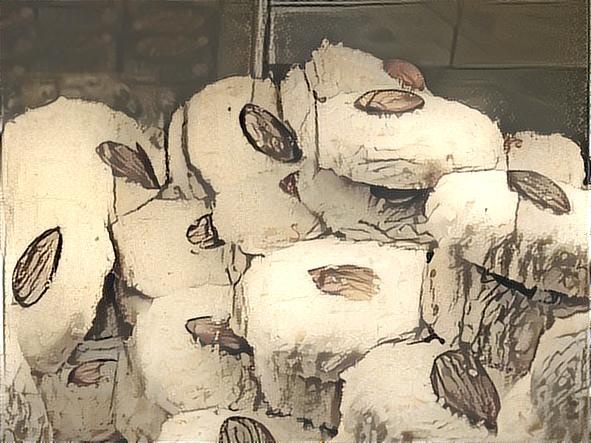
On days before the full moon, Rana’s shop was always full of customers, women requesting the round almond moon cakes that were one of the baker’s specialties. And on the days of Equinox and Solstice, and the corner days between them, Bilhah and her aunt could barely keep up with the demand for the tasty treats.

In this way, Bilhah was ushered into women’s society. She didn’t ask many questions, but she kept her eyes and ears open, and soon she had learned quite a bit about the rites and rituals of women, the keeping of time by the moon, the celebrations of the sun cycle, the moon cakes offered to the Queen of Heaven.

One early morning, carrying a squirming two-year-old Leeta on her back, Bilhah opened the bakery door to a wall of billowing smoke. Neighbors came running, and waded through the smoke to the kitchen where they found a batch of moon cakes burning in the oven. Rana had died of a sudden stroke mid-batch, and the cakes had burned.

Gormlek the Mourner himself took his sister to the houses of the dead, where he prepared her body for the cremation. Lawyers who opened her sealed testaments discovered that all her worldly possessions she had left to her niece Bilhah.  And so it was that Bilhah became Bilhah the Baker, and Leeta the Wolf-Child came to be raised in the company of women, with the exception of her doting and adored Babu Gormlek.