Advent 17: Loneliness

On the way to and from school these days, the kids and I are listening to Maggie Stiefvater’s magical book series, The Raven Cycle. Yesterday, she explored one character’s way of being/not being with others in a tender discussion of loneliness and lonesomeness and aloneness. I can’t reconstruct her dreamy prose here, but the idea caught the flighty bird of my attention.

I have been considering these concepts lately, too, because one of the shadows that overwhelms in this season of shifting shadows is loneliness. Let’s keep our eyes open and hearts aware, as we walk this path together, of those who live with a deep sense of isolation and lack of connection from others. I see them at school, those who–for whatever reason–remain separate from the rest, keep their heads down and their eyes low, who take up so little body space they can almost make themselves invisible. Whether it’s fear or shyness or past pain or perceived difference, they live in isolation from others, and it takes deep tenderness and patience to step through the veil toward them. Social anxiety is a monstrous fear for so many young people these days, and it breeds an aching loneliness.

It’s also possible to be extremely socially interactive and still feel separate and apart, lonesome. In places where you feel a profound sense of unbroachable difference with others, it’s easy to feel isolated, no matter how gregarious and interactive your relationships. Yesterday, I posted Brene Brown’s message on my board at school: “If I get to be me, I belong. If I have to be like you, I fit in.” The holiest communities for me have been the ones where we can acknowledge and appreciate the ways in which we are different, where we can revel in the uniqueness of each individual while meeting at our common points. In this season, I have been more acutely aware of some of the challenges of meeting in ways that appreciate difference when theological and political discussions have created such chasms. Our current cultural divide heightens our separation and makes belongingness even more elusive. It is possible to be interactive and friendly on the surface while feeling the width of the chasm between self and others as a poignant and painful lonesomeness.

One of my deep, deep longings, especially at times when the rest of the world seems to gearing up the energy to a frenzy, is for long periods of quiet aloneness, a nearly impossible commodity in this season. The demands of the world outside become so intense that I can find it hard to catch my breath. I need to take my aloneness when I can, and keep my schedule as loose and open as possible. I need to be my own dragon at the gate. It’s hard at times to keep the open and watchful heart that is ready to notice the lonely hearts of others when I am protecting my own aloneness, and I feel this tension acutely in the shadow season.

Let’s keep our hearts aware and awake to our own needs for space and quiet in this season, even while we offer belonging to those in our communities who may be feeling invisible or isolated.


Gratitude List:
1. Quiet moments of restful aloneness
2. Belongingness. Deep, true heart-meeting belongingness
3. Warm fleeces and flannels
4. Watching students open themselves to being known
5. You, out there, breathing and thinking and dreaming and being present.

May we walk in Beauty and Belongingness.

Advent 16: Companionship

Last summer’s wren nest from the behind the light switch in the shop. Even claustrophobic people love the cozy symbolism of a nest.

Today, as we Breathe-Step-Stop-Listen, Breathe-Step-Stop-Listen, Breathe-Step-Stop-Listen, a song and a poem to sustain us on this walk through Day Sixteen toward Advent. Thank you for walking with me. Only five more days until Sunreturn, Beloveds. We are going to make it.

When I compare this year’s more deliberate and careful wander into the dark of December with last year’s panicked careen, I am filled with gratitude. I know I tried last year, but I had decided that I was going to try a keto-based way of eating last fall, and my deliberations were focused on that, and less inward. It was only when I reached the growing light of late January that I realized how deeply I had sunk into winter’s numbness. Last year, I probably should have checked in with a therapist to keep me coping. This year, I am watching and ready to make that call, in case I feel myself sinking into the pool of sadness. If the season weighs too heavily, or the cold seeps into your spirit, I encourage you to be ready, too, to check in with a professional.

Funny, isn’t it? Usually, we look for the light at the end of a tunnel, meaning we’ll be out and into the fresh air, but while this journey into the well of December may bring us to a lighted chamber, we have to turn and walk out again the same distance before we get back out of the tunnel. Still, that moment of coming to center and pausing, then the turning, and setting our faces toward the return journey into the light–oh, how I long for that moment. That will be so joyful. Five more days.


Here is a video of Brian Claflin and Ellie Grace singing “I’m Gonna Walk It With You.” Whether our journey is the descent into winter’s darkness, or the determined march toward justice, I am glad of your companionship. You can support Claflin and Grace by buying their music at https://www.youtube.com/watch?v=c8boCrXOp9M.


I wrote this poem a few years ago, but it feels like it fits this moment, my deep gratitude for your companionship on this journey.

Stepping Toward the Solstice

We stand in the shadows.
Hold my hand.
The darkness suffocates.
Look this way,
to where the sun shines briefly
through a curtain of ice.
This. This one moment
will sustain us for the next steps.


Gratitude List:
1. I made an enormous dent in my Impossible Mountain last night. Part of my relief today is the amount of work I accomplished, but a greater part of the relief is the feeling of that dam being unclogged. Still so much to do, but I have returned to the truth that Will builds Will. An act of will creates the possibility for more acts of will. As long as I keep that energy, I should make it.
2. Great gratitude to Nancy, for listening and sharing the story. I think I needed an accountability partner, and I used our conversation yesterday as the slingshot to get me around the hardest bits of the Impossible Task.
3. A new warm thing. I stopped at Goodwill and bought myself a new warm fleece jacket-thing. It’s for wearing around the house at home, and it’s cozy, and it’s a wild cat print, so it makes me feel a little fierce. Is that a middle-aged woman thing, to want to wear wildcat print? Or maybe it’s just a Leo thing. I know that some consider it a tacky thing, too, but I’m not fussed about that. It’s warm and it’s fierce, and so Merry Christmas to me.
4. The sacred moments within the mundane.
5. The anticipation of a snow day, even when it doesn’t seem like it’s going to pan out.

May we walk in Beauty!

Advent 15: Finding the Flow

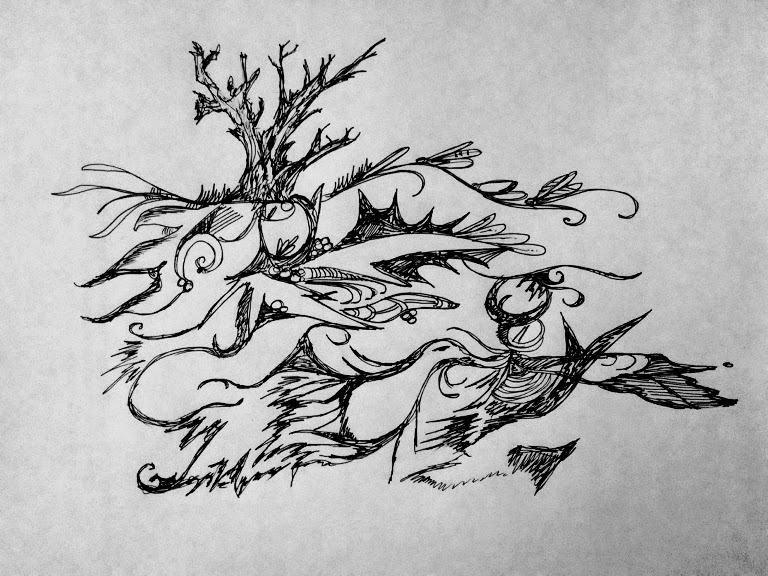
An attempt at an automatic drawing. I think, in its purest sense, it’s supposed to be non-representational, but my mind started pulling out that tree, so I went with it. And then, there’s that bird. . .

We’ve considered the element of air as we have drawn in our breath. We’ve considered our fire, and tended our lights. Now, perhaps, it’s time to consider the element of water, as we travel deeper into this winter labyrinth.

Perhaps today’s passage opens onto an underground river, and we can settle ourselves into little boats for this part of our spiral toward the center. Or swim–walk right in and let the water carry you gently in its arms. Today, I want to think about the flow of my life.

So often, here in this dark and inward time of year, when my inward voices tell me to slow down, rest more, begin taking note of the dreams and the silences, the rest of the world turns up the pace to a frantic pitch, with parties and shopping, raucous frenzy and noise. For some of us, the response to the darkness is to push it back with activity and color and sound. I am grateful to have the festival atmosphere to dip into. The Big Party of this season is how many of us cope with the gathering darkness, and I have no quarrel with other people’s festivities. But I need to take great care in this season how I spend my energy.

One of the more common things I hear people express in these days is their exhaustion, how the constant round of parties and gatherings and things to do and prepare for completely wipes them out. In many families, this work still seems to fall to the women. I’m grateful to be part of a family where much of the pressure of holiday preparations is taken on by my partner, or else we do them jointly, together. I’m not sure I could cope with the added stress of the approaching end of semester along with a full load of holiday prep.

One way that we deal with the challenges to the easy flow of our lives in the frenzied season is simply to do less. We buy fewer presents. We have one afternoon in which we all decorate, and only a little. We focus our festivities on the kids’ school events and family gatherings.

Still, my flow in this season is choppy, blocked in places, and racing beyond my capacity to stay afloat in others. I know that my stacks of grading, and my avoidance tactics are the things that clog the passages and keep me from flowing gracefully. Somehow, I need to come to terms with the dailiness of the workload, to steadily chip away at the challenges that hinder my smooth progress. The thing is, the clogged places force the stream in other places to race along at an unmanageable pace.

If your life is a river flowing through a tunnel, what are the things that clog and impede the flow of your stream, causing the water to flow frantically and wildly in other parts of the passage? What do you need to do to shift and clear the blockages? Wendell Berry points out that “the impeded stream is the one that sings.” So perhaps it isn’t necessary to clear all blockages completely, just shift the impediments enough so that we can hear the song rather than the roar. Today, I commit myself to doing several hours of steady, unclogging work. I can already hear the echoes shifting in the tunnel. I can almost hear the song behind the roar.


Gratitude List:
1. Enough. Enough work to keep me occupied. Enough time to do what needs to be done (I do not feel this one deeply, but I am trying to live it).
2. Live choral music
3. How stories interact in my own personal narrative, shifting my interpretation and experience of my own unfolding tale.
4. Christmas cookies, especially those peppermint ones a student brought to school on Friday.
5. The flight of birds, high-flying flocks, and the furtive dashes of little birds seeking seeds in the chill. Be warm and filled, little ones!

May your day have warmth and light.

Advent 14: Becoming Safe Harbor

On this day in the walk through the December labyrinth, I mark the death of six people in a small village fifteen miles from here on the other side of the river. On December 14, in 1763, a group of angry white men from the Paxtang area of Harrisburg saddled their horses in the darkness and rode to Conestoga, to a small village a couple miles from the Susquehanna River in Lancaster County, where they burned the houses of the few remaining members of the Conestoga group of the Susquehannock people, and brutally murdered the six people they found there.

Fourteen residents of the village were away at the time, and escaped to Lancaster City, where they requested protection. Officials placed them in the county workhouse/jail on Water Street in the City for their protection. Two weeks later, just after Christmas, on December 27, the murderers broke into the jail and massacred everyone, men and women, elders and children.

The Paxtang Boys, as they were called, gathered reinforcements over the following days, and rode to Philadelphia, intent on murdering Native people taking refuge there. Only the forceful eloquence of Benjamin Franklin, who confronted them outside the city, kept them from continuing their murderous rampage. As far as I know, none of the men ever had to face justice for their murders. And in my research, I have found no account of anyone who tried to protect the villagers, either in their village or in Lancaster’s jail. Other than the cold comfort of locking them inside a jail cell (which proved in the end no protection at all), no one was able to offer the last remaining members of the Conestogas safe harbor.

One of my deep shadows this December is a fear of how we have let the Paxtang Boys out to ride again: white people’s rage, racism, privilege, a sense of entitlement to power and economic security, greed and grasping, fiercely protective anti-otherness. I need to keep probing this shadow, exposing my fear of today’s Paxtang Riders, so that I can be ready to stand against them, to stand between them and the vulnerable people they are intent to destroy.

Today, so many who have been seeking safe harbor within the borders of my country have been denied that safety, have been turned away to wait in squalid camps where they are in danger of looting and rape and kidnapping and murder, have been separated from their parents/children by my government and thrown into cold cells, have been forced to hide for fear of deportation. I cannot escape the irony of the modern-day name of the road where the stone marker memorializes the Paxtang Boys’ massacre of local indigenous people: Safe Harbor Road.

How shall we prepare ourselves to be Safe Harbor in days when the Paxtang Boys are riding again?

Here is a poem I wrote in 2013, after I visited the site of the stone marker at the place where the massacre occurred, at the corner of Safe Harbor and Indian Marker Roads. The names of the six who died on this day are in the poem.

Come with me now, Bright Souls
and we’ll sit in a circle together
silently a while. Then we talk.

Light six candles
for the people of the longhouse
who died that wintry dawning.

The air is filled already
with too many words.
The day carries so many mutterings
on the wind, on the wings
of the vulture, drifting
above the broken fields.

Sheehays, Wa-a-shen,
Tee-kau-ley, Ess-canesh,
Tea-wonsha-i-ong,
Kannenquas.

If we are to keep awake,
to live in the place
where the heart stays open,
then perhaps we must look
into the teeth of the story.
Together we gaze at those shadows.
Together we speak their names.
Together we listen for the sparrow’s call.

At the place of the great stone
I did not speak their names.
I left my shell there at that place
in the glittering sun.

Some days I cannot bear the darkness,
but I will close my eyes and sing
while you keep vigil near me.
And when you falter, too,
I will have found the strength renewed
to witness the tale while you sing to me.

Perhaps you will not believe me
when I tell you: As I drove
that road toward the River,
six deer ran across blue shadows
cast by afternoon sun on snow,
over the fields to the road.
They paused a moment to watch
the golden fish of my car approach,
then slipped across Indian Marker Road
and were gone, past the still pond
and into a fringe of wood.

The marker at the corner of Indian Marker Road and Safe Harbor Road.

Envisioning:
(At the beginning of Advent, my pastor asked us to hold the swords-into-ploughshares vision in our heads, to look for stories of people choosing that vision. For the next little while, I am going to look for such stories as my daily morning meditation.)

This week, a friend of mine who lives in Arizona wrote about visiting Casa Alitas, a program of Catholic Community Services of Southern Arizona, which provides immediate assistance to migrants who have been released by ICE and the border patrol onto the streets without any assistance, after their grueling journeys and government processing. Sometimes as many as 240 people come to the Casa Alitas hospitality center in a day. The worker and volunteers of Casa Alitas hold a vision of a community which offer help and safe harbor to people in the direst of circumstances. You can go the Casa Alitas website and click on the donate link at the bottom of the page to help them offer safe harbor.

Advent 13: Mother Holle

Do you know the story of Mother Holle? It’s one of the tales recorded by the Grimm brothers. At first glance, it appears to be a moralistic and scolding tale about the good and beautiful and dutiful daughter versus the mean and ugly and lazy one. Ugh.

You can read a simple translation of the Grimm version here. As in so many fairy tales, the mother in the story loves the mean and lazy daughter best, and mistreats the good and industrious one. The dutiful daughter accidentally drops her spindle in the well and climbs down to retrieve it. Instead of drowning, she encounters an entire world down below, helps various characters out of trouble, and dutifully works for an old woman, Mother Holle, cleaning her house and fluffing her pillows. Mother Holle gives her her spindle, sends her back up the well with gold and jewels magically clinging to her clothes.

The mother sees the girl’s good fortune and throws the other daughter’s spindle down the well. But this daughter is lazy and rude and refuses to help anyone she meets in the underworld. She is rude to Mother Holle, who tells her that because she refused to fluff the feather pillows, the snow would not fall in her own world, and so there would be a drought. This daughter returns to the upper world with tar and insects and creepy crawly creatures magically clinging to her clothes.

The defiant spirit in me resists the controlling moralism of this story, the coercive shaming of the reader into good behavior for the sake of reward. Still, there’s something deeper, something more ancient and real going on here than a simple morality tale.

For one thing, scholars concur that Mother Holle seems to be a version of an ancient European goddess, Frau Holla, or the Hulda, an agriculture/fertility goddess whose beneficence was responsible for the health of the fields and crops, for the abundance which kept families and communities fed and healthy through the changing seasons of the year. Industrious hard work by members of ancient communities ensured the health of one’s family and one’s community. Textile work–creating clothing from the fibers of plant stems and animal fur–was an almost magical process, and it was women’s work. Girls with their spindles, from these two daughters to the poor miller’s daughter in the Rumpelstiltskin story, were keepers of this great mystery of spinning straw (plant stems and bits of fur) into gold (beautiful and functional cloth).

The first daughter sensed the needs of those she met in the world of Mother Holle, and she met their needs with her own soul force. She brought her whole self into the adventure presented to her, and did what needed to be done, as a member of the community in which she found herself. And when Mother Holle asked her to work for her, she did not consider herself above the menial tasks, but did them joyfully.

There’s so much in here, but the piece that catches me for today, in this place where I am descending into the well of winter, is to notice that each task presented to the girls in their underworld journey may seem basic and mundane, but each one has a sacred significance, from the spinning they were doing at the very lip of the well to the shaking of Mother Holle’s feather pillows.

Today and in the coming days, how can I shift my seeing, as I observe the daily mundane tasks ahead of me, to feel the sacred significance of each? This stack of grading that threatens to drown me–can I look at each piece of paper as a contract between myself and the student who receives it back from me? Each is a piece of the community bond that we share, and I need to strategize a way to be present for the work.

What work calls out to you today, this weekend, this season, to be done? What is the sacred truth of the most mundane task that you must accomplish?


Envisioning:
(At the beginning of Advent, my pastor asked us to hold the swords-into-ploughshares vision in our heads, to look for stories of people choosing that vision. For the next little while, I am going to look for such stories as my daily morning meditation.)

Yesterday I listened to the report on NPR about the group Parents for Peace, about family members of extremists who created a safe group for people whose family members have been part of hate groups. They welcome former extremists into the group as well–former IS members, former Klan members, former neo-Nazis–and they’re spreading a message of care and compassion. Some of the members who have themselves been part of extremist groups are part of other groups that help families stage interventions with their loved ones who are caught in up in hate groups. They hold a vision that there is a basic humanity within people that can help lead them out of a life of hatred.

Advent 12: Claustrophobia

Beloveds, we are just over halfway to through this December labyrinth walk into the dark. The light begins to return on Solstice, on the 21st.

Where I live, the holiday traffic is ramping up to frantic, and the afternoon commute gets long and dark and claustrophobic. Yesterday, I nearly let the long ride home ruin my evening. Being trapped in a box on wheels on a highway in the dark for hours feels too much like my inner state in December.

Today, I need to make sure that I am intentionally working to combat the claustrophobia I feel rising in me as the constricting layers of winter clothes and the darkness and the schedule and the traffic have all closed around me.

First, Breathing:
Breathe in. Pause. Breathe out.
Pause: Remember last night’s moon.
Breathe in, holding the image of moon.
Pause: Let go of the traffic.
Breathe out.
Pause: Yesterday’s lovely morning snow.
Breathe in.
Pause: Let go of the work ahead.
Breathe out.
Pause: So many shining, twinkling lights surround me, students and family and friends.
Breathe in. Pause. Breathe out. Pause. . .

Second, Art:
Yesterday before I went to bed, I watched a little video of comic artist Tim Gula doing an exercise in automatic drawing. It’s kind of like a journal free-write, where you just keep your hand moving and put whatever comes down on the paper. I have noticed that even my doodles have become constricted lately, lines choked and tight. I think that some drawing practice might help me to free up some of this claustrophobic inner space.

Third, Story:
I’ve queued up the next book in Maggie Stiefvater’s The Raven Cycle on my tablet, and I am going to have it along on the ride to school so we can start to listen to it today.

Perhaps claustrophobia isn’t a struggle for you at this time of year. Is it panic, silence or noise, loneliness? Or maybe this is your happiest time. What are the tools you use to cope with the challenges or to mark and celebrate the joys?


Gratitude List:
1. Story
2. Art
3. Breath
4. Wildness
5. Moon

May we walk in Beauty!

Advent 11: Letting Go

In the story of Inanna descending the labyrinth to see her sister Ereshkigal, she had to leave some outward emblem of her power at the gates at each turning. The symbols that represented her identity as the Queen of Heaven were stripped away from her, one by one.

What are the images of your identity that you cling to? What “clothing” hides the true and essential you?

In the daytime summer worlds, certain aspects of my self serve me and help me to do the work I am meant to do. But here in the darkness, on the way to meet with my shadow-twin, all the trappings of my personal power and identity only get in the way of the deep recognition of self, shadow and all.

Right now, I am trying hard to live with the picture that I have everything under control. While there’s a certain truth and effectiveness to faking it until I manage to get back in control of things, I think that holding on to this image of myself is actually hindering the work. I am desperately behind on the grading, more than is comfortable for me or for my students. Every day, every evening, there’s something that pulls me away, takes energy and time that I need to get my work done. Still, I pretend to myself that I’ve got this under control. I think it’s time to relinquish that emblem of my sense of personal power, admit that I don’t have everything under control, and make a plan that will help me to catch up. Here, in the dark of the eleventh day, I lay down that piece of myself.

I cannot meet my shadow self and understand her, truly, until I can look honestly at my daytime self. I have no stone to lay at this turning, as I do when I walk a labyrinth in real time. Here is a long, sighing outward breath to symbolize my relinquishing of this inner belief that I am in control of things.


Envisioning:
(At the beginning of Advent, my pastor asked us to hold the swords-into-ploughshares vision in our heads, to look for stories of people choosing that vision. For the next little while, I am going to look for such stories as my daily morning meditation.

Today, I think of the people of Le Chambon, France, who resisted the Vichy attempts arrest Jewish people by hiding people in their homes. As a village, a town, a region, they did what was right, not because they wanted to be heroes, but simply because it was right. They held a vision of what is the right thing to do–quiet, dedicated harboring of people in danger for their lives–and in doing so, actively resisted the violence of the political machine in which they lived.

Advent 10: Where Is Your Fire?

Here’s an image this morning of a tiny origami dragon, a reminder that we carry our fire within us as well as without. On that first day walking into this labyrinth, we checked our batteries, checked our fuel for the journey inward, for the lamps and lights that we carry. I have been feeling your fire, your warmth. I’ve been seeing the glimmer and twinkle of your light as we walk together down these dark passages.

Outwardly, my fire can seem pretty weak in December. I sleep a lot. I forget things. I find myself getting dreamy and vague. But inside, I am curling around my inner fire, like a bear or a rabbit or a chipmunk in winter, who curls itself around its heart core to keep the warmth inside. If you feel like your fire is disappearing, it might just be that you need to curl up around it, focus inward on the way it shines and warms, and rest.

Speaking of dreaming, I hd a most amazing dream last night, about driving through a little village with massive trees on either side of the road. The leaves were yellowed, and the branches were gnarled and curling. from the ends of the branches hung thousands of red and yellow fruits. Eventually we were walking beneath the trees, which hung down over the village like archways. People would just reach up and grb a fruit when they needed it.

What you need is there for you, if you just reach out your hand.


Envisioning:

(At the beginning of Advent, my pastor asked us to hold the swords-into-ploughshares vision in our heads, to look for stories of people choosing that vision. For the next little while, I am going to look for such stories as my daily morning meditation.)

I think today of the youth activists combatting the climate crisis, how they speak up, how they stay on task, how they avoid attacking those who attack them, but relentlessly (there’s that word again) speak the truth of their message over and over again. They don’t let themselves get caught in the culture war that their elders keep trying to pull them into. They simply tell the story, again and again and again. They hold the truth of their vision without taking up the sword.

Advent 9: Mending

This weekend, I mended things. Each one of the four of us had an item of clothing with at least one hole. I am learning to darn knitwear. Some are easier than others, but I definitely got a little better as I went along. One special shirt was losing its SOUND CREW letters, and was full of little holes. I patched up the holes the best that I could and stitched the letters into place. On my own knit cardigan, instead of darning the holes closed, I stitched a thick ridge of thread around the edges of the holes, making a decorative element rather than trying to cover up the problems.

In this walk through the shadowy tunnels of the December labyrinth, I wonder how the mending metaphor can work for me in other ways. At times, it’s easy enough to repair a communication breach: stitch the edges together, and call it done. The line of repair might be obvious, but it stands as a reminder of the care needed for good communication.

Other times, relationships need serious reweaving, one person patching a new warp, and the other weaving a new weft back and forth, catching the frayed and slipping threads as you go. That’s tedious work, but the resulting repaired relationship can come through stronger and more interesting for the art and care put into the mending. Or sometimes, we work together to make the pain of the break in a relationship into a thing of beauty, a decorated memory of the hole we fell into. I have a few of these relationships in my life, and I treasure them with the sort of obstinate intensity that I lavish on a favorite article of clothing that will never be thrown away because the mended spots have become a part of the essential beauty and truth of the garment.

What needs mending today? How will you approach that which must be rethreaded, restitched, tended with threads of connection?


Envisioning:
(At the beginning of Advent, my pastor asked us to hold the swords-into-ploughshares vision in our heads, to look for stories of people choosing that vision. For the next little while, I am going to look for such stories as my daily morning meditation.)

Have you heard of ICU nurse Lori Wood, who was working with a 27-year-old-patient who needed a heart transplant? The young man was both autistic and homeless, and unable to get a heart transplant if he had nowhere to go afterward and no one to take care of him. In order to ensure that he could get all the care and treatment he needed, Ms. Wood adopted him, took him home, and cared for him. She wasn’t trying to be a hero. She was living her vision of true humanity.

(While this isn’t a situation that shows someone choosing a peaceful response to potentially violent situation, I think it’s not too far a stretch to call the experience of homelessness and the lack of health care for people in poverty a violent situation. Ms. Wood was offering an intentional compassionate response to a systemic violence, so I am going to say it fits the parameters of the exercise.)

Advent 7: There Lives in Me

When I taught at a Waldorf School, we taught a little poem to the children:
There live in me an image
of all that I could be.
Until I have become it,
my heart is never free.

For some reason, as I try to recall it, my mind always substitutes “shadow” for “image.” It’s like something tickling at the back of my brain is trying to remind me that I am not only what can be seen on the surface, but that there’s something else there, too, some deeper me that needs to be recognized and integrated before I am truly whole and free.

Several years ago, I wrote a poem on the subject:

Shadow
I will be Crow.
Stone Steps to the Lady Shrine.
Spider’s tidy strands.
Moss. Pine cone.
Lichen. White stone.

Lady, what have you to say to me?

There lives in me a shadow. . .
Water trickling in the grotto.
Bark of the Sycamore Tree.
Crow. Willow.
Acorn. Sparrow.

What have you to say?

An image of all that I could be.
Ladybug on Her child’s chubby knee.
Spider in the fold of Her robe.
Green leaf. Cool breeze.
Whisper. Oak trees.

Become the Shadow.

I am the Crow and the Spider.
Scent of new boxwood.
The whisk-footed Squirrel.
Egg sac. Chickweed.
Web. Speedwell.

Breathe.

(From Song of the Toad and the Mockingbird by Elizabeth Weaver-Kreider, Skunk Holler Poetryworks, 2013.)

When I look into my own shadows, they’re composed of as many subtle colors and hues as the ones that intersect across my living room floor in the mornings. Some are indeed frightening and uncomfortable, because they are unknown, because they hold the secrets of my unresolved and unacknowledged self. Others hold a thrill, because they hide the daring and adventurous and wild side of me, because they harbor the self hinted at in my dreams. They whisper to me, ask me to take up the work they have.

The various personality and temperament studies I have done often point toward shadow work, to exploring those unexplored regions inside. I have found the Enneagram to be particularly helpful in this work. In the Enneagram, I am a pretty standard Seven, an Enthusiast. I call it Hedonist, to remind myself of the shadow possibilities. The Enthusiast wants to enjoy life to the fullest. What choose one option when five will do? We tend to overschedule ourselves, to take on more than we can handle, to eat too much and drink too much. We have a thousand unfinished projects because we want to try everything. We can be enjoyable companions because we like to pile on the fun. Some of the shadows that dog me are hoarding and gluttony and pain avoidance. There isn’t time or attention span enough to handle all the projects and ideas and things that I want to take on. And I get so excited about the next new thing that I avoid the actual work of other things I have committed myself to. In this case, working with my shadows means knowing this pitfalls, working with the anxiety that comes with saying no to the next new and exciting thing that comes along, learning to discipline myself to do the next thing that might bring work or pain.

And there are shadowselves that call me to integrate my the wilder, fiercer, more daring part of me into my everyday self. The shadows call: “Don’t let yourself be tamed! Don’t become domesticated! Don’t settle into safety and predictability. Don’t settle for the status quo.” It’s these shadowselves that raise their heads when everyday systems of oppression and injustice, patterns that everyone seems to accept, make us raise our heads and look around and start to ask questions. In order to live in a world that actively creates unjust systems, parts of ourselves slide into the shadows in order to function with minimal pain and less of the jarring sense of contradiction. Change in the world comes about when we let these sleeping shadows wake up and live within us.

Here, on the eighth day of our journey into the shadows of the December labyrinth, let’s walk into those rooms where our shadows wait, and examine their colors and shapes and textures. What might they have to teach us? This afternoon, I must tackle some things I have been avoiding, and set up a plan for myself to focus instead of fluttering from bright and shiny thing to bright and shiny thing.

What goal will you set for yourself? Maybe your natural state is to try to control all the details, and today you will let go of control? Maybe you’re dogged by particular shadow anxieties, and today is the day to look at them more closely, perhaps in the company of a beloved who can help you? Perhaps today is the day to wake up some sleepy shadows and start to make a plan to break the chains in an oppressive system that profits from your sleepiness?


Envisioning:
(At the beginning of Advent, my pastor asked us to hold the swords-into-ploughshares vision in our heads, to look for stories of people choosing that vision. For the next little while, I am going to look for such stories as my daily morning meditation.)

I think of the people of Landisville Mennonite Church and others who work with them to be companions to refugees and asylum seekers and immigrants who have been detained in York County Prison. These people are holding a vision of a welcoming community that helps people find their way in a new place. A group of people has come out of this work to raise money to pay the bonds for immigrants in the York detention center. Their website is IBAEPA.org, The Immigration Bond and Advocacy effort, if you would like to participate in their making their vision a reality.