Reading Redwall

I have been second-guessing myself a little.  I decided to read Redwall to the boys, without remembering how violent it can get.  It’s pretty intense stuff for bedtime reading.  I love the peaceful realm of Redwall and Mossflower, but the warring bits are intense, and there’s that whole holy defense bit that makes me nervous in its approximation of a just war philosophy.  On the other hand, for small children who are trying to learn to face their fears and anxieties, a tiny mouse facing up to a bully of a rat might be a good metaphor.  This afternoon, One Small Boy said, “Hey Mom.  If a Badguy came into our house, this is what I would do to it.”  And he ran forward with a series of karate-like moves.  He might bowl a Badguy over with pure cuteness, I’m thinking.  Still, I found it interesting that Badguy is “it,” like a monster or a phantom, or a floating anxiety.  I think we’ll keep reading the book, remembering to reflect on the way Matthias cares for his friends, on the Abbot’s refusal to mistreat even his enemies, on the way the mice work together.

Gratitude List:
1. Cool breeze
2. Constructing meaning
3. Reading with the boys
4. Getting to be the scholar
5. Zinnias

May we walk in Beauty!

Discussing Gnome Philosophy

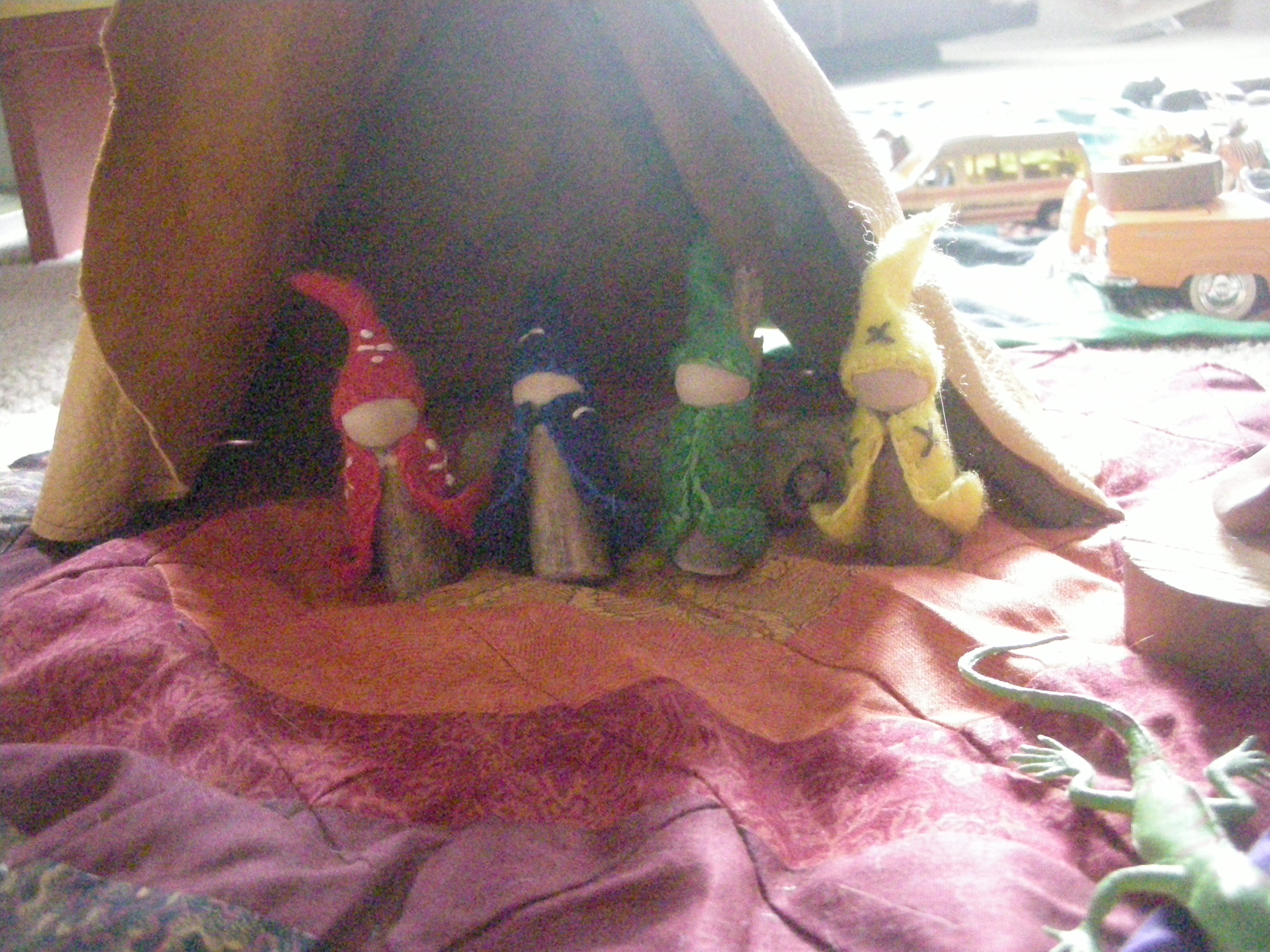
This evening, we decided that the Math Gnomes are actually Element Gnomes, representing Earth, Air, Water and Fire, as well as the four operations.  The Equals Gnome has always been the Queen of the Gnomes, so that remains her character.  I was playing with a sixth gnome in a sort of shaggy green robe, and I decided to call her the Swamp Gnome, and in our Gnome Convocation this evening, the Swamp Gnome was responsible for the coming together of all the elements.  I thought this was a brilliant way to represent the spirit at the center of the circle–Swamp Gnome, the eldest of the gnomes, brings them all together.  My elder son, ever the thinker, was really uncomfortable with this: “Mom, there is no Fire in a swamp!  Swamps are really a combination of Water and Earth.”  I thought that the will-o’-the-wisp would qualify, but he said that will-o’-the-wisp is extremely rare, so it hardly gives Fire an equal place.  He’s right, of course, so I said that perhaps the Fire part of the swamp is the life force in the plants and trees, but he thinks that’s the realm of Earth, and it is a strong argument.  “And anyway,” he said, “You have the Queen over here, and she is really the center, the place where all the Elements come together.”  When did he get so wise?  And I am in awe, having spent part of my evening discussing the philosophy of the Deep Nature of Things with my son.

I feel a need of a caveat, just to make it clear: I do not always feel like a success at this parenting business.  I yell and ignore and belittle and cave in way too often.  That is one of the reasons moments like this one are so sweet–it reminds me that I can mess up regularly, but these people are going to grow into themselves despite my messy momming.

Oh, and there was this, too: He was actually playing on the iPod while the younger one and I were playing with the gnomes.  My gnomes were having a meeting, and the Queen was checking in with each of her helpers.  At one point, he stopped his game and looked over at me: “I think your gnomes are having a formal meeting, Mom, using formal language.  They probably should not be using contractions.”  Indeed.  Ahem.

DSCN8252 DSCN8227
The Queen on her throne, the Four Elements.

DSCN8225
Fred the Dragon captures the Queen.

DSCN8240 DSCN8223
All Aboard the Gnome Train, and Chicken and Mouse nests in tree.

Examen:
How did Mystery encounter you today?
In thoughtful conversation with a child on the nature of things.

What awakened you?
The breeze in the evening as the sun was setting out of Skunk Hollow.  The cool of the day.

What nudged you forward?
The singing group kith+kin, whom I just now discovered when I was looking for a version of the song “The Cool of the Day.”  Sublime.
Also, working in my classroom today.

What sits in your heart?
Satisfaction, delight, quiet care, tending the spirit, peacefulness.
Some deep sadness remains–there is always an undercurrent of deep sadness, no matter how content and joyful my own place is.  Someone is always suffering.  While I can keep that ocean of sadness outside the door most days, I know it is there, and some days it wants to be acknowledged.

What do you take deeper?
My children.  Mothering.  Preparing the space for my students.

What do you offer tomorrow?
Intention.  I will be present to my moments.

May we walk in Beauty!


Refining the Questions

I have been refining my questions today, and thinking about this process.   I have been reading about education in the last few weeks–about educating the intellect and the spirit and the emotions.  I realize that when I phrase questions like, “What do you feel?  What do you sense?  What do you think?”  I understand the surface meaning, but there’s a boxy feel to it.  I feel like those questions will trap my words, somehow.  I want to ask myself those questions, but they need to have a more fluid grace, an ability to slide and flow into many boxes.  These might work better.  I’m still connecting a bit to some of St. Ignatius’ questions, but sliding sideways into my own.

How have you been met by Mystery today?
Walking into the room of myself.
Exploring names for God.

What awakens you?
A golden finch flying across my path and upward into blue.

What sits in your heart?
The satisfaction and anxiety of holding vigil for people I love.  Being a watcher.
Hope.
Reverence.
Frustration at the work it took to complete an assignment today–that can build in me compassion for my students in the coming year.

What nudges you forward?
Plans, projects, art.

How will you step into tomorrow?
I will write my goals for the rest of the summer, and include play and art on the list.

May we walk in Beauty!

Burning Through

Sometimes a new thing catches me on fire, and I just have to let it burn through me, so I can see the trail it leaves, follow the glowing embers.  This poem by Mary Oliver–“Gratitude“–has taken hold of me.  First, I had to copy it, using her questions, and then I had to create my own, while still adding my own regular 5-point gratitude list at the end.  Tonight, more of my own questions.

And I am lifting my nose to sniff the air–there’s an aroma there of something lodged in my memory.  Here it is: I have been feeling compelled to call this emerging process an Examen.  I have been looking it up, and I think that perhaps it isn’t so far from the Examen of St. Ignatius.  His process, according to the Loyola Press website, is to:

1. Become aware of the presence of God.  (I like to call God the Mystery, or Love, or the Source, or Mama.)
2. Review the day with gratitude.  (That’s the part I have been working on for the past three or four years.  It has been transformative in ways I could not have predicted.)
3. Pay attention to your emotions.  (Sometimes I stop at the second step.  This is a good reminder.  Also, I think I would add, Check in with your energy, because that is part of my practice, too.)
4. Choose one feature of the day and pray from it.  (For me, the noticing is prayer, the gratitude is prayer.  Still, I get what this is about: take one thing deeper.  Oh, I do like that.)
5. Look toward tomorrow.  (Bring the past and the present and the future together in this moment.  How does the past [the work of #2] inform the present [#1, #3, #4]?  And how can the past-imbued present inform the future [#5]?)

How is the Mystery present to you?
In silence.  In the space between my breaths.  In the night sounds of crickets and peepers.

What visions brought your spirit awake?
Three crows flying above the fields into morning.
A white heron flying over the city in the afternoon heat.
The hard work of preparing an essay.
What words awakened you?
“Prophetic listening,” transformation, kairos, dialectical hermeneutics
What awakened your senses?
Rice and peas, garlic, squash, long thin green beans, broccoli, and fat slices of pink tomato with coarse salt.

What does your heart say?
There is anxiety here for friends who are suffering.
Contentment, which is sometimes better than wild joy.
I am tired.
Anticipation.
New ideas flitting through the rooms of my brain excite and exhaust me.

What goes deeper?
I am one spider on this humming web,
surveying the movement from strand to strand.
We all weave and spin together,
no longer simply waiting for the Morai
to measure and cut, but being ourselves the spiders,
tending the web, minding the movement.

Where does this go tomorrow?
Tomorrow is a clearing day–
get things accomplished.

May we walk in Beauty!

Inner Examination

Inner Examination, a la Mary Oliver’s “Gratitude”:

What brought you joy?
Community, family, hiking in the woods.

What did you learn?
That words of peace lose their meaning when the writer is violent.

What did you see?
Queen Anne’s lace, chicory, and day lilies.

What was your work?
To sing, to watch, to breathe, to pray, to walk, to play.

What was sublime?
The tender cod with oranges and tomatoes.

What did you appreciate?
Stories of earnestness, intention, and powerful dialogue.

What makes you anxious?
Time: I feel it racing by.

For what are you grateful?
1. Spiders: they remind me to hold my place in the web
2. Birdsong
3. Mulberry/Strawberry/Cranberry Juice smoothies
4. Sleep
5. Imaginings. . .

May we walk in Beauty!

Lego Factory Explosion

DSCN8216


“I believe that appreciation is a holy thing–that when we look for what’s best in a person we happen to be with at the moment, we’re doing what God does all the time.  So in loving and appreciating our neighbor, we’re participating in something sacred.”  ~~ Fred Rogers

In this story, there are two boys.  Their Mama’s cousin came for a visit one day, and while she was there, she listened to them and she watched them and she noticed them.  Not in that overwhelming way that some of us do sometimes, that actually draws more attention to the adult and makes the child anxious, but quietly and thoughtfully.  Just aware of who they are.

The next week, when she had gone home, two boxes arrived in the mail, addressed to the boys.  The cousin was giving them her old Lego blocks.  Gearhead Boy received a special bagful of gears in his box, and Racecar Boy received racecars in his (“Look!  You can make them crash together, and they come apart!  And then you just put them back together again!)  They felt noticed and known.

Isn’t that really what our Work is about?  We’re here to notice each other, to let each other know that we see who they are.  Sometimes it’s just a raise of the eyebrows in the middle of a conversation, and you know that person gets you, sees you.  Sometimes it happens when someone asks you just the right question at the right moment, totally heart-open to listen to your truth.  Sometimes it occur when someone says, “You have been working so hard at that task.  That must be really important to you.”

In some Christian practices, people seek the Christ in each other, look for the living Incarnation of the Divine in those around them.  Wouldn’t healing seep into all our crevices if we watched for the beauty and truth of the Great Mystery in each person we met?  How might our perspectives on each other shift?  How might our world change?

Gratitude List:
1. The Village.  Noticing.  Loving.  Healing.
2. Corn on the cob
3.  Summer Storm
4.  Green beans
5.  Pie R Shared.  It is all gone now, but it helped to create the circle as completely as any equation.  Pie R Best Shared.

May we Walk in Beauty!  So much love, People!  So much love.

Woman in the Wilderness


DSCN8186

Gratitude List:
1.  Pete Seeger’s version of Ode to Joy
2.  Earnest community
3.  Making stuff with the boys
4.  All that is shiny
5.  Satisfying work

May we walk in Beauty!

Sometimes the professor of this course that I am taking in Shaping Classroom Communities will suggest that one option for our writing assignments might be to do something creative rather than purely academic.  This week, one of the assignments was to take a quotation from one of the books we are reading and to reflect on it.  He invited us to consider other forms of creative expression than simple essay.  Here is mine:

Woman in the Wilderness

When I was at the Jesuit monastery, I spent a few quiet hours in the Resource Room, with breezes coming in the open window, paging through the works of the Indian Jesuit priest Anthony de Mello.  Several of de Mello’s books are written as short fiction pieces, each a moment of encounter between seekers or disciples and a Master.  I have been thinking about these short pieces of writing in the weeks since, considering the possibility of working on a similar sort of writing project, incorporating some of the fairy tale images that I have been working with in my poetry.  Reading Parker Palmer’s discussion of the Desert Mothers and Fathers has inspired me to try to create some of these short pieces as a response to this Kairos prompt, with the possibility that I might expand them and add to them in the future.

“We too must stand apart from the modern alliance of knowledge and power.  We too must enter an uncharted space, beyond the familiar confines of the city of intellect, seeking another way to know and to teach” (Palmer 40).

The old woman known as Amma lived in a clearing in a forest, far from the well-worn paths of travelers and adventure-seekers.  Her cottage and its little garden could be found by pilgrims and wanderers who left the common ways and followed the trails hidden among brambles along winding streams.


LOST AND FOUND

A group of seekers wandered for weeks in the forest, torn by briars and terrified by wild beasts, when finally they stumbled upon the clearing where the old woman kept her small cottage and garden.

“Amma!  Wise Mother!” they cried as they rushed into her garden, “We have finally found you!”

The old one pinched off a tip of mint and crushed it between her fingers, releasing the bright fragrance into the air.  “I was not aware until this moment that I was lost.”

ON THE INDIVIDUALITY OF ANGER

“Elsewhere the world may be blustering or sleeping, wars are fought, people live and die, some nations disintegrate, while others are born, soon to be swallowed up in turn — and in all this sound and fury, amidst eruptions and undertows, while the world goes its merry way, bursts into flames, tears itself apart and is reborn: human life continues to throb. So, let us drink a cup of tea.”  – Muriel Barbery, “The Elegance of the Hedgehog”

Two young activists showed up at Amma’s door one day.  During their travels, they had encountered injustice and evil.  They had marched in the streets to lend their voices to the voiceless.  They had walked with people in great distress.  They had spoken truth to power.  But they had come to doubt themselves and their work in the world.

“You are angry,” she said to them both.  “You carry your anger with you wherever you go.”

They bowed their heads silently for a moment.  “What shall we do?” they finally asked.

“You,” she said to the first, “must carry your anger within you like the coals that start a fire.  Use it to feed you when you feel as though you cannot go on, when you feel your energy flagging.”

“And you,” she said, turning to the other, “you must let your anger go.  Put out those coals, or they will eat you up, and drain your energy, leaving you a burned-out shell.”

“Do this,” she said to them both, “and the work that you do in the world will thrive and bear fruit.”


JOKES

A group of serious-minded seekers came to the old woman to learn wisdom.  For weeks, they worked with her in her garden, learning the disciplines of hard work and of silence, learning the names and the ways of the herbs and the birds and the insects that inhabited the clearing where she lived.

One evening, she called to them to pour themselves some tea from the kettle, and settle on the benches around the table near the fire.

Finally! they thought.  Now she will speak to us of wisdom.  Now she will teach us how to become wise.

“So,” said the old one, looking into the expectant faces, “have you heard the one about the rabbi, the priest, and the witch who walked into a bar?”

For hours, hoots and peals of laughter rang through the trees surrounding the old woman’s cottage as Amma and the seekers told each other funny stories and jokes.  As the embers of the fire were glowing in the grate, one of the seekers wiped the tears of mirth from her eyes and said, “This was wonderful, Old Mother, but when are you going to speak to us of wisdom?”

Amma gathered the empty mugs from the table.  “I already have,” she said.


CONVERSION

Once, a woman came to Amma and asked to be her intern.  “You can teach me,” said the young one, “how to live a holy life.”

“Go home,” responded Amma, “and return when you are ready to be converted.”

“But,” the young one protested, “I have already been converted!  Years ago, in my childhood.  Now I am ready to learn to be holy.”

Amma knelt down and began to pull the weeds from around her broccoli plants.  “This morning, I woke up and dressed and prepared myself a cup of tea,” she said.  “And then suddenly I realized that I was not awake, that I had dreamed my waking.  And so then I awoke and dressed, made my tea, and went out to milk the jersey cow.  Then again, I realized that all that time I had only been sleeping, and so I awoke again and did it all again.  Each time I woke up, I was sure that I had reached the full state of wakefulness, and yet each time I had another layer of dream to throw off.”

“But Amma, how do you know that, even now, you are not still sleeping, and dreaming this moment?”

The old woman shrugged.  “Perhaps I am dreaming even now.  I will do the tasks that this dream requires of me so I am ready for the next awakening.”

She clipped several nettle stalks into her basket.  “Do you still want to learn to be holy,” she asked.  “Or perhaps you would prefer to dream with me a while.”

Belly Laughs and Fairy Houses

Gratitude List:
1.  Talking through the ancestors: “Didn’t Uncle Paul look exactly like Great-Grandpa Lauver?”  “That photo of Mammy Weaver looks just like Whistler’s Mother.”  “Fancy hats?  Since when did Mennonite women in Great-Grandma’s day wear fancy hats?”
2.  The evening of Chaotic Flying Things.  This was actually last night, but I am putting it down with today’s list because it was part of the Riotous Cousin-Fest of the past two days.  My father collects interesting things that fly: gliders, slingshot airplanes, kites. . .  We spent that lovely evening last evening throwing things through the air.  The chimney swifts joined in, and a jet flew over, some small planes, too, and a hot air balloon.
3.  Cousins.  Did I say this was a weekend of Cousin-Fest?  I have had several of those lately, and this weekend was just marvelous.  My own cousin Karen from Ohio, and the kids playing with their cousins: hide-n-seek, card games, goofing off and hanging out.
4.  Building Fairy Houses.  This caught fire.  The small cousins saw the fairy house at the sycamore tree on Goldfinch Farm, and they made a tiny village of fairy houses in the woods at Mimi and Pawpaw’s house.
5.  Belly Laughs.  That game of I Doubt It/Bull/Baloney was just hilarious.  I love trying to lie to people, and trying to guess what they’re doing.How long has it been since I have had such a healing dose of uncontrollable, giddy laughter?

So much love.  So much love.  Walk in Beauty!

Midwifing

I am taking a class right now, called Shaping a Community of Learners.  We are using terms like the “invisible curriculum” and discussing the ways in which various philosophers defined the word “care.”  We are asking ourselves what it means to be a teacher, what it means to have a relationship with our students, what capacities we want to develop within our students beyond good grammar, knowledge of the world, and strong mathematical and science skills.

Today, in Jan Richardson’s Sacred Journeys, I came across this excerpt from a sermon by Dorri Sherrill, in reference to Shiphrah and Puah, the Hebrew midwives who defied the pharaoh’s order to kill the male Hebrew babies.  Some people refer to this as the first recorded act of civil disobedience.  Sherrill says: “The truth is that Pharaohs, in some form or fashion, always will exist.  And as Shiphrah and Puah faced the Pharaoh of their day, so we must face ours.  We must face with courage and power those who want to take freedom because we, today, still are called to bring liberation into being, to be co-creators with God in the continual re-creation of the world.  We may not be midwives in the the literal sense, but each of us has a calling to bring to birth that which is in us and each other which, left to its own, likely will die.”

She has much more to say on the subject of courageously facing our Pharaohs, but this last sentence struck me as part of the answer to some of the questions we are asking ourselves in this class: What is the deeper role of the teacher?  The teacher assists as midwife at the birth of her students’ callings.  We help them to birth their dreams, their visions, and their destiny.

Gratitude List:
1.  For all the midwives of my life, real and metaphorical.  Those who helped me to birth my sons, those who helped me to birth my poems and books, those who helped with each vision, each idea, each dream.
2.  For the color orange.  We talk about the food cravings that people have when they are pregnant.  During my very first pregnancy, and then again during my pregnancy with Ellis, I had intense cravings for the color orange.  Weird, perhaps, but I bought orange cloth, wore orange clothes, and hung a picture on my wall of a Maasai mother and child swathed in orange (that picture is still on my wall today).  Today Ellis, clad all in orange, said, “Orange is an apt color for me.”  Yes, I believe so.  Incidentally, my color cravings during my pregnancy with Joss were purple.
3.  Mockingbird.  I think he was following us from field to field during harvest today.  Probably spying on us, to ensure we weren’t going to steal his babies, but along the way he told us marvelous jokes and stories.  Becky reminded me that sometimes they will imitate people, so I am going to start trying to teach him the first few bars of “Ode to Joy.”
4.  Cucumbers and cream cheese on sourdough bread.  A little salt.  Just right.  (And while I am on the subject of food, those boys ate tonight’s pizza supper, though I put so many veggies on it, it was more like casserole on a crust than pizza.)
5.  Working in the fields with the Goldfinch Farm crew.

May we walk in Beauty!

Bowlful of Prayers

EWK 5 001

The stories converge.
The strands on this web meet,
connect, and twist outward again.

This is a bowl of stones, holding prayers:
a shining soul who just received a terrible diagnosis,
another bright spirit who is caring for a suffering loved one,
another, walking the confusing labyrinth of a broken relationship,
a quiet spirit grieving a loss that never seems to heal,
an eager heart aching with loneliness,
a disappointed one,
a tired one,
and you?

A stone for each of these I love,
and also, one for the bright cardinal
who comes with messages of hope,

one for the courage of the activist
climbing high and challenging oppression,

one for hope, one for love, one for tenderness,
one for patient remembering to give yourself time,
to cut yourself a break, to let yourself cry,
to remember your truest, greenest, most powerful self,

and one for the spider who brings all the stories
together in a web, binding us all into one.
One story.

Gratitude List:
1. Change
2. Stability
3. Prayers, stones, and feathers
4. Watchfulness
5. Root beer floats

May we walk in Beauty!