Finished!

Early in the summer, I agreed to create a Camp-in-a-Box for my school. I decided to do a camp on Zine-Making, which is something I love, and I got into the project with gusto.

A few things about me: I am a Leo, and I am a Seven, so when I get excited about a project, I can tend to go a little teensy bit overboard. Roar. But I can also get snagged on the tail end of a deadline. Sigh. The materials are due tomorrow at 9 am, and I just finished packing them up.

I thought it would be really fun to have all the instructions for every day in little Zines! And every day should have a sample Zine! And more instructional Zines! In the end, I wound up folding nearly two hundred Zines for this project.

But it’s finished now. On to the next thing!


Gratitude List:
1. We’re trying to get one long walk or bike ride in every day. I’m loving making a habit of going to the local trails for a daily walk. There is so much beauty here!
2. Yesterday at High Point, we saw and heard several grasshopper sparrows, and two meadowlarks!
3. I’m done with that L-O-N-G project!
4. So many generous people.
5. Art and poetry.

May we do justice, love mercy, and walk humbly in Beauty!


Hold onto your hearts. Take Courage.
Here are some Thoughts for Friday:
Mother Teresa: “So often the problem is simply this—that we make the circle we put around our family too small.”


Chimamanda Adichie: “Stereotypes are not wrong; they are just incomplete.”


“We must ask ourselves as Americans, ‘Can we really survive the worship of our own destructiveness? We do not exist in isolation. Our sense of community and compassionate intelligence must be extended to all life-forms, plants, animals, rocks, rivers, and human beings.”
—Terry Tempest Williams


“It’s hardest to love the ordinary things, she said, but you get lots of opportunities to practice.” —Brian Andreas


“To live in the world without becoming aware of the meaning of the world is like wandering about in a great library without touching the books.” —Manly P. Hall


Be softer with you.
You are a breathing thing.
A memory to someone.
A home to a life.”
—Nayyirah Waheed


“Small acts, when multiplied by millions of people, can transform the world.”
―Howard Zinn


“Never, ever be afraid to make some noise and get in good trouble, necessary trouble.” —Representative John Lewis


Antonio Machado:

“Traveler, there is no path.
The path is made by walking.

Traveller, the path is your tracks
And nothing more.
Traveller, there is no path
The path is made by walking.
By walking you make a path
And turning, you look back
At a way you will never tread again
Traveller, there is no road
Only wakes in the sea.”


“I don’t write out of what I know; I write out of what I wonder. I think most artists create art in order to explore, not to give the answers. Poetry and art are not about answers to me; they are about questions.” ―Lucille Clifton, who was born on this day in 1936


“Everyone is born with a set of sacred agreements to a higher authority than those of this world. Like a pole star, there is a divine Self which directs and shapes our lives into what we’re meant to become. Sooner or later, we must navigate by our star’s light, or risk being lost in the dark night of the soul.” —Toko-pa Turner


“To love at all is to be vulnerable.” —CS Lewis


“. . .without a sense of the sacred, all knowledge remains abstract.” —Rosebrough and Leverett, Transformational Teaching


“Education is not the filling of a pail, but the lighting of a fire.” —William Butler Yeats


“We live in a world of theophanies. Holiness comes wrapped in the ordinary. There are burning bushes all around you. Every tree is full of angels. Hidden beauty is waiting in every crumb. Life wants to lead you from crumbs to angels, but this can happen only if you are willing to unwrap the ordinary by staying with it long enough to harvest its treasure.” —Macrina Wiederkehr


“The storm walked around the hills on legs of lightning, shouting and grumbling.” ―Terry Pratchett, Equal Rites


“most people don’t set foot outside their own heads much.” ―Terry Pratchett, Equal Rites

Cherry Cobbler

Here’s to good neighbors! A couple days ago as we were walking, our neighbor down the road invited us to his Solstice drumming circle. I would have taken him up on it, but we were going to see my parents the next day, and I wanted to limit my exposure to other people. I do hope he asks again!

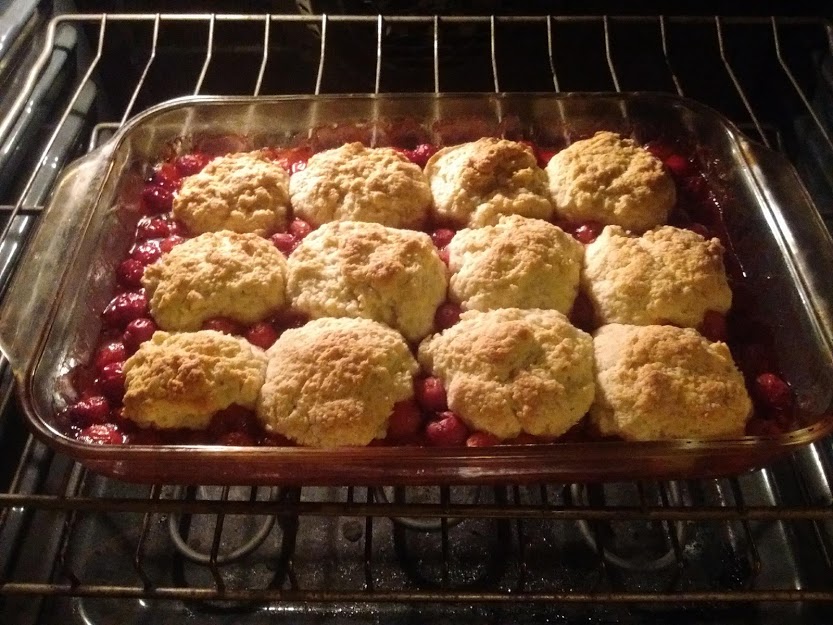
And a couple days ago, another neighbor texted me that she had a bunch of extra sour cherries from her cherry tree–Could we use them? Um. Yes, please, and thank you! Supper last night was a sweet summer fruits meal: cherry cobbler with ice cream.

Gratitude for kind neighbors.

May we do justice, love mercy, and walk humbly in Beauty!


“They say a little knowledge is a dangerous thing, but it’s not one half so bad as a lot of ignorance.” ―Granny Weatherwax, Terry Pratchett, Equal Rites


‪”Nature is real and vital. Wealth is neither. How is it we grant imaginary dragons the power to breathe real fire?‬” —Jarod K. Anderson, The Cryptonaturalist


“Only you and I can help the sun rise each coming morning. If we don’t, it may drench itself out in sorrow. You special, miraculous, unrepeatable, fragile, fearful, tender, lost, sparkling ruby emerald jewel, rainbow splendor person. It’s up to you.” —Joan Baez


“You can tell people of the need to struggle, but when the powerless start to see that they really can make a difference, nothing can quench the fire.”
―Leymah Gbowee


“A person’s a person, no matter how small.” —Dr. Seuss


“There can be no keener revelation of a society’s soul than the way in which it treats its children.” —Nelson Mandela


“Every child you encounter is a divine appointment.” —Wess Stafford


“Children are one third of our population and all of our future.” —Select Panel for the Promotion of Child Health, 1981


“Anyone who does anything to help a child is a hero to me.” —Fred Rogers


“Safety and security don’t just happen, they are the result of collective consensus and public investment. We owe our children, the most vulnerable citizens in our society, a life free of violence and fear.” —Nelson Mandela


“Power concedes nothing without a demand. It never did and it never will.” —Frederick Douglass


“Do not be afraid to include other people in your story, to ask others to hold the light for you in times of darkness and pain. This is a grace and a gift you offer them, to allow another the honor of walking beside you on the path, in silence or in song, no matter how treacherous the journey.” —Beth Weaver-Kreider, 2012


“When you realize the Earth is so much more than simply your environment, you’ll be moved to protect her in the same way as you would yourself. This is the kind of awareness, the kind of awakening that we need, and the future of the planet depends on whether we’re able to cultivate this insight or not. The Earth and all species on Earth are in real danger. Yet if we can develop a deep relationship with the Earth, we’ll have enough love, strength and awakening in order to change our way of life.” —Thich Nhat Hanh


“It is a wholesome and necessary thing for us to turn again to the earth and in the contemplation of her beauties to know the sense of wonder and humility.” —Rachel Carson

We’re All Coopers

As an English teacher, one of the disciplines I try to teach my students is analysis. Take a situation, a piece of art, a novel, a political view, a fight you had with your friend. Lay it out in front of you and examine it from every angle. Check out its component parts, and start asking yourself questions. How does this cog fit into that cog and make this crankshaft turn? How does this word combined with this biblical or pop culture allusion develop this tone that creates in the reader a sense of satisfaction or humor or existential dread? How does the painter use indigo to create a sense of depth perception in this painting?

So often, when we see a painting, or read a poem, or experience a national moment, we rush into our conclusions, and that’s not necessarily bad or un-intellectual. I think first impressions are really important in analysis. How did it make you feel? The first reactions lead the analyst into deeper questions, beginning questions: Why did she do that, I wonder? What caused him to react that way? How would I have acted in that situation?

Here’s why I am ranting about analysis today: Amy Cooper woke me up really early this morning. She’s the most recent national “Karen,” a white woman calling the police on a black person for being in a public space. Yesterday, I had First Reactions. Remember, first conclusions are not invalid. They’re the spark that takes us deeper into analysis. Why am I so angry? What was she thinking? Yesterday, Amy Cooper stepped out of her individual story and into the boat of an archetype. She’s a “Karen.” She’s a morality lesson. She’s an example of implicit bias and unquestioned entitlement and white supremacy. And when she floated into my mind at 4:30 this morning, I wasn’t getting back to sleep.

I do not know Amy Cooper, and any guesses I make about her motivations and choices are a complete disservice to her as an individual. I’m pretty sure she had no intention of stepping onto the stage and becoming a player in a National Morality Play. But she did do so. And now her part in this story has become the setting for necessary cultural analysis.

There are a lot of possible points of analysis here. The most obvious, of course, is race. The setting, however, has to do with civic duty and entitlement. Again, I do not know Ms. Cooper or why she would walk through a sensitive wildlife habitat, past signs that read Dogs Must Be Leashed At All Times, and let her dog run free of the leash. (Just this week, a friend of mine was injured while walking her own leashed dog, by a rambunctious unleashed dog in a park with Leash Your Dog Signs. “Oh, he’s friendly!” called the scofflaw owners of the leash-free pup just moments before the dog barreled exuberantly into my friend and her dog.) What is this entitlement that causes people to assume that basic laws and guidelines of civic and community co-existence don’t apply to me? There’s fodder for a whole article here. I would guess that we could all find some of these rules that we would scoff at personally. My favorites are the Homeowners’ Associations that forbid gardens in front lawns or washlines or wildflower patches. This piece of the analysis gets to the root of who we are as a society: Where does your freedom end and mine begin? Are there necessary “rules” for how we behave together in shared spaces? Don’t we need rules that protect the Earth and animals, which cannot speak for themselves? Should we regulate industries that pollute the air and earth and water that we all share? Can we ask each other to wear masks in public in order to protect each other from a pandemic? American individualism versus community health and well-being. Anarchy, individualism, authoritarianism, communitarianism, civic-mindedness all crunch together. There are whole articles to be written on this one.

Obviously, the main issue in this story, however, is the race issue. A white woman calling the police on a black man. Birding while black. Upholding community standards while black (he was simply asking her to leash her dog). In the context of the murder of a Minneapolis man by the police this week, the possible danger she placed him in cannot be discounted or minimized. Amy Cooper said later that she saw the police as protectors. As a black man in America, Christian Cooper (no relation) has every historical reason to fear the police when a white woman says, “I am afraid!” There are historical echoes in Amy Cooper’s phone call, echoes of Carolyn Bryant Donham calling down white wrath on Emmett Till, echoes of white slave-holding women maintaining cultural supremacy by placing black men in the role of dangerous savage from whom they needed protection.

And the moment I get into that territory, I need to recognize the gender story here. While this is a Morality Play about Race, we can’t ignore the gender question, the fact that women fear public spaces. I’m not sure how to parse the general fears of women from the racialized use of that fear that Amy Cooper played upon. A woman alone hiking in the woods has to contend with fear of male violence. Women grow up knowing we’re prey in some men’s minds. It doesn’t matter that most men would not harm us. We learn to be watchful and vigilant, to feel unsafe. We who look through Christian Cooper’s camera feel no sense of threat toward Amy Cooper. Yet we don’t know what traumas she may have experienced in her life that might have sent her into her reptilian brain for responses. We do hear her name race in her call, repeatedly. (Echo. Echo.) Still, simple gendered fear has to be taken into account not as an excuse, but as a factor.

You could analyze the surreality of their names. Were you to write this as a short story about race and gender and social entitlement in the US today, surely you wouldn’t name them the same thing. And yet, there’s something that awes me about this detail, some universal synchronicity that says: In the midst of it all, you’re the same. You’re related. You may think you’re the opposite on every imaginable scale–race, gender, age, civic engagement–but you’re really the same. You’re coopers, barrel-makers. You take the different elements of wood and metal and put the pieces together with such skill that the water and the wine stay safely within.

You could analyze their age difference. You could do a psychological exploration of the role of fear in this encounter. You could look at her treatment of the dog. You could look at the subculture of birders, and wonder about the warblers that Christian Cooper was most likely watching that day. You could explore their religious and political leanings (she appears to fall on the liberal side of the spectrum, if you’re making assumptions).

To do this justice, I would parse each piece in much greater detail, examine every element, but this is a blog-journal and not a professional article. It’s personal ramblings and not an English essay. Instead of trying to wrap it up neatly, I want to take it back to what I wrote yesterday, about curiosity. After all this muddling through today, I’m still angry. I still think Amy Cooper needs to be held accountable for calling the police on a black man who just wanted her to follow the rules and leash her dog, despite that fact that the story may have human complexity that extends beyond the symbolic and archetypal significance we place upon it.

But now I am curious. I wonder how this story would play out as deliberate fiction, what it might tell us about ourselves and how we live in the world. I’m curious about how Amy Cooper will find her way into life again as herself after living as an archetype. I wonder what would happen if Mr. Cooper and Ms. Cooper could be brought together in a mediation situation where they could tell each other their stories. I wonder what would happen if we would all begin to tell each other our stories, if we would all explore our internal biases, if we could maintain curiosity as a constant, if we would choose to encounter each other–with all our differences in age and race and gender and social awareness and civic-mindedness–as somehow inherently the same. This really is a morality play in which each character holds layers of symbolism. It’s a Jungian dream, in which each of us is equally each of the characters, bringing with us the distinct elements of race and gender and age and experience that make us distinct. We’re all Coopers.


Gratitude List:
1. We’re all different. We’re all the same. Being human is messy, but it’s so beautiful.
2. Wonder and curiosity
3. The way dawn came this morning on an aural wave, first the night insects and the early twittering of birds, along with an occasional rumble of a bullfrog in the pond, then louder, more voices joining, echoes resonating in the bowl of the hollow.
4. Finding closure
5. Blackberry blossoms covering the bluff like snow.

May we walk in Beauty!


“What does it mean to be pro-life if you defend the life of a child in the womb, but not the life of a child on the border?” —James Martin SJ


“It simply isn’t an adventure worth telling if there aren’t any dragons.” —Sarah Ban Breathnach


“Forests will always hold your secrets,
as that’s what forests are for.
To envelop things.
They’re the blankets
of the earth,
grown to protect,
to comfort, to hide,
to carry, to seep
into our chests,
and to teach.
Your sharpest aches
and bygone dreams
will be scattered across
these knowing trees
while the ancient contrasts
of shadow and light
whisper once again
that we are built to seek.
It is here in this space
where we’ll rediscover
the rhythms of roots
and what it fully means
to renew.
To revive.
To breathe.” —by Victoria Erickson


“Live in the sunshine, swim in the sea, drink the wild air.”
—Ralph Waldo


“The more clearly we can focus our attention on the wonders and realities of the universe about us, the less taste we shall have for destruction.” ―Rachel Carson


“In nature’s economy, the currency is not money. It is life.” —Vandana Shiva

Grace for What Will Be

Interesting patterns of lichen and rust on the old iron bridge at school. I am holding the image of this bridge in my heart as I think about how we make a safe and purposeful bridge for our students and community into the fall and beyond. What Will Be is going to look different from What Was. And that will be okay. We get to choose, now, to construct the beautiful and thoughtful and creative future that we want.

I have no doubt that there may be pieces of the future plan that will push me out of my comfort zone–continued elements of online learning, strange new schedules–but leaving my comfort zone is how I grow.

And, despite the changes, we carry important elements of the old way forward, into the new times, traditions that support and identify us as who we are, deep down. Some of the Beauty of What Was will permeate and inform What Will Be, not just at school, but everywhere. Let’s be deliberate, gracious, and filled with compassion as we create a future that is safe and humane and comfortable for everyone.


Gratitude List:
1. The hope of hummingbirds
2. How the children educate themselves, given half a chance. One is researching, in great depth, how to create and develop a Youtube channel, along with exploring how to create artful imagery and videos. The other is learning things about computers that I have no name for, but which I know are important to the world somehow.
3. Integrating some Qigong suggestions from a dear friend into my daily stretching and breathing practice. Sometimes, and especially at times like this, intangible gifts are special treasures. Every day, when I stretch and breathe, this will be like opening–once again–a little gift package from someone I love.
4. Getting kicked out of my comfort zone. I am not always grateful for this, and usually I am actually sort of kicking and screaming, but hindsight, baby, is full of grace.
5. Pathways through the woods. Yes, and I mean those, too. . .

May we walk in Beauty!


“Alas, the webs are torn down, the spinners stomped out.
But the forest smiles. Deep in her nooks and crevices she feels the spinners and the harmony of their web. We will dream our way to them.
[….]
Carefully, we feel our way through the folds of darkness. Since our right and left eyes are virtually useless, other senses become our eyes. The roll of a pebble, the breath of dew-cooled pines, a startled flutter in a nearby bush magnify the vast silence of the forest. Wind and stream are the murmering current of time, taking us back to where poetry is sung and danced and lived. In the distance a fire flickers—not running wild, but contained, like a candle. The spinners.” —Marylou Awiakta


“I don’t know if y’all heard, but women are the same as humans.” —Leslie Jones


“Someday, after mastering the winds, the waves, the tides and gravity, we shall harness for God the energies of love, and then, for a second time in the history of the world, man will have discovered fire.”
―Pierre Teilhard de Chardin


“Joy is the infallible sign of the presence of God.”
―Pierre Teilhard de Chardin


“I know that when I pray something wonderful happens, not only for the person that I am praying for, but also for me. I am being heard.” —Maya Angelou


“My pen is my harp and my lyre; my library is my garden and my orchard.” —Judah Ha-Levi (Spanish Poet, Physician)

Jesus and the Women

Jesus and the Women
A Mother’s Day Poem
by Beth Weaver-Kreider

His mother and his aunt made sure he knew more
than just the laws and canons of the men,
the patriarchy passed from father down
to son. They passed on their own mysteries,
from mother, from aunt, to these sons
they were raising. They suspected something big
was coming when Jesus and his cousin
came into their own, and they wanted them prepared.

And at his own wedding, when she upbraided him
for skimping on the wine, the gospels don’t record
his mother’s upraised eyebrow, quirked grin, tilted chin,
the way she swirled those robes of sky like hurricane
about her ankles as she turned and pointed to the empty
amphoras, then poked the steward in the chest, “Just do
whatever he tells you.” How the son hung his head
and shook it side to side, laughing. “Fill ‘em up
with water,” he told them, hands out in front of him,
like surrender. “No one can fight my Mama on this one.”

Martha had her say, too: “Bro! You’re bringing all these people
into the house! There are chairs and tables to set up,
children to tend to, food to be cooked and served.
Can’t you tell Maggie to help me with the work?”

“Whoa! First of all, let’s get this straight. No one tells Maggie
what to do. Maggie does what Maggie wants,
and furthermore, Mama said we’ve got to get the men
into the kitchen, too. Zaccheaus, will you grab that roast?
John, rearrange those chairs, will you? Uncle Nick,
can you catch that baby there before she toddles
out the door? Come sit here with us, Mar, and tell them
that idea you had about community gardens in Bethany.”

And when the party ended in the wee hours of night
and they were cleaning up, Martha handed him a dishcloth:
“Everybody wants a revolution,” she said and slapped him on the back.
“But no one wants to do the dishes.” He chuckled as he did them.

Then there was beloved Maggie—Don’t quibble with me
about Miriam and the Magdal-Eder and the names
of seaside towns. This is my poem, and I say
he called her Maggie like the rest of them, except
in the dark, when those healing hands were wrapped
around her. Then, “Mary,” he said, and “Mary,” again,
which is why the name went through her like knives,
like the sunlight which pierced her eyes on that morning
in the garden. But that came later.

“Why does the rabbi let his wife walk about,” they grumbled
in the synagogue, “with her head uncovered?”

I can see him rolling his eyes. Can’t see you how he
rolls his eyes? How he responds: “We’ve been over this
and over this. No one tells Maggie to do or not do anything.
Maggie speaks. Maggie writes. Maggie lets her raven hair
swirl about her shoulders in the sun. You might
as well tell thunder when to speak or to keep silence.
Maggie’s got a perfect mind, and Maggie will do
whatever Maggie pleases to do, and that pleases me.
Listen to this poem she wrote yesterday:
I am the mother and the daughter.
I am the barren one
and many are my sons.
I am she whose wedding is great,
and I have not taken a husband.
I am the midwife and she who does not bear.
I am the solace of my labor pains.
I am the bride and the bridegroom,
and it is my husband who begot me.”

And when the time had come, they gathered—
mother, aunts, sisters, wife—and they waited
and they watched. They knew what they had to do,
as women do who have received the mysteries of women
from generation to generation, and passed them on,
as women who have borne pain and healed pain
from the beginning of time. They stayed at the cross,
they went to the garden, they carried life forward
in the way that women do, in vials of oil and jars of herbs,
in loaf and grail, in words of thunder, and in mysteries
that you can see if you but look behind the veil.


Gratitude List:
1. My wise and compassionate mother
2. All my beloveds who mother me in so many ways
3. The experience of mothering. The joys and delights outweigh the wrenching sense of inadequacy, the shameful awareness of all I have done wrong in this gig.
4. All those birds out there. Some people say they think that global shelter-in-place has contributed to more songbirds. Anecdotally, I would say that could well be true.
5. Coffee

May we walk in Beauty!


“I stand before what is with an open heart. And with an open heart, I dwell in possibility.” —Macrina Weiderkehr


“The way to right wrongs is to turn the light of truth upon them.”
― Ida B. Wells-Barnett


“Somewhere in the world there is a treasure that has no value to anyone but you, and a secret that is meaningless to everyone except you, and a frontier that possesses a revelation only you know how to exploit. Go in search of those things.

Somewhere in the world there is a person who could ask you the precise question you need to hear in order to catalyze the next phase of your evolution. Do what’s necessary to run into that person.” —Rob Breszny
*“Pain travels through families until someone is ready to feel it.” —Stephi Wagner


“The object of terrorism is terrorism. The object of oppression is oppression. The object of torture is torture. The object of murder is murder. The object of power is power. Now do you begin to understand me?” ―George Orwell


“Each time a person stands up for an ideal, or acts to improve the lot of others, or strikes out against injustice, that person sends forth a tiny ripple of hope, and crossing each other from a million different centers of energy and daring, those ripples build a current that can sweep down the mightiest walls of oppression and resistance.” —Robert F Kennedy


“The ultimate weakness of violence is that it is a descending spiral begetting the very thing it seeks to destroy. Instead of diminishing evil it multiplies it.” —Martin Luther King Jr


“The limits of tyrants are prescribed by the endurance of those whom they oppose.” —Frederick Douglass


“Only if we understand, can we care. Only if we care, we will help. Only if we help, we shall be saved.” ―Jane Goodall

Justice Delayed

Don’t get me wrong.
I am glad that those men have been arrested.
There’s an aroma of justice to that part of the story.
It’s just that it’s so late in the story.
It’s just that it took a leaked video.
It’s just that it took concerted and focused public outrage.
It’s just that it took so long.
It’s just that it has happened before,
and it will happen again.
And again.
And again.
And what will it take for justice,
each time it happens?
And how does justice happen
if there’s no video to leak?
And is delayed justice any kind of justice at all?

Something is broken in America.
It’s been broken for a long time.
It’s never not been broken.
But we keep saying we have fixed it,
living like it’s been healed.
Acting shocked when we see how broken it is.
And then another round of outrage,
hoping that some sort of justice will be done,
and shrugging with relief and disgust
when the arrests are finally made,
knowing it’s never enough,
never soon enough.

I don’t know how to finish this.
I’ve run out of words.

Birthing Day

Fourteen years ago today, this person came to join us. I’m grateful every day.

Gratitude List:
This amazing child. That’s my gratitude for today.
Fifteen years ago, I lost my first pregnancy, over a period of about a week. One year later, to the week, this marvel of a human came into our lives. From the first hours of his time here, he was curious and awake, observant and engaging. He’s goofy and gorgeous, compassionate and tender. He loves his people and his cats. He spends hours thinking about how things work. He teaches me daily how to be a better person.


“We are not just made by God. We are made of God.” —Julian of Norwich


“In the very end, civilizations perish because they listen to their politicians and not to their poets.” —Jonas Mekas


“Awake, my dear. Be kind to your sleeping heart. Take it out into the vast fields of Light, And let it breathe.” —Hafiz


“Life loves to be taken by the lapel and told: ‘I’m with you kid. Let’s go.’” —Maya Angelou


“Once a little boy sent me a charming card with a little drawing on it. I loved it. I answer all my children’s letters — sometimes very hastily — but this one I lingered over. I sent him a card and I drew a picture of a Wild Thing on it. I wrote, “Dear Jim: I loved your card.” Then I got a letter back from his mother and she said, “Jim loved your card so much he ate it.” That to me was one of the highest compliments I’ve ever received. He didn’t care that it was an original Maurice Sendak drawing or anything. He saw it, he loved it, he ate it.” ―Maurice Sendak


“The best teachers are those who tell you where to look, but don’t tell you what to see.” —Alexandra K. Trenfor

Parallels

Portals everywhere.

I have been thinking about parallel stories in the last couple of days. Margaret Starbird begins her book, Woman With the Alabaster Jar, with a retelling of the story/legend of Mary Magdalene and Joseph of Arimathea fleeing across deserts to Egypt to safety. And I couldn’t get out of my mind the images of the Flight to Egypt, of Mary and Joseph–the parents of Jesus–fleeing with a donkey and the child of promise across the deserts to safety.

The Flight into Egypt, 1305 - Giotto Art Print, Canvas

Jesus is the sandwich of the stories. In one, an elderly Joseph and his young bride Mary flee with their newly-born child from Herod’s wrath. In the other, an elderly Joseph and his friend’s young bride Mary flee to protect her child or soon-to-be-born child (Jesus’s child) from the wrath of the whole Empire. Knowing how the stories of the second flight were part of medieval European lore, I wonder how many of the Flight to Egypt images from that period may have intended to hold the mystery of the second as well as the first.

There are many historical explorations of the likelihood of Jesus’s marriage and the suppression of this knowledge by 3rd and 4th century patriarchs. I won’t go into that discussion here, except to note that when a story is forced underground, it will find its way to remain within the human collective unconscious. It will show up on the other side of the looking glass. Joseph and Mary flee with the child of promise into Egypt. And beneath that story, reflected in pools of history, wavery and unclear, but there all the same, another Joseph and another Mary flee with another child across the deserts into Egypt.


Gratitude List:
1. Meaningful work. Six years ago today, I interviewed for a job that would change my life. Grateful that I got the job.
2. Ellis. Fourteen years ago today, I began a long and arduous labor that ended with a most incredible young person coming into the world. He arrived unconventionally, and he took his own time, and he opened his eyes and lifted his head and gazed at the world within hours of his arrival. And that’s how he’s been ever since: He moves to his own drumbeat, he’s got his own timeline, and he’s obsessed with figuring out how everything works.
3. That touch of flame in the branches: oriole.
4. Greeeeeeeeeeeeeeen
5. Moon: Tonight is the Full Flower Moon.

May we walk in Beauty!


“One of the greatest tragedies in life is to lose your own sense of self and accept the version of you that is expected by everyone else.” —K.L. Toth


“Believe me, you will find more lessons in the woods than in books. Trees and stones will teach you what you cannot learn from masters.” —St. Bernard of Clairvaux


“A woman with opinions had better develop a thick skin and a loud voice.” —Anya Seton


“The best teachers are those who show you where to look, but don’t tell you what to see.” —Alexandra K.Trenfor


“It doesn’t interest me what you do for a living, I want to know what you ache for. It doesn’t interest me how old you are, I want to know if you are willing to risk looking like a fool for love, for your dreams, for the adventure of being alive. I want to know if you can live with failure, yours and mine. It doesn’t interest me where you live or how rich you are, I want to know if you can get up after a night of grief and despair, weary and bruised to the bone, and be sweet to the ones you love. I want to know if you can be alone with yourself and truly like the company you keep in the empty moments of your life.” —Oriah Mountain Dreamer


The Bridge

In a trivial gesture, in a greeting,
in the simple glance, directed
in flight toward other eyes,
a golden, a fragile bridge is constructed.
This alone is enough.

Although it is only for a moment, it exists, exists.
This alone is enough.
—Circe Maia
translation from the Spanish by Jesse Lee Kercheval


“If you have good thoughts they will shine out of your face like sunbeams and you will always look lovely.” ―Roald Dahl


“To live in this world, you must be able to do three things: to love what is mortal; to hold it against your bones knowing your own life depends on it; and, when the time comes to let it go, to let it go.” ―Mary Oliver


“What should young people do with their lives today? Many things, obviously. But the most daring thing is to create stable communities in which the terrible disease of loneliness can be cured.” ―Vonnegut

Back to the Morning Studio

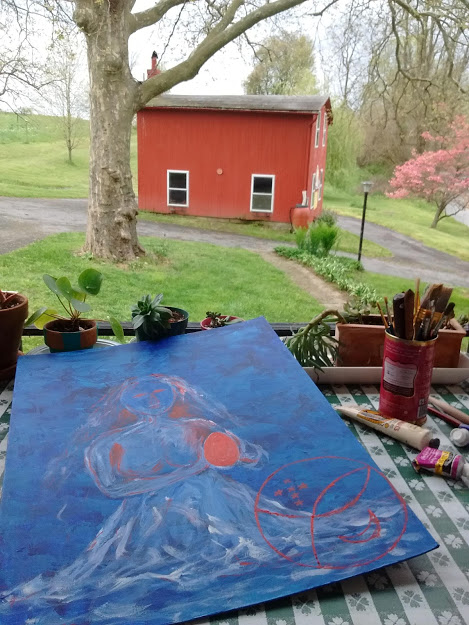
Just a sketchy start. Yemaya. Mary Magdalene. Chagall.

Gratitude List:
1. Oriole calling in the hollow
2. Morning Studio is open again
3. Watching a cardinal taking a bath in the stream
4. Scent of lily of the valley, scent of geranium
5. All the people who are responsibly doing their part to keep the curve flat.

May we walk in Beauty!


“The best way for us to cultivate fearlessness in our daughters and other young women is by example. If they see their mothers and other women in their lives going forward despite fear, they’ll know it is possible.” —Gloria Steinem


“You can learn to be lucky. It’s not a mystical force you’re born with, but a habit you can develop. How? For starters, be open to new experiences, trust your gut wisdom, expect good fortune, see the bright side of challenging events, and master the art of maximizing serendipitous opportunities.” —Rob Brezsny


“There is a way that nature speaks, that land speaks. Most of the time we are simply not patient enough, quiet enough to pay attention to the story.” —Linda Hogan


“You choose to be a novelist, but you’re chosen to be a poet. This is a gift and it’s a tremendous responsibility. You have to be willing to give something terribly intimate and secret of yourself to the world and not care, because you have to believe that what you have to say is important enough.” —May Sarton


“There is indeed a fire burning over the earth, taking with it plants and animals, cultures, languages, ancient skills, and visionary wisdom. Quelling this flame and reinventing the poetry of diversity is perhaps the most important challenge of our time.” —Wade Davis, The Wayfinders


“. . .war against a foreign country only happens when the moneyed classes think they are going to profit from it. . . . [E]very war when it comes, or before it comes, is represented not as a war but as an act of self-defence against a homicidal maniac. . . .

The essential job is to get people to recognise war propaganda when they see it, especially when it is disguised as peace propaganda.” —George Orwell

Shelter in Place

We live in a pocket of a hollow between two arms of Mt. Pisgah, the ridge that runs behind Wrightsville and up to the Susquehanna River. The Hollow is aptly names Skunk Hollow, and down the road from us a quarter of a mile is a farm lane by the name of Skunk Hollow Lane. We are in York County, but some of us used to travel down the ridge and over the River into Lancaster County for work and school.

For two weeks, the schoolfolk among us have been sheltering in place, and all of us have been here for the past week, making errands only to buy groceries or to make panicky trips back to the classroom to get things we thought we had forgotten. (Yes, that last was me, and it was only once, and it turns out that the papers I thought I had left in my room were actually slide shows my students had shared with me online.)

Yesterday our two counties were added to Pennsylvania’s list of counties under mandatory Shelter in Place rules. While there’s a direness to stricter restrictions, it also feels comforting, in a way, because we think people should have been voluntarily sheltering in place already, and this makes it mandatory. We’re all safer in the end for this new order.

On the other hand, we have an ideal place to shelter in, so I shouldn’t be too hard on the people who kept going out, who ignored the distance guidelines. Today we shelter in the house and watch the rain, coffee in one hand and a cat or two on the lap. Were it not for the plaguing anxiety about the spread of this virus, this would be my ideal day. I know it is not so for everyone.

What does shelter mean to you?


Gratitude List:
1. Warm cat,
2. and blanket,
3. and recliner,
4. and windows with a view
5. to the rain in the woods.

Take care of each other.


“Fiction and poetry are doses, medicines. What they heal is the rupture reality makes on the imagination.” —Jeanette Winterson


“Writing is a very emotional experience for me. Once, when I was writing the film adaptation of Charlotte’s Web, the phone rang and the caller said, ‘You sound all choked up.’ I said, ‘A spider just died.'” —Earl Hamner


“But the wood is tired, and the wood is old
And we’ll make it fine, if the weather holds
But if the weather holds, we’ll have missed the point
That’s where I need to go” —Indigo Girls


Thich Nhat Hanh:
“Real change will only happen when we fall in love with our planet. Only love can show us how to live in harmony with nature and with each other and save us from the devastating effects of environmental destruction and climate change.”


“In every outthrust headland, in every curving beach, in every grain of sand there is the story of the earth.” —Rachel Carson


“The Dwarfs are for the Dwarfs.” —CS Lewis


“One day I will find the right words, and they will be simple.” —Jack Kerouac


“If everyone demanded peace instead of another television set, then there’d be peace.” —John Lennon


“Art means nothing if it simply decorates the dinner table of power which holds it hostage.” —Adrienne Rich