Parallels

Portals everywhere.

I have been thinking about parallel stories in the last couple of days. Margaret Starbird begins her book, Woman With the Alabaster Jar, with a retelling of the story/legend of Mary Magdalene and Joseph of Arimathea fleeing across deserts to Egypt to safety. And I couldn’t get out of my mind the images of the Flight to Egypt, of Mary and Joseph–the parents of Jesus–fleeing with a donkey and the child of promise across the deserts to safety.

The Flight into Egypt, 1305 - Giotto Art Print, Canvas

Jesus is the sandwich of the stories. In one, an elderly Joseph and his young bride Mary flee with their newly-born child from Herod’s wrath. In the other, an elderly Joseph and his friend’s young bride Mary flee to protect her child or soon-to-be-born child (Jesus’s child) from the wrath of the whole Empire. Knowing how the stories of the second flight were part of medieval European lore, I wonder how many of the Flight to Egypt images from that period may have intended to hold the mystery of the second as well as the first.

There are many historical explorations of the likelihood of Jesus’s marriage and the suppression of this knowledge by 3rd and 4th century patriarchs. I won’t go into that discussion here, except to note that when a story is forced underground, it will find its way to remain within the human collective unconscious. It will show up on the other side of the looking glass. Joseph and Mary flee with the child of promise into Egypt. And beneath that story, reflected in pools of history, wavery and unclear, but there all the same, another Joseph and another Mary flee with another child across the deserts into Egypt.


Gratitude List:
1. Meaningful work. Six years ago today, I interviewed for a job that would change my life. Grateful that I got the job.
2. Ellis. Fourteen years ago today, I began a long and arduous labor that ended with a most incredible young person coming into the world. He arrived unconventionally, and he took his own time, and he opened his eyes and lifted his head and gazed at the world within hours of his arrival. And that’s how he’s been ever since: He moves to his own drumbeat, he’s got his own timeline, and he’s obsessed with figuring out how everything works.
3. That touch of flame in the branches: oriole.
4. Greeeeeeeeeeeeeeen
5. Moon: Tonight is the Full Flower Moon.

May we walk in Beauty!


“One of the greatest tragedies in life is to lose your own sense of self and accept the version of you that is expected by everyone else.” —K.L. Toth


“Believe me, you will find more lessons in the woods than in books. Trees and stones will teach you what you cannot learn from masters.” —St. Bernard of Clairvaux


“A woman with opinions had better develop a thick skin and a loud voice.” —Anya Seton


“The best teachers are those who show you where to look, but don’t tell you what to see.” —Alexandra K.Trenfor


“It doesn’t interest me what you do for a living, I want to know what you ache for. It doesn’t interest me how old you are, I want to know if you are willing to risk looking like a fool for love, for your dreams, for the adventure of being alive. I want to know if you can live with failure, yours and mine. It doesn’t interest me where you live or how rich you are, I want to know if you can get up after a night of grief and despair, weary and bruised to the bone, and be sweet to the ones you love. I want to know if you can be alone with yourself and truly like the company you keep in the empty moments of your life.” —Oriah Mountain Dreamer


The Bridge

In a trivial gesture, in a greeting,
in the simple glance, directed
in flight toward other eyes,
a golden, a fragile bridge is constructed.
This alone is enough.

Although it is only for a moment, it exists, exists.
This alone is enough.
—Circe Maia
translation from the Spanish by Jesse Lee Kercheval


“If you have good thoughts they will shine out of your face like sunbeams and you will always look lovely.” ―Roald Dahl


“To live in this world, you must be able to do three things: to love what is mortal; to hold it against your bones knowing your own life depends on it; and, when the time comes to let it go, to let it go.” ―Mary Oliver


“What should young people do with their lives today? Many things, obviously. But the most daring thing is to create stable communities in which the terrible disease of loneliness can be cured.” ―Vonnegut
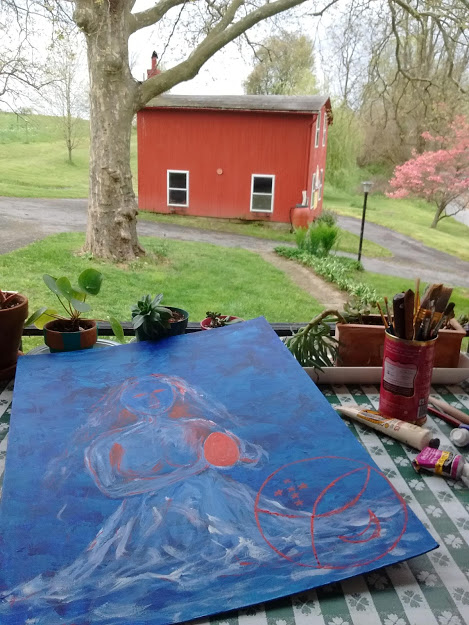
Back to the Morning Studio

Just a sketchy start. Yemaya. Mary Magdalene. Chagall.

Gratitude List:
1. Oriole calling in the hollow
2. Morning Studio is open again
3. Watching a cardinal taking a bath in the stream
4. Scent of lily of the valley, scent of geranium
5. All the people who are responsibly doing their part to keep the curve flat.

May we walk in Beauty!


“The best way for us to cultivate fearlessness in our daughters and other young women is by example. If they see their mothers and other women in their lives going forward despite fear, they’ll know it is possible.” —Gloria Steinem


“You can learn to be lucky. It’s not a mystical force you’re born with, but a habit you can develop. How? For starters, be open to new experiences, trust your gut wisdom, expect good fortune, see the bright side of challenging events, and master the art of maximizing serendipitous opportunities.” —Rob Brezsny


“There is a way that nature speaks, that land speaks. Most of the time we are simply not patient enough, quiet enough to pay attention to the story.” —Linda Hogan


“You choose to be a novelist, but you’re chosen to be a poet. This is a gift and it’s a tremendous responsibility. You have to be willing to give something terribly intimate and secret of yourself to the world and not care, because you have to believe that what you have to say is important enough.” —May Sarton


“There is indeed a fire burning over the earth, taking with it plants and animals, cultures, languages, ancient skills, and visionary wisdom. Quelling this flame and reinventing the poetry of diversity is perhaps the most important challenge of our time.” —Wade Davis, The Wayfinders


“. . .war against a foreign country only happens when the moneyed classes think they are going to profit from it. . . . [E]very war when it comes, or before it comes, is represented not as a war but as an act of self-defence against a homicidal maniac. . . .

The essential job is to get people to recognise war propaganda when they see it, especially when it is disguised as peace propaganda.” —George Orwell

Shelter in Place

We live in a pocket of a hollow between two arms of Mt. Pisgah, the ridge that runs behind Wrightsville and up to the Susquehanna River. The Hollow is aptly names Skunk Hollow, and down the road from us a quarter of a mile is a farm lane by the name of Skunk Hollow Lane. We are in York County, but some of us used to travel down the ridge and over the River into Lancaster County for work and school.

For two weeks, the schoolfolk among us have been sheltering in place, and all of us have been here for the past week, making errands only to buy groceries or to make panicky trips back to the classroom to get things we thought we had forgotten. (Yes, that last was me, and it was only once, and it turns out that the papers I thought I had left in my room were actually slide shows my students had shared with me online.)

Yesterday our two counties were added to Pennsylvania’s list of counties under mandatory Shelter in Place rules. While there’s a direness to stricter restrictions, it also feels comforting, in a way, because we think people should have been voluntarily sheltering in place already, and this makes it mandatory. We’re all safer in the end for this new order.

On the other hand, we have an ideal place to shelter in, so I shouldn’t be too hard on the people who kept going out, who ignored the distance guidelines. Today we shelter in the house and watch the rain, coffee in one hand and a cat or two on the lap. Were it not for the plaguing anxiety about the spread of this virus, this would be my ideal day. I know it is not so for everyone.

What does shelter mean to you?


Gratitude List:
1. Warm cat,
2. and blanket,
3. and recliner,
4. and windows with a view
5. to the rain in the woods.

Take care of each other.


“Fiction and poetry are doses, medicines. What they heal is the rupture reality makes on the imagination.” —Jeanette Winterson


“Writing is a very emotional experience for me. Once, when I was writing the film adaptation of Charlotte’s Web, the phone rang and the caller said, ‘You sound all choked up.’ I said, ‘A spider just died.'” —Earl Hamner


“But the wood is tired, and the wood is old
And we’ll make it fine, if the weather holds
But if the weather holds, we’ll have missed the point
That’s where I need to go” —Indigo Girls


Thich Nhat Hanh:
“Real change will only happen when we fall in love with our planet. Only love can show us how to live in harmony with nature and with each other and save us from the devastating effects of environmental destruction and climate change.”


“In every outthrust headland, in every curving beach, in every grain of sand there is the story of the earth.” —Rachel Carson


“The Dwarfs are for the Dwarfs.” —CS Lewis


“One day I will find the right words, and they will be simple.” —Jack Kerouac


“If everyone demanded peace instead of another television set, then there’d be peace.” —John Lennon


“Art means nothing if it simply decorates the dinner table of power which holds it hostage.” —Adrienne Rich

Because This is How We Live Now

Because This is How We Live Now
by ElizaBeth Weaver-Kreider

(with thanks to Lillian Faith,
who puts out crumbs for the robins
when it snows during the Exile)

Because
this is how
we live now.

Because this is how we mitigate.
(From the Latin: mītis, soft
and agere, to act.)
We make things soft
until the harm has passed:
hearts and bellies,
breath and eyes.
Soften everything.
Mitigate.

Because this is how we Exile.
We weep. We rage.
We dance in separate living rooms,
apart.
And together.
We look into a screen,
into each other’s eyes,
and we name each other Beloved.

Because this is how we find our edges.
We sway and shift,
feeling the edge of the pose
deep in the muscle,
and then we pause,
and breathe.

Because this is how we learn
we are not invincible,
unconquerable, alone.
Because we are together
in our isolation.

Because this is how we flatten the curve of sadness,
one small thing at a time,
one little loss,
and then another,
not all at once
taking the time to feel each one
together. Alone together.

Because this is how spring comes:
one day the sweat rolls down
between shoulder blades,
and on the next day it snows.
One day you spend in ashes,
the next within the golden branches
of the forsythia bush.

Because.
This is how
we live now.
–3/23/20


Gratitude List:
1. Foolery
2. Remembering to ask a question rather than to ignore what feels like a put-down. Deeper understandings come.
3. The feisty wren. I know, they are the terrors of the bird world in the holler, but they are also delightful to watch.
4. I’m so glad we had a good supply of thistle seed–the goldfinches are transforming, and its been years since I could sit here at this window for hours, working and watching the birds in spring.
5. Pluto. Have you seen Pluto? I know it’s a product of our silly internet culture, but it’s artful and playful, and she meets some common human need. If you haven’t seen the videos by Pluto the Dog, go Googling.

Take care of each other!


“Fear’s contagious, but so is courage.” —Betty Williams, 1976 Nobel Peace Laureate, 1943-2020


I had hardly begun to read
I asked how can you ever be sure
that what you write is really
any good at all and he said you can’t

you can’t you can never be sure
you die without knowing
whether anything you wrote was any good
if you have to be sure don’t write
—W. S. Merwin


“Kindness is a mark of faith, and whoever has not kindness has not faith.” —Muhammad


“How do I prepare a child for a future that doesn’t yet exist?” —Prince Ea


“I can feel the suffering of millions
and yet, if I look up into the heavens,
I think it will all come right,
and that this cruelty too will end,
and that peace and tranquility will return again.
In the meantime,
I must uphold my ideals,
for perhaps the time will come
when I shall be able to carry them out.” —from The Diary of Anne Frank


Bring me all of your dreams,
You dreamer,
Bring me all your
Heart melodies
That I may wrap them
In a blue cloud-cloth
Away from the too-rough fingers
Of the world.
—Langston Hughes, “The Dream Keeper”


“.. I had that wonderful feeling writers get sometimes, not very often, of being ‘with’ a great many people, ancient spirits, all very happy to see me consulting and acknowledging them, and eager to let me know, through the joy of their presence, that, indeed, I am not alone.” —Alice Walker

Note to Self

Note to self: Today, what are three things you have been putting off? Schedule time to begin, or plan, or complete each one. Mark each one with a small celebration of the weight that slides off your back with each task completed. Also, schedule a little time before dark to walk a mile.


Gratitude List:
1. People who actively move to create safe, loving spaces in the world.
2. All the green people peeking up above ground, basking in the sunlight.
3. The way the sun appears in the hollow in stages, first the grey light of dawn, then the glow which fills the bowl, and then the direct rays sliding down into the hollow as the sun clears the ridge.
4. How the kids grow, how they become themselves.
5. Fixing things.

May we walk in Beauty!

Gained In Translation, Again

Three years ago, I ran a couple of my short poems through Google Translate to see what would happen. From English to Pashto and back again. From English to Pashto to Hindi to Javanese and back again. How does meaning become fractured through the algorithmic translation process? Last week, I tried it again. I started with:

Long have I longed for
and dreaded
this moment
of darkness,
belonging to silence,
sure of my shadows.

Then I ran it through
Sinhala —> Tajik —> Swahili —> Malayalam —> Pashto —> back to English

Here is what happened. Look how it pulled a rhyme in there for me (afraid/shade), and the meaning has definitely shifted, but I’m really happy with it. I added punctuation at the end for clarification. I actually like it better than my original.
I’ve been waiting a long time.
Don’t be afraid.
At this point:
Dark,
In silence,
I believe in shade.


Then I tried Mr. McConnell’s famous Truth: Nevertheless she persisted.
Ran it through Punjabi —> Bangla —> Hmong —> Kyrgyz —> Tamil —> English
Ended up with: The reality is, however, there is more.
This changes the meaning a little more than I really want to, but it is an interesting end.


I tried a third, another of my tiny poems. This time, that fifth line changed anger to sex. Hmmm.
Take a deep breath.
Find the place inside you
that remembers how truth feels;
remember that there
are kinds of anger
that are more effective
than blind outrage.

Tamil —> Javanese —> Cebuano —> Hindi —> Kazakh —> English

Take a deep breath.
Find a place in your stomach
The cruelty of truth is considered;
Remember
Sex is scary
It was very effective
Especially the blind.


Ah, well. I like putting the essence of meaning outside of my control for a moment and seeing what happens.

In Creative Writing classes, many of the exercises I have students do are to encourage us to move behind that space in our brain that controls the meanings. Part of the reason for this is that is helps us to discover hidden wells and springs of words and ideas within ourselves that we didn’t know were there, like finding the secret room in your house in the dream. At a basic level, it helps us learn that there are a thousand ways to say a thing, a thousand hues of meaning. Giving up control in the immediate moment, as with an exercise like this, helps us learn to take control, to refine and define our meanings.


Gratitude List:
1. Singing in the pit for our school’s musical. It’s a rather big commitment, but I love it.
2. Yesterday after I dropped a Big Boy off for tech prep for the play, I had a couple hours just to be by myself. I went shopping, of all things. Hit the Goodwill pay-by-the-pound bins, and A.C. Moore’s going out of business sale. I bought Small Boy a stack of canvases for painting–half price.
3. The Small Boy hasn’t painted for months, but at the moment he is creating a marvelous abstract cloud-like scene with watercolors. Hmm. Now he is adding some acrylics on top of that. Experiment, Kid!
4. Silver hair. When I see photos of myself now, my first awareness is of a middle-aged, grey-haired, gnome-like woman. I’m okay with that. No, I’m actually happy with that. I like being middle-aged, and I like having unicorn hair.
5. The way the sun casts shadows in the bosque across the road when it slides up and over the opposite ridge in the mornings. All those tree-shadows!

May we walk in Beauty!

Soon

Soon, soon, soon,
say the dawn birds.
Soon, say the breezes
scuttling down the ridge.
Soon, says the sunlight
slanting springlike
through windows.


Gratitude List:
1. Meeting a new friend
2. Soon comes Spring
3. That day of rest was just what I needed
4. I am beginning to live into the sense of being caught up
5. Big salad for supper last night. The boys ate theirs with chopsticks, so I did too.

May we walk in Beauty!

Rain

Gratitude List:

  1. Kimchee. This jar comes from Gap, and I’m sure it’s not nearly spicy enough to taste correct to a real Korean person, but the ginger and garlic and fermentation taste perfect to me, and remind me of the Korean restaurant in our neighborhood when we lived in Lancaster.
  2. I’m in the grading zone right now. May it continue. I am mostly caught up at the moment. I’m feeling hopeful.
  3. Bald eagle flying over the school yesterday after school.
  4. Yellow aconites spreading among last fall’s leaf cover. Things are waking up.
  5. I found some evening energy yesterday, despite having this nasty cold. Lately, finding evening energy has been a serious challenge. The light is returning.

May we walk in Beauty!

Angelic Troublemakers

Mindy’s sermon yesterday was about holy troublemakers. She told some of the story of Bayard Rustin, and shared his quote (in gratitude list, below) about being angelic troublemakers, about placing our bodies in the cogs so the wheels don’t turn. Not too long ago, House Representative John Lewis referenced Rustin’s point when he said it was time to make some good trouble.

What does that look like today? I don’t work at a place where ICE is making arrests. How do the regular citizens harbor and shelter people who are living in fear of deportation? How do we fight through the moral exhaustion of the daily destruction of human rights and protections for the environment? What does it mean to “tuck [my body] in places so the wheels don’t turn”?

Yes, teaching high school students is part of making change, pushing them to examine their inner worlds, to think with clarity and compassion, to explore their own relationship to others and the world. Still, I think the times are calling for more than good people quietly doing good things. But I don’t know how to fashion a response. I don’t know how to step into those places Rustin is talking about.


Gratitude List:

  1. The holy priestess voices and words of the vocal trio yesterday morning.
  2. The gathered community of birds and small animals on the back hill yesterday: goldfinches on the thistle sock, a red-belly woodpecker and a hairy on the suet cake, juncos and white-throats, starlings. Bluebirds murmuring from the woods edge. Reginald the Happyfat, a squirrel. A skyful of Canadas calling above. A woodchuck running along the edge of the hill. Sun shining. A little bit of Eden.
  3. Angelic troublemakers. May we have the courage to place our identities and our bodies where hope and justice lie. “We need in every bay and every community a group of angelic troublemakers. The only weapon we have is our bodies, and we need to tuck them in places so wheels don’t turn.” —Bayard Rustin
  4. Spiritual practices that keep me grounded and centered.
  5. This little Peter Pan cat. He’s at least six years old, but you’d think he was a baby kitten–he’s so sure he’s my little baby.

May we walk in Beauty!

Snow Geese

I’m not sure whether to be delighted or alarmed at the processional flights of snow geese across the sky. I cannot stifle delight. That feels like a sin. So I will feel it, as I always do, with my whole being, when I see them. It’s akin to the joy of a flock of Canada geese, but sweeter somehow. The Canadas are year-round residents, and although they’re rather a mess in the places they choose to reside, I love them. Perhaps that’s why the snow geese bring on a frisson of wild thrill when I notice the longer wings, the different colors and shapes against the sky, the wilder cry: the Canadas are so habituated to humans that they’re almost something between wild and domestic. I love them for that, but I love the feral flight of the snow geese, the mystical quality of the white bodies/black wings against the blue.

The alarm, of course, is because they’re here now. When I started marking their travels, early March was the date to watch for. Then February. Now early January. Perhaps it’s a fluke of the year. Perhaps it’s a sign of changes to come. May they thrive in whatever future they face.


Tuesday’s Thoughts
“The mystic sits inside the burning.” —Rumi
*****
“Writing is the painting of the voice; the closer the resemblance, the better it is.”
—Voltaire
*****
“Be kind whenever possible. It is always possible.” —Dalai Lama
*****
“Look at your feet. You are standing in the sky. When we think of the sky, we tend to look up, but the sky actually begins at the earth.” —Diane Ackerman


Gratitude List:
1. Snow geese
2. Tabula rasa
3. New habits
4. Tidying up
5. Learning about learning

May we walk in Beauty!