Syncretism

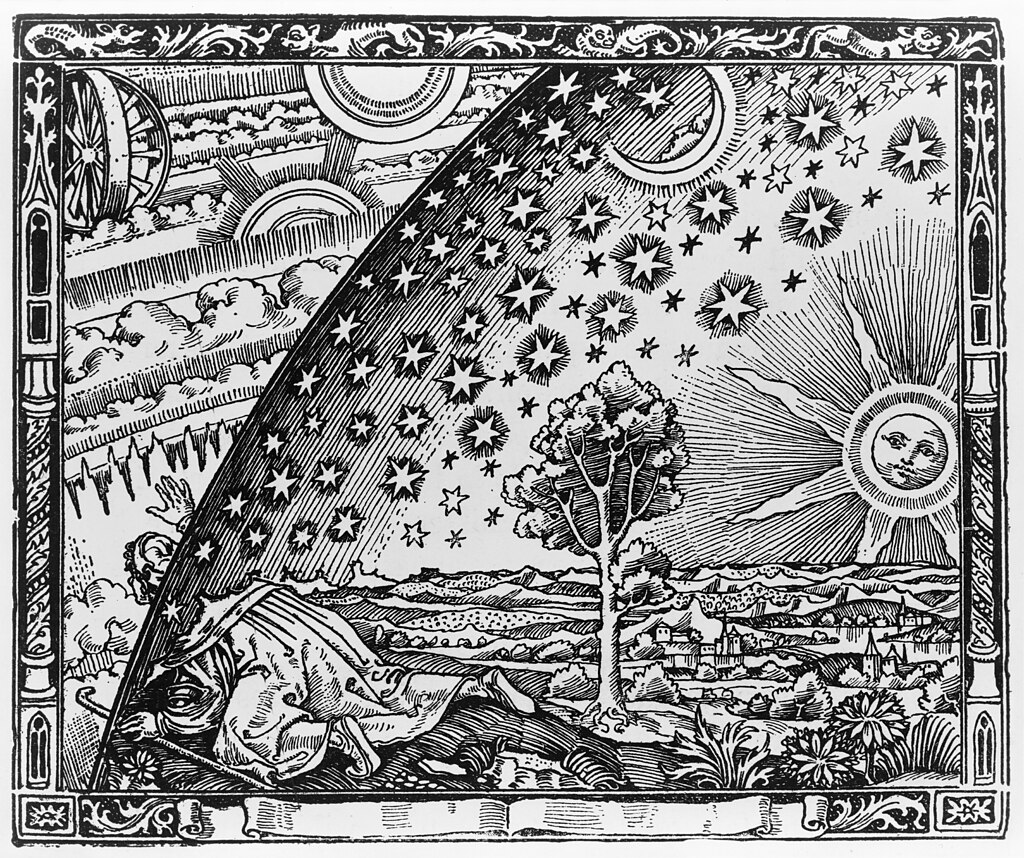
The “Flammarian Engraving.” Artist unknown

Well, here’s a fun etymology! Syn- means together, as in synchronize, synonym, synapse, sync. But that second part is harder. It could, according to etymologyonline.com, come from the old Greek word kerannynai, or the word krasis, which both carry the meaning of a mixture or blending. To blend together. Probably the appropriate linguistic trail.

But eymologyonline.com also explains that the cretism could also refer to Crete, and an old adage about “lying like a Cretan.” To bring the liars together? Hmmm.

The word took on specific meaning during the German Reformation, when people with varying ideas of religion were fracturing into sects, and theologians were working to “bring together” or syncretize their theological systems. As often happens when people try to stitch varying ideas together, the sects became even more fractured, and syncretism became a bad word, taking on the meaning of trying to put together things which absolutely should not be put together.

Which is how I learned it, in a Religion class in my Mennonite High School. Syncretists, we learned, see religious experience as a smorgasbord, taking a little of this and a little of that, whatever shiny ideas their ignorant or heretical minds find appetizing. We were told that they don’t commit to a single path, so they are less enlightened, less spiritually mature, than the creedal religions, like Islam, Judaism, and especially Christianity.

While I certainly, and to my shame, felt the superiority and pity required by the fervent evangelical system of my Religion class regarding the syncretists, something in me started singing then–perhaps it was the budding poet: “Not everyone feels compelled to fit the boxes! Some people choose their path.” Perhaps that was when I first began to give myself just a little permission to look at my spiritual story from a lens other than the steel-sided theological boxes I was handed by church and school.

I love the old Catholic women who pray to Mary and also read tarot cards, the devout Mennonite grandmothers of my own lineage who may have been practitioners of the German sympathetic magical tradition of powwow, the indigenous people who honor the ancestral truths passed on to them while weaving them into faith traditions they’ve known from other lines of ancestry, the witches who follow the path of the Earth Goddess and maintain their heritage faiths in whatever way seems best to them.

Today, I often call myself a Universalist, which applies, and yet that label takes me out of the specific realms where I find my spiritual buffet. I am an Anabaptist Mennonite, steeped in the peace tradition and the yieldedness and the opposition to Empire that my Mennonite ancestors experienced. Faith without works is dead, they said, and the priesthood belongs to all believers. I no longer accept the moniker Christian because of the way that term has been drained of its life-force and turned vampirical by the blood-sucking life-denying forces of the modern US evangelical movement. But I am dedicated to the teachings of Jesus. And, like the old Catholic women, I pray to his mother in all her forms.

And I am a witch, a word I wore quietly in private until it was given me as a public accusation and I chose to wear it proudly and publicly. A witch is one who trusts her own connection to the life-giving force of the Earth, of the Goddess who is the spiritual expression of Earth. One who believes in being her own priestess (like the Mennonites and their egalitarian priesthood). One who believes in finding Truth in her embodied experience. One who believes that magic is, as Dion Fortune wrote, “changing consciousness at will,” beginning with my own consciousness. I honor the rich traditions of indigenous spirituality here in the US and in Africa and elsewhere in the world, not choosing to assimilate their beliefs into my own, but allowing them to inform and enrich my personal practices and beliefs, which are grounded in my own heritage.

Mostly I am a poet, finding significance in metaphor and symbol, in the way words and ideas and images and people weave together to create a tapestry of meaning.

I recently watched The Truman Show again with one of my high school classes, and afterward we compared the image of Truman Burbank standing at the top of the staircase at the edge of the sky at the border of his world with the image of the “Flammarian Engraving” of the man peeking under the veil of the visible world into the deeper reality of the workings of the universe. I want to be always finding my way to the next doorway, the next veil, ready to face my fears and stand in awe at the new discoveries to be made. Ready to syncretize new ideas and revelations with my current limited understanding.

And Now for Something Completely Different

Robert Lee Brewer’s prompt today is to write an And Now For Something Completely Different poem, trying something you’ve never tried before. I’ve been delighting in deconstructing the shape of the poem this month, making sculptures of poems, inspired by the work of the brilliant CAConrad. Playing with lines has led to a certain new freedom in the placement of words and the structuring and de-structuring of sentences in poetic form.

So for my completely different poem, I decided to play with a couple of phrases one of my children said several years ago when he was just playing with the sounds of words as they came out of his mouth, and see what happened if I just followed the rabbit trail of that into the weeds.

It’s hard for me to unhitch the horse of the brain. Sometimes when I get a good flow of nonsense or newness in a poem or a sentence I am writing, my brain suddenly lights up with ideas about where to take it, how to do it again and differently. Kind of like the friend who was always interrupting the flow of imaginary play with a, “Guys! I have a great idea! How ’bout if we. . .?” Which was well and good and often provided hours of fun, but sometimes it was simply interruption upon interruption and it pulled us out of the essential imagination zone. My brain kept being that friend as I wound my way through this poem. I would get into a series of sounds and suddenly brain was inserting words that added sense. I’m actually kind of happy with the tension that created, the veering from sense to sound and back again.


Gratitude List:
1. Noticing the roadside plants as we walked along the road just before dusk: aster, mustards, bedstraw, chickweed, roadside penny cress, sorrel dandelion, purple and white violets, wild daffodils
2. The garlicky bite of penny cress, the bitter tang of dandelion
3. Vespersong: Field sparrows and red-winged blackbirds, robin, titmouse, chickadee, mockingbird. . .
4. Kind and thoughtful neighbors
5. Quiet contemplative time
May we walk in Beauty!


“My turn shall also come: I sense the spreading of a wing.” —Osip Mandelstam, Russian poet and essayist


“Be wary of any influence in your environment that dismisses or judges your enthusiasm. Without it, you would become anaesthetized to life itself. Anyone who demands this smallness of you is in danger themselves and may have contracted this insidious, deadening monotone. Enthusiasm is the vitality of spirit, expressing itself through us, and its grace in our voice should be welcomed and cherished. The word originates in the early 17th century, from the Greek enthousiasmos meaning ‘possessed by god.’ Now, more than ever, the world needs your enlargement, your weirdness, your fiery crescendos of rebellion from boring.” —Toko-pa Turner


“Grief is normal. It’s not like you’ll have a life someday with no grief. Life is all about loss, but grief is the medicine for that loss. Grief is not your problem. Grief is not the sorrow. Grief is the medicine. The people that have grief cultural awareness are always turning all of their losses into beauty in order to make more life instead of just trying to get through it and then forget about it.” —Martin Prechtel


“The only weapon we have is our bodies, and we need to tuck them in places so wheels don’t turn.” —Bayard Rustin


“There is a sacredness in tears. They are not the mark of weakness, but of power. They speak more eloquently than ten thousand tongues. They are the messengers of overwhelming grief, of deep contrition, and of unspeakable love.” ―Washington Irving


“Gratitude is not a passive response to something we have been given, gratitude arises from paying attention, from being awake in the presence of everything that lives within and without us. Gratitude is not necessarily something that is shown after the event, it is the deep, a-priori state of attention that shows we understand and are equal to the gifted nature of life.” ―David Whyte


“Our strategy should be not only to confront empire, but to lay siege to it. To deprive it of oxygen. To shame it. To mock it. With our art, our music, our literature, our stubbornness, our joy, our brilliance, our sheer relentlessness—and our ability to tell our own stories. Stories that are different from the ones we’re being brainwashed to believe.
.
“The corporate revolution will collapse if we refuse to buy what they are selling—their ideas, their version of history, their wars, their weapons, their notion of inevitability.
“Remember this: We be many and they be few. They need us more than we need them.
“Another world is not only possible, she is on her way. On a quiet day, I can hear her breathing.”
―Arundhati Roy, War Talk


“And this brings us back to the Hen Wife—that figure of magic who dwells comfortably among us, not off by the crossroads or in the dark of the woods; who is married, not solitary; who is equally at home with the wild and domestic, with the animal and human worlds. She is, I believe, among us still: dispensing her wisdom and exercising her power in kitchens and farmyards (and the urban equivalent) to this day—anywhere that women gather, talk among themselves, and pass knowledge down to the next generations.” ―Terri Windling


“‪Birds have a fascinating evolutionary history winding back to the dinosaurs. Except flamingos. Flamingos resulted from a child’s drawing brought to life by a birthday wish.” —Jarrod Andersen, The Cryptonaturalist

Ekphrastic Poem

Today’s prompt is to write an ekphrastic poem, to take a piece of art, and to write a poem about it. All month, I have been writing a poem, and then creating a piece of AI art to go with it. As I began to create a piece of AI art to use for this prompt, the poem approached. Before I managed to create a piece of art, the poem had found its way to my notes, and so I created the art to go with the poem that went with a piece of artwork that I had imagined. And so it goes: Which comes first?

Which came first:
the image or the word,
the sound or the sense,
the egg or the bird?

Did it happen with BANG or “Begin,”
with the seed or the dream,
with poem or picture,
with to say, or to seem?

A project, a poem, a world comes to be
in the nodes where the lines of word and image cross,
the woven fibers of vision and voice interlocking,
and in the silence and darkness between,
meaning–like water– trickles into the spaces,
into the interstices, of the living, breathing tapestry.

Becoming becomes,
word takes shape and image speaks,
and something new comes into being.


Gratitude List:
1. Every day right now: November Roses!
2. People telling their stories
3. The buck who whuffed at me in the grove
4. Cardinal singing in the cherry tree
5. Words and images
May we walk in Beauty!


“Choosing to be honest is the first step in the process of love. There is no practitioner of love who deceives. Once the choice has been made to be honest, then the next step on love’s path is communication.”
― bell hooks, All About Love: New Visions


“Some believe it is only great power that can hold evil in check, but that is not what I have found. It is the small everyday deeds of ordinary folk that keep the darkness at bay. Small acts of kindness and love. Why Bilbo Baggins? Perhaps because I am afraid, and he gives me courage.” ―Gandalf


Let the rain come and wash away
the ancient grudges, the bitter hatreds
held and nurtured over generations.
Let the rain wash away the memory
of the hurt, the neglect.
Then let the sun come out and
fill the sky with rainbows.
Let the warmth of the sun heal us
wherever we are broken.
Let it burn away the fog so that
we can see each other clearly.
So that we can see beyond labels,
beyond accents, gender or skin color.
Let the warmth and brightness
of the sun melt our selfishness.
So that we can share the joys and
feel the sorrows of our neighbors.
And let the light of the sun
be so strong that we will see all
people as our neighbors.
Let the earth, nourished by rain,
bring forth flowers
to surround us with beauty.
And let the mountains teach our hearts
to reach upward to heaven.

Amen.
―Rabbi Harold Kushner


I place in the hands of Time these stones:
the story of this day,
the people I have been near to,
the songs the Fates have whispered in my ears,
the colors that haunt me.

See how they turn to mist,
how they glow for a moment–
red, then golden, then blue–
then dissipate like ash blown by a wind
before I can register
that they have lost their substance.

Where does memory go
when it flows out with the tide,
when it slips down the drain,
when it is blown out with the morning fog?

I am still the child in the forest,
walking blind through the swirling mists,
under the shadows of the great trees.
With each forward step on the trail,
a little bird flutters from the pathway behind,
a bread crumb in its beak.
―Beth Weaver-Kreider


“When I stopped trying to change you, you changed me.” ―Rachel Macy Stafford

Portent

Shining Through

This moment actually happened last night as I was driving home. My mind made a meaning of it, where perhaps someone else might not have noticed the way the eagle flew, or watched the crow fly after. I think my point is that it’s not just that I am overly whimsical or that the spirits of the land had a specific message for me, but that we make the meaning we see, and that that does have portent and meaning because of the context we give it. And that perhaps not being ready to see, not paying attention, deprives us of inner connections we could be making.

Portent
by Beth Weaver-Kreider

Last night as I crested Mt. Pisgah ridge
beneath a wispy crescent of a moon,
an eagle flew low across my vision
from west to east, across the moon
across the gold-splashed indigo dusk.

I’d caught my breath when
flying north to south, a solitary crow
crossed the eagle’s path
and disappeared into the growing dark.

I could say it was important. Potent.
A portent. Was I the only observer?
Was it a moment meant for me,
an implication for my mind to find?
Had I not been meandering homeward
at that very instant, would there have been
a meaning in that moment?

If a tree falls, and all that, right?
What I do know is
that within the world of me
there is now
a great X inscribed
by black wings
across an indigo sky,
saying, “Here, here, here.”


“You can pray until you faint, but unless you get up and try to do something, God is not going to put it in your lap.” —Fannie Lou Hamer*****”Writing is like driving at night in the fog. You can only see as far as your headlights, but you can make the whole trip that way.” —E.L. Doctorow*****“Silence is a frightening thing. Silence leaves us at the mercy of the noise within us. We hear the fears that need to be faced. We hear, then, the angers that need to be cooled. We hear the emptiness that needs to be filled. We hear the cries for humility and reconciliation and centeredness. We hear ambition and arrogance and attitudes of uncaring awash in the shallows of the soul. Silence demands answers. Silence invites us to depth. Silence heals what hoarding and running will not touch.” —Joan D. Chittister*****“The present moment is the intersection of eternity with time.” ―Beatrice Bruteau*****“Only the present moment contains life.” ―Thích Nhất Hạnh*****“I believe the world is incomprehensibly beautiful—an endless prospect of magic and wonder.”―Ansel Adams*****“I have been and still am a seeker, but I have ceased to question stars and books; I have begun to listen to the teaching my blood whispers to me.” ―Hermann Hesse, Demian*****“I went inside my heartto see how it was.Something there makes me hearthe whole world weeping.”―Rumi (Barks)*****”Did you ever hear a tree pushing out of the ground or the snow falling? Great things happen in silence.” ―Mother Angelica*****”Everything belongs, even the “bad” and dark parts of yourself. Nothing need be rejected or denied. No one need be hated. No one need be excommunicated, shunned, or eliminated. You don’t have time for that anymore. You’ve entered into the soul of the serene disciple where, because the Holy One has become one in you, you are able to see that oneness everywhere else. Almost like magic!” ―Richard Rohr*****“Our work is to show we have been breathed upon—to show it, give it out, sing it out, to live it out in the topside world what we have received through our sudden knowledge, from body, from dreams, and journeys of all sorts.” ―Dr. Clarissa Pinkola Estes*****“We found ourselves in a realmwhere dreams are formed,destiny is chosenand magic is as realas a handprint in the snow.”―Libba Bray

Random Associations

Ugh. Insomnia. And it’s the fuzzy-headed kind. Trying to head off a cold, I took a tablet before bed that has zinc and valerian in it. I slept soundly for about five hours, and then that was it. Sometimes I can starting listing the countries of the world, and I’ll fall back to sleep before I can fill a continent, but tonight I got through all of them, and here I am, still awake. By the time I got through South America and was working my way through Africa, I knew I was done for. And now, it’s only half an hour until my alarm goes off, so I might as well start the process of waking up.

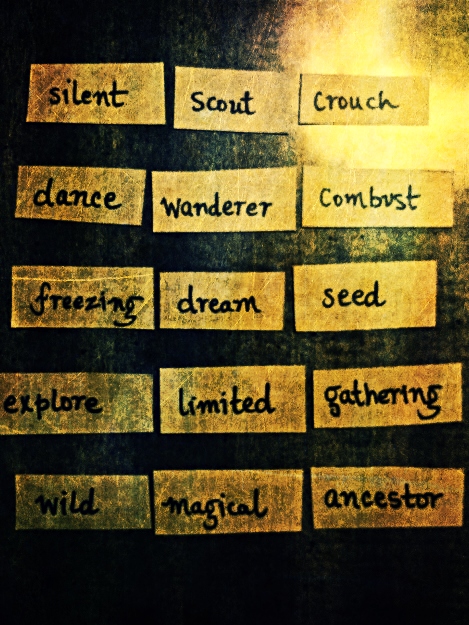
Today in Creative Writing, we’ll look at the pictures and poems that people put together with their random words. I showed several of my own on Friday as examples, so I don’t know if I’ll put up pictures like this one. I just pulled fifteen random cards from my word tickets and arranged them together. I’m not sure I like the line “dance wanderer combust.” The flow feels wrong, like I’m packing too many syllables into it. I like the word wanderer on its own, but in some contexts, that “-erer” can sound like a car with an engine that won’t turn over.

I hope my students are feeling the sense of freedom from prescribed meaning that I am feeling from working with word pools. We’ll get into intentional meanings soon enough, but it’s a nice breath to begin the semester with nonsense and random associations. It’s been an odd experience for me, a little risky. I feel sort of vulnerable, like I am letting my students in to my own personal crazy. I keep worrying that they’ll start rolling their eyes, that they won’t get it. And this is so deeply connected to the way my brain works that I feel like I might feel a greater sense of personal rejection if they can’t get into it. Enough of them have sent me fantastic random word projects, however, that I am feeling less anxious about it.


Gratitude List:
1. The shadows that swoop through the woods behind the house when vultures are flying in front of the sun.
2. Random meanings plucked from odd associations
3. Even though sleep was short, I did get some good solid hours of deep sleep
4. The ones who work for justice
5. Warm blankets

May we walk in Beauty!

Orts and Crots and Meaning-Making

Cup of Coffee: I might be having too much fun with the business of labeling things with random words. I hope my students are having half as much fun as I am. I should make sure to credit Susan Goldsmith Woolridge for the idea, in her marvelous book: poemcrazy.

One of the things about the Judeo-Christian creation story that always captures my attention is the idea that the humans are tasked with the work of naming. The Holy One breathes life into the clay to make a living person, and then the people set about the task of breathing out the names of their companions, the animals. I wish I could figure out how to make a seamless connection here to the sort-of-silly and whimsically-fun project of labeling people and things with random words from our Word Pools that we are doing in my Creative Writing class.

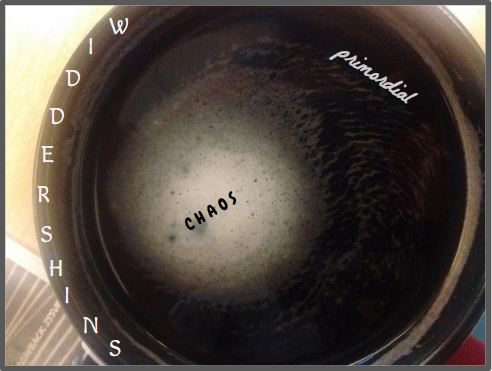
There’s something mind-expanding about taking the random word “chaos” and using it to label the foamy swirl in the middle of my cup of coffee. When I added “widdershins” to the outward spiral of the cup, I was being less whimsical, because the old word for the leftward spiral is widdershins. And “chaos” begat “primordial,” so that, too, was association rather than simple randomness.

Even so, I can see how, turned loose to run in its own pathways, my brain played a simple associative game with words and ideas, building up tidbits of meaning into a cohesive whole. And that’s the process I want my students to be finding. Breaking it all down to the little bits, and rebuilding up new structures and associative maps of meaning. Beginning, like First Human, with words for things, and then building up relationships and intricate and complex webs of patterns and thoughts.

Speaking of words and the structuring of meaning, for some reason this morning, my mind has pulled the words “ort” and “crot” out of the stew of my brain. An “ort” is a small piece of something, particularly a leftover bit from a meal. I am thinking of all these little random words that we have pulled out of the webs of sentences and ideas and thrown onto other objects, like the crumbs dropped from the table of a messy eater. A “crot” is a piece of a phrase, an abrupt fragment of meaning used to create movement and rapid transitions in a piece of writing.

Begin with the crumbs, the orts, that fall out of the meal of a conversation. Grab twenty random words. Thirty? Forty? Taste them. Memorize them. Write them. Throw them against the wall. Toss them together and see which ones stick together. Combine them into crots, little strands of potential. Knot them. Twist and spin them. Form them into longer strands and webs, phrases, sentences, ideas. Follow the footsteps of First Human. Breathe that Holy air into your lungs, and breathe out Words. Orts. Crots and phrases. Make a new thing.


Gratitude List:
1. Orts and Crots: Tiny pieces and fragments of meaning that get thrown and tossed and jumbled together to create meanings and ideas and conceptual frameworks.
2. Breath. Breathing. In. Out. Gratitude and compassion. Hope and fortitude. Breathe. Breathe. Breathe.
3. Goldfinches on the thistle sock. (Thistle sock–that’s fun to say.)
4. Morning writing while my small architect designs a house made of shipping containers. He has taped four pieces of graph paper together to create his idea.
5. A little bit of snow remains on the ground. I’d like some deeper snow at least once this winter, please.

May we walk in Beauty!

Twelvenight: Synchronicity, Orenda, and the Fool

One of the subjects that keeps snagging my poetic attention is the landscape manuscript–how everything around us (not just the landscape) has a “text” that we might understand, if only we could read it. When I’m driving down the road and thinking about a knotty issue I am trying to resolve and I see three crows standing quietly in a winter field, or seven geese suddenly fly overhead in a raggedy V across my view, or something in the way the sun shines on the remaining leaves of that old oak seems to have a message for me–it’s as if there’s a deep text in the world that could be understood if only I knew the letters. And of course the landscape does have messages, and they can be read. It’s what farmers and meteorologists and hikers have done forever. It is what ecologists and environmentalists are doing right now, to save our lives.

And sometimes the visual and aural messages in my environment do seem to align themselves in perfect messages that feel like they’re meant for me, specifically, to read. Again, this is whimsical and playful rather than scientific. And it also captures my attention. I’m not going to make a judgement about whether or not the Holy One Herself, or the Universe, or the faeries, set up yesterday’s little alignment just so my heart could see it, but I will claim the whimsy, say that the synchronicity caught my heart, and then I will use it to construct the next steps of intuitive meaning for the shape my ponderings take in the coming days. I’d rather step into the future making meaning from the rich webs of whimsy and coincidence that surround me than refusing to gather the symbols that dance through my life and live with meaning defined only by the hardest of logic.

I was driving across the Route 30 bridge, listening to the most recent episode of “This Jungian Life” podcast, on the Trickster archetype, because my friend had recommended it to me. I was thinking about the Fool, and how I hoped that this archetype would inform my activism in the coming year, speaking truth through the lies in the way only the Fool can. The theme of the podcast suddenly turned to the way that tricksters throughout history have been challengers of suppression and repression and autocratic rule, how they act as a corrective when a person or a system becomes too rigidly rule-based and oppressive. There was a “click” in my brain at the coincidence of thought and outer message.

At that moment, my eye caught the new Sight and Sound billboard at the end of the bridge—shining purple, it advertised their upcoming production of Queen Esther, and one of my favorite Bible phrases, from the book of Esther, took up the central space in large letters: “FOR SUCH A TIME AS THIS.” Again, an internal click.

As I passed the billboard, a large vulture swooped low above the highway. Click.

Yes, it’s whimsy and intuition, poetry and dreaminess, rather than hard science or pure logic or cold reason. While I need the latter, while I value science and logic and reason as important mental processes, I think a world that makes meaning without the more poetic processes is bereft of the spark of spirit.

And so it is settled, this day before Epiphany. My word, my archetype, my guiding principle, for the coming year is the Fool. Sacred clown. Jester. Trickster. I’ve been considering how the Fool subverts the dominant paradigm (to use an old phrase) to speak the truth behind the lies. In a political milieu swimming in falsehoods, how does the Fool speak truth? Lear’s Fool spoke from deep love and tenderness, was not afraid to speak harsh truths right to the king’s face, and kept repeating the truth from various angles until the truth shone in.

Even the travelers whose arrival we celebrate today and tomorrow, the Wise Ones, the magi, have an element of the Fool. Magi, Mages, Magic, Image, Imagination. The truth they first told Herod was too bald, too open, too dangerous, and so, when they were presented with the deep truth of this Child, they disobeyed the king and fled home a different way, tricking the King. Still, the consequences were grave and terrible for too baldly proclaiming the truth to the king in the first place. This is lesson to be deeply conscious of to whom and how the truth is presented. The Fool must be wise.

So. The Fool.
Those black vulture wings are also in my consciousness.
And the echidna, a hybrid creature who survives and thrives because it is more than one thing.
Those mists and rainbows, veiling and shattering, scattering light.
Wading in the water: Do you want to be well?
And Aslan’s words to Lucy: “Courage, Dear Heart!”

There is one more thing, a more abstract word rather than an archetype: Orenda. It comes from the Iroquoian language systems, and it refers to the spiritual power that exists in all things, the energy that we transmit between us, that we can access to change the world.

Okay, and there’s one more thing. My friends. Community. Last night’s dreams were a succession of anxiety dreams. In several scenes, I was trying to find Joss, and just couldn’t make contact. In several scenes, I had little fiddly school details to remember and take care of while I was rushing around trying to do other things. In several scenes I was in a car, constantly missing my exit, needing to turn around, but unable to get around another car or to fit my car into the space of the turn-off. Finally, standing on a sidewalk, about to throw my phone on the ground because I couldn’t get it to make a simple call to Joss, a group of my college friends walked up. Nancy took my phone and got it to dial Joss. Gloria put her hand on my shoulder and looked into my eyes, and started to tell me a helpful story. The others gathered around. I could feel everyone’s presence. And I calmed down. Friends. I get by with a little help. . .

What are your messages from the coming year? What words and images coalesce for you? What synchronicities in your inner and outer landscape call to you to listen and follow?


Gratitude List:
1. Friends. How even in my dreams, my beloveds appeared to bring me peace. You. The little connections that are bigger than you know. The way the web of our connections holds us up, and holds the world.
2. The spiritual force within each one of us that enlivens and enlightens and helps us to bring change and goodness into the world.
3. Synchronicity and coincidence and making meaning where it comes.
4. Image and imagination and magic.
5. Being greeted throughout the day by cats.

May we walk in Beauty!

Twelvenight: New Year’s Eve

Stepping off the Edge: The Fool Sallies Forth
“Walk on air against your better judgment.”
–Seamus Heaney “The Gravel Walks”

Yesterday, as I was scrolling through Facebook in a lazy moment, I came upon another of those word search puzzles. This one was different. It was a different color, different font. The same friend had posted both this one and the one from the day before. The blurb at the top of the second, like the first, was something like: “The first three words you see are your words for the coming year!” I have my own processes for choosing my words for the year, but still, I couldn’t resist.

I’m a sucker for this stuff, and social media has been happy to oblige. I used to take those Facebook quizzes before I began to get wary about viruses and data collection. Like the puzzles, the quizzes offer you some random answer to an inner question. “What is my personality?” “What will 2020 be like?” “Who among my friends is most like me?”

I think that probably most of us who take these quizzes and do these inconsequential games are participating playfully, but also holding some tiny deep-self spark of hope that this little bit of utter randomness will offer us a truth we can hold onto. Like the mining of dreams or daily experience for images and ideas that will guide the inner work of the coming year, these games engage the younger, more playful deep-self part of our psyches, offering us a chance to seek meaning in organic and flowing associative connection as opposed to marked and organized logical connection.

Both processes are valid for inner work, but we have a tendency to downplay the imaginative and associative parts of our inner selves and try to make meaning and sense of the world through the logical processes. This is where I think we get ourselves into trouble. Even Einstein said, “Imagination is more important than knowledge,” and claimed to use associative processes like sleeping on an idea, and following intuitional trails, to find his way to some of his greatest thoughts about how the world works.

Searching for meaning in this way, by following the rabbit trails of the intuition, and associating seemingly random images and stories to create a narrative guide, is a form of divination. Humans have practiced divination since our early days as humans, and through all our cultures. We divined, through our senses and awareness of the natural signals around us, whether the day would be a good one for gathering mushrooms or for hunting. We let our intuition tell us whether those new mushrooms might be like the ones that feed us or the ones that kill us. It’s only natural, perhaps, that three crows in a dead tree or the sudden appearance of a coyote at the woodsedge might begin to take on greater significance, too.

Divine: an adjective, and sometimes a noun. Holy. Godlike. Heavenly. Having the properties and attributes of a deity.
Divine: a verb. To seek to know. To observe patterns and (perhaps random) elements in a landscape or a mind in order to create meaning, to develop a guiding narrative for the future.

Do my friends and I (and you, perhaps) believe that the faery folk, or God, or some spirit presence, guides our eyes down those word search charts to find us the exact words that are meant for us for the coming year? Probably not, or not exactly. Do those words take on meaning, at least for some of us? Yes. Out of the random soup of the thousands of words that we read and experience daily, here are three to focus on, three to consider special. Yes, the prophecy is definitely self-fulfilling. If Health appears in my three and I have been feeling an internal sense of having neglected my health, perhaps taking this as my word will mean that I begin, in intentional and unintentional ways, to look to my health, and so 2020 becomes a year of robust health for me. When I look back at the end of the year and remind myself of my 2020 words: “Amazing! Look! Health was one of my words, and look how that has come true!”

Magic happens in many ways, and sometimes we make the magic happen.

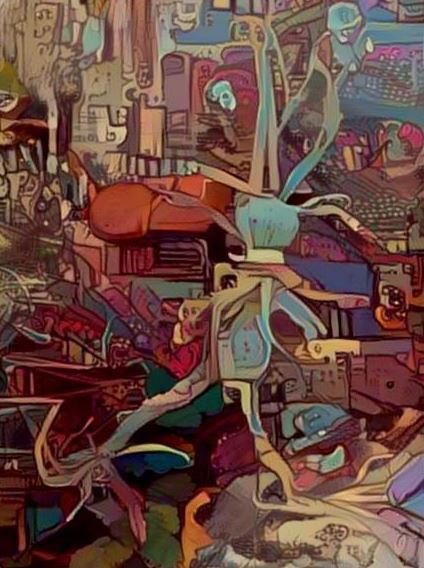
In the tarot system of divination, one of the major cards is the Fool, who dances on the edge of a cliff, seemingly unaware of the danger, but perhaps aware and dancing anyway, because one must live joyfully no matter the circumstances. Perhaps because of the dire nature of circumstances, the Fool must dance. Since I began to play with the idea of the Fool as one of my guiding concepts for 2020, the Fool has begun to appear everywhere, in books and images and references. Two days ago, I made that little corn dolly Fool and took some photos of her in various places. Yesterday, I did a little digital twisting of some of those photos, and came up with the one attached to this post. See how she dances at the edge of that cliff, even setting her foot into air as though she is about to trust the wind to hold her?

And here’s the strange thing about following the intuitional, poetic, pathways. Sometimes (and maybe often) delightful coincidences/synchronicities (call them what you will) occur. In the first Word Search I did, the words I saw first were: Health, Gratitude, Wade. Wade? Not particularly inspirational. Not like the others at all, haha. The maker of the puzzle clearly didn’t intend it. Of all the possibilities, wouldn’t you know it, I would find the odd one out. The second puzzle, remember, was a different puzzle. I looked closely at it afterward, and the words were definitely different, in different places. My words in the second? Dance, Friendship, and. . .Wade. Yes.

My logic-brain is rolling its eyes and chuckling. But that laughter is a doorway to the deep-self fool, who loves sense that doesn’t make sense, who molds coincidence into meaning. As quick as my logic-brain was working to shrug it off, that deep-self elf had already begun to weave the patterns of a new idea. So I’m wading in the coming year. Does that mean that things will be a slog? Or maybe I have finished swimming in waters above my head and I might now be free to wade instead. I’m heading toward the second. And, because my being human means that I am a meaning-maker, I will build the meaning into my narrative for the coming year.


Dreamwork:
Last night wasn’t particularly dreamy, but I did wake up with a sense of a dream in my head. I don’t remember all of the context or even the images. But I do remember the terrible sense of urgency to get a book ready to send to a publisher. Oooof. I don’t really want urgency in my collecting basket at the moment, and I’ve been wanting to put some poems or reflections or stories together into a book, but I’m not sure I want to marry that to greater urgency. There is a deadline coming up at the end of the month for a chapbook contest for Paraclete Press. Perhaps I’ll begin with that.


Gratitude List:
1. These long slow mornings I have had for writing and contemplating and meditating. I’m beginning to feel an edge of panic that I’ll be losing the gift of morning in just a few days, but I want to focus on being grateful for the days I have had to re-develop the habit of long morning writing sessions. My blog posts will soon be getting much shorter and quicker.
2. Still two days of break. Time to get more work done, and time to spend with my family and the cats.
3. Playing games. The boys got some new games for Christmas. Can’t Catch Harry is sort of like spoons, and Ravine and Spaceteam are collaborative problem-solving games.
4. Deep, sound sleep.
5. How the logic-brain and the deep-self work together to create meaning.

May we walk in Beauty!

DIY Mythmaking and a New Poetic Form

I’ve been thinking about my poetic process, looking through some of the neglected poems that I want to figure out how to publish, and realizing that quite a number of my poems are myth-making poems. I use poetry as a DIY Mything process, taking my own experiences and observations and transmuting them into myths. This thought is tangling with the threads of my current morning writing project of working with the Inanna story. Storytelling, writing, speaking–this whole language gig–is all about how we make meaning in the world. Art, too, as a communicative process, is about charging existence with meaning.


Gratitude List:
1. Meaning-making, DIY Myth-making, poetry, art, communication
2. Participating in a Literary Festival, listening, learning, absorbing
3. Good writing
4. How the sun shines in
5. Oak trees

May we walk in Beauty!


I’ve been thinking again about the process of poetry. In my AP Literature class recently, I have had the students choose a poetic form, no matter how lofty and traditional or edgy and nonsensical, to teach to the class. We’ve had some delightful lessons this week, learning the Magic 9 and the Nonet and the Rondeau and the Fib, among others. Yesterday, we found ourselves with a little extra time after the presentations, and we were ready to do our own thing, so we spent half the period creating our own poetic form! We developed our own rules for our own Lit Poetic Form. The process was delicious and intensely collaborative. At the end, we came up with this:

Lit Poem
Two stanzas of seven lines each.
It’s a word-count poem, with the following pattern:
Stanza 1: 1, 3, 5, 7, 5, 3, 1 (It makes a diamond shape)
Stanza 2: 7, 5, 3, 1, 3, 5, 7 (This one makes an hourglass form)
When you put them together, they look somewhat like a lit candle. (Get it?)
The rhyme scheme goes like this:
Stanza 1: abcxcba (in which x is random and unrhymed)
Stanza 2: cbaxabc (in which x is also random, and not necessarily rhymed with the first x)

This is how we make meaning. We spent twenty minutes collaboratively creating a world, complete with its order and purpose. Now we have to write the poems to prove its viability.

Voices Made of Fire

If you could trust your voice completely,
if you didn’t have to consider how how others would respond,
if you didn’t have to be safe, to be tame, to be docile and
humble, acceptable and charming and quiet,
if you had not been trained to make your words
into an easy chair, to turn your voice to honey:
What would you say?