This is the post (3/3) that I wrote for my rosary group this morning:
Crown of Thorns Novena Day 37 , Friday, 30 January 2026 Joyful Mysteries: You Are Shameless!
Today, we walk through the Garden of Yes, to the House of my Beloved, to the Village of Birth, to the Blessing of the Elders, to the Finding of Myself in the Temple.
It is possible I have written of this here before. Several years ago, I wrote a poem about my grandfathers, the ways in which the patriarchy of my Mennonite ancestors affected the women. I can no longer find the poem, but I remember part of the end of it:
Oh, Shameless! To be without shame. Could you know, Sister-Ancestors, that they blessed in their cursing. We’ll find our own valley, called Shameless. Called Brazen. Oh, carry that name. I’ll wear it, too.
In many religious traditions, and particularly in some streams of the Mennonite tradition of my own ancestors, it was considered shameful just to be a woman, especially if you did not redeem your femaleness by being feminine, by keeping immaculate house, by serving, by listening instead of talking, but submitting to the will of God (which meant the will of the men in your family and church). Women have borne the burden of keeping the family’s honor, of doing the emotional labor, of passing on the culture. If she stepped out of line, she was labeled shameless.
My own parents did everything they could, fiercely and with great intention, to break those assumptions about gender and to give their children a different pathway to follow. And in many ways we did, and in other ways, we—like our peers—absorbed many of the messages that church and culture told us about women and men and about staying within the lines, about behaving ourselves, about not being shameful. And I, who am so many things that are not that womanly ideal, could never measure up.
No matter your gender, can you hear those elders and gatekeepers of the past scolding you for not being all you were told you should be? “Shameless! Have you no shame?”
Why, no. Thank you very much. No, actually, here on this pathway of the Joyful Mysteries today, no, I have no shame. I am shameless.
Practice: Settle. Breathe. Rest in the Mother’s Arms. It helps if you can look in a mirror while you do this. Take the curse and twist it into a blessing, for blessing it is. Say it: “I am shameless.” “I have no shame.” Say it again. Again. Grin at yourself. You ARE shameless, you know. So worthy. So Beloved.
This is the post I wrote for my rosary group today, part 2 of 3:
Crown of Thorns Novena Day 36 , Thursday, 29 January 2026 Glorious Mysteries: Walking the Pathway of the Resurrection
On this pathway, we walk through the Garden of Resurrection, the Ascension (Enlightenment), the Coming of the Spirit, the Mother’s Assumption (Dormition), and the Coronation of the Queen of Heaven.
I love the word Somatic. It basically just means “of or relating to the body.” I extend it to mean embodiment. My heart’s desire prayers in recent novenas has been focused on embodiment issues, exploring how I live my feelings in my body, how I move and inhabit my body as I age into this next stage of menopause, how I build my strength, how I experience the world through my senses, how I learn to love and really treasure this body I am in. I am almost 60, about to start my Third Act, and I want to cooperate with and listen to my body as I step onto this stage. I want to keep her healthy as long as I can, and to (as Mary Oliver puts it), “Let the soft animal of my body love what it loves.”
Speaking of stages, I haven’t actually been on dramatic stages much at all since I was the rose seller in Oliver, and sister Berthe in The Sound of Music at Lancaster, PA’s Fulton Theater in my early twenties. But I remember some of the things that bloomed in me when we did warm-up exercises in theater classes. Walk like a giant. Walk like a cow. Walk like a toddler discovering the world. And suddenly, as I walked like a giant, in my five-foot human body, I was a giant, then a cow, then a toddler. For today’s “lesson,” we walk like someone completely unashamed.
After yesterday’s discussion of Shame in the Sorrowful Mysteries, I wonder if we could resurrect some of the certainty and belonging and confidence and courage that inhabits a body unencumbered by shame, simply by walking or standing (or sitting or lying) as someone without shame. What does it feel like in your body to stand without shame? To walk with confidence? To hold your head and shoulders as if what you are saying deserves to be heard?
Sometimes it helps to have an image to work with. I picture Eleanor Roosevelt’s calmly confident face, Harriet Tubman’s fierce belonging, Greta Thunberg’s truth-telling. I picture the Sun card from one of my tarot decks: a person standing, feet shoulder width apart, face and heart lifted to the sun, arms out to the sides in a receiving gesture.
Practice: Try this Somatic/Embodiment Exercise.
Stand with your feet shoulder width apart. (Or, if standing is not an option, you can do this to the best of your ability from a sitting or lying position. It’s about what you feel in your body, after all.) Settle. Breathe. Rest in the Mother’s Arms. Breathing, straighten your spine. Roll or shake your shoulders and let them drop slightly. Breathing, feel your feet on the earth (or the floor or the bed). Send roots down into the earth. Breathing, tilt your face toward the sun (even if it is a cloudy day and you have no windows). Breathing, lift your heart toward the sun. Breathing, open your arms wide, receiving the sun into your body. Feel comfort and courage and confidence fill you. Let belongingness fill you.
Breathe it in.
If you feel any of those shame-messages whispering in your head, turn each one into a raindrop, and let it drip from your fingers into the earth. How does confidence and courage and shamelessness feel within your body? What color is it? Does it have a shape or temperature? A voice? A name? Where in your body do you feel it most strongly? Now move—walk or shrug or dance or just feel it in your face—with shameless ease. You are worthy. You deserve to be here, to take up space, to speak your mind.
I know this now: It was a dangerous choice to go there in the first place. I was in danger of losing so much, constricting myself into the tiny little boxes required of those who existed in that place.
I went in with my eyes open, knowing of the claustrophobic boxes, how the language pulled toward dogma and creed. I went in with my own language, my own protective wards, kept secret in my pockets. I went, tethered to those who stood outside, who could watch for me, who could pull me back if I got stuck in the tiny places, injured by the sharp corners, the barbed words, and the lack of fresh air to breathe.
I can view my time in that place as a setback, a wrong choice, a misstep. Or I can look at how it changed me and transformed me, how it prepared me for this moment, gave me courage, made me fierce. Although it left me with wounds, it did not take my essential Self from me: I am always new, always a dragon shedding her skin to become fresh and reborn again, but always the same essential me, growing and changing and developing.
I don’t want to give those eight years power by saying I should not have taken that journey, that the breach of Self was too destructive. Because although my ego took its hits, I didn’t lose my Self. And there were gifts in this journey too. The young people who were there with me taught me so much, so much that I bring with me now that I’m out in the outer world again. Those eight years were a necessary phase of my development. They changed me forever in good and powerful ways. They too were initiation, difficult initiation. Not a break in my line of learning, not a backward step–or if a backwards step, only part of the dance.
Anytime we willingly submit to the claustrophobia of a religious institution, we put ourselves in danger of either taking on the rules for ourselves, or of losing some essential confidence and courage and forcefulness as we make ourselves smaller in order to fit inside the boxes. Me, I’m so grateful now for the ones who tethered me while I was in the land of boxes, those who held the lamps for me to see my way out when I reached the point of banishment.
I called myself an exile when I left that place. As though it had ever been my true home. I can laugh now looking back, and see how even though the lines that draw my past (for a couple generations) ran straight through that place, it was never my home. I have always been my home.
And I look back today with gratitude for the expansiveness of the escape, for the fact that I can breathe, and run and explore, and call myself by my real name, and not have to look over my shoulder.
So many sacred journeys happen in three days. My sojourn was eight years. And now three years more have passed and finally I feel the new wings stretching out behind me. I am ready to fly again. Blessed be!
I’ve had quite a few ideas about how I wanted to organize this year’s November Poem-a-Day. Try on a different persona every day? Do a month’s worth of epigraph poems? Do two days on each of the fifteen Mysteries of the Rosary? Write a daily ekphrastic poem based on drawing a tarot card? Do a month’s worth of found poems? Make each a magic spell?
Today I hadn’t yet settled on an organizing motif, and I’d sketched out the beginnings of several ideas for today’s poem, when I picked up The Best American Poetry 2000 (edited by Rita Dove) to read during Library Period while my students were independently reading.
One of the poets described how his poem in the anthology had taken him three years to write. Three years!?! How does a poet sustain the energy and attention for a single poem over three years? My own process has become very tied to my poem-a-day cycles in April and November, a discipline that tends to place practice over craft, a way to ensure that even when I go through dry times, I’ll always come back to a writing practice twice a year.
Even as I wrote that last sentence, I began to quibble with myself, because the practice, messy as it is, has definitely honed and sharpened my craft, and I always come back, select the best of the month’s harvest, and subject them to more careful crafting. I’m not just a word-vomit poet. I take crafting seriously.
But this poet who took three years to craft a poem! Perhaps it’s my own squirrelly attention span, or the mediocrity of my poetic sensibility, but I have never been able to imagine the process when poets talk about lengthy poem-crafting, the aching strain of shaping an idea over such a span of time. What was the poem doing in those years? Was it like a painting waiting for the artist to dab a few dabs of paint a day? Or half-abandoned like one of my knitting projects that gets stuck in the bottom of a basket for months before I remember to work on it again? Was it working on the poet’s psyche every day?
Perhaps the poem that rushed from me as I considered this poet and his process, and my own slap dash throw-it-on-the-page method of writing, made me a little defensive. I don’t really intend the tone to be snarky–toward him or myself. I was invigorated by the rush of ideas, the whoosh and whisper as the words winged in.
Perhaps this is one I will return to more deliberately, to craft into a gem. It will not take me three years, and yet, despite that essential lie, I feel like I’ve found some gold inside today’s idea.
Three Years by Beth Weaver-Kreider
This poem has taken me three years to write. First, it was a simple spot of blood, blooming crimson on the white petal of the page, glowing slightly, touched with were-light. It hovered in that state for months, in stasis while I hammered out the form, the quiet exhalations of its line breaks, the humming tension of occasional enjambment heightening the tautness of the structure, driving the metrical processional to the first stanza’s end. That was the first year.
In the second year, I crawled about, blindly, in the dusty rooms of the poem, gathering shadows like cobwebs stuck to my knees, my hair, my teeth. Here and there I tugged transitions into place, opened blinds to let light in, took myself in hand and faced the demon labyrinth of the second stanza with every scrap of strength my soul could muster. Perhaps you can sense, Sensitive Reader, the longing that fed me forward to the exhausting conclusion of the second year?
The third year was filled with howling and wrangling, attempting to tame the wild creature of the poem without breaking its will, feeding it symbols and reasons, assonance, consonance, rhythms and patterns to live for, then recanting the dominion within me that sought to subject it, to coax and corral it under my will. I gave it some rein for its wildness, then set it free. And just today I heard it nickering on the hill behind the orchard, its gentle form slipping through the mists to return to me complete.
Gratitude List: 1. Writing Practice 2. Writing Craft 3. How golden sunlight fills the bowl of woods, of hollow. 4. Weekend 5. No matter what happens, people will continue to work for good. May we walk in Beauty!
“I am passionate about everything in my life, first and foremost, passionate about ideas. And that’s a dangerous person to be in this society, not just because I’m a woman, but because it’s such a fundamentally anti-intellectual, anti-critical thinking society.” —bell hooks
“Bless the light and the darkness, the love and the fear.” —Rabbi Olivier BenHaim
“It doesn’t matter who you are or what you look like, so long as somebody loves you.” —Roald Dahl, The Witches
“For women who are tied to the moon, love alone is not enough. We insist each day wrap its knuckles through our heart strings and pull. The lows, the joy, the poetry. We dance at the edge of a cliff. You have fallen off. So it goes. You will climb up again.” —Anais Nin
“The creation of a thousand forests is in one acorn.” —Ralph Waldo Emerson
“In the morning I went out to pick dandelions and was drawn to the Echinacea patch where I found a honeybee clinging to one of the pink flowers. She seemed in distress, confused and weak. She kept falling off the flower and then catching herself in midair and flying dizzily back. She kept trying to get back to work, to collect her pollen and nectar to take home to the hive to make honey but she was getting weaker and weaker and then she fell into my hand. I knew she would never make it back to her hive. For the next half hour she rested in my palm, her life slowly ebbing away as a thunderstorm started to brew. I sat on the earth waiting for death with her. The lightning flashed over the mountains, a family of turkeys slowly walked the ridge, a wild dog keyed into what was happening circled past us. The trees appeared startlingly vivid and conscious as the wind blew up and the thunder cracked and then her death was finished. She was gone forever. But in her going she taught me to take every moment as my last flower, do what I could and make something sweet of it.” —Layne Redmond
“Let me seek, then, the gift of silence, and poverty, and solitude, where everything I touch is turned into prayer: where the sky is my prayer, the birds are my prayer, the wind in the trees is my prayer, for God is all in all.” —Thomas Merton
“Beware; for I am fearless, and therefore powerful.” —Mary Wollstonecraft Shelley, author of Frankenstein
Audre Lorde: “For women, then, poetry is not a luxury. It is a vital necessity of our existence. It forms the quality of the light within which we predicate our hopes and dreams toward survival and change, first made into language, then into idea, then into more tangible action. . Poetry is the way we help give name to the nameless so it can be thought. The farthest external horizons of our hopes and fears are cobbled by our poems, carved from the rock experiences of our daily lives. . As they become known and accepted to ourselves, our feelings, and the honest exploration of them, become sanctuaries and fortresses and spawning grounds for the most radical and daring of ideas, the house of difference so necessary to change and the conceptualization of any meaningful action. Right now, I could name at least ten ideas I would have once found intolerable or incomprehensible and frightening, except as they came after dreams and poems. This is not idle fantasy, but the true meaning of “it feels right to me.” We can train ourselves to respect our feelings, and to discipline (transpose) them into a language that matches those feelings so they can be shared. And where that language does not yet exist, it is our poetry which helps to fashion it. Poetry is not only dream or vision, it is the skeleton architecture of our lives.”
“Wake at dawn with a winged heart and give thanks for another day of loving.” —Khalil Gibran
Marge Piercy: Forgive the dead year. Forgive yourself. What will be wants to push through your fingers. The light you seek hides in your belly. The light you crave longs to stream from your eyes. You are the moon that will wax in new goodness.
“Surrender is not passively resigning yourself to something. . .it is a conscious embracing of what is.” —Cynthia Bourgeault
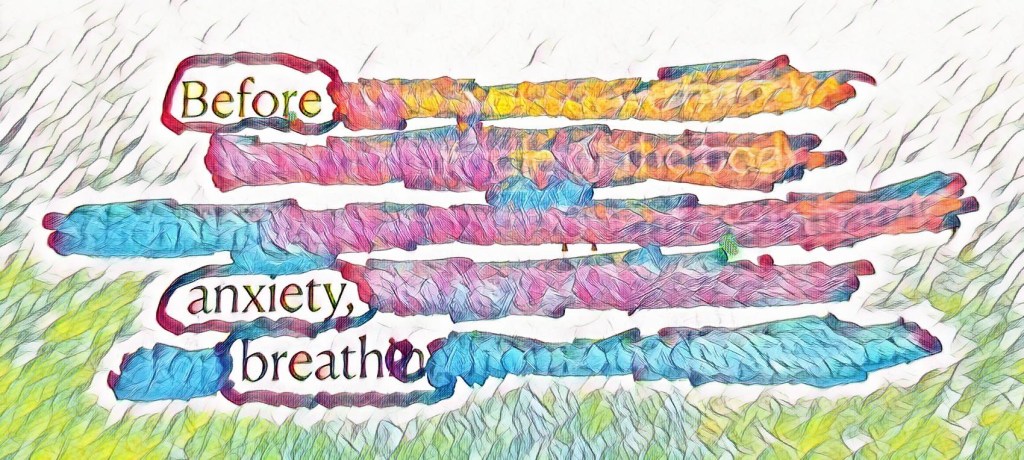
“Before anxiety, breathe.” Found redacted poem (that’s a prompt for another day) by one of my ninth graders. I ran it through a filter for some color.I love how she got to that last word and decided she needed to manipulate the word to suit her purposes.
Here’s a little refresh for the page: Poetry Prompts!
A few days ago, I re-tolled a fun prompt I sometimes use to get myself out of a rut, using predictive text to break me out of my overused words and rhythms. Wordplay and found poetry help me to find new ways to breathe into a poem, and sometimes offer profoundly new ways of expression. “Let go of the reins of the horse of your brain, and let it wander where it wants to for a while,” I sometimes tell my students. I find that the beautiful balance of letting go, and being ready to step in and actively create (as my student did in the image above) not only informs my poetic process, but my living as well.
So here are some initial ideas for using predictive text to restart your poetic mojo. If you don’t think of yourself as a poet (I disagree, btw–if you put words together in your own way, you are a poet), you can use these exercises to play and explore language. I’ll call the prompts Games, just to make it clear that we’re starting playing here.
One note before we begin: Each Game has rules. Try to follow them, to give the game a little structure and challenge. But be ready to break them if the Poem Gnome taps you on the shoulder and suggests you try something different.
Game 1: You’re going to write a six- or eight-line poem. You are in charge of the word or short phrase that begins each line. Then let predictive text finish the lines for you. Here’s an example, with my words in bold. Of course, I have stolen the words for this one, for the sake of play: Roses are the only thing I need. Violets are the only thing I have. Sugar and honey roasted figs with you And now I’m waiting for the bus. So are you. So it will be.
Game 2: Let’s try the same thing, only alternating words with the predictive text. I find this one creates more tension as I try to direct the predictive text. I actually fought it a little and changed the predictive text generator’s (PTG’s) “look” to “looked.” And I actually let the PTG suggest “whenever” instead of the “when” I was considering. Wafting to the bottom of Pandora’s pool, my little feather was almost ready for you. Dreams of her own box of possibilities flew out of the grove in the rain, and now she has forgotten about her last lover, how the clouds looked whenever he was leaving.
NOTES: 1. You might notice, like I do, that you find yourself backtracking and choosing different words in order to force the PTG to offer you better choices. Feels like chess with the computer. 2. Maybe what you came up with, like mine, is laughable trash. But maybe it gives you an idea for something to do next with your own line breaks and cadences. Steal that and run with it! 3. Likely the poem itself it not a publishable gem. But perhaps there’s a line in there that sings? Take it an spin it into another poem of your own! 4. I love that the PTG gave me “Pandora’s,” but I didn’t want to let it force me into using “box.” But my work in the poem quickly became about telling Pandora’s story. I think I should change the “my” to “her.”
Gratitude List: 1. The wild creatures of Goldfinch Farm. 2. Although there is a lot to accomplish in my summer days, I like how I can choose and plot the course with my own intentions. 3. This lavender-filled collar that I put in the freezer and then wear about my neck when the heat feels overwhelming. 4. These teenagers. I love their company, quiet and reserved as it is. Comfortably being together in the house. 5. The creative urge. Making stuff. May we walk in Beauty!
I woke up at 5:30 this morning, as I tend to, but then I was able to fall right back to sleep. In the hour and a half that followed I had this dream.
In the dream, I am writing a short story:
Once there was a girl who wanted her writing to be real and alive with emotional impact. So every day before she sat down to write, she would stand at her open window and simply let herself feel. As she let the feelings wash through her, she would weep, great tears falling like rain from her window onto the plants below. Then she would turn from the window, sit down at her table, and write.
One day as she was looking from her window, she noticed that leaves and vines were growing in wild riot below her window. As her feelings began to rise and flow through her, and the tears began to fall, she noticed that where each tear fell, a small plant would begin to grow, whether it fell on brick or wood or other plants. At the point of each tear’s impact, a leaf or sprout would emerge and start to grow.
Her feelings enriched her stories, and they also greened and grew the world around her.
In the dream, I become the girl who is writing. I am trying to help my friends solve a problem, but for each thing I offer to do, they see another problem on the other side. I retreat into myself, and start to wear my hair down over my face like a veil. I stand in corners and alcoves so I can watch people without being seen.
I am burdened with the weight of emotion and pain that has no solution.
It was sort of a relief to wake up and put down the weight of feelings! But although the dream is heavy, and the ending is isolating, I am grateful for the essential message, that feelings have a green and growing reality in the world outside ourselves.
Now I am sitting at my own writing table, looking out to the snowy hill behind the house, and the red-gold glow of the sun is illuminating the trees in the woods, first the tops of the trunks further up the hill, and now the little oak at the edge of the wood is glowing, too. (And then, in a moment, the clouds must have come over the sun, and the wood has gone wintry grey.)
Gratitude List: 1. The way the morning sun sets the woods to glowing. 2. Feelings, even when they are big, especially when they are big. 3. Long sleep and dreams rich with messages. 4. Something got into my kids yesterday. Kid #2 is always re-arranging his room, but yesterday he went big and tried a wildly creative (and mostly successful) configuration. Suddenly Kid #1 was re-arranging his monster computer set-up. I think he may have stayed up most of the night, but this morning, it looks mostly tidy and organized in a way it has never been. Settling into spaces. 5. Yesterday’s crockpot stew–comfort food on a cold wintry day. May we walk in Wisdom!
“Today I am grateful for truth, for narratives that center stories of people who have been cut from the narratives told by the powerful to skew the truth to their own agenda. I am grateful for the weavers and menders and spinners who pick up the torn and tangled threads and get to work to repair the tapestry of our story, holding the lie-mongers to account, and weaving in the threads of truth.” —Mockingbird
“A man is either free, or he is not. There cannot be an apprenticeship for freedom.” —Amiri Baraka
“Beloved community is formed not by the eradication of difference but by its affirmation, by each of us claiming the identities and cultural legacies that shape who we are and how we live in the world.” ―bell hooks, killing rage: Ending Racism
“Consider whether great changes have not happened deep inside your being in times when you were sad. The only sadnesses that are unhealthy and dangerous are those we carry around in public in order to drown them out. Like illnesses that are treated superficially, they only recede for a while and then break out more severely. Untreated they gather strength inside us and become the rejected, lost, and unlived life that we may die of. If only we could see a little farther than our knowledge reaches and a little beyond the borders of our intuition, we might perhaps bear our sorrows more trustingly than we do our joys. For they are the moments when something new enters us, something unknown. Our feelings grow mute in shy embarrassment, they take a step back, a stillness arises, and the new thing, which no one knows, stands in the midst of it all and says nothing.” —Rainer Maria Rilke
“After silence, that which comes nearest to expressing the inexpressible, is music.” —Aldous Huxley
“Listen to the mustn’ts, child. Listen to the don’ts. Listen to the shouldn’ts, the impossibles, the won’ts. Listen to the never haves, then listen close to me… Anything can happen, child. Anything can be.” —Shel Silverstein
On this day when everyone’s attempting to solve and re-solve their solutions, to resolve their resolutions, to tend to their intentions, I’m still waiting on a word. I watch my dreams and inner questions until the shining sixth, Epiphany, until the kings come. Wise ones. Mages. The light pours in on Epiphany and wisdom comes to the house.
It doesn’t really matter which day you embark on the journey. It only matters that you take it. Today we stand with Janus in his doorway, looking back and looking forward. With the double-faced god beside us, we can simultaneously look behind to the road that has brought us here, and ahead to the road we’re soon to take.
How could I live the coming year without that knowledge of the shadow that travels behind me, the road I walked to get here, the person I have been? It’s so easy, when we turn over a new leaf marking a new season in our lives, to simply yank the leaf from its twig, but the what-will-be is built upon the what-was. The new self which is emerging only arrived at this doorway on the persistent legs of the self which brought me here.
Whether you are waiting, like me, for Wisdom to come on Epiphany, or whether you step away from the door this morning to begin the journey of the year, this is the season of the set intention, the forward-moving affirmation. This is the time of the tabula rasa, the blank page upon which you can write whatever you choose.
Do you have a resolution for the coming year? A re-solution, perhaps, to an old and persistent problem? Or perhaps you need this official moment to end a habit that has you in a rut? Or to begin a new one that will get you traveling a more liberating and exciting road than the one you’ve become accustomed to walking? Many people I know prefer to call it an intention rather than a resolution. Perhaps an unachieved intention sounds less like a broken promise than an unsolved resolution.
The road to February is littered with broken resolutions and lost intentions, with holy words discarded and new habits jettisoned as old habits creep from the undergrowth and reattach themselves. I don’t think this means we shouldn’t set intentions or resolutions. Perhaps we need to set the intention and then set a second intention: To tend the first. If I set the intention to get 7,000 steps a day, and I succeed for a week or two, but then fall away, I will have had a less sedentary week or two. That’s a good thing. The idea, then, is to come back to it. Perhaps 7,000 is too much to ask, amid all the other things I need to accomplish. So maybe I re-set my intention and say 5,000 steps a day during the weekday, and 7,000 on weekends. And I try again, with fresh will and determination. After all, February first is another new beginning.
And I think we need to take great care in the intentions we set. If I decide that I don’t like the way I look these days, so I am going to whip my body into shape by diet and exercise, that’s a punishing resolution. My body is going to rebel, and the deep-self is going to feel attacked. But the fact is that for my whole life, I have needed to keep re-setting the intention to move more, and to maintain a healthier balance of the foods I eat. I don’t believe in self-denial. I will never entirely give up chocolate or ice cream or cookies, because then I am bound for failure. But I can probably re-set some of my boundaries with the sweet things. Slow down and savor.
Now there’s a good intention for experiencing life in 2020: Slow down and savor.
In the coming year, may you be kind to yourself. May you set reasonable goals that help you meet with success and fulfillment. May you bring out the best you, informed by all the versions of yourself that you have been. May you not jettison old versions of yourself along the trail behind you, but transform yourself in ways that acknowledge all the work you’ve done to get here.
Blessing for the New Year by Beth Weaver-Kreider
May you be born fresh and shining into the new year and may the old you continue, too, a thread that ties you to past versions of your truest self, for we need to be constantly reborn while we hold a deep sense of the shape we create in the universe.
Gratitude List: 1. All the birdlife of yesterday! It felt like we were in a legend. Suddenly, after weeks of very little bird activity, there were birds everywhere: bluebirds on the wires, finches and sparrows at the feeders with juncoes and mourning doves catching the windfall below, woodpeckers rowing through the space between trees. On the road, flocks of little birds schooled from grove to grove of roadside trees. Vultures, and maybe an eagle, hung in the updrafts above the Susquehanna. And a kingfisher chattered on Fishing Creek. 2. A good, hard hike/climb on the Mason-Dixon Trail south of Long Level. The trail rises above the river on a steep rocky ridge climb, and you’re on a dragon’s back of up-jutting rocks for a quarter mile or more, the river flowing wide like a lake on your left, and Fishing Creek rushing rapidly down the steep ravine to your right. 3. The hike reminded me of the moment in Prince Caspian when the children and Trumpkin are walking along the gorge, trying to find their way, and Aslan appears to Lucy. She must make a choice to follow him rather than going the way the others are going. She knows what is right, and she must follow that way, even when the others mock her for seeing things they cannot see. Even though he doesn’t say it at that moment in that book, I still heard him say, “Courage, Dear Heart” as we picked our way along the stony pathway. I’ll take that with me into the New Year. 4. We meant to go to Infinito’s for their pizza bar for supper last night, but they had closed early for the holiday. Instead, we went next door to Asian Yummy, and it was beautiful as well as yummy. 5. Again, as I feel the sadness and loss of these long mornings for writing and thinking, I can only be grateful for the gift of them in this Time out of Time. While I have not made headway on any projects in particular, I have stretched my writing/thinking muscles on the blog, and it has been satisfying and fortifying.
May we walk in Beauty!
Last January, I had repeated visitations from kingfisher, in waking life, in dreams, in conversations, in books. I chose kingfisher as one of my symbols for the year. Yesterday, as we were finishing our hike, climbing down the ridge toward Fishing Creek, where it moves slowly in deep pools before rushing down the ravine, we heard a kingfisher chattering in the hollow, over and over again. When I got home, inspired by a friend who is writing Shadormas, I wrote this two-stanza shadorma (3/5/3/3/7/5):
Kingfisher, who visited me at the start of the year chattered farewell to the year this cold afternoon.
And vulture floated like eagle through currents o’er the ridge while last year’s waters flowed down the Susquehanna.
Dreamwork: I don’t have much to say about last night’s busy anxiety dreams. In the dream, there is some sort of educational conference going on. It is both at my school, and not at my school. I go into a room, meaning to climb the stairs and go up a few floors, but it’s kind of Escher-like in design. I climb a flight of stair, walk along a landing, and the next flight leads down again into the same room, though I don’t really remember stepping down. Someone tells me I need to find the secret door on the landing. After that it’s possible to find stairs that go up, but each leads to an identical room with the same weird stair situation.
At one point, my colleagues are walking through my bedroom, and I say, “It wouldn’t be so bad if I felt this tired at the end of the day, but I feel like this right after waking up!”
Another of my colleagues, who retired a few years ago, is there, and he has brought his pet echidna. It’s really quite curious and adorable. It keeps sort of morphing into a puppy.
Perhaps I do need to pay attention to the exhaustion bit in here, and the confusion of stairs.
I’ve been thinking about my poetic process, looking through some of the neglected poems that I want to figure out how to publish, and realizing that quite a number of my poems are myth-making poems. I use poetry as a DIY Mything process, taking my own experiences and observations and transmuting them into myths. This thought is tangling with the threads of my current morning writing project of working with the Inanna story. Storytelling, writing, speaking–this whole language gig–is all about how we make meaning in the world. Art, too, as a communicative process, is about charging existence with meaning.
Gratitude List: 1. Meaning-making, DIY Myth-making, poetry, art, communication 2. Participating in a Literary Festival, listening, learning, absorbing 3. Good writing 4. How the sun shines in 5. Oak trees
May we walk in Beauty!
I’ve been thinking again about the process of poetry. In my AP Literature class recently, I have had the students choose a poetic form, no matter how lofty and traditional or edgy and nonsensical, to teach to the class. We’ve had some delightful lessons this week, learning the Magic 9 and the Nonet and the Rondeau and the Fib, among others. Yesterday, we found ourselves with a little extra time after the presentations, and we were ready to do our own thing, so we spent half the period creating our own poetic form! We developed our own rules for our own Lit Poetic Form. The process was delicious and intensely collaborative. At the end, we came up with this:
Lit Poem Two stanzas of seven lines each. It’s a word-count poem, with the following pattern: Stanza 1: 1, 3, 5, 7, 5, 3, 1 (It makes a diamond shape) Stanza 2: 7, 5, 3, 1, 3, 5, 7 (This one makes an hourglass form) When you put them together, they look somewhat like a lit candle. (Get it?) The rhyme scheme goes like this: Stanza 1: abcxcba (in which x is random and unrhymed) Stanza 2: cbaxabc (in which x is also random, and not necessarily rhymed with the first x)
This is how we make meaning. We spent twenty minutes collaboratively creating a world, complete with its order and purpose. Now we have to write the poems to prove its viability.
Gratitude List: 1. I am sinking so deeply into the story of Inanna as I write these mornings. 2. How stories of descent help me to live into the growing darkness of the season 3. How a walk can bring clarity 4. Anticipation, though today and tomorrow will end it: I am going to the Literary Festival at Millersville tonight and tomorrow. With the intensity of excitement this has brought me, I wonder why I have not done more festivals and conferences and workshops for writers. 5. The trees are still orange and golden.
I went to bed really late again last night, after a couple hours of writing. I was frustrated. I had just realized that the sweet and tender scene I had just written would completely through off the truth of another piece of the story that I am deeply attached to, so I have to rewrite a few pages, and make sure that one character is kept in the dark about her mother’s true identity.
Consequently, my dreams were fragmented and illusory. I cannot remember them. Perhaps I just slept well because of the late hour. So I have no dream images to add to my storehouse of images for the year.
I did do some meditation work yesterday, drawing upon three sets of images that have been in my mind. Pairs of images seemed to play with and inform each other. From this dance of images came three principles I will consider for the coming year:
* In crunchy and conflictual situations, instead of squashing my own feelings and needs or avoiding the stress of conflict, I will strive to be generous with myself and others while setting strong boundaries.
* In response to my weariness and exhaustion about picking up the Impossible Tasks (the looming work that gets bigger the more it gets avoided), I will create gentle life-giving personal rituals that ease me through the challenges and mark the little accomplishments along the way.
* For the sake of balancing my mental health, I will do something that I deeply love, which at this moment is writing. Deep down, I still long for a Writer’s Life, but I have a family to support, so I cannot simply leave my wonderful job to write. But my wonderful job ceases to be wonderful when it feels like it keeps me from doing what I love. If I am to maintain balance, I must make time to write. And it can no longer just be practice and place-holding, but seriously crafted Storymaking.
Gratitude List: 1. Messages 2. Sunshine 3. Homemade bread and soup 4. Following the trail of bread crumbs in a story 5. Twinkling lights and twinkling eyes
May we walk in Beauty!
Words for the Fourth Day of Kwanzaa: Today’s Kwanzaa Word is one of my favorite Swahili words: Ujamaa. Cooperative economics. How can we create local systems that develop economic justice for all? How can we share our finances in ways that build up the community?
“Don’t let the tamed ones tell you how to live.” —Jonny Ox
“The best way for us to cultivate fearlessness in our daughters and other young women is by example. If they see their mothers and other women in their lives going forward despite fear, they’ll know it is possible.” —Gloria Steinem
Mark Twain: “I’ve been through some terrible things in my life, some of which actually happened.”
Frederick Buechner:
“Here is the world. Beautiful and terrible things will happen. Don’t be afraid.”
“A night finally came when I woke up sweaty and angry and afraid I’d never go back to sleep again. All those stories were rising up in my throat. Voices were echoing in my neck, laughter behind my ears, and I was terribly, terribly afraid that I was finally as crazy as my kind was supposed to be. But the desire to live was desperate in my belly, and the stories I had hidden all those years were the blood and bone of it. To get it down, to tell it again, to make something—by God, just once to be real in the world, without lies or evasions or sweet-talking nonsense. It was a rough beginning—my own shout of life against death, of shape and substance against silence and confusion. It was most of all my deepest, abiding desire to live fleshed and strengthened on the page, a way to tell the truth as a kind of magic not cheapened or distorted by a need to please any damn body at all. Without it, I cannot imagine my own life. Without it, I have no way to tell you who I am.” —Dorothy Allison, from “Deciding to Live”
Fyodor Dostoyevsky, The Brothers Karamazov:
“Love all of God’s creation, the whole and every grain of sand of it. Love every leaf, every ray of God’s light. Love the animals, love the plants, love everything. If you love everything, you will perceive the divine mystery in things. Once you perceive it, you will begin to comprehend it better every day. And you will come at last to love the whole world with an all-embracing love.”
Antonio Machado, Border of a Dream: Selected Poems:
“Traveler, there is no path.
The path is made by walking.
Traveller, the path is your tracks
And nothing more.
Traveller, there is no path
The path is made by walking.
By walking you make a path
And turning, you look back
At a way you will never tread again
Traveller, there is no road
Only wakes in the sea.”
Walt Whitman:
“Allons! whoever you are come travel with me!
Traveling with me you find what never tires.
The earth never tires,
The earth is rude, silent, incomprehensible at first, Nature is rude and incomprehensible at first,
Be not discouraged, keep on, there are divine things well envelop’d,
I swear to you there are divine things more beautiful than words can tell.
Allons! we must not stop here,
However sweet these laid-up stores, however convenient this dwelling we cannot remain here,
However shelter’d this port and however calm these waters we must not anchor here,
However welcome the hospitality that surrounds us we are permitted to receive it but a little while.”
“A voice is heard in Ramah, mourning and great weeping, Rachel weeping for her children and refusing to be comforted, because they are no more.” Jeremiah 31:15





 Mockingbird Chronicles