“It is our mind, and that alone, that chains us or sets us free.” —Dilgo Khyentse Rinpoche
That quote is one I have had tucked away in the unlikely event that I would end up in jail or in a hospital, or sheltering in place during a world pandemic. Hmmm. Well, here we are. I think quotes like this can be used inappropriately, to make people feel like they’re not working hard enough at the inner life if they’re feeling caught and trapped. On the other hand, I am finding it profoundly liberating to keep reminding myself that the claustrophobia and sense of entrapment in this experience is partly self-imposed, that I can be free, even in confined conditions. And to be honest, I am hardly confined, here on the farm. But that shows me even more deeply how the sense of being chained or free in a situation like this has more to do with my inner work than with my outer situation.
I’ve been posting twice on these April days of Poetry. Once in the morning for musings and quotes and gratitudes, and a second time in the afternoon, when I have written my poem for the day.
Gratitude List: 1. Though I miss Room 206, my current office/classroom is a pleasant, well-lit place. 2. My coworkers and students (present and virtual) are lovely people. 3. Such hope-filled Zooming with beloveds yesterday. 4. I’m wearing my bracelets today. I don’t usually wear them around the house, but I have missed having the clink and the flash of color. 5. In the midst of this terrible uncertainty, there is much to be certain of: love, spring, birdsong, laughter. When I sit on the recliner, I know that within ten minutes there will be a cat on my lap–that is a comforting certainty.
May we walk in Beauty! Take care of each other.
“Political language is designed to make lies sound truthful and murder respectable, and to give the appearance of solidity to pure wind.” —George Orwell
“We must live from the center.” —Bahauddin, father of Rumi
“Some days I am more wolf than woman and I am still learning how to stop apologising for my wild.” —Nikita Gill
“Whoever undertakes to set himself up as a judge of Truth and Knowledge is shipwrecked by the laughter of the gods.” —Albert Einstein
“Writer’s block results from too much head. Cut off your head. Pegasus, poetry, was born of Medusa when her head was cut off. You have to be reckless when writing. Be as crazy as your conscience allows.” —Joseph Campbell
“Ask yourself: Have you been kind today? Make kindness your daily modus operandi and change your world.” —Annie Lennox
Looking out the southern window of the living room just now, I was struck by the vertiginous sense that the world outside was twisting and shifting. It took me a moment to realize that it was the willow tree, beyond the black branches of sycamore and dogwood in my foreground, a yellow veil flowing back and forth in the dawn breezes.
Not everything that appears disconcerting and unsettling needs to be feared. That is not to say that fear and horror are not logical and acceptable responses to these altered days; but it is a reminder to myself (and you, if you want it) that the horror is not all-encompassing. Not everything should be interpreted through the lens of Pandemic. I need to keep reclaiming Wonder and Awe, grasping Calm and Centeredness, reaching out in Love and Openness.
Last evening, about twenty-five people/families from my congregation participated in a Zoom meeting, re-connecting, telling our stories, smiling and laughing together. And then in the night, I had my first teleconferencing dream. There was a screen with the whole Brady Bunch grid of a group meeting, and someone was saying, “Make sure they can tell that you love them through the screen.” That was it, but every time I woke up in the early morning, I saw that image, heard that voice.
Gratitude List: 1. Dream messages 2. Two weeks before the Exile, I went to Goodwill near my school and pulled a bunch of big sweaters and shawls out of the by-the-pound bins. I brought them home and washed them, and felt a little odd for buying more sweaters just as spring was breaking. I have been incredibly grateful, in these anxious and chilly days, to have big sweaters to wrap around me. 3. Even a week of working from home needs a weekend (especially, actually). Tome to catch my breath. Friday’s here. 4. The aconite have gone to seed, after blooming early this year, but the green umbrellas remain, and I take the seed pods and sprinkle them across the bank out front. Last year, I sprinkled them under the sycamore, and this year we had yellow blossoms there. 5. Cress. Bitter cress and water cress, and actually all the spring greens. Yesterday I made a spring greens milky soup. It actually didn’t taste as good as I was longing for it to, but it tasted healthy, so there’s that. I felt fed and tended by the land. I trailed my fingers through the frigid water of the stream as I was picking water cress.
Take care of each other. Walk in Beauty!
“Sound or vibration is the most powerful force in the universe. Music is a divine art, to be used not only for pleasure but as a path to Awakening.” —Yogananda
“As above, so below, as within, so without, as the universe, so the soul.” —Hermes Trismegistus
“The greatest danger to our future is apathy.” —Jane Goodall
“Did I offer peace today? Did I bring a smile to someone’s face? Did I say words of healing? Did I let go of my anger and resentment? Did I forgive? Did I love? These are the real questions. I must trust that the little bit of love that I sow now will bear many fruits, here in this world and the life to come.” —Henri Nouwen
“In the end, we’ll all become stories.” —Margaret Atwood
“Privilege is when you think something’s not a problem because it’s not a problem to you personally.” —attributed to many authors
Dea Ex Machina by Beth Weaver-Kreider
What we speak we create. Writing, we make meaning into existence.
These words, cogs and gears, shift meaning to matter:
MESSAGES TO SELF: Breathe in. Breathe out. Breathe in sunshine. Breathe in the fluttering of bird wings in sunlight. Breathe out worry and anxiety and grief. Breathe in the solidity of trees. Breathe in the stalwart courage of oak and locust and sycamore. Breathe out worry and anxiety and grief. (They will still be there for you to examine and explore. For now, let them go.) Breathe in and raise your head. Drop your shoulders. Stand or sit up straighter. Breathe the worry and sadness out the soles of your feet, into Earth. She can hold them for you. Breathe in love and compassion. Breathe out gratitude. Breathe in. Breathe out.
Today at some point, put you bare feet on Earth. Put your fingertips in water. Place your hands oh so tenderly on the bark of a tree. And breathe.
Gratitude List: It feels like these lists are all beginning to repeat, as I sit at the same window every morning to write these lists, and my days look the same. 1. Bird life in the holler. One goldfinch is now fully suited up for summer. Phoebe is speaking its name into the cool morning. The sun turns that red cap on the downy woodpecker to fire. 2. The trees that surround me. 3. The waters that run through the hollow on their way to the River. 4. A lighter day today. The assignments are a little lighter today, and I am going to grade speeches. Enough. Enough. I have done enough. 5. Finding joys and wonders and delights to balance the sadness and anxiety.
Take Care of Yourself. Take Care of Each Other.
“What we seek, at the deepest level, is inwardly to resemble, rather than physically to possess, the objects and places that touch us through their beauty.” —Alain de Botton
“We are capable of suffering with our world, and that is the true meaning of compassion. It enables us to recognize our profound interconnectedness with all beings. Don’t ever apologize for crying for the trees burning in the Amazon or over the waters polluted from mines in the Rockies. Don’t apologize for the sorrow, grief, and rage you feel. It is a measure of your humanity and your maturity. It is a measure of your open heart, and as your heart breaks open there will be room for the world to heal.” —Joanna Macy
“We should have respect for animals because it makes better human beings of us all.” —Jane Goodall
“Let yourself be silently drawn by the strange pull of what you love. It will not lead you astray.” —Rumi
“If you hear the dogs, keep going. If you see the torches in the woods, keep going. If there’s shouting after you, keep going. Don’t ever stop. Keep going. If you want a taste of freedom, keep going.” —Harriet Tubman
“The little grassroots people can change this world.” —Wangari Maathai
“Some form of the prayer of quiet is necessary to touch me at the unconscious level, the level where deep and lasting transformation occurs. From my place of prayer, I am able to understand more clearly what is mine to do and have the courage to do it. Unitive consciousness—the awareness that we are all one in Love—lays a solid foundation for social critique and acts of justice.” —Richard Rohr
“You don’t have to attend every argument you’re invited to.” —Anonymous
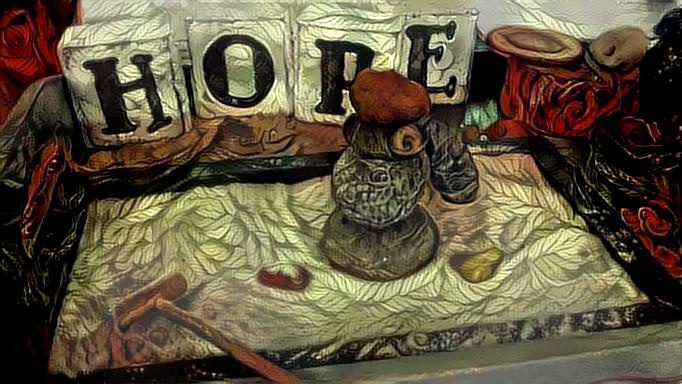
This is the little zen garden in my classroom. It was constantly changing throughout the day as different students would rake and arrange it. I miss those moments.
Since I have been working from home, I have noticed–along with the uncomfortable energies of anxiety and irritability and grieving–a positive energy shift. In normal life, I am often exhausted and worn down. I can’t sleep past 5:30. I get home, and all I want to do is sleep. I try to get to the big grading projects, and it’s like trying to walk through a wall inside my brain. I start to feel like I am a lazy procrastinator. The sense of inadequacy makes me feel more tired and run-down.
In the two and a half weeks since I’ve been working at home, I find that I have to remind myself to stop working. I have to make it a point to take breaks. I feel like I have the energy to work like I need to, to do ALL the grading.
As I have been pondering it, I realize that the energy shift has to do with introversion and extraversion, with being an ambivert–both intro and extra. I think that in many public spaces I present primarily as an extravert, and I love that part of myself. When I am teaching, the interaction with students, whether one-on-one or in a class setting, is one of my great joys. I love pushing myself outward, meeting the other, making connection. But the constant extraversion, and the need to be “on” all the time, takes a toll on my emotional energy. The introvert never gets fed.
Grading, while it’s a solitary sort of task, is (I think) an extension of the extraverted element of the working day. In normal life, I just hit a wall and can’t seem to get past it to push myself out there to do the next thing. My extravert side is exhausted and run-down, and my introvert can’t find the energy to get back into balance.
These days, the grading and the school communicating is pretty much all I have for that crucial connected part of my work-life. My introvert is being fed with lots of quietness and stillness, even in this crowded house. I pace myself. I have re-taught my body to sleep until 6:30. The grading and the school communications give my life purpose and structure. The wall between me and the grading projects is gone. I just sit down and do the next thing. I actually feel (mostly) adequate to these particular tasks.
But I miss my students terribly. I can hardly bear that I might never see some of them again. I know that some of them are hurting and struggling, and I don’t know how to be Present through a computer. When this is over, I will happily go back to physical school. Despite what I am learning about myself and my energy, I don’t think I am meant to be a cyber-school teacher. I need faces and classrooms. While I think that my teaching can be perfectly adequate from home, there’s nothing like the magic of exploring ideas about literature and writing in a real-time class. And there are costs to this kind of work. I NEED to have a life outside of school, and now that school has invaded my home, there is almost nothing that is not school. I must set boundaries, and leave some work unfinished.
I think I will need to hold some of this sense of empowerment and adequacy that I am gaining in my introverted time when I return to extraverted life. Perhaps this current sense of being adequate to the grading tasks will stick to me a little more solidly and I will be able to manage my ambiverted self with a little more balance and grace.
Gratitude List: 1. National Poetry Month! Something to break up the steady monotony of constant school. Today’s prompt is to write a new world poem. 2. Chipping sparrows. They’re so sweet, sort of timid, smaller than the white throats, and they wear those rusty caps. When they come in to the bird feeder, they sometimes hover for a couple seconds before they alight. 3. The sound of a woodpecker rat-a-tatting in the walnut tree. 4. Vanilla in my coffee. I make coffee shakes in the mornings: hot coffee, a little butter a little coconut oil, half-and-half (if I have it), and a scoopful of vanilla protein powder. Blend and drink. 5. How the altered times are teaching me things about myself, things I knew in my head, but didn’t have the space within which to explore the deeper truths.
Take care of each other!
Words for the Day of the Holy Fool: “The fullness of joy is to behold God in everything.” —Julian of Norwich
“Loneliness does not come from having no people about one, but from being unable to communicate the things that seem important to oneself, or from holding certain views which others find inadmissible.” —Carl Jung
“The historical Jesus probably looked like an average Syrian refugee. You know…the ones we turn away.” —Rebecca James Hecking
“Poems are maps to the place where you already are.” —Jane Hirshfield
“Be still, and the world is bound to turn herself inside out to entertain you. Everywhere you look, joyful noise is clanging to drown out quiet desperation. The choice is to draw the blinds and shut it all out, or believe.” —Barbara Kingsolver, High Tide in Tucson
“When you do not know you need mercy and forgiveness yourself, you invariably become stingy in sharing it with others. So make sure you are always waiting with hands widely cupped under the waterfall of mercy.” —Richard Rohr
“All four gospels insist that when all the other disciples are fleeing, Mary Magdalene does not run. She stands firm. She does not betray or lie about her commitment to Jesus—she witnesses. Hers is clearly a demonstration of either the deepest human love or the highest spiritual understanding of what Jesus was teaching—perhaps both. But why—one wonders–do Holy Week liturgies tell and re-tell the story of Peter’s threefold denial of Jesus, while the steady and unwavering witness of Magdalene is passed over—not even noticed? How would our understanding of the paschal story change if instead of reflecting upon Jesus dying alone and rejected if we were to reinforce the fact that one person stood by him and did not leave? For this story of Mary Magdalene is as firmly stated in scripture as the denial story. How would this change the emotional timbre of the day? How would it affect our feeling of ourselves? How would it reflect upon how we have viewed, and still view, women in the church? About the nature of redemptive love?” —Cynthia Bourgeault, Episcopal Priest
“When I feel this fog rolling in on me, I light fires of affection in the hearts of others. I tell them in tangible ways how the life they live makes me live mine differently, how precious and important they are to the rest of us. That fire then becomes like a beacon which burns through the grey and which I can sail towards.” –Toko-pa Turner
It’s good to leave each day behind, like flowing water, free of sadness. Yesterday is gone and its tale told. Today new seeds are growing. —Rumi
Yesterday, in her online sermon, my pastor used the Psalm 23 text, and emphasized the sheltering aspects of the psalm. At one point, she was discussing the sheltering canopies of trees, and she intimately described this weeping beech tree who lives on the campus of the Jesuit Center in Wernersville, PA. We cannot travel there now to sit beneath her branches, but here is a photo. I will meditate within her shelter today, through the images I have of her, but I will also physically sit on my porch under the sheltering canopy of my sycamore friend.
Do you have a tree friend? If you can do so without breaking your rules of sheltering in place, why not find a tree today, someone whose bark you can feel beneath your hands, whose branches filter light and air above you, whose presence can hold you steady in these unsteady times.
Below is a paraphrase of Psalm 23 that another of our pastors read during our online service yesterday. I love it.
Psalm 23 Nan Merrill | March 2010 (Vol. XXIII, No. 3)
O my Beloved, you are my shepherd, I shall not want; You bring me to green pastures for rest and lead me beside still waters renewing my spirit, You restore my soul. You lead me in the path of goodness to follow Love’s way.
Even though I walk through the valley of the shadow and of death, I am not afraid; For You are ever with me; Your rod and Your staff, they guide me, they give me strength and comfort.
You prepare a table before me in the presence of all my fears; you bless me with oil, my cup overflows. Surely goodness and mercy will follow me all the days of my life; and I shall dwell in the heart of the Beloved forever.
~ from Psalms for Praying
Gratitude List: 1. The weeping beech at Wernersville. How she is present even at a distance. 2. The sycamore who holds our home in the hollow beneath her sheltering arms. 3. That little oak up the hill, who was a tiny sapling mere years ago, and now rises twenty or thirty feet at the top of the bluff. 4. Jacarandas and frangipanis, baobabs and acacias, the trees of my childhood. 5. The trees that you are. Together, we are a massive forest of shelter and presence. Thank you for your steady breathing, your strong presence.
Take care of each other.
“I do believe in an everyday sort of magic. . .the inexplicable connectedness we sometimes experience with places, people, works of art and the like; the eerie appropriateness of moments of synchronicity; the whispered voice, the hidden presence, when we think we’re alone.” —Charles de Lint
“My invitation to each of you—student, faculty, community member—is to find a story of someone who has made a change, small or large, whether the consequence was their life or their comfort, and I want you to share that story with at least one other person, something that inspires you to step beyond the boundaries of your courage into a new world beyond the measure you ever thought you could make.” —Kevin Ressler, in 2017 memorial for M. J. Sharp
“What you will see is love coming out of the trees, love coming out of the sky, love coming out of the light. You will perceive love from everything around you. This is the state of bliss.” ―Miguel Ruiz
“My darling girl, when are you going to realize that being normal is not necessarily a virtue? It rather denotes a lack of courage.” ―Alice Hoffman
“Sometimes I can feel my bones straining under the weight of all the lives I’m not living.” —Jonathan Safran Foer
I get to choose from three possible thumbnails. What it they’re ALL goofy?
Mary Oliver quotes the German poet Rainer Maria Rilke in her poem “Invitation.”
“You must change your life,” says Rilke.
And here is our invitation, in the middle of this muddle of Exile and Isolation and Distancing: Change Your Life. To a very large degree, it has been wrenched out of our own hands. My life has changed, whether I wanted it to or not. Out of my control.
So how can I take up this invitation, and take the pen in my own hands, the yarn, the paintbrush? How can I pick up the reins of my story and change my own life in this time?
In the two weeks since I have been home, I keep saying, every day, that I am going to get control of this wild horse of school work that will take up every inch of space in my day if I let it. And it’s been a comfort to know that I have something to do that is contributing, in some way, to the continuing work of the world in a time of shut-down. Still, I need to make my balance.
This is the first way that I will change my life. I will figure this out–that spaces between Work and Not-work.
How will you accept Rilke’s invitation?
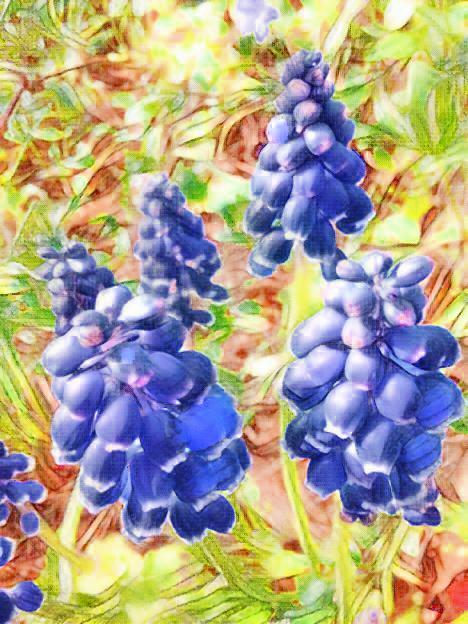
Gratitude List: 1. Mary Oliver and Rainer Maria Rilke and the invitation to change my life. 2. Fridays are catch-up days. In school, there are Study Halls, and classes are sometimes work periods. There are spaces in the days for catch-up. Somehow, at home, it all runs together, and students and teachers can get a little breathless. Many students are being called in to work extra hours at their essential jobs, and these jobs are helping to support families in a time of uncertainty. Others are struggling with the fear and anxiety and overwhelm of the new normal. So Fridays, while still school days, are days to take a little breath, to have meetings with non-class groups, to regroup in preparation for the coming week. Breathe in. Breathe out. 3. The phoebe perched on the birdfeeder station for a moment, then flitted off. 4. I’m going to bake rolls today. Grateful for yeast and flour and work that teaches me patience. 5. Wild purple hyacinths. We always called them bluebells, and that’s how I think of them.
Take care of each other!
“We get over things. It is the most amazing faculty that we possess. War or pestilence; drought or famine; fire or flood; it does not matter. However devastating the catastrophe, however frightful the slaughter, however total the eclipse, we surmount our sorrows and find ourselves still smiling when the storm is overpast. . . . Nature heals her wounds with loveliness. She gets over things.” —Frank W. Boreham
“I believe a huge part of our collective feeling of emptiness comes from living in this self-centred phase of our evolution as a species, where everything begins with I. I want this object, I want to succeed. I want to improve myself. Even: I want to belong.
But true happiness depends upon our reciprocity with the environment in which we are embedded, and unto which we are indebted. In the same way that mitochondria work to break down nutrients and turn it into energy for our bodies, we too are but a single component of a greater biosphere that sees no hierarchy between ferns and redwoods, worms and eagles.
If we imagine an invisible mycelial network under the visible surface of things, of which we are but fruiting bodies, then we see how our lives should be in service to feeding the whole forest together. Our negligence of that reciprocity is, more than any other factor, what fosters unbelonging.” —Toko-pa Turner
“We are here to awaken from the illusion of separateness.” —Thich Nhat Hanh
“We must learn to respond not to this or that syllable, but to the whole song.” —Thomas Merton
“For still there are so many things That I have never seen In every wood in every spring There is a different green” —J.R.R.Tolkien
“We’re all just walking each other home.” —Ram Das
“I am an instrument in the shape of a woman trying to translate pulsations into images for the relief of the body and the reconstruction of the mind.” —Adrienne Rich
Spring has returned. The Earth is like a child that knows poems. —Rainer Maria Rilke
When this is all over, I wonder how it will have affected my teaching? I try to create a student-centered classroom, and I think my normal (non-Exile) classroom is very student-focused, but I still found myself spending a lot of time as the sage on the stage. But now, in the past week and a half, I have probably erred on the side of not enough teaching, and more on project-style instruction. I am working toward finding a balance. I hope that as I travel this new pedagogical pathway I can integrate old and new aspects of my teaching self. Maybe, hopefully, I will come out of this a better teacher.
How are you faring in your new rhythms? Are you able to consider that the new ways of doing things in this time-out-of-time might actually improve your understanding of yourself? It’s okay if you feel like you are in a holding pattern, or like you’re losing ground. Or if you’re back and forth (truth be told, that’s a more accurate picture of my status–it’s just that morning brings a clarity that is not always completely present for me all day).
My heart is with you, who must still go out daily to do essential jobs for the good of the community. May your immune system be as strong as your good heart.
My heart is with you, who have been laid off, or who will be laid off. May you find a settled place within, to face the uncertainty of these days. May help come soon.
My heart is with you, who live alone in Exile. May you find alternate ways to do community, from a safe distance.
My heart is with you, who suddenly have two or more overwhelming jobs: working from home or out in the community, and still supervising your children’s schooling, or caring for the emotional needs of family members and beloveds. May you find rest and may you settle into the new rhythms with grace. You are doing enough. You are enough.
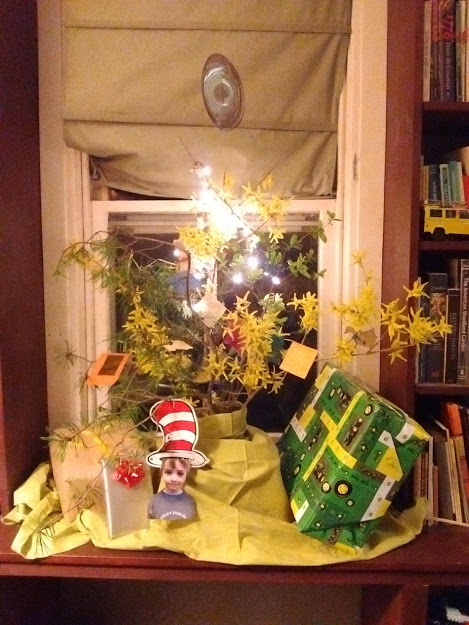
Gratitude List: 1. The birthday bush (I thought tree, but I have been corrected by the soon-to-be-birthday-boy) survived the night. Before we went to bed, I repeatedly reminded the cats that it was their responsibility to protect the tree from goblins in the night. They’re less likely to destroy something (like sleep or a birthday bush) if they have been charged with its protection. 2. I realized yesterday that I will likely be home this year when Oriole returns. My heart rises in anticipation. To sit on the porch all day and listen to him calling in his beloved is one of my great joys. 3. Yesterday, I managed to keep up with the minute-by-minute work as well as catch up significantly on pre-Friday-the-13th work. I am feeling more on top of things, school-wise, than I have felt since the beginning of the semester. Now if only I can try to end my school day at 5 today, then I will be golden. 4. The way humans rise to a crisis. And I know not all humans are rising. But the regular people, often those with the most to lose, have been settling in and creating community, reaching out, looking after each other. I really do love humans. 5. The bird feeders. If I go back to teaching in my physical school building this spring, I am going to have to figure out how to set up some bird feeders on the roof outside my windows. It brings me such great joy to watch the birds.
Take care of each other!
This morning my grandmother is teaching me that the easiest (and most elegant) way to defeat an army of hatred, is to sing it beautiful songs until it falls to its knees and surrenders.
It will do this, she says, because it has finally found a sweeter fire than revenge. It has found heaven. It has found HOZHO. —Lyla Johnston
“It’s dark because you are trying too hard. Lightly child, lightly. Learn to do everything lightly. Yes, feel lightly even though you’re feeling deeply. Just lightly let things happen and lightly cope with them. I was so preposterously serious in those days… Lightly, lightly – it’s the best advice ever given me…So throw away your baggage and go forward. There are quicksands all about you, sucking at your feet, trying to suck you down into fear and self-pity and despair. That’s why you must walk so lightly. Lightly my darling…” —Aldous Huxley
“We travel, some of us forever, to seek other states, other lives, other souls.” —Anaïs Nin
“What a miracle to be awake inside your breathing!” —Hildegard of Bingen
Definition of Weald: wild, forested lands, uncultivated regions
“Religion is at its best when it makes us ask hard questions of ourselves. It is at its worst when it deludes us into thinking we have all the answers for everybody else.” —Archibald Macleish
“This poem is not housebroken.” —Anne Haines
*I have already lost touch with a couple of people I used to be.” —Joan Didion
“Give yourself time to make a prayer that will become the prayer of your soul. Listen to the voices of longing in your soul. Listen to your hungers. Give attention to the unexpected that lives around the rim of your life. Listen to your memory and to the inrush of your future, to the voices of those near you and those you have lost. Out of all of that attention to your soul, make a prayer that is big enough for your wild soul, yet tender enough for your shy and awkward vulnerability; that has enough healing to gain the ointment of divine forgiveness for your wounds; enough truth and vigour to challenge your blindness and complacency; enough graciousness and vision to mirror your immortal beauty. Write a prayer that is worthy of the destiny to which you have been called.” —John O’Donohue
If you have never read Toko-pa Turner’s work, begin by buying her book Belonging. It will be a comforting and enlightening companion for your Exile.
My classroom has cats. I think Sachs would approve of the look this filter gave him.
Because this is how we live now.
Gratitude List: 1. Slowly, but surely, I am catching up on some of my pre-Friday-the-13th work. It has been really difficult to adjust schedules and plans to fit online learning. I’m beginning to carve out spaces for big grading in the midst of the daily tasks. 2. Maybe it’s the fat coffee (cream and butter, coconut oil and protein powder), or maybe it’s the new schedule, but I realized yesterday that I don’t feel run down and exhausted anymore. Even though I am working almost all the time, I feel charged and up to the tasks of my day. 3. From the Mixed-Up Files of Mrs. Basil E. Frankweiler. Josiah and I finished that one yesterday, and I love the reminder that the real adventure is the one that takes you inside yourself. That adventure is always available. 4. Goldfinches. They’re going to show up a lot on here because they’re my constant visual companions right now, and getting shinier by the day. I live on Goldfinch Farm, and we named it that for a reason, and in these challenging days, that reason has become one of my grounding delights. 5. Yesterday I saw the phoebe! Sitting on a branch above the bluff, dipping her tail. I have been hearing them, but there’s something about catching that glimpse. . .
Take care of each other!
“Let us keep courage and try to be patient and gentle. And let us not mind being eccentric, and make distinction between good and evil.” —Vincent van Gogh
“Age is foolish and forgetful when it underestimates youth.” —Albus Dumbledore
Love the earth and sun and the animals, despise riches, give alms to everyone that asks, stand up for the stupid and crazy, devote your income and labor to others, hate tyrants, argue not concerning God, have patience and indulgence toward the people, take off your hat to nothing known or unknown, or to any man or number of men, go freely with powerful uneducated persons, and with the young, and with the mothers or families, re-examine all you have been told in school or church or in any book, and dismiss whatever insults your own soul; and your very flesh shall be a great poem. —Walt Whitman, from the Preface to Leaves of Grass
THE OLD WISDOM
When the night wind makes the pine trees creak And the pale clouds glide across the dark sky, Go out my child, go out and seek Your soul: The Eternal I. For all the grasses rustling at your feet And every flaming star that glitters high Above you, close up and meet In you: The Eternal I. Yes, my child, go out into the world; walk slow And silent, comprehending all, and by and by Your soul, the Universe, will know Itself: the Eternal I. —Jane Goodall
“If you believe peace is the absence of war, you’ve missed the mark. There will never be full peace until we treat each other the way we want to be treated. Peace is allowing an individual or group of people to command their space in the way they know how without the violent intervention from another.” —Leymah Gbowee
I don’t usually do selfies on here, but purple hair is making me very happy today.
Last Thursday, I made a little PSA video for my students, to try to encourage them to stay home, to heed the cautions so they can be part of this great effort to Flatten the Curve. I told them that even if they feel invincible, they should be invincible at home.
Yesterday, I acted like I was invincible at home. I thought I would take a break from walking as my exercise, and do something for the good of the farm, so I went out with a big clipper and a string trimmer, and I attacked a bramble patch up on the top of the bluff. I felt a few twinges in my back, but did I stop? No! I was in-vinc-ible!
But evening, I was in pain. I couldn’t sit, couldn’t lie down, couldn’t walk. I usually try to avoid pain-killers for muscle-type pains because I think pain is a messenger, and if I don’t feel it, I might further damage whatever body part if aching. But I figured I wouldn’t do any damage in my sleep, so I took some ibuprofen, and after trying three different surfaces, I fell asleep on the futon–the fam opened that up for me.
So I am learning something about invincibility. The Old French vincere means “to overcome.” My lower back muscles were overcome, but my sense of sturdy physical dependability has been seriously overcome. I am not invincible, and I need to know my limits. When she leads us in morning yoga online, my friend Yasmin reminds us to find our edges, but not to go past them.
Living life in Exile is about finding our edges. Some edges have been imposed upon us, and bless you for keeping those edges–you are protecting the more vulnerable, and helping to ease the decisions that our health care workers are going to need to face in the coming weeks. But other edges exist for us to find: How much clearing of brush will damage a 52-year-old back. How much time we can spend in a house with small people needing our attention. How much binge-watching of The Office we can do before we start talking like Dwight Shrute. What is the edge of loneliness? What is the edge of anxiety about the future?
Some of my friends have been dealing with the edges in really creative ways. Loneliness and disappointment can’t, perhaps, be cured by walking in the park, keeping a safe distance from others, but it can be mitigated. Anxiety can be mitigated by yoga and meditation, by phoning a friend. The demands of children can be somewhat mitigated by a slight lessening of screen time rules in order to give oneself a break. A sense of inefficacy can be mitigated by reaching out to others through the available technology, by baking bread, by planting a garden.
After all, this whole Exile is about mitigation. Vocabulary.com says this about the word mitigate: “Choose the verb mitigate when something lessens the unpleasantness of a situation. . . . The somewhat formal verb mitigate comes from the Latin roots mitis ‘soft’ and agere ‘todo/act,’ which add to to ‘to soften.’ It is often used with words that indicate an outcome or something harmful.”
Let’s soften. Let’s act. Let’s not pretend we are invincible. This is a time to act upon our softness. Hang in there, Friends. There will be an ending. We just have to live through the middle first. Let’s find our edges–and accept them–and mitigate as much of the trouble as we can.
Gratitude List: 1. My back feels SO MUCH better this morning! 2. Exile is a good time to make the whole hairdo purple. I might never go back to non-purple hair. 3. All the people who are working in all the ways to mitigate the harmfulness of this pandemic. 4. The world of the woods and the hollow, the creek and the pond, the fields and the sky–all goes on out there as normal. The world turns to spring. 5. Yellow and gold. All those shades: goldfinches turning, Golda the gold-orange koifish, blooming forsythia so yellow they seem to be on fire.
Take care of each other!
Today’s Poem for the Exile
“To oppose something is to maintain it. They say here ‘all roads lead to Mishnory.’ To be sure, if you turn your back on Mishnory and walk away from it, you are still on the Mishnory road. To oppose vulgarity is inevitably to be vulgar. You must go somewhere else; you must have another goal; then you walk a different road.” —Estraven, in The Left Hand of Darkness, Ursula K Le Guin
“The Messenger of Allah [Muhammed], peace and blessings be upon him, said, ‘The parable of the believers in their affection, mercy, and compassion for each other is that of a body. When any limb aches, the whole body reacts with sleeplessness and fever.’” —Al-Nu’man ibn Bashir
Once or twice in a lifetime A man or woman may choose A radical leaving, having heard Lech l’cha — Go forth.
God disturbs us toward our destiny By hard events And by freedom’s now urgent voice Which explode and confirm who we are.
We don’t like leaving, But God loves becoming.
by Rabbi Norman Hirsh
“Only those who attempt the absurd will achieve the impossible.” —M. C. Escher
“Everything in nature invites us constantly to be what we are. We are often like rivers: careless and forceful, timid and dangerous, lucid and muddied, eddying, gleaming, still.” ―Gretel Ehrlich, The Solace of Open Spaces
“The Word is living, being, spirit, all verdant greening, all creativity. This Word manifests itself in every creature.”
“The earth is at the same time mother, she is mother of all that is natural, mother of all that is human. She is the mother of all, for contained in her are the seeds of all. The earth of humankind contains all moisture, all verdancy, all germinating power. It is in so many ways fruitful. All creation comes from it. Yet it forms not only the basic raw materials for humankind, but also the substance of Incarnation.” —Hildegard of Bingen
“. . .life is so lifey, but that is going too easy on it.” —Anne Lamott
“Spring has returned. The Earth is like a child that knows poems.” ―Rainer Maria Rilke
Sky over Skunk Hollow: Dove, or angel, or ashy wisps of phoenix after the egg is laid and the transformation is set in motion?
Gratitude List: 1. Community 2. Cats 3. Morning coffee 4. There is always another poem 5. Puzzles
Take care of each other.
Friday’s Finds: “We take our stand on the solidarity of humanity, the oneness of life, and the unnaturalness and injustice of all special favoritisms, whether of sex, race, country or condition. If one link of the chain be broken, the chain is broken. A bridge is no stronger than its weakest part, and a cause is not worthier than its weakest element.” —Anna Julia Cooper
“…now is all there ever is…” —Eckhart Tolle
The moon is most happy When it is full. And the sun always looks Like a perfectly minted gold coin That was just polished And placed in flight By God’s playful kiss. And so many varieties of fruit Hang plump and round From branches that seem like a sculptor’s hands. I see the beautiful curve of a pregnant belly Shaped by a soul within, And the Earth itself, And the planets and the Spheres– I have gotten the hint: There is something about circles The Beloved likes. Hafiz, within the Circle of a Perfect One There is an Infinite Community Of Light. —Hafiz
“The church says: The body is a sin. Science says: The body is a machine. Advertising says: The body is a business. The body says: I am a fiesta.” —Eduardo Galeano
“It is the scientist whose truth requires a language purged of every trace of paradox; apparently the truth which the poet utters can be approached only in terms of paradox.
“T. S. Eliot said that in poetry there is ‘a perpetual slight alteration of language, words perpetually juxtaposed in new and sudden combinations.’ It is perpetual; it cannot be kept out of the poem; it can only be directed and controlled.
“The tendency of science is necessarily to stabilize terms, to freeze them into strict denotations; the poet’s tendency is by contrast disruptive. The terms are continually modifying each other, and thus violating their dictionary meanings.” —Cleanth Brooks, “The Language of Paradox”
If you must look back, do so forgivingly. If you must look forward, do so prayerfully. However, the wisest thing you can do is be present in the present. . .gratefully. —Maya Angelou