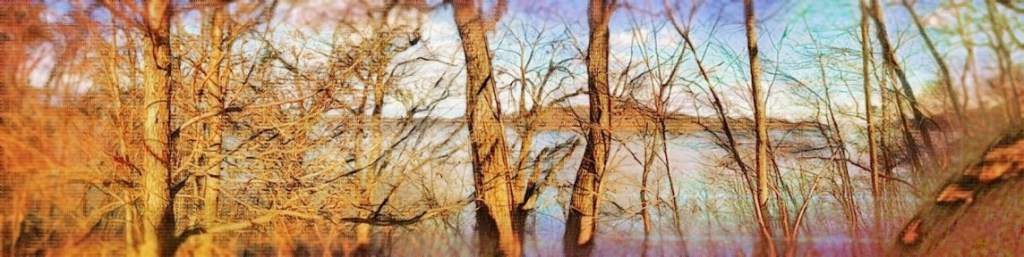
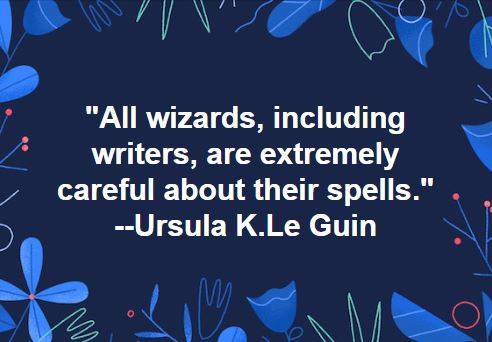
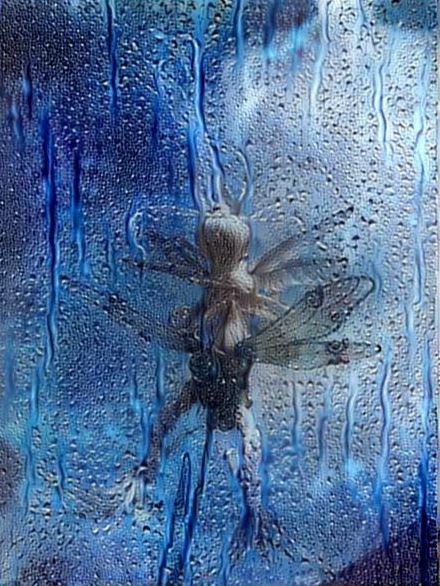
On a walk by the pond yesterday with my small boy, the phone slipped as I was taking a photo, and gave me a swirly image, so I replicated the slip, and found this.
Gratitude List: 1. Motivation. Wherever it comes from. I read a silly thing the other day that suggested that if you have trouble getting the motivation to exercise or remembering to take your vitamins, imagine that the health boost is magically transferred to Ruth Bader Ginsburg. Somehow, at least for now, it’s been helping. 2. Learning to rest. When I had the backlog stacks of grading hanging over me, I didn’t always manage to get to chipping away at it every evening, but everything I did was colored by that low-grade panic: I SHOULD be doing that. Now that I am caught up and keeping up, I still find that panic rising, and now I can remind myself that everything is okay. I am caught up, and I am going to keep up with it this time. I have a better plan. 3. Little synchronicities 4. Little daily rituals 5. Nourishment, of all sorts
May we walk in Beauty!
“We love because it’s the only true adventure.” —Nikki Giovanni
“Everything we do is music.” —John Cage
Abba Poemon said, “Teach your mouth to say what is in your heart.”
“If I didn’t define myself for myself, I would be crunched into other people’s fantasies for me and eaten alive.” ―Audre Lorde
“There is no thing as a single-issue struggle because we do not live single-issue lives.” ―Audre Lorde
“The master’s tools will never dismantle the master’s house” ―Audre Lorde
“We’re still dumb kids, just gray and tame. If we had it to do again, we’d get it right.” ―from Jack Ridl’s “The Reunion”
“For a lack of attention a thousand forms of loveliness elude us every day.” ―Evelyn Underhill
“… a ditch somewhere – or a creek, meadow, woodlot, or marsh…. These are places of initiation, where the borders between ourselves and other creatures break down, where the earth gets under our nails and a sense of place gets under our skin.… Everybody has a ditch, or ought to. For only the ditches and the field, the woods, the ravines – can teach us to care enough for all the land.” —Robert Michael Pyle, Thunder Tree: Lessons from an Urban Wildland
In the dream, I am back in a little town where I have often found myself in dreams. It’s a fully realized little town, with neighborhoods and trees and people and traffic. It’s miles away from any other town or city, out in a scrubby desert. On the outskirts of town are several truckyards–I suppose this is the source of the town’s thriving economy. But this is something I know from previous dreams about the place. ** In this particular dream, we are living in a house (that I think belongs to us or a friend). People come and go through the property, and the path leads over a steep, muddy embankment in the corner of the yard. When I skid down over the hill, I realize at the bottom that the mud and grass cover an enormous quartz crystal “colony.” Some beautiful points are visible beneath the mud. Bits have broken off, and points and broken pillars of crystal scatter the lower yard. They’re so clear and shiny, even amidst the mud that they look almost more like Herkimer Diamonds than Quartz. I collect LOTS of random pieces, and someone has left baskets of stones and little carvings and treasures on the sidewalk near our house. I know that they are for us, if we want them, so I decide to come back and get them later, along with several of the more beautiful quartz bits. ** A little later, we’re going to eat lunch at the cafe in the community center (which might also be our house, or next to our house). We’ve gone to taste the Bhaktar (not a waking-life word or recipe), which is a cracker-like bread crumbled into a bowl with a creamy soup poured over top. On the way in, we pass a student of mine who is taking people’s orders. She looks at me and says, “Have you ever seen James Kinder’s wife? She reminds me so much of you!” I google them, and it turns out that she is the creative director of the plays and events at the community center.
After lunch, we watch some of the dancers preparing a performance at the community center. I don’t think James Kinder’s wife looks or acts anything like me. She reminds me a bit of Amanda Palmer, someone with a lot of creative energy and vision, which I really admire, but super vampy/campy in her own aspect, which makes me feel uncomfortable and awkward. I wonder if people perceive me as vampy and insincere. Not that she is insincere, really. I just can’t get past the vampy-style mask to make a human connection. I wonder if people think of me as wearing too much of a mask to really get to know me.
The dance performance they’re preparing is amazing. Back stage (or maybe on stage), I make friends with the Kinders’ sweet black cat. ** A little later, my whole family is gathered at our house. Everyone seems to have something they really want to do right there at the house, but I want to explore the town. Finally, I get up the nerve to tell everyone that I would like to go window shopping. They sort of chuckle, but they don’t make fun of me for wanting to shop. I say it’s because I want to get the steps on my step-counter. ** Just as I am waking up, I find myself fascinated with how my legs and arms move as I am walking up the hill, and I realize that I am actually in someone else’s body. I’m not sure if anyone else notices. I enjoy the odd experience of being in a different body. Her limbs are long and thin and very dark brown. I’ve tripped and scratched her knee, but I don’t feel the hurt. ** A small ginger cat in the waking world is licking my cheek, and someone is meowing in the hall to say that no one filled the cat food bowl before we went to bed, so the dream ended and the day began.
Gratitude List: 1. Sincerity and honesty. People who can interact without too much of the mask. 2. While I am tired of the recent days of constant waking in the night, the waking brings the memories of dreams, and dreams are fascinating, and they offer me clues to my deeper self. 3. New strategies for handling the workload. There’s always hope that another way to organize will help me keep up with things better this time. 4. Reading books to a small person. I’m going to string this out as long as he can take it. He still demands that we read every night. 5. The interplay between language and ideas. In AP Comp, we watched a TED talk by Lera Boroditsky on how language shapes thought, and I am finding that the video itself is giving me new language for thinking about how vocabulary actually directs the shape of abstract ideas.
“Grab the broom of anger and drive off the beast of fear.” —Zora Neale
“Choosing authenticity and worthiness is an absolute act of resistance. Choosing to live and love with our whole hearts is an act of defiance. You’re going to confuse, piss off, and terrify lots of people, including yourself. One minute you’ll pray that the transformation stops, and the next minute you’ll pray that it never ends. You’ll also wonder how you can feel so brave and so afraid at the same time.” —Brene Brown
“For last year’s words belong to last year’s language And next year’s words await another voice.” ―T.S. Eliot, Four Quartets
“Words are pale shadows of forgotten names. As names have power, words have power. Words can light fires in the minds of [people]. Words can wring tears from the hardest hearts.” ―Patrick Rothfuss, The Name of the Wind
“silence is the language of god, all else is poor translation.” ―Jalaluddin Mevlana Rumi
“Meow” means “woof” in cat.” ―George Carlin
“But if thought corrupts language, language can also corrupt thought.” ―George Orwell, 1984
“Human speech is like a cracked kettle on which we tap crude rhythms for bears to dance to, while we long to make music that will melt the stars.” ―Gustave Flaubert, Madame Bovary
“The limits of my language means the limits of my world.” ―Ludwig Wittgenstein
“I like you; your eyes are full of language.” [Letter to Anne Clarke, July 3, 1964.]” ―Anne Sexton
Gratitudes: 1. Baked oatmeal 2. I did get back to sleep. There was that moment in the night when I ache and wakefulness make me almost leap from the bed. But the recliner soothed me back to sleep 3. Lunch duty. I would have said that the last job I wanted was to be the Watcher in the Gathering Area at lunch. I maybe be an ambivert, but the introverted part of me is made extremely anxious by noise and crowds. It helps to have a task and a plan, and then students have a way of approaching me to make conversation, or standing nearby in circles talking larger than life and glancing my way to see if I am noticing their delightful performances. I get to note who is lonely, who is going out of her way to greet someone who is on the fringe, who is gathering others together. 4. This cat pacing behind me like a sentry. (Oops! It’s because the food bowl is empty–I’ll have to remedy that.) 5. Stories.
I have been fuzzy in my civic understanding of the differences and similarities between a democracy and a republic, and to what degree my own nation is one or both of those. This morning, alarmingly, I have seen two articles posted online, one warning that our democracy is dying, the other that our republic is in its death throes. I suppose it’s time I develop a clearer understanding of the terms so that I can better understand what it is we are in danger of losing.
I think we are an oligarchy. I think we are in end-stage capitalism. I think that greed and self-interest have become the MO of our most powerful public servants. Serving the will of the people, and doing the right thing, have taken second place to staying in office, and garnering personal political power and wealth. The ideals of democracy and republic have failed to serve us as a nation.
There have been some bright spots in this impeachment process, some fine speechmaking and oratory, some grand ideals expressed, some hope for a society that governs itself according to core principles of freedom and justice for all. Still, the defensiveness and bullying, the sense of threat hanging over the whole proceeding, begins to make the story feel ominous and tragic.
A society that cares more about protecting the assets of its wealthiest members rather than providing for the basic needs of its most vulnerable members is headed for implosion.
Gratitude List: 2. This is my tabula rasa morning. I’ve been living in semester two for two weeks, but finishing up the grading for semester one. I will hit the Grades Ready for Registrar button in half an hour, and then the last rocks blocking this tunnel will crumble and disintegrate, and I will walk into the full light of the new story. 3. Wise people. Wise women. Helpful, thoughtful, perceptive friends. I don’t know how I would get by without those serendipitous and intentional moments of wisdom and care that you share. 1. Not everything is dire and tragic. So much is beautiful and wise and thoughtful and hopeful. You are here, and so am I, and we hold the ideals of a civilization that protects the environment and cares for the vulnerable. 5. Stretching, releasing breath, grounding, centering. 4. The breathing spaces in the day to come.
“Like water, be gentle and strong. Be gentle enough to follow the natural paths of the earth and strong enough to rise up and reshape the world.” ―Brenda Peterson
“Tyrants fear the poet.” —Amanda Gorman, U.S. Youth Poet Laureate
In the very end, civilizations perish because they listen to their politicians and not to their poets.” —Jonas Mekas
“Are you enhancing your power to discern the difference between rash risks motivated by fear and smart gambles driven by authentic intuition?” —Rob Brezsny
“I think hard times are coming, when we will be wanting the voices of writers who can see alternatives to how we live now, and can see through our fear-stricken society and its obsessive technologies, to other ways of being. And even imagine some real grounds for hope. We will need writers who can remember freedom: poets, visionaries—the realists of a larger reality. Right now, I think we need writers who know the difference between production of a market commodity and the practice of an art. The profit motive is often in conflict with the aims of art. We live in capitalism. Its power seems inescapable; so did the divine right of kings. . . . Power can be resisted and changed by human beings; resistance and change often begin in art, and very often in our art—the art of words. I’ve had a long career and a good one, in good company, and here, at the end of it, I really don’t want to watch American literature get sold down the river. . . . The name of our beautiful reward is not profit. Its name is freedom.” ―Ursula Le Guin
“I wonder how the world would be different if we grew down?” —Someone in my House, a few years ago
Gratitude List: 4. Planning and processing 3. The shades of gold, saffron, yellow, ochre 2. Grilled cheese and sauerkraut sandwiches with all the condiments 1. The way the eyes make sense of what they see. The way the create meaning: Tree branches that curve into the shape of a fish. Clouds that are dragons. A rough patch in the ceiling that is an old woman smiling. 5. Light at the end of the tunnel. I tend to visualize the light at the end of the tunnel as a gleam at the end of a long straight railroad tunnel. Sometimes it turns out that you’ve got lots of rock and debris to move from the pathway, or that it’s just a little opening, and you’ve got to dig yourself out. No matter what shape the tunnel is in, the light is there to inspire and guide.
Welcome, rain. Welcome, dawn on this chilly morning. Welcome, work of the day, of the weekend. Welcome, time yet to come when the work is done. Welcome, clean new pages to write my next chapter.
Gratitude List: 1. Yesterday’s dawn. It began as we pulled out of the driveway, with pink streaks on the horizon over Spicher’s field. On the way to pick up our car pool, we passed the small paddock where two mountainously fluffy sheep graze, and the sky was beginning to glow gently magenta against the woolly clouds, the grass a green almost glowing. The River, as we crossed, flowed pink beneath the old bridge to the south, and the lamps were still twinkling along its span. By the time we reached school, the sky colors had shifted out of indigos and violets and pinks, to tangerine, and rays of coming sun shot upward through the low-flung clouds. 2. Rain and reflections on a Saturday morning 3. People who stand up for peace 4. People who stand up to bullying behavior 5. Poetry
Grades are due Monday. I’m focusing on the day ahead, the weekend ahead, on getting it done. Fueled by coffee, hope, and the wild burst of procrastinator’s eleventh-hour mania. I am good at getting things done on time, but not in a timely fashion, if that makes any sense. Always hoping to rectify that, and sometimes, like now, finding myself deeper in the hole than ever.
Gratitude List: 1. Good colleagues. I love working with these earnest and compassionate people. And they’re funny, too. 2. There are some clear-thinking, justice-aware folks in that room in Washington. I don’t think I am really hopeful at all that the rule of law will prevail, that justice will be done, that the democracy will be saved. Still, some people are standing up for truth and democracy and justice. 3. Reading through student journals yesterday about people they admire. Some of their answers were my colleagues (see point number one), and others were family members. One student write a gripping couple paragraphs about being inspired by Bernstein and Woodward. Another write a page and a half about Tolstoy as an inspirational model for living. I love these young people. 4. Animal companions 5. Flannel sheets
A few years ago, a friend of mine told me about some online quizzes that help you learn world geography. I play them every few months, and every time I come back, I have lost fewer of them. Now I put myself to sleep at night by reciting the names of the nations of the world. It’s time for a new challenge. I am going to start on flags now, and then capitals, I think.
One of the powerful benefits of this has been that when I read headlines about the people of The Gambia suing Myanmar for the genocide of the Rohingya people, I no longer think, “Somewhere in Africa” or “Somewhere in Asia.” I see the place on the map. As tensions with Iran have increased, I see Iran in my head, where it is in relation to the countries around it. When students say they come from Thailand, or South Korea, or Singapore, or Ghana, I can picture where they come from on the map in my head. And so I have increased the sense of my own place, my own places, too.
It also increases my anxiety at times. A couple years ago when the Caribbean was torn apart by massive hurricanes, I knew the names of the islands in their paths, could sense the vulnerability in ways I had been previously unable to imagine. But some painful knowings are important knowings, and help me to better understand my own connection to others.
As we apply ourselves to the study of our own inner maps, I think we have similar experiences. When I dare to memorize the shape and location of sadness and despair within myself, then perhaps I can be more attentive when I see it in someone else. “I recognize that!” Joy. Confusion. Satisfaction. Secretiveness. Deviousness. Compassion and Empathy. They all take on more recognizable shapes as I explore their geography within me. And the anxious knowing applies as well. How will your small islands weather the hurricanes of grief and loss and stress? Can you pick up the pieces and set up a new infrastructure when the storms rage through? Hang in there. Put out a call for help to others to send boats and aid, to airlift hope and helping hands.
Gratitude List: 1. Asian New Year celebration at my school today. Such talented students. Songs, drumming, and K-Pop Dancers. Incredible! 2. Half a day to grade. Catching up with myself. 3. I’ve been reading the poetry of Reginald Dwayne Betts in the spaces of the day. His word-work is so inspiring. 4. That samosa a student brought me from their Ethnic Foods class (or maybe it was just Ethnic Foods Unit in a regular Foods class?) 5. Walking, stretching, being good to the organism that is me.
Is this a blog entry about petting cats or about getting used to themself?
The problem with writing a blog of random musings is that, over time, a writer is bound to repeat themself.
Here is a little metacognition moment: I woke up this morning with Thor-the-cat butting his head into my hand for a head scratch, and I started ruminating on that idea of the sweet pleasure relationship between human beings and the animals that live with us, how scientists believe the cats and wolves came to live with us because we were a stable food source, and we let them come because they helped us to deal with rodents who ate our own food. How that certainly explains the exchange of energy in a certain way, but how it doesn’t explain the pleasure exchange, how we humans get such pleasure from the feel of fur, and from the sensation of the animal’s pleasure. How my distant cousin David Kline writes in his book Scratching the Woodchuck of encountering a groundhog sleeping in the sun, how he reached out his walking stick to gently touch it, how it leaned into the scratch, how satisfying it was to him. How I saw an online video yesterday of a goose tickling a puppy with its beak: Everyone wants to pet the puppy.
But I am pretty sure I have written that before, and then I started writing it anyway, and I came upon that perfect opportunity to practice the singular “they.” (There’s where the metacognition begins.) So today’s musing is not really about the mutual pleasure cycle between humans and animals, after all, but about the process of shifting their (one’s/our) language to include alien-seeming ideas and structures.
We do it all the time, unconsciously or semi-consciously: pick up new words and phrases and ways of saying things. Teenagers do it at such an alarming pace that sometimes they seem to be speaking another language, and those of us whose synapses are getting hard and calcified find it challenging to keep up, to interpret the cant and the jargon. But we do it too. There’s that but at the beginning of the last sentence. “Never,” my teachers told me, “put a but at the beginning of a sentence.” But I do it all the time now. Too often perhaps. It expresses a sense of the fragmentary thought, how my brain experiments with holding an idea, and then skitters over to its complement or opposite. New words and linguistic patterns have a way of seeping in to enhance and brighten our communication.
The injunction against singular they, however, seems to have a particular staying power. My starting sentence up there feels clunky and awkward to me, not just in the fact that its using a “plural” pronoun to refer to a singular human, but because it actually singularizes the plural: themself. Because I identify as female, it would have been perfectly logical for me to use herself in that sentence. Were I someone who identified as male, however, to use the masculine pronoun in a sentence about a generic human being would have taken on political meaning, a sense of masculine as default.
As a teenager, I took the common practice of identifying every generic human in my writing as the “default” he/him, trying to believe that it meant people of any gender, no matter that I saw a distinctly male person in my mind when I tried to picture the sentence. As my consciousness shifted, I rejected the male default, and began to use he or she for a time, or he/she, or s/he, and there’s a certain satisfaction in that, but it does get clunky in the speaking, especially when you start tossing in the him or her. For a while, I tried the pompous-sounding one, but those sentences can get laborious and babbly and, as I said, pompous.
To return to both the meaning and the revelation of that first sentence, I think that along with writing previously about petting puppies and kittens, I have written about singular they before. Shakespeare did it. According to this Oxford English Dictionary blog entry (click the link), we’ve been doing it since at least the 1300s. They (generic use–I don’t know who I am referring to) discuss the attempts by grammatical structuralists in the 18th century to eliminate the use of singular they. But hey, if it was good enough for Shakespeare, it’s good enough for me, and he occasionally began a sentence with he, and finished off using they for the exact same antecedent. If he’s allowed to be so messy, I’m just going to wade right in.
There is plenty of reason to challenge my discomfort, besides my own feminist consciousness. Sure, I can sprinkle lots of generic she into my writing to startle and inspire, but singular they has become a fight for recognition of identity. As we welcome the blooming sense of personal identity and power that non-binary folx are expressing, it’s important for those of us who identify comfortably (say: privilege) on the binary to let ourselves get a little unsettled in the linguistic world, and then to embrace new forms and structures. Embracing new ways of using pronouns is a way to embrace the people who use them.
That first sentence is awkward in my ear. I am comfortable with singular they in many flowing contexts, but that one up there stopped me. Even Shakespeare didn’t use it so jarringly. But why should I try to rephrase it to make it gentler and more flowing to our ears? Instead, I am going to leave it there, to give us both a chance to begin exploring the possibility of new ways of using singular they. We can handle it. In recent years we’ve absorbed so many new words and ways of putting them together, and we’ve hardly looked up from our screens long enough to ponder the significance of all the changes. We can let themself slip in, too.
One way to make non-binary folx in a room feel more embraced and included is to put our own pronouns on our nametags, so they’re not the only ones with the burden. Another is to start using the pronouns in new and creative, and sometimes jarring (deliciously jarring) ways.
Gratitude List: 1. Expanding the brain by using words in new ways 2. Soft fur and purring 3. Vs of geese enlivening the sky 4. Getting the work done. I began to see the light at the end of the tunnel 5. So far, I seem to be holding this cold slightly at bay. Lots of zinc, lots of elderberry
Ugh. Insomnia. And it’s the fuzzy-headed kind. Trying to head off a cold, I took a tablet before bed that has zinc and valerian in it. I slept soundly for about five hours, and then that was it. Sometimes I can starting listing the countries of the world, and I’ll fall back to sleep before I can fill a continent, but tonight I got through all of them, and here I am, still awake. By the time I got through South America and was working my way through Africa, I knew I was done for. And now, it’s only half an hour until my alarm goes off, so I might as well start the process of waking up.
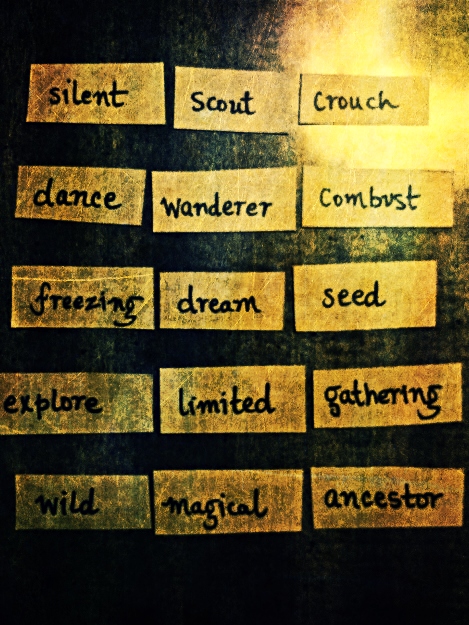
Today in Creative Writing, we’ll look at the pictures and poems that people put together with their random words. I showed several of my own on Friday as examples, so I don’t know if I’ll put up pictures like this one. I just pulled fifteen random cards from my word tickets and arranged them together. I’m not sure I like the line “dance wanderer combust.” The flow feels wrong, like I’m packing too many syllables into it. I like the word wanderer on its own, but in some contexts, that “-erer” can sound like a car with an engine that won’t turn over.
I hope my students are feeling the sense of freedom from prescribed meaning that I am feeling from working with word pools. We’ll get into intentional meanings soon enough, but it’s a nice breath to begin the semester with nonsense and random associations. It’s been an odd experience for me, a little risky. I feel sort of vulnerable, like I am letting my students in to my own personal crazy. I keep worrying that they’ll start rolling their eyes, that they won’t get it. And this is so deeply connected to the way my brain works that I feel like I might feel a greater sense of personal rejection if they can’t get into it. Enough of them have sent me fantastic random word projects, however, that I am feeling less anxious about it.
Gratitude List: 1. The shadows that swoop through the woods behind the house when vultures are flying in front of the sun. 2. Random meanings plucked from odd associations 3. Even though sleep was short, I did get some good solid hours of deep sleep 4. The ones who work for justice 5. Warm blankets