While the saber-rattlers practice their stern faces in mirrors, we gather our children and see the reflections of the eyes of mothers on the other side of endless wars, holding their children to their own hearts.
While the war profiteers add up their numbers, we count too, numbering our young people, knowing that somewhere, in that distant land, other mothers pull sons and daughters away from that red line in the sand, other teachers are doing the math of the beloved scholars ripening to the age of soldier.
We know, as those others know, that collateral damage means someone’s child, someone’s empty arms, someone’s heart torn apart. We know that the men who make war, the maestros who orchestrate the grand drama, are not the ones who do the war, are not the ones who live it.
We know, as the women of Iran know, as the war-makers can never seem to understand, that every casualty has a mother.
Gratitude List: 1. That quiet doe who slipped across the road in yesterday’s headlights, reminding me of shy tenderness, of the need to take great care in all things, to pay attention. 2. The people of Lancaster, standing in the freezing cold, holding up the hope of peace between nations. Young and old, and everyone’s toes like ice, but hearts warm and determined. 3. Doing the last-minute hopeful tweaks on second-semester classes. I love jumping in to second semester, despite the stress of the overlay of first semester’s finish on second semester’s start. Tabula rasa. Anything can be. 4. Last night I heard a story of a former student (before my time here) whose family has recently been reaching out to the school to share how much the school helped to shape–in often quiet and seemingly small respects–the life of their son. I’m grateful for all the ways in which the little things we do for each other open us to deeper connection–in ways we might not always be able to express. 5. The shine of snow-covered landscapes. Winter is not simply dark and drear. Some days, it dazzles!
Aha! The light is here. We have found our way by star and by dream, by following the song inside us.
Now we face a terrible choice. A new dream asks us to stand against a great evil that threatens to destroy this promise, that will destroy the lives of many children and their families until all is said and done. But we are used to following the paths where our dreams take us, and so we must see the child on his way, pack up our things, and head out another way, tricking the old king of his quarry.
Legends say that the astrologers and seers who followed the star in search of the child of promise came from Persia. At least some of them probably came from Iran. Rumi’s beloved Shams was from the city of Tabriz, in Iran, and my own beloved Hafez was from the city of Shiraz, Iran, where the Nasir Ol-Mulk–the Rainbow Mosque–is located today.
As my own country is crouched on the brink of a war with Iran, a rogue president at the helm and all semblance of Congressional checks and balances seemingly in tatters, we must consider our own response to despotic and ruthless leadership. How will we find a different way out of the murderous city? How will we protect the small ones? Perhaps today calls not for a quiet exit through the back door, but a conscious and public standing up and speaking out.
The people of Iran are not our enemy. We have, perhaps, more in common with them than with the angry old men who plot war between our countries.
What do your dreams tell you? Where will this star lead us today?
La Befana: The Epiphany Witch
She’d got her eyes fixed on what was right in front of her, the dust and the dirt and the everyday mess. Wanted to be ready for the coming of the child but couldn’t see beyond the day she was in.
Believe me, I know what the old one was up to. I too get caught by the fishhook of the present, stuck in the nextness of each task ahead, forget to lift my eyes to see the shine and sparkle of my arriving guests, can’t put down my broom, my pen, my daily rhythm, to look up and outward.
Like Old Befana, I catch, too late, the jingle of the caravan bells as they turn the corner in the distance, see the disappearing cloud of dust.
Hastening to grab my cloak and bag, I’ve lost their trail before I reach the distant corner, left behind, bereft, alone, dust-covered, traveling bag in one hand and besom in the other, destined to spend my life sweeping the skies on my broom, chasing down the Holy Aha.
Gratitude List: 1. Dreams and visions 2. Watching a boy and his grandparents yesterday, putting together a giant Lego jet. Hearing him hum and whistle as he concentrated. 3. All the people who are standing up and speaking out. 4. All those crows! On the way home last night, as we were driving beneath a sunset sky full of crows, a boy began to sing, “Magical, magical, magical.” (Of course, when he noticed me appreciating it, he switched and sang, “Unmagical, unmagical, unmagical,” but it was too late. I had noticed.) 5. The holy Aha! Finding the way by starlight and dream. Choosing to disobey, if that what is called for.
One of the subjects that keeps snagging my poetic attention is the landscape manuscript–how everything around us (not just the landscape) has a “text” that we might understand, if only we could read it. When I’m driving down the road and thinking about a knotty issue I am trying to resolve and I see three crows standing quietly in a winter field, or seven geese suddenly fly overhead in a raggedy V across my view, or something in the way the sun shines on the remaining leaves of that old oak seems to have a message for me–it’s as if there’s a deep text in the world that could be understood if only I knew the letters. And of course the landscape does have messages, and they can be read. It’s what farmers and meteorologists and hikers have done forever. It is what ecologists and environmentalists are doing right now, to save our lives.
And sometimes the visual and aural messages in my environment do seem to align themselves in perfect messages that feel like they’re meant for me, specifically, to read. Again, this is whimsical and playful rather than scientific. And it also captures my attention. I’m not going to make a judgement about whether or not the Holy One Herself, or the Universe, or the faeries, set up yesterday’s little alignment just so my heart could see it, but I will claim the whimsy, say that the synchronicity caught my heart, and then I will use it to construct the next steps of intuitive meaning for the shape my ponderings take in the coming days. I’d rather step into the future making meaning from the rich webs of whimsy and coincidence that surround me than refusing to gather the symbols that dance through my life and live with meaning defined only by the hardest of logic.
I was driving across the Route 30 bridge, listening to the most recent episode of “This Jungian Life” podcast, on the Trickster archetype, because my friend had recommended it to me. I was thinking about the Fool, and how I hoped that this archetype would inform my activism in the coming year, speaking truth through the lies in the way only the Fool can. The theme of the podcast suddenly turned to the way that tricksters throughout history have been challengers of suppression and repression and autocratic rule, how they act as a corrective when a person or a system becomes too rigidly rule-based and oppressive. There was a “click” in my brain at the coincidence of thought and outer message.
At that moment, my eye caught the new Sight and Sound billboard at the end of the bridge—shining purple, it advertised their upcoming production of Queen Esther, and one of my favorite Bible phrases, from the book of Esther, took up the central space in large letters: “FOR SUCH A TIME AS THIS.” Again, an internal click.
As I passed the billboard, a large vulture swooped low above the highway. Click.
Yes, it’s whimsy and intuition, poetry and dreaminess, rather than hard science or pure logic or cold reason. While I need the latter, while I value science and logic and reason as important mental processes, I think a world that makes meaning without the more poetic processes is bereft of the spark of spirit.
And so it is settled, this day before Epiphany. My word, my archetype, my guiding principle, for the coming year is the Fool. Sacred clown. Jester. Trickster. I’ve been considering how the Fool subverts the dominant paradigm (to use an old phrase) to speak the truth behind the lies. In a political milieu swimming in falsehoods, how does the Fool speak truth? Lear’s Fool spoke from deep love and tenderness, was not afraid to speak harsh truths right to the king’s face, and kept repeating the truth from various angles until the truth shone in.
Even the travelers whose arrival we celebrate today and tomorrow, the Wise Ones, the magi, have an element of the Fool. Magi, Mages, Magic, Image, Imagination. The truth they first told Herod was too bald, too open, too dangerous, and so, when they were presented with the deep truth of this Child, they disobeyed the king and fled home a different way, tricking the King. Still, the consequences were grave and terrible for too baldly proclaiming the truth to the king in the first place. This is lesson to be deeply conscious of to whom and how the truth is presented. The Fool must be wise.
So. The Fool. Those black vulture wings are also in my consciousness. And the echidna, a hybrid creature who survives and thrives because it is more than one thing. Those mists and rainbows, veiling and shattering, scattering light. Wading in the water: Do you want to be well? And Aslan’s words to Lucy: “Courage, Dear Heart!”
There is one more thing, a more abstract word rather than an archetype: Orenda. It comes from the Iroquoian language systems, and it refers to the spiritual power that exists in all things, the energy that we transmit between us, that we can access to change the world.
Okay, and there’s one more thing. My friends. Community. Last night’s dreams were a succession of anxiety dreams. In several scenes, I was trying to find Joss, and just couldn’t make contact. In several scenes, I had little fiddly school details to remember and take care of while I was rushing around trying to do other things. In several scenes I was in a car, constantly missing my exit, needing to turn around, but unable to get around another car or to fit my car into the space of the turn-off. Finally, standing on a sidewalk, about to throw my phone on the ground because I couldn’t get it to make a simple call to Joss, a group of my college friends walked up. Nancy took my phone and got it to dial Joss. Gloria put her hand on my shoulder and looked into my eyes, and started to tell me a helpful story. The others gathered around. I could feel everyone’s presence. And I calmed down. Friends. I get by with a little help. . .
What are your messages from the coming year? What words and images coalesce for you? What synchronicities in your inner and outer landscape call to you to listen and follow?
Gratitude List: 1. Friends. How even in my dreams, my beloveds appeared to bring me peace. You. The little connections that are bigger than you know. The way the web of our connections holds us up, and holds the world. 2. The spiritual force within each one of us that enlivens and enlightens and helps us to bring change and goodness into the world. 3. Synchronicity and coincidence and making meaning where it comes. 4. Image and imagination and magic. 5. Being greeted throughout the day by cats.
I am grateful for deep, deep sleep during this Twelvenight. How blessed it is to rest well and soundly.
The consequence, of course, is that I do not remember my dreams, except as impressions, or fleeting images. Last night when I went to sleep, I asked for a word to come to me in the night. I would like a word to contemplate in the coming year, and I was hoping that the deep-self Fool might cast one up out of a dream as it sometimes does.
This morning I woke up not with a word or a narrative or images, but with a sense of the small standing up to the big, pushing back the tide of largeness that threatens to overwhelm the tiny.
Of course my subconscious would toss me such a morsel after yesterday’s meander with anxious demons. This potential for war with Iran has me panicky and anxious. I think I am managing the worry, mostly, but it takes a lot of deep intention and careful breathing. Of looking for news and analysis. Of ignoring news and analysis. Of connecting with others who believe that the people must stand up and say that we do not want war, that we have no quibble with the people of Iran and Iraq, that we want peace for our children and for the children of Iran. That the big powers must not have the last word about the world where the small ones will live.
And so the message of the morning is of the small ones pushing back the big ones. This coming week, Women in Black, a local Lancaster group connected to a worldwide peace movement, will stand silently on our courthouse steps with signs expressing our desire for peace. We may read Iranian poetry. We may weep. We may simply stand silently, as women have stood for decades, for centuries perhaps, in the public square, to tell the powers that be that we do not sanction sending the young ones to die in old men’s wars.
Then we will walk down the block to join in a larger community protest against war with Iran.
They will tell you that you are unrealistic. They will tell you that you do not understand. They will tell you that we must kill before we are killed. They will tell you that world affairs are for the patriarchs to decide. They will tell you to go back to the hearth and the kitchen and the children. And then they will take those children and turn them into machines for their wars. And we must be ready to stand between them and our children. A flowing river of women, of grandmothers, of sane men, too, standing between the powers of the angry old men and the children of the US and Iran. Take my hand. Hold the line.
Gratitude List: 1. The women, and men too, who are pledging to be Love in the face of hatred and war. 2. Despite appearances to the contrary, reason and humanity do often prevail against the powers of the angry old men. 3. Interspecies relationships. I love waking up curled into a ball with a small creature tucked into the circle of me and purring. 4. The poetry of Rumi and Hafez, from Persia, modern-day Iran. And for the poetry of modern Iranian poets. Yesterday afternoon, I read poems by Forough Farrokhzad. 5. Morning mist is magical.
I have absolutely no recollection of dreaming last night. The door between sleeping brain and waking brain is shut tightly. No narratives or images come from that world into this today.
This morning when I looked out the window at 5:35, the darkness was touched by a hint of grey. Dawn is slipping slowly and silently back the clock. Light returns.
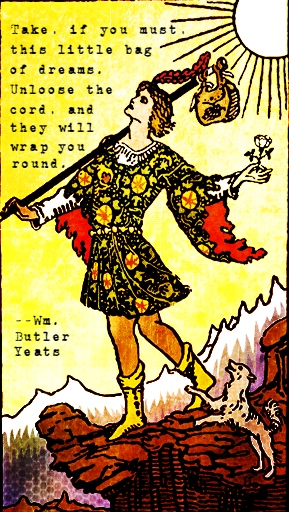
The quotation in the image I attached above is from William Butler Yeats’ poem, “Fergus and the Druid.” Fergus the King has relinquished his crown and abdicated his responsibilities as king, and he asks the Druid to teach him knowledge, to give him wisdom. Finally, after a little bit of back-and-forth, the Druid offers Fergus a bag of dreams. Though I put the words with the Fool, the Druid is much more earnest than the Fool, more shamanic, seeking wisdom in all things, pursuing knowledge. The Fool just trusts that the wisdom necessary for the moment will arrive when it comes. The Fool is both younger and older than the Druid, more foolish, and wiser.
Going back to school yesterday meant a different kind of mental focus, put me in more of a Druid zone, seeking knowledge with deep intention. But of course Teacher is an archetype of its own, the one who passes on knowledge and wisdom, seeking it like the Druid, drawing it out of the people themselves, helping them to find it. Druid, Teacher, Queen/King/Ruler, Fool: We are so many people at once, aren’t we?
On a morning when the dream-door is closed, still I carry with me the bag of dreams I have been dreaming. Today, they wrap me round as I go out again, stepping out as the Fool, the Druid, the Teacher, carrying my little bag–of dreams, of wisdom, of story. May your own dreams feed you and wrap you round.
Gratitude List: 1. Pie. Yesterday was pie day in the faculty lounge. One of my colleagues is a masterful pie-maker. Once a year, he brings eight or ten pies for us to sample. It’s the best snack day of the year, and it made yesterday a celebration instead of a foggy slog. 2. My shiny students. Many of them were as tired as I was. So many of them just want to be done with the semester already. Me, too. But there’s joy and hope and community there, too, and for some students, school is the safe place, the belonging place. I am grateful that school can be that haven for those who need it. 3. Yesterday’s chapel speaker. It was mostly a personal introduction for a member of our school community, but he was engaging and lively. He caught students’ attention on the first day back from break. He made us laugh, he made us think. 4. Resolutions and intentions. I know all the reasons to be cynical about New Year’s Resolutions, but here’s the thing. New Year’s Day can be like the moon, and I can use the gravity of this day to help boost my energy as I create an intention. I have been wanting to maintain a higher daily step-count, but I sometimes I need the extra artificial push of a New Year’s Resolution or an outside challenge to motivate me. Here’s to the attempt! 5. Dawn is inching back the clock. Day is slowly lengthening.
The work-world isn’t waiting for me to finish my Twelvenight ruminations. School starts again this morning. So my writing may, of necessity, be shorter.
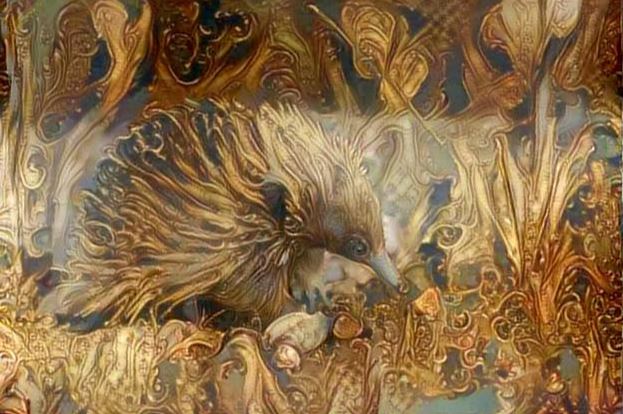
Yesterday, I sort of dismissed my dream as the anxious eruption of school into my sleep-psyche. I set that little echidna to the side in my considerations of meaning. But it kept snuffling into my awareness throughout the morning. It felt odd to me that I would dream such a little-known creature. Josiah and I had read about them last year when he was doing a report on the platypus–echidna and platypus are cousins–but I haven’t thought about them since.
There are all those articles that keep popping up about the massive losses of animal life in the Australian fires. I had been thinking sadly of kangaroos and quokkas and wombats and koalas, but echidnas hadn’t crossed my mind. Why was I dreaming an echidna?
I mentioned the dream on Facebook, and a friend said that he, too, has been having Australia dreams, and I wonder: When the Earth is hurting, do we feel it in our dreams? Are we dreaming our own deep-self messages as well as picking up signals from the Beings around us? It’s a whimsical thought, and perhaps ought to be the organizing concept of a novel or short story, at least. But whether or not it’s a message from Earth herself, it draws my attention to the terrible loss on the other side of the world and gives me another connection to that world that I know so little of.
My friend said that he is planning to try to find the characters in his Australia dreams and ask them to tell him more. So I tried to find my way back to the echidna last night. I saw her just as I was falling asleep. A larger echidna came along and stomped on her neck. I managed to pull the larger one off, and save the little one, but then the dream was over. If that was a further message, it’s pretty traumatic. Sigh.
I have been doing some thinking about echidnas in the last day, how they have a hybrid sensibility to them: mammals who lay eggs, hedgehog/anteater/birds. They’re sort of not quite one thing or another, but wholly themselves. And their back feet seem to be on backwards. They can burrow backward with their powerful hind claws, which face behind them. The echidna is feeling like a perfect animal symbol for me to walk with this coming year. During the past four or five years, the tension has been building for me, the feeling that I am both teacher and writer and not quite either one, really. It’s hard to hold onto these two identities which demand so much of my time and brainwork. Perhaps the echidna is my message that this year is to be one of problem-solving, really figuring out how to be this hybrid creature that I seem to have become.
Last night’s dream: I need to go to Harrisburg for a meeting. I leave at 5:30 in the morning, and I am taking my little blue Festiva. It’s been so long since I have driven it that I can’t seem to adjust the height and angle of the seat and mirrors. I stop at a convenience store for coffee and batteries. I need three AA and three AAA for my Walkman. It’s really hard for me to get help getting what I need. People are busy and distracted.
The meeting is at the convenience store, so I sit down with my styrofoam cup of hot chocolate (where’s the coffee?) while someone is getting my batteries. We talk about the boss, who is corrupt, and is using his position at the store to enrich himself. He loves roller coasters, so he has built a small theme park with several special roller coasters that he can ride. We vote that the woman next to me will write a letter of complaint. The meeting is over, and I start to drive home.
It’s easy to see how several pieces of this are basic anxiety-dream elements. Before I went to bed, I worried that for some reason my watch alarm might not wake me up at 5:30. Do I have everything I need to make it through these two days of school? Can I fit myself back into the driver’s seat? My own particular work bosses are extremely ethical and generous, but the “boss” of my country seems to be enriching himself and satisfying his whims at taxpayer’s expense, and that has occupied a great deal of my mental energy in the past few years.
I seem to need a lot of batteries, and coffee/chocolate, to keep me going. I ought to spend some more time working out how to best use and renew my energy. I ought to be using rechargeable batteries by now, anyway. And where was my reusable mug? I was rushing and anxious, and so I was not managing my resources very well. Slow down and savor, I think I told myself a day or so ago. Slow down and find the resources I need instead of frittering away with non-renewable energy sources. There’s a pretty serious message for someone who walks the borderlands of exhaustion.
Gratitude List: 1. The messages in the most mundane anxiety dreams. 2. Echidnas. What an odd and lovely dream-animal to get to know. 3. I didn’t get it all done, but I got a LOT done, and that’s something. 4. As reluctant as I am to get back to work, I am eager to see my school-people again. They give me energy. I do love being a teacher. 5. This is only a two-day week, after all. I can do two days. In fact, as much as I grumbled about going back today rather than Monday, I think there’s something to be said for starting with a short week.
On this day when everyone’s attempting to solve and re-solve their solutions, to resolve their resolutions, to tend to their intentions, I’m still waiting on a word. I watch my dreams and inner questions until the shining sixth, Epiphany, until the kings come. Wise ones. Mages. The light pours in on Epiphany and wisdom comes to the house.
It doesn’t really matter which day you embark on the journey. It only matters that you take it. Today we stand with Janus in his doorway, looking back and looking forward. With the double-faced god beside us, we can simultaneously look behind to the road that has brought us here, and ahead to the road we’re soon to take.
How could I live the coming year without that knowledge of the shadow that travels behind me, the road I walked to get here, the person I have been? It’s so easy, when we turn over a new leaf marking a new season in our lives, to simply yank the leaf from its twig, but the what-will-be is built upon the what-was. The new self which is emerging only arrived at this doorway on the persistent legs of the self which brought me here.
Whether you are waiting, like me, for Wisdom to come on Epiphany, or whether you step away from the door this morning to begin the journey of the year, this is the season of the set intention, the forward-moving affirmation. This is the time of the tabula rasa, the blank page upon which you can write whatever you choose.
Do you have a resolution for the coming year? A re-solution, perhaps, to an old and persistent problem? Or perhaps you need this official moment to end a habit that has you in a rut? Or to begin a new one that will get you traveling a more liberating and exciting road than the one you’ve become accustomed to walking? Many people I know prefer to call it an intention rather than a resolution. Perhaps an unachieved intention sounds less like a broken promise than an unsolved resolution.
The road to February is littered with broken resolutions and lost intentions, with holy words discarded and new habits jettisoned as old habits creep from the undergrowth and reattach themselves. I don’t think this means we shouldn’t set intentions or resolutions. Perhaps we need to set the intention and then set a second intention: To tend the first. If I set the intention to get 7,000 steps a day, and I succeed for a week or two, but then fall away, I will have had a less sedentary week or two. That’s a good thing. The idea, then, is to come back to it. Perhaps 7,000 is too much to ask, amid all the other things I need to accomplish. So maybe I re-set my intention and say 5,000 steps a day during the weekday, and 7,000 on weekends. And I try again, with fresh will and determination. After all, February first is another new beginning.
And I think we need to take great care in the intentions we set. If I decide that I don’t like the way I look these days, so I am going to whip my body into shape by diet and exercise, that’s a punishing resolution. My body is going to rebel, and the deep-self is going to feel attacked. But the fact is that for my whole life, I have needed to keep re-setting the intention to move more, and to maintain a healthier balance of the foods I eat. I don’t believe in self-denial. I will never entirely give up chocolate or ice cream or cookies, because then I am bound for failure. But I can probably re-set some of my boundaries with the sweet things. Slow down and savor.
Now there’s a good intention for experiencing life in 2020: Slow down and savor.
In the coming year, may you be kind to yourself. May you set reasonable goals that help you meet with success and fulfillment. May you bring out the best you, informed by all the versions of yourself that you have been. May you not jettison old versions of yourself along the trail behind you, but transform yourself in ways that acknowledge all the work you’ve done to get here.
Blessing for the New Year by Beth Weaver-Kreider
May you be born fresh and shining into the new year and may the old you continue, too, a thread that ties you to past versions of your truest self, for we need to be constantly reborn while we hold a deep sense of the shape we create in the universe.
Gratitude List: 1. All the birdlife of yesterday! It felt like we were in a legend. Suddenly, after weeks of very little bird activity, there were birds everywhere: bluebirds on the wires, finches and sparrows at the feeders with juncoes and mourning doves catching the windfall below, woodpeckers rowing through the space between trees. On the road, flocks of little birds schooled from grove to grove of roadside trees. Vultures, and maybe an eagle, hung in the updrafts above the Susquehanna. And a kingfisher chattered on Fishing Creek. 2. A good, hard hike/climb on the Mason-Dixon Trail south of Long Level. The trail rises above the river on a steep rocky ridge climb, and you’re on a dragon’s back of up-jutting rocks for a quarter mile or more, the river flowing wide like a lake on your left, and Fishing Creek rushing rapidly down the steep ravine to your right. 3. The hike reminded me of the moment in Prince Caspian when the children and Trumpkin are walking along the gorge, trying to find their way, and Aslan appears to Lucy. She must make a choice to follow him rather than going the way the others are going. She knows what is right, and she must follow that way, even when the others mock her for seeing things they cannot see. Even though he doesn’t say it at that moment in that book, I still heard him say, “Courage, Dear Heart” as we picked our way along the stony pathway. I’ll take that with me into the New Year. 4. We meant to go to Infinito’s for their pizza bar for supper last night, but they had closed early for the holiday. Instead, we went next door to Asian Yummy, and it was beautiful as well as yummy. 5. Again, as I feel the sadness and loss of these long mornings for writing and thinking, I can only be grateful for the gift of them in this Time out of Time. While I have not made headway on any projects in particular, I have stretched my writing/thinking muscles on the blog, and it has been satisfying and fortifying.
May we walk in Beauty!
Last January, I had repeated visitations from kingfisher, in waking life, in dreams, in conversations, in books. I chose kingfisher as one of my symbols for the year. Yesterday, as we were finishing our hike, climbing down the ridge toward Fishing Creek, where it moves slowly in deep pools before rushing down the ravine, we heard a kingfisher chattering in the hollow, over and over again. When I got home, inspired by a friend who is writing Shadormas, I wrote this two-stanza shadorma (3/5/3/3/7/5):
Kingfisher, who visited me at the start of the year chattered farewell to the year this cold afternoon.
And vulture floated like eagle through currents o’er the ridge while last year’s waters flowed down the Susquehanna.
Dreamwork: I don’t have much to say about last night’s busy anxiety dreams. In the dream, there is some sort of educational conference going on. It is both at my school, and not at my school. I go into a room, meaning to climb the stairs and go up a few floors, but it’s kind of Escher-like in design. I climb a flight of stair, walk along a landing, and the next flight leads down again into the same room, though I don’t really remember stepping down. Someone tells me I need to find the secret door on the landing. After that it’s possible to find stairs that go up, but each leads to an identical room with the same weird stair situation.
At one point, my colleagues are walking through my bedroom, and I say, “It wouldn’t be so bad if I felt this tired at the end of the day, but I feel like this right after waking up!”
Another of my colleagues, who retired a few years ago, is there, and he has brought his pet echidna. It’s really quite curious and adorable. It keeps sort of morphing into a puppy.
Perhaps I do need to pay attention to the exhaustion bit in here, and the confusion of stairs.
Stepping off the Edge: The Fool Sallies Forth “Walk on air against your better judgment.” –Seamus Heaney “The Gravel Walks”
Yesterday, as I was scrolling through Facebook in a lazy moment, I came upon another of those word search puzzles. This one was different. It was a different color, different font. The same friend had posted both this one and the one from the day before. The blurb at the top of the second, like the first, was something like: “The first three words you see are your words for the coming year!” I have my own processes for choosing my words for the year, but still, I couldn’t resist.
I’m a sucker for this stuff, and social media has been happy to oblige. I used to take those Facebook quizzes before I began to get wary about viruses and data collection. Like the puzzles, the quizzes offer you some random answer to an inner question. “What is my personality?” “What will 2020 be like?” “Who among my friends is most like me?”
I think that probably most of us who take these quizzes and do these inconsequential games are participating playfully, but also holding some tiny deep-self spark of hope that this little bit of utter randomness will offer us a truth we can hold onto. Like the mining of dreams or daily experience for images and ideas that will guide the inner work of the coming year, these games engage the younger, more playful deep-self part of our psyches, offering us a chance to seek meaning in organic and flowing associative connection as opposed to marked and organized logical connection.
Both processes are valid for inner work, but we have a tendency to downplay the imaginative and associative parts of our inner selves and try to make meaning and sense of the world through the logical processes. This is where I think we get ourselves into trouble. Even Einstein said, “Imagination is more important than knowledge,” and claimed to use associative processes like sleeping on an idea, and following intuitional trails, to find his way to some of his greatest thoughts about how the world works.
Searching for meaning in this way, by following the rabbit trails of the intuition, and associating seemingly random images and stories to create a narrative guide, is a form of divination. Humans have practiced divination since our early days as humans, and through all our cultures. We divined, through our senses and awareness of the natural signals around us, whether the day would be a good one for gathering mushrooms or for hunting. We let our intuition tell us whether those new mushrooms might be like the ones that feed us or the ones that kill us. It’s only natural, perhaps, that three crows in a dead tree or the sudden appearance of a coyote at the woodsedge might begin to take on greater significance, too.
Divine: an adjective, and sometimes a noun. Holy. Godlike. Heavenly. Having the properties and attributes of a deity. Divine: a verb. To seek to know. To observe patterns and (perhaps random) elements in a landscape or a mind in order to create meaning, to develop a guiding narrative for the future.
Do my friends and I (and you, perhaps) believe that the faery folk, or God, or some spirit presence, guides our eyes down those word search charts to find us the exact words that are meant for us for the coming year? Probably not, or not exactly. Do those words take on meaning, at least for some of us? Yes. Out of the random soup of the thousands of words that we read and experience daily, here are three to focus on, three to consider special. Yes, the prophecy is definitely self-fulfilling. If Health appears in my three and I have been feeling an internal sense of having neglected my health, perhaps taking this as my word will mean that I begin, in intentional and unintentional ways, to look to my health, and so 2020 becomes a year of robust health for me. When I look back at the end of the year and remind myself of my 2020 words: “Amazing! Look! Health was one of my words, and look how that has come true!”
Magic happens in many ways, and sometimes we make the magic happen.
In the tarot system of divination, one of the major cards is the Fool, who dances on the edge of a cliff, seemingly unaware of the danger, but perhaps aware and dancing anyway, because one must live joyfully no matter the circumstances. Perhaps becauseof the dire nature of circumstances, the Fool must dance. Since I began to play with the idea of the Fool as one of my guiding concepts for 2020, the Fool has begun to appear everywhere, in books and images and references. Two days ago, I made that little corn dolly Fool and took some photos of her in various places. Yesterday, I did a little digital twisting of some of those photos, and came up with the one attached to this post. See how she dances at the edge of that cliff, even setting her foot into air as though she is about to trust the wind to hold her?
And here’s the strange thing about following the intuitional, poetic, pathways. Sometimes (and maybe often) delightful coincidences/synchronicities (call them what you will) occur. In the first Word Search I did, the words I saw first were: Health, Gratitude, Wade. Wade? Not particularly inspirational. Not like the others at all, haha. The maker of the puzzle clearly didn’t intend it. Of all the possibilities, wouldn’t you know it, I would find the odd one out. The second puzzle, remember, was a different puzzle. I looked closely at it afterward, and the words were definitely different, in different places. My words in the second? Dance, Friendship, and. . .Wade. Yes.
My logic-brain is rolling its eyes and chuckling. But that laughter is a doorway to the deep-self fool, who loves sense that doesn’t make sense, who molds coincidence into meaning. As quick as my logic-brain was working to shrug it off, that deep-self elf had already begun to weave the patterns of a new idea. So I’m wading in the coming year. Does that mean that things will be a slog? Or maybe I have finished swimming in waters above my head and I might now be free to wade instead. I’m heading toward the second. And, because my being human means that I am a meaning-maker, I will build the meaning into my narrative for the coming year.
Dreamwork: Last night wasn’t particularly dreamy, but I did wake up with a sense of a dream in my head. I don’t remember all of the context or even the images. But I do remember the terrible sense of urgency to get a book ready to send to a publisher. Oooof. I don’t really want urgency in my collecting basket at the moment, and I’ve been wanting to put some poems or reflections or stories together into a book, but I’m not sure I want to marry that to greater urgency. There is a deadline coming up at the end of the month for a chapbook contest for Paraclete Press. Perhaps I’ll begin with that.
Gratitude List: 1. These long slow mornings I have had for writing and contemplating and meditating. I’m beginning to feel an edge of panic that I’ll be losing the gift of morning in just a few days, but I want to focus on being grateful for the days I have had to re-develop the habit of long morning writing sessions. My blog posts will soon be getting much shorter and quicker. 2. Still two days of break. Time to get more work done, and time to spend with my family and the cats. 3. Playing games. The boys got some new games for Christmas. Can’t Catch Harry is sort of like spoons, and Ravine and Spaceteam are collaborative problem-solving games. 4. Deep, sound sleep. 5. How the logic-brain and the deep-self work together to create meaning.
So many of the little treasures that wash up on the shore of my consciousness after a night of dreaming seem insignificant, silly, unconnected. This morning, I woke up really early with my mind tugging at a joke it was making, about someone with the last name of Waters who had a son named Wade. Weird brain.
I know where my deep-self elf pulled the word Wade from. Yesterday one of my friends posted one of those word searches where the first three words you see are to predict something about your coming year. The words are always sweet and inspiring. I saw HEALTH, and GRATITUDE, and WADE. Wade? I think that word got into the search by accident, but there you have it. And then I think, the inner fool sent it back to me again, as a sort of joke. If I keep to the beachcombing metaphor, this one is a really odd-shaped piece of who-knows-what. It’s interesting enough, if it doesn’t seem to have any particular meaning. Into the collecting bag it goes.
Later, in my more complete and final waking of the morning I am dreaming: We are staying with friends at a little bed and breakfast sort of place in a sort of European-seeming city-town. I wake up really early and wander around the courtyard a bit. After a while, one of our friends wakes up and makes a fire in the fireplace in the kitchen. We sit and talk, but I wish we had made the fire in the courtyard by the garden, to watch the sun rise and feel the morning breeze.
Later, I go up to the second floor to pack up some things, and I open a window and look out at the sunrise. The landscape before me is green and rolling, first the gardens of the town, then rolling hills, and finally deep blue sky and the sun rising in a halo of rainbow. (There’s rainbow again.) I am filled with a sense of complete well-being.
I woke into the waking day to a grey-fog-filled hollow, which has its own kind of deeply satisfying beauty. I love the mystery of a good fog.
Do your dreams bring you satisfaction? Are they unsettling? I am paying attention to that sense of wellbeing I felt at the end of my dreams. The deep-self speaks in feelings as well as in images.
Gratitude List: 1. Fogs and mists 2. The long view 3. Mysteries–both holy and mundane (maybe they’re the same thing) 4. How people show up, even when it’s hard 5. Our friend’s surgery seems to have been successful. We pray that he will now be cancer free and on the road to recovery.
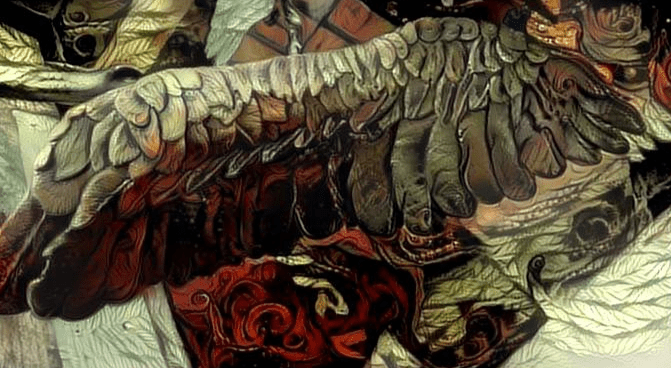
As I process the dreams I have been having, I have been making and gathering symbols of my psychic flotsam of the past week or so. A couple summers ago, we went to the Visionary Art Museum in Baltimore. I took a picture of a door handle that was a wing, and did some digital altering. This morning I happened upon it, and noticed that it resembles the black wings of the vultures in my dreams a couple nights ago:
And yesterday as I was bringing in the trash cans, I noticed a little pile of corn husks I had brought back from a walk weeks ago and left in a planter. I had intended to make a corn dolly. Yesterday, I picked them up and started to work, but suddenly what I saw in my head was a jester, a fool, rather than a pioneer woman. So this happened:
Neither corn dolly nor straw man, she is a corn jester, a jokester, a trickster. Now I need to find some really good rainbow images. Oh! We did see faint sundogs yesterday afternoon! Rainbow spots.
Last night’s dream feels more like an anxiety dream than anything, but I don’t want to discount the images. I am sitting on a table in the middle of a church basement, leading a service or meeting of people gathered in a circle around me. I have to keep turning to face people in various parts of the circle. I am talking to a woman I keep calling Bibi (which means grandmother in Swahili), honoring her for the work she’s done, noting that she deserves the break that she is taking. A young man with a scruffy beard begins to pray, and I am sort of relieved because I wasn’t sure I could make the meeting go as long as it’s supposed to. But this man starts to ramble, making l-o-n-g pauses and using lots of Father-god and Lordy phrases, and I know that we’re all getting sort of uncomfortable with this almost militant gendering of the Holy One. Finally, the pastor, who is sitting next to the man, nudges him, and he sort of comes out of his prayer trance and sits up, and it’s over.
More hints at something to do with bringing patriarchal assumptions to light. I don’t know how that might be something new for the coming year. I am really tired of battling the patriarchy, tired of sidestepping them and ignoring them and waiting for them to finish. I want to jump back to wings and fools and rainbows. Hmm. Maybe instead of battling the patriarchy, I need to be the Fool to the crumbling system in the coming year.
Oh, and there’s the Bibi, the grandmother. Maybe it’s time to let the grandmothers rest and begin taking on the work they leave behind.
What are the images and messages you are receiving? What animals are crossing your path? What is catching your eye in these days of Time Out Of Time?
Gratitude List: 1. Eating and laughing with good friends. 2. Sundogs 3. Wings 4. Making things 5. Watching and Listening