I’ve been thinking about my poetic process, looking through some of the neglected poems that I want to figure out how to publish, and realizing that quite a number of my poems are myth-making poems. I use poetry as a DIY Mything process, taking my own experiences and observations and transmuting them into myths. This thought is tangling with the threads of my current morning writing project of working with the Inanna story. Storytelling, writing, speaking–this whole language gig–is all about how we make meaning in the world. Art, too, as a communicative process, is about charging existence with meaning.
Gratitude List: 1. Meaning-making, DIY Myth-making, poetry, art, communication 2. Participating in a Literary Festival, listening, learning, absorbing 3. Good writing 4. How the sun shines in 5. Oak trees
May we walk in Beauty!
I’ve been thinking again about the process of poetry. In my AP Literature class recently, I have had the students choose a poetic form, no matter how lofty and traditional or edgy and nonsensical, to teach to the class. We’ve had some delightful lessons this week, learning the Magic 9 and the Nonet and the Rondeau and the Fib, among others. Yesterday, we found ourselves with a little extra time after the presentations, and we were ready to do our own thing, so we spent half the period creating our own poetic form! We developed our own rules for our own Lit Poetic Form. The process was delicious and intensely collaborative. At the end, we came up with this:
Lit Poem Two stanzas of seven lines each. It’s a word-count poem, with the following pattern: Stanza 1: 1, 3, 5, 7, 5, 3, 1 (It makes a diamond shape) Stanza 2: 7, 5, 3, 1, 3, 5, 7 (This one makes an hourglass form) When you put them together, they look somewhat like a lit candle. (Get it?) The rhyme scheme goes like this: Stanza 1: abcxcba (in which x is random and unrhymed) Stanza 2: cbaxabc (in which x is also random, and not necessarily rhymed with the first x)
This is how we make meaning. We spent twenty minutes collaboratively creating a world, complete with its order and purpose. Now we have to write the poems to prove its viability.
This morning, I decided to just dive into the myth that has been calling me, and I spent my writing time working on the story of Inanna/Ishtar, pondering the way her descent into the Underworld mirrors my own inward travels as the year turns cold and dark. I think this one will keep me busy for the rest of the week and beyond.
What symbols of your personal power and wisdom and authority are you prepared to relinquish as you circle downward into the deepest realm of your own inner knowing?
Gratitude List: 1. Myths and stories that frame and guide our own daily journeys 2. Small breaks 3. Seeking the fire within 4. Anticipation 5. Layers and layers of warm clothes
On these November days, instead of writing a daily poem, as I have for most of the past eight Novembers, I am writing short pieces of prose: fiction, meditation, dream. This morning’s piece was simply a telling of last night’s dream:
Combustible
The hillsides are covered with loosely growing trees, not quite close enough to be woods, and yet woods, for all that. Some places are woodsy enough that no sky shows through, though there is space enough between to see through them down the hillside to where the paths curve and separate. To the east, the trees open out toward bare grassy hillside and the smell of the sea. In the shade at the edges of the wood, three tidy white-washed Baba Yaga huts stand on stilts in a sandy courtyard, and further off, beyond the first grassy hill, smoke rises from a little village.
The trees are sinewy and resinous, Mediterannean, not pine—more like laurel, if laurel were thirty feet tall. The trunks are thin and many-branched, but open, and the leaves are mostly at the crowns, letting light filter magically through. All is green and blue and twinkling golden. Though there are no people, there is the sense of people, the presence of people doing people things.
In your head, a soundtrack starts to play, a woman’s voice talking about a sudden and catastrophic event, how one moment one notices the short bursts of steam rising from individual trees, curiously taking in the strange phenomenon, and then, suddenly, the whole wood will combust, not a long-burning, raging conflagration, but a whoosh of fire that’s there one moment, and in the next is gone, leaving bare and charred hillsides. You wonder why there are no signs to warn visitors off the paths. And then you notice the explosive bursts of mist and steam puffing from random trees on the hillside below you. Should you start to get nervous? If the voice is correct, it could happen at any moment. But you are entranced, curious, unable to give yourself to fear. You turn onto a path that leads up the hill toward the Baba Yaga courtyard, intending to explore the little huts, to see if anyone lives there. At the edge of the courtyard a long tube suddenly rises, like a cannon being aimed for a blast, and powerful jet of water bursts into the air, raining down on the little houses, raining down on you, sparkling through the sunlight, wetting the trees. Looking back the way you came, you can see several more of the water cannons discharging their spray through the groves and woods covering the lower hillsides.
You wander through the small village beyond the Baba Yaga houses, where people wander, eating foods from the markets, taking pictures beside the quiet houses, murmuring to each other. You look back over the hillsides where you have been wandering, and the trees have vanished. At the edge of the village, the green grass ends at bare soil. Everything is gone. Despite the water precautions, the woods and pathways are gone. An enormous yellow bulldozer rumbles over the destroyed land.
Gratitude List: 1. Dreams and their messages 2. Many sources of light 3. The lull after the grading storm. There’s so much more to do, but after a weekend of fierce grading, I took a break last night and rested. 4. The line of orange light along the horizon at dawn 5. New England clam chowder when it is made well
Gratitude List: 1. Feeling my wings 2. Grades are ready to submit for Quarter 1. How have we gotten here already? 3. Breath. It’s always there when I need it, and more effective than sugar or coffee for a quick lift. 4. Keeping the resolve 5. The tunnel to Faerie up in the orchard, between the pear and cherry trees.
May we walk in Beauty! Breathe.
Sit in a quiet place, calm and undisturbed. Shift yourself into place. Let your upper body fidget a bit. Shrug and stretch, stretch your spine upwards, making little breathing spaces between all the bone. Sigh. Yawn. Sigh audibly. Settle your bones, making sure your ribcage is straight, your shoulders are restful, your hips are aligned.
Now begin to notice your breath as it enters and leaves the space of your body. Notice where your body rests on the chair, the floor, the earth. As you hold your awareness on your points of contact with earth, begin to draw the breath into your whole body. Breathe not only into your lungs, but into your stomach.
Feel the breath enliven your ribs and your gut. Breathe into the muscles and bones of your arms. Draw it down over your shoulders, swirling down your arms and down to your fingertips. As you breathe out, feel the breath flow out the tips of your fingers.
Draw breath down your spine. Let it flow out the base of your spine. Breathe it into your thighs and down your legs. Wiggle your toes and ankles as the breath fills your feet and trickles out the soles of your feet into the earth.
Breathe. And breathe. And breathe
Now shuffle your upper body once again, like a bird re-adjusting its feathers, and find your way to stillness, letting the breath continue to circulate through you.
Bring your attention to your back. Sit up a little straighter and pull your shoulders back. Can you sense your shoulder blades back there? These are your wingbuds. Breathe into them and out through them. Shift your shoulders as you need to, to maintain your awareness of them.
Feel or imagine them beginning to itch, to swell, to pulse with life. Feel the moment when a small, folded pair of wings bursts through the surface, like the tiny curl of a plant breaking through soil, or a small bird breaking out of an egg. As they grow larger with each breath, notice their color, their texture. Don’t rush to unfold them. Let them develop. Feel them in the space behind you. Roll your shoulders forward. Shrug. Give them space.
Then, when you are ready, on a breath, lift them upward and out. Feel their strength. Feel the way they lift you. Practice opening them and folding them. Notice how they become invisible when you fold them up, how you will be able to go about your normal life with your wings folded against your shoulders and back, and only those who Know will know.
Now when you need them, to give you strength, to help you move from one stuck place to a new open field—when you need to escape—when you need to see something from a distance, to change your perspective—now they will be there for you. All you have to do is to breathe into them, hear them rustle in the space behind you, stretch, and open.
Hear the story of Cassandra: She longed to serve the goddess Athena, to give herself to wisdom and law, to craft and mathematics, to courage and strategy and skill. Athena offered her a life filled with the tools and the skills of her own empowerment, her own scholarship. In Athena’s worship, she could follow the trails of her own curiosity and speak the truths she encountered. Enter Apollo. As patriarchs so often are, he grew jealous of the woman’s devotion to the women’s ways, fearful of truths spoken that issued from sources not under his control. He offered Cassandra music and poetry, promised her the gift of prophecy if only she would serve him instead, a beautiful bird in his golden cage, there to do his bidding and sing his songs instead of her own. Safe. But the safety he promised was his, for her inner knowing, her self-assurance threatened the ego that wanted control of everything. The wisdom of women was mysterious to him, and the mystery disconcerted him and terrified. So he cursed her. Although she refused him, still he gave her the gift of prophecy he had offered, and she would always speak true. Her voice would ring out in the marketplace, telling the story of what was to be. But the curse was this: her voice would not be heeded. As happens in the belly of any patriarchy, the woman’s voice was ignored and discounted. Old wives’ tales! they scoffed. Cassandra is making things up, looking for attention. Pay her no mind. And the fire she saw and spoke of engulfed the city. The mercenaries and looters and kidnappers swarmed the streets as she had foreseen. They broke the ten-year siege, and overthrew the city. Cassandra herself became a pawn of the men in their men’s war, a tool of their scheming. Heed Cassandra, Friends. Listen to her words. Perhaps we can yet rescue her from Apollo’s clutches.
Gratitude List: 1. The Cassandras who will not be silenced, who speak even when threatened, even when they are ignored. 2. Circles of beloveds. 3. Speaking it out loud. Telling the story that itches to get out. 4. The magic of wind and water, fire and air. Everywhere we look, there is magic. 5. Lights at the ends of tunnels.
This month, I am trying to re-arrange some of my daily practice in order to make more space for writing. I have had two books floating about in my brain for some time, but I can never seem to find the time to work on them, so I thought I would give my first morning moments to the process and see what happens. So far, in the last two days, in the moments before I wake up fully, my brain has grasped a piece of dream-flotsam, and wrangled it into an image or phrase which I have used to begin a dreamy piece of super-flash fiction.
Perhaps I’ll be able to fit these into one of the books. Meanwhile, I am following the Dreamcatcher to see what she offers me.
In the past six or eight years, I have missed very few November Poem-A-Day challenges with Poetic Asides blog. This new process feels a little solitary, even lonely. But it feels like I have stepped onto a pathway, in much the same way that my first forays into Poem-A-Day were steps on a poetic pathway.
Here’s another thing: This week, I opened a Bag of Longing to see what was inside. This one was the idea of getting an MFA. It’s been haunting the deep corners of my brain for some time now. I decided to look at it more closely and see what it might look like this week. It’s so easy to get excited about it, but it’s hard to justify adding debt to debt when we have projects on the farm that must be fed money, and when the first of the children has just entered high school and will be exploring college possibilities himself before we can even catch our breath. Shall I close this Bag and stuff it back into a corner before it starts to eat me? Or shall I let the creature inside it out to roam, hoping it can find its own way home?
Gratitude List: 1. The many varieties of orange 2. That bright scarlet leaf on the neighbors’ orange dogwood tree was actually a cardinal 3. One small person humming quietly to himself in the car last night on the way home from trick-or-treating in town 4. November means cats in the bed, and that’s wonderful, as long as they give each other space and don’t start hissing 5. New practices
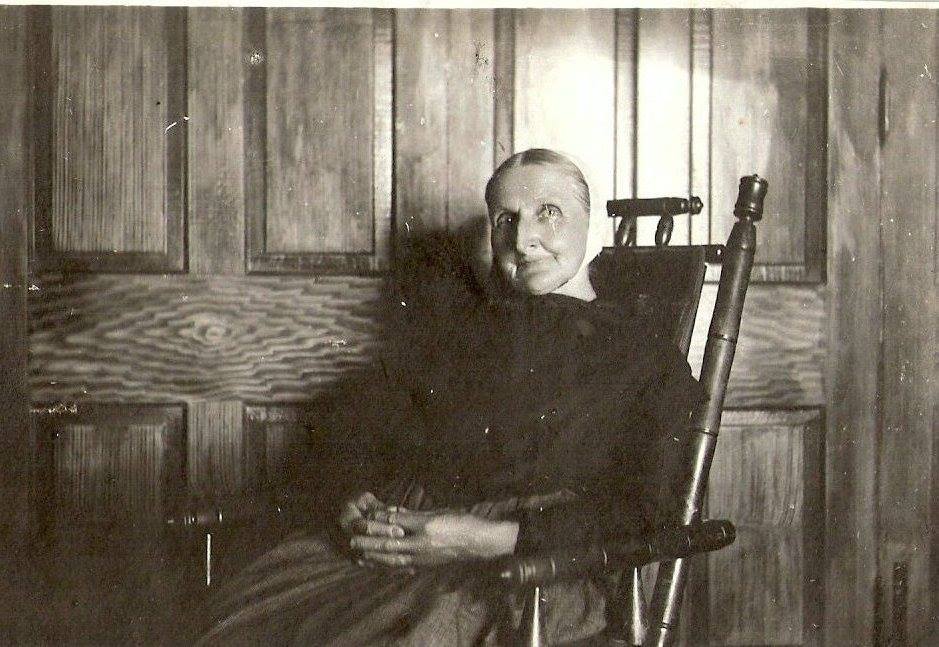
This is Catherine Witwer (1833-1905), married to Isaac Weaver. My Great-Aunt Elizabeth Nolt Weaver (her granddaughter) said that she cared for women in childbirth (a lay midwife, I think), and then cared for their older children in her own home so the mothers could recover. Aunt Lizzie told me that people called her Mammy.
They lived at the White Hall Mill on Weaverland Road near Union Grove. My Great-Grandfather John W. Weaver was their son, and his son Daniel was my grandfather, who is my father’s father.
All sorts of ancestors, known and unknown, line the spiraling staircases of your DNA, watching, singing, remembering for you. What will you carry forward as you walk through the veil of this season?
Gratitude List: 1. The way the sun slants through colored leaves in this season when we step further into the darkness. 2. Stepping forward. 3. The light we carry inside ourselves. 4. Knowing, as we walk into this tunnel of seasonal darkness, that we will walk out again in a season to come. 5. The bright candle flame of a new idea.
I think this is going to sound vague and smug and self-serving. I think my writing here and on social media is so often heart-on-my-sleeve, but this is more raw, more personal, more sulky, and yes, more vague, too. It’s a thing I want to talk about without talking about it. Do you ever have those experiences?
I’m dealing with some resentment and rage right now. I’m used to experiencing outrage on behalf of others. It sometimes feels like it’s become one of my defaults in recent years. Less frequently do I feel outrage on behalf of myself, and I don’t know exactly where to feel it, but here it is. It’s been plopped right into my lap. I think I have become really good at being reasonable about other people’s attitudes and behaviors toward me, so when I feel deeply and personally attacked about something that really matters to me, I have to take hours to process, to sort out what is mine, and what is truly cause for outrage. It’s a slow burn, rather than a quick blaze.
I don’t want to feed the fire by giving it air. Perhaps it will become the source of poetry and story, and I can give it a voice that way. Meanwhile, I think I need to re-start my Gratitude Practice, get back to essentials, take care of my own house so I don’t set fire to the houses of others.
Gratitude List: 1. A voice. Whether it’s a whisper, a shout, an echo, a web of sound, a single word, an avalanche of analysis: Give voice to your voice. Do not let anyone take it away from you. Boost the voices of others. Amplify the signal. 2. The ones who stand in the gap, who speak out for justice for those who are oppressed, who fight for the survival of the planet, who put people above greed and money. 3. The turning. Like the turning of the season to autumn, the world is turning. Like the transition from labor to birth, the world is groaning. From the fire comes new life. May we stand in solidarity with those who are midwifing the new thing into being. 4. Three cats in the house. 5. Cool weather and warm clothes. This is a not a metaphor. This is a metaphor.
I woke up at four-thirty this morning, the morning of my 52nd birthday, to the sound of a coyote howling, deeper down the hollow. I couldn’t get back to sleep, so it looks like I will welcome the dawning of my 53rd year.
Wikipedia reminds me that if you consider the majuscules (capitals) and miniscules (lower case) as separate letters, you’ve got 52.
There are 52 weeks in a year, with an extra day added to make 365. Perhaps this year, I will work on living with that sense of the extra day, the time beyond time.
On a piano, there are 52 white keys. Perhaps now I begin to learn the complexities of playing on the half notes.
There are 52 cards in a deck of playing cards, plus that extra tricksy Joker. Perhaps this year, I’ll be a Wild Card, playing any role I choose in the game.
(In the minutes it has taken me to write this, the sky has gone from the luminous grey of the pre-dawn, to a shining indigo. The dawn chorus is beginning.)
The web page Affinity Numerology tells me: “The numerology number 52 is a number of introspection and expression of a personal sense of freedom. It is studious and is mentally sharp. The energy the number 52 represents tends to do whatever attracts its attention as desirable to experience. But not on a whim. It analyzes what it experiences and what it observes.” I’ll take it.
Isn’t aging a wonderful thing? We grow more into ourselves, year by year. Sometimes I feel like I am a very young person, encountering the same ideas and experiences over and over again as if they were new, but always at a deeper level of awareness. Life’s a spiral–I keep coming back to the same things, but not really at the same place. Looked at from the top down, it could appear to be a solid, repetitive circle; looked at sideways and from a distance, it looks like a straight line. But we keep spiralling on.
Thank you, my friends, for walking this spiral with me. We were made for these times.
Gratitude List: 1. Coyotes howling in the holler 2. Getting older 3. Dawn chorus 4. My wise, wise friends 5. The fluttery purr of a contented, sleepy cat
“There is still a place for you at our table, if you will choose to join us,” the young man said. “Yes,” people chorused, “even now, there is a place for you.” –Starhawk, The Fifth Sacred Thing
At the end of The Fifth Sacred Thing, when the military forces are over-running their city, Maya and the others decide on this strategy: They approach the soldiers and tell them they have set a place for them at the community table. They know that some of them, in the moment of invitation, will be shot and killed. They know the situation is dire. But they decide to appeal to the humanity of their enemies.
Can I say to the fiercely adamant Trump supporter on my Facebook threads: “There is a place for you at our table of welcome, if you choose to join us?”
Can I say it to the racists who are spouting venom and hatred?
Can I say it to the fear-mongers who scapegoat immigrants and Muslims and Latinx?
Could I say it to Mr. Smucker, my local representative, who consistently votes against everything I stand for, and for everything I stand against?
Could I say it to a denier of the climate Crisis? To a Monsanto exec?
Could I say it to Mitch McConnell? To Mr. Trump?
It’s an invitation that requires some self-reflection: “. . .if you choose to join us.” It doesn’t condone the soldier’s violence. It begs a different relationship, a sideways step across the line. It offers a way out for the individual trapped in a cycle of violent words and actions.
I am unsettled and twitchy these last few days about my own position in this story, my own lack of empathy and welcome. I’ve been working really hard at keeping the conversation to a high level. Still, in conversation this weekend, I said something to the effect that this administration has drawn the racist and homophobic cockroaches into the light. A dear and wise friend firmly and kindly called me on it. Just days after I wrote something calling out the president for calling people animals, I was calling people cockroaches. In my defense, I was being metaphorical. I didn’t intend to dehumanize, I tell myself. But what did I intend? Why use such metaphors? We tend to stomp on cockroaches. There’s a verbal violence for you. I can’t defend such language.
My friend encouraged us to look at people’s needs, to ask what needs are not being met when a person chooses, either verbally or physically, to harm another. This is the beginning of empathy.
In The Fifth SacredThing, the community was willing to risk their lives for the truth of this question. Am I willing to risk letting go of some of my protective rage so I , too, can invite people to the table? What will we be asked to risk if we offer this invitation? It’s not about destroying healthy boundaries. The community was actively standing up to the soldiers. Still, they chose to offer their enemies a choice, a way out.
My personal rhetoric in these difficult times has had a strong edge of boundary to it. I believe that to fight the evil (yes, evil) that is harming children and families and communities, we must declaim the truth. When a president uses a constant barrage of lies in order to confuse and demoralize the populace, truth-telling is a necessary and powerful act.
I wonder if there are ways that I can hold firmly to the truth-telling, and still set the tables in the rooms of my words in ways that invite my rivals to sit and eat and be nourished. Can I speak against the lies in ways that invite those who believe them to tell their stories and share their pain? And perhaps become transformed rather than entrenched?
“We die. That may be the meaning of life. But we do language. That may be the measure of our lives,” said Nobel Laureate Toni Morrison, who joined the realm of the ancestors this week. She told the truth, directly and fiercely. And she also knew the power of words to heal, the power of narrative to create a bridge to a more just future: “This is precisely the time when artists go to work. There is no time for despair, no place for self-pity, no need for silence, no room for fear. We speak, we write, we do language. That is how civilizations heal.”
And further: “Is there no context for our lives? No song, no literature, no poem full of vitamins, no history connected to experience that you can pass along to help us start strong? You are an adult. The old one, the wise one. Stop thinking about saving your face. Think of our lives and tell us your particularized world. Make up a story. Narrative is radical, creating us at the very moment it is being created. We will not blame you if your reach exceeds your grasp; if love so ignites your words they go down in flames and nothing is left but their scald. Or if, with the reticence of a surgeon’s hands, your words suture only the places where blood might flow. We know you can never do it properly–once and for all. Passion is never enough; neither is skill. But try. For our sake and yours forget your name in the street; tell us what the world has been to you in the dark places and in the light. Don’t tell us what to believe, what to fear. Show us belief’s wide skirt and the stitch that unravels fear’s caul. You, old woman, blessed with blindness, can speak the language that tells us what only language can: how to see without pictures. Language alone protects us from the scariness of things with no names. Language alone is meditation.” ―Toni Morrison, The Nobel Lecture In Literature, 1993
I don’t know if I can do it with grace and brilliance, with fierceness and tenderness. But I can try, as Morrison requests. Language has magic to it. As a teacher of language and a writer, I take that seriously. Let’s apprentice ourselves to the powerful human magic that language offers us, to create spaces within our words where our rivals may find a space to rest and consider, where we may all be transformed, and the future may be created with love.
As an epilogue, I offer you this song by Mary Gauthier, “Mercy Now.” Click the link, sit back, and listen.